Mistras Group Inc
NNYSE:MGQ4 FY2025 · Earnings Call TranscriptMarch 5, 2026
Operator
Good day everyone. My name is Luke and I will be your conference operator today.
At this time, I would like to welcome you to the Mistras Group, Inc. Q4 2025 Earnings Conference Call.
All lines have been placed on mute to prevent any background noise. After the speakers' remarks, there will be a question-and-answer session.
If you would like to ask a question during this time, and if you have joined the webinar, please use the raise hand icon which can be found at the bottom of your webinar application. At this time, I would like to turn the call over to Thomas Tobolski, Senior Vice President Finance and Treasurer.
Thomas Tobolski
Good morning, everyone, and welcome to Mistras Group's fourth quarter 2025 earnings conference call. I'm joined today by Manuel Stamatakis, Executive Chairman of the Board; Natalia Shuman, President and Chief Executive Officer; and Ed Prajzner, Senior Executive Vice President and Chief Financial Officer.
Before we start, I want to remind everyone that remarks made during this conference call, as well as supplemental information provided on our website, contain certain forward-looking statements and involve risks and uncertainties as described in Mistras' SEC filings. The major factors that can cause Mistras' actual results to differ are discussed in the company's most recent annual report on Form 10-K and other reports filed with the SEC.
The discussion in this conference call will also include certain non-GAAP financial measures that we believe are useful to investors evaluating the company's performance, but that were not prepared in accordance with US GAAP. Reconciliation of these non-US GAAP financial measures to the most directly comparable US GAAP financial measures can be found in the tables contained in yesterday's press release and the company's related current report on Form 8-K.
These reports are available at the company's website in the Investors section and on the SEC's website. I will now turn the conference over to Natalia.
Natalia Shuman
Good morning, everyone. Thank you for joining us today.
It is my pleasure to report to you highlights of our fourth quarter and full-year financial performance, and provide an update on the progress made to date on our strategic plan, and our outlook for '26. Let me first start with fourth quarter results.
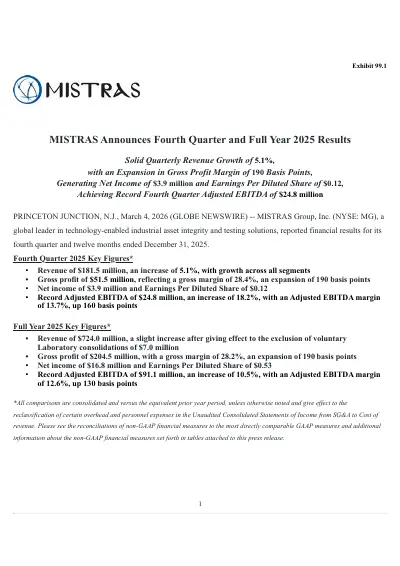
I'm pleased to report that we delivered consolidated revenue growth of 5.1% in the fourth quarter versus the prior year. As we communicated earlier this year, we successfully executed on a number of critical initiatives to restart revenue growth in the second half of 2025.
In particular, we generated double-digit revenue growth across several key areas of our business, namely within the Aerospace & Defense, Power Generation, and Infrastructure end markets. Our Aerospace & Defense business, which is our long-term growth engine, led the way with $4.5 million of growth in the fourth quarter, increasing 21.9% over prior-year quarter.
Power Generation was up $3.3 million, representing 33.2% growth over prior-year quarter. The Industrials and Infrastructure verticals were also up 6.7% and 26.8% respectively over the same timeframe.
These increases more than offset the anticipated decline in oil and gas revenue due to timing of projects and the closure of unprofitable labs. Our Aerospace & Defense operations, as we have reported throughout the year, have made significant improvements in 2025, driven by new leadership, supported by targeted capital investments.
We have rebuilt the structure, introduced a hub-and-spoke operating model, and implemented dynamic pricing strategies. In addition to commercial aerospace strength, demand within the private space and defense industries has also played a favorable role in expanding our growth in this market.
These actions led to the record-high performance in our laboratories business, which grew by 61% in our fourth quarter as compared to the prior year. Aerospace & Defense expansion plus the double-digit growth in other key industries already mentioned has resulted in favorable business mix, which in turn was a major driver behind the 190 basis point improvement in gross profit margin of 28.4% on gross profit of nearly $51.5 million for the fourth quarter.
These contributed to our GAAP net income of $3.9 million and EPS of 12 cents in the fourth quarter, and non-GAAP net income and EPS of $7.9 million and 20 cents, respectively. We achieved adjusted EBITDA of $24.8 million, which was up 18.2% over the prior-year quarter, representing a 13.7% adjusted EBITDA margin, which was a 160 basis point improvement over the prior-year comparable quarter.
Our fourth quarter adjusted EBITDA and adjusted EBITDA margin represent the highest-ever fourth quarter performance achieved in the company's history. Equally important, this performance reflects improved pricing discipline, mix, and operating efficiency, and not only one-time actions such as restructuring and lab closures.
Next, I would like to provide a few highlights of our full year 2025 results. On a full-year basis, consolidated revenue was $724 million, which was slightly up year-over-year, excluding the impact of laboratory closures.
Revenue was up for the full year in our Aerospace & Defense, Industrials, Power Generation, and Infrastructure end markets. Our International segment delivered revenue growth of nearly 6% for the year, driven by a diversified platform, most notably solid performance within the Industrials and Aerospace & Defense markets.
We had anticipated our second-half revenue performance to exceed that of the first half of the year, and this trend materialized, driven by significant improvements across key growth markets while improving margins. We expect to continue this trajectory of profitable growth in the future.
Our overall efforts in 2025 resulted in the generation of adjusted EBITDA of $91.1 million for the year with an EBITDA margin of 12.6%, which exceeded our previously issued outlook. Our intense focus throughout the year was to deliver EBITDA margin improvement.
We, in fact, achieved these goals utilizing financial and operational discipline while establishing a strong foundation in 2025 and providing credibility to the market, which our results demonstrated. To summarize our 2025 results, I am very pleased with our performance, achieving adjusted EBITDA at all-time record.
This is a testament to our proven business model and client-first mindset. In 2025, I was focused on building a new executive team, eliminated unprofitable business, and streamlined the organization while focusing on the strategic direction and building new capabilities and developing a winning culture.
We have already experienced early success, including recent wins, improved margins, the adoption of new pricing strategies, and an overall new sense of purpose, direction, and intensity, which position us very well for the future. Let me now shift to a brief overview of our most recent progress against our three key priorities in our strategic plan, Vision 2030, the first of which is expanding our share of wallet and transforming our current services into more comprehensive, integrated, and innovative solutions for our customers.
Our data solutions business plays a key role in executing on this priority. This business derives significant value from its more than 20 years of inspection data that we have collected, analyzed, and transformed into actionable insights for our customers.
Specifically, within this business, we achieved great success within our plant condition management software, PCMS offering, which grew by 20.7% in the fourth quarter of 2025 and 25.2% for the full year versus the prior-year comparable period. This growth was driven by market demand, new customer adoption, and increasing the number of in-house implementations.
This offering is a specialized industrial software platform with a high level of recurring revenue. This platform is a part of broader OneSuite asset protection software ecosystem, a cloud-based integrated platform that brings together our various software tools, data services, and analytics into a single connected environment, which helps to keep complex infrastructure safe, compliant, and operating effectively.
We expect to enlarge our market share related to our data analytical solutions business as we expand our platform from its original compliance focus to its current risk-based inspection, which will ultimately transition to more sophisticated predictive maintenance and AI-centric platform, reflecting our commitment to continued innovation in data-driven inspection. We are monitoring and driving this data services revenue growth by measuring several interrelated metrics, including sustaining a high year-over-year renewal rate, expanding the percentage of available applications utilized by each customer, and increasing our customer retention.
We intend to prospectively report upon the growth rate of this business utilizing this and related metrics so that you can monitor our progress going forward. In addition to doing more for the existing customers in the oil and gas market, we are also winning projects with new customers, allowing us to diversify our business, which is the second priority within our strategic plan.
Examples of successful end market diversification include two recent wins in bridge monitoring contracts in the US, where our innovative monitoring and data analytical capabilities set us apart. These projects helped to contribute to the growth in our Infrastructure end market, which grew by $2.5 million, or 26.8% in the quarter, and $4.5 million, or 13.2% for the full year.
This growth, coupled with recently announced strategic hires, including a Vice President of Building and Infrastructure, further expands our capabilities and creates new opportunities across an exciting end market. Another example of executing on this second priority is our recent announcement in December of 2025 of a win of a long-term construction project with Bechtel related to a new LNG terminal for Woodside, which is a multi-billion dollar LNG production and export facility under construction in South Louisiana.
This project is one of the most significant energy infrastructure developments in the world and represents a major investment in the US Gulf Coast energy capacity. Additionally, we continue to pursue data center business.
Our services provide integrated support throughout the entire data center lifecycle, which is responding to high demand within this sector. Currently, we are performing projects with some of the largest data center owners, with the ability to further scale our services throughout the entire lifecycle of the data center projects.
This is illustrated in our previously announced partnership with [Bacheler & Kimble?] to deliver our suite of specialized inspection services to B&K's data center projects.
Our overall diversification efforts, including targeted capital expenditures as well as additional strategic sales hires, have bolstered our growth in Power Generation, Industrials, and Infrastructure in the second half of the year. This diversified revenue growth demonstrates the success of our differentiated solutions and ability to deliver on customer expectations.
The third priority of our strategic plan is focused on building operational leverage by doing what we do today, but better, through efficiency and productivity gains. We have invested in innovative, proprietary technology to assist with digitalization of timekeeping and scheduling to more efficiently monitor the utilization of equipment and productivity of our technicians.
In addition, we continue to strengthen our sales and business development teams, all of whom bring industry experience and fresh perspective to our business. In summary, we have executed on several planned actions and initiatives throughout 2025, which have produced favorable outcomes.
We believe that this growth reflects the strength of our people, integrated offering, and continued focus on driving efficiencies across the business. I will share more thoughts on 2026 later, but let me now turn the call over to Ed for more details on fourth quarter results and the highlights of full year 2025.
Ed Prajzner
Thank you, Natalia. Given some early successes of our strategic efforts, gross profit increased to nearly $205 million for the full year 2025, up 6.4% from $192 million for full year 2024, representing a gross profit margin of 28.4%, which was a 190 basis point improvement year over year compared to 26.3% in the prior year.
As noted in our press release yesterday, our results reflect certain overhead and personnel expenses which have been reclassified from SG&A to cost of revenue. The effect of this for the fourth quarter 2024 was $5.5 million, and for the full year 2024 was $20.9 million reclassification from SG&A to cost of revenue.
This redistribution of overhead and personnel expenses had no impact on operating income, net income, or adjusted EBITDA comparability. Selling, general, and administrative expenses were up $3.6 million in the fourth quarter compared to the prior-year comparable period, attributable to strategic investments to grow our business and unfavorable foreign translation conversion.
SG&A for full year 2025 was $139.9 million as compared to $135.5 million in the prior year, an increase of $4.4 million, again due primarily to unfavorable foreign translation conversion, in addition to strategic investments to grow our business, the selling component of SG&A, whereas general and administrative overhead spending has been and will continue to be tightly controlled. During the current fiscal year, we've revised our presentation of foreign currency losses and gains, which are now included within other expense and income line net.
Previously, such amounts were presented within selling, general, and administrative expenses. The prior-year amounts have not been reclassified due to immateriality.
This change in presentation had no effect on previously reported net income. GAAP income from operations in the fourth quarter of 2025 was $10.4 million compared to $10.5 million in the prior-year period.
GAAP income from operations for the full year improved to $40.6 million from $39.8 million in the prior year. Non-GAAP income from operations in the fourth quarter improved to $15.7 million from $14.3 million, an increase of nearly 10%.
On a full-year basis, non-GAAP income from operations improved to $55 million from $46.2 million, which was an increase of nearly 19%, or 130 basis points year over year. We recorded $12.6 million of reorganization and other costs for the full year 2025 and $4.8 million during the fourth quarter, related to our continuing initiatives to reduce and recalibrate overhead costs, in addition to incremental costs of other related actions.
Our effective income tax rate for the full year 2025 was 24.7% as compared to 22% for the prior year. We anticipate our effective income tax rate for 2026 to be in the mid-25% range.
Interest expense was $3.7 million for the fourth quarter, down by $0.2 million from the prior-year period. For the full year 2025, interest expense was $14.6 million, down $2.5 million from the prior year.
For the fourth quarter, we reported GAAP net income of $3.9 million, or 12 cents per diluted share. On a non-GAAP basis, we reported non-GAAP net income of $8 million, or 25 cents per diluted share for the fourth quarter.
This resulted in GAAP net income of $16.8 million, or 53 cents per diluted share for the full year 2025, and non-GAAP net income of $28.1 million, or 88 cents per diluted share for the year ended December 31, 2025. This compares to GAAP net income of $19 million, or 60 cents per diluted share, and non-GAAP net income of $22.7 million, or 72 cents per diluted share in the prior-year period, due primarily to incremental reorganization and other costs incurred in '25.
As committed in the third quarter, we delivered positive free cash flow in the fourth quarter of 2025, and I'm pleased to report that we generated $32.1 million of cash from operations and $24.6 million of free cash flow in the fourth quarter of 2025. This compares to $25.7 million of cash from operations and $20.8 million of free cash flow in the prior-year comparable period.
For the full year 2025, we generated $33 million of cash from operations and $3.8 million of free cash flow, as compared to $50.1 million of cash from operations and $27.1 million of free cash flow in the prior-year period. While full-year free cash flow declined versus last year, this was driven by three identifiable factors: elevated DSO during our ERP stabilization period, higher restructuring activity, and growth-related CapEx.
Two of these three factors are already moderating, and we expect improved cash flow conversion as we move through 2026. We will build upon this cash improvement achieved in the fourth quarter and continue to prioritize improving our cash flow performance in 2026, specifically by leveraging a newly hired Vice President of Working Capital Management, as well as by improving back-office structure, tools, and accountability to accelerate the order-to-cash cycle and lowering accounts receivable.
Our total accounts receivable balance was $154.7 million as of December 31, 2025, up $27.4 million as compared to $127.3 million as of December 31, 2024. This was due to the timing of working capital throughout the year.
We are intently focused on reducing our accounts receivable balance below fiscal '24 levels throughout 2026. In addition, increased restructuring charges of $7 million and incremental CapEx investments of $6.2 million year over year, which were anticipated as a part of our strategic plan, also adversely impacted our cash flow.
Specifically, our CapEx in 2025 was $29.2 million as compared to $23 million in the prior year. This increased capital expenditure spending in 2025 was heavily focused on the selective expansion of lab capabilities and capacity, in addition to strategic equipment purchases focused on improving the safety and efficiency of our field operations.
We anticipate maintaining CapEx at this higher level into 2026 to approximately 4.5% of revenue, but maintaining spending thereafter at our prior depreciation level. This will enable us to continue to expand and upgrade capacity, particularly at our in-lab Aerospace & Defense facilities, which have been partially constrained by capacity.
These investments are targeted towards areas where demand already exists. The primary return mechanism is improved utilization and throughput, which allows us to convert existing demand into revenue more efficiently, rather than relying on speculative growth.
Gross debt was $178 million at December 31, 2025, compared to $169.7 million at December 31, 2024, an increase of $8.3 million. Net debt was $150 million at December 31, 2025, compared to $151.3 million at December 31, 2024, a decrease of $1.3 million.
Our bank-defined leverage ratio was approximately 2.5 times at December 31, 2025, which is up versus approximately 2.3 times as of December 31, 2024, yet is well within the maximum allowable leverage ratio of 3.75 times. Our capital allocation strategy is to use residual free cash flow to pay down debt to a two times leverage ratio while maintaining a temporarily elevated CapEx level.
We will continue to emphasize debt reduction as our priority use of our residual free cash flow, and we are targeting a debt paydown of approximately $20 million in fiscal '26, in addition to the significant paydown we made in the fourth quarter of 2025. This would result in a defined bank leverage ratio of approximately two times by the end of fiscal '26.
In summary, this significant financial improvement reflects our proactive cost management, operational efficiency leverage, and focus on higher-margin businesses. This success was attributable to a new and invigorated executive team, reducing unprofitable business, and being laser-focused on our strategic direction, all while building new capabilities and developing the culture to win.
Let me now turn the call back over to Natalia for her to give us her outlook on '26.
Natalia Shuman
Thank you, Ed. Given that we have established the foundation for future success in 2025, we view 2026 as an opportunistic time in the market to continue on a number of management imperatives towards executing on our strategic plan, in order to position Mistras to unlock its inherent value over the longer term.
First, as Ed mentioned, we will be increasing capital expenditures from our historic five-year average of approximately 3% to 4.5% of revenue, to expand and upgrade capacity and remove constraints for targeted growth. These investments will be primarily focused on our in-lab business serving the fast-growing Aerospace & Defense market.
Scale is a key for our customers within this market, who demand integrated services in large capacities from their supply chain partners. Additionally, we will invest in CapEx related to innovative AI capabilities in our data solutions businesses.
This will enable faster and more accurate analytics and insights for our customers. Our overall CapEx plan reflects confidence in our customer demand trends with compelling ROI expectations.
Most importantly, these investments are targeted and sequenced. We do not view margin erosion, leverage creep, or negative free cash flow as acceptable tradeoffs.
Our intent is to protect the earnings base while expanding long-term earnings power. Secondly, we will be focused on our go-to-market strategy and invest in our sales-related technological applications and other initiatives.
This investment will focus on advancing our effort in marketing and selling our leading proprietary technology and innovative data-centric solutions, such as art crawlers and OneSuite digital applications as a suite of data-centric services, providing predictive solutions and strategic insight. By undertaking these strategic initiatives and investing organically for long-term market-leading growth, we will leverage our competitive advantages and strengths to best position ourselves for success and future growth.
Accordingly, for 2026, we anticipate full-year revenue to be between $730 to $750 million, and adjusted EBITDA to be between $91 to $93 million. While we are addressing both CapEx and targeted operating investments in 2026, we expect adjusted EBITDA margins to remain resilient, as we plan to maintain operational discipline and cost control.
We also expect net income and EPS to exceed 2025 performance. Importantly, our 2026 outlook does not assume a macro acceleration or strong rebound in oil and gas activity, or any contribution from acquisitions.
I would now like to our Executive Chairman of the Board, Manuel Stamatakis, to offer his remarks.
Manuel Stamatakis
Thank you, Natalia, and good morning, everyone. I would like to offer you a brief board-level perspective as we look ahead.
2025 was a very good year for the company, particularly in strengthening our position in data-driven inspection, mission-critical testing, and Aerospace & Defense programs. I am pleased with the operational progress and the platform the management has built across these end markets.
Particularly, I want to commend the meaningful strides we've made this year in significantly improving our executive team, under the direction of our CEO. The strengthened leadership and sharper execution have materially improved our performance and strategic focus.
As we enter 2026, the board fully supports management's view that this will be an investment year, focused on transforming and modernizing our platform. In our industry, long-term value is created by investing to meet demand within our end markets, in data integrity, digital inspection capabilities, specialized talent, and accreditation for higher-complexity Aerospace & Defense work.
Such investments take time to translate into revenue and margin expansion, but they are essential to sustaining durable growth. Most importantly, the board views 2026 as an acceleration of our strategy via increased investments, and a deliberate step to deepen our technical differentiation and expand our relevance to customers operating in regulated mission-critical environments.
We are confident in the execution plan, the capital allocation priorities, and the long-term ambitions, particularly as risk-based inspection and Aerospace & Defense spending continue to evolve. I wanted investors to hear clearly that the board views 2026 as a targeted year, which will strengthen the foundation for future growth.
I'll now turn it back to Natalia for her to give you her closing thoughts.
Natalia Shuman
Thank you, Manuel. I'll close by thanking all of our customers and partners who contributed to our superior results throughout 2025, and in particular, I would like to sincerely thank all of our Mistras team members, from the front lines to the back office, for their tireless efforts in executing on their day-to-day tasks while embracing transformative change and the evolving strategy of our company.
These efforts are creating value for our customers, and in turn for our shareholders. We look forward to updating you on our performance as we progress further in 2026 towards our strategic goals.
With that, let me turn the call back to the operator for questions.
Operator
Thank you. We will now begin Q&A.
For today's session, we will be utilizing the raise hand feature. If you would like to ask a question, simply click on the raise hand button at the bottom of your screen.
Once you've been called upon, please unmute yourself and begin to ask your question. Thank you.
We will now pause for a moment to assemble the queue. Our first question comes from Mitchell Pinheiro with Sturdivant and Co.
Please unmute your line and ask your question.
Mitchell Pinheiro
Hi. Can you hear me?
Natalia Shuman
Yes, Mitch. Hi.
Mitchell Pinheiro
Good morning. Great.
Good morning. Hey, couple questions.
Aerospace & Defense had a great quarter, and it's obviously a big part of your longer-term growth engine, I think as you said. I'm curious, and in other remarks you talked about good visibility.
I guess, you look at backlog of your customers, both in the space side and the aerospace side and then on the defense side, what kind of confidence do you have in that? Number two, from a capacity, you talked about expanding capacity, is that at all revenue limiting in 2026, or you have plenty of capacity to do what you need to do?
Then, are you winning new business with these customers, and if so, how are you doing that in terms of capabilities, or just curious how you're doing that.
Natalia Shuman
Thanks for this question. I will start with customers.
Indeed, we do have very good close relationships with our customers. We meet with them specifically in Aerospace & Defense, I'm talking about.
We meet with them monthly to evaluate their demand. We know what they expect, and as I mentioned before, for them scale and capacity matters.
We also have established the hub-and-spoke model that allows us to use that platform at large for our customers, regardless of their location, we are able to assist that, again by expanding the capacity. When talking specifically about capacity and your questions whether we do have constraints, yes, we do have constraints, and that's exactly where we're going to invest to remove those constraints to then increase the utilization, increase the throughput, increase the productivity, and then sort of unlock the demand really into the revenue.
That's essentially what we're doing in Aerospace & Defense. We have great visibility into demand, and in Aerospace & Defense, there is a strong demand for NDT, particularly NDT testing, and they don't have enough of in-house capabilities.
They certainly looking for other suppliers who can support them, and who can be large enough to support them. Yes, we're winning new business.
We're celebrating adding a few new customers this years, and this is all thanks to our team that's there on the ground, and they're doing really good job.
Mitchell Pinheiro
Then just one more question on Aerospace & Defense. In terms of capabilities, is this a target area for maybe a tuck-in acquisition?
Do you have any plans for something like that, or are you looking at that, or you think you can sort of do it just through your own CapEx, your own internal investments?
Natalia Shuman
Look, you're absolutely right. The growth and differentiation comes from the capabilities depth in that business specifically.
We have commented before that we are enlarging our offering. In addition to NDT testing, we now do welding, machining, repairs, cleaning, and so on.
That is quite critical for our customers. In terms of acquisitions, as you can imagine, is very pricey acquisitions at this moment.
Of course, we're always looking at our capital allocation strategy, but at this time, we believe that the highest return on our capital is organic expansion. We believe that we are capable of building these capabilities and organically expand our capacities.
I can give you a good example, and Q4 demonstrated that. To respond on demand, in one lab, we added 100% of headcount, basically we enlarged headcount, we removed that constraint, and we were able to generate increase in revenue of 61%.
Can we repeat it? Probably not to that extent, but we already see the ways how we can remove existing constraints to generate additional revenue.
Mitchell Pinheiro
Helpful. Thank you.
Then, with obviously the disruption in the Middle East, I'd love to hear your thoughts about how it may be affecting operations, or how you view the first quarter. Any insight you could provide there would be helpful.
Natalia Shuman
Yes, certainly. We have not seen a material direct impact.
Our footprint in that region is very limited, but of course there's a lot of uncertainty, and we continue to monitor geopolitical developments. Our customers are still evaluating what it means to them.
Obviously, as you well know, as a result of this events, if oil price goes up, the upstream activities will be intensified within the US, and it will positively impact us, but at this time, it's too premature to say.
Mitchell Pinheiro
Then just one more question. In terms of obviously oil and gas is the majority of your business at the moment, and the faster-growing segments, aerospace, energy, power generation I guess I could say, infrastructure, they're going to be your focus, or obviously, your growth focus, let's say.
Could you talk about new customer wins, bid activity in those segments, what do you think the growth is going to come from existing customers, a balance between existing customers and new customers, and also if you could talk about sort of the margin profile of these growth businesses as compared to, say, your company average?
Natalia Shuman
Yes, thank you for this question. It's very good one.
It's actually touches on two of our strategic priorities that we intently focused on. One is oil and gas customers where we are expanding our offerings and services, and that's where again we believe very strongly that we are able to participate in oil and gas customers' digitalization efforts, and by offering to them our data services and data analytics and AI tools, we're able to help them to be more efficient as they looking at their performance.
There we're talking about expanding that existing client base, or expanding the share of their wallet, and we're talking expanding of the margins, right? We intently focused on margins profile in our core markets of oil and gas.
The second priority is the diversification, and those industries, like you mentioned, is Infrastructure, Power Generation, where again, we're winning new contracts. There it's all about capabilities and all about building that go-to-market strategy.
While we're working on capabilities, while we are investing in that part, we're also looking at how best competitively position ourselves. Again, great example will be data centers.
We have what it takes when it comes to data centers. It's the same services we already provide for our core client base like oil and gas, but here we're using a new use case.
It takes a little time to get this going, but we already had that wins. Margin profile, to answer to your question, is higher because those services in high demand at the moment and the demand is very visible.
That allows us again to position us competitively well and still generate sufficient amount of margins.
Mitchell Pinheiro
Okay. By the way, I just have one more question.
I'm sorry.
Natalia Shuman
Sure.
Mitchell Pinheiro
When you look at the revenue guidance for this year, the difference between the low end of the range and the high end of the range is what? Why would we be at the low end versus why would we be at the high end?
Natalia Shuman
Good question. Basically, there's a couple of scenarios that we're looking at, right?
Our large share of our business is still in oil and gas, and so our customers, although they did already present themselves as, I would describe it, less pessimistic, but they're still quite cautious. It's a large portion of our business, depending on how oil and gas customers do this year would largely impact our performance.
We quite confident when it comes to Aerospace & Defense, Infrastructure, Power Generations. We will generate sufficient amount of growth there, but again it's a smaller share of our total revenue, and therefore we are dependent on the oil and gas market.
Again, all this strategic plan is about to diversify as much as possible, we are less dependent, but at this time, this is our scenarios where all depends how well we do in the oil and gas market. All
Mitchell Pinheiro
right. Thank you.
That's all for me.
Natalia Shuman
Thank you.
Operator
Our next question comes from John Franzreb with Sidoti and Co. Please unmute your line and ask your question.
John Franzreb
Good morning, everyone, and thanks for taking the questions. I'd like to start with the fourth quarter results, especially the improvement in the gross margin profile.
I was wondering if you could quantify how much of that is pricing versus mix versus maybe exiting some of the unprofitable businesses. Can you kind of put a bandwidth around where the improvements came from?
Natalia Shuman
Absolutely. I will start qualitatively, and then Ed will add if anything.
There's a three three distinct factors that influence our performance in Q4. It's mix, a favorable revenue mix, number one.
Number two, it's improved pricing discipline. Number three is really the operating efficiency.
There's less impact of the unprofitable laboratories closures, and I will talk about it. Let me unpack it a little bit.
Obviously, revenue mix comes always the expansion of the Aerospace & Defense, right, as our laboratory business contributed really well, as well as our data services. Again, we saw great growth in PCMS due to multiple implementations.
That's revenue mix that contributed to higher gross margins. Let me touch on the pricing first.
Pricing discipline. We, as we already mentioned in 2025 in the beginning, we had established very rigorous pricing programs, and now they're working really well.
The pricing discipline and again, in a Q1, when in a Q4, when we had a surge in demand in Aerospace & Defense, we were able to apply that pricing discipline, and we had some expedited fees and in fact, it's again had a positive impact on our gross margins. If I have to quantify it, it's probably think about it as 25% price and 75% volume, specifically in Aerospace & Defense.
Then on operating efficiencies, right, it's obviously there's some restructuring impact, but it's minimal. It's around 1.5%, but it's not big.
It's really the effect of price and the mix.
John Franzreb
Got it. Just maybe to reframe one of the previous questions, is there a way to call out how much of your Aerospace & Defense revenues are just in defense?
Natalia Shuman
Just in defense, I probably would say, and we can follow up with you on that, it's 70% commercial
John Franzreb
aerospace
Natalia Shuman
and private space, and about 30 to 35% in defense. We have good presence in defense in International segment, and that's where we see that increase, again as defense budgets are going up.
It's clearly benefits and creates positive impact.
John Franzreb
Understood. Natalia, it seems to me like you're taking maybe a more cautious view to the oil and gas market in 2026 than you were, say, three months ago.
Is that extended into the current upcoming turnaround season, or are you just looking at 2026 as a whole?
Natalia Shuman
A couple of comments here. Let me start with turnarounds, right?
We had exceptionally good turnaround season in 2025. Whenever turnarounds happens, it's usually not every year, because customers have to extensively plan for turnarounds, it's usually once in three years, once in two years.
This particular year, 2026, is not that robust when it comes to turnarounds. That's number one.
That certainly will have some impact. We still have quite good visibility into turnarounds already for Q1 and Q3, but certainly that's apologies, for Q2 and Q3, but certainly this is something that we are still working on.
Secondly, if you look at oil and gas, again, what we hear from our customers, they actually do not spend as much on CapEx. They are projecting to be flat or somewhat down.
What it means for us is they will maintain their maintenance budgets, right? They want to get more life out of their assets, basically.
That means that it should favorably impact us. I don't foresee some negative impact in oil and gas by any means.
I do see that we have a very good opportunity, and especially with our data services. We have to be a bit cautious.
Again, to me, I think it largely depends on the spending of our oil and gas customers.
John Franzreb
Understood. I got a bunch more questions, but I'll ask this last one to get back into the queue.
Regarding the CapEx increase to 4.5%, is that viewed as a one-time 2026 phenomenon, or do you expect to be spending at an elevated level for maybe a couple years?
Natalia Shuman
That's right. We anticipate CapEx to remain at elevated levels in 2026 and into 2027,
John Franzreb
but then
Natalia Shuman
we anticipate the intensity to moderate after that and kind of following the completion of our key initiatives that driven by our strategic plan. That's the outlook.
Then we expect our CapEx to return to our historical depreciation levels after 2027 to about 3% of revenue.
John Franzreb
Got it. Thanks for taking the questions.
I'll get back in the queue.
Natalia Shuman
Thank you, John.
Operator
Our next question comes from Gaugi Sree with Singular Research. Please unmute your line and ask your question.
Gowshihan Sriharan
Hi. Can you hear me?
Natalia Shuman
Yes, hi.
Gowshihan Sriharan
Okay. Good morning.
Just a few questions from my side. Firstly, on the International, the profitability seemed to have improved quite nicely there.
Just was wondering, are those gains concentrated in just a couple of standout contracts or countries, or do you feel that you've made more systemic changes in pricing, cost structure, or customer mix that should make that improvement more sustainable in 2026 as well?
Natalia Shuman
It is structural improvement, just to answer to your questions directly. International had a good year, very good year.
We had overall 6% increase in our revenues and improved margins profile. There in International, we have quite diversified platform.
In fact, oil and gas was slightly down in International for the year, but we did had good increase in Aerospace & Defense, we had good increase in Infrastructure, good increase in Power Generation. The International segment and the teams in Europe and elsewhere did really, really well.
From margins profile, we will invest slightly in our international facilities as well. We will see some capacity enlargement and capacity constraints removal, we would anticipate margins to be sustainable in the long run.
Gowshihan Sriharan
Okay. Then secondly, on your largest, let's say strategic accounts, particularly in the oil and gas sector, how has your wallet share and contract duration trended over the last 12 to 18 months, as you have shifted towards higher-value, more integrated offerings?
Are you seeing any change in competitive dynamics or insourcing there that would make the wallet share harder to hold in 2026?
Natalia Shuman
I would not—and thank you for this question—I would not say it's harder to hold the wallet share. It's just we see that there's more appetite from our customers to consider digital platforms, to consider data analytics, data insights.
We see this is a very good opportunity for us to introduce the higher-value work to them, right, that benefits them as they continue to execute capital discipline. Having said that, they also increasing their risk managing spending.
Again, to increase the efficiency, the operational excellence, their asset life extension, and so they have higher demands. All our strategic customers come to us to help them to create that digital data platforms now, right?
There's much more appetite to look at this type of solutions, the integrated offering. That's what we see in particularly there.
It's harder to keep and retain the volume, but we are shifting away from the commoditized kind of just NDT services to more value-driven solutions, where we are expanding our offerings to include data analytics, to include digital data, to include the digital platform, and that's what we essentially doing, expanding that services portfolio for our existing oil and gas customers. Again, from the bid activity, from our sales activity, we see that increased interest, and because again, they're very much of in tune with what they need to do in terms of the risk management when they expect more from their assets, right?
Because there's a more load, right, the more bigger probability of failure. They have to manage their risks.
Gowshihan Sriharan
Okay. Understood.
That's helpful. That's all from my side.
Thank you.
Natalia Shuman
Thank you.
Ed Prajzner
Thank you.
Operator
Our next question comes from Alex Rygiel with Texas Capital Securities. Please unmute your line and ask your question.
Alex Rygiel
Thank you very much. Very nice quarter.
As it relates to the restructuring actions over kind of last 12 months or so, can you talk to or quantify the long-term cost savings, and also address sort of any negative revenue headwinds that you could be facing in 2026 because of those?
Ed Prajzner
Thanks, Alex. I'll address that question.
The restructuring was elevated in '25. Of course you saw that $12 million.
That's a combination of severance in there from headcount reductions, there's lease breaks in there, and other strategic actions we've taken to really drive efficiencies and productivities. There is a good payback on much of that.
The facilities, the lab closures that we talked about throughout the year, there is payback there. That's an uplift to the margins.
There was no contraction of business, there's not a negative revenue implication from those restructurings. We really are streamlining and driving for efficiency, more throughput.
Natalia mentioned earlier getting another shift of operational effectiveness out of an existing site by really debottlenecking our own sort of self-induced capacity constraints. That's a big part of restructuring is about is really to have clean line of sight, delayering the organization to speed up decision making.
There's a lot of soft benefits as well there. Most of that cost is out.
Again, some of the heads got replaced, that's not a direct one-for-one savings, but facilities is definitely a savings. There was some one-time expenses here driving strategy and other things in restructuring in '25.
This number will moderate significantly in '26, so that number will come back down. It was also a drag on our free cash flow a little bit.
We look for returns on the reorg expense that we booked here, and you will see that kind of reflecting itself in '26. Then
Alex Rygiel
as we look out longer term, can you help us or remind us what your sort of longer-term organic revenue growth and EBITDA margins could look like for this business that you're improving?
Natalia Shuman
Yes, thanks, Alex. When we look at our strategic plan, are we looking at a CAGR of about 5% through 2030, and for margins, our aspirations are to reach 15% margins, EBITDA margin.
That's the profile we're looking at.
Alex Rygiel
Very helpful. Thank you very much.
Natalia Shuman
Thank you.
Operator
At this time, I see no callers in the queue, I'll hand the call back to Ms. Shuman for her closing remarks.
Natalia Shuman
Thank you, Luke. Thank you everyone for joining this call today, and for your continued interest in Mistras.
I look forward to providing you with an update on our business, strategic plan, and progress achieved towards our ongoing initiatives on our next call. Thank you, everyone.
Operator
This ends today's conference call. You may disconnect at this time.