Megacable Hldgs SAB de CV Cert Part Ord Cons of 2 A
Q3 FY2026 · Earnings Call TranscriptOctober 30, 2026
Alan Esaú Gallegos López
With us this morning we have Mr. Enrique Yamuni, CEO, Mr.
Raymundo Fernández, Deputy CEO, and Mr. Luis Zetter, CFO.
Let me remind you that the information discussed in today's earnings call may include forward-looking statements on the company's future financial performance and prospects, which are subject to risk and uncertainties. Megacable undertakes no obligation to update or revise any forward-looking statement.
I will now turn the call over to Mr. Enrique Yamuni.
Sir, you may begin.
Enrique Yamuni
Good morning, everyone, and thank you for joining us today. It is a pleasure to present another quarter of strong performance for Megacable.
As we have discussed over the past several quarters, the company has largely completed its network expansion and investment cycle, building one of the most advanced telecommunications infrastructures in Mexico. That investment has translated into a network with the capacity, quality, and convergence to sustain steady growth in the coming years.
We are now entering a new phase in Megacable's evolution. After several years of significant investment, our priority is no longer pursuing scale as the primary objective.
Instead, we are focused on extracting greater value from the infrastructure we have built by improving operational efficiency, attracting and retaining higher-quality customers, and driving profitable, sustainable growth. This means placing greater emphasis on customer lifetime value, margin expansion, and cash generation, while maintaining a disciplined approach to subscriber growth.
We believe that a more balanced approach between growth, profitability, and customer value ultimately leads to a healthier and more resilient business. The pace of subscriber growth has slowed, reflecting a more selective approach to both customer acquisition and retention.
We are increasingly focused on attracting and retaining customers who generate sustainable growth, long-term value, while becoming more disciplined in promotional activity and commercial spending. We believe this approach supports healthy growth, stronger margins, and improved long-term returns.
This progress is most clearly reflected in our profitability. EBITDA grew faster than revenue, reaching the highest level in the company's history, while margin expanded both sequentially and year-over-year.
Importantly, this outcome is consistent with the trajectory we outlined last quarter. Additionally, net income continued to rise strongly compared with the third quarter of this last year.
Cash generation also continued to strengthen, in line with the priorities we set for 2026. The efficiency gains we are seeing are not limited to our commercial operations.
They are also becoming increasingly visible across the organization. We are simplifying processes, raising productivity standards, investing in automation, and gradually incorporating artificial intelligence and digital tools into our operations.
At the same time, we continue to focus on attracting, developing, and retaining high-performance talent. These initiatives are helping us create a leaner and more agile organization, supporting sustained margin expansion while improving the quality of service we deliver to our customers.
From a financial perspective, we believe Megacable is entering one of the strongest position in its history, with a moderated investment profile, growing EBITDA generation, and a disciplined approach to leverage, we expect our financial flexibility to continue improving over time. During the quarter, a small portion of our debt matured.
However, we maintained leverage in a level much better than the range we consider appropriate for the company, combined with a lighter investment profile and continued EBITDA growth. This provides us with significant flexibility in how we allocate capital going forward.
Our priority remains balancing investments that support future growth with actions that enhance shareholder value, while continuing to improve our cash flow generation, leverage profile, and overall financial strength. This focus extends beyond the residential market.
Our enterprise business also continued to move in the right direction, delivering sustained growth during the quarter and more stable performance throughout the year. These results reinforce our view that the repositioning of the business towards integrated TOP solutions for enterprise customers is gaining traction.
In summary, the third quarter reflects the early results of an important transition for Megacable. We are evolving from a period defined by investment and expansion into one increasingly characterized by efficiency, profitability, cash generation, and disciplined growth.
The infrastructure is in place, our competitive position is strong, and our financial profile is becoming increasingly resilient. We believe the foundations for the next stage of value creation are firmly established, and our focus is now on disciplined execution.
We remain confident in the opportunities ahead and in our ability to capitalize on them. I will now hand the call over to Raymundo, who will walk you through our operating performance.
Raymundo, go ahead, please.
Raymundo Fernández
Thank you, Enrique. Good morning to all of you.
As Enrique mentioned, this quarter marks a transition in our strategy toward a phase centered on efficiency, productivity, and profitability. With much of our investment cycle now behind us, we are well positioned to capture the benefits of our infrastructure transformation and convert them into sustainable value creation for shareholders.
Starting with internet, we added 60,000 subscribers during the quarter, ending September...
Enrique Yamuni
Dijiste se fue el audio?
Alan Esaú Gallegos López
We are having some technical issues. Please stand by.
Enrique Yamuni
Mhm.
Raymundo Fernández
Are we back?
Enrique Yamuni
Yes, we're back.
Raymundo Fernández
Sorry about that.
Enrique Yamuni
You better start again.
Raymundo Fernández
As I was telling everybody, starting with internet, we added 60,000 subscribers during the quarter, ending September with roughly 6.1 million, up 7% year-over-year, equivalent to 405,000 net additions over the last...
Enrique Yamuni
Se volvió a cortar. We're having technical issues here.
[unclear] We are having some technical issues. Please stand by.
Raymundo Fernández
We are really sorry. We don't know whether it's a problem with the video conference platform.
We will try to continue. Hopefully we don't have a problem.
Sorry for everybody. It is important to analyze this strategy based on the maturity level of each market.
In our organic territories...
Enrique Yamuni
Se cortó ese.
Alan Esaú Gallegos López
We are having some technical issues. Please stand by.
Raymundo Fernández
Let's try once again, and sorry. Never happened before, but it's always one time to do this.
In video, traditional subscriber declined by 84,000 in the quarter to over 3.7 million, reflecting the continued migration of viewing habits toward digital platforms. Meanwhile, our streaming applications grew to 2.7 million users, from 2.4 million in the second quarter, keeping unique video subscribers at nearly 4 million, broadly in line compared with the third quarter 2025.
For this reason, we remain committed to a flexible content proposition that pairs linear programming with app-based alternatives. Fixed voice, which continues to benefit from its integration into our bundle packages, added 84,000 lines in the quarter to reach 5.4 million, up 6% year-over-year.
Mobile also kept up its momentum, adding 64,000 lines in the quarter, taking our MVNO base to 845,000 lines, up 32% year-over-year. Looking at customer behavior, retention remained healthy across our core services.
Broadband churn improved to 1.9%, compared with 2.3% a year ago. Telephony churn improved to 2.1% from 2.7%, while video churn declined to 2.5% from 2.7% over the same period.
These trends reflect the progress we are making in strengthening our subscriber base and support a more sustainable profitability profile over the long term. Our infrastructure continues to support this strategy, with 19.9 million homes passed across approximately 112,000 kilometers of network at quarter end.
The share of subscribers on full fiber reached 89%, up from 82% at the end of the third quarter 2025. With the buildout largely complete, our network agenda now centers on penetration, reliability, and operating productivity.
Our infrastructure already allows us to differentiate from the competition. During this period, we launched new broadband symmetrical bundles with speeds of up to 5 gigabits, leveraging Wi-Fi 7 technology and further reinforcing our leadership in connectivity and network performance.
Turning to monetization, ARPU stood at 429.5 pesos. This was practically unchanged from the 430 pesos recorded in the second quarter, while the 2% year-over-year decline mainly reflects the package mix and a higher...
Alan Esaú Gallegos López
We are having some technical issues. Please stand by.
Raymundo Fernández
Sorry, we're back. Across the organization, we have continued to execute on the efficiency initiatives introduced last quarter, leveraging automation, digitalization, and artificial intelligence to improve productivity and simplify processes.
These actions contribute to a leaner and more efficient operating structure, better aligned with our...
Alan Esaú Gallegos López
We are having some technical issues. Please stand by.
Raymundo Fernández
Hello, everyone. Could you hear me?
Operator?
Alan Esaú Gallegos López
Yes, we can hear you. We are
Raymundo Fernández
really sorry. I believe we are having problems with the Zoom platform.
All our backup systems went off, too, but let's try to improvise and adapt, and I appreciate your patience on this technicality problem. Let's try to finish my speech, and I will turn to Luis on the financials.
Enrique Yamuni
Go to the...
Raymundo Fernández
These actions contribute to a leaner and more efficient operating structure, better aligned with our long-term strategic priorities. As part of this transition, we ended the quarter with approximately 31.7 thousand employees, reflecting a more focused organization while maintaining the operational capabilities required to support future growth.
All in all, our operating base is in good shape. Growth is more selective, churn is stable, mobile keeps expanding, and corporate is growing again.
Over the coming months, we will build on this base by lifting penetration, getting more out of our existing footprint, and further raising the productivity of our operations. Thank you for your attention.
I will now turn the call over to Luis. I hope, Luis, you will have a better luck than I did, who will take you through the financial results.
Thank you. Go ahead, Luis.
Luis Zetter
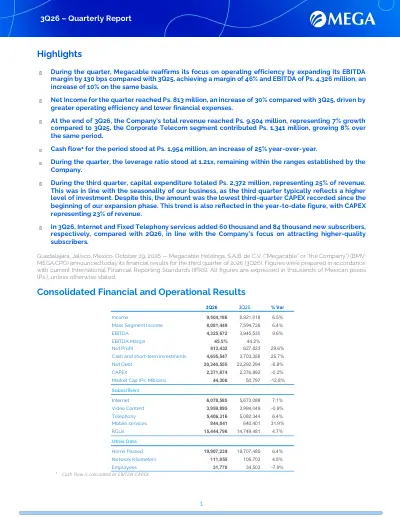
Thank you, Raymundo, and good morning, everyone. Starting with the top line performance, consolidated revenue for the third quarter reached 9.5 billion pesos, up 7% year-over-year.
This represents a moderation from the growth record in the second quarter, reflecting the slower pace of subscriber additions, as Raymundo described. By segment, mass market grew 6% year-over-year to reach 8.1 billion, supported by the continued expansion of our subscriber base, particularly broadband, and the stabilization of churn, both enabled by broader reach of our network.
Corporate revenue in turn increased 7% year-over-year and 5% sequentially to 1.4 billion pesos. Mobile revenue, on its side, reached 285 million pesos, a new high for the business, up from 274 million pesos in the second quarter.
On the cost side, cost of services amounted to 2.5 billion pesos, up 2% year-over-year, while SG&A came at 2.7 billion pesos, up 6%. That represents a significant moderation from the second quarter, when these lines grew 5% and 11%, respectively.
Taken together, cost and expenses grew 4%, well below the pace of revenue, and early reflection of the workforce optimization and cost control measures put in place in recent months. A key contributor was the reduction of more than 2,600 employees compared with year-end, lowering labor costs while improving productivity across the organization.
In addition, growth continued to be concentrated in broadband, which carries a lower cost per subscriber than video, reducing our average cost per subscriber and contributing to the favorable cost trend. As a result, EBITDA rose 10% year-over-year to 4.3 billion pesos, the highest level in the company history, outperforming revenue growth by 3 percentage points.
This led to an EBITDA margin of 45.5%, representing an expansion of 130 basis points compared to 44.2% in the third quarter of 2025, and 60 basis points sequentially from 44.9% in the second quarter of this year. Moving below the operating line, operating income increased 15% to 1.7 billion pesos.
Comprehensive financing cost was 531 million pesos, a 3% lower year-over-year, mainly due to lower interest expense. This decrease was partially offset by a foreign exchange loss of 61 million pesos.
It is worth noting that 71% of the debt is at a floating rate and is denominated entirely in Mexican pesos. Net income totaled 813 million pesos, 30% above the third quarter of 2025.
On a year-to-date basis, net income reached 2.5 billion pesos, an increase of 18%. Turning to investment, capex for the quarter was 2.4 billion pesos, or 25% of revenue, compared with 2.4 billion pesos, or 26.6% of revenue, in the third quarter of 2025.
This brings nine months total to 6.5 billion pesos, equivalent to 23% of revenue. For the full year, we continue to anticipate capex between 23% and 24% of revenue.
The combination of stronger profitability and a more disciplined level of investment translated directly into higher cash generation. EBITDA minus capex reached 2 billion pesos in the quarter versus 1.6 billion in the third quarter of 2025, an increase of 25%, and total 6.3 billion pesos year-to-date, up 19% year-over-year, consistent with the cash generation objectives we set for 2026.
On the balance sheet, a 1 billion pesos loan matured during the quarter, which drove most of the 1.2 billion pesos sequential reduction in total debt. We closed September with cash and investments of 4.7 billion pesos, up 26% year-over-year, total debt of 25 billion pesos, and net debt of 20.3 billion pesos, down 9% and 6% compared with the third quarter of 2025 and the previous quarter, respectively.
Net leverage stood at 1.21 times EBITDA, compared with 1.45 times in the same period of last year, and 1.31 times at the end of the second quarter, while interest coverage was 6.8 times. These levels kept us within the 1.0 to 1.3 times range we consider appropriate for the company.
During the quarter, HR Ratings reaffirmed Megacable's AAA credit rating, consistent with the reaffirmation received from Fitch in the second quarter. We believe these ratings are a clear reflection of the company's financial strength, operational resilience, and disciplined financial management.
Together with our improved cash generation profile, they provide us with significant financial flexibility and place us in a strong position to pursue value-creating investment opportunities as they emerge, while maintaining a prudent approach to leverage and liquidity. To conclude, this quarter brought a clear improvement in the quality of our earnings.
EBITDA outpaced revenue, margins improved in both a quarterly and annual basis, net income rose meaningfully against last year, and cash generation strengthened. Revenue growth moderated, consistent with a more selective approach to growth, while the balance sheet remains solid and continues to support both investment and shareholders' return.
Thank you. We now ready to take your questions.
Alan Esaú Gallegos López
If you would like to ask a question, please use the raise your hand function in Zoom. You may also submit your question through the Q&A function.
Please ensure that you are unmuted when it's your time to participate. Our first question comes from the line of Marcelo Santos from J.P.
Morgan. Marcelo, go ahead.
Marcelo Santos
Hi, good morning. Thanks for taking my questions.
I have two. The first is regarding this strategic transition, the new focus you mentioned, like in cash generation.
Given that you generate much more cash, given that the mobile asset that was on sale has been sold, what is going to be that use of cash? Could you provide some more clarity on what you plan to do with that?
That's the first question. The second question is regarding net adds.
What can we expect going forward? In the past, you used to discuss something between 100, 150,000.
Understand that's not the case anymore, how to think about this? What kind of network penetration you think you can achieve in the more longer term?
Thank you so much.
Raymundo Fernández
Thank you, Marcelo. The first question regarding the use of cash, as you are aware, we like to have a strong balance sheet.
We have several options looking forward into that. Right now, we're focusing to increasing the penetration and our EBITDA margin.
We will look for the best for shareholders. Far, we can tell you that we're still looking to be a strong player on the fixed telecom market or bring any possibility of bringing more value to the shareholders to that cash, whether it can be dividend, it can be different parts on that area.
We'd like to keep it that way and be strong for any possibility that might be arise. We cannot tell you right now anything concrete, but we'd like to keep that level.
On the net adds, we see it less as a question of difficulty and more as a question of choices. For us, each additional customer has to meet a standard of value in terms of retention, mix, and profitability, and that standard is what shapes the pace at which we grow the base of our subscribers.
In our point of view, penetration of the broadband service in the country is near its peak, especially in urbanized areas, which limits the market growth as a whole. Competitive environment will drive net additions of the operations to a more conservative pace.
That's something that is going to happen for all the subscribers on that part. At the end, we still believe there is still a lot of growth into our expansion territories.
There is a big amount of kilometers and homes passed that are only served by one or two players and not by three. That's where we're focusing, in very surgical and strategic areas, we can bring better subscribers and not that much in retention.
What you can look into that, we believe we can still grow at a pace of 70 to 125,000, pretty much 70 to 100,000, instead of the 100, 150 that everybody was asking us. That one with less gross adds, okay, and continue to decrease the churn with a much more quality subscriber.
That's what we believe it can be happening in the future. We are in this third quarter, and it's going to be looking into the future very disciplined in terms of where we sell, and less sales, but more quality subscribers.
That's our strategy so far to bring value from what we have. We finished our growth in expansion, even though we are building 750,000 homes passed every year.
That is normal growth for a company of this big, and that is the amount that will still decrease our capex over revenue ratio. We are just focusing, as I said, in expansion, where we have the highest growth, and where we believe there is still a big amount of kilometers with only two players and only one with fiber.
Marcelo Santos
Perfect. Thank you very much.
Raymundo Fernández
Thank you, Marcelo.
Alan Esaú Gallegos López
Thank you, Marcelo. The next question comes from the line of Lucca Brendim from Bank of America.
Go ahead, Lucca.
Lucca Brendim
Hi, good morning, everyone. Thank you for taking my questions.
I have two, also on this line of the new strategy. Your ARPU for this quarter remained mostly stable on a quarter-over-quarter basis and declined a little bit on the year-over-year basis.
With the new strategy, do you think this ARPU can start to pick up as you'll be slowing down on the expansion, you have less expansion territories, and you're also focusing on higher-value clients? Then does this new strategy change your outlook for capex for the coming years, in 2027, '28?
You mentioned a little bit already for this year, but when we look to the future years, would this also mean a reduction in the capex? Thank you.
Raymundo Fernández
Thank you, Lucca. ARPU was stable sequentially.
It is the result of two forces in call. One is the package mix, that means video and broadband.
Video is decreasing for all the telco companies. Also we have a higher share of expansion territory customers that currently dilute the average, and a growing base that increases total revenue.
We believe ARPU is going to stay and remains on the levels that we have. We compensate the package mix that I told you and the expansion territories with increasing rates.
Also we've been very successful in the strategies of bringing apps into the revenue for our subscribers on that part. In this quarter, we increment the value proposition of our video package.
We brought Netflix into the equation also, and add with Amazon Prime, it is a strong proposition that we believe it can increase the number of subscribers going into the triple play package compared to the second. That will take a little bit of the slowdown of traditional video into a better and more robust platform.
ARPU, I believe, is going to stay within the levels that you are seeing right now going into the future. The second one, Luis?
Luis Zetter
With regard to capex, the heaviest part of the investment cycle is behind us, and the network that we built gives as coverage, capacity, and quality for the next stage. The investment question is no longer how much to build, but where to additional peso generates the best return, as Raymundo explained.
For 2027, we will keep that discipline, prioritizing investment tied to penetration, service reliability, operating productivity, and continuing to improve cash generation. A level of 21% to 22% we expect for 2027.
Raymundo Fernández
21%
Luis Zetter
to
Raymundo Fernández
22%? 21% to 22% of
Luis Zetter
revenues, yes. We will rather commit capital selectively and at the highest return now the capex return uses that maintain an investment pace for its own sake.
Raymundo Fernández
I want to be clear for everybody. Our third quarter results brings 25% of capex over revenue.
It reflects seasonality of what we're doing. It reflects also exchange rate that affects us, if not it was going to be below that.
It does reflect online with the 23% that we will have for year-end 2026. With all the discipline that we're telling you in terms of all the employees, network, not network, the maintenance and everything we are doing with third-party, very disciplined management, we're focused on that.
We believe that 21% to 22% that Luis is telling you is going to be reflected on 2027 with no doubt, unless something happens with the exchange rate that we cannot control. We see that 21% to 22% is going to be really achievable by our company.
From thereon into the future, the same. We are really really focusing to bringing capex over revenue in the future to below 20%, as we has declared before in all our conference with you.
Lucca Brendim
Very clear. Thank you for the answers.
Raymundo Fernández
Thank you, Lucca.
Alan Esaú Gallegos López
Thank you, Lucca. The next question comes from the line of Phani Kanumuri from HSBC.
Phani, please go ahead.
Phani Kanumuri
Thanks for taking my questions. The first question is, what is the competitive scenario you're observing in the broadband market?
It does seem like it has increased in the quarter, but I would be interested in the color that you can provide on that. The second is on your enterprise revenue.
It had seen a good growth this quarter. What is driving the growth, and can it be sustained going forward?
Thank you.
Raymundo Fernández
Thank you, Phani. Yes, we are very aware of the competitive scenario.
We are four players into that, and we're reaching a mature market in that area. We have proved in the past that we can continue to provide growth, and we have a penetration to increase in the expansion territories and subscribers to maintain in the existing territories.
We are by far the leader on the organic territories, based on a good package mix, based on service, brand awareness, based on revenues per subscriber that we have. All around, we have proven in the past that we can focus into that.
We are keeping our strategy in organic to retain subscribers in those competitive. We increase speeds, as we said.
Now, 90% of our network is fiber pretty much, in the upper territories where we have competition is fiber. We increased to 200 megabits.
We have a good speed. We challenge our Net Promoter Score, customer satisfaction, we have a low churn below 2%.
We want to keep that churn decreasing, slightly, but trying to decrease, because we are an aggressive company. That will cover our organic part.
The expansion territories, as I said, we are very focused into markets where we are only two players, one with fiber and the other one transforming into coax and to fiber, where they have higher ARPU. Even though we will be more selective in the promotions, we still have better price than the price that the actual subscriber is paying.
Even though market is reaching maturity, I believe we can still provide growth in subscribers in the upper single digits for the year to come in that part. We expect to continue to growth.
If we growth this year over year at 7%, we still continue to believe that we can aim to those targets of growth within the Megacable regardless of the increase on competition that we have. Now talking about the enterprise, we're very happy that we're increasing our revenue on that part.
It's not an easy market. If you look at our competitors, our colleagues in the fixed market, we are all selling around 5 billion to 5.5 billion per year on that area, and very steady in the growth that we have, not talking about América Móvil, Telmex, which is the preponderant in the sector and the big guy to beat.
The other ones, we are going through a transition from fiber and increasing fiber all over and increasing the speeds and a lower of the ARPU, and bringing more solutions, IT solutions, to these subscribers. That transition is not easy.
I believe we have done a good job to keeping track of the transition of the market, and we believe we can be on those levels and increase slightly going into the future and contribute to the revenue growth of Megacable.
Phani Kanumuri
Okay. Thank you.
Maybe if I can have a quick follow-up on that. In the enterprise revenue, what percentage of your revenue is coming from these solutions versus, let's say, connectivity?
Raymundo Fernández
Your question was what percentage will come into the future?
Phani Kanumuri
What percentage of the enterprise revenues is coming from the solutions versus, let's say, connectivity?
Raymundo Fernández
Yes, we have around 80% of our subscriber revenue is coming still from connectivity. The other one is coming from cloud services, from solutions, from collaboration, on that part that we have.
Also, that percentage doesn't change, because the base is completely different, and we still sell a lot of connectivity to carriers, long distance. We have a very robust network on that part.
The base, even though as a percentage or less, as a percentage of the overall revenue, the majority continues to be connectivity.
Phani Kanumuri
Perfect. Thank you.
Raymundo Fernández
Thank you, Phani.
Alan Esaú Gallegos López
Thank you, Phani. The next question comes from Matheus Tostes from Citi.
Matheus Tostes
Hi, thanks for taking my question. Congratulations on the results.
I want to ask on the video disconnections. This was the second quarter of some disconnections at the video side.
I just want to hear your thoughts on the future of this business, and what would be the relevance today for this revenue line in terms of EBITDA? How do you see this evolving in the future?
If I can add a second one, if you could also share what specific actions Mega is taking to be more selective of the customers that it's bringing in its network? Perhaps charging an installation fee or something like this, if you could share any specific actions and some early results, that would be interesting.
Thank you very much.
Raymundo Fernández
Thank you, Matheus. Very specific, and I like the questions.
As we are very detailed in everything we explain and we do here. Video disconnection is a trend of the market, mostly linear TV.
We see a decrease on that way of consuming content. We are balancing that with apps, as I explained before.
People are getting more apps and less video linear channels. We believe that bundling video with apps is a robust way because there is still a huge amount of people that want to see some of that linear video.
That's why, as I explained, we brought to our proposition Netflix and Amazon Prime. What you can do is you get a double play package, and that mostly because all our subscribers are also not that much into the triple play.
On that area, we are the ones that have the higher percentage of video. What we're doing is all our new sales, we're trying to focus into quality subscribers that get a promotional of 350 pesos for broadband, or for only 150 pesos more, you can get a triple play package that includes Xview with all the capability of the non-linear and linear TV, and also Netflix and Amazon.
That's a very powerful offer that we believe and we know that is increasing the number of new subscribers that comes on board with triple compared to double. That's our strategy to compensate what we're losing on that part, and we believe it can be robust.
We'll see how that results into the future coming there. We're very confident, because that's the trend all over to going to apps and combine them with video.
On the strategy, we're more selective in terms of the subscriber, where we have technology. We have artificial intelligence already applied with our sales force.
We are moving a lot into digital sales, and we're also moving into specific areas and markets where we know that the penetration is low. Now all our sales force goes straight to where we have that low penetration and where we believe that is less competition in terms of number of players in the expansion territories, and focusing to making their compensation based on more stable subscribers.
I've been very specific. I would not like to go more because that's very very inside Megacable.
I want to give you assurance that that's part of our strategy that is already being in place, and that affect the gross adds. That's the way we're doing that.
That strategy is bringing also EBITDA up, being much more productive in our sales force, and with less opex and capex coming from subscribers. I would not like to go more.
I'm very specific, and I believe I gave you the whole idea that we're really really serious about what we're doing with the study.
Matheus Tostes
No, for sure. Thank you very much for the color.
It was great.
Raymundo Fernández
Thank you, Matheus.
Alan Esaú Gallegos López
The next question comes from Emilio Fuentes from GBM. Go ahead, Emilio.
Emilio Fuentes
Hi, thank you for taking my question. It's on capital allocation.
Given the ongoing consolidation we've seen in this space, could expanding into mobile services even further than your current MVNO be a strategic priority, either organically through your MVNO or any partnerships or M&A? Additionally, are you actively evaluating any further opportunities within the segment, and how do you weigh these potential investments against a return on capital to shareholders, particularly share buybacks, given your current share price and valuation?
Thank you.
Raymundo Fernández
Thank you, Emilio. Going to the second one, yeah, we're we're always looking into opportunities.
All of the above that you're saying, we will we will see how this this scenario or industry end. As right now, one of our competitors, Televisa, acquired AT&T on the on the convergence sector.
We continue to look for opportunities that might arise. Talking about the mobile or the MVNO that we have, MVNO for us is a compensate it compensates It is an add-on to our existing subscribers.
It is good because it doesn't take any capex. As we say, our capex, it goes straight to our network, and contributes to EBITDA of the company.
The majority of our subscribers are based in in Altán, and another portion of those in AT&T. We have two of them.
We don't have a problem going into the third player also, and we're looking into having the three of them in commercial agreements with Megacable. We don't have a problem also if we move all our subscribers into the Altán platform.
That will depend on how we see the strategy of Televisa with AT&T, but we don't have a problem that we're covering into into that area. We will continue to put some effort on the MVNO as a as an add-on to our existing strategy.
We're not wasting any strategic effort of our company going into capex or going into convergence so far. We're focusing into what we told you guys before, which is bringing results as we see of this quarter, where we have a 7% revenue, 10% EBITDA growth, and 30% net net profit compared to last year.
I believe our financial results we brought down net debt to 1.21. We are a good free cash flow generating company and increasing that going into the future, and and not future, but actually.
We're in a very well position to look for the second part that you asked me, which is the opportunities. We we are actively looking for opportunities on that part.
You can count on that, Emilio.
Emilio Fuentes
Thank you, very insightful.
Alan Esaú Gallegos López
Thank you, Emilio. The next question comes from Jesús Romo from BGlobal.
Jesús Romo
Hello. Good morning, and congratulations on the results.
My question goes in the sense of if you could add more color on how did AT&T Televisa impact your mobile strategy going forward? I think that you covered the wholesale right now, but I like to ask, more specifically, how does it impact your mobile strategy in terms of other type of wholesale relations for mobile, the bundling strategy, opportunities for acquisition in the mobile segment, and opportunities beyond residential, for example, mobility for B2B services or IoT even?
Thank you.
Raymundo Fernández
Thank you, Jesús. As I told Emilio now, let me expand it to the explanation.
Far, the impact, as I said, the majority of our subscribers are with Altán, not with AT&T. We'd like to keep relation with AT&T if they like to keep it, but at the end, if we need to move our subscribers to Altán or to other player, we don't have a problem doing that.
It's an additional revenue for us. It's not our core business on that part.
We will continue to growth mobile subscriber at the pace that we have, based on the agreements so far that are. If you're talking about acquisitions for the mobile or for other part, of course acquiring América Móvil is out of any question.
That's not the one you're looking for. As I said, whether we growth into fixed, mobile, whether we do purchase of our share buybacks, whether we increase dividends, we're looking at all the opportunities that make more sense.
Far, we're proving that we continue to grow and strengthen our position, and I cannot tell you anymore right now, but we're looking into everything to be done. Result, impact on the mobile, we will continue to grow and contribute to the EBITDA the way we have right now, and we'll see 2027 focusing into more Altán and less AT&T.
We'll see. We don't know yet.
It's too early to call.
Jesús Romo
Thank you.
Alan Esaú Gallegos López
Thank you, Jesús. We have one additional question through the Q&A section that is from Marco Bataglia from Templeton.
It says, "Why did ARPU did not recover in the third Q?"
Raymundo Fernández
Marco, ARPU did not recover for two reasons, as we said. One is the mix of package, or the package mix.
That means less video over total subscriber with a lower ARPU. The other one is we have more subscribers on the expansion territories with lower ARPU.
I call it the growing pains on that part, and the mix. As I said, the way that we are compensating that is with less promotion, more selective subscriber, and bringing a much more robust video and app offer to our existing internet and new internet subscriber, we can keep and manage that trends that affect our ARPU.
Thank you, Marco.
Alan Esaú Gallegos López
Since we have a follow-up from Emilio Fuentes from GBM.
Emilio Fuentes
Hi, just a quick follow-up. I recall you previously had a long-term or medium-term guidance from your expansion plan on reaching ballpark numbers, 45% to 47% EBITDA margins, and a network penetration of somewhere around the 30 30% if I'm correct.
My question is, is this still something you see achievable, and how does a reduced penetration target affects this mix with a more selective approach to customer acquisitions? Thank you.
Raymundo Fernández
Thank you, Emilio. Interesting question.
The EBITDA that we forecast for that was was around 44% to 46%. We we are certain we're going to meet those those percent percentage.
Where where I don't recall was the penetration that you call there, because that 30% penetration over the expansion territories will bring our market share in 33%, and that's not what we aim when we did the expansion of that part. Remember that in those territories also there are four players, four strong players, all of them, splitting the market between the three three of them.
What we aim at that part at that part was something between 20 22% to 25% penetration. I can tell you that we have all kind of penetration so far.
Some of the areas has more than 20% penetration, another one between 15% and 20%, and new territories and more buildups between 20 24 and 25 has less than 15% and 10%. We have some at 5%, new cities that we open in northern border and some in the southeast part of Mexico.
That mix, I'm pretty sure that we can continue our focus is to continue to increase penetration in those territories, and that put pressure on ARPU, again, as I said, because those brings with promotion. What we're doing is being more selective on the terms where we acquire the subscriber.
One of our one one of the questions of Matheus, one of his question was how do we plan to change that? I get I now I recall I did not answer that.
Yes, we are collecting more money when you get It's not an installation fee, but it's an advanced payment, and that's a way that you clear out. Also it's with technology.
Technology tell us where where where we have all the database of subscriber that is possible, not who belong to the competition, but how many homes passed, how many houses this the the our our sales force can go and knock on that part, whether they can do an upgrade in that area because it's an existing subscriber, or whether they can sell to the competition. It's technology, efficiency, charging a little bit more to the to the to the to the customer on that part, reducing the amount of promotions that we have.
All all into that part, Emilio. Expansion should meet that 44% to 46%, and should get us to 22% to 25% penetration.
Alan Esaú Gallegos López
Thank you. Seems like we have no further questions.
This concludes the question-and-answer session. I will now turn the call over to Mr.
Enrique Yamuni for his final remarks.
Raymundo Fernández
Enrique? You're on mute.
I hope he doesn't have a problem.
Enrique Yamuni
I'm sorry, I was in mute. Yes, thank you very much, and thank you all for taking the call and for your interest in the company.
If you have any further questions, you can contact our investor relations department directly. Please have a nice weekend and see you in our next conference or before.
Raymundo Fernández
Thank you, everyone. Really good questions, and we enjoyed having this conversation with you.
Thank you.
Enrique Yamuni
Sorry for the glitches we had.