Sabaf S.p.A.
Q3 FY2026 · Earnings Call TranscriptNovember 10, 2026
Operator
Good afternoon. This is the Chorus Call conference operator.
Welcome and thank you for joining the third quarter 2026 results conference call. As a reminder, all participants are in listen-only mode.
After the presentation, there will be an opportunity to ask questions. Should anyone need assistance during the conference call, they may signal an operator by pressing * and 0 on their telephone.
At this time, I would like to turn the conference over to Mr. Gianluca Beschi, CEO of Sabaf.
Please go ahead.
Gianluca Beschi
Thank you, and good afternoon to everybody. We are here to comment the third quarter results, where our group has recorded satisfactory results compared with a market that stays weak for all the reasons that we have already commented also during the first half.
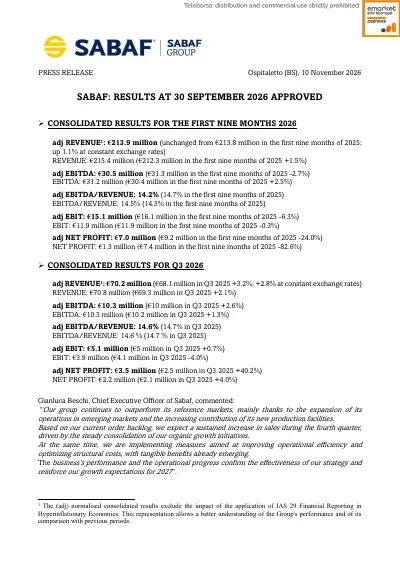
Sabaf is overperforming the market thanks to the contribution of the emerging markets, our wide presence in markets over Europe and the US, and also thanks to the contribution of the new plants, the ones in Mexico and in India that are sustaining growth in line with expectations. This good performance is confirmed also by the evolution of profitability, with EBITDA that passes from 13.6% in first quarter to 14.5% in second quarter and reaches 14.6% in the current third quarter.
This was partly helped by volumes, geographical diversification, but also thanks to the work that we continue to do on efficiency, productivity, and also fixed costs. We have also been able to manage and to mitigate the impacts of the increase in variable input costs.
I refer to raw materials and cost of energy power. This was possible even through hedging, partly by anticipating some purchase of raw materials, and in the end, the impact on the quarter has been quite limited.
That we can say that during the third quarter we have been able to close the gap that was generated during the first quarter, that started weak compared to the first quarter '25. We closed the nine months with sales which are in line with at the previous year's same period.
At the same exchange rate, we would have recorded in the nine months a slight growth, 1.1%. In the third quarter specifically, we have been able to grow 3.2%, and the growth would have been more or less the same at the same exchange rate.
Which are the growth area during the quarter? North America was slightly growing in a market which is instead declining.
This is the fact that Sabaf is gaining share thanks to the Mexican plant. Starting from July, we have started the sales of a new product family of burners to our customers in Mexico and US.
At present, the Mexican plant is recording sales well over €1 million per month. We have reached what is our present full capacity, that we will further increase by another 20% during '27, because the path goes on in this direction.
This full utilization of the capacity in Mexico is also translating in a very good performance in terms of profitability, which is now over the average of our group. On the same side goes the growth in India.
That our India project has a time to release the effects which is longer than the one in Mexico, but the performance of the quarter are exactly in the direction that we expect. That makes us very confident also for the remaining part of the year, especially for '27.
Now the issue here is to further increase and optimize the efficiency of our production plant, because we have a strong demand on which we can rely. These are, let's say, the two most relevant and structural effects that have contributed to growth.
On the other side, we can also say that LatAm confirms a solid market, some slight signs of slowdown, but always on a good levels compared to historical trends. A market in which Sabaf has a strong presence, and that continues to be satisfactory in terms of results.
Middle East continues to be impacted by all the supply chain constraints and difficulties to work in this area. Still some potential that is not in the figures of this period.
Generally speaking, let's say that if we look at the product contribution of the different families, growth comes mainly from gas, from the gas division, both because the new plants are in that business, and because the gas division is the one for which the international presence of our group is in general larger. We are less impacted by the weakness of US market and of the European final market, on which I would not add too many information because, let's say, has been commented also by our customers the reasons for which the white goods market continues to be well below what should be the normal level of final demand.
I was saying that during the quarter we have been able to improve the profitability compared to the first two quarters and to keep the same margins as in the third quarter '25, so that EBITDA has improved from €10 million in third quarter '25 to €10.3 million for the EBITDA in third quarter '26. This is due mainly to higher sales volumes.
We have been able to balance the negative impact of raw materials and energy partly, I would say more or less half, by price, selling price increase, increase in price lists, and the other half by operational efficiency and lower fixed costs. In the end, we have kept the same margins in terms of percentage and improved thanks to higher level of sales.
I was saying that partly of the mitigation of the raw material inflation has been mitigated through hedging strategies. This has partly affected our working capital at the end of September.
You will notice a higher level of stock compared to June and compared to the same date of last year. This is mainly raw materials for which, in order to benefit from lower prices on one side, but also to avoid any supply chain disruption for which we had to manage some risks, partly because of logistics and partly because of the very low availability of scraps, especially for aluminum, in Europe during the period, we decided to keep a higher level of safety stocks.
This has partly impacted the working capital. It's a temporary effect that we expect to absorb already most of it during the fourth quarter.
Of course, this higher level of working capital has a direct reflex in the moment on the net financial debt. I repeat, we consider it temporary, and so nobody's too much worried for that.
A couple of words about the outlook. We have seen in the past two years that the fourth quarter has been particularly weak, because most of the customers tend to reach the end of the year with very low level of working capital.
We are seeing instead that during the fourth quarter '26, demand stays relatively good, once again, not because the market is recovering—we are not in the position to see any signs of recovery—but let's say that our projects, the new plants, and in general, some other startups for some supplies are giving a positive effect, so that we think that the fourth quarter should have a level of sales increase even better than the third quarter compared with the same quarter of a previous year. In the end, we expect to close the year with figures in terms of sales better compared to '25.
As regards profitability, we still expect that there could be some effect on the input costs, and as during the third quarter, we will try to manage it partly thanks to the price increases that we have already agreed, and partly still working on operational efficiency and fixed costs. Let's say that, more in general, the second part of the year for Sabaf is proving to be less difficult, or at least more satisfactory, than the first half, in such a tough environment, that allows us to say that we are in the right direction also for the year to come.
It's probably too early to give a more specific indication on '27, but we know that we will have a lot of contribution from our new initiatives, new supplies, and so on. Confident that '27 can be for Sabaf, once again, a year in which our group will perform better than the market.
For the moment, I stop here, and I'm available for any questions. Thank you.
Operator
Excuse me. This is the Chorus Call conference operator.
We will now begin the question-and-answer session. Anyone who wishes to ask a question may press * and 1 on their touch-tone telephone.
To remove yourself from the question queue, please press * and 2. Please pick up the receiver when asking questions.
Anyone who has a question may press * and 1 at this time. The first question is from [Karl-Jan Webb?]
of Cairo Capital. Please go ahead.
Marc Saint John Webb
Hello, can you hear me?
Gianluca Beschi
Yes.
Marc Saint John Webb
Hello. Hello, Gianluca.
Thank you for the presentation. Good to see that things are picking up a little bit in Q3 and Q4.
I wonder whether you can update us all on not the figures, but governance at the company. What is the plan?
What's happening in terms of the governance of the company?
Gianluca Beschi
Yes, do you refer to the management, I suppose?
Marc Saint John Webb
Management, yes.
Gianluca Beschi
Yes, okay. Yes.
Let's say that with my appointment as CEO, there has been, at the same time, the appointment of Andrea Boffadelli as Chief Operating Officer. We are working closely, each with our own responsibility, in order to set the good directions.
We have worked internally on the organization, giving a more divisional architecture to our group. With gas, hinges, and electronics, each one with specific responsibilities, and a head for the business development to one single manager for each division.
The division dimension is becoming more and more important in the structure of our group. All the management, the top management, is following up in the right way.
We are really very compact, there is enthusiasm, even considering that the difficulties that the market and the sector, the industry has to face. I think that this, on this side, we are on the right page, doing a good job, and all the team is on board, and the results that we see, but also the results that we will see in the next quarters, will also be the result of this strong commitment from all the management team.
No necessity to have new management on board from outside. We have given a more clear responsibility to some of the internal people, and everybody's working tough and with enthusiasm in the right direction.
Yes. Very good.
Marc Saint John Webb
Great. Great to hear.
That means that there are three divisional managers: one for gas, one for hinges, and one for electronic components. Is that right?
Gianluca Beschi
You are right.
Marc Saint John Webb
What were these people doing before?
Gianluca Beschi
Yes, they had a responsibility more concentrated on some single companies inside the group. Now it's more, let's say, we have appointed them on the division level, and so The legal entity is less interesting.
Apart from the fact that one can keep the role of managing director or CEO of one single company, but we point on the division, independently of, from legal entity aspect, and that is in a second stage.
Marc Saint John Webb
Okay? Great.
How does that change the strategic approach to Sabaf, which in the past had one sort of operational CEO and encouraged factories to look at a factory that was making hinges, to look at making in the US, maybe one day, gas valves and burners, and a Mexican plant that was making burners, maybe making something else? Those sort of group synergies disappear with this governance organization?
Gianluca Beschi
Let's see that the different plants where we manufacture hinges or where manufacture gas components have a more direct comparison one with the other, so that we are going to use or we are already using the same KPIs in the factories. We are able to bring the best practices across the factory, with one single eye that can help in this direction.
We have to say that across the division, we keep a sales structure which is across all the divisions. We have sales directors among which there are split the responsibilities for our big multinational customers that have the target, also the goal to bring synergies across the divisions and possibility also to add further sales across all the division to the same customers.
Then, of course, remains the possibility that in some of the factories we can have also different departments or product lines, as it is in the case in Turkey, where, for instance, we have production both for burners and valves, both for hinges, and for electronics. The three plants are under the responsibility of three different directors.
Marc Saint John Webb
Great. Thank you very much.
Gianluca Beschi
Thank you.
Operator
The next question is from Domenico Ghilotti of Equita. Please go ahead.
Domenico Ghilotti
Good afternoon. I have three questions.
The first is if you can elaborate a little bit more on the hinges and electronics trend. Electronics have already been, say, suffering the previous quarters.
They remain negative. If I'm not wrong, hinges moved to negative in Q3, and well, I would like to understand, so, how this compared with the message that actually is more supportive.
If it is coming just from the gas components. Second, maybe on Q4 comments, should we assume is a matter of forex, or is a matter also at constant forex you are also getting some improvement in the growth profile?
Last, you were mentioning on the working capital side the inventory level. If I'm not wrong, also you had quite significant decline in payables.
Domenico Ghilotti (Equita): Is it also a temporary impact on the working capital?
Gianluca Beschi
I will answer in the reverse order because it's easier. As regards payables, yes, it's a seasonal effect, the same happened in the third quarter last year if you go and look at the figures.
That it's typical of the third quarter that we have a decline, because we have lower purchase during the summer season, while we continue to pay suppliers. It's just a seasonal effect.
As regards the growth in the fourth quarter, maybe forex helps a lot, but we see growth also in terms of volumes, it's not just a matter of forex that we hope that can give us a slow contribution. As regards the performance of hinges and electronics: as regards hinges, it's all due to the market, the weakness of the market.
We have a high level of exposure to the US and a high level of exposure to Europe, which are the two areas on which the market is particularly weak. The third quarter's been definitely also worse compared to the previous ones in this context.
For the fourth quarter, we expect a big of recovery, also in this sense, the figures that we see at constant perimeter, without any contribution of new projects in the fourth quarter, are better than Q3. While as regards '27, there are some new supplies that are going to start that will help also the growth in the hinges division.
As regards electronics, we know that we are in this transition phase for which we have lost some supplies to weak customers, especially in Turkey, and of products which, let's say, were more on the commodity side. We are switching, and we are making all the efforts to be more in customized products and in applications in industries which are different from white goods.
We are still in this phase. It takes some time.
We expect that also for electronics, '27 can be better than '26.
Domenico Ghilotti
Thank you.
Operator
The next question is from Emanuele Negri of Mediobanca. Please go ahead.
Emanuele Negri
Yes, good afternoon, everybody. Thanks for the presentation and for the Q&A.
My first question is on the expected production capacity expansion you mentioned before in Mexico, if you can elaborate a bit on this. The second one is if you have any comment or any outlook to share with us on the Brazilian market.
Thanks.
Gianluca Beschi
Yes, so as we were saying that we are increasing capacity in Mexico because we are already running at full capacity, we will add the fifth press to die-cast burners that will start production at the end of the first quarter of '27. This will add around 20% capacity with investment in the order of €1.5 million more or less.
We are also adding capacity in India. In this case, we will partly move some machinery from Italy to India and make some additional investments, but let's say not material amounts, so.
Also in this case, we need to increase capacity to be able to answer to increase in demand. As regards Brazil, we've been running along the year substantially at full capacity, we are satisfied with the performance, a bit struggling to keep good level of profitability, even because part of the sales are in dollars and also these have been impacted, especially in the first part of the year.
Nowadays, let's say we are looking at a market that I mentioned that maybe there is some slight sign of weakness, not dramatic slowdown. Let's say that everybody's looking at potential effects after the elections there.
The monetary policy also is very important, because a big part of the final demand is made at credit, so that people pay by instruments when they buy white goods. A tight monetary policy would not definitely help the market.
As far as we can see, there is not any structural sign of change that we can see. We keep our strong position in all what is the premium high-end part of this market.
Emanuele Negri
Thank you.
Gianluca Beschi
Thank you.
Operator
As a reminder, if you wish to register for a question, please press * and 1 on your telephone. Once again, if you wish to ask a question, please press * and 1 on your telephone.
For any further question, please press * and 1 on your telephone. Mr.
Beschi, there are no more questions registered at this time.
Gianluca Beschi
Thank you to everybody for attending this call, and I wish you a good evening to everybody. Thank you.
Operator
Ladies and gentlemen, thank you for joining. The conference is now over.
You may disconnect your telephone.