Matrix Service Company
Q1 FY2027 · Earnings Call TranscriptNovember 5, 2026
Operator
Good morning, and welcome to the Matrix Service Company conference call to discuss results for the first quarter of fiscal 2027. Currently, all participants are in listen-only mode.
Later we will conduct a question-and-answer session, and instructions will be given at that time. As a reminder, this conference is being recorded.
I would now like to turn the conference over to Mr. Patrick Roberts, Director of Corporate Development and Investor Relations of Matrix Service Company.
Patrick Roberts
Thank you, and good morning, everyone. Welcome to Matrix Service Company's first quarter fiscal 2027 earnings call.
Participants on today's call include: Chief Executive Officer Shawn Payne, Interim Chief Financial Officer A.J. Smith, and Chief Financial Officer-elect Dominic Savarino.
Following our prepared remarks, we will open the call up for questions. The presentation materials referred to during the webcast today can be found under Events and Presentations on the Investor Relations section of matrixservicecompany.com.
As a reminder, on today's call we may make various remarks about future expectations, plans, and prospects for Matrix Service Company that constitute forward-looking statements for the purposes of the Private Securities Litigation Reform Act of 1995. Actual results may differ materially from those indicated by these forward-looking statements because of various factors, including those discussed in our most recent annual report on Form 10-K, and in subsequent filings made by the company with the SEC.
The forward-looking statements made today are effective only as of today. To the extent we utilize non-GAAP measures, reconciliations will be provided in various press releases, periodic SEC filings, and on our website.
On our last call, I highlighted a project that showcased the depth of our capabilities and the type of complex work Matrix is built to deliver. I'd like to continue that practice today because it provides useful context around the markets we serve and how Matrix has evolved.
While many investors may still associate Matrix primarily with storage tanks, today's Matrix supports critical infrastructure across a much broader set of end markets, including power generation, LNG and NGLs, utilities, mining and minerals, and increasingly data centers. One area that illustrates this evolution particularly well is the power sector.
For decades, Matrix has supported customers through the construction and maintenance of critical power facilities and systems. Our capabilities extend across power generation facilities, substations, and other supporting systems.
These capabilities are becoming increasingly important as electrical demand continues to grow and customers seek greater certainty of supply. Whether through additional generation capacity, backup power systems, or on-site LNG fuel infrastructure, organizations are investing in solutions that enhance reliability and resiliency.
We continue to see strong growth in our opportunity pipeline associated with these specialized services. That demand comes from a diverse customer base that includes public utilities, private utilities, power producers, industrial customers, and energy companies.
More recently, we have also begun supporting the rapidly expanding data center market, providing the same services for customer-owned energy and power assets as developers and owners look for ways to secure reliable power, greater certainty of supply, and enhanced operational resiliency. Matrix's experience in power generation, backup fuel, electrical systems, and construction execution positions us well to participate in that growth.
Most recently, we were awarded a project in this space which Shawn will discuss in more detail in his remarks. What these opportunities demonstrate is the versatility of Matrix's capabilities.
Whether supporting LNG, power generation, electrical infrastructure, mining and minerals, or data centers, we are able to leverage the same core strengths across multiple end markets where critical infrastructure investment continues to grow. Regardless of the market we serve, our focus remains unchanged: delivering projects safely, with quality, and in a manner that creates value for our customers and shareholders.
With that, I'll turn the call over to Shawn.
Shawn Payne
Thank you, Patrick, and good morning, everyone. Before discussing our first quarter results, I'd like to welcome Dominic Savarino to Matrix as Senior Vice President and Chief Financial Officer, effective tomorrow, November 6th.
Following a comprehensive search, we selected Dominic because he brings a combination of financial leadership and operational experience that is particularly well-suited to Matrix. He has built his career in engineering, construction, energy, and industrial infrastructure businesses, and has held roles in both financial leadership and with direct operational and P&L responsibility.
That experience gives him a strong understanding of how financial discipline, project execution, commercial strategy, and risk management come together to drive profitable growth. His perspective will be especially valuable as we continue executing on our Win, Execute, Deliver strategy and position Matrix for its next phase of growth.
We are excited to have Dominic on the team and look forward to his contributions. Now to the quarter.
As I discussed last quarter, Win, Execute, Deliver is how we run the company. It turns our strategy into everyday choices about what we pursue, how we work, how we allocate resources, and the results we create.
Over the past 18 months, we've taken meaningful actions to improve execution, create a more efficient operating model, and drive consistent profitability as we grow. Today, I want to focus on how those actions are strengthening our business and translating into better results.
Under the Win pillar of our strategy, our focus is on building a stronger business by improving the quality and diversity of our backlog, strengthening customer relationships, and expanding into attractive end markets. Since we last reported, our opportunity pipeline has increased from approximately $7.4 billion to $8.2 billion.
Importantly, that growth is not concentrated in a single market. We have seen expansion across all of our segments, including LNG, power generation, electrical infrastructure, and mining and minerals, reinforcing our confidence in both the demand environment and the opportunities ahead.
The breadth of this growth reflects the continued diversification of our business and gives us a stronger, more balanced opportunity set from which to drive profitable growth. We are already seeing tangible results from this approach.
This quarter, we were awarded a meaningful power generation project supporting data center infrastructure. This project is particularly significant because it aligns several strategic priorities for Matrix.
It expands our participation in the growing power generation market, strengthens our position in the rapidly developing data center ecosystem, and it also demonstrates the continued importance of construction-only opportunities in supporting a stable and diversified revenue base. As another example of our Win strategy in action, we continue to see strong momentum in the mining and minerals space.
In addition to the significant award we discussed last quarter, we secured several awards in Q1 with another important client in multiple facilities specifically targeted under our strategic growth plan. Under the Execute pillar of our strategy, our focus is on creating value through safe, disciplined, and consistent project delivery.
We continue to see encouraging results from the operational discipline we've implemented across the business. Project execution remains solid, and we are seeing greater consistency in how opportunities are evaluated, risks are managed, and the work is delivered.
During the quarter, we advanced several initiatives designed to strengthen the decision-making process and increase accountability throughout the project lifecycle. Another important component of execution is workforce development.
Capturing the opportunities ahead requires not only the right projects, but the right people to deliver them safely and successfully. We have established a more coordinated, enterprise-wide approach to recruiting, developing, and retaining craft and supervisory talent, including adding field recruiting resources and strengthening our trade school relationships and internal career paths.
These efforts are supporting our execution capacity while upholding our rigorous safety and quality standards. Ultimately, the objective of Win and Execute is to Deliver.
Deliver means producing consistent results, generating sustainable profitable growth, and creating long-term value for our shareholders, customers, employees, and communities. While we are still early on this journey, our third consecutive quarter of profitability is a clear indicator of the progress we are making.
During the quarter, we also purchased $2.5 million of our shares. This effort is consistent with the Deliver pillar of our strategy related to disciplined capital allocation and creating long-term shareholder value.
In summary, we have a clear strategy, a stronger operating foundation, and a leaner, more efficient cost structure. We are a stronger company today, with meaningful opportunities ahead and the focus, discipline, and capabilities to convert those opportunities into consistent profitable growth and long-term shareholder value.
As Dominic officially assumes the Chief Financial Officer position tomorrow, A.J. Smith will be reviewing our first quarter financial results today.
With that, I will turn the call over to A.J.
AJ Smith
Thanks, Shawn. Our results this quarter reflect the continued momentum behind our Win, Execute, Deliver framework, culminating in the third straight quarter of profitable performance.
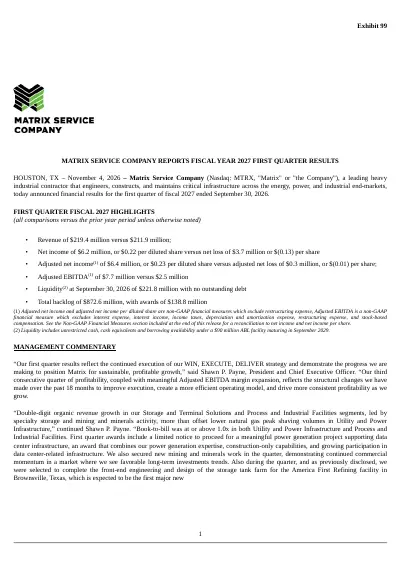
During the first quarter, despite some revenue from several booked projects shifting into future quarters, revenue increased 4% to $219.4 million, compared to $211.9 million in the first quarter of fiscal 2026. We expect quarterly revenue levels for the remainder of the year to be, on average, higher than in the first quarter.
Gross profit was $18.1 million, or 8.2% of revenue during the quarter, compared to $14.2 million, or 6.7% of revenue for the first quarter of fiscal 2026. Gross margins during the period benefited from strong project execution and improved overhead recovery.
SG&A expenses were $13.3 million in the first quarter of fiscal 2027, or 6% of revenue. SG&A decreased by $3 million compared to the prior year period, due in part to lower salary and wage expense and stock compensation expense resulting from our organizational restructuring plan.
Additionally, SG&A decreased $1.9 million year-over-year due to the variable accounting for cash-settled stock-based compensation. As a result of our higher revenue, higher gross margins, and lower SG&A expense, the company had positive EPS during the quarter of 22 cents, compared to a loss of 13 cents per share in the prior year quarter.
On an adjusted basis, EPS was 23 cents per share, compared to an adjusted net loss of 1 cent per share in the prior year period. Adjusted EBITDA also improved to $7.7 million in the first quarter, compared to $2.5 million in the first quarter last year.
Moving to the segments. Storage and Terminal Solutions segment revenue increased 12% to $122.9 million in the first quarter of fiscal 2027, compared to $109.5 million in the first quarter of fiscal 2026, driven by an increased volume of work for specialty tanks and the associated balance of plant work.
Gross margin was 9% in the first quarter of fiscal 2027, compared to 5.9% in the first quarter of fiscal 2026. Segment gross margin was driven by improved project execution overall, as well as improvement in overhead cost absorption.
Utility and Power Infrastructure segment revenue decreased 21% to $59.1 million in the first quarter of fiscal 2027, compared to $74.5 million in the first quarter of fiscal 2026, due to a decrease in volume of work for natural gas peak shaving projects, partially offset by an increase in power generation work. Gross margin was 8.6% in the first quarter of fiscal 2027, compared to 9.1% for the first quarter of fiscal 2026, a decrease of 0.5%, primarily due to mix of work, partially offset by improved overhead cost absorption.
Process and Industrial Facilities segment revenue increased to $37.4 million in the first quarter of fiscal 2027, compared to $27.9 million in the first quarter of fiscal 2026, primarily due to increased revenue volumes for mining and minerals work. Gross margin was 3.7% in the first quarter of fiscal 2027, compared to 5.1% in the first quarter of fiscal 2026.
Current quarter margins were impacted by the resolution of a subcontractor dispute for a project originally completed in fiscal 2023. While resulting in a decrease in segment margins in the current quarter, the impact is a net positive for the business based on savings of anticipated fiscal 2027 legal costs.
Moving to backlog. During the quarter, project awards were $138.8 million, resulting in a book-to-bill of 0.6.
Awards in the Utility and Power Infrastructure segment include the award of a meaningful power generation project supporting data center infrastructure that Shawn previously mentioned. As we've noted in previous quarters, we believe award activity will pick back up in the second half of our fiscal 2027, but those awards will primarily solidify our fiscal 2028 revenue base.
Our backlog as of September 30th of $873 million provides clear visibility into improved revenue run rates through the remainder of the fiscal year, along with continued profitability. We continue to maintain a strong balance sheet and liquidity position.
Total liquidity is $222 million, including $182 million of unrestricted cash and $39 million of borrowing availability under our credit facility. With our liquidity position, we executed $2.5 million of share buybacks during the quarter.
Also this week, we amended our credit facility to expand our annual stock repurchase limit, and our board approved a new buyback program of $25 million, which expires in two years. We will opportunistically repurchase stock under the program based on market conditions and our liquidity position.
With that, I will turn the call back to Shawn for a few additional comments.
Shawn Payne
Thank you, A.J. Before moving to Q&A, I want to thank A.J.
for his leadership and dedication while serving as Interim Chief Financial Officer while we conducted our search for a new CFO. A.J.
helped ensure continuity and stability during an important period of transition for Matrix. A.J.'
s contributions have been invaluable, and I appreciate his continued partnership. With that, I'd like to open up the call for questions.
Operator
Thank you. If you would like to ask a question, please press star one one on your telephone.
You will hear an automated message advising your hand is raised. If you would like to remove yourself from the queue, please press star one one again.
We also ask that you wait for your name and company to be announced before proceeding with your question. One moment while we compile the Q&A roster.
Our first question will be coming from the line of John Franzreb of Sidoti. Please go ahead.
John Franzreb
Good morning, everyone, and thanks for taking the questions, and welcome aboard, Dominic. I'd like to start with the recent results, particularly the SG&A line.
It was down rather noticeably. You kind of called out some of this based on share the change in the share price, but you also said that there's an organizational restructuring.
I'm kind of curious how much of the change in SG&A is temporary and how much of it is on a permanent basis?
Dominic Savarino
I'll take this one. Our SG&A run rate, I think, like you mentioned, was impacted by some of the variable expense related to our cash-settled stock-based compensation.
I think there's always going to be some variability in that line, but generally speaking, I think a good run rate for us is probably $15.5 million to $16 million a quarter, depending on activity levels and variable compensation.
John Franzreb
Got it. It's hard to ignore the book-to-bill profile.
Can you talk a little bit particularly what's going on in storage, what you're seeing there, and maybe a little bit about the competitive landscape and how that's shaping out?
Shawn Payne
You bet, John. I know that you know the book-to-bill is relatively low.
We've discussed that over the last few quarters, right? We expected the award activity to be lighter in the first half of fiscal 2027.
I'll say that we have several large opportunities that are progressing towards customer decision points later in the fiscal year, and we think that's really going to strengthen the award activity in the second half. Some of those projects are storage, particularly LNG-related.
Also should note that those larger awards aren't expected to contribute really meaningfully to full year 2027 revenues, our focus with those is really on positioning the business for fiscal 2028. I think also important there is while we can't control the exact timing of the customer decisions, large or small projects, what really gives us confidence there is the strength and the breadth of our opportunity set.
As we said on the call, our pipeline increased approximately 11% up to $8.2 billion with opportunities across LNG, NGLs, power gen, electrical infrastructure, and mining and minerals. Important to note there that we're not dependent on any single project, customer, or end market.
Then lastly, John, I'd just tell you there that we're also seeing a broader mix of smaller, quick-turn construction projects, like construction-only work and also repair and maintenance work. That's important to us because with those projects, we can convert that revenue faster.
We can get to the field faster. That's one of our strategies, right, is to provide a more consistent baseload of activity to make sure we have that work during the ebbs and flows of some of the large EPC works.
I think together with those two factors, it really gives us a balanced path to rebuilding backlog and entering in the fiscal 2028 from a stronger position.
John Franzreb
Just to clarify a bit, the competitive landscape, maybe you could give some color of what the margin profile is on new jobs being written today versus, say, six months ago? Any kind of color there would be helpful.
Shawn Payne
It really depends on what we're bidding. We're into a lot of different things, different markets, certainly different customers, different contract types.
I would say, in general, there is a lot of demand right now, obviously, going on, a lot of projects being bid, and that's putting pressure on labor, workforce, and just general resources. Typically, when that happens, what you see, John, is the margins increase on those projects, particularly larger projects.
John Franzreb
Okay. What, I'll get back in the queue.
Thanks for taking my questions.
Shawn Payne
You bet.
Operator
Thank you. One moment, please.
If you would like to ask a question, please press star one one on your telephone. I see there are no more questions in the queue, and I'm going to pass the call back over to Patrick for closing remarks.
Please go ahead.
Patrick Roberts
Thank you, everyone, for your participation today. Matrix Service Company will be participating in the upcoming Northland Growth Conference on December 16th.
If you will be attending, we welcome the opportunity to visit with you. Additionally, if you would like to have a conversation with management, please contact me through the Matrix Service Company Investor Relations website.
You may also sign up to receive MTRX news by scanning the QR code on your screen. Again, thank you for your time today.
Operator
Thank you for participating in today's program. You may now disconnect.