Minerals Technologies Inc.
Q3 FY2026 · Earnings Call TranscriptOctober 30, 2026
Operator
Good morning, and welcome to the Minerals Technologies Third Quarter 2026 Earnings Conference Call. All participants will be in listen-only mode.
Should you need assistance, please signal a conference specialist by pressing the star key followed by zero. After today's presentation, there will be an opportunity to ask questions.
To ask a question, you may press star then one on your telephone keypad. To withdraw your question, please press star then two.
Please note, this event is being recorded. I would now like to turn the conference over to Lydia Kopylova, Head of Investor Relations.
Please go ahead.
Lydia Kopylova
Thank you, Gary. Good morning, everyone, and welcome to our third quarter 2026 earnings conference call.
Today's call will be led by Chairman and Chief Executive Officer Doug Dietrich and Chief Financial Officer Erik Aldag. Following Doug and Erik's prepared remarks, we'll open it up to questions.
As a reminder, some of the statements made during this call may constitute forward-looking statements within the meaning of the federal securities laws. Please note the cautionary language about forward-looking statements contained in our earnings release and on these slides.
Our SEC filings disclose certain risks and uncertainties which may cause our actual results to differ materially from these forward-looking statements. Please also note that some of our comments today refer to non-GAAP financial measures.
A reconciliation to GAAP financial measures can be found in our earnings release in an appendix of this presentation, which are posted on our website. Now I'll turn it over to Doug.
Doug?
Doug Dietrich
Thanks, Lydia. Good morning, everyone, and thanks for joining today.
I'm going to kick us off with a review of our third quarter numbers before Erik takes you through the financials in more detail and provides our outlook. After Erik's comments, I want to take you through some highlights of our recent Investor Day, which took place at one of our R&D facilities in Bethlehem, Pennsylvania.
After that, we'll open up the call to questions. This was a quarter that I would characterize with some significant highlights: solid top-line growth for the company and a record operating performance in Engineered Solutions; and also some challenges, dealing with another round of energy and raw material inflation in Consumer & Specialties.
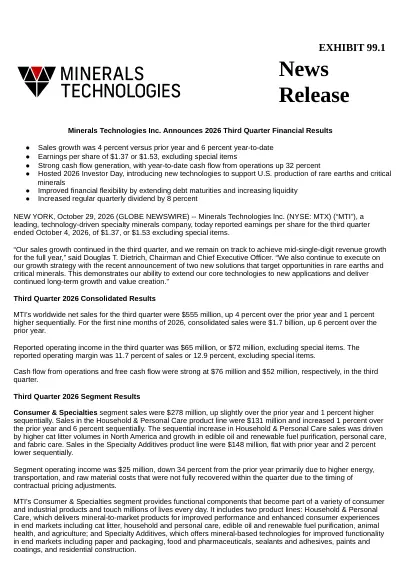
As we projected, we continued along our target growth track this quarter, with sales of $555 million, up 4% over last year and up 6% year-to-date. Both segments are executing on their growth initiatives.
In the Consumer & Specialties segment, we are seeing strong demand for our newest cat litter formulations in North America, and our fabric care and natural oil purification volumes are growing, supported by the expansions that came online a few months ago. In the Engineered Solutions segment, we see solid growth across the board.
In High-Temperature Technologies, we continue to see good traction for our MINSCANs, with six new installations this year and more coming online next. We have also secured new contracts for our calcium wire products at two greenfield steel plants that are scheduled to come online next year.
Volumes of foundry greensand bonds continue to grow, driven by strong automotive EV production in Asia, offsetting continued soft agricultural equipment and heavy truck markets in the U.S. Stronger environmental remediation markets and solid drilling product sales have contributed to several quarters of growth in the Environmental & Infrastructure product line.
Overall, we're executing on the strategic projects we laid out for this year and remain on track to hit our full-year mid-single-digit revenue growth target. We see this rate continuing through 2027.
Our operating income in the third quarter was $72 million, and earnings per share were $1.53. Our Engineered Solutions segment had another very strong quarter, with 9% sales growth, 9% operating income growth, and generating 17.6% operating margins.
This segment's performance puts it on track for a record year. Total operating income for the company was slightly below our guidance this quarter, driven by a challenging operating quarter in Consumer & Specialties due to the significant increases in energy, transportation, and raw material costs.
However, our teams around the world continue to work closely with our customers to adjust prices. Previous rounds of price increases have taken hold, and these latest price changes will take effect this quarter and carry over into the next.
We expect to fully recover segment margins, which historically have been around 14%, as our pricing catches up with these inflationary costs. Doing so will drive full-company margins back to the 15% level.
Despite the inflationary challenges, we continue to generate strong cash flow. Year-to-date, our cash from operations is $171 million, up 32% compared to last year.
Our balance sheet remained solid, and we improved our financial flexibility by extending debt maturities and expanding our revolving credit facility. Lastly, we announced that we increased our regular quarterly dividend by 8% to 13 cents per share.
This is the fourth year in a row that we have announced an increase, which reflects the continued confidence we have in our future cash generation. With that, I'd like to hand the call over to Erik.
Erik?
Erik Aldag
Thanks, Doug, and good morning, everyone. I'll start by providing an overview of our third quarter results, followed by a detailed review of our segments and a summary of our fourth quarter outlook.
Following my comments, I'll turn the call back over to Doug for a recap of our recent Investor Day and some closing remarks. Now let's review our results.
We continued to see positive momentum with our growth initiatives in the third quarter, with sales increasing by 4% versus prior year to $555 million. In the Consumer & Specialties segment, there were several encouraging developments in the quarter in the Household & Personal Care product line.
We saw higher sales of our new fabric care additives, higher sales of cat litter in North America, and our natural oil purification volumes continued to ramp up through the quarter. These higher sales were partially offset by softer-than-normal seasonal volumes for European cat litter.
On the Engineered Solutions side, we had another strong quarter, with sales in High-Temperature Technologies up $13 million versus prior year as sales to steel customers remained on their growth track and our foundry business had a solid quarter. In the Environmental & Infrastructure product line, the positive sales momentum we saw through the first half of the year continued, with sales up $8 million versus prior year, bringing the total sales growth for the segment to 9% for the quarter.
On a year-to-date basis, total sales are up 6% for the company, and as Doug mentioned, we remain on track for full-year growth in the mid-single digits. In the Consumer & Specialties segment, the Household & Personal Care product line is up 4% year-to-date, driven by 6% growth in cat litter and 11% growth in natural oil purification.
In the Specialty Additives product line, changes in the paper and packaging market in North America and a soft residential construction market have impacted sales on a year-over-year basis. Nonetheless, sales for the product line are higher by 2%, driven primarily by the progress of our growth initiatives in Asia.
Altogether for the segment, sales are up 3% year-to-date. In the Engineered Solutions segment, the third quarter was largely a continuation of the strong growth performance we delivered in the first half.
Sales in the High-Temperature Technologies product line are up 7% year-to-date, and in the Environmental & Infrastructure product line, sales are up 16% year-to-date, totaling 10% growth for the segment so far this year. Operating income for the quarter was $72 million.
As we moved through the third quarter, we faced additional cost increases, primarily in the Consumer & Specialties segment, driven by higher energy costs and rising diesel prices, which contributed to increased transportation, mining, and raw material costs. We have pricing actions planned and in place to cover the inflationary cost increases we experienced in the third quarter, and our teams remain focused on productivity and cost control at the plants.
Meanwhile, in the Engineered Solutions segment, our pricing has been keeping pace with changes in cost throughout the year. Income for the segment was $4 million higher year-over-year in the third quarter and $14 million higher year-to-date.
Now let's turn to a review of our segments, beginning with Consumer & Specialties. Third quarter sales for the Consumer & Specialties segment were $278 million, up 1% sequentially and slightly above prior year.
In the Household & Personal Care product line, progress with some of our key growth initiatives gained additional momentum in the third quarter, driving product line sales higher by 6% sequentially and up 1% year-over-year to $131 million. Cat litter sales improved by 5% over the prior quarter as improved traction with some of our newest cat litter offerings contributed to higher sales in North America.
This growth was partially offset by temporarily lower cat litter sales in Europe due to a more pronounced seasonal impact than normal and a large customer promotion that moved to the fourth quarter. Meanwhile, sales for edible oil and renewable fuel purification were up 21% sequentially as volumes ramped through the quarter.
For added context, by the time we exited Q3, volumes were 33% above our Q2 run rate. This upward momentum is expected to continue through the fourth quarter.
Lastly, we began to see sales for our innovative fabric care additives move higher in the third quarter, and we expect this to continue to build in the months ahead. Specialty Additives sales were $148 million, down 2% sequentially and flat with prior year.
Our newest satellites in Asia contributed to strong sales growth in the region during the third quarter, with Asia sales up 13% year-over-year. This solid growth in Asia was offset by a challenging comparison in the North America paper and packaging market, driven by a mill closure, a paper machine conversion, and customer downtime.
Demand from residential construction customers also remained soft, and some of those customers have begun to communicate plans for extended shutdowns as we approach the end of the year. Operating income for the segment was $25 million in the third quarter.
During the quarter, the segment faced rapidly rising energy, transportation, and mining costs, which resulted in an unfavorable price versus cost lag for the segment due to the timing of contractual pricing adjustments. In addition, the softer volumes in North America paper and packaging, residential construction, and European cat litter contributed to an unfavorable volume and mix impact on income in the quarter.
As we look ahead to the fourth quarter, we expect segment sales to be similar sequentially, as the continued ramp-up of sales from our growth initiatives in Household & Personal Care will offset typical seasonal patterns in Specialty Additives. We expect operating margin for the segment to be similar to the third quarter, as pricing and productivity actions offset the impact of sequentially higher costs and seasonally lower residential construction volumes.
Now let's turn to a review of the Engineered Solutions segment. This segment has performed well all year, driven by solid execution on growth initiatives, such as the ramp-up of new business in the North American EAF steel market, which is driving higher sales of refractory products, calcium wire, and application equipment, as well as continued penetration and growth in the Asia foundry market.
We've also seen a nice uptick in activity this year in the Environmental & Infrastructure product line after several years of end-market softness. We're seeing higher sales across environmental products, building materials, and infrastructure drilling products.
We're seeing continued growth for our FLUOROSORB product targeting PFAS remediation, as we've converted four additional drinking water pilots into full-scale commercial implementations so far this year, with four more scheduled over the next two quarters. This segment has achieved these record levels of performance despite continued softness in large foundry end markets like agricultural equipment and heavy truck.
The environmental and infrastructure end markets still have a long way to go to return to their prior peak years, which is all to say there's still much more potential in this segment. In the third quarter, this strong performance continued, with total sales of $277 million, up 1% sequentially and up 9% versus prior year.
Sales in the High-Temperature Technologies product line were $192 million, up 1% sequentially and up 7% versus prior year, driven by strong sales to steel and foundry customers globally. In the Environmental & Infrastructure product line, sales of $85 million in the quarter were up 1% sequentially and 11% above prior year.
We continue to see stronger demand for drilling products and environmental project solutions, and some large-scale commercial construction projects contributed to increased demand for our building materials. Operating income for the segment was $49 million in the third quarter, up 9% over prior year, driven by continued volume growth, price adjustments, and solid operational execution.
Operating margin was very strong at 17.6%. Looking ahead to the fourth quarter, we expect segment sales to decrease by approximately 10% sequentially, driven primarily by the typical seasonal reduction in project activity in the Environmental & Infrastructure product line.
Now let's turn to a review of our balance sheet and cash flow highlights. Cash flow generation was strong in the third quarter, with cash from operations totaling $76 million and free cash flow of $52 million.
Year-to-date free cash flow of $97 million is up significantly over prior year, and we remain on track for full-year free cash flow around 6% of sales. Capital expenditures totaled $24 million in the third quarter, and we expect to be in the $95 to $100 million range for the full year.
Earlier in October, we completed a private offering for $400 million of senior notes due in 2032. Funds were used to redeem all of our outstanding senior notes that were due in 2028, extending the overall maturity of our senior notes obligation.
We also extended the maturity of our revolving credit facility and expanded its capacity to $500 million. On the lower left, you can see that since the third quarter last year, we've increased liquidity by over $160 million to $868 million, and we're showing our revolver availability on a pro forma basis to reflect the recent increase in capacity.
Overall, the balance sheet remains solid. At the end of the third quarter, net debt stood at $579 million, and our net leverage ratio decreased to 1.5 times EBITDA.
As Doug mentioned, the board recently authorized an 8% increase in our regular quarterly dividend, marking MTI's fourth year in a row of dividend increases. Now let's review a summary of our outlook for the fourth quarter.
Fourth quarter sales for MTI are expected to be approximately $525 million, with operating income between $60 and $63 million, and EPS between $1.15 and $1.20. It's worth highlighting that there are six fewer days in our fourth quarter this year compared to last year.
On a days-adjusted basis, this outlook represents high-single-digit sales growth over prior year and a similar level of operating income and EPS relative to last year. In our Consumer & Specialties segment, sales are expected to be similar sequentially, as the continued acceleration of our growth initiatives in Household & Personal Care is partially offset with seasonally lower sales in Specialty Additives.
In the Engineered Solutions segment, sales are expected to be approximately 10% lower sequentially, driven primarily by the seasonal patterns in the Environmental & Infrastructure product line. The overall cost environment continues to be volatile, with energy and transportation costs remaining near their recent peak levels, and the increases we saw through the third quarter will result in another sequential increase in cost in the fourth quarter, particularly in the Consumer & Specialties segment.
That being said, we remain confident that the combination of price-cost recovery, volume leverage, and the continued growth of higher-margin new products will contribute to higher margins in 2027. We have good line of sight that our mid-single-digit top-line growth will continue next year.
With that, I'll turn the call back over to Doug.
Doug Dietrich
Thanks, Erik. Last month, we held an Investor Day at our R&D labs in Bethlehem, Pennsylvania.
Thank you to all who attended in person and online. We certainly enjoyed the opportunity to spend more time with you and give you a firsthand look at another one of our R&D facilities.
At the event, we reconfirmed our strategic growth and long-term financial targets, which you can see here on the right, and highlighted what will drive MTI's near- to mid-term sales growth. We discussed how the company has delivered 4% compound annual revenue growth over the last five years and how we're set up to continue to deliver an average of 5% through the cycle going forward.
We provided an overview of our growth strategy and shared how we are applying our capabilities and technologies in higher-value markets. We also outlined our path for margin expansion, which we see returning to an operating margin of 15% in the near term and the potential to move above 15% through our strategy execution.
Erik covered MTI's strong cash flow profile and deep financial resources, which provide the company with the flexibility to fund our organic growth, continue to return capital to shareholders, and pursue M&A opportunities simultaneously. The past five years, we've converted an average of 6% of our sales to free cash flow and are maintaining our target of a 7% conversion rate along with a 12% return on invested capital target.
Another objective of the Investor Day was to outline our new product pipeline, which we currently estimate at $1.4 billion in revenue potential. To highlight part of what makes up this potential, we showcased two new innovations that are near commercialization and that will drive long-term value creation.
I'd like to provide a quick recap of those on the next slide. First, we shared details about a new technology associated with the production of high-purity calcium metal.
MTI produces calcium metal at our facility in Canaan, Connecticut, and we've been doing so for over 40 years. Recently, our R&D teams have established capability and process to manufacture it in high-purity form.
High-purity calcium metal is required in the production of rare earth metals, and a U.S.-based supply of this type of calcium metal is essential for the establishment of a domestic rare earth supply chain. We see demand for high-purity calcium increasing rapidly over the next three years and are well-positioned to be the domestic supply partner for this critical market.
We have high-purity production in place and are in the process of expanding capacity. Several companies are currently scaling heavy rare earth metallization in the U.S., and we have qualified our calcium metal in their production process.
I will also add that our capability is very well understood by the U.S. government's national security and critical minerals initiatives.
We estimate that the high-purity calcium metal opportunity will drive over $100 million in incremental revenue for MTI in the next 3 to 5 years. Second emerging opportunity we discussed at our Investor Day is derived from our crystal engineering technology, specifically the technology that is the foundation for our proprietary NewYield product, which repurposes waste streams for the paper and packaging industry.
We recently developed ways to apply this underlying technology to other waste byproducts. One area that we are currently targeting is steel slag, a waste stream from the steelmaking process.
Our solution repurposes the slag into commercially viable critical metals like magnesium and manganese. These metals, which are currently almost 100% imported to the U.S., are needed to support infrastructure development and the production of batteries, electric vehicles, and aerospace and defense technologies.
We plan to pilot this technology with our partner over the next year and explore opportunities to apply it to recover critical minerals and materials from other untapped domestic byproducts. There's a broad palette of waste streams to work from, and the estimated addressable market for the steel slag opportunity alone could be greater than $250 million in the U.S., with similar opportunities in a variety of other sectors.
Let me conclude by saying that innovation has always been a core tenant of MTI's strategy, and it remains a key driver of long-term value creation. We're excited about these new technologies, but they are only two of the many new solutions moving through our innovation pipeline.
We look forward to sharing how these two new projects evolve and how our other products under development will continue to open up higher-growth, higher-value markets for us going forward. With that, let's open the call to questions.
Operator
We will now begin the question-and-answer session. To ask a question, you may press star then one on your telephone keypad.
If you are using a speakerphone, please pick up your handset before pressing the keys. To withdraw your question, please press star then two.
At this time, we will pause momentarily to assemble our roster. Our first question today is from Daniel Moore with CJS Securities.
Please go ahead.
Daniel Moore
Thank you, Doug and Erik. Good morning, thanks for taking the questions.
Doug Dietrich
Hi, Dan.
Daniel Moore
Wanted to start with price/cost. I just want to make sure I heard correctly, starting with the assumption that inflationary pressures and raw material and transport and everything else start to level off, which is anybody's guess, but if they do, sounds like by sometime in Q1, you would expect to sort of catch up so that we are back to a more normal kind of margin level in Q2.
Did I hear that correctly?
Erik Aldag
Thanks for the question, Dan. This is Erik.
I think you have that right. What we're facing right now is another increase in cost in Q4 relative to Q3.
We're looking at another roughly $5 million of cost increases sequentially just based on how a lot of these energy-linked costs moved in the third quarter and how it's flowing through into the fourth quarter. Let's assume costs stabilize in the first quarter.
We've talked about how this price-cost lag is primarily in the Consumer & Specialties segment. A lot of it sits in the Household & Personal Care product line.
For that segment, we've got this near-term margin improvement opportunity of about 200 basis points from this price-cost catch-up. Assuming costs stabilize in the first quarter, that segment is well-positioned to be at 12% plus in the second quarter of next year.
That puts the company at 14% plus in the second quarter of next year. Importantly, I'm assuming here Engineered Solutions, 17% right now, we're assuming that holds for next year.
We've got one side of the business at 17% operating margins, we've got Consumer & Specialties with a near-term kind of 200 basis points uplift as soon as costs stabilize, and yeah, you could see us at a company level at 14% in the second quarter of next year. Then as we move into the second half, with the volume leverage that we're getting from continued 5% growth, with the growth of these higher-margin products like bleaching earth in the Household & Personal Care product line, we should be getting back to that 14.5%, 15% run rate in the second half of next year.
Doug Dietrich
Dan, let me just add a little bit. Maybe give you some more kind of dynamics on the pricing and how it works.
We've been very active throughout the year as we've seen these cost increases come in, working with customers on a daily basis to make sure that we're following the contracts and moving things through. DJ, you want to give us some color on kind of some of those discussions and how we've been doing some work on actually compressing this timeline from our current 90 days into something much shorter as we go forward?
D.J. Monagle
Sure, Doug. Dan, as both Doug and Erik had mentioned during this, it's been kind of an extraordinary time with increases, especially as it relates to fuel and all of the commitments that we make on-delivered pricing.
Over the last several months, we've been increasing the prices and trying to catch up on that lag, but more importantly, over these last couple of months, we're working hard to restructure the contracts so that we've got more dynamic pricing models and we're able to reduce that lag. Starting next year, we're getting commitments now that start reducing that lag, and so we're comfortable that we can work through this in a more profitable footing.
For those who have been with the company for a while, I would bring it back to that time where we had some significant structural lags in the paper PCC contracts. This is a little bit different, but our approach is very similar to that, as we're able to demonstrate kind of long-term value, long-term partnerships.
Even with these retail partners, we're able to over time reduce these lags, yet still come up with an economic equation that is mutually beneficial to both parties.
Doug Dietrich
Good. Hope that helps, Dan.
Daniel Moore
No, no doubt. Dan, DJ, thanks for the color.
Doug, I was going to ask anyway, but you got out ahead of me on the two new opportunities or two of the new opportunities that you described or detailed at the Investor Day, high-purity calcium metal as well as recapture from steel slag. Can you maybe talk to the relative cadence or ramp that you expect of these opportunities over the next 1, 2, 3 years, and just remind us how much CapEx is involved, and just a little bit more color on why and how you're kind of uniquely positioned to take advantage or capture these opportunities from a competitive perspective?
Doug Dietrich
Sure. Let me start it off.
I'll give you kind of where they are in kind of staging. Then I'm going to pass it off to Brett and DJ to give you more color on kind of how these things are rolling out.
First, I would say the high-purity calcium metal is probably a nearer term. It is something that we're producing in small quantities today, and that we're scaling up as we speak.
That scale-up probably early first half, mid-first half of next year will give us the capacity to continue to follow the rare earth metallization ramp and the demand that we see ahead of us, albeit small, and it'll ramp slower as these customers continue to build their processes. We'll say that we've already qualified the high-purity calcium metal in their process, it's more a matter of kind of the forward look and the forward curve of that rare earth metallization kind of production process.
I'd say that steel slag, and the general technology, it's not just steel slag, but we're looking at other waste streams. This is a capability and a technology that we have that we're applying currently, because we actually do sit in a lot of steel mills, we know this material well, and have partnered with one to explore how this will work with steel slag.
There are other waste streams that are in development, we'll talk about them right now, but there are other pretty valuable waste streams out there, or there's waste streams that have some valuable constituent parts that we have a capability of separating effectively. Now how that works and how that develops, we're going to be exploring that opportunity a little bit more over next year.
I think we'd be in a position to probably pilot the steel slag opportunity, probably mid-next year. That'll take some time to build and ramp and test, and then we can explore.
In that time, we're going to be exploring some other waste streams as well. I don't know, Brett or DJ, if I left you anything to talk about, but Brett, why don't you go ahead with the high-purity calcium and give a little more detail on what you think the timing and maybe the capital could be as we ramp that over the next three years?
Brett Argirakis
Sure. Hi, Dan, thanks for the question.
Let me just give you a little bit of a recap of the project. As the U.S.
government's really promoting bringing heavy rare earth manufacturing into the U.S., of course, for aerospace, defense, electric vehicles, medical technology, several things. In order to domestically manufacture the heavy rare earths, they need a high-purity domestic calcium source.
That's used for the metallization process. As you know that our refractories group has a plant in Canaan, Connecticut, that has been producing calcium metal for decades.
It's well-established and it's perfectly suited for this process. Our R&D and ops teams have successfully developed this purification process, and we're working really closely with the rare earth manufacturers to ensure that we could ramp up and meet the 2027 demand.
Then we're building a scalable model so that as these rare earths expand, we expand with them. That capital will clearly grow as we need to grow with the market.
Our calcium has, as Doug mentioned, has been successfully tested in rare earth elements such as dysprosium and yttrium already, so that's really positive. That puts us in a really good position.
The rare earth market is fluid, we're not sure how fast it's going to ramp up, but as we stated at the Investor Day and today, we expect really to generate $100 million over the next 3 to 5 years.
Doug Dietrich
Dan, I'll only add on the capital with that. We don't see that this is any significant outsized capital that wouldn't be already contained probably in our $100 million per year, right?
From the growth capital, as we stated over the next three years, we think we can well adapt or well absorb that into kind of our routine growth capital that we have outlay for the company. If that would be different, it would probably only be a $5 to $10 million kind of range above an average number, it's nothing outsized at this point.
Daniel Moore
That's very helpful. We'll jump back with any follow-ups, thanks.
Doug Dietrich
DJ, you want to take us through the steel slag?
D.J. Monagle
Sure, glad to. Dan, if you heard Brett saying he can purify things now and then kind of grow with the market, the steel slag project is a little bit different.
We'll be putting out a pilot plant, and as Jim Wright and the Specialty Additives leader had highlighted during Investor Day, that pilot plant will be able to generate some revenue. We'll make a decision on a pilot plant probably early next year and get that deployed.
I guess what we're weighing is what Doug was alluding to earlier. We are really confident about pursuit of that $250 million opportunity that converts these mountains of steel slag, of which there's 3 million of steel slag made every year.
We are comfortable we can convert that mountain into four value streams that include going into cement, calcium carbonate products, and iron oxide. There's a whole host of value streams.
Including in that is the capture of rare minerals and metals. I mix them both because we have some flexibility to provide these metals in mineral form or in the metal form.
It's a very flexible process that is all born from our crystal engineering that we had expanded into NewYield. I guess the part that we're exploring is where do we best deploy that pilot scale facility to explore the broad range of recycle opportunities.
What they all have in common is inorganic materials that we can refine, precipitate, shape, and design for very specific markets. That is what's unique about this process.
We are the only ones that can do it for basically every aspect of that waste stream.
Doug Dietrich
Capital of that is a little bit more TBD in terms of full scale. I think the pilot plant is something in that, probably $10 to $15 million range or thereabouts.
Then depending on how that works and how we scale it will determine the capital for a fuller scale or what that size of a fuller scale plant should be at that point. Who do we have next?
Daniel Moore
It's great. Thank you.
Doug Dietrich
Yup, thanks, Dan.
Operator
The next question is from Mike Harrison with Seaport Research Partners. Please go ahead.
Mike Harrison
Hi, good morning.
Doug Dietrich
Hi, Mike.
Mike Harrison
Was hoping that we could dig in a little bit on the Household & Personal Care business and the sales there up 1% year-over-year. You mentioned that you were seeing some headwinds in Europe, but just hoping that you could maybe address kind of higher-level demand trends as you see things over the coming quarters just in terms of some of the new business wins and contracts in pet care, how you see the competitive environment with private label pet care, and then I guess the contribution from new bleaching earth capacity, maybe some of the other consumer-related opportunities that you guys are working on.
D.J. Monagle
Thanks, DJ? In both North America and Europe, we're seeing call it low-single-digit sort of growth.
That seems to be bifurcated, Mike, a little bit: brick-and-mortar is a little bit lower, e-commerce seems to be a little bit higher, growing in both of those things. We're finding that our customers, our private label customers, those ones that are successful at putting an e-commerce component in have been growing at or above market rates, and those that have less successful e-commerce have been stale or a little bit slow.
The particular thing that Erik was talking about in Europe that caught me a little bit off guard was just some delays that they had in some major customer promotions. I don't think that that's an overall macro driver.
That just seemed to be something that is sliding out of the third and into the fourth. Overall, we remain positive about that market in general and our ability to meet the needs of private label and also work with branded partners as well as they pursue, especially, geographic growth.
On the other parts, I'd bring it back to our bigger strategy of kind of growing into higher-value markets, and that's where the bleaching earth and the fabric care come in. Bleaching earth has got off to a little bit of a slow start, but that facility has come up, is pretty close to being at capacity, and we look to expand and debottleneck even further.
That market in general is growing GDP plus, with sustainable aviation fuel growing substantially in that. Both the consumer pull, I'd say the consumer sentiment or public sentiment, possibly is a better way to put it, and the regulatory environment are lining up to have sustainable aviation fuel grow closer to the double-digit sort of growth number, and we're working as hard as we can to keep up with that demand, because that is where our product from Turkey in particular excels.
The product works very well in that market. The fabric care market as well, this is particularly addressing the dry detergent.
We put in investment there along with our other investments that we had announced late last year, early this year, where we were helping a specific partner with a new launch in dry fabric care market. That launch was a little slow, but it seems to be in track now, and we got to see a little bit of growth in the third quarter.
We'll see more substantial growth in the fourth quarter, and it's on pace, just to give you a dimension on that, Mike, that's probably a $20 million growth opportunity for us, and we'll just see there's some upside to that depending on how successful our partner is in the market.
Mike Harrison
All right, very very helpful, thank you. Then wanted to understand just within refractories and some of the strength that you're seeing in steel, we're hearing that some of that is maybe related to data centers and some of the related infrastructure there.
Was just hoping that you could talk about the trends you're seeing from steel customers in North America and Europe, and how they're talking about the drivers of their business.
Doug Dietrich
Go ahead, Brett.
Brett Argirakis
Mike, yeah, thanks. Let me just give you a little overview of both North America and Europe, the markets.
Demand in the U.S. is strong.
It remains strong. We're seeing service center inventories, they remain at low levels.
Lead times are increasing. The steel pricing is up.
It has remained strong. There's, when you look for that data center true data, we were looking at it, and it's about 2% of the steel production in the U.S.
right now, a couple it really a couple million tons a year on an annual basis. It is contributing.
There's no doubt it's contributing to the strength of the U.S. steel market.
In general, the steel industry is strong. The automotive is stable.
The construction is holding, we feel pretty good about North American market. The European steel market, they put in the CBAM import measures, there's some that is starting to help.
It's still a little sluggish, of course, it's not up to where we'd like to see it. Steel pricing has started to hold, it's pretty steady.
Of course, the Iran conflict continues to create some supply and export issues in the Middle East market, particularly with our Turkey business and our Saudi business. All in all, it's the steel market we feel pretty good about.
We think next year it'll continue in the right direction, if we can see an uptick in the European business, we should have another good year.
Doug Dietrich
The only thing I'd add, Mike, is that I think, as Brett said, we're seeing some improvement in the European steel market, and particularly in Germany. With a relatively stable market, even though some of that certainly is buoyed by some data center builds, but even at that stable level, the performance of the High-Temperature Technologies business has been much more around growth and penetration in these businesses in the EAF markets with the MINSCANs and our new bank and bottom materials that are really taking we think some share, but not only that, but also at higher price point and higher value to both parties, to both our customer and to us.
What you're seeing in that margin expansion and what you're seeing in these growth numbers is really being done in more of a flat steel market in North America. I think that just speaks to the innovation, that speaks to the team's performance, and in partnership with our customers being able to sell these new solutions to them.
Just want to highlight that.
Mike Harrison
All right, thanks for that. Then just wanted to talk a little bit about Environmental & Infrastructure and the sales growth that you're seeing there.
It's kind of up mid-teens year-to-date. Understand that the comps are getting a little bit tougher, but I just want to understand, how does the backlog look, and maybe I think there's probably some pent-up demand when you look at commercial construction, maybe some of the drilling and environmental applications.
How should we be thinking about growth into next year? Is that something that kind of levels out and stabilizes, or could we still see a double-digit type growth number in 2027?
Doug Dietrich
As Erik mentioned, we're coming off of a couple of years of rather slow markets for this product line, especially in the environmental and the mining lining systems and tailing ponds, also commercial construction. We've seen about four quarters now in a row, four or five quarters in a row that have seen increases, and that's really due to activity kind of across the board.
I think we will see continued growth into next year, Mike. I'm going to be hesitant to say that we're going to see 11%, 12%, 15%, kind of percent growth, but there's a couple elements in there.
That's really the reason I'm hesitant is where are we with interest rates and some of the big construction projects, right? I think they're going to continue to be elevated next year.
That's not to say that there isn't some pent-up demand, I think that's what we're seeing today. We'll continue to see some of that, but a real outbreak of kind of more construction activity will probably need to see some more improved interest rate environment.
That said, though, we are seeing a lot of improvements in the environmental markets and lining systems and also in our drilling products. We had about 20% growth this quarter over last year in drilling products, and so Brett, what's behind those two things?
I think that's what's really going to carry us through into 2027. Go ahead.
Brett Argirakis
Let me add to that. As Doug said, since pre-COVID years, we haven't really reached that point, there's really a lot of room for us to improve.
Let me give you a little bit of details on where we are year-to-date. Year-to-date, really, we're showing a 15% growth plus, and that's really focusing on our key growth initiatives.
The environmental products, revenue is up about 18%, and that's really focusing on our geosynthetic liners for groundwater leachate systems in the mining sector in both the U.S. and in Europe and Africa.
Our drilling products, as Doug mentioned, revenue is up over 20%, increased work in the oil and gas, fiber optics, and other infrastructure projects in North America and Europe. Then the building materials business, we successfully completed two really large projects for waterproofing in both California and New York.
We anticipate to see more of that as the interest rates come down. Hopefully next year as we see those improved economy, we're going to see more capital going into construction.
That should be good. Then really lastly, our energy services business, we've improved our service activity across the globe and process equipment for our offshore business by nearly 10%.
The whole product line is really doing much better. We feel good about it, and we think with a little bit of an improvement in the market conditions next year, we could maintain another pretty good year.
Mike Harrison
All right, thanks for the color.
Doug Dietrich
Thanks, Mike.
Operator
The next question is from Pete Osterland with Truist Securities. Please go ahead.
Pete Osterland
Hey, good morning. Thanks for taking the questions.
I just wanted to start by following up on the H&PC discussion. You've talked about the potential for that business to be kind of a high-single-digit grower.
Just wanted to ask first just what level of growth are you assuming for H&PC that is embedded in your 4Q guidance? Maybe within that segment, you called out some of the areas within the Consumer & Specialties portfolio where you're seeing some strength.
Is there anything in that broader portfolio that's currently underperforming what you'd expect longer term?
Erik Aldag
Let me take the guidance question, Pete, this is Erik. Fourth quarter, as I mentioned, we've got fewer days, which is a little bit of a different situation for the fourth quarter versus last year, but despite that, we're looking at probably mid- to high-single-digit growth for Household & Personal Care.
If you adjust for the days, you're looking at, probably close to double-digit growth.
Doug Dietrich
I think if you're going to ask, Pete, where we see some underperformance, I think in the fourth quarter, this is more the high season for pet care, and the other areas in there were the bleaching earth and the fabric care, which I think probably underperformed a little bit in the third quarter because we had anticipated that ramp being early in the third, that's moved to late in the third, but now as we mentioned, we exited the quarter in bleaching earth at 33% growth over the second quarter, but that was kind of a last part of the quarter kind of rate, and so that's carrying into the fourth. I see the delay that we saw in fabric care and bleaching earth, that's over, and we see in the fourth quarter that's starting to ramp nicely, and that's where Erik giving you that kind of high single-digit, perhaps double-digit growth going into Q4.
Pete Osterland
Great, very helpful. Then just also wanted to ask on the Specialty Additives business.
I guess just based on what you're seeing now between the trend of closures impacting the paper and packaging market and then your comments around customers in the construction market potentially looking at extended shutdowns, do you expect the Specialty Additives business will still be able to grow as you look into 2027?
Doug Dietrich
I do. I think, a significant portion of that business is in the residential construction, which is at its lows.
If we start to see some increase in homebuilding activity, if we see some do-it-yourself improvements, we think that that'll rebound. On top of that, I think we're going to lap the North America closures that we have, and we have two new satellites coming online.
We have one ramping and two new satellites coming online in Asia. I don't know, DJ, you want to give some color on the timing of that, but we think that that brings the Specialty Additives business to probably some growth, probably low-single-digit growth, but if the residential market reverts, we think that that could be more significant next year.
D.J. Monagle
Pete, I would say that, just to further embellish, that component of the Specialty Additives business that is around our mines, that is the most affected by the construction business. Erik highlighted on the pulp and paper side the growth that we're getting out of Asia, so that will continue.
There are some four satellites, five satellites that have been contributing that, they'll incrementally grow over next year. We also have two new opportunities coming online right now, it looks like at the end of the first quarter, early in the second quarter, packaging-related opportunities.
Plus we're further advanced in if I look at that pipeline, the pipeline is pretty robust in other opportunities that may not hit us in '27, but will still be in business development mode where we're probably signing some new satellite contract deals. As we've been emphasizing before, that spans the traditional application of PCC in printing and writing grades, still a lot of pull on the packaging side, and then we're even getting some both Asia satellites and domestic interest in expansions in the U.S.
with the paper industry. The short-term outlook should still be that that's growing at a lower rate than the Household & Personal Care business, but the pipeline is still pretty good for longer-term growth.
Pete Osterland
All right, very helpful. Thanks a lot.
Doug Dietrich
Thanks, Pete.
Operator
The next question is from David Silver with Freedom Capital Markets. Please go ahead.
Mr. Silver, your line is open on our end.
Perhaps it's muted on yours.
David Silver
Oops. I got the speaking into mute out of the way.
I did just want to go back on I guess your recounting of the progress on commercialization of the PFAS opportunity. Just to review, you've successfully commercialized four year-to-date, I guess through September, and you're anticipating four more in the fourth quarter.
If I recall, that's just a little bit below, I think, the total of 10 that you were anticipating. Just from your perspective, how would you rate the book of commercializations that are on tap for I don't know, the balance of this year, maybe first half of next year?
Have there been any unusual problems encountered in let's say moving from a standalone pilot plant situation to something that needs to be fully integrated into an existing system, each one probably a little different? Thank you.
Brett Argirakis
Hi, David, it's Brett. I can hopefully answer that question for you.
As we've talked about, the global PFAS treatment market is still in its early stages, and we believe there's really a significant long-term opportunity. FLUOROSORB, as is the newer technology, and it requires a really rigorous qualification process.
That said, we do continue to see commercial adoption with 10 full-scale municipal drinking water installations, and as you mentioned, we have another 10 that are scheduled for next year, and eight additional systems that have been specified and we're awaiting award for those. The pipeline is growing.
We expect project activity to continue to build as the utilities move through these several piloting, design, and specification programs. It's just taking a while.
We feel good about it. We're also encouraged by the other activity outside of drinking water, which is, we're seeing demand on military bases, remediation, and also in the international markets.
Those opportunities go even beyond drinking water opportunities. We are promoting those as we're waiting for these regulations to take effect for the drinking water.
We're encouraged by the military and remediation opportunities, and we continue to promote those. We are advanced in drinking water and in-situ remediation pilots across the EU.
We're in the UK and also in Japan. We have initiated a reactive core mat with FLUOROSORB in Sweden in the third quarter, and we have an additional expansion in the fourth and the first quarter already set up.
In addition to that, we've initiated some soil remediation projects in Belgium. We feel really good about the global acceptance.
It's just taking us some time, and I think as the regulations start to get closer, we'll see that start to pick up.
Doug Dietrich
We're also in a process with the EU and Germany to go through a year-long a year-long qualification,
Brett Argirakis
and
Doug Dietrich
that is kicked off, but that is similar to an EPA an EPA acceptance, and so once we have that, we think that that's going to be a nice catalyst in Europe as well.
Brett Argirakis
It is.
David Silver
Great. Thank you for all the color.
I'm going to maybe ask Erik to just go back, you discussed the lag in full-cost recovery in some detail, which I appreciate, but if I compare the cost effect, I guess, in operating income for the Consumer & Specialties segment, I guess over the past year, it's at $15 million, and the corresponding figure for Engineered Solutions is at $4 million. Just at a high level, is that all fuel-related?
If so, is that something to do regionally or something in the Western U.S.? In other words, I do recall there was train availability or cost issue.
Just on the cost side, how much of that is pure, we've got higher oil and diesel costs, and how much of it might be due to just some local particular issue, either was transportation options or other kind of things that unique to workers?
Erik Aldag
Thanks, Dave. It's not really anything idiosyncratic like that.
The majority of it is energy-linked costs, and I would say the biggest one is transportation, trucking. That's why a lot of it is sitting within that Household & Personal Care business.
We truck a lot of products around the country in the U.S. and also around Europe.
When energy prices are higher, when diesel prices are higher, we get hit with fuel surcharges, and that's been the largest impact, I would say, by far. Second to that is probably European natural gas.
We've got plants in Europe that use natural gas, and that's an impact as well. Then third is probably the I would say oil derivatives raw materials like packaging, and that's also impacting the Household & Personal Care business because of the packaging that they use for the products.
It has largely been driven by global increases in energy, and the largest impact for us has been in transportation.
David Silver
Idiosyncratic, I got to put that in my thesaurus here. Then just last question, also related to Consumer & Specialties, I just wanted to follow up on that 21% sequential growth in edible oil and renewable fuel purification sales increase.
Just briefly, would I be correct in assuming that it's largely renewable fuel purification driven? If so, with that bump, that 21% sequential pick-up, would that be, a new customer pipeline filling kind of effect, or is that, I don't know, due to just broad-based increased demand?
Just characterizing that bump-up, 21% sequentially, on the edible oil and renewable fuel purification side. Thank you.
D.J. Monagle
David, it's DJ. The best way to think about it is I'll take it back to those investments we made in growth and the fact that that mineral performs extremely well in sustainable aviation fuel.
We brought that new growth online earlier this year. It took a little bit of time to get qualified, and you may recall I was saying that we're a little behind in the third quarter for qualifications, and we had some shipping logistics to work through, but we've for the most part been qualified in those new locations, and it's the first time we've been able to qualify because of that new process that came online in Turkey for us, and so it is reasonable for you to think that that is further penetration into this sustainable aviation fuel market that is growing at pretty high rates, and we will sustain that level of growth, and I'm already looking at debottlenecking and expanding further.
Doug Dietrich
There are some significant sustainable aviation fuel refineries that have been developed and growing around the world, largely in Europe and in Southeast Asia. This expansion has given us the capacity to be able to reach those new refineries.
Similar customers in many cases, but being able to qualify with that refinery in Asia, that took a little bit of time to get it ramped up, and like DJ said, but now that that's fully ramped, what you're seeing is that volume that we anticipated from delivering to those refineries.
David Silver
All right, again, just to beat it one more time, but that bump in the third quarter is not, just a single-customer pipeline fill, it's more like you're on a ski lift now and you're moving steadily up as qualifications and everything just open up your available market for that product. Is that fair to say?
D.J. Monagle
That is fair to say, but I'll just peel that back one more time. Ski reference aside, I would say that it was more than one customer.
One of those customers was substantial, the largest biofuel refinery in the world, and we're ramping up both within these new customers that we penetrated into. We're going to be sold out soon, David, and so I'm already looking at debottlenecking and growing further.
You will see this rate continue, and then I got to figure out a way to get more. There's great demand for the market.
Doug Dietrich
We're on that ski lift, David. We made it through the ski lift line, but we're on about seven or eight different ski lifts, right?
They're all in different stages, and yeah, well, I think it's a great analogy, sorry, DJ, I like it. We're going to make it through those lines and qualify, and we're going to get on that lift as well.
We do see the long-term growth rate of sustainable aviation fuel, and we're going to keep pace with that growth, and we have got a great product to do it, David, so.
David Silver
Great. Thanks for the extra color there.
I appreciate it. Thanks very much.
Doug Dietrich
Thank you.
Operator
This concludes our question-and-answer session. I would like to turn the conference back over to Doug Dietrich for any closing remarks.
Doug Dietrich
Thank you, everyone, for joining today. We hope it was informative.
Again, thank you to those who joined either in person or virtually to our Investor Day. We hope you enjoyed that, found it informative, and we'll talk to you again next quarter.
Thank you.
Operator
The conference is now concluded. Thank you for attending today's presentation.
You may now disconnect.