SOLV Energy, Inc.
NNASDAQ:MWHQ4 FY2025 · Earnings Call TranscriptMarch 19, 2026
Operator
Greetings, welcome to SOLV Energy's fourth quarter and full year 2025 earnings call. At this time, all participants are in a listen-only mode.
A question-and-answer session will follow the formal presentation. If anyone should require operator assistance during the conference, please press star zero on your telephone keypad.
Please note this conference is being recorded. I will now turn the conference over to Anthony Rozmus with Investor Relations.
Thank you. You may begin.
Anthony Rozmus
Good morning, everyone, and thanks for joining us for SOLV Energy's fourth quarter and full year 2025 earnings conference call. Before we begin, we would like to remind you that this conference call may include forward-looking statements within the meaning of the safe harbor provisions of the Private Securities Litigation Reform Act of 1995.
These statements, which are subject to various risks, uncertainties, and assumptions, could cause our actual results to differ materially from these statements. These risks, uncertainties, and assumptions are detailed in this morning's press release as well as our filings with the SEC, which can be found on our website at investors.solvenergy.com.
We undertake no obligation to revise or update any forward-looking statements or information except as required by law. During our call today, we'll also reference certain non-GAAP financial information.
The presentation of this non-GAAP financial information is not intended to be considered in isolation or as a substitute for the financial information prepared and presented in accordance with GAAP. Reconciliations of GAAP to non-GAAP measures can be found in this morning's press release and in our SEC filings.
Joining me on the call today is SOLV Energy CEO George Hershman and CFO Chad Plotkin. Following our prepared remarks, we'll open the line for your questions.
As a reminder, there will be a replay of this call posted on our IR website. With that, I'll turn the call over to George.
George Hershman
Thank you, Anthony. Good morning, everyone.
We're thrilled to be here today to give an update on our fourth quarter and full year 2025 performance. This also marks our first earnings call since becoming a public company, and we want to extend our sincere gratitude to everyone who supported us through this process.
To our SOLV Energy team, thank you for the amazing work that you do and your tireless efforts that got us to this point. Let me start today by grounding us in something that defines who we are as a company: safety.
Safety isn't just a metric to us, it's a fundamental part of how we operate. The most important job we do at SOLV is to get our people home safely every day.
A TRIR of 0.48 is 70% below the industry average, and an LTIR of 0.19 is also well below benchmarks. These results reflect disciplined process, strong leadership in the field, and the investment we made in dedicated site and corporate safety personnel.
It's why customers trust us and our employees feel valued. A safe job is a profitable job, and our track record directly contributes to loyalty and repeat business.
With safety as the foundation of everything we do, let's shift to the market environment we're operating in today. Moving to the next slide.
Across the US, we are experiencing an unprecedented surge in electricity demand driven by data center growth and reshoring of manufacturing. Digital infrastructure and manufacturing investment are running at roughly 3 times historical average.
Solar and storage build rates have nearly tripled, and expected load growth has increased almost fivefold. Traditional generation, gas and coal, cannot meet this level of demand, and customers increasingly expect carbon-free solutions.
Solar remains the lowest-cost source of new generation with or without tax incentives, and paired with battery storage, it is uniquely positioned to meet near-term reliability needs, not to mention the speed in which it is deployed. Let me walk you through how SOLV is positioned to capitalize on the rising demand on slide 6.
SOLV Energy is the leading provider of lifecycle infrastructure services for the US power sector and is a recognized market leader in utility-scale solar, battery storage, operations and maintenance, and high-voltage substations. Our lifecycle service approach focuses on the full 35-year life of a power plant.
Through delivery of services during the build, operate, maintain, and future augmentation and repowering of plants, our business model is differentiated in the industry. Our backlog as of December 31st, 2025 was over $8 billion, a strong signal of the demand environment.
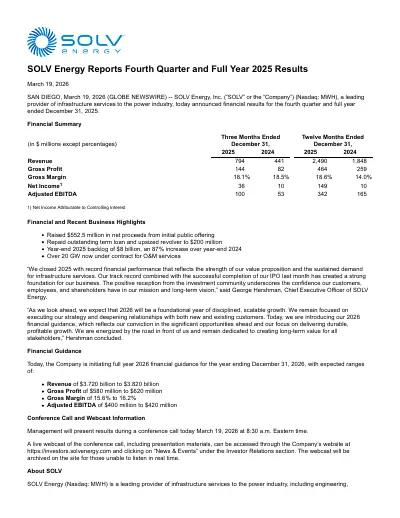
In 2025, we delivered nearly $2.5 billion in revenue and 3 $342 million of adjusted EBITDA, all records for the business. These results reflect a healthy demand environment and deep trust our customers place in SOLV as a long-term partner to deliver critical solutions.
We operate across all 48 continental US states, supported by more than 2,600 employees, including 1,950 in the field. We also manage over 2,000 local-hired or union dispatch workers on a temporary basis each day.
We've completed more than 500 projects and constructed over 21 GW of capacity. Today, we are under contract to manage more than 20 GW of generation across 150 power plants.
This scale gives us deep visibility into the market and into long-term customer needs. Moving to slide 7.
Our competitive advantage lies in the breadth and integration of our capabilities through the lifecycle of a power plant. Upfront, we deliver engineering, modeling, design optimization, forecasting, and environmental compliance.
Through procurement, our scale across all major plant components and transmission structures helps reduce costs and schedule risk for customers. On the construction side, we deliver full-scope civil, structural, mechanical, electrical, and commissioning execution, largely self-performed across most regions.
Once assets are online, SOLV truly differentiates itself from other EPC peers. Our O&M business provides 24/7 monitoring, preventative maintenance, emergency response, and performance analytics.
End-to-end, from design to build to long-term operations, we offer a full-lifecycle suite of services that drives best-in-class execution and supports long-term customer partnerships. Turning to the next slide, 8.
EPC is the largest category of spend on a solar-plus-storage project, and it's increasingly difficult for new entrants to compete at the scale of the market today. Experience, financial stability, and execution discipline create meaningful barriers to entry.
At the same time, EPC converts more EBITDA into free cash flow than any other part of the value chain. When paired with our long-duration O&M relationships, we effectively build 35-year annuities, predictable reoccurring revenue streams supported by five-year contracts with automatic annual renewals.
As demonstrated in the graph on the page, and using illustrative unit economics from third-party sources, our business focuses on converting the average 82 cents per watt build in EPC into a lifecycle revenue opportunity of $1.19, an over 40% higher revenue opportunity. This model provides meaningful upside as installed capacity grows and customers look to partner with providers who can support the full lifecycle.
Let's discuss embedded revenue on slide 9. Within our installed base, the long-term revenue opportunity is significant.
We now are under contract to manage more than 20 GW of operating assets. Over an expected 35-year project life, we estimate customers will spend roughly $7.4 billion on preventative maintenance, corrective maintenance, and inverter replacements.
That doesn't include additional opportunities like repowering, bays expansions, battery storage additions, and transmission and distribution upgrades. Importantly, only a very small portion of this, about $540 million, is currently reflected in our backlog.
That highlights just how much future revenue remains available to be captured. Importantly, this is our portfolio today.
On the next slide, we highlight the growth opportunity in the O&M business. As you can see in slide 10, since 2020, the amount of solar and storage capacity we manage has grown 2.2 times, and looking forward, industry forecasts show a 3.8 times increase in operating utility-scale solar and storage capacity by 2034.
Every new gigawatt built today will require long-term operations and maintenance services. Given our scale and position, we are incredibly well-aligned with the rapid expansion, both in terms of construction demand and long-term O&M growth.
Let's move to slide 11, our growth strategy. Given the market demand backdrop, we have a clear and disciplined growth strategy.
First, we continue to focus on the fastest-growing segment of the market, especially projects above 200 MW, where our scale matters most. Second, we are expanding our O&M business to deepen our recurring revenue base.
Third, we are leveraging our capabilities to move into adjacent markets where we can add immediate value. Fourth, we are investing in innovation, in digital tools, construction methods, and predictive maintenance, to accelerate growth and expand margins.
Finally, we continue to pursue strategic acquisitions that strengthen our capabilities and extend our reach. Together, our safety culture, scale, lifecycle capabilities, and disciplined strategy positions us exceptionally well to power the next generation of US industry and infrastructure.
Thank you, and now I'll turn the call over to Chad to provide a summary of our fourth quarter and full year 2025 results. Chad?
Chad Plotkin
Thank you, George. It is great to be here this morning, and thank you to everyone for taking the time.
Starting on slide 13 to discuss our Q4 and full year 2025 financial results. 2025 was a record year for SOLV.
Fourth quarter revenue was up 80% year-over-year to $794 million, and we delivered approximately $2.49 billion in full year revenue, or an increase of 35% year-over-year. This performance was driven by the ongoing growth in our core EPC business as well as our existing infrastructure or O&M services business, which contributed $113 million for the full year, an increase of nearly 55% year-over-year.
Our services business continues to grow, as we are also now contracted for over 20 GW of services, which will continue to support our business through predictable cash flow. Along with our revenue growth, we also recognized record profitability across the business.
Fourth quarter and full year '25 gross margin was over 18%, with realized gross profit of $144 million and $464 million, respectively. This performance was primarily driven by the strong productivity and cost containment across the core EPC business and ongoing contribution from our service business.
As a result of this performance, adjusted EBITDA for the fourth quarter was $100 million, and full year adjusted EBITDA was $342 million, for a more than doubling from 2024. Before I turn to the next slide, I just want to say thank you to the entire SOLV team.
2025 has been a transformative year for us, and none of this success could happen without your dedication and commitment to the company. Turning to slide 14.
Backlog as of the end of 2025 stood at 8 $8 billion, an increase of 87% since year-end 2024, providing us meaningful visibility into future performance. As a reminder, based on conversations with our customers, 100% of our backlog is with safe-harbored projects.
On backlog, all signed backlog relates to fully enforceable LNTP and FNTP agreements. Awarded backlog reflects the remaining value of estimated contracts under LNTP.
Our services business reflects the remaining duration of original agreements plus an estimate for corrective maintenance. Please note that this estimate reflects historical trends for non-covered services, which as of the end of 2025 stood at approximately 75 cents on the dollar of covered services.
Now let's turn to our '26 outlook on slide 15. With the strength of our backlog, today we are initiating full year financial guidance with revenue in the range of $3.72 and $3.82 billion, representing a 51% increase at the midpoint compared to 2025.
We're also targeting gross margin in the range of 15.6% and 16.2%, which will drive our adjusted EBITDA expectations between $400 to $420 million, which would be further records for the company. With the IPO now behind us, SOLV is in an incredibly strong position.
Net IPO proceeds of approximately $553 million allowed us to fully delever the balance sheet with additional cash on hand. When coupled with our newly expanded credit facility to $200 million, we are now placed with significant flexibility to drive further growth into the business.
As we consider this dynamic, our financial goals for the year are quite simple. We expect to meet our financial expectations, we plan to utilize our new balance sheet capacity to drive accretive growth via an expansion of our service offerings, and we will be steadfast in our focus to drive the ongoing professionalization as a new public company, including meeting all of our compliance requirements such as Sarbanes-Oxley readiness.
With that, I'll turn it back to George for closing remarks.
George Hershman
Thank you, Chad. Thank you all for joining us for our first earnings call.
What an exciting step for SOLV Energy. We're proud of the foundation we built and energized by the opportunities ahead.
Our team remains focused on disciplined execution, long-term growth, and delivering value for all of our stakeholders. With that, I'd like to open the line for your questions.
Operator
Thank you. We will now be conducting a question-and-answer session.
If you would like to ask a question, please press star one on your telephone keypad. A confirmation tone will indicate your line is in the question queue.
You may press star two if you would like to remove your question from the queue. For participants using speaker equipment, it may be necessary to pick up your handset before pressing the star keys.
To ensure we have enough time to get to everybody in the queue, we ask that you please limit yourself to one question and one follow-up question. Our first question is from Julien Dumoulin-Smith with Jefferies.
Please proceed.
Julien Dumoulin-Smith
Hey, good morning, team. Thank you guys very much, and congratulations, I must say, inaugural call.
What a great step.
George Hershman
Great. Thank you, Julien.
Julien Dumoulin-Smith
Absolutely. Nice to chat with you guys.
Look, let me start it off with an observation just real quickly. As I look at the gross margin guidance for '26 and look at what you guys were able to put up last year, just a phenomenal improvement from '24 to '25.
Obviously, a little bit of a dip here in 4Q '25. How would you set expectations on the seasonality of gross margin, and then overall, how do you think about the gross margin expectations that you're setting here for '26 vis-à-vis what you just did last year?
How would you define the construction environment last year vis-à-vis maybe normalization in the current year, or just how would you benchmark that? Because certainly, it stands out in terms of the guidance you put out here.
Thank you again for the inaugural question.
George Hershman
Great. Thanks, Julien.
Yes, obviously, our business has seasonality, and 2025, we saw just really strong performance across every region of the country, and that reflected in a strong gross margin. We also had some large repair projects that contributed to margin as well, and so those are harder to predict, the large repair projects that are contributors, and so those aren't forecasted typically into our long-term forecasts.
Those have meaningful effect if a large repair comes in that is unforecasted. I think that's kind of how we look at our forecast for 2025 and maybe some of the adjustment to gross margin.
Chad Plotkin
Julien, I'll just add, bear in mind for this year, we have a lot of new starts of projects given the scale of backlog and what we're looking at on revenue, and obviously, as projects start, we've got a view of how we think about underwriting, and I think as we spend a lot of time on the road prior to, i.e. speaking with everybody, and I think as we see performance and productivity enhancement over time, we certainly know that there is the ability to see higher margins.
With all these new starts and everything that comes with that, we feel like we're in and around a range of what we view as a reasonable assumption certainly at the start.
Julien Dumoulin-Smith
Excellent. Then maybe just a quick follow-up, if I can.
How do you think about use of cash on the balance sheet, right? Obviously, you all are on the front foot here, and certainly so post the raise here.
How would you characterize or set expectations on that front as you look at '26?
George Hershman
I think we are looking at a lot of different options to continue to grow our services, and we recognize that we're in a really strong position coming out of the IPO and the strength of the balance sheet. We are going to stick to our growth strategy and recognize that we want to find areas we can strengthen our core services, add additional core services, whether inorganically.
We're clearly looking for options there, and I think we're sitting in a wonderful position to do it coming out of the IPO.
Julien Dumoulin-Smith
Awesome. Excellent, guys.
All the best. Talk soon.
George Hershman
Thank you. Thank you.
Operator
Our next question is from Mark Strouse with JPMorgan. Please proceed.
Mark Strouse
Good morning, guys. Thanks for taking our questions and welcome to the public markets.
Wanted to start with kind of how you're thinking about gas prices. Obviously, prices have been going up recently.
Is there a rule of thumb of how we should think about that as a percentage of your project costs and kind of how you're baking that into your 2026 guide? Thank you.
George Hershman
Yeah. Yes, Mark, well, thank you first of all for the question and joining the call and all the help.
We are obviously watching this in real time. The reality is that fuel costs have probably less than 1% impact on direct fuel costs on the cost of a project.
Obviously, there are shipping cost impacts and other things that are also impacted, and I think that we see it as something that we need to monitor, but should not have a huge impact on or significant impact on the cost of our projects today based on where fuel costs are. Obviously, disruptions in the supply chain can have impact, and we are watching that, but we don't see any issues currently with disruptions in shipping routes and supply chain.
We also have force majeure in our contracts to address these type of issues.
Mark Strouse
That's great, George. Then just a quick follow-up, maybe just kind of provide your latest thoughts on the competitive environment.
Clearly, your backlog is surging, your visibility is extending, projects are getting bigger and more complex. Just kind of curious how you're thinking about kind of some of competitive gains and how that proceeds over the foreseeable future.
Thank you.
George Hershman
There continues to be just massive amounts of demand, I think from a competitive standpoint, we're seeing plenty of opportunities for us, and so that's driving backlog. As we've said, because of the size of projects, we're just seeing the competitive landscape getting smaller and smaller as there are less EPC and O&M providers that can provide this service at the scale in which it's now being asked.
I think that is limiting the competitiveness of the environment.
Operator
Our next question is from Philip Shen with Roth Capital Partners. Please proceed.
Philip Shen
Hey, guys. Congrats on a successful IPO, and I'll say as well, and welcome to the public markets.
Hey, wanted to talk about the bookings outlook for the coming quarters. Insofar as you can quantify or qualify, what can you share in terms of the momentum there?
You've had really strong momentum through '25, and how much should we expect that to continue from a bookings standpoint through '26? Thanks.
George Hershman
Thanks, Phil. We're seeing continued opportunities in our pipeline that are converting into backlog, and I think quarter-over-quarter, we're continuing to see our backlog grow as we continue to obviously put work in place.
I don't see that the market is slowing down, I guess from a book-to-build standpoint.
Chad Plotkin
I think I'll just add, we appreciate the question. You've got $8 billion as of the end of the year, which gives us visibility.
Obviously, we've talked about how that is, call it sort of like a 12 to 30-month window into revenue realization. We're seeing a lot of demand.
These are not immediate sale, like when you think about a sales cycle, it's not like you're signing contracts daily. These are large projects with significant capital commitments.
We're continuing to see great demand for our services, and outlook continues to be really robust.
Philip Shen
Great. Hey, thanks.
That's... Our...
Go on, George. Go ahead.
George Hershman
I said our conversions in from LNTPs to FNTPs are on schedule. We're seeing those dates hit, which is consistent with our forecast.
Philip Shen
Great. Okay.
Thanks, guys. Hey, was wondering if you might be able to provide a little bit of color on how much you guys think might be safe-harbored out there, and to what degree that can support the outlook for your business as well.
You have the backlog, that's great, and then there's a substantial amount of safe harbor, I think, that is out there. Was wondering if you might be able to share any color on that topic as well.
Thanks.
George Hershman
We're hearing, I'm sure what you're hearing as well and what has been reported is something over 200 GW of safe harbor. Obviously, that is being done at our customer level, we don't have direct visibility into all of it, but I think those are probably realistic numbers.
Philip Shen
Great. Thanks, George.
I'll pass it on.
Operator
Our next question is from Marc Bieging with TD Cowen. Please proceed.
Marc Bianchi
Hey, thanks so much. I guess maybe following on to that last point there about the safe harboring, do you have a sense of how much of that 200 has been awarded?
All of your backlog is safe-harbored, is that some portion of the 200, and if we try to think about how many gigawatts have yet to be awarded to you and your competitors, what that number might look like?
George Hershman
All of our backlog is safe-harbored. My assumption is that most projects that are awarded today are safe-harbored because of the provisions for '24 and '25 and even through the first half of '26.
All projects, I think, today are being awarded are safe-harbored.
Chad Plotkin
I think, Mark, I'll just add, and it's coming back to the comment George made in his prepared remarks. Obviously, safe harboring is important, and it's part of a health driver of long-term capital formation for our customers, but we're in a rising power price environment with scarcity, and with all this demand, candidly, even independent of the safe harboring, our core service is still just fine and highly competitive to other forms of generation.
Marc Bianchi
Yep. Yep, indeed it is.
The other one I had was also related to something that was discussed before and in this sort of gross margin outlook. The guidance has some lower gross margins, which is understandable.
You've got a lot of new work, big backlog growth over the course of last year. From boots on the ground, can you talk to us about what you've done to prepare for this uptick in work, what can you say to give investors confidence that you'll be able to execute on all this new business?
George Hershman
The interesting part about the backlog growth is it's not in significantly more projects, the projects are just larger. We get a lot of leverage out of project teams because of scale of projects.
We've been able to continue to grow revenue and execution through just the size of projects versus the number of projects, right? If you think about the difference between a project team from a 200 MW project to an 800 MW project isn't 4 times more people.
It's really the same project team with some additions. Obviously, there's labor force and other things that we have to manage, but there is scalability in this business, and we've been able to do it over the last almost two decades that we've been building this business.
We've been managing for this, preparing for this, and building one expertise and process to be able to scale the business in this way.
Marc Bianchi
Great. Thanks, George.
I'll turn it back.
Operator
As a reminder, it is star one on your telephone keypad if you would like to ask a question. Our next question is from Sangita Jain with KeyBanc Capital Markets.
Please proceed.
Sangita Jain
Good morning. Thanks for taking my question.
I just have one. Just following up on the fuel cost comment and I just want to ask if there are any supply chain disruptions from the Middle East that you're factoring into the sequencing of your backlog.
I know there's $8 billion of backlog that you're going to burn over the next two years. Just trying to see how much clarity you have into equipment availability over that period.
George Hershman
We are not seeing any supply chain disruptions today. Obviously, we're continuing to watch and monitor the situation, and again, we have contractual remedy for these type of issues if we see something in the future.
Today, where we sit today, we're not seeing any supply chain disruption.
Sangita Jain
Understood. That's it for me.
Thank you.
Operator
Our next question is from Ben Kallo with Baird. Please proceed.
Ben Kallo
Hey, good morning. Congratulations, guys.
Just two quick ones. First on FEOC, if you're seeing anything in either panels or trackers or anything else in the supply chain that's a bottleneck.
Then my second question is just more on bookings, but longer term, are you having any kind of conversations for post-ITC projects now, or is that too early? Thank you, guys, very much.
George Hershman
Thanks, Ben. We are not seeing direct FEOC impact today.
I think the industry has done a lot to prepare for this, and so a lot of domestic content, a lot of manufacturing that has moved internationally, and I think there's just a robust supply chain addressing this, we're not seeing direct impacts because I think about the work that we've done as an industry to prepare for this. Then your second question, I'm sorry?
Chad Plotkin
Just...
Ben Kallo
Post-ITC.
George Hershman
Yes, project demand post-ITC, yes. We are starting to see portfolios from customers that have placed-in-service dates that are post-ITC, and they're seeing continued demand from their customers, and so to Chad's point and to my point earlier, demand is driving this market, and so I think the industry is set up for post-ITC.
Demand is there, recognizing that there's projects now that are at least being planned post-ITC. Based on the speed in which we deploy, we won't see those projects come into our backlog now because our backlog is really a 24 to 30-month window because of the speed in which we can deploy projects.
I wouldn't expect that we would see projects that would have COD and placed-in-service dates post-ITC as of yet in our backlog.
Ben Kallo
Great. Thank you, guys.
Operator
Our next question is from Dylan Nassano with Wolfe Research. Please proceed.
Dylan Nassano
Hey, good morning. Thanks for taking my question.
Just wanted to kind of check on the storage angle here. Could you give us a little bit of a sense of within the $8 billion just what the mix is of solar-only versus paired with storage, and then just any kind of color on how that momentum has kind of gone year-to-date so far?
George Hershman
I think, when we think about our storage, there is a lot of momentum, a lot of discussion both for standalone and sort of what we're really excited to see is just more and more projects where you've got hybrid solutions, right? On the backlog, I think it's roughly of our 8, kind of roughly as of the end of the year, $2 billion of that is related to either standalone or projects that are otherwise hybrid or both solar and battery.
No, I think it's a really exciting part of the business and definitely an area of focus.
Dylan Nassano
Great. Thank you.
George Hershman
Thanks, Dylan.
Operator
Our last question is from Mark Jarvi with CIBC Capital Markets. Please proceed.
Mark Jarvi
Thanks, and congrats on the progress over the last couple months here. Just on the last question following up, just how do you think the opportunity is to gain market share in the battery side of things versus standalone solar?
Is there a concentrated focus to lean in a bit more on the battery just given there's longer duration of the tax credits side of things?
George Hershman
That is a growing portion of our business and a focus. Yes, we're in customer discussions with all of our customers.
Honestly, are looking at battery storage as a growing part of their portfolio, which ultimately drives our business as well. It's a direct focus on both our EPC business and our O&M business because there's a lot of opportunity in the OEM services side of battery storage.
It is a significant focus in our business.
Mark Jarvi
Just in terms of market share gains, you feel like there's an opportunity to do greater on the battery side of things?
George Hershman
Yeah. No, I think that this market is growing dramatically, I think that if we continue to hold or grow our market share, we'll continue to be a market leader.
Then
Mark Jarvi
just going back to the question about potential M&A, are you guys able to comment a little bit in terms of the opportunity set you see there today, funnel, deal activity? Is there a likelihood that you guys feel there's an opportunity to transact in 2026?
George Hershman
Yes, we will transact in 2026. I can't really comment on what opportunities we're looking at, but they're all in line with our strategies that we've outlined for growth.
Mark Jarvi
Those would not yet be in the guidance, or is there any small tuck-ins already factored into guidance at this point?
George Hershman
I think our expectations are based on where we are today. Obviously, how we allocate capital in the future is going to be done with the right level of discipline that we need to ensure that we're putting our dollars to work prudently and accretively.
Mark Jarvi
Sounds good. Thanks for time.
George Hershman
Thanks, Mark.
Chad Plotkin
Great. Thank you.
Operator
We have reached the end of our question-and-answer session. That will conclude today's conference.
You may disconnect your lines at this time, and thank you for your participation.