SOLV Energy, Inc.
NNASDAQ:MWHQ1 FY2026 · Earnings Call TranscriptMay 12, 2026
Operator
Good morning and welcome to SOLV Energy's First Quarter Earnings Results Conference Call. Today's call is being recorded and we have allocated one hour for prepared remarks and Q&A.
At this time, I would like to turn the conference over to Anthony Rozmus, Investor Relations of SOLV Energy. Thank you, and you may begin.
Anthony Rozmus
Good morning, everyone, and thank you for joining us for SOLV Energy's First Quarter 2026 Earnings Conference Call. Before we begin, we would like to remind you that this conference call may include forward-looking statements within the meaning of the safe harbor provisions of the Private Securities Litigation Reform Act of 1995.
These statements, which are subject to various risks, uncertainties, and assumptions, could cause our actual results to differ materially from these statements. These risks, uncertainties, and assumptions are detailed in this morning's press release as well as our filings with the SEC, which can be found on our website at investors.solvenergy.com.
We undertake no obligation to revise or update any forward-looking statements or information, except as required by law. During our call today, we will also reference certain non-GAAP financial information.
The presentation of this non-GAAP financial information is not intended to be considered in isolation or as a substitute for the financial information prepared and presented in accordance with GAAP. Reconciliations of GAAP to non-GAAP measures can be found in this morning's press release and in our SEC filings.
Joining me on the call today is SOLV Energy's CEO, George Hershman, and CFO, Chad Plotkin. Following our prepared remarks, we'll open the call for your questions.
As a reminder, there will be a replay of this call posted on the IR website. With that, I'll turn it over to George.
George Hershman
Thank you, Anthony. Good morning, everyone.
We're thrilled to be here today to give an update on our first quarter performance. Before we begin, I'd like to officially welcome Mike Adams as Vice President of Investor Relations to the SOLV Energy team.
Mike brings over 20 years experience with a broad background spanning investor relations, capital markets, and corporate finance. Mike is here with us this morning and we are thrilled to have him on board.
With that, let me begin with a few key highlights from the quarter. First, safety remains top of mind across the organization.
We continue to perform well against industry benchmarks, and our last 12 months results through the first quarter reflect a strong and consistent safety culture across our field operations. Our focus on safety remains steadfast, and we will continue to work across the entire organization for continued improvement in this critical area.
Turning to performance, in which Chad will provide more color, our first quarter results reflect strong execution across the business with profitability coming in above expectations. From a market standpoint, conditions remain as constructive as we've outlined previously.
We continue to see no change in the underlying outlook. Demand for power is accelerating, the need for new supply is clear, and solar, batteries, and battery storage remain among the most competitive solutions to meet that demand.
Against that backdrop, we are executing on our growth strategy. We expanded the number of megawatts under O&M contracts during the quarter, further extending our long-term, reoccurring revenue base.
We also announced the exciting acquisition of Roebbelen-Weight Electric, which strengthens our capabilities in utility infrastructure and supports our continued expansion into the regulated market. That execution, combined with our differentiated value proposition, continues to drive backlog momentum.
We ended the quarter with approximately $8.2 billion of backlog, providing strong visibility into future revenue. Finally, given the strength of our first quarter results, the evolving business mix, and additional projects reaching full notice to proceed, we are increasing our full year guidance for both adjusted gross profit and adjusted EBITDA.
Overall, we believe the quarter underscores both the durability of the market and our continued ability to execute and capture that opportunity. As we turn to slide 5, we will give a quick reminder of who we are.
SOLV Energy is a leading provider of lifecycle infrastructure services to the US power sector, with a strong position across utility-scale solar, storage, O&M, and high voltage infrastructure. What differentiates us is our lifecycle model.
We support assets from initial design and build through long-term operations and future repowering opportunities, looking out over a 35-year horizon. That integrated approach drives deeper customer relationships, sticks, and more durable revenue streams.
We build and operate at scale, with over 21 GW constructed to date and nearly 22 GW under management. This is supported by a national footprint of a large, experienced workforce.
That scale gives us strong visibility into both market demand and customer needs. Importantly, our model combines EPC execution with long-duration O&M contracts, allowing us to extend each project into a reoccurring, long-term revenue opportunities.
Overall, our breadth of capabilities, execution track record, and lifecycle approach positions us well to capture continued growth as investment in power infrastructure and grid reliability remains a national priority. Moving to slide 6, the demand backdrop for our business remains compelling and continues to strengthen.
We're seeing a step change in the US power demand, with load expected to grow approximately 28% over the next decade, well above the roughly 5% growth seen over the prior decade. That acceleration is being driven by structural trends including AI infrastructure buildout and the reshoring of industrial manufacturing capacity.
At the same time, the expectations are for over $500 billion of investment in solar and battery storage over the same period, translating to roughly 430 GW of new capacity, about three times the level of the prior decade. Battery storage in particular continues to scale rapidly, with growth in the mid-20% range annually.
Importantly, that buildout creates a long-duration opportunity for our lifecycle model. We expect operating solar capacity to more than triple over the next decade, and each gigawatt deployed represents decades of ongoing operations, maintenance, upgrades, and repowering activity.
Taken together, these dynamics reinforce our confidence in a long-term growth trajectory of the market and position SOLV to participate across both the upfront build cycle and the reoccurring lifecycle opportunity that follows. Let's move to slide 7 for a reminder of our growth strategy.
Against the market demand backdrop, we have a clear and disciplined growth strategy. First, we continue focusing on the fastest growing segment of the US PV and storage market, projects above 200 MW, where our scale matters most and is resulting in ongoing growth in our backlog.
Second, we are expanding our O&M business to deepen our reoccurring revenue base with nearly 22 GW under contract. Third, we are leveraging our capabilities to move into adjacent markets where we can add immediate value.
Fourth, we are investing in innovation, digital tools, construction methods, and predictive maintenance to accelerate growth and expand margins. Finally, strategic acquisitions that strengthen our capabilities and extend our reach will be important to our growth strategy.
In fact, as we turn to the next page, we can see that following the end of first quarter, we announced the strategic acquisition of Roebbelen-Weight Electric, which further advances our long-term positioning in the utility infrastructure. Roebbelen-Weight Electric is a California-based high voltage and utility substation contractor founded in 1975 with deep, longstanding relationships across the major California utilities.
The business brings an experienced workforce of approximately 100 employees and specialized capabilities in turnkey substation construction as well as battery energy storage system deployments. From a strategic standpoint, this transaction expands our utility infrastructure platform and accelerates our entry into the regulated utility market, an area where we see sustained investment driven by grid modernization and resiliency priorities.
Importantly, RWE adds differentiated substation capabilities across construction, testing, and commissioning. This enhances our ability to offer a more complete lifecycle-oriented solution alongside our existing solar, storage, and high voltage infrastructure services.
We also see a strong cultural and operational fit. Their experienced team and established utility relationships are highly complementary to our platform and should provide incremental operating leverage as we scale these capabilities across the business.
From a transaction perspective, total consideration is approximately $45 million, subject to customary closing adjustments, and will be funded with cash on hand. We currently expect the transaction to close in the third quarter of 2026.
Thank you, and now I'll turn the call over to Chad to provide a summary of our first quarter results and updated guidance.
Chad Plotkin
Thank you, George, and good morning, everyone. Let's start on slide 10.
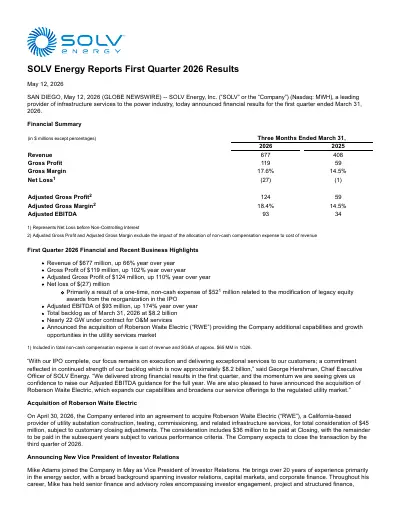
I'm pleased to report that our first quarter results reflect strong momentum across the business and demonstrate the continued execution capability of the SOLV team. First quarter revenue was $677 million, an increase of 66% year-over-year.
This growth was primarily driven by significant new construction revenue as our strong and growing backlog continues to convert into results. On gross profit, please note that on a go-forward basis, due to the treatment of the allocation of non-cash compensation in cost of revenue, including that which relates to legacy awards, we will be presenting an adjusted gross profit and margin figure to appropriately communicate our profitability.
On that point, adjusted gross profit for the quarter was $124 million, reflecting adjusted gross margin of 18.4%. This performance was driven by productivity gains from continued strong project execution, seasonally favorable weather conditions across several key regions, and the recovery of reserves related to favorable settlements of outstanding change orders.
Adjusted EBITDA for the first quarter was $93 million, representing an increase of 174% year-over-year. Adjusted EBITDA benefited from the favorable gross margin and reflects the increasing operating leverage in our business as we scale our revenue base.
I do want to address the net loss of $27 million that you will see in our reported results. This was primarily due to a one-time non-cash expense of $52 million from the modification of legacy equity awards associated with the reorganization in connection with our IPO.
This is non-recurring, non-cash item and is not reflective of the underlying performance of the business. We have provided additional information around the composition of our GAAP SG&A in the appendix section of the presentation.
Before we move on, I just want to thank the entire SOLV team. These results are a direct reflection of your hard work, discipline, and commitment in the field and across the organization.
Turn to the next slide to discuss our backlog. At the end of the first quarter, backlog stood at approximately $8.2 billion.
This represents 82% growth over the last 12 months and a continuation of the sequential net growth in each quarter since year-end '24. This ongoing momentum underscores our commitment to excellence, the strength of our customer relationships, and the compelling value proposition we offer as a full lifecycle service provider.
On our backlog, there are a couple of important points for consideration we'd like to remind you of. First, quarterly bookings and net backlog changes will not be linear, and may be lumpy due to the nature of our sales cycle and the timelines involved in moving from LNTP to FNTP.
Additionally, our reported backlog does not include verbal awards or other business development activity that has not yet been contracted or reached the LNTP stage. On this point, the pipeline outlook for activity beyond what is reported remains robust.
With that, let's turn to slide 12 for an update on our financial outlook. Today, I'm pleased to share that based on our strong first quarter performance, continued confidence in our outlook, and execution capabilities of our teams, we are updating our full year 2026 financial guidance.
Revenue guidance remains unchanged at $3.72 to $3.82 billion. We are updating our adjusted gross profit guidance to a range of $610 to $650 million, which accounts for the adjustment related to the allocation of non-cash comp expense.
This reflects an updated gross margin expectation with a range of 16.4 to 17%. We are also increasing our adjusted EBITDA guidance to a range of $435 to $455 million, up from our prior range of $400 to $420 million.
Lastly, we are making progress on our key financial goals and objectives. First, we expect to deliver on our financial targets and our first quarter results were an incredible start.
Second, we are executing on accretive growth opportunities to expand our service offerings as evidenced by the Roebbelen-Weight Electric acquisition. Third, we remain focused on driving ongoing professionalization as a public company with continued progress towards Sarbanes-Oxley compliance.
With that, I'll turn it back to George for closing remarks.
George Hershman
Thank you, Chad, and thank you all for joining us for our first quarter earnings call. For SOLV Energy, this reflects our continued progress as we build momentum and convert our strong foundations into results.
We are pleased with our performance to date and energized by the opportunities ahead, including our continued focus on disciplined and strategic M&A to enhance our capability and support long-term growth. I will end today with where it all begins, our incredibly passionate and dedicated people.
I'm humbled by their passion, expertise, and consistent execution. They are committed to delivering value for all of our customers and stakeholders each and every day.
With that, we're pleased to take your questions and I will hand it back over to the operator. Thank you.
Operator
Thank you. We will now be conducting a question-and-answer session.
If you would like to ask a question, please press star one on your telephone keypad. A confirmation tone will indicate your line is in the question queue.
You may press star two if you would like to remove your questions from the queue. For participants using speaker equipment, it may be necessary to pick up your handset before pressing the star keys.
One moment please while we poll questions. The first question comes from the line of Mark Strouse with J.P.
Morgan. Please go ahead.
Michael Fairbanks
Hey, this is Michael Fairbanks on for Mark. Wondering if you guys could talk about the acquisition and just how it complements or adds to the existing capabilities from Spartan T&D, and then also would just be curious to hear how the acquisition factors into the new guidance.
Thank you.
George Hershman
I'll take that first. From a strategic point of view, RWE brings a lot of expertise in high voltage and substation work, it's complementary to our Spartan acquisition in that really focuses on transmission and distribution.
RWE's expertise is in the substation and high voltage work itself and really brings a complementary expertise to our existing high voltage services. Then, Michael, on your other question, just given the timing of the transaction and when we would expect to close and obviously just the relative size of the acquisition, I'd say that it certainly informed how we looked at it, but the dollar amounts are implicitly in the range more than anything else.
So.
Michael Fairbanks
Great. Then maybe just as a follow-up, backlog's grown for at least five consecutive quarters now.
As you look at the pipeline, Chad, I think you mentioned continued strength, but anything you can say about visibility into continued growth in the backlog or anything you see here in the pipeline? Thank you.
George Hershman
We are seeing continued growth in the pipeline and more opportunities that are converting throughout this quarter. I would expect to see continued growth in our backlog.
Michael Fairbanks
Thank you.
Operator
Thank you. Next question comes from the line of Julien Dumoulin-Smith with Jefferies.
Please go ahead.
Nick Figa
Hey guys, Nick Figa on for Julien. Really nicely done on the quarter.
Margins clearly were the standout. I saw you noted change orders and favorable weather as drivers there, but can you help just parse out how much of the margin upside was in those items versus maybe structural bid margins on your contracts flowing through?
Then separately, with the guide raise, should we think of this as a new baseline for margins or more of a reflection of timing on those existing projects? Thanks.
George Hershman
It's a good question, maybe on a couple of them. On the change order one, I would look at that impact, the way to think about it is these were prior reserves that ultimately for settlement reasons and stuff, I would look at that number sort of inside of the $10 million mark.
I think on the rest of it, it's sort of a mixture of just project execution and on weather. The way I would think about it is we all are aware of sort of the conditions across the country through the winter and the end of winter, and there's areas where such as the southwest part of the country where it was incredibly dry, which allows our teams to be more productive, it helps reduce cost on sites cuz you've got less in things like general condition costs that are needed.
Not to get in the weeds, but a simple example is you don't have to bring on as much salt to help in icy conditions and stuff like that. That certainly was really helpful overall.
I think on your point on margins, look, we're going to report on overperformance, we don't forecast overperformance. We see the opportunity as we've talked about in the past to do really well on our projects, and then obviously as we continue to expand the service business, that contribution is very accretive as we've talked in the past, and we're optimistic about other parts of the business that we've acquired recently where we'll see improved margin contribution as well coming out of those investments.
Nick Figa
Awesome. Separately, we've seen some mixed project updates from maybe some of your solar EPC peers.
Just curious on whether you're seeing anything similar across your portfolio, whether that's scheduling delays, cost pressure, maybe even tax equity issues at the counterparty level on any of your projects. Thanks.
George Hershman
We aren't seeing any specific issues that you addressed. Obviously across the entire business we have pressures on pricing and schedule.
I will just say that our teams continue to execute and we are seeing the outperformance in a number of areas reflecting in our results. We obviously understand that is part of our business and we have to build a robust infrastructure to be able to manage and mitigate those risks.
Nick Figa
I'll leave it there. Hey guys, thank you so much.
All the best.
George Hershman
Thanks, Luke.
Operator
Thank you. Next question comes from the line of Jon Windham with UBS.
Please go ahead.
Jon Windham
Perfect. Congratulations on the result and thanks for taking the questions.
I just had sort of a big picture question. I'm just wondering if you're one of the larger EPC companies working on storage in the United States, there have been a number of announcements from the auto OEMs, namely General Motors, Ford, SK and Honda, and LG with their legacy Stellantis JV converting battery factories in the United States from EV technologies to LFP for stationary storage.
I'm just wondering if you've already started having conversations and how you would think about having the benefits of having more available batteries in the United States. Thanks.
George Hershman
Thanks for the question. We think it's wonderful.
It's a great tailwind for our business. Honestly, what the US grid and infrastructure needs is a robust supply of batteries and energy storage.
It only furthers that opportunities to place storage in urban grid locations, areas where it's hard to get transmission, and continues to drive opportunities within our PV and storage business. A robust supply chain is really a strong tailwind for our business.
Jon Windham
Maybe just as a quick follow-up, just to be very specific, are those players I mentioned, namely the large auto OEMs, already in the market having conversations with SOLV?
George Hershman
The majority of our projects, the IPPs bring the energy storage technology, but I know that those conversations are being had by our customers and with our engineering teams. We are working with our customers to ensure that we can deliver a project with OEM technology from automakers.
Jon Windham
Perfect. George, Chad, thanks so much for doing the call.
George Hershman
You bet.
Operator
Thank you. Next question comes from the line of Philip Shen with ROTH Capital Partners.
Please go ahead.
Philip Shen
Hey guys, congrats on the great quarter. Wanted to check in with you guys on the permitting freeze.
We wrote in mid-November last year that we could see some reprieve, and we got a bunch of projects unblocked and moving forward, but since then my sense is things are slowing down. Was wondering how that plays out.
I know, George, you talked about how you expect a backlog to continue to grow. What are your thoughts on the outlook on this topic?
Thanks.
George Hershman
Thanks, Philip. Appreciate the question.
Yes, as we've spoke about in the past, we had some significant projects that had nexus to federal government permits. At the end of the year, those projects got approved and released, one on BLM land and one with a federal interconnect requirement.
Both of those are proceeding, both of them are near gigawatt-scale, so that was exciting. Our current backlog has limited to no exposure to federal permitting, and so we feel very strong on the projects currently in backlog and the pipeline.
It is something that we're watching, obviously working closely with our industry partners and associations to work through any government freeze around permitting. It's a huge impediment to reaching the energy goals that we need to.
We're working together on it, but we watch it very, very closely, right, so that we limit or minimize at all costs our exposure to federal permitting on solar and storage projects.
Philip Shen
Got it. Thank you.
Then shifting over to one of your points in your growth strategy, number four was harness innovation to grow faster and increase margins. Was wondering if you could elaborate a little bit more on that, specifically as it relates to robots.
What's your sense in terms of when you could start to deploy robots more in the field to make your labor even more efficient, and maybe it's more of a '27 timeframe, but could we start to see gigawatts of installations in that timeframe, and then what is the impact on margins? Given the testing that you've done, if you've done any thus far, could we see hundreds of basis points of improvement from these robots that might be a kind of one-time upfront CapEx with again, providing a lot of leverage for the existing highly trained labor force that you guys currently have?
Thanks.
George Hershman
Yes, we are using robotics today on a number of projects. We're working with a number of the manufacturers of anything from factories out on site, where they will pre-build rows and move them into locations, as well as the module install robots that are in the market and autonomous pile driving.
We're doing it all, working very closely with different manufacturers to see what best optimizes our workforce, drives speed of installation. I would say that we're going to continue to do that.
We have a large and robust innovation team and invest in that area to ensure that we can continue to deliver at the scale and demand that's necessary, because we're being asked to build faster every day, and to do that we need to use robotics, optimize our workforce, optimize how we handle logistics. All those things are in process and quite frankly part of our execution strategy today.
Are driving strong results in a number of areas.
Philip Shen
Great. Thanks, George.
I'll pass it on.
George Hershman
Thanks, Phil.
Operator
Thank you. Next question comes from the line of Ben Kallo with Baird.
Please go ahead.
Ben Kallo
Hey, thanks for taking my question. Congrats, and welcome, Mike.
Can you guys give us any kind of shaping of backlog and just, as we look into next year, how much of '27 is underpinned by current backlog, and then I have a follow-up.
Chad Plotkin
I think to answer your question, look, I think we've talked in the past, we have a slide in the appendix that gives a little bit of a characterization of just sort of the makeup of backlog. Obviously because implicitly we've got an increase in backlog, it means you have a lot more that have gone into LNTP.
We've talked about backlog as sort of a 12 to 30-month window. Some projects move faster depending on where they are and what regions, some might lag a little bit.
Obviously, Ben, if you look at financial guidance and revenue on where we are with what we have signed and what we expect to convert through the end of the year, and you look at the balance of that, that should hopefully give you a sense of kind of where we are in current origination without me getting in front of providing a '27 expectation. Look, we're excited about where we are as a business.
Backlog is robust, we're seeing a lot of momentum as George said. We're obviously going to continue to allocate capital prudently across the business and drive growth in the business.
Ben Kallo
Great. Just on the energy storage market, could you just talk about your interest in doing standalone storage and that you guys talked about how strong that market is, and just how we should think about that just on a go-forward basis in addition to solar plus storage?
Thank you, guys.
George Hershman
Yes, we're very excited about the growth in standalone storage, and the amount of standalone storage that we're currently doing and we see in the pipeline. One of the acquisition thesis around RWE was that they bring a lot of expertise in battery storage in high-density population where energy standalone storage is best served, honestly, is in areas where there is load demand and difficulty with bringing in transmission.
If you think about urban centers and how do you get more energy where it's needed is battery storage at existing substations in urban areas. RWE has expertise in those areas, and so adding that to our overall platform of understanding how to deliver energy storage at scale and their expertise of doing it in high-density areas drives just a bigger opportunity for us in standalone storage.
We're excited about it, back to the earlier question about the supply chain growing and robust manufacturing in the US further drives that market.
Operator
Mr. Kallo, are you done with your questions?
Ben Kallo
Oh, yes. Thank you, guys.
George Hershman
Thanks, Ben.
Chad Plotkin
Great. Thanks, Ben.
Operator
Thank you. Next question comes from the line of Nick Amicucci with Evercore ISI.
Please go ahead.
Nicholas Amicucci
Hey, George. Hey, Chad.
How are you guys? Just I wanted to kind of prod a little bit on the backlog again.
Just as we kind of think about the margin profile, and sorry if I missed this, the margin profile within the backlog and kind of pricing associated with that, just how is that trending or is it similar? Should we be kind of thinking about that still like the long-term adjusted gross margin right around that 14, 15% level over time, or are we seeing kind of upward trends in that?
Chad Plotkin
I think, Nick, maybe to follow up the point, I think, one, when we think about our collective business, I think we've been very consistent that plus 15% given all the contribution of other businesses, how we think about budgeted margins, I want to emphasize the fact on what I've said earlier, which is we report on overperformance, we don't forecast that. That's an important distinction.
We continue to drive in our origination to optimize profit delivery across our projects. I think we're certainly demonstrating in the performance of our projects on where we can drive more efficiencies than say something that we might have underwritten, and
George Hershman
that candidly is a benefit across the board because when we're delivering projects better, more profitably, we're generally bringing projects online faster for our customers, which is a huge advantage for them as well. We're just optimistic about the ongoing performance of what we're seeing and the overall mix of the contribution from various parts of the business.
Nicholas Amicucci
Perfect. Then kind of dovetailing with that, too, just if we could just kind of look at the repowering opportunity, and just given you guys outlined 21 GW built since 2008, what portion of the install fleet is now or kind of approaching that repowering range if you're able to provide it, and just how we should think about the margin profile of those repowering projects relative to just a greenfield EPC?
George Hershman
Nick, we're really getting into that stage in the industry. If you think about our early stage utility-scale projects, they're just hitting their kind of half-life.
We're starting to see those repowering opportunities because of technology failures or weather damage and other things that are causing significant rework within the fleet. I think that we are really in the early days of true repowering as we see that power density is becoming so much higher than it has just in the recent past, and being able to get more megawatt hours out of a acre of land is going to become more and more valuable as you think about the interconnect value.
I think when you think about immediate repowering, in quotes of repowering, is probably battery augmentation to existing solar plants. We're starting to see that in many areas where solar has been built over the last decade without energy storage, and there's a good opportunity to add energy storage to the optimization of a power plant.
I think that's where we're going to see it initially, outside of just large-scale technology upgrades that are necessary to drive plant performance.
Nicholas Amicucci
Makes sense. Thanks, George.
Thanks, Chad.
George Hershman
You bet.
Operator
Thank you. Next question comes from the line of Mark Jarvi with CIBC Capital Markets.
Please go ahead.
Mark Jarvi
Thanks for the great update today. Just maybe you guys could comment on the sort of mix on the backlog additions, or maybe expand to the projects at the verbal award stage, just in terms of solar versus battery split and markets, just where you guys are on the T&D side of things as well.
Chad Plotkin
On the backlog side, I think we're in and around $1.9 billion of the backlog associated to hybrid or battery projects standalone. We're seeing ongoing momentum there.
It just has to do with timing and stuff when we originate deals, which is great. I think we've got that mix in the appendix as you've seen before.
I think on the T&D side, look, that is an area that we're certainly expecting to see grow over time. It's not what I would call a materially significant part of backlog at this juncture.
We've got our investment in Spartan, we haven't closed the RWE deal yet, but that's definitely an area. Look, the bulk of the backlog as you can see is the core business just given with the ongoing scale and momentum that we have.
Mark Jarvi
Good to hear. Then just on acquisitions, I know RWE itself is not a big transaction, but as you look ahead and maybe do more of these deals, how do you see the integration in terms of impact to margins or in the first year?
Can they be neutral, can they actually be slightly positive given operating leverage you can bring to bear? Then when you think about how this impacts sort of growth rates post-integration, are you looking for businesses that enhance the organic growth rate, or is it more about breadth and resiliency of the growth across the platform?
Chad Plotkin
I think it's sort of a combination of both. I think we talked about the M&A strategy previously.
There's a combination of using M&A as a vehicle to expand the breadth of services we can provide or continue to expand our ability to do more self-perform work, but we are definitely looking to acquire businesses that have a growth vector to them. I don't know if that answered your question, and there was a first part of your question, forgive me,
Mark Jarvi
It was just on integration of sort of medium-sized transactions, if they'd be sort of margin neutral or can you actually drive efficiencies in the first year? Yeah.
Chad Plotkin
Look, I think obviously doing things accretive is pretty important for underwriting. I think the integration strategy is, it's always evolving and I think every transaction will have sort of unique characteristics to it.
We certainly want to drive ways to bring sort of operating leverage to the platform, but we also want to be cognizant of doing that in a means that doesn't in any way compromise the type of businesses that we're acquiring and making sure that they can continue to perform to our underwrite, but we definitely put consideration into ways that we can leverage things like shared service across. There's no reason to acquire businesses and have redundancy in sort of certain back office functions, there's a lot of things that we can do, and we look at that relative to our underwriting criteria.
George Hershman
Our M&A strategy is to ensure that we're working with companies that will enhance our overall service offering, ensuring that RWE can provide services to our existing customer base and services that we need to deliver on our lifecycle approach of being able to provide services across the entire lifecycle of a project. That from an operational integration standpoint is always a key factor.
Spartan is building transmission for projects where we are building the solar and PV. I expect that RWE will be doing substations and substation services for projects where we're doing storage or PV.
From an operational integration standpoint, it is absolutely part of our strategy.
Mark Jarvi
Just on that last comment, George, have you done a lot of projects in parallel with RWE before?
George Hershman
Not directly with RWE, but adjacent to RWE. We've known of them and the company for quite a while and so we're looking forward to them supporting some of our projects in California where they have significant expertise.
Mark Jarvi
Sounds good. Thanks for your time today.
George Hershman
Good.
Operator
Thank you. Next question comes from the line of Joseph Osha with Guggenheim Securities.
Please go ahead.
Joseph Osha
Thank you. Good morning, folks.
Two two questions for you. First, I'm wondering if you can just let us know roughly what the current storage attach rate is on projects.
I know we've talked about that before. Then secondly, thinking about freestanding storage, obviously you're doing lots of front-of-the-meter stuff, I'm curious whether you've looked at the behind-the-meter opportunity.
There's lots and lots of discussion around storage for data centers, whether that might be something you're beginning to look at. Thank you.
George Hershman
I don't know that we have an attach rate with energy storage to PV, cuz usually those projects are engineered together and kind of get awarded together, I don't know that we have a distinct attach rate, cuz we never really see PV being awarded to one EPC and then energy storage on the same project being awarded to someone else. That just isn't an efficient way of doing it, it would be hard to really follow an attach rate other than when we're building PV and storage, we're building PV and storage.
Joseph Osha
Let me try asking it a different way. If I look at your portfolio of business, how much of it is solar-only versus solar plus storage?
Chad Plotkin
I think we talked about it, I think for the coming out of the first quarter, I just like to look at it relative to backlog. Within backlog, we have $1.95 billion of our backlog is attributed to, I think I said 1.9 earlier, forgive me, I'm looking at my notes, it's one point roughly $1.95 billion of backlog associated to standalone or hybrid projects against our, the number we just reported.
It's almost aligned with what we had previously, we're seeing sort of a consistent, at least out of the gate, a more or less, I hate to use the word book-to-bill, but that's a good way to think about it on what we saw since last year. We're seeing good attach in the sense that projects that are coming our way are with customers are these kind of hybrid projects, and we're going to expect that to continue, especially as the type of power needs in many of the markets that our customers are building are looking for broader firming kind of solutions.
Joseph Osha
Thank you. The other question was behind-the-meter, is that something you guys have taken a look at at all?
I know it's a little far afield, but I'm curious.
Chad Plotkin
I don't think it's far afield. I think we are starting to see our customers are in discussions with many of the hyperscalers around opportunities that are behind-the-meter, both in storage and in PV.
Currently everything we're doing is in front, but I think that as these larger data center complexes and kind of bring-your-own-power solutions happen, we will absolutely be doing large-scale behind-the-meter both PV and energy storage.
Joseph Osha
Thank you very much.
Operator
Thank you. This concludes our today's teleconference.
You may disconnect your lines at this time. Thank you for your participation.