Myomo Inc.
Q3 FY2026 · Earnings Call TranscriptNovember 9, 2026
Operator
Please note this event is being recorded. I would now like to turn the conference over to Vivian Cervantes, Investor Relations.
Please go ahead.
Vivian Cervantes
Thank you, operator, and good afternoon, everyone. This is Vivian Cervantes with Alliance Advisors IR.
Welcome to Myomo's third quarter 2026 financial results conference call. With me today are Myomo's Chief Executive Officer, Paul Gudonis, and Chief Financial Officer, Dave Henry.
Before we begin, I'd like to caution listeners that statements made during this call by management other than historical facts are forward-looking statements. The words "anticipate," "believe," "estimate," "expect," "intend," "guidance," "outlook," "confidence," "target," "project," and other similar expressions are typically used to identify such forward-looking statements.
These forward-looking statements are not guarantees of future performance and may involve and are subject to risks and uncertainties and other factors that may affect Myomo's business, financial condition, and operating results. These risks, uncertainties, and other factors are discussed in Myomo's filings with the SEC.
Actual outcomes and results may differ materially from what is expressed in or implied by these forward-looking statements. Furthermore, except as required by law, Myomo undertakes no obligation to revise or update any forward-looking statements to reflect events or circumstances after the date of this call today, November 9th, 2026.
Now, my pleasure to turn the call over to Myomo CEO, Paul Gudonis. Paul, please go ahead.
Paul Gudonis
Thanks, Vivian, and good afternoon, everyone. Thank you all for joining us today.
Myomo's purpose is to help people living with chronic arm and hand paralysis to regain function and independence with our powered arm braces. In the third quarter, we made progress in reaching more of these patients we serve while improving the economics of our business.
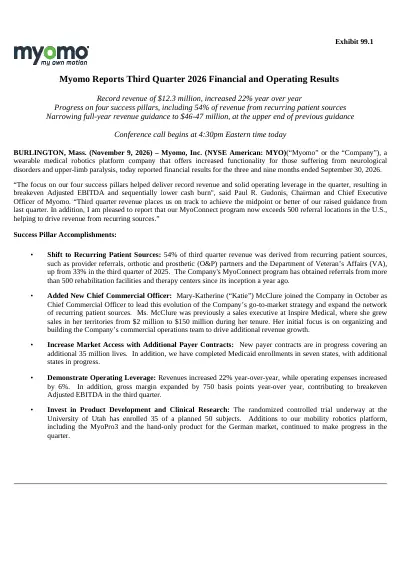
Revenue reached a quarterly record of $12.3 million, up 22% from a year ago. Gross margin rose to 71.3%, and we delivered approximately break-even adjusted EBITDA.
These results reflect continued execution on the four success pillars we discussed on our last call, including building recurring patient sources, expanding payer access, demonstrating operating leverage, and investing in product development and clinical research. Let me walk through the progress on each.
The first success pillar relates to increasing revenue from recurring patient sources. Patients referred from rehab hospitals and stroke clinics, orthotics and prosthetics partners, and the VA represented 54% of third quarter revenue, compared with 33% a year ago.
This reflects the success of our MyoConnect program, which is now entering its second year. Since its launch, healthcare professionals at more than 500 rehabilitation facilities and therapy centers have referred potential MyoPro patients to us, which is an increase of over 200 locations in the past quarter.
That milestone gives us a broader base of relationships through which patients can learn about the device during their care, and enables us to build a more durable business over time versus relying solely on direct-to-patient marketing. We see a growing number of physicians and therapists recommending a MyoPro for their patients, and we expect a larger number of referrals per facility as they see the benefits of the MyoPro for their patients.
We're already seeing this same-store sales growth. Over 30% of our recent referrals came from existing sites, with therapists and physicians that know our company, the product line, the clinical research that's been published, and their patients' good outcomes with the MyoPro.
The increase in referring locations contributed to the record number of orders in the quarter, which came in at 258 in the third quarter. Our success pillar number two is to increase market access so that more qualified patients can obtain a MyoPro.
During the quarter, we've either entered into agreements or are in the process of finalizing agreements with payers that cover an additional 35 million lives. For the payers with contracts that have been completed, we're in the process of going live as an in-network provider, and these agreements include the payers' Medicare Advantage and commercial plans.
We also made progress with state Medicaid agencies, where we are now enrolled with seven states, such as Pennsylvania, Michigan, and Wisconsin. We have other state Medicaid plans in the queue.
This will help us with patients that have Medicaid in these states, subject to individual medical coverage policies, plus the ability to receive secondary insurance payments for our Medicare patients who may reside in these states. Our plan is to continue to enter into more such contracts, given our track record of a higher pre-authorization rate for the MyoPro when we are an in-network provider.
Our third success pillar is generating operating leverage. Our target is to grow revenues at least as twice as fast as operating expenses.
We achieved that goal again in the third quarter, as revenue grew 22% year-over-year while operating expenses grew just 6%. In addition, gross margin improved by 750 basis points in the third quarter compared with the prior year.
We are continuing our path to profitability and sustainable positive cash flow by working on additional cost savings, such as the insourcing of 3D printing of the custom-fabricated shells for each MyoPro, which should go online by the end of this year. Our efficiency efforts in the other functional areas are also making a financial impact, with our overall volumes up while our head count is down over the past two years.
Our fourth success pillar is continued progress with product development and clinical research. The randomized controlled trial at the University of Utah continues to make steady progress, with 35 of the planned 50 subjects now enrolled, up from 25 at the time of our second quarter call.
Development work also continued on the MyoPro 3 and on the hand-only product for the German market. These efforts are part of our longer-term work to expand the evidence base and the applications of our wearable robotics platform.
We will provide further updates as milestones are reached. In summary, the quarter showed how executing across our four pillars of success reinforce each other.
More referral relationships and payer access help drive record orders and revenue. Higher volume and cost reductions support a stronger gross margin and improved operating performance.
We are building on our market-leading position by investing in the clinical, commercial, and product capabilities needed to serve more patients. To continue scaling our commercial operations, last month we announced that Katie McClure has joined Myomo as our new Chief Commercial Officer.
She has a successful track record of growing revenues, establishing strong referral partnerships, and leading a sales and field clinical team from her experience at fast-growing Inspire Medical and other medical device companies. I'm pleased to have her bring this experience to Myomo as we execute our plan to further address this large, unmet need of chronic arm paralysis in the country.
With that overview, I'll turn the call over to Dave Henry to review our financial results in greater detail.
Dave Henry
Thank you, Paul, and good afternoon, everyone. Our revenue for the third quarter of 2026 was a record $12.3 million, up 22% versus the prior-year period.
The increase was driven by both a higher average selling price, or ASP, and a higher number of revenue units. ASP for the quarter was approximately $55,500, up about 2% versus the prior year, and we recognized revenue on a record 222 MyoPro units, an increase of 19% over the third quarter of 2025.
Looking at payer mix, Medicare Part B patients represented 54% of both third quarter revenue and prior-year period revenue. Medicare Advantage plans represented 17% of third quarter revenue, compared with 18% in the second quarter of 2025.
Our transition toward recurring patient sources continued to accelerate during the quarter. Recurring patient sources represented 54% of third quarter revenue, compared with 33% in the prior-year quarter.
Within those recurring channels, 27% of total revenue was generated by direct billing referrals through our MyoConnect program, up from 23% in the second quarter and 20% in the first quarter of 2026. We continue to see strong results from our other recurring channels, international revenue representing 17% of revenue and US O&P revenue representing 8% of revenue.
VA patients represented 2% of revenue in the third quarter. Turning to our metrics, we received a record 258 MyoPro orders during the quarter, up 13% year-over-year.
We added 600 patients to the pipeline during the quarter, down compared with the second quarter of 2026. MyoConnect referrals represented 18% of pipeline adds in the third quarter.
Third quarter MyoConnect pipeline adds were influenced by seasonality in the third quarter from summer vacations among referring sources, as well as temporary internal staffing constraints. Staffing constraints have been alleviated entering the fourth quarter.
Our direct-to-patient advertising spending was up 2% year-over-year. Advertising-driven pipeline adds in the quarter were impacted by an inefficiency in our lead generation, which resulted in fewer workable leads and a lower conversion rate among those generated in the quarter.
We continuously test new methodologies for patient targeting in order to maximize spend effectiveness and optimize customer acquisition cost. With the aforementioned MyoConnect resource constraints alleviated and the implementation of improvements in direct-to-patient lead generation, we generated approximately 30% more direct billing pipeline adds in October than the per-month average in the third quarter.
We ended the quarter with a backlog of 217 patients, down modestly from the second quarter as the efficiency of our operations turned record orders in the quarter into a record number of revenue units. Turning to our financial results, gross margin in the second quarter was 71.3%, up from 63.8% in the prior-year quarter.
The improvement was driven primarily by the higher ASP, material cost reductions, and the spreading of fixed costs over a higher number of revenue units, partially offset by somewhat higher clinical costs reclassified to cost of goods sold. Operating expenses were $10.5 million, representing an increase of 6% compared with the third quarter of 2025.
Higher general and administrative expenses in R&D was tempered by lower sales, clinical, and marketing spending in the quarter. Operating loss improved significantly to $1.7 million, compared with $3.5 million in the prior-year quarter.
We achieved adjusted EBITDA break-even in the third quarter, compared with a loss of $2.7 million a year ago. We are keenly focused on operating leverage and minimizing cash burn as we carefully invest in MyoConnect.
Note that a portion of the improvement in adjusted EBITDA is due to higher stock-based compensation expense, as certain employee incentive payments were paid in stock during the third quarter as part of our cash management initiatives. We expect stock-based compensation expense to return to its typical run rate in the fourth quarter.
Below operating loss, second quarter results include a non-cash charge of approximately $1.8 million related to a mark-to-market adjustment for the valuation of our derivative liabilities, as well as cash and non-cash interest expense associated with the Avenue Capital term loan. Including the aforementioned non-cash charge, net loss for the third quarter was $4.2 million, or 10 cents per share, compared with $3.7 million, or 9 cents per share, in the third quarter of 2025.
Turning now to our balance sheet and cash flow, as of September 30th, 2026, cash, cash equivalents, and short-term investments totaled $11.9 million. Cash used in operating activities during the second quarter was $1.3 million, compared to $1.8 million used during the third quarter of 2025.
Cash burn, or the change in cash in the quarter, was $1.5 million, an improvement from $2.2 million in the second quarter. Let me conclude with our outlook.
Last quarter, we raised our full-year guidance to a range of $45 million to $47 million. We are narrowing that guidance today to $46 million to $47 million at the upper end of that previous range.
We expect that the beneficial effect of manufacturing cost reduction initiatives will result in a modest sequential increase in gross margin in the fourth quarter. One-time costs associated with the transition of our Chief Commercial Officer and higher head count in support of our MyoConnect program is expected to result in a modest sequential increase in operating expenses in the fourth quarter.
Despite this expected increase, we are maintaining our previously communicated operating leverage objective to limit the growth of operating expenses in all of 2026 to half the rate of 2026 revenue growth. We continue to expect total cash burn during the second half of the year to be less than $2 million, or less than $500,000 in the fourth quarter.
Overall, we're pleased that we are poised to meet or exceed our financial and operating objectives for 2026, and we look forward to continued execution in 2027. With that financial overview, I'll turn the call back to Paul.
Paul Gudonis
Thanks, Dave. To summarize, over the past year we've executed on all four of our success pillars to grow Myomo volume and revenues, while improving key financial metrics including gross margin, adjusted EBITDA, and cash usage.
In September, I attended the American Orthotic and Prosthetic Association National Conference, where we met with new and existing O&P partners to establish deeper engagement with this channel so that they can have another product include in their treatment plans for their stroke patients. As an example of how these relationships are working, one of the national providers recently brought our MyoConnect clinicians into one of their hospital referral sources, which resulted in several patients added to their candidate pipeline and the delivery of their first MyoPro to a patient who's now able to use their arm and hand again for the first time in years.
We look forward to replicating these successes in our markets in the US and Germany, as we have a very large opportunity in front of us to improve the lives of many individuals with our proprietary technology. We've established Myomo as the market leader with over 4,000 devices provided to patients with paralysis, and yet this is only about 1% penetration of the addressable market.
Over 3 million individuals in the US suffer from chronic arm paralysis, and another 250,000 cases that result from the 800,000 strokes that occur annually in the US. We've already laid the foundation for executing our strategy of continued market penetration and revenue growth by hiring additional field clinical staff across the US and Germany to develop more referral relationships with the physicians and therapists that treat these patients.
This evolution of our go-to-market strategy will lead to a growing, durable business serving this patient population for years to come. Now, Dave and I are ready to take your questions.
Operator?
Operator
We will now begin the question-and-answer session. To ask a question, you may press * then 1 on your telephone keypad.
If you are using a speakerphone, please pick up your handset before pressing the keys. If at any time your question has been addressed and you would like to withdraw your question, please press * then 2.
At this time, we will pause momentarily to assemble our roster.
Paul Gudonis
While we're waiting for the first question, I'd like to mention that next week we'll be participating in the Craig-Hallum 17th Annual Alpha Select Conference in New York on November 17th. Dave and I, along with our new Chief Commercial Officer, Katie McClure, will attend in person at this conference and will be available for one-on-one meetings.
Hey, operator, let's go with the first question whenever you're ready.
Operator
The first question comes from Chase Knickerbocker with Craig-Hallum. Please go ahead.
Chase Knickerbocker
Good afternoon. Thanks for taking the questions.
Couple from me, maybe just first on pipeline adds. We haven't seen this seasonality in Q3 before.
Do you kind of expect this going forward now that MyoConnect is a bigger piece of the pipeline strategy? Then second to that, guidance implies most of the change was kind of in Q3 here.
Appreciate your thoughts on October for kind of pipeline activity now that MyoConnect kind of brings a higher percentage of adds that are filled. Is there some potential conservatism in Q4, or how to think about some of the positive kind of indicators that you gave around October?
Dave Henry
Regarding the pipeline adds, there were a couple of things. The seasonality that I mentioned was more around MyoConnect and trying to schedule screening days and things like that at these referring locations, just found it was a bit harder to do so during the summer months.
The other part on the advertising side, I did mention that there were inefficiencies in the quarter. That contributed to the 600 pipeline adds.
What I mentioned was with the combination of the staffing constraints that we also had on the MyoConnect side during the third quarter, combined with what we think is fixing some of these inefficiencies on the DTC side, resulted in the 30% increase in pipeline adds in October. Remember though that advertising is seasonally lower in the fourth quarter compared to third.
It's something that we always do. Keep that in mind as you look at any projections for pipeline adds in third in fourth quarter.
In terms of the conservatism or in our forecast, I would just say that we try to give guidance that we believe is achievable.
Chase Knickerbocker
Understood. Maybe just around the commercial organization.
Under Katie's new leadership, what should we expect to change around commercial strategy and go-to-market?
Paul Gudonis
Thanks, Chase. She's been on board for a month, been out in the field meeting with our team.
She is looking at how we're organized, where we ought to be staffing. We've already added several more clinicians in the field in the last 30 days because we got this tremendous opportunity.
She's looking at how to organize, where should we add more clinical staff, compensation plans, and the like. Stay tuned.
She's only been here 30 days, but she brings a wealth of experience from a tremendous track record of growing Inspire Medical's business over the 8 years that she was there.
Chase Knickerbocker
Understood. Just last for me, appreciate that you're certainly not giving guidance here, but just would appreciate some early thoughts on '27.
I guess do you think your guided range in 2026 from a revenue growth perspective is sustainable into 2027 and a decent way for us to think about potential growth? Then, secondly, on '27, do you expect the same leverage target that you've given in 2026, growing revenue twice as much as operating expenses?
Thank you.
Dave Henry
Sure. I guess I'll take the second one first.
I think we're in the process now of doing our planning for 2027, I'll defer my answer on the leverage target until we finalize those plans. Then in terms of the revenue, we're making this transition, we're in the midst of it now, and I think we've done a pretty good job in 2026, trying to bring more of our revenues, have them come from recurring patient sources.
We want to continue to build on that into 2027 and to continue with the progress that we've made. While I'm not giving any revenue guidance today, we are focused on trying to grow revenue at a rate that as quickly as we can grow it, while at the same time making sure that we maximize that operating leverage and minimizing the burn.
Chase Knickerbocker
Understood. Thank you, guys.
Operator
The next question comes from Jeremy Pearlman with Maxim Group. Please go ahead.
Jeremy Pearlman
Good afternoon. Thank you for taking my question.
Firstly, of the 500-plus MyoConnect locations, maybe how should we look at what percentage of them are actually generating orders for you? Should we look at it like the 80/20% 80/20 rule, 20% the top 20% are generating 80% of the referrals?
If that's the case, what are your plans to maybe bridge that divide between the top performers to maybe the lower performers?
Paul Gudonis
Thanks, Jeremy. This MyoConnect program is really just a little over a year old now.
Most of these referring facilities, we went in, we met with the physicians, the therapists, conducted the in-services and education, and received an initial referral. Typically, the process would be refer one patient to us.
They want to make sure that the patient is medically qualified, that the insurance will pay for the device. Then after they get the device, these referring facilities will then treat the patients.
There's a 12-week Myomo therapy training protocol. After that, as they see these good outcomes, they will then refer second and third patients.
We're seeing that. The ones that first came on a year ago are already starting to refer the second, third, or more patients.
A lot of them, as I mentioned, we had over 200 new ones in this third quarter, typically have just done their first patient. I expect that over time, we'll see the same-store sales growth as they see the good outcomes from their patients that are referred.
About 30% of the referrals in the quarter came from these referring facilities that already had experience with MyoPro.
Jeremy Pearlman
Understood. Is is do you have a is there a better conversion rate, a higher conversion rate from these the MyoConnect versus historically what you like the DTC, let's say?
Paul Gudonis
Yes, in a couple of respects. One, we find that these are better qualified patients medically because unlike the direct-to-consumer marketing where anybody sees an ad, they will contact us and we do an evaluation of that patient, because our clinicians do such a good job explaining who makes for a good MyoPro candidate in terms of their inclusion criteria, we find that more of these patient referrals actually enter the pipeline.
Then because we outline what are the typical payers in an area, whether it's Medicare Part B, certain Blue Cross or other plans covering the device, we see a higher authorization rate as well. I look at the quality of the pipeline coming from these referrals as much higher both from a medical qualification as well as a reimbursement qualification.
Jeremy Pearlman
Understood. Great.
Then just this last question from us. You said that the DTC was having some headwinds this quarter.
I know we've heard from other companies that it's related to Google, the AI Overviews really preventing the click-throughs that you would usually get. How should we look at that, what the issues were, and then what steps did you take to rectify them?
Thanks.
Paul Gudonis
I don't think. When we think of social media and lead generation, most of it comes from Meta.
I'm not sure if Google and whatever issues that they had, I'm not actually aware of them, actually had much of an impact with respect to our pipeline adds in third quarter.
Jeremy Pearlman
Okay. Understood.
All right. I'll hop back in the queue.
Thank you.
Operator
The next question comes from Scott Henry with AGP. Please go ahead.
Scott Henry
Thank you, and good afternoon. I guess for starters, Dave, did you give us a cumulative reimbursement pipeline number?
Dave Henry
I did not, but it's around a little over 1,400 at the end of the third quarter.
Scott Henry
Great. As we look at the metrics and kind of the model, which most people used to get down to product placements, the top of the funnel was always pipeline adds, which was always the key number to try to gauge growth.
Now with over 50% now coming from recurring patient sources, I guess, first of all, do all of those people make it through the top of the funnel? The second thing is, should we be looking at it a little different now, given that half the patients are coming from recurring sources?
Dave Henry
For pipeline adds, we still gather information for O&P providers to the extent that they provide it to us. We also gather it from our operations in Germany, and obviously as well as direct-to-patient marketing.
Now speaking of direct billing specifically, regardless of whether the patient comes from a referral or it comes through advertising, we still track pipeline adds. I think, for your modeling, I would say that the pipeline adds is still the key metric to look at.
I will say, and I think Paul just mentioned it in response to a previous question, that the conversion rate, as the pipeline adds become more weighted in the future toward MyoConnect, we would expect a better conversion of those pipeline adds into revenue as compared to direct-to-patient. I think I gave a stat, I think last quarter, which still holds true, that about 10 times MyoConnect pipeline adds turn into revenue at a rate 10 times better than direct-to-patient advertising.
I still think that pipeline adds is still a good metric to model off of here going forward.
Scott Henry
As the hit rate goes up because the quality of the adds is higher, do you think the total pipeline adds will still drift up? Might they drift up at a lower rate because the hit rate's higher?
Just trying to get a think, because it looked like we were on our way to 800, consistently in the 800s, and perhaps eventually getting to four digits. Maybe that may take longer now if the hit rate's higher, which isn't a bad thing.
I just wanted to get your sense of how we should think about that top of the funnel.
Dave Henry
We would like to see that top of the funnel be, obviously, as high as we can, but that hit rate, as you say, will have an effect because, in terms of growing revenue, it's more about the quality of those pipeline adds as opposed to the sheer volume of them, because that's ultimately what will drive revenue going forward. The other way to say it, 800 pipeline adds yesterday is not the same as 800 pipeline adds in the future going forward because of this transition we're making towards recurring patient sources.
Scott Henry
Anything different on the Medicare front that you're seeing in kind of Q4 versus Q3, or even Q3 versus Q2? How is that evolving, or maybe we think more about the beginning of next year for where we may see some changes?
Dave Henry
We continue to get reimbursement under our HCPCS code for Medicare Part B patients. That with proper medical documentation, all those patients are getting reimbursed for their device.
Where we're in-network with a payer's contract, those contracts often include Medicare Advantage or commercial plans, and we have a higher authorization rate in those instances compared to being an out-of-network provider. That's why we continue to invest in getting more payer contracts because we do get more Medicare Advantage authorizations that way.
Scott Henry
Great. Final question for me.
I know you were asked on prior questions about your outlook in 2027 for revenue growth. Perhaps even drilling it down a little bit, how do you think about the pricing environment going forward?
Should we expect incremental gains, or perhaps, as you come out with new models, maybe even larger pricing gains, or just wanted to get your thoughts on the topic?
Paul Gudonis
Thanks, Scott. Most of the pricing really is established here in the US by the CMS allowable fees.
It's now $68,800 for the flagship MyoPro G. We've seen price increases from Medicare based on the cost-of-living increases over the last couple of years around 2%, 2.5%.
I don't know if those will continue, but that pricing is really set by CMS, and then that becomes sort of the benchmark for all these commercial contracts that we enter into. Then our O&P pricing is more of a wholesale pricing because then they have to do all the clinical work, the reimbursement work to provide the device to the patients.
In Germany, the pricing is really set, again, by the payers, the statutory health insurers, such as TK and others, who basically take our pricing and work with the O&P who actually gets reimbursed for the device. We're not planning to make any changes to that.
That's really dependent on what CMS does.
Scott Henry
Great. Thank you for taking the questions.
Paul Gudonis
You're welcome.
Operator
The next question comes from Sean Lee with H.C. Wainwright.
Please go ahead.
Sean Lee
Hey, good afternoon, Paul and Dave, and congrats on a great quarter. I just have a couple of questions.
First on the gross margin, we see that it's up quite a bit year-over-year, but down a little bit sequentially. I was wondering what are some of the pushes and pulls on that number?
Also with things like the 3D printing moving house and also the hand-only device in Germany, while thinking about those, how do we expect the margins to move going forward?
Dave Henry
Thanks for the question. The sort of the components of that 750 basis point increase in gross margin year-over-year: about 90 points, 90 basis points was related to the 2% year-over-year ASP increase; about 190 basis points was related to material cost reductions that we put in place, and there are still others coming down the road, like for example, as you mentioned, the 3D printing; and then the rest of it was primarily due to higher volume and the spreading of fixed costs over that higher volume.
Paul mentioned we've been holding down the head count to the extent that we are able to, and that's translating into benefits to the gross margin line. Then, as you look at gross margins going forward, I would still say sort of a low 70s gross margin is something that you should think of modeling.
There will be incremental improvements. We would expect, as I mentioned, fourth quarter gross margin is expected to be modestly higher as we have some of these improvements take effect.
Then, like I said, I would continue in that sort of that low 70s vein as you move into 2027.
Sean Lee
Got it. That's very helpful.
My last question is on the reimbursement side. As you mentioned, you tend to get better authorization rates once you're in-network and approved from these payers.
I was wondering can you provide some color on what's the increasing authorization rates that you're seeing once you're in-network? Also, how many payers do you expect to expand over the next year or so in terms of new coverage?
Paul Gudonis
Without going through this on a plan-by-plan basis, I would tell you that certain payers have a much higher authorization rate. They're not at 100% like we have with Medicare Part B patients, but they are certainly higher than when we don't have a contract, and that's why we're going to continue to get more of these contracts.
Then where we get enrolled in state Medicaid plans, those plans will often pay for the secondary copay for Medicare Part B patients. That helps raise our ASP by collecting that secondary insurance payment from that state Medicaid plan for certain patients.
Sean Lee
Got it. That's all I have, and thanks again for taking my questions.
Paul Gudonis
Great. Thanks, Sean.
It was good to see you at the H.C. Wainwright conference back in September.
Operator
Again, if you have a question, please press * then 1. The next question comes from Edward Woo with Ascendiant Capital.
Please go ahead.
Edward Woo
Congratulations on the quarter. My question is on Germany.
You guys have done very well. Is it time to expand your focus beyond Germany into other EU countries?
Thank you.
Paul Gudonis
Thanks, Ed. Germany is doing very well, another year of record revenues, year-over-year growth, and so on.
We're going to continue to double down in Germany. It's a big market.
Again, just like the US, very small market penetration so far. We've already added a couple more clinical staff, business development staff to keep growing that business force.
When I look at the best return on a euro, do I invest to try and open up new markets, or just doing more in Germany because that converts to revenue much more quickly? For right now, even though there are certainly other market opportunities across Europe, we're doubling down and just doing more in Germany.
The new hand product that's being developed for Germany that gets released in 2027, that will even further open up the market because right now, some patients are not medically qualified for the MyoPro because they may have elbow movement, but they don't have hand function. That will address a need and further expand the market potential for us in Germany, and then we'll bring that here to the US.
Edward Woo
Great. Thanks for answering my questions, and I wish you guys good luck.
Thank you.
Paul Gudonis
Great. Thank you, Edward.
Operator
This concludes our question-and-answer session. I would like to turn the conference back over to Paul Gudonis for any closing remarks.
Paul Gudonis
Thank you, operator, and thanks to all of you for joining us today and for your questions. We look forward to seeing and hearing from you in the coming months.
Please have a good evening, and thanks again. Goodbye.
Operator
The conference has now concluded. Thank you for attending today's presentation.
You may now disconnect.