Navient Holdings, Inc.
Q3 FY2026 · Earnings Call TranscriptNovember 4, 2026
Operator
At this time, I will turn the call over to Roger Yankoupe, Navient's treasurer and head of investor relations. Please go ahead.
Roger Yankoupe
Hello. Good afternoon, and welcome to Navient's earnings call for the third quarter of 2026.
Joining me today are Ed Bramson, Navient chief executive officer and chair of the board, and Steve Hauber, Navient chief financial officer. After Ed and Steve's prepared remarks, we will open up the call for questions.
Today's discussion is accompanied by a presentation, which you can find on navient.com/investors. Before we begin, keep in mind our discussion will contain predictions, expectations, forward-looking statements, and other information about our business that is based on management's current expectations as of the date of this presentation.
Actual results in the future may differ materially from those discussed today due to a variety of risks and uncertainties. Listeners should refer to the discussion of those factors on the company's Form 10-K and other filings with the SEC.
During this conference call, we will refer to certain non-GAAP financial measures, including core earnings, adjusted tangible equity ratio, and various other non-GAAP financial measures derived from core earnings. Our GAAP results, description of our non-GAAP financial measures, and a reconciliation of core earnings to GAAP results can be found in Navient's third quarter 2026 earnings release, which is posted on our website.
Thank you, and I will now turn the call over to Ed.
Ed Bramson
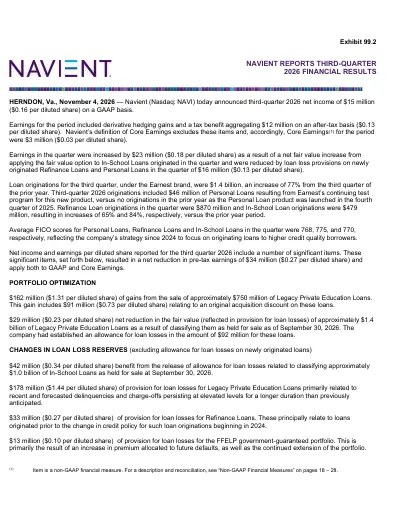
Thank you, Roger, and thank you to everyone for joining us today. As you'll see, the reported earnings for the third quarter is 16 cents per share on a GAAP basis and 3 cents on the core basis that we also report.
Another measure that we also look at, adjusted tangible equity percentage, came in at 9.5% for September, up from 9.0% in June. Overall, this was a noisy but pretty good quarter, and I have a slide in the deck that lists a few of the high points.
As part of our growth strategy, we've been investing in a significant strengthening of the marketing and credit teams for the Earnest brand. Their performance this quarter, almost 80% growth in total originations, shows that the investment's really starting to pay off.
All of the Earnest products did well. In particular, in-school grad originations were up about 170% on a year ago, and the personal loan test generated $46 million, up from nothing last year.
At the same time that they generated this exceptional growth, the team kept very tight control of credit. They averaged FICO scores well into the 770s, as they've done all of this year.
Another major achievement for this team was how effective they were in leveraging the data from our flagship refinance product to originate personal loans at a cross-sell rate of over 60%. This is a major benefit to cost of acquisition and to returns for this product.
Capital markets is on a roll, too. Capital markets has been a longstanding strength for Navient, and the team delivered another great performance.
In the quarter, we sold $700 million of legacy private education loans. If you strip out the reserves that we were carrying those loans at, the actual sale price came in between 103 and 104.
The sale priced in September, and given the rapid rise in benchmark rates that was occurring at the time, the team delivered an outstanding result. The group's also succeeded in improving the spread on the AAA tranches of our refi securitizations by about 20 basis points this year, so far, versus a year ago.
This tightening of spread has a particularly significant impact on the economics of our securitizations, as we have such a high proportion of AAA securities in our recent deals. Turning now to our work on optimizing the loan portfolios.
After moving part of the legacy private education portfolio to held-for-sale status in Q2, we moved another $1.4 billion to held-for-sale in Q3. We used the higher benchmark rates at the end of the quarter to value these loans, and recorded a provision of $29 million, approximately 2%, to bring them down to fair value.
These reclassifications reflect our willingness to reallocate capital to more strategic uses when the economics justify it, and we're also looking at moving additional loans to market-based measurement as part of this process. Now I'd like to touch quickly on the impact of rising interest rates.
This has already affected the fair value of some of our loans at the end of September, and it may start to affect the return on equity for future securitizations. For marketing reasons, we've been raising the coupon rate we charge on new loans, but we've been raising it more slowly than benchmark rates, as that rise has been unusually rapid.
We're continuing to raise coupon rates to protect our returns, and we may start to see an impact on originations. Far, we haven't seen a reduction in demand, but it's something we're keeping an eye on.
One final point before I turn the presentation over to Steve. Navient has tens of billions of dollars in loans on its balance sheet.
They're divided up among more than 130 portfolios, mostly securitizations, each with distinct characteristics. For example, some of the loans were purchased, as in the case of many of those we just sold, rather than originated by us.
In other cases, the trusts have different tax positions, and there are many other variations within the portfolio. I think it speaks to the overall robustness of Navient's portfolio that, in part because of this diversity, we added more than $200 million to loan loss reserves this quarter while still reporting a profit.
At this point, I'd like to turn the discussion over to Steve, and I'll be around for questions later. Steve?
Steve Hauber
Thank you, Ed, and good afternoon, everybody. In the third quarter, we delivered strong growth across refinance and in-school lending while continuing to improve efficiency.
We also took additional steps to optimize our legacy portfolio and focus the business on products with growth potential. I'll provide additional detail on the quarter, starting with slide 4.
Core earnings per share were 3 cents for the quarter. The third quarter was our first reporting period under the fair value option of accounting for in-school originations, and we recognized a positive $23 million fair value mark on this volume.
We also recognized $16 million of provision on refinance and personal loans originated during the quarter. Slide 4 highlights several significant items affecting third quarter results, including $162 million of gains on legacy private loan sales, a net $13 million provision benefit from classifying an additional $2.4 billion of loan portfolios as held-for-sale, $224 million of provision on previously originated loans, and a $15 million benefit to regulatory operating expenses from an insurance reimbursement.
Together, the significant items highlighted on slide 4 reduced third quarter results by a net 27 cents per share. I'll cover the loan sales, held-for-sale classifications, and provision in more detail shortly.
Moving to slide 7, refinance originations increased 65% from a year ago. The credit profile of new originations remained high quality, with a weighted average FICO of 775.
We generated better operating leverage on higher volume and reduced acquisition costs year-over-year. Slide 8 provides an update on in-school lending and the peak season.
We originated $475— $479 million in the quarter, an increase of 84% from the third quarter of 2025. Growth was particularly strong in graduate lending, where originations increased over 170% from a year ago.
Our experience in this market and the work we've done to position the business for growth allowed us to serve significantly more graduate borrowers during the peak season. We originated graduate loans at more schools, reflecting growth across both existing and new school relationships.
We achieved this growth while significantly improving our cost-per-loan efficiency. Overall, we're encouraged by the results of the peak season and our ability to serve a broader graduate market.
We recognized a positive fair value adjustment of $23 million on third quarter in-school originations, reflecting an average fair value of approximately 105% of par. The valuation reflects both the initial value of the loans and market movements during the quarter.
We managed the interest rate exposure on these predominantly fixed-rate loans with interest rate swaps. At the end of the third quarter, we classified approximately $1 billion of in-school loans originated before the quarter as held-for-sale.
The fair value of these loans exceeded their carrying basis, and we released the prior allowance for loan losses, recognizing a $42 million provision benefit. The held-for-sale classification reflects our ongoing strategy of considering loan sales as part of our balance sheet and capital management.
Slide 9 summarizes our Consumer Lending segment results for the third quarter. Net income was $2 million compared with a loss of $76 million a year ago.
Expenses increased $12 million from a year ago, primarily reflecting higher seasonal marketing and origination costs associated with increased volume and our personal loan test program. Turning to credit, changes in the underlying portfolio affect comparisons with prior periods.
These changes reflect our loan sales, held-for-sale classifications, and the adoption of fair value accounting for new in-school originations. Private 31-plus and 91-plus delinquency rates ended the third quarter at 5.1% and 2.2%, respectively, approximately 20 to 30 basis points lower than last quarter.
Private charge-off rates were 1.5% in the third quarter compared with 1.8% in the second quarter. The lower reported rates largely reflect the change in portfolio mix following our loan sales, held-for-sale classifications, and fair value option classification, including a greater proportion of refinance loans.
Before moving to the allowance, let's review this quarter's legacy private portfolio actions. The loan sales and held-for-sale classifications support our strategy to focus management attention and capital on our growth businesses while continuing to evaluate opportunities to best realize value from our legacy assets.
During the quarter, we sold approximately $750 million of legacy private loans and recognized a gain of $162 million, which included the recognition of $91 million of loan discount. We also classified an additional $1.4 billion of legacy private loans as held-for-sale.
The fair value of these loans was $29 million below their carrying value, resulting in provision expense of the same amount. With that context, let's move to slide 10 and the allowance for loan loss.
We recorded $227 million of provision in the third quarter, with $13 million related to FFELP and $214 million related to the consumer loan portfolio. The consumer lending provision had three components.
First, we recorded $16 million of provision associated with refinance and personal loan originations during the quarter. The second component relates to the $2.4 billion of legacy and in-school loans that we classified as held-for-sale at the end of the third quarter.
As previously discussed, these classifications resulted in a net $13 million provision benefit. The third component was $211 million of additional provision on previously originated private loans, consisting of $178 million related to the legacy portfolio and $33 million related to refinance loans.
The legacy provision primarily reflects recent and forecasted delinquencies and charge-offs remaining elevated for longer than we previously anticipated. While we continue to expect credit performance to improve, that improvement has taken longer than we assumed in our prior forecast, and we increased the allowance accordingly.
The $33 million refinance provision primarily relates to pre-2025 origination vintages. Performance on those vintages has been weaker than expected, while more recent refinance originations reflect the higher credit quality we have been targeting.
Slide 11 summarizes the results of our Federal Education Loan segment. Net income was $22 million compared with $35 million a year ago.
The year-ago period included an $18 million benefit from a change in prepayment assumptions. Operating expenses continued to decline as the FFELP portfolio paid down and our variable servicing expenses decreased.
FFELP credit trends were generally stable during the quarter. The charge-off rate was 20 basis points compared with 18 basis points in the second quarter.
The 91-plus delinquency rate was unchanged at 8.0%, while the 31-plus delinquency rate increased quarter-over-quarter from 14.7% to 15.5%. Expense results are on slide 12.
Total expenses in the third quarter were $77 million compared with $109 million in the third quarter of 2025. Approximately half of the $32 million reduction is attributable to the previously mentioned insurance proceeds received in connection with prior litigation matters, which benefited regulatory expense.
The balance of the year-over-year decrease primarily reflects cost reductions across the company. Year-to-date operating expenses, excluding regulatory and restructuring expenses, were $258 million.
We remain on pace for full-year operating expenses of $350 million or lower. Capital is highlighted on slide 13.
Our adjusted tangible equity ratio increased from 9.0% to 9.5% during the quarter. We continue to have capacity to invest in attractive loan originations while maintaining a strong and flexible balance sheet.
During the third quarter, we returned $25 million to shareholders through dividends and share repurchases. In summary, the third quarter demonstrated strong origination activity across our refinance and in-school lending businesses.
We originated $1.4 billion of loans, completed a strong in-school peak season, and continued to improve operating efficiency. We also took additional steps to reposition the legacy portfolio while increasing the allowance to reflect the credit performance we are seeing in previously originated loans.
We remain focused on disciplined growth, continued efficiency, and thoughtful capital allocation. Before we move to Q&A, I want to thank the Navient team for their continued focus and execution during the quarter.
Thank you for your time, and we'll now open the call for questions.
Operator
Thank you. If you have a question at this time, please press *1 on your telephone keypad.
If your question has been answered, you may remove yourself from the queue by pressing *2. Others can hear your questions clearly, we ask that you pick up your handset for best sound quality.
Our first question today comes from Bill Ryan with Seaport. Your line is now open.
Bill Ryan
Good afternoon, Ed and Steve. First question kind of focusing in on the changes in assumptions underlying the reserve true-up.
You explained the FFELP portfolio in terms of being mostly related to duration extension. Obviously I know third quarter is the quarter you typically do a more thorough review of pretty much all the portfolios.
If you could maybe talk about what the underlying assumptions were, maybe a bit more granular, to give some investors a little bit more comfort. I hate to say this is the final true-up, but that anything kind of going forward from this point should be fairly small.
What gives you comfort that you really kind of got your arms around it at this point, relative to the last couple of quarters where the true-ups have been a bit smaller and a year ago when it was still pretty high?
Steve Hauber
Hi, Bill. Thanks for the question.
Let me talk a bit how we're thinking about the provision and just in general our private portfolio and with a focus on the legacy private portfolio, which had the bulk of the provision for the quarter. I think it's important to consider all that in the context of the other actions that we're taking with the legacy portfolio.
We've discussed the sale on the loans during the quarter of $750 million. We have the portfolio that we moved to held-for-sale of $1.4 billion.
In those cases, we've moved really those portfolios, in the case of the sold portfolio, to kind of actual realization of value, or in the case of the held-for-sale portfolio, moved the balance sheet value there to the fair value. That's a step in terms of really reflecting kind of true market value for those portfolios.
With those loans removed from the CECL portfolio, we evaluated the remaining $3.3 billion of private legacy loans to which the CECL reserve applies. We've been managing that portfolio for decades.
It generates significant cash flow. We know the portfolio well.
We like the portfolio. It does have some variability and consistency of payments, which we assist borrowers in overcoming, but which does create some variability in performance.
We've shared some of our additional perspectives on this portfolio in recent quarters. Delinquency and loss levels have been running higher than our historical norms.
We saw really strong improvement in credit trends in the first few months of this year, and then in late second quarter and in the third quarter, that began to level out some. Against all that backdrop, in terms of this quarter's evaluation that we performed, we were looking at trends, looking at the data in terms of collection rates and roll rates and the like.
Those trends really were pointing to flat to modestly favorable performance in the near term, and so we adjusted the reserve and the provision accordingly. We feel like this puts us on a trajectory and a plan for what we're seeing in the portfolio.
We do expect longer-term improvement in the portfolio, given what we've seen in terms of the historical relationship between the payments that this portfolio consistently makes and what we see that turn into in terms of performance. We feel good about how we're positioned and feel that the provision was a significant provision that puts us at a level that we feel really good about.
Bill Ryan
Just as a follow-up question, obviously related to the adoption of fair value accounting on in-school originations. Could you maybe talk about the assumptions underlying the fair value marks?
Whether it's the discount rate, the benchmark proxy that you used to establish it, and maybe cumulative loss expectations. Just a little bit of highlights on some of the key assumptions underlying the fair value marks.
Thank you.
Steve Hauber
Sure. In our disclosure in our Q, which will be if it's not filed now, I'm sure it will be in the next handful of minutes or whatever, we have disclosures that go through the precise details there.
Let me just step back and think and talk about that more generally here and get to some of what you're looking for there, Bill, but also would refer everyone to the disclosures for more specifics there. In terms of first of all, I'd say the process that we went through there, we obviously went through a very rigorous process.
We used a third party to assist us in the valuation, and then we evaluate the results coming out of that to make sure they're reflective of the appropriate fair value. We feel good going through that process for the first time.
I'd say some of the key assumptions here would be portfolio performance in terms of not only default rates, but also prepayment rates. For those, we are using portfolio assumptions that are very similar to what we use in some of our other valuation exercises.
I'd say the default rate that we have there, I think it's important to note that that's a default rate, more of a CDR, an average CDR, constant default rate that you see over the life of the portfolio, which includes both a kind of in-school period where there are either no payments or, in the case of our portfolio, usually reduced payments when borrowers are in school, and then that migrates into more of a longer-term default rate. In terms of the discount rate, that's really reflecting what a market participant would require to own the asset.
I'd say the approach here has been very similar to the approach that we understand that others use, and I'd, like I said, refer you to some of the details, and happy to talk offline more about the details of that that are in our disclosure.
Bill Ryan
Okay. Thank you for taking my questions.
Operator
Thank you. Our next question comes from Rick Shane with JP Morgan.
Your line is now open.
Rick Shane
Thanks, guys, for taking my question, and I will admit my timelines could get a little bit blurred here, but it's I think about 10 days since you guys made the announcement, and obviously you've had a lot of conversations with investors, both equity and credit investors. I'm curious what the takeaways are and what sort of additional message, based on those conversations, you want to share with the market.
Obviously there was a pretty significant reaction in the equities, and also in the bonds. The equities seem to have rallied, and I think there's still some concern in the bond market.
Can you help investors now that you've sort of reflected on the back and forth think about how things proceed going forward?
Ed Bramson
Maybe I'll start that one. On the equity side, yeah, we are getting more incoming interest than we've had.
Roger actually takes a lot more of those calls than I do and so does Steve. As to the interest, you can see it in increasing volume in equity versus say a year ago.
On the fixed income side, I think anytime you make a change, people have questions. Just to say clearly, from our point of view, our intention to pay people is the same as it was the day before.
We think that should gradually filter out. Performance is key, and I think everyone here is giving the same message to investors.
From here on out, we are focusing the fixed income side of things on just making sure that people get paid, and we're talking about strategy more as it relates to the equity side, and hopefully over time that will work out.
Operator
Thank you. Our next question comes from John Hecht with Jefferies.
Your line is now open.
John Hecht
Thanks very much for taking my questions. Just thinking of, call it, the intermediate-term outlook for originations, given that it's from a peak seasonality period, Q4 is pretty low, higher rates, I think affect obviously refinance volumes or demand.
Then you're also getting into the personal loan market. I saw you did $50 million of originations there.
How do we think about all of those together in Q4?
Ed Bramson
Actually, John, I think we gave a forecast of total originations for the year, $3.8 billion, most recently, and I believe we've done $3.1 billion about year-to-date. Between all of the products, I think you could see our plan was to do about $700 million for the fourth quarter.
That's about what I think we'll do.
John Hecht
Any comments on the mix of that as we get into the quarter?
Ed Bramson
I think there's going to be a bit more PL, a lot less in-school because of the seasonality, and probably flat refi, something like that. There's seasonal patterns which I shouldn't try to remember, but we've been managing to the year rather than the quarter.
John Hecht
Yep, that's very helpful. Thank you.
Then second question is, maybe could you give us, call it, the target risk-adjusted or net interest margin targets for the graduate school, and I know these are relatively new products, but I assume you guys have had some internal discussions about targets on NIM and risk-adjusted NIM with graduate school loans and personal loans?
Ed Bramson
I'll defer to Steve on that a little bit, but what I would say is that there's a bit of a change going on now, which you can kind of see in some of the narrative here. We're more focused on return on equity to us, given that we're going to securitize these things.
I have a fairly good idea of what our return on equity targets are. How you back into them from NIM and risk-adjusted return, I'm going to hand over to Steve.
Steve Hauber
Thanks Ed. Thanks for the question.
I think in terms of our in-school product, I'd say first of all, we really like our performance that we had this peak season and its carry-through. I know you had a question about the volumes and how that's carrying through to the end of the year.
I think it's important to note that although the peak season is essentially over at this point, we saw that strong performance continue into October in terms of kind of that year-over-year rate of growth that we saw during the peak season. We saw that continue, really like the way that we've wrapped things up there.
In terms of profitability and from a NIM point of view, we're originating the grad loans there with a healthy NIM, probably in the 3%ish range. That's something that we can kind of share more information as we continue to expand and send our presence here.
John Hecht
Great. Thank you guys very much.
Operator
Thank you. We'll go next to Jeff Adelson with Morgan Stanley.
Your line is now open.
Jeff Adelson
Hey, good afternoon. Thanks for taking my questions.
Just wanted to circle back on the in-school originations and the fair value election. I guess it's still early here, but maybe just could you update us on how your conversations with market participants and loan buyers have gone at this point and how are you thinking about approaching the market to eventually monetizing this, whether it be spot sales or deconsolidation through securitization?
I guess at this point, what are your plans in the future for actually executing on eventual sale there?
Ed Bramson
I'll take that, and Steve may well want to add. If you look at the various products that we have and you look at how the demand for product is from people like private credit, probably the in-school product really fits pretty well because of the excess spread.
Organizationally we are more set up to do securitizing than sell the residual. We're thinking about adding a bit more sales effort on the in-school side, but the overall intent for that particular product, given where the margins are and what the market demand is, is probably to make that, over time, a manufacture-for-sale product.
I hope that answers your question. That's how we've been thinking about
Jeff Adelson
it. Great.
Personal loans, still in the testing phase, it sounds like. What are your thoughts at this point in terms of ramping that up more meaningfully, and maybe just any sort of I know you're not talking about the risk-adjusted yields right now, but I guess sort of any color into the characteristics or what you're putting on the books at this point and what you're looking to do from here?
Thanks.
Ed Bramson
At the moment, it's still testing, what we've been trying to optimize for is actually credit quality, obviously, but cost of acquisition, because the cost of acquisition on an annualized basis in PL is relatively high. That's why we're talking about cross-sell.
As you scale, there's only so much cross-selling you can do, but I think for next year, we're going to focus on getting a larger sample of PL than we did this year, and that's really a step on the way to getting rating support so that we can either securitize and sell or do forward agreements. I don't think it's going to be huge next year, but we're continuing to ramp up the testing that we're doing.
Jeff Adelson
Okay. Thanks, Ed.
Operator
Thank you. Our next question comes from Moshe Orenbuch with TD Cowen.
Your line is now open.
Moshe Orenbuch
Great. Thanks.
Ed and Steve, you guys have alluded to the idea of raising coupons on the refi product during the increase in rates in Q3. Can you talk a little bit about where those rates are now or how much you raised them by?
Ed Bramson
Not to get into competitive data, but I think another way of answering the question, Moshe, is that we look at these things on a return on equity basis. Given the way they are, you get relatively low NIM, relatively low losses, and you get quite efficient financing.
At the beginning of the year, we were seeing at that margin well into the 20% returns on equity. We've seen an increase in benchmark rates since September, probably of 120 bps.
As we go out to the year, we'll probably be after 2/3 of the way to catching up there. At that point, then you have to see what it does to originations.
The return on equity at the current ratio of market rates to what we've raised the coupons to is getting return on equity down into the 10s, down into actually single digits, where you don't want to stay. I think we'll have to look at early next year to see where it levels out.
Moshe Orenbuch
Got it. Recognizing that not all of the $1.4 billion was originated at the beginning of the quarter, but net interest income dollars are actually down from the second quarter with, I'm guessing, probably your largest or one of your larger quarterly origination amounts.
I guess, is there any kind of commentary on some of the loan sales, did they have an impact on net interest income in the quarter, or how do we understand that and the go-forward rate of dollars of NII?
Ed Bramson
I'll give that one to Steve.
Steve Hauber
I think one of the factors there, Moshe, is in terms of the loan sale factor, loan sales were executed towards the end of the quarter. However, the 600 million, approximately $500 million to $600 million portfolio that we moved to held-for-sale at the end of the second quarter, that was the portfolio that had the significant purchase discount associated with it, we did suspend discount amortization, as the rules require, in the third quarter.
That had an effect of income that otherwise would have been recognized in the third quarter. Instead, that turned into essentially a component of the gain.
Then I'd say overall, the other main driver is simply the mix of the portfolio, with the continued paydown of our legacy assets being replaced by the new assets. Granted, a lot of those were really attractive in-school loans, but, having refi, which also had some strong originations in the quarter, but as Ed was describing and as you I know are aware, have that thinner NIM associated with them.
Moshe Orenbuch
All right. I did notice you bought back roughly $10 million worth of stock in the quarter.
The idea, I guess, of what you're doing in terms of changing the corporate structure I thought was to kind of preserve capital efficiency. Do you have the ability to buy back stock prospectively in that context?
Ed Bramson
I think our buybacks are pretty much opportunistic, but I think we have about $70 million left on our authorization.
Steve Hauber
60-some million, $68 million, yeah.
Ed Bramson
Yeah. If we used it up, we would increase it.
There's no restriction that wasn't in place before.
Moshe Orenbuch
Great. Thank you.
Operator
Thank you. Once again, if you'd like to ask a question, please press * and 1 on your keypad now.
We'll take a follow-up from Bill Ryan with Seaport. Your line is now open.
Bill Ryan
Thanks. I just want to focus on the return on tangible common equity that has been highlighted over the course of the Q&A.
This goes back to a conversation we had back in August, and you were kind of talking about in-school loans on a blended basis maybe having on an economic basis, stripping out all the noise from loan sales and anything else, but a return on tangible common equity kind of in the mid-teens. You noted on the second part on the refi business, it had gravitated to low single digits, high single digits.
It also sounded like in addition to interest rates, there might have been some competitive pressures in that business kind of influencing the ROTCE as well. Is that still the case on the refi part of the business?
Thanks.
Ed Bramson
Yeah. That's a good question.
You've got two factors in refi, and the reason that the return on equity is so good is because they're so efficiently financed. There's a point at which, if the compression in margins is too great, it starts to come down.
You've got the two things that limit you are obviously people are refinancing loans that they already have, so as rates go up, refinancing gets less attractive. We're not there on that one, because the new kids who are graduating have higher interest rate loans.
The other thing is that the refi business is fairly concentrated, and so part of your marketing is to make sure you stay competitive. Part of the reason that actually margins are moving up at the rate they are is that we're sort of following the market, if that answers your question.
Bill Ryan
Then the ROTCE on the in-school loans?
Steve Hauber
Yeah. I think still feel the same about them as we talked about last quarter.
Bill Ryan
Okay.
Ed Bramson
In terms of what we're looking for for anything that we're doing consistently is high teens or even better.
Steve Hauber
Yeah. We do think that really what we're doing now, as well as the potential on in-school, like Ed said, is potentially even higher.
Bill Ryan
Okay. Thank you.
Operator
Thank you. This does conclude today's question-and-answer session.
I would now like to turn it back to Roger Yankoupe for closing remarks.
Roger Yankoupe
Thanks, Angela. Thank you for joining today's call and for your continued interest in Navient.
If you have any follow-up questions, please contact me or Mike Andrews. We look forward to speaking with you again next quarter.
Thank you.
Operator
Thank you. This brings us to the end of today's meeting.
We appreciate your time and participation. You may now disconnect.