NANO-X IMAGING LTD
NNASDAQ:NNOXQ3 FY2025 · Earnings Call TranscriptNovember 20, 2025
Operator
Stand by and thank you for standing by. Welcome to Nanox's Third Quarter 2025 Earnings Conference Call.
At this time, all participants are in a listen-only mode. After the speakers' presentation, there will be a question-and-answer session.
To ask a question during the session, you will need to press star-one-one on your telephone. You will then hear an automated message advising your hand is raised.
Please note, today's conference is being recorded. I will now hand the conference over to your speaker host, Mike Cavanaugh of Investor Relations.
Please go ahead.
Mike Cavanaugh
Good morning, and welcome to the Nanox Imaging third quarter 2025 investor call. Earlier today, Nanox Imaging Limited released financial results for the quarter ending September 30, 2025.
The release is currently available on the Investors section of the company's website. With me today are Erez Meltzer, Chief Executive Officer and Acting Chairman, and Ran Daniel, Chief Financial Officer.
Before we get started, I would like to remind everyone that management will be making statements during this call that include forward-looking statements regarding the company's financial results, research and development, manufacturing and commercialization activities, regulatory process and clinical activities, and other matters. These statements are subject to risks, uncertainties, and assumptions that are based on management's current expectations as of today and may not be updated in the future.
Therefore, these statements should not be relied upon as representing the company's views as of any subsequent date. Factors that may cause such a difference include, but are not limited to, those described in the company's filings with the Securities and Exchange Commission.
We will also refer to certain non-GAAP financial measures to provide additional information to investors. A reconciliation of the non-GAAP to GAAP measures is provided with our press release, with the primary differences being non-GAAP net loss attributable to ordinary shares, non-GAAP cost of revenue, non-GAAP gross profit, non-GAAP gross profit margin, non-GAAP research and development expenses, non-GAAP sales and marketing expenses, non-GAAP general and administrative expenses, and non-GAAP gross loss per share.
With that, I'd now like to turn the call over to Erez Meltzer.
Erez Meltzer
Good morning, everyone, and thank you for joining Nanox's third quarter 2025 earnings call. While many companies talk about global expansion, Nanox is delivering on it.
It is important for us to share not only where we stand today, but also the path we are shaping for 2026 as we work to fulfill our mission and strengthen Nanox as a leading company in the medical imaging industry. We are building a comprehensive medical imaging portfolio focused on increasing revenues and accelerating our path to profitability.
Our strategy includes reinforcing our position in the medical AI sector, deepening our foothold in the US healthcare system, and driving meaningful change in the standard of care for medical imaging. We are entering into our second execution phase.
We plan to further expand the ARC deployments and pipeline, grow our AI presence through the acquisition of Vaso Healthcare IT that is being contemplated, and explore further opportunities in imaging equipment with potential acquisitions and collaborations. While not every element is fully within our control, we believe it is the right time to share our growth roadmap.
For 2026, we are guiding for more than $35 million in revenues. Coming back to 2025, the third quarter brought progress across the organization, including our technology expansion, market scaling, AI infrastructure, and operational efficiency.
Today, I'm excited to share with you the progress we are making across our strategic three pillars where we are demonstrating real momentum in moving from innovation to commercial scale with a measurable results. Our first pillar focuses on technology expansion and market scaling where we see momentum in our commercial deployment efforts.
Nanox.ARC is now entering a growth phase in the retail imaging segment, expanding access to advanced imaging in community and outpatient settings where patients need it most. We recently signed two new agreements in the Czech Republic and in France that represent an important milestone in Nanox' European strategy and follows recent distribution agreement in Greece, Romania, demonstrating the rising demand for Nanox' imaging ecosystem and strengthening its presence across Europe.
We are progressing toward our goal of deploying 100 systems worldwide in various stages for clinical, demo, and commercial purposes by the end of 2025. A number of systems are attending final regulatory approval and site preparations.
As we scale our current ARC deployment, we are simultaneously working on unlock even greater market potential through regulatory advancement. In the US, we continue to work with the FDA to remove the adjunct use limitation, which will allow us to market the Nanox.ARC as a stand-alone modality.
Building on both our deployment momentum and anticipated regulatory progress, we are preparing to launch our next generation platform that will further accelerate market penetration. The new Nanox.ARC-X system, which is to be unveiled at the RSNA annual meeting in less than two weeks, will extend our commercial reach even further with its smaller footprint and simplified installation process.
Importantly, it has the flexibility to support additional clinical indication in the future. This enhanced platform is designed specifically to meet the diverse needs of our growing customer base and expand our addressable market significantly.
I'd like to highlight another example of how we are working to expand the market for Nanox.ARC. The Nanox.ARC-X is AI-ready, which means it is compatible with future AI solutions that are currently under development to interpret the ARC images.
Ultimately, the clinical output will be an AI-enhanced 3D digital tomosynthesis series with annotated pulmonary nodules, which may be an innovative new tool in the arsenal of lung cancer detection. Our second pillar, AI infrastructure and integration, represent the technological heart of our strategy, connecting all the pieces of our ecosystem and driving new revenue opportunities.
Artificial intelligence is part of our core value proposition, transforming us from a hardware company into a comprehensive imaging platform. In a key move to advance our AI business, we recently reached an agreement to acquire Vaso Healthcare IT, or VHCIT, a wholly owned subsidiary of Vaso Corporation, which provides best-of-breed healthcare IT solutions from various technology partners, specifically imaging information technology solutions, which support imaging workflow for providers.
Nanox and VHCIT together create a powerful synergy that connects Nanox AI's FDA-cleared imaging AI solutions with VHCIT's deep expertise in IT integration, implementation, and customers operation. This will potentially help us deliver improved customer service to our growing US customer base.
This acquisition will align with our ongoing progress on multiple fronts as we expand our network and collaborations with prominent organizations such as Cedars-Sinai, 3DR, Covera Health, and others. More details are included in my remarks below.
Now for an update on our third strategic pillar, which focus on operational efficiency and sustainable growth. We are building a leaner, more focused organization to support long-term success.
Our workers' compensation and retail imaging initiatives continue to grow, creating scan-based revenue opportunities that strengthen our financial foundation. Additionally, we are strengthening our production capabilities through our partnership with Fabrinet, preparing to manufacture hundreds of systems, and in parallel, we continue to enhance our tube manufacturing infrastructure as well.
Nanox remains dedicated to accelerating and development of a highly efficient manufacturing operation. Let's now review the progress we made during the quarter in our US deployment progress, which demonstrates the strong commercial traction we are building across multiple channels.
Currently, we have a growing number of ARC systems actively scanning, showing consistent utilization and clinical adaptation. One of the most active sites is an imaging center in California.
During the third quarter, it achieved above-average scanning levels, and the feedback from them has been very positive. Our installation plan provides us with a solid foundation for revenue generation and market presence.
Another example is our recent collaboration with Keiser University, where the Nanox.ARC has been integrated into their radiological technology graduate program. This flagship training and demonstration site is already actively scanning, giving future imaging professionals hands-on experience with Nanox.ARC early in their careers.
The full engagement of our business partners and the upcoming retail infrastructure reinforces our confidence in the next year guidance. I also want to let you know that Nanox will have a strong presence at the Radiological Society of North America, or in short RSNA, annual meeting, which begins on November 30th in Chicago.
There, we will provide more detailed insights into our commercial progress and future strategy. We welcome you to visit our booth if you are attending the event.
In a recently announced partnership, we entered into a distribution agreement with X-ray, a leading Czech distributor of medical imaging systems, to introduce Nanox' advanced imaging solutions to healthcare providers across the Czech Republic. Under the terms of this agreement, X-ray will lead the market introduction, sale, and service of Nanox' medical imaging solution, the Nanox.ARC.
Founded in 2013, X-ray is recognized as the number one supplier of digital radiography systems in the Czech Republic, with installations in more than half of the country's 200 healthcare facilities and nationwide sales and service coverage. Additionally, this week, we signed off a distribution agreement in France with Althea France SARL, part of Althea Group, one of the Europe's largest independent providers of managed medical technology services.
As part of the agreement, Althea France will lead the introduction, distribution, installation, and service of Nanox' medical imaging solution, the Nanox.ARC, across France's public and private healthcare sector. We have stated before that our initial foray into the many European countries will be best served by commercial partnerships such as this, and rest assured we are working on others.
These partnerships are just some of the steps we took in the third quarter to better position us to scale globally and redefine the standard of care through innovation that makes imaging more accessible and efficient. As we scale our current ARC deployment, we are simultaneously working to unlock even greater market potential through regulatory advancement.
In the US, the company has submitted the TAP 2D software module to the FDA through the 510(k) program. TAP 2D is a 2D view image output for the Nanox.ARC systems, a practical tool for radiologists to enhance their diagnostic confidence as they become more experienced evaluating digital tomosynthesis images.
TAP 2D, once cleared, will be part of a wider vision held by Nanox to alleviate adjunctive use limitations in the future. For perspective, adjunctive use limitation do not apply for the CE-marked Nanox.ARC in the European market.
This remained one of our top priorities, and we believe that removing the adjunctive use limitation will be a critical milestone that may unlock significant new market opportunities for the Nanox.ARC platform. This regulatory advancement represents a potential key catalyst for accelerated adaptation across healthcare system.
Outside of the US, our regulatory efforts continue, but it is worth noting that these efforts will not be as streamlined as those in the US, where FDA clearances allow distribution in the entire country. The rest of the world, by nature, is very fragmented, and we're working with many different countries, which have their own processes and regulations.
In some instances, regulatory progress is slower than we would like. Nevertheless, we have not stopped pushing ahead with our regulatory efforts, which continue to be of paramount importance to Nanox.
Now, I'd like to discuss some of the extensive clinical work we are undertaking that supports all of our commercial efforts by generating robust data supporting the use of our solution across multiple clinical applications. I'm happy to report that Cedars-Sinai Medical Center is joining a trial of Nanox AI for a new AI model for aortic valve calcification measurement solution that is under development.
The solution is intended to quantify the level of aortic valve calcium, which is an important measure of risk for aortic valve disease. We are very pleased to be partnering with Cedars-Sinai, one of the nation's premier medical institutions.
We also have begun a collaboration with MDS Wellness, an independent provider of wellness screening programs located in Michigan, with whom we are engaging clinical trials to further assess the clinical value of Nanox.ARC in the context of lung cancer detection, management, and screening. Last month, we attended the Early Lung Cancer Action Program's, the ECLIP, 40th conference in New York, focused on lung cancer screening and early detection.
Among several presentations about the advantages of digital tomosynthesis in lung cancer screening, Dr. Lawrence Tanenbaum delivered an inspiring talk about how he believes that Nanox.ARC can be utilized in lung cancer screening and disease management protocols.
Outside the US, we are excited about recent collaboration with ALAP Imagerie, which is a group of independent radiologists who practice at several sites in Île-de-France utilizing high-performance technical facilities. Through this collaboration, the Nanox.ARC system has been deployed at Hôpital Privé Jacques Cartier at Massy, one of the leading private hospital groups in Paris metropolitan area, for a clinical trial designed to further assess the value of the Nanox.ARC in supporting lung cancer detection, management, and screening.
This collaboration advance our clinical evaluation efforts in the second largest country in the EU. The data derived from this trial is intended to demonstrate the ARC's potential to improve patient outcomes through early screening for lung cancer, which is the deadliest cancer worldwide.
We continue to engage with research partners globally to execute a comprehensive clinical evidence generation strategy. I mentioned we will have a large presence at RSNA this year, and I encourage you to visit our booth.
All details regarding our participation were published last week. As I mentioned in my opening remarks, we are acquiring Vaso Healthcare IT, or VHCIT, a wholly owned subsidiary of Vaso Corporation, which provides best-of-breed healthcare IT solutions from various technology partners, specifically imaging information technology solutions, which support imaging workflow for providers.
Nanox and VHCIT together create a powerful synergy that connects Nanox' FDA-cleared imaging AI solutions with VHCIT's deep expertise in IT integration, implementation, and customer operation. Under the terms of the proposed transaction, Nanox will acquire VHCIT for a total consideration of up to $800,000, consisting of a $200,000 cash payment at closing and up to $600,000 in performance-based earnout payments over a period of up to two years, contingent upon revenue retention targets with respect to existing customers.
This transaction is intended to accelerate deployment of Nanox AI solution across US healthcare facilities and is expected to be executed and completed within a couple of weeks. Given the rapidly evolving nature of medical imaging technology, it is a challenge to keep up with these changes, and Vaso Healthcare IT serves as a trusted advisor to address and solve these issues.
We expect this partnership to accelerate the commercialization of Nanox AI solutions and help generate scalable recurring revenues. Key synergies include cross-leveraging our organizational shared expertise, active accounts, sales funnels, and product offerings.
We believe this acquisition immediately expands the value we deliver to customers and shareholders. We recently entered a commercial partnership with 3DR Labs, one of the largest and most trusted providers of 3D medical imaging post-processing services in the US.
3DR Labs offers Nanox AI FDA-cleared imaging solution to its network of more than 1,800 hospitals and imaging centers across the US. The partnership enables 3DR Labs to market and distribute Nanox AI software solution to its client base network of more than 1,800 hospitals and imaging centers across the US.
The agreement positions Nanox AI technology to support initiatives to drive early disease detection and improving clinical outcomes at scale across the United States. We are also expanding direct-to-clinician access to Nanox AI solutions and launching new AI applications that have the potential to improve diagnostic accuracy, early detection, and patient management.
I'm happy to report that we have closed our first deal under this new direct-to-clinician business model. This approach enable AI at the clinic level, equipping clinicians with value-added tools on site and eliminating the need to send patients to other locations for CT scans.
I'm particularly excited about our current lineup of advanced AI solution that analyze routine medical CT scans for early clinical indications to help identify patients with asymptomatic or undetected findings correlated with chronic conditions in cardiac, liver, and bone, promoting preventive care management where AI assists clinicians in generating numerical indications for further decisions support. We are in the process of developing more innovations to add our offering, and I look forward to announcing new AI developments as they become available.
In other AI-related news, we have successfully expanded our existing agreement with Covera Health. This new agreement builds upon our initial collaboration, which focused on retrospective analysis to identify care gaps and support their platform.
Our expanded agreement now includes prospective use cases, such as opportunistic screening for improved care outcomes. We've also extended our AI footprint to India, having recently signed a distribution agreement with an Indian commercial partner, and we're already running two pilots project with several more in the pipeline.
A key element of the third pillar in the creation of sustainable and efficient supply chain to ensure we can meet anticipated future demand. With that in mind, we continue to engage with third-party manufacturers and suppliers for the commercial production of our digital X-ray tubes and other components for the use in the Nanox.ARC, based on, among other things, cost-effectiveness, etc.
We are currently developing glass-based digital X-ray tubes for use in the Nanox.ARC. As previously disclosed, we are working with the third parties, such as SIA and Varex, to build tubes and Sysmex, a chipmaker located in Switzerland, for our chips.
Our work with our manufacturing partners is a key component of the third pillar of future success. We will continue close collaboration with our technology suppliers to secure the supply of components needed as our ARC deployment continues.
As of today call, we have fabricated enough emitters and begun scaling tube production to support the initial launch of our next generation, Nanox.ARC-X. Specifically, to Varex, we are well underway with performing all the necessary tubes and ARC-level testing to add them as an approved supplier early next year.
We have additionally taken receipt from them of multiple MBX multi-source demonstration to advance our testing and development of stationary digital tomosynthesis and stationary CT-type solutions. Varex' MBX, or multi-beam X-ray, combines the precision of traditional X-ray with the detail insight of CT imaging and enable faster, higher quality scans with reduced radiation exposure, offering clearer images and better patient outcomes.
Varex personnel will visit our lab in Israel soon to support these efforts. We're also working in partnership with novel imaging technology company to explore utilization of our emitter with their specialty detectors.
These efforts toward low-dose, single-exposure dual-energy capabilities significantly enhance visualization for medical, security, and inspection applications. On the OEM business development front, in response to request from the security materials analysis and high-resolution inspection market, we are in the process of fabricating several novel emitter layouts, each with unique functionality to specifically address pain points or add requested capability as compared to their current offering.
We've also recently delivered two of our developer kits. One is the leading US academic institute for medical application development, and another to one of the largest global providers of industrial X-ray NDT inspection to assist developing their next generation system.
Regarding our project with Oak Ridge National Laboratory, we are now working towards material acquisition and fabrication of the second generation prototype to be utilized in their novel and compact mobile X-ray technology developments. As previously reported, we have entered into a multi-year volume supply agreement with Fabrinet, a leading global electronic manufacturing services provider, to support the scalable manufacturing of Nanox.ARC system.
We believe this collaboration will drive down our manufacturing costs over time, which will, in turn, to support our mission to expand access to innovative, affordable imaging technology worldwide. Looking ahead, Nanox is dedicated to accelerating the development of a highly efficient and scalable manufacturing infrastructure.
We will always be looking for ways to extract more efficiencies and may include future strategic collaborations. As we look ahead, we would like to provide our investors with some financial guidance for the coming year.
Given our current business trajectory, sales funnel, new partnership, and the Vaso acquisition, we expect to generate a minimum of $35 million in revenue in 2026. Furthermore, we project the AI business segment, with the addition of VHCIT, will achieve EBITDA break-even on quarterly basis sometimes in 2026.
We expect Nanox as a whole to reach EBITDA break-even on a quarterly basis in 2027. These projections reflect our belief in an achievable path to sustainable profitability driven by our expanding commercial deployments and recurring revenue streams.
We are executing a clear and consistent strategy across all three pillars, moving forward with confidence while systematically expanding our market presence and strengthening our foundation for long-term success. With that, I would like to hand the call to Ran Daniel for a review of our financials.
Ran, over to you.
Ran Daniel
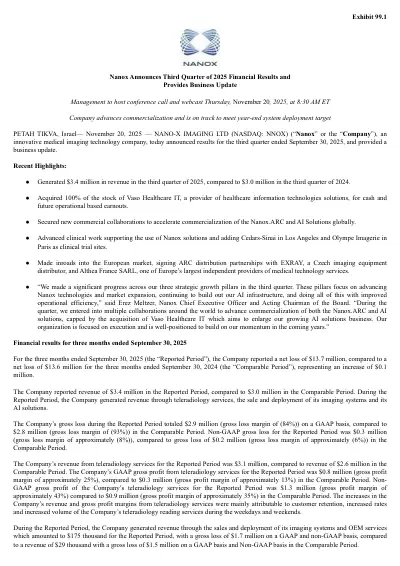
Thank you, Erez. We reported a GAAP net loss for the third quarter of 2025 of $13.7 million, which is the reported period, compared with a net loss of $13.6 million in the third quarter of 2024, which is the comparable period.
Revenue for the reported period was $3.4 million, and gross loss was $2.9 million on a GAAP basis. Revenue for the comparable period was $3.0 million, and gross loss was $2.8 million on a GAAP basis.
The increase of $0.4 million in the revenue stems from an increase of $0.6 million in our revenue from our teleradiology services, a decrease of $0.3 million in our revenue from our AI solutions, and an increase of $0.1 million in our revenue from the sales and deployment of its imaging systems and OEM services. Non-GAAP gross loss for the reported period was $0.3 million as compared to a gross loss of $0.2 million in the comparable period, which represents a gross loss margins of approximately 8% on a non-GAAP basis for the reported period, as compared to a gross loss margins of 6% on a non-GAAP basis in the comparable period.
Revenue from the teleradiology services for the reported period was $3.1 million, with a gross profit of $0.8 million on a GAAP basis, as compared to revenue of $2.6 million, with a gross profit of $0.3 million on a GAAP basis in the comparable period, which represents a gross profit margins of approximately 25% on a GAAP basis for the reported period, as compared to 13% on a GAAP basis in the comparable period. Non-GAAP gross profit of the company's teleradiology services for the reported period was $1.3 million, as compared to $0.9 million in the comparable period, which represents a gross profit margins of approximately 43% on a non-GAAP basis for the reported period, as compared to 35% on a non-GAAP basis in the comparable period.
The increase in the company's revenue and gross profit margins from the teleradiology services was mainly attributable to customer retention, increased rates, and increased volume of the company's reading services during the weekends and weekdays. During the reported period, the company generated revenue through the sale and deployment of its imaging systems and OEM services, which amounted to $175,000 for the reported period, with a gross loss of $1.7 million on a GAAP basis and a non-GAAP basis, compared to a revenue of $29,000, with a gross loss of $1.5 million on a GAAP basis and a non-GAAP basis in the comparable period.
The company's revenue from its AI solutions for the reported period was $0.1 million, with a gross loss of $1.9 million on a GAAP basis, compared to revenue of $0.4 million, with a gross loss of $1.6 million in the comparable period. Non-GAAP gross profit of the company's AI solution for the reported period was $75,000, compared to a gross profit of $370,000 in the comparable period.
Research and development expenses net for the reported period were $4.6 million, compared to $4.7 million in the comparable period, which represents a decrease of $0.1 million. The decrease was mainly due to a decrease of $0.4 million in share-based compensation and $0.5 million in expenses related to our development activities, which were mitigated by an increase of $0.5 million in salaries and wages and a decrease of $0.3 million in grants received.
Sales and marketing expenses for the reported period were $1.5 million, compared to $0.9 million in the comparable period, which represents an increase of $0.6 million, mainly due to an increase of $0.5 million in salaries and wages, $0.5 million in marketing activities with connection to the commercializations in the US market, which mitigated by a decrease of $0.1 million in share-based compensation. General and administrative expenses for the reported period were $5.3 million, compared to $5.7 million in the comparable period.
The decrease of $0.4 million was mainly due to a decrease of $0.6 million in share-based compensation, decrease of $0.2 million in the company's legal expenses, and a decrease of $0.2 million in D&O insurance expenses, which were mitigated by an increase of $0.5 million in salaries and wages and recruiting fees. Non-GAAP net loss attributable to ordinary shares for the reported period was $9.9 million, compared to $8.7 million in the comparable period.
The increase of $1.2 million in the non-GAAP net loss attributable to ordinary shares was mainly due to an increase of $0.1 million in the non-GAAP gross loss and an increase of $1.1 million in the non-GAAP operating expenses. Turning to our balance sheet.
As of September 30, 2025, we had cash, cash equivalents, and marketable securities of approximately $55.5 million and had $3.2 million short-term loans from a bank. We ended the quarter with the property and equipment net of $46.7 million.
As of September 30, 2025, and December 31, 2024, we had approximately 65.4 and 63.8 million shares outstanding, respectively. With that, I will hand the call back over to Erez.
Thank you, Ran. The third quarter of 2025 was transformative for Nanox as we evolved from a hardware company into a comprehensive imaging platform.
With our acquisition of Vaso Healthcare IT, new partnerships with 3DR Labs, Althea, and X-ray, and the upcoming launch of our AI-ready ARC-X system at RSNA, we are building the infrastructure for sustainable, recurring revenue streams that will define our future growth. Together with our recent collaboration in Greece, Romania, the Czech Republic, and France, we are strengthening our European footprint, and in parallel, our collaborations with Cedars-Sinai and our ongoing clinical trials in France continue to advance the clinical validation of our technology and contribute to the global momentum behind our platform.
Through our three strategic pillars, we are executing a comprehensive commercial strategy that combined innovative technology with robust clinical evidence generation and systematic market deployment. Although some elements being beyond our direct control, we believe this is the right moment to present our growth roadmap, and for 2026, we are guiding to revenues of over $35 million.
Our purpose remain unchanged: to redefine medical imaging by uniting innovation, intelligence, and accessibility, creating meaningful impact for patients, clinicians, and healthcare system worldwide. The momentum we are building across our commercial deployments and clinical evidence generation positions us well for continued growth and market leadership.
Thank you for your continued support. Operator, please open the call for questions.
Erez Meltzer
Operator, just before the question, it's Erez, one comment regarding what actually was said, that last night we have actually closed the Vaso Healthcare IT acquisition. Actually, it's done.
With that, you can go ahead and open for the Q&A.
Operator
Thank you. Ladies and gentlemen, to ask a question at this time, you will need to press star-one-one on your telephone and wait for your name to be announced.
To withdraw your question, simply press star-one-one again. Please stand by while we compile the Q&A roster.
Our first question coming from the line of Ross Osborn with Cantor Fitzgerald. Your line is now open.
Ros Osborn
Hi, good morning. Thanks for taking our questions.
Congrats on the progress. Starting with the quarter, would you walk through how many systems were in the field and performing scans that resulted in your revenue of $175,000?
Erez Meltzer
Few dozens out of all together. A few of them are being installed as we speak, and a few will be installed in the next few weeks.
As mentioned, we are counting on the expansion of the retail, expansion of the business partners, expansion of the sales people that are closing deals right now. We have a few, as mentioned, some of them are waiting for regulatory approvals, for physics approval, for site preparation, but all together, this is the number.
Ros Osborn
Okay. Sorry if I wasn't clear.
Looking back during the 3Q, your reported revenue, how did you generate $175,000? Not for the rest of this year, but during the quarter.
Erez Meltzer
It was a combination of revenue from scans and our OEM services. I assume that you are regarding to the paragraph in the script and the PR that describes the revenue from deployed systems and OEM services, correct?
Ros Osborn
Yes, just curious how many systems were deployed.
Erez Meltzer
I'll refer you to this paragraph, and I don't think in generally saying that the answer is changing with regards to the systems.
Ros Osborn
Okay. Then looking to the balance of 2025 and meeting 100 units in various stages of deployment, what types of agreements should we be thinking about in terms of those being lease versus capital sales?
Ran Daniel
I would say the majority are MSAs. Okay.
Thanks for taking the questions.
Erez Meltzer
We can see an increased activities in the CapEx sales arena, okay? We do expect to have some capital sales over here.
The retail.
Ros Osborn
Got it. I'll jump back in queue.
Thank you.
Erez Meltzer
No problem. Thank you, Ross.
Ran Daniel
Thank you.
Operator
Our next question coming from the line of Jeffrey Cohen with Ladenburg Thalmann. Your line is now open.
Jeffrey Cohen
Hi, Erez and Ran, thanks for taking our questions and nice to see the company at Medica this week. A few from our end.
It seems like we got a good sense of the top line from what you're talking about for the balances as well as showing for 2026 with the many partnerships and at this...
Erez Meltzer
Jeff, I'm sorry. Can you raise your voice, please?
Cuz you are a little bit too far away from the speaker. Thanks for that.
Sorry about that.
Jeffrey Cohen
Could you talk about how OpEx could look over the next four to six quarters as you talk about achieving these 2026 targets versus currently?
Erez Meltzer
Generally saying, what you would expect to see is that our investment in the deployment efforts, namely the sales and marketing expenses, will increase, of course, because we need to invest in all the activities that are related to the deployment of the systems and the sales. On the other hand, you should see more tamed R&D expenses as the focus is going towards commercializations and less on development activities, and we're trying our best to be as efficient as we can be.
You should see the same level of G&A with some fluctuations.
Jeffrey Cohen
Got it. Could you talk about...
Erez Meltzer
Don't forget that a major portion of our G&A expenses are related to us being a public company, and, sometimes those expenses increase.
Jeffrey Cohen
Got it. Could you talk about Vaso?
I saw in the press release there's a mention of approximately 100 customers. Could you talk about what types of customers that they currently have and the opportunity for those customers into the Nanox family?
Erez Meltzer
The 100 customers of Vaso are all of them are medical-related. They are actually serving hospitals, imaging centers across the United States.
From our point of view, we have a lot of cross-selling that can be achieved. I would say the main purpose of the Vaso acquisition will be to serve the operational and the growing customer base of Nanox AI.
The more we go into the details, what we see right now in the PMI, the post-merger integration, that they will be able to expand our sales force to the ARC systems, to those institutions, to expand the services of the IT services that they are providing, because many of those customers are modality-related customers. In addition, what we see is that customers, a few of the customers already mentioned an interest that USARAD, the teleradiology business, will be provided by our teleradiology services.
In addition, those customers are saying that they can actually refer a few of their customers to teleradiology services to be obtained. I would say that this will actually strengthen our IT and software, which is one of the major pillars of our growth, and we definitely can see their network and their customer base as a way to grow our business, our existing business.
Jeffrey Cohen
Got it. One more, if I may.
I did hear you mention break-even 2027 EBITDA levels, but just prior to that, you mentioned something about '26. Could you reiterate that?
Erez Meltzer
We mentioned this is already the second time that we say that on a run-rate basis in '26, that the AI business will be break-even. In fact, this was even before Vaso acquisition.
Right now, we believe probably that it will accelerate the probability of this to be break-even sometimes at the end of 2026. The other thing that we said, that the ARC hardware business will shoot for break-even in 2027.
This is something that we already mentioned in the past. What you see is that we are making progress in all the fronts in technology and the regulation, in the commercialization of the business.
We strongly believe that the retail business, the business partners, and our facility would actually enable us to be there. Ran, would you like to add anything?
Ran Daniel
Yes, let me fine-tune it. What we have said in the past that the AI business will be break-even on a quarterly break-even during some sometimes during 2026.
We didn't specify any quarter. We do we do emphasize the the growth of the AI division by the expansion of their B2B to B B2B to C model, entering to new geographies, and of course with the acquisition of Vaso, which expand expand their operations and their potential for growth and achieving the quarterly break-even on on a quarterly run-rate.
What we also have said that we expect that sometimes doing during 2027, we may be break-even in the ARC division. All in total, it will bring us, sometimes in 2027, we may be break-even on a wide company range, just to be more accurate.
Jeffrey Cohen
Okay. That's perfect.
Thank you for taking our questions. No problem.
Ran Daniel
Thank you, Jeff. Hopefully you enjoyed the Medica conference.
Jeffrey Cohen
Yeah.
Operator
Thank you. Our next question coming from the line of Scott Henry with AGP.
Your line is now open.
Scott Henry
Thank you, and good morning or afternoon, depending on your location. I want to talk a little bit about the 2026 number.
$35 million, that's a pretty big number. My question is, how should you think about the cadence of the year?
Do you expect that to start in Q1 and ramp up, or should we think about that in the second part? Then, as well, do you have any pre-orders or any, just trying to gauge your confidence in that number.
Thank you.
Erez Meltzer
I would start with the second comment. I would say major part we are based on pre-order and the outcome of what we are doing right now, including those three elements: the business partners, the retail, which is a major part, and the sales force that we currently have, not to mention the new acquisition.
Second, I would say that it will start slowly from Q1 and ramp up over the quarters and achieve the number at the fourth quarter. If I have to say something about mathematics, I would say that probably the line will be kind of an exponential one and not a linear.
Scott Henry
Okay. Great.
Thank you for that color. In terms of levers...
Ran Daniel
Just to add to your question is that we do see some more activities. I'm going to refer to what I said in the last questions for Jeffrey.
Don't forget that the current censuses and your estimates are based without the Vaso acquisition. When you add the Vaso acquisitions, we have to account for the $4 million in revenues that approximately that Vaso have.
Other than this, that the growth may come probably organic and in-house.
Scott Henry
Okay. I think, Ran, did you say that Vaso would contribute $4 million in revenues?
You broke up a little bit. Approximately.
Ran Daniel
Yes, approximately.
Scott Henry
Okay. As far as the levers in 2026, what about teleradiology?
It reported a strong growth rate in third quarter. Is that growth increasing?
Historically, it's been kind of a 10% grower. Are you looking for kind of a breakout in that category?
Erez Meltzer
Certainly it was strong in Q3. The answer is if you look at the numbers that we gave as guidance, the numbers are not based on a major quantum leap growth on the teleradiology.
We hope that it will grow, but based on the indication that we gave, it's based on sort of the existing plus/minus numbers. All the growth will come from the other business that we have, namely the ARC business, and especially the deployment of the ARC-X, and especially hopefully the elimination of the adjunct device of the FDA, and the other business that we said, and the AI business that we're talking.
I think that OEM also will grow slowly, and we will see a major growth from 2027 based on the indication that we currently have from our existing customers and potential customers of the OEM business.
Scott Henry
Okay.
Erez Meltzer
The growth will be the AI and the ARC, okay, and the hardware and the product.
Scott Henry
Great. Thank you for taking the questions, and I look forward to seeing you down at the RSNA conference.
Erez Meltzer
See you there.
Scott Henry
See you. Thank you very much.
Operator
Thank you. That's the end of our Q&A session.
Ladies and gentlemen, this concludes today's conference call. Thank you for your participation, and you may now disconnect.