NANO-X IMAGING LTD
NNASDAQ:NNOXQ4 FY2025 · Earnings Call TranscriptApril 20, 2026
Operator
Ladies and gentlemen, thank you for standing by. Welcome to the Nanox Fourth Quarter 2025 Earnings Call.
At this time, all participants are in a listen-only mode. After the speakers' presentation, there will be a question-and-answer session.
To ask a question during the session, you would need to press *11 on your telephone. You will then hear an automated message advising your hand is raised.
To withdraw your question, please press *11 again. Please be advised that today's conference is being recorded.
I would like now to turn the conference over to Mike Cavanaugh, Investor Relations. Please go ahead.
Mike Cavanaugh
Good morning and welcome to the Nanox Imaging fourth quarter 2025 investor call. Earlier today, Nanox Imaging Limited released financial results for the quarter ending December 31st, 2025.
The release is currently available on the investor section of the company's website. With me today are Erez Meltzer, Chief Executive Officer and Acting Chairman, and Ran Daniel, Chief Financial Officer.
Before we get started, I would like to remind everyone that management will be making statements during this call that include forward-looking statements regarding the company's financial results, research and development, manufacturing, and commercialization activities, regulatory process, and clinical activities, among other matters. These statements are subject to risks, uncertainties, and assumptions that are based on management's current expectations as of today and may not be updated in the future.
Therefore, these statements should not be relied upon as representing the company's views as of any subsequent date. Factors that may cause such a difference include, but are not limited to, those described in the company's filings with the Securities and Exchange Commission.
We will also refer to certain non-GAAP financial measures to provide additional information to investors. A reconciliation of the non-GAAP to GAAP measures is provided with our press release, with the primary differences being non-GAAP net loss attributable to ordinary shares, non-GAAP cost of revenue, non-GAAP gross profit, non-GAAP gross profit margin, non-GAAP research and development expenses, non-GAAP sales and marketing expenses, non-GAAP general and administrative expenses, and non-GAAP gross loss per share.
With that, I'd now like to turn the call over to Erez Meltzer.
Erez Meltzer
Thank you, Mike, and thank you all for joining us today. In the fourth quarter of 2025, we continued to move the business forward across multiple fronts.
While our primary focus remains on expanding our commercial presence, given the current geopolitical situation, we spent a lot of effort during the quarter and the beginning of 2026 to secure our supply chain and strengthen our financial positions as well. On top of that, we made good progress advancing the capabilities of Nanox platform and strengthening the operational infrastructure needed to support our long-term growth.
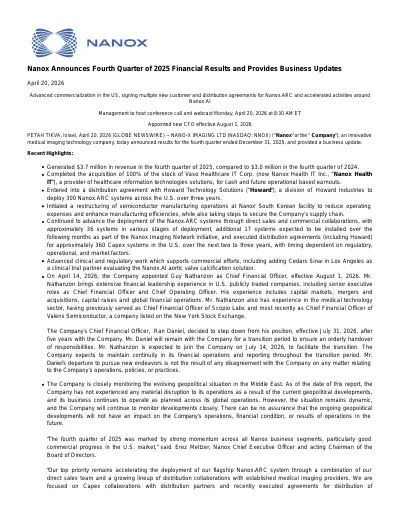
I'm happy to report that we recently entered into an agreement with Howard Technology Solutions, a division of Howard Industries, which has a national reach and an established presence in healthcare and public sector markets, providing us with a scalable framework for expanding Nanox.ARC deployments. This agreement reflects our confidence in the commercial demand for the Nanox.ARC and our ability to engage partners that can support sustained growth in system placement across the US.
Under the framework of this agreement, Howard is expected to deploy 300 Nanox.ARC systems over a three-years period, of which 60 are indicated to be deployed in the first year. We also recently announced multiple commercial agreements, which together accumulates to roughly 360 systems over a 2 to 3 years period.
These partnerships expand our reach across imaging centers and specialty care settings where point-of-care imaging is integral to clinical workflow and patient management. This represent a fundamental shift in how we are poised to scale our business from providing our technology to deploying it in a meaningful volume, shifting toward a growing CAPEX portion.
This is what we see as getting us closer to our indicated revenue of 2026. The framework has the potential to become a meaningful contributor over time and gives us confidence in our ability to convert our robust pipeline into revenue as we move forward.
We view this as continued momentum and see ourselves moving closer to an inflection point. We observed a clear shift in the market perception at major radiology conferences, including RSNA in the US and ECR in Europe, where engagement and inbound interest increased meaningfully.
We've also taken important steps to strengthen our operational foundation. A key component of this initiative is the restructuring of certain activities in our Korean manufacturing facility in order to reduce our Korean operations OPEX and cash burn, and improve efficiency while maintaining our supply of Nanox.ARC systems components.
We are very pleased with the progress we have made recently, but it is clear that the pace of deployment continues to be influenced by various external processes, including import licenses, construction timelines, and regulatory requirements in certain markets. These steps take time to complete, and while we are not satisfied with the pace and would like to see deployments move faster, this reflects the current operating reality across multiple markets.
We expect that many of these processes will be streamlined as additional sites move through the pipeline. Introducing new technology of any kind into a medical environment is always complex process.
It requires alignment across clinical workflow, regulatory framework, and operational infrastructure, as well as changing behaviors, which all takes time to achieve. While this can slow down the early stages of deployment, it is also a natural part of introducing innovative technology into the healthcare systems.
Turning to revenues, we continue to target $35 million in revenue for the full year of 2026, based on the execution of our current plans. To date, as part of the above mentioned, we have signed commercial agreements which we believe could result in present and future placements of up to roughly 400 systems globally over the next 2-3 years.
Of this, approximately 38 systems are currently at various stages of deployment, including commercial installation and systems pending construction and/or regulatory approval. In addition, there are approximately 15 systems that are expected to be installed over the next few months as part of our Nanox Imaging Network.
That said, it is important to emphasize that our current revenue base remains at an early stage, and part of this deployed base is not generating revenues, and the pace of ramp-up will depend primarily on the timing of system activation, their transition into revenue-generating operation, and the impact of the deployment by the business partners. As more systems move into operation and utilization increases, we expect revenue to build accordingly.
However, the exact timing of this ramp may vary and always depending on the deployment process and progress and other factors. I will now provide some additional color on the Korea restructuring that I referenced in my opening remarks.
Recently, we adopted a restructuring plan designed to better align our manufacturing cost structure with our long-term financial model, support our path toward improved gross margin, and align our manufacturing capabilities with the company's strategic priorities. As part of this plan and our border cost-reduction efforts, we are closing our chip manufacturing line in South Korea, downsizing our fabrication facilities, and shifting production to established international manufacturing partners, including CSEM, a Switzerland-based manufacturing partner.
We currently hold substantial emitter inventory, which we plan to work through as we transition to a more efficient outsourced production model better aligned with current and projected demand. With these actions, we expect to reduce structural and overhead costs, lower our cash burn, and enhance overall operation efficiency.
With that overview, let's now take a detailed look at our various business segments, starting with the US deployment. Beyond the Howard agreement, we also recently announced a distribution agreement with Imperial Imaging Technology, a US-based provider of diagnostic imaging solutions, to support rollout across the Southeast, particularly in orthopedic-focused environment, where there is strong demand for point-of-care imaging.
In addition, we signed agreements with distributors such as Integrity Imaging, a US-based provider of medical imaging solution with established relationship across imaging centers and healthcare providers; Elite Surgical, which serves surgical and specialty care environments; Digital X-Ray Imaging, a leading diagnostic imaging provider with deep regional presence across Arkansas; and most recently, a collaboration with Novarad, an imaging solution provider focused on expanding access to diagnostic imaging and radiology oncology systems to support the deployment of Nanox.ARC systems. These collaborations aim to strengthen our distribution capability by adding sales resources and on-the-ground presence, expands our geographic coverage, and we believe it is the potential to become a meaningful contributor to revenues over time.
In parallel, we remain in active discussion with additional partners, reflecting continued interest from medical equipment providers and likely further expansion of our US pipeline. Alongside our channel strategy, our US direct sales team on the ground continues to make progress in targeted clinical segments.
For example, we recently signed an agreement with Regional Sports Medicine and Orthopedic Group, our first orthopedic practice customer in the United States. This represents an important step into a segment where imaging plays a central role in diagnostic and treatment decisions, and where providers benefit from having imaging available on site.
Orthopedics remain a high-volume and imaging-driven specialty with strong incentives to retain imaging in house. Additionally, we are advancing the Nanox Imaging Network, a focused initiative designed to build a network-based imaging services model in the US.
This initiative targets segments such as the workers' compensation and specialized care, where reimbursement dynamics may support higher per-scan pricing. We are currently deploying already systems across a number of sites in the US.
Under this model, Nanox supports Nanox.ARC system deployment, maintenance, and connectivity, while our partners manage site operations and local engagement. While still in the very early stage, we believe this initiative can become an important component of our long-term commercial strategy as utilization increases and the model is further validated.
To provide additional context around this shift in engagement, we participated in two major industry events during the period. At RSNA, the world's largest annual radiology conference held in the US, our booth featuring live demonstration of the Nanox.ARC system saw strong interest throughout the event.
At the European Congress of Radiology, ECR, the largest radiology conference in Europe, we showcased the Nanox.ARC live in Europe for the first time and presented new clinical and AI data. Engagement levels were high, reflecting growing awareness of the system's clinical value and its potential role in routine imaging workflow.
We were also proud to receive the Red Dot Award for Product Design 2026 for the Nanox.ARC X, a prestigious international recognition that reflects the maturity, usability, and clinical readiness of our platform. Let's now turn to work outside of the US.
As I mentioned earlier regarding ECR, we were also honored to receive the Newcomer Award at ECR 2026, reflecting the growing recognition of Nanox within the European radiology community. In February, Nanox announced an exclusive distribution agreement with Inteck S.R.L., a leading medical distributor in Argentina with more than 35 years of experience.
Under this agreement, Inteck will oversee marketing, distribution, installation, and support for the Nanox.ARC system and related services across the country. The collaboration intended to support commercial expansion of Nanox's 3D digital tomosynthesis technology in Argentina and strengthen the company's presence in Latin America, leveraging Inteck's established relationship with healthcare providers and nationwide service capabilities.
Commercialization will be subject to obtaining the required regulatory approvals. In Latin America, we are expected for a significant presentation at the International Congress of Radiology, the ICR, in Cartagena, Colombia.
The presentation will support clinical discussion around digital tomosynthesis and contribute to engagement with regional clinicians and industry stakeholders. In Europe, we continue to build momentum through partners and additional regional distributors.
As a reminder, over the past few quarters, we have announced multiple European collaborations, including France, Romania, Czech Republic, Serbia, alongside additional engagements in other European markets. These collaborations support our ability to navigate local regulatory environments and advance commercialization across multiple countries.
Switching gears, we continue to advance the regulatory work that supports our commercial initiatives by expanding the use cases for our solution and making them accessible in more markets. We have advanced key milestones, including TAP 2D clearance in the United States.
As a reminder, TAP 2D is a 2D view image output for the Nanox.ARC system, a practical tool for radiologists to enhance their diagnostic confidence as they become more experienced evaluating digital tomosynthesis images, and part of our broader vision to alleviate adjunct use limitation over time. We also updated the AMAR approval for Nanox.ARC in Israel, based on our existing CE mark, enabling use of the systems without adjunct limitations.
Removal of the adjunct use limitation in the US remain a key regulatory priority. We believe this is an important step that can expand our addressable market and support broader adoption.
We are also working to finalize our CE mark submission for the Nanox.ARC in Europe, which is currently anticipated in 2026, subject to change based on regulatory priorities. Turning to our AI business, we continue to strength our position as a comprehensive platform for the interpretation of medical images.
I'm happy to report that Cedars-Sinai Medical Center in Los Angeles is joining a trial studying the benefits of Nanox AI aortic valve calcification measurement solution, which is currently under development. We recently conducted an on-site evaluation of the model across approximately 600 retrospective cases.
The results exceeded our expectations, with six cases of severe calcification identified and approximately 100 cases showing clinically relevant findings. The Cedars-Sinai team has also expressed interest in collaboration on scientific publication based on these results.
We are very pleased to be partnering with Cedars-Sinai, one of the nation's premier medical institutions. Overall, we are seeing growth in Nanox AI business driven by new customers, expansion of existing agreements, and the integration of Nanox Health IT.
During the quarter, we completed the strategic acquisition of Vaso Healthcare IT, now Nanox Health IT, a healthcare IT provider serving hospitals and healthcare system across the United States with expertise in healthcare IT implementation. Since completing the acquisition, we have been progressing with integration and alignment, while also signing several new customer agreements.
We are seeing growth driven by new customers, expansion of existing agreements, and the integration of our Health IT capabilities, and we expect this business contribute to revenue from day one. In addition to increasing our footprint in AI, the Health IT platform enhance our ability to integrate into clinical workflow, expand customer base access, and support cross-engagement across our ecosystems.
Moreover, the rest of the organization is leveraging the Health IT team's expertise and market presence, particularly as it pertains to lead generation for the US around Nanox AI and Nanox.ARC. Similar to our regulatory work, clinical validation remains central to our strategy and support our commercial efforts, generating evidence across multiple applications and supporting the use of Nanox solutions.
I've already mentioned that Cedars-Sinai Medical Center is joining a trial of Nanox AI aortic valve calcification measurement solution, and we have accomplished much more recently. In an exciting update from our collaboration with MDS Wellness, an independent provider of wellness screening programs located in Michigan, we secured our first institutional review board approval for a clinical trial within the US.
The trial will focus on lung cancer screening of high-risk patients and the applicability of Nanox.ARC technology as it relates to patient population of MDS. As I stated earlier, we attended the European Congress of Radiology, the ECR, where we were able to present several scientific achievements, and I'd like to share some highlights now.
Dr. Noga Shabshin, ARC's Chief Medical Officer, presented our scientific work on lung cancer screening using the Nanox.ARC in the work with our collaboration in what was shown that is the majority of patients, the screening outcomes based on the Lung-RADS category, the standard lung cancer screening classification system, were similar when analyzing the CT and digital tomosynthesis.
This further strength the applicability of the DTS as a potential addition to screening activities ramping up globally. Dr.
Ruth Weinfurtner, senior medical and clinical advisor, presented the proven value of opportunistic screening for CT images using Nanox AI's three FDA-cleared algorithms enabling earlier detection of chronic disease. Our latest imaging addition, tomosynthesis augmented projection, known as TAP 2D, was also featured in several scientific posters showing the value of TAP 2D image as a supplemental image to DTS in lieu of the traditional 2D X-ray imaging, with no additional dose or acquisition time inflicted on the patient.
In addition, at the recently concluded World Congress of Osteoporosis, Nanox AI's bone solution were featured, including updates from our Adapt trial conducted across four NHS Trusts and led by the University of Oxford, as well as initial observation from our collaboration with the Greek Air Force. The data will show once more the clinical and economic benefits of AI-based opportunistic screening for routine CT exams.
The validation abstract comparing the accuracy of the CCS 2.2 compared with cardiology expert reader as part of AI-INFORM trial was expected as a poster at the Society of Cardiovascular Computed Tomography Annual Scientific Meeting in the coming July. Outside the US, we are excited about our recent collaboration with Meir Medical Center in Israel, which is part of the Clalit, Israel largest health services organization, where we have an exciting relationship.
The Nanox.ARC has been deployed in the emergency department and will be utilized by orthopedic staff as part of the clinical workflow to help establish the digital tomosynthesis as an effective tool with lower dose and more efficient workflow than today's CT-based workflow. This is the first time that Nanox.ARC is installed within an emergency department in a major hospital and represent confidence our collaboration has in Nanox solution.
I'll now provide an update on our robust OEM relationship. Nanox continue to advance its technology pipeline with ongoing development of next-generation field emission X-ray sources and tube architecture.
Recent progress includes improvements in emitter design and fabrication processes aimed to extending chip lifetime and enhancing performance, development of microfocus and multizone emitter configuration for application such as semiconductor inspection and handheld XRF, and continue advancement of the Nanox MBX, the multisource tube platform enabling new system architecture for 3D imaging. The company is also progressing in multiple OEM collaboration and pilot projects across industrial, semiconductor, and security markets, supporting the expansion of Nanox technology into new applications.
We recently received a purchase order from a leading semiconductor equipment manufacturer for developmental emitters supporting advanced inspection applications at the leading edge of next-generation IC technologies. With Oak Ridge National Laboratories, a US government agency, a second round of prototypes is currently in process, with preparations underway as required materials become available.
In parallel, one global imaging component supplier has agreed to evaluate our microfocus emitter technology and is preparing dedicated test infrastructure to support that work. Another major OEM continues to advance prototype development based on our emitter design, with validation activities ongoing.
Overall, these engagements reflect continued momentum across multiple development tracks as we work to validate our technology with established industry partners. Before I move on, I'd like to briefly note that despite the current geopolitical situation in the Middle East, we have not experienced any material disruption to our operation, and our business continues to operate as planned.
With that, I'll turn the call over to Ran to review our financials. Ran, over to you.
Ran Daniel
Thank you, Erez. We reported a GAAP net loss for the fourth quarter of 2025 of $33.4 million, which is the reported period, compared with a net loss of $14.1 million in the fourth quarter of 2024, which is the comparable period.
The increase was largely due to an impairment of long-lived assets in the amount of $17.5 million, which was recorded during the reported period as a result of the company's restructuring plan that is intended to better align the company's manufacturing activities. The increase was also due to an increase of $0.7 million in the gross loss, increase of $1.1 million in the sales and marketing expenses, and increase of $1.4 million in other expenses.
Revenue for the reported period was $3.7 million, compared to revenue of $3.0 million in the comparable period. The increase of $0.7 million, increase of 23% in the revenues, stems from an increase of $0.3 million in our revenue from the teleradiology services and an increase of $0.4 million in our revenue due to the consolidations of Nanox Health IT Inc.
since the completion of its acquisitions on November 19th, 2025. Gross loss for the reported period was $3.6 million on a GAAP basis, compared to a gross loss of $2.9 million in the comparable period on a GAAP basis.
Non-GAAP gross loss for the reported period was $1.2 million, as compared to a gross loss of $0.3 million in the comparable period, which represents a gross loss margins of approximately 32% on a non-GAAP basis for the reported period, as compared to a gross loss margin of 9% on a non-GAAP basis in the comparable period. Revenue from the teleradiology services for the reported period was $3.1 million, compared to revenue of $2.8 million in the comparable period.
The company's GAAP gross profit from the teleradiology services for the reported period was $0.9 million, gross profit margins of approximately 27%, compared to $0.6 million, gross profit margin of approximately 21% in the comparable period. Non-GAAP gross profit of the company's teleradiology services for the reported period was $1.5 million, gross profit margins of approximately 48%, compared to a non-GAAP gross profit of $1.1 million, gross profit margin of approximately 41% in the comparable period.
The increase in the company's revenue and gross profit from the teleradiology services was mainly attributable to customer retention, increased rates, and increased volume of the company's reading services. During the reported period, the company generated revenue through the sales and deployment of its imaging systems, which amounted to $49,000 for the reported period, with a gross loss of $2.6 million on a GAAP and non-GAAP basis, compared to a revenue of $136,000, with a gross loss of $1.5 million on a GAAP and non-GAAP basis in the comparable period.
The revenue stems from the deployment of our Nanox.ARC systems and the sales of our OEM services in the US. The company's revenue from its AI and software solutions for the reported period was $0.5 million on a GAAP and non-GAAP basis, compared to revenue of $0.1 million on a GAAP and non-GAAP basis in the comparable period.
Included in the reported period revenue of $0.4 million, which was generated by Nanox Health IT Inc. since the completions of its acquisitions on November 19th, 2025.
The company's gross loss from its AI and software solutions for the reported period was $1.9 million on a GAAP basis, compared to a gross loss of $2.0 million on a GAAP basis in the comparable period. Non-GAAP gross profit of the company's AI and software solutions for the reported period was $0.1 million, compared to $6,000 in the comparable period.
Research and development expenses net for the reported period were $4.8 million, compared to $5.4 million in the comparable period, which represents a decrease of $0.6 million. The decrease was mainly due to a decrease of $0.2 million in share-based compensation, $0.6 million in grants received net, and $0.4 million in expenses related to our research and development activities to maintain our current and future product.
The decrease was mitigated by an increase of $0.5 million in salaries and wages. Sales and marketing expenses for the reported period were $2.0 million, compared to $0.9 million in the comparable period, which represents an increase of $1.1 million, mainly due to an increase of $0.7 million in salaries and wages due to our increased efforts to commercializations of our products in the US market, and $0.4 million in sales and marketing activities, mainly due to expenses that are related to the RSNA conference, which took place during the fourth quarter of 2025.
General and administrative expenses for the reported period were $6.0 million, compared to $5.8 million in the comparable period. The increase of $0.2 million was mainly due to expenses that are related to the acquisitions of Nanox Health IT Inc.
Other expenses net for the reported period were $1.4 million, largely due to the non-cash settlement with the shareholder. Recently, we initiated a restructuring plan that is intended to better align our manufacturing and overhead cost structure and to support gross profit margin improvement to the company's long-term financial model and the company's strategic priorities.
As part of this restructuring plan, the company will shift its manufacturing operations from the company-owned facilities into a fully outsourced model. The plan will reduce structural and overhead costs by downsizing the manufacturing facilities located in the company's fab in South Korea and transfer the production to other international manufacturers, such as the Swiss chipmaker CSEM.
The restructuring plan is expected to be largely completed in fiscal year 2026 and resulted with the company recording a non-cash impairment of its long-lived assets of approximately $17.5 million in fiscal year of 2025, a cost that is related to the impairment of its machinery and equipment of the company's chip manufacturing line. We continue to evaluate the overall compositions of the restructuring-related charges, including potential additional cash components.
The remaining restructuring-related costs, if any, are expected to be incurred over the course of the implementation of the restructuring plan. The estimates of the total charges and the timing thereof are subject to a number of assumptions and uncertainties, and actual results may differ materially.
Non-GAAP net loss attributable to ordinary shares for the reported period was $11.2 million, compared to $10 million in the comparable period. The increase of $1.2 million in the non-GAAP net loss attributable to ordinary shares was mainly due to an increase of $0.9 million in the non-GAAP gross loss and increase of $1.4 million in the non-GAAP operating expenses.
Please refer to the non-GAAP adjustments which were included in the financial portion of the PR that we have issued today. Turning to our balance sheet: as of December 31st, 2025, we had cash, cash equivalents, and marketable securities of approximately $60 million, compared to $55.5 million as of September 30th, 2025.
We also had a $3.1 million short-term loan from a bank as of December 31st, 2025. We ended the quarter with a property and equipment net of $29.7 million, compared to $45.4 million as of December 31st, 2024.
The decrease was mainly attributable to an impairment of approximately $17.5 million that was recorded in the reported period as a result of the above-mentioned impairment related to the machinery and equipment of the company's Korean fab. We had approximately 69.6 and 63.8 million shares outstanding as of December 31st, 2025, and December 31st, 2024, respectively.
During the fourth quarter of 2025, the company sold approximately 4.2 million ordinary shares, which generated net proceeds of approximately $15.5 million, net of issuance expenses. With that, I will hand the call back over to Erez.
Erez Meltzer
Thank you, Ran. Before closing, I'd like to address the leadership update.
After five years with the company, our great Chief Financial Officer, Ran Daniel, decided to step down from his role to explore other opportunities. During his tenure, Ran played an important role in strengthening our financial discipline, supporting our transition to a public company, and building the financial and reporting infrastructure needed to support our long-term strategy.
He also led successful capital raises that strengthened our balance sheet. In addition to leading our finance organization, Ran also oversaw our investor relations activities and worked closely with investors and analysts throughout his tenure.
We are grateful for his many contribution and wish him continued success in his future endeavors. Ran will remain with the company to support a smooth transition period.
As we look ahead, we are pleased to announce that Guy Nathanson will be joining Nanox as Chief Financial Officer. Guy brings extensive financial leadership experience with US publicly traded companies, including several senior CFO and COO roles in the medtech companies, as well as his deep experience supporting growth, scale, and global operations.
His background includes capital raising, capital markets, both sell-side and buy-side M&A, and global financial operations. Guy also brings deep medical technology leadership experience, with senior CFO and COO roles at multiple medtech companies during periods of commercialization, scale-up, and global expansion.
Guy also brings medical technology experience, having served in senior leadership roles during periods of commercialization and expansion. He previously served as a CFO of Scopio Labs, medical technology company developing AI-based diagnostic platform, and most recently was CFO of Valens Semiconductor, a New York Stock Exchange-listed company.
We are pleased to welcome Guy to the leadership team. He will join the company and will assume the role of Chief Financial Officer as of August 1st.
As we look back to this quarter and ahead to the rest of 2026, I want to leave you with a few takeaways that underscore the momentum we are having with Nanox. First, our commercial progress in the United States has been good.
We have established a strong foundation with various partners expected to place systems over the next 2 to 3 years, including significant agreements with Howard Industries, Imperial Imaging, Integrity Imaging, and others. This represents a fundamental shift in how we are poised to scale our business, from providing our technology to deploying in a meaningful volume, shifting toward a growing CAPEX portion.
This is what we believe will get us closer to our indicated revenues of 2026. Second, our strategic acquisition of Vaso Healthcare IT, now operating as Nanox Health IT, has immediately strengthened our capabilities and revenue base.
The recognition we received at RSNA and ECR, including the Newcomer Award at ECR, reflect a broader truth: Nanox is now recognized as a credible player contributing to conversation around the future standard of care in the medical imaging. That perception shift is translating into deeper market engagement and robust pipeline.
The foundation we have built positions us well to convert our pipeline into revenues and deliver on our growth objectives. We are excited about what lies ahead and remain committed to executing on our vision of democratizing medical imaging globally.
Thank you all for your continued support, and we look forward to updating you on our progress in the quarters ahead. Operator, please open the call for questions.
Operator
Thank you. As a reminder, to ask a question, please press *11 on your telephone and wait for your name to be announced.
To withdraw your question, please press *11 again. The first question comes from Jeffrey Cohen with Ladenburg Thalmann & Co.
Your line is open. ):
Jeffrey Cohen
Hey, good morning, Erez and Ran. Just a couple questions I'd like you to dive into a little further.
Could you talk a little bit about your footprint and commercial organization mainly related in the US as far as teams that are direct sales organizations and talk a little bit about how that works with your distribution channels in the US?
Erez Meltzer
Okay. We have in the US what we call the Nanox Impact.
We have five direct sales people with the director of sales, the national sales, that is coming from one of the biggest distributors in the country, with a lot of experience. In addition, we have what we call the clinical education specialist, where their role and assignment is to go to the places that we have systems installed, train the people, try to get better understanding of the referring physicians who works with this site.
Their job is to build awareness around the site and what's the clinical value that can be added for other referring physicians that will do that. We have a few administration and operational responsibilities, including tech people who are doing the part of the installations.
In addition, we have people who are doing the SDR, like building the deal flow. We are in the process of adding another two people who will be responsible for the channel management, because right now, since we have almost 10 business partners, one of them is, as mentioned today, is huge, this will require a lot of coordination, a lot of support.
We have an onboarding processes for each one of them, which is very methodologic that we do in the process to when we sign an agreement, the training process, the demo unit, for example, with a few of the business partners that we lately signed, we have tens of meetings that already were arranged with potential customers in order to expand and to fulfill what we agreed to do in this agreement. ):
Jeffrey Cohen
Got it. Then as a follow-up, could you talk a little bit about the South Korean facility and the impairment?
What should we expect for 2026? Do you anticipate further restructuring and impairment, and will that be in the front half of the year versus the back half of the year?
Could you guestimate for us if that will be cash or non-cash?
Ran Daniel
Besides the impairment expenses we recorded in 2025, which was the impairment of mainly whatever is related to the chip line in the Korean fab, which was amounted to $17.5 million in the non-cash expense, we do anticipate relatively minor expenses which are related to more efficiency steps that we are going to enact. We don't anticipate it to be a significant amount of dollars, and that's actually going probably to be a cash expense, but as I said, it's not going to be material.
Erez Meltzer
Bear in mind that this fab was built during COVID when semiconductors were not necessarily available, right now we are rationalizing the situation where we have a sustainable supplier with a much lower cost of the chips that we do. The fab in Korea will be converted to more of R&D center for the ceramic tubes that we are developing there and might be even another product that is going to come out from this region.
):
Jeffrey Cohen
Perfect. Thanks for taking our questions.
Operator
Thank you. As a reminder, to ask a question, please press *11 on your telephone.
Our next question will come from Scott Henry with AGP. Your line is open.
Scott Henry
Thank you, and good morning or afternoon, depending on your location. First, Ron, it was a pleasure working with you.
I wish you the best in your future endeavors.
Ran Daniel
Thanks, Scott, but don't kill me yet. I have another one earnings call.
Oh,
Scott Henry
okay. Fantastic.
Participate
Ran Daniel
in your conference. Oh,
Scott Henry
excellent. Thank you.
Then I guess the first question, when we look at the guidance for 2026, the $35 million, which is strong growth, can you talk about the cadence throughout the year? Q1's over, when will we see that inflection point to reach those impressive numbers?
Thank you.
Ran Daniel
Okay. I think that you will see most of it in the second half towards the second half of 2026.
I don't think that you should expect a big ramp in the revenue in Q1, but once we will be able to materialize all the opportunities in terms of the distribution agreements that we just announced, you may see a ramp-up in the second half of 2026.
Erez Meltzer
Scott, the most of the agreements were signed beginning of about a month or two after the RSNA, and part of them also after the ECR. Most of the business partners agreements, which are going to shift our revenues to be more from CAPEX rather than only the MSaaS, have been signed in the last few weeks, let's say a month.
Right now, what we will do, we will start the onboarding, the process, and the ramp-up will be, hopefully, exponential, but towards, as Ran said, towards the second part of the year.
Scott Henry
I appreciate that color. Just from a modeling perspective, the teleradiology services, which at this point is still your largest revenue driver, for 2026, should we be thinking about kind of low-double-digit growth?
Is it still on that trajectory?
Ran Daniel
I don't think that we refer to the specific segment in our guidance, I don't want to make any specific attribution to any specific line of business or segment, but generally saying, I think that your assumption would be
Erez Meltzer
Not far from reality.
Ran Daniel
Yes.
Scott Henry
Thank you.
Ran Daniel
That was not an official answer. Then
Scott Henry
when we look at spending for Q4, removing the one-time items, it was a little elevated from Q3. With the restructuring, would you think that it should start declining from Q4 levels going forward?
How should we think about those trends in spending?
Ran Daniel
If you look at the non-GAAP, though, of course, which adds on the impairment expenses and the other expense that mainly related to the settlement with the shareholder, you've seen an increase in G&A, which is I would call it a seasonal increase, mainly because of audit and all kind of other year-end item, and expenses that were related to the acquisition of Vaso Healthcare, which is one-time in nature. On the other hand, you also see an increase in the sales and marketing, which are some of it is related to the commercialization effort in the US market, so that's actually something that is not one-time item in nature, but on the other hand, and if we will participate again in RSNA conference, that's really depends on the question of if we participate in the RSNA in the fourth quarter, as you remember, that cost money, unfortunately, but if we'll participate again, then it will be a recurring.
If you want, it won't.
Scott Henry
Great. That should do it for me.
Thank you for taking the questions.
Ran Daniel
Thank you so much, Scott.
Erez Meltzer
Thank you so much.
Operator
Thank you. This does concludes today's conference call.
Thank you for your participation, and you may now disconnect.