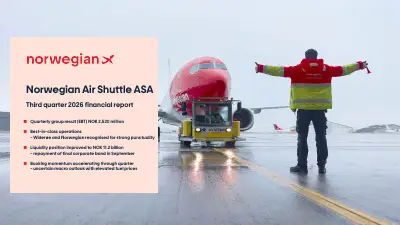
Norwegian Air Shuttle ASA
Q3 FY2026 · Earnings Call TranscriptOctober 28, 2026
Jesper Hatletveit
Good morning, and welcome to the third quarter presentation for the Norwegian Group. My name is Jesper Hatletveit, and I am the VP of Investor Relations here at Norwegian.
Today's presentation will be held by our CEO, Geir Karlsen, and our CFO, Hans-Jørgen Wibstad. The presentation will be followed by a Q&A from the audience and the web.
Please go ahead, Geir.
Geir Karlsen
Thank you very much, Jesper. Good morning, everyone.
Good to see you. Beautiful day in October in Oslo.
Let's start with, and also good morning to everyone following following on online. Let's start with the highlights for for the quarter.
It turned out to be a strong third quarter for Norwegian, with an EBT of 2.5 billion Norwegian kroner, translated into 2.7 billion in EBIT, divided on 2.5 billion, close to, for Norwegian, and Widerøe with an EBIT of 242 million. That translates into an EBIT margin of 21.4%.
If you look at the third quarter results for 2026, it's more or less in line with the with the underlying result in the third quarter in 2025, because in the third quarter last year, it included gains from aircraft acquisitions, as well as compensations due to delays of deliveries of aircraft. We are continuing to focus on the cost side of the of the business, and very happy to still keep the guiding on a flat CASK for the full year compared to 2025.
Operational excellence, as you all know, is extremely important for Norwegian and for Widerøe. We have a punctuality of 80.7% in Norwegian, and very impressive by Widerøe, I'll come back to more details on it, of 93.5%.
We have close to zero cancellations in Norwegian and also a massive reductions in cancellations in Widerøe. Although we had an impact of the ATC strike in August here in in Norway.
I'll talk a little bit about Widerøe later, as they are doing very well operationally. As we always say, why connect when you can fly direct?
That is that is the slogan. We do have the most direct routes from the Nordics to Europe as per today, flying more than 500 routes together with with Widerøe.
NPS score is very important for both companies. We are doing well.
We have seen an increase in NPS scores on a on a 12-month rolling basis with a result over 50. That is a very good results regardless of who you compare us to.
We are continuing the the adapt into the corporate market, and we do we do plan also to to come with a better product offering for these corporate travelers in the weeks and months to come. Also happy to see that Norwegian Reward is surpassing 10 million members.
We have also launched the tiers, as you have seen, during the last couple of months. We are continuing to work on the balance sheet.
We have a liquidity position today of 11.2, or at the end of the quarter. That's up 700 million, and that is after we have repaid the so-called retained claim bonds to the to to the investors.
Most of them are, let's say the majority part of that is the Norwegian government. Equity ratio up to 20.6%.
We have a balance sheet today and a liquidity position that makes us able to do investments like the NLTG investment, and I'll come back to the details on on that as well. Talking about NLTG, this is an acquisition that we did during the summer.
It is a complementary acquisition where we are going to add a product offering to the passengers that we are already flying, now also entering the package tour segment as well as hotels. We are in the process with the EU competition authorities, and we have a target to close and have an approval by the end of this year.
Traffic figures. 8.8 million passengers in the quarter in in in together with Widerøe, 4% up.
We are 5% up in Norwegian. Widerøe is 2% up on on ASK.
Load factors at at good levels, I would say, 85. 88.5% in Norwegian, Widerøe at 76.1%.
Punctuality is is normally lower in the in the very busy summer season, but still it's up 3 percentage points in Norwegian to 80.7. Again, very impressive by Widerøe, 93.5.
Regularity is continuing to stay very high. It is very important.
We don't cancel much, and that is going to be the fact also for the weeks and months to come. Passenger growth.
This is a graph that we are showing every quarter. It shows the number of passengers.
It shows load factor and and yield. As you can see, if we when we entered into the second quarter this year, we saw a softening in the in the market.
That was after the Iran situation, and we had a lot of speculations in the media when it comes to availability of fuel. We had We entered into June when Norway did quite well in the World Cup in football.
People were not was not traveling. I think that it had a huge effect.
We were quite, concerned going into the third quarter. Then when we entered July and into July, August, and September, we saw a an aggressive rebound, I would say, and and the demand really came back.
That's why you can see the increase both in load and in and and in yield during the the third quarter. I think the third quarter turned out to be actually better than how it looked when we entered into July this summer.
We had a capacity growth of 5% in in Norwegian, load factor as again, up 0.2 marginally. We have had a little pressure on yield.
Yield compared to last quarter the same quarter last year is down 1%. Have in mind that we have seen a strengthening of the Norwegian krone that counts for a negative yield effect of 3%.
Underlying, I would say that the yield is is pretty okay. Looking at Widerøe, you are seeing that the load factors are coming off a little bit into the third quarter.
That is normally what happened in in Widerøe. That said, I think we are a little bit disappointed, especially about the corporate market in Widerøe after the summer into August.
We are seeing these days that this is picking up again. Capacity is up 2% year-on-year, but again, we are marginally down both on on load factor and the number of passengers.
However, Widerøe is contributing with 242 million in EBIT for the quarter. We are seeing, a continuous increase on the transfer traffic between Widerøe and Norwegian, and we are taking market share as we go, and we have actually taken market share since we took over Widerøe a few years back.
We have also continued to work on the synergies between Norwegian and Widerøe. We have and and what a lot of a portion of that is obviously to try to optimize the two networks, and Widerøe is actually going to fly part of the capacity for Norwegian next summer, where we are using the E2s in our own Norwegian network, and thereby freeing up 737s to fly to other destinations.
Widerøe is, in general, doing very well. It's going to be another very good year.
Operational excellence, I will come back to. I have promised Tore to give him a a big hand on his operational excellence work, and it's really starting to to give to to give results.
This is how Widerøe has been doing on on-time performance. As you can see, it has increased from 84.4% in the fourth quarter last year to 93.5% to to in in this quarter.
That is really, really impressive, I have to say. If you look at airlines flying more than 1,500 flights a month, Widerøe has been a global lead, I mean global lead, 4 out of the 6 last months, and that's the level that Widerøe is is at during the last 6 months.
Also, when you when you are looking at, the number of cancellations in Widerøe, it's massively down. That has been an issue, but it's much better performance as per today.
Why is it important with what we call operational excellence? It's very important for the customers.
If you look at the drivers for the NPS score, on-time performance is one of the absolute most important ones. Also for the transfer traffic, knowing that 50% of the passengers in Widerøe is in transfer, going to another airline, mostly now going to Norwegian.
As well, it is very expensive to be to not be on time, and we are also seeing a massive reduction in the so-called EU261 costs in in Widerøe. It makes sense in on all levels to be very good on operations.
Norwegian is also doing well, operationally. We are top five on on-time performance in in Europe in August and September.
That is a result I'm very happy about. At least and and also if you see it in combination with with the high efficiency we have both on aircraft and on crew, and the market-leading turnaround times that we have on different airports throughout the network we are flying.
A big hand to Widerøe. Again.
All right. Booking momentum.
As you can see on the on the top left graph, that is seven-day rolling sales on number of passengers. As you can see, we had a relatively weak second quarter, but then heading into July, you can see the red curve is is is moving away from 2025.
That has actually stayed throughout the fall and all the way into what we are seeing today. That means that there is nothing wrong with demand, as we see it, and at the price also for the periods or the months going forward.
We are, however, doing some adjustments to the winter production. Winter production for us is November to to to March.
We are, during the next months, flying somewhere between 25% and 40% less than what we are flying in October. Also in the first quarter of 2027, we have reduced the capacity with approximately 5% to 6%.
Part of that is the Dubai production that we have canceled by obvious reasons, but we have also done some other changes and some other reductions throughout the network. That is because of the high fuel prices we are seeing in today's market.
The momentum in booking is still very solid, I would say. Looking at the next months, we are ahead on load on all months for the winter production compared to the same period last year.
Today, we have sold approximately 290,000 tickets more than the same day last year. That is on a capacity increase of 3%, but we have sold 15% more tickets.
If you look at the load factors for the next 12 months, we are above on all months compared to compared to the same period last year. You could say that we have somewhat front-loaded the the sales, then and then the aim is then to yield up closer departure for every month going forward.
Norwegian Reward, I told you that we will come with some news during the third quarter then, and this is the news. We have implemented and launched tiers.
I think Norwegian Reward, even if we have surpassed 10 million members, and the the levels that we previously had with, especially on the top level, I think it is has been let's say, undercommunicated, undersold. I think by implementing these levels, it's going to be much more easy to understand for our customers, while we are still going to be very generous when it comes to giving our passengers the benefits you deserve.
The five tiers are Member, Traveler, Bronze, Silver, and Gold. As as well, on Widerøe is, of course, now onboarded into Norwegian Reward.
The Spenn community is developing very nicely. We had a successful launch when REMA 1000 came into the community during August and September.
We are also seeing that when we are looking at the frequent travelers travelers traveling with either Widerøe or or Norwegian, more and more of these travelers are now deciding to stay at Strawberry hotels. That is a kind of evidence by the fact that now we are actually creating what I call real loyalty, and that has been the aim for for establishing Spenn all the way.
Now we are starting to see the results. We're also planning to do some status match processes with other programs, and we will share news on that as soon as absolutely possible.
Also very glad to say that we are going to do the Christmas calendar this year in Norwegian Reward, and that's going to be good fun. Hans-Jørgen.
Hans-Jørgen Wibstad
Thank you, Geir. Good morning, everyone.
Really great to see you here. I will go through the third quarter results for Norwegian in some more detail in a quarter which turned out to be a really good quarter for for the business.
As Geir said, delivering an EBIT of 2.7 billion and a net result before tax of 2.5 billion. Group revenues came in at 12.7 billion, which is up a healthy 4% versus last year, with Widerøe contributing 2.1 billion.
As Geir mentioned, the group the capacity there was a capacity increase, but we're very happy to see that the customers are there. We're seeing that load factors is picking has been picking up and is better than it was in the same period last year.
After a challenging Q2, without a doubt, Q3 also from a traffic point of view, also looking at our traffic reports every month, turned out to be a a good a good quarter result which is the, which which has a huge impact on on the on the bottom line. The EBIT, 2.7 billion with with Widerøe contributing 242 million.
There is a one-off positive impact on the FX repricing on maintenance reserves, but I'll come back to that in a minute. If you look at the underlying, as Geir said, if you look at the underlying EBIT for the quarter, it's pretty close to where we were at the same time last year.
Looking at the kind of overall rather challenging macro environment, in particular relating to fuel, we think that is is quite quite good. It's to large extent driven by good hedging positions, not only on the percentage-wise, but also we had very attractive pricing on our hedges going into the quarter and this kind of challenging macro environment when it comes to the fuel price, which is which is continuing.
Also on the cost side, I think we have had now consecutive quarters of very strong cost performance. We have our costs under control.
We're seeing that the underlying cost increase on the CASK versus last year is up 4%. Comparing with inflation and other factors, that is a good result.
As Geir was alluding to, we are guiding flat CASK year-over-year based on an underlying performance. We think the, again, another strong quarter for the group in terms of cost performance and cost discipline.
Very happy to see that. Also coming out of the quarter, we have a very strong balance sheet, another quarter with a good balance sheet.
We're seeing a good liquidity position up year-over-year despite having repaid bonds as well as paid dividend. I'll come back to that in a minute.
We have gotten three new aircraft this quarter. We're seeing that the deliveries from Boeing is going according to plan.
We're happy to see that. We're gradually eating into our backlog of 80 aircraft which is on order, which originally were on order.
Also, as Geir said, NLTG, we have a strong balance sheet to support the acquisition. We're planning for a bond issue of about 2.5 billion in in the coming months.
I think our balance sheet is well placed for that, also taking into account that we have recently, over the last 18 months, retired 3.9 billion. In some sense, the bond issue that we will go forward with over the next few months is really a refinancing of existing bonds.
We're well-placed to to have a successful execution of that bond placement. A little bit more on the on the revenue side.
It's It's quite easy to understand. Top line is up by 4%.
We're seeing that the volume is contributing 540 million, yields a little bit down, 108 million, load factor, happy to see again, load factors coming up despite the increase in in capacity, and then with Norwegian coming in at 10.7 billion and Widerøe contributing a nice 2 billion to 12.7 billion in total. Operating profit, I think quite easy to understand kind of the bridge between this quarter and last quarter for Norwegian, 310 million down.
I'll come back to that also a little bit later. There are a couple of adjustments there which are important to understand.
One is the is the one-offs in third quarter last year, where we acquired a couple of aircrafts out of leases and also got compensation from Boeing, 269 million of the 432 million is purely relating to to the acquisition of aircraft as again plus the Boeing compensation. Then you have the reclassification of translation effect of the maintenance reserves at the 244 million in other gains and losses coming there.
Then you have somewhat higher operating costs, 347 million, and then on top on top of that, of course, the the the the net impact of of revenue increase and also a rather limited impact of the fuel, taking into account how much the fuel has really gone up over last or is it or compared with with last year. Again, why is that?
Two main reasons: the hedges that are have been very attractive and has a huge impact in the third quarter. Second thing, going in the other direction is the strengthening of of the NOK, which is obviously makes a US dollar Fuel is paid in US dollar, so that makes it makes makes the bill in in NOK lower.
Overall, a a good position to be in. In summary, on the P&L side, we recognize the 4% that we talked about a few a few times.
Fuel price only going up by 7%. Again, fuel and also the FX having a positive impact.
Fuel price massively negative, but then again, our our hedges. Then, looking at the underlying earnings, the EBITDAR is only only 127 million behind last year.
Then you have, on the one side, we have a positive impact on the on the translation effect of the of the maintenance reserves having a positive effect, and then also the negative effect that relates to the one-offs in Q3 2025 on the purchase of the aircraft and delay compensation. On this particular line, this is kind of the normalized level.
This is not a normalized level, obviously, based on on kind of one-off impact of that. Which which then leaves an EBIT of 2.5 billion, as we talked 2.7 billion and an EBT of 2.5 and a net profit after tax of 1.8 billion.
Coming out of the quarter, again with the robust balance sheet, a few things has happened there. We talked about that.
We have made our final repayment of the bond. Essentially now, Norwegian is has only debt related to aircraft financing, and which is quite a big difference from where we were only 18 months ago, when we still had 3 billion of retained claim bonds outstanding as well as we hadn't retired the convertible bond that we partially repurchased in 2025.
That's a that's a massive, or not a massive, but quite a a significant change, and and we're very happy to see that we're coming out of the quarter finally with a clean balance sheet with no kind of, unusual items in there or, let's say, legacy debt. That's really good.
The other thing to make note of is that our air traffic liabilities is is as a seasonal reduction, but kind of underlying that we have had good presales sales during the quarter. It's up 8% year-over-year.
That's kind of a proof of the pudding that we have sold quite a lot more tickets than we did at at the same time last year. Equity ratio going up from 14.2% to 20.6% at the end of the quarter, partially because of the good results, but also that equity ratio takes into account the the net value of our remaining hedges, which has also had an increase in its value in the quarter.
Net interest-bearing debt, up just a little bit, 800 million. We can see that with there is the retained claim bond finally in zero.
We've been waiting for that quite a long time, and we're very happy to that we actually executed on this plan that we started to work on basically three years ago on the on the total kind of redo and clean up of of the balance sheet. With coming out with a healthy cash position, and with the retirement of 3.9 billion, out of which 1.5 billion in this quarter, total 3.9 billion in the last 18 months, I think that sets the ground for a successful bond offering in the next few months.
Again, three aircraft delivered in the quarter, impacting the balance sheet, obviously, two is being on sale-leaseback, the other one has is a aircraft we own, kind of holding onto our strategy to partially have sale-leaseback deals as well as own deals. The and the terms that we have received all both on the financing of the owned aircraft as well as on the sale-leaseback are the best we've ever seen in the group, which is a fantastic starting point for what's ahead for Norwegian.
To summarize the cash flow, and also the the cash balance going from 11 billion to 11.2 billion in the quarter. Ticket prepayments, obviously, seasonally down, but higher than it was last year, sorry, yeah, at the same time last year.
Strong underlying cash flow, and we have investment activities where we repaid the the bond, and so, again, a healthy position to be in coming out of the quarter. We have placed the excess liquidity at attractive returns, we have a combination of bank deposits as well as money market instruments that has been a good balance for us.
It's also important looking out, we have already prepaid 3.6 billion into the order, and we the remaining prepayments before 2028 is limited to less than 0.5 billion NOK. All right.
Thank you. Yep.
[unclear].
Geir Karlsen
Okay. Let's have a look at Nordic Leisure Travel Group.
That is an acquisition, as I said, we did through the summer. The holiday market, the tour operator market is a market we have been looking at for the last, I would say, couple of years.
Then this opportunity came came up, and and we took it. We have been trying to develop our own value proposition in this market over the last years in something we call Norwegian Holiday.
It is It is a, it's a part of Norwegian that, translates into approximately 100 million NOK in in revenues. By doing this transaction, we are, overnight, more or less overnight, turning into, by far, the biggest tour operator in the in the Nordics.
That's why we have done it. NLTG is, I would say, well-run company, and and that applies to the hotels hotel side of the company, as well as the the the airline, Sunclass.
That's a long track record on with profitability. This is a complementary acquisition where we are going to offer passengers, customers in Norwegian and Widerøe something in addition.
We're not only going to fly them to a destination, we're going to offer more, and thereby, taking a chunk, a part of this market. This is a market that has been growing over the last years, and we anticipate that this will continue to be the case also for the periods ahead.
NLTG is having approximately 1.3 million guests a year, and with a turnover, or a revenue of approximately 17 billion Swedish krona. The most interesting part of NLTG, as we see it, is the so-called concept hotels.
They have 26 hotels as per today. The picture to the left is one of them, which is the Ocean Beach Club at Canary Islands.
I visited actually the hotels a few weeks back. I was not able to stay at hotel because it was full, and that is always a a good a good sign.
The strategy in NLTG is to expand on the concept hotels, and we would like to do that in the on destinations where Norwegian is already flying a lot today. One example is Spain, where we are flying close to 5 million passengers each year.
That's a huge opportunity for the periods in front of us. The concept hotels stands for 25% of the volume, but 60% of the gross profitability.
NLTG includes many well-known brands in in the Nordics: Spies in Denmark, Ving in Sweden and Norway, Tjäreborg in Finland, and then, of course, also Sunclass, which is an airline with 12 aircraft. We are paying 3.5 billion Swedish kronor for the company in addition to 300 million shares.
The owners of NLTG, which is Altor, Strawberry, and TDR, will become significant shareholders in in Norwegian. I think that is a very positive thing.
They will also be represented at the Board of Directors. We are very much looking forward to that.
We have, of course, done all the analysis when it comes to synergies, and we do expect to take out synergies already in 2027 on the basis that we can get an approval from the EU competition authorities, where the process has been ongoing since since the the the summer. This is something we are really looking forward to, and we are very excited to get going working on the synergies, and in order to take out the value from this acquisition.
Fleet, not so much to to to update you on. We have taken delivery of 5 out of the 80 firm aircraft that we have on order from Boeing.
Boeing is delivering on schedule, and the quality of the aircraft is absolutely amazing. The aircraft is very much liked by our cabin crew and our pilots, and it's also a better product for the customers with massively less noise, both in the cabin and the and the and in the cockpit, as well as the fuel burn is 15%, 16%, 17% less than on the 737-800 NG.
We have financed 25 of the aircraft already in addition to the engines that we have also bought, spare engines. We just came back from a couple of days in China where we met 10 to 15 banks, and the appetite to finance these these aircraft and engines are absolutely amazing.
It's a wide open capital market out there, and we are able to finance these these assets at terms we have not seen in Norwegian, I would say, ever. That is very, very promising.
We have even if we are having an order of 80 aircraft, we're not really growing that much. As you can see, we have 98 737s today.
That increases to to 103 in the summer of 2028. The aircraft order of 80 aircraft is mostly a fleet renewal process where we're going to have newer and newer assets burning less and less fuel.
Should we wish to grow more than what it looks like here, we can always extend the leases that we have on the NGs and thereby having a more aggressive growth. That's the option we love to have.
We can then decide based on how the market is evolving, how to grow for the years to to to come. Very happy with Boeing these these days.
We are still planning to own 50% of these aircraft, and then we will do operating leases on the rest. That's at least the idea for now.
Program X, not much to news to to share, but it the program has, in my opinion, delivered, based on the targets that we set, at least almost. The reds are the recurring effects.
We took out 400 million last year, sorry, yeah, last year, another 600 million with recurring effects in 2026. I think when we come to the end of 2026, we will deliver more than 1.25 billion.
Hopefully, we will we will Program X is coming to an end by the end of the year. That's what how we have, communicated it all the way.
I think we can kind of finalize the the the the the program with with with a slightly higher figure than 1.2 billion. We will come back to that next quarter.
The areas where we have focused on, we have been working through the whole company over these last couple of years. The ownership cost is part of it where we have been buying out operating leases, and thereby we will have a lower ownership cost for the years to come.
We have done done the synergies, first of all, with Widerøe, 20%, and then general cost reductions throughout the company, 24%. Then we also took the so-called new sales distribution platform live during the summer or spring, and we're also seeing effects from that.
Going into 2027, Program X is coming to an end, but we will most likely start a new program with a high focus on the integration process with NLTG and a continuous, performance improvement project for the next couple of years. We will also work towards a strategy that is now in place for for both companies, Widerøe and Norwegian, that will take us into '29 and 2030.
Guiding, we are capacity for the full year is 2% up, I would say, only. That is down 1% compared to what we said last quarter.
Most Most of that is the Dubai capacity that we have taken out by obvious reasons and some other smaller changes. Q4 is 2% up, again.
That was 4% up last quarter, we have taken it down by reasons I've already explained. For '27, it's 5% on average for the for the full year.
Then again, happy to say that on CASK, we are guiding a flat CASK 2026 compared to 2025. Then on something completely different, we are, in addition to to running the airlines hardcore, we are also supporting children around.
UNICEF is a is a corporationship that we had had for I think 15, 16, 70 17 years started by Bjørn Kjos. We are continuing that relationship.
We are very proud of it. We are doing activities throughout the years at the year as you can see.
We're also, as part of the contract with UNICEF, doing something we call Fill a Plane, where we have done that quite a few times, and we're going to do it again this year. This is helping children around the world, and we're flying to destinations decided by UNICEF.
This is a process where we are filling up a 737, both in the luggage area and in the cabin, with what you call crucial, lifesaving equipment, supplies. That could be medicines, it could be clothes, toys, etc.
This year, we're going to Malawi in in Africa. That's actually happening next year.
Widerøe as well is doing something they call a Dreamflight, where they are taking children with cancer, out of the hospital routines, and and making a special day for these for these children. Looking forward to going to Africa next week with some what we call UNICEF ambassadors, where which is then crew flying on their free time, supporting then UNICEF.
All in all, if you look at the markets ahead of us, yes, we have a fuel environment that is challenging. We are sitting in a position now where we are 53%, 54% hedged at approximately $660 per ton for the rest of this year.
We are approximately 30% hedged for the first quarter next year at similar levels. Then the hedging process percents are going down to 20%, 25% for the remaining part of the year.
We're sitting in a in a in a good position, I would say, also when you compare us to the competitors. Then we will all see how this market is developing and how the situation in the Hormuz Strait is developing and and and and and thereby how the fuel prices are evolving.
There's also a a very widening crack spread when it comes to the difference between, let's say, fuel, or oil and and and Jet A. That has been widening over the last few months, and and obviously this is something that we are following very closely.
There is nothing wrong with the bookings. That is 100% sure.
Thank you.
Jesper Hatletveit
Thank you. Thank you, Geir.
Can we get Hans-Jørgen up as well? We'll then go on to some Q&A.
We'll start with the audience. Any questions from the audience today?
Hans-Jørgen? Yes.
Good morning, and congratulation with a very good Q3. I have a few questions for you.
The elevated jet fuel price is expected to continue next year. Would improved yield be more important than to achieve the highest load factor for the Norwegian Group airlines?
Also, premiumization demand dries up in many airlines. You have seen that this year.
Will we see more new type of perks for the corporate market? You mentioned it in your presentation, Geir, like middle seat blocked, lounges, and maybe even starting products on Norwegian Group airlines going forward?
Finally, about the top five revenue markets in financial '26 is Norway, Spain, Sweden, Denmark, and UK. Which market do you foresee the largest revenue growth next year, and what would be the triggers for this?
Geir Karlsen
It's a lot of questions, Hans-Jørgen. Obviously, since the Iran situation happened, right, you saw ticket prices coming up.
It worked for a while, and then you saw the ticket prices coming down again. The customers were not willing to pay what we asked for at the time.
That's why we are seeing the yield development over the last months. You have a competitive landscape, as you very well know, Hans-Jørgen, and that is what it is, and we have to rely on that.
We have to adapt to the competition. You have had players during the last months that has been very aggressive on pricing, maybe especially here in Norway.
That's just the reality. The fuel prices is what it is.
It is hitting us, obviously, but it's hitting everybody else as well. We have been in a good position in 2025, in my opinion, with 55% hedging ongoing, and then we will just have to see how this develops over the winter.
I think that we are doing more or less the same as the other airlines around us, meaning reducing the capacity, especially for the next two to three to four months, and then we will just follow the market. When it comes to the product offering, I think what you are seeing is both the kind of the legacy players are to an extent moving into a position that Norwegian is in, meaning in between the ultra-low-cost companies and the legacy companies.
You're also seeing the low-cost companies, maybe especially in the US, is also moving towards the position that we have, offering a more premium product, trying to attract the premium leisure market. I think that we are in a perfect position today, at least up until now, and then we will see whether we're going to move to the left or to the right.
I think, if anything, we will most likely move to the right. What was the third one?
The third one was your top five markets 2026. How do you see the development in these five markets?
Do you see anyone that will outperform and what will be the triggers for?
Geir Karlsen
If we look at the three Scandinavian markets, Norway, Sweden, and Denmark, it's no doubt that Norway for us is where we have the most capacity. Looking on the margin, meaning EBIT margin, for example, it's not very different to Denmark and Sweden.
Obviously, as you mentioned, Sweden is probably the market that is developing the best on the relative today, but that's also mainly because that the domestic market in Sweden is maybe only 60%, 70% back compared to the pre-pandemic levels, while Norway and Denmark is surpassed 2019.
Jesper Hatletveit
Okay. Other questions from the audience?
We'll then move to some questions from the web. We'll start with Petter Nystrøm, ABG.
"In your presentation, you flag some fare pressures in the winter. How do you see fares/yields developing from here on, and are you surprised of any, call it, aggressiveness among our competitors?"
Geir Karlsen
As we have said, there is nothing wrong with the demand. We are ahead for all the coming months compared to the same period last year.
On some of these months, significantly above as well. Then the aim is to try to yield up closer to departure.
There is a pressure on yields, as we have also communicated during the third quarter. That is also the case going forward.
Yes, there is a tough competition, as always. Are we surprised?
I think I should be a little bit careful.
Jesper Hatletveit
Moving on to a question from Sondre Sneisrud from Nordea. "Fuel hedging: any reflections on your hedging portfolio, 25% around for 2027 given the current fuel price environment, and also the, call it, hedge ratio among our peers?"
Geir Karlsen
We have a policy in Norwegian saying that we would like to be 50% hedged for 12 months going forward on a rolling basis. This year, we have had a higher percentage.
I think, obviously, we can say today that I would have liked to be 100% hedged for 2027 at $500 a ton, but that's not the case. To do hedging today on a price, let's say, $1,500, $1,600 a ton is, as I see it, not very attractive.
We would probably put on more hedges going forward compared to what we have done in the last years.
Jesper Hatletveit
Okay. Moving on to two questions from Ole Martin Westgaard, DNB Carnegie.
"ASKs for next year: you guide on a 5% ASK growth. How does that play out between the quarters?"
Geir Karlsen
We are planning, as it looks today, for quite an increase in the fourth quarter next year. Other than that, we will be between 3% and 4% for the first three quarters.
Okay.
Hans-Jørgen Wibstad
I guess the winter capacity next year is also dependent on Dubai, normalizing and so on.
Geir Karlsen
Absolutely.
Jesper Hatletveit
Absolutely. Okay.
Question from him on unit cost. "With Program X ending and the new capacity cuts that you announced for Q1, what is your early view on 2027 unit cost excluding fuel?
Should we expect a new cost program?"
Geir Karlsen
Not a cost program as such, but performance program will definitely be still in place. We will all be, of course, focusing a lot on the synergy project with NLTG.
We will come back to the guiding for 2027 later on on CASK.
Jesper Hatletveit
Okay. Then we'll move on to some questions from Andrew Lobbenberg, Barclays.
"Labor relations: SAS Link is currently on strike. Can you benefit from this, and how do you view your own labor situation?
Is it stable, or is it at risk?"
Geir Karlsen
I think we have a good relationship with our unions, and we have quite a few unions in Norwegian. We are currently in negotiations with the majority of our pilots, both in Denmark and in Norway.
It's a constructive dialogue, and then the aim is to find a good solution for the period in front of us.
Jesper Hatletveit
Okay. Another question from Andrew: "NLTG: any concern with regards to regulatory approval, or is that plain sailing, as we see it?"
Geir Karlsen
We believe that we will get it approved, but there's absolutely no guarantee on these processes. It has been a challenging process with a lot of documentation, a lot of question from the Commission.
We are getting close to clarity.
Jesper Hatletveit
Finally, on NLTG, can we say anything on how it trades through the summer?
Geir Karlsen
We don't know.
Jesper Hatletveit
Yep.
Geir Karlsen
Fair enough.
Jesper Hatletveit
I'll ask if there's any more questions from the audience. Thomas?
Yes. Thank you.
On yield, I know you guided on or you let us know that reported or booked yield was flat for Q3 last quarter. Can you say anything about Q4 on booked yield for now?
Geir Karlsen
No, the only thing we are saying is that there is a pressure on yield, but the load is higher than the same period last year. Then the aim, obviously, is to try to yield up.
I think, if you look at, for example, October, yields are now actually in a decent area, if I can say it like that. That was not how it looked a month, two month ago.
It is kind of, at least for October, working.
Good.
Jesper Hatletveit
I think that's the final question. Finally, like to say, thank you to Hans-Jørgen, whose is his last presentation for us today.
Other than that, I'd like to say thank you for all of you for attending today, and we'll conclude the session there.
Hans-Jørgen Wibstad
Thank you very much.
Geir Karlsen
Thank you. Thank you.
Thank you.