NexPoint Residential Trust, Inc.
Q3 FY2026 · Earnings Call TranscriptNovember 3, 2026
Operator
Hello, everyone. Thank you for joining us, and welcome to the NexPoint Residential Trust third-quarter 2026 earnings call.
I will now hand the conference over to Carly Messer with Communications and Corporate Affairs. Carly, please go ahead.
Thank you, Al. Good morning, everyone, and welcome to NexPoint Residential Trust conference call to review the company's results for the third quarter ended September 30th, 2026.
On the call today are Paul Richards, Executive Vice President and Chief Financial Officer; Matt McGraner, Executive Vice President and Chief Investment Officer; and Bonner McDermett, Vice President, Asset and Investment Management. As a reminder, this call is being webcast through the company's website at nxrt.nexpoint.com.
Before we begin, I would like to remind everyone that this conference call contains forward-looking statements within the meaning of the Private Securities Litigation Reform Act of 1995 that are based on management's current expectations, assumptions, and beliefs. Listeners should not place undue reliance on any forward-looking statements and are encouraged to review the company's most recent annual report on Form 10-K and the company's other filings with the SEC for more complete discussion of risks and other factors that could affect any forward-looking statements.
The statements made during this conference call speak only as of today's date, and except as required by law, NXRT does not undertake any obligation to publicly update or revise any forward-looking statements. This conference call is also includes an analysis of non-GAAP financial measures.
For a more complete discussion of these non-GAAP financial measures, see the company's earnings release that was filed earlier today. I would now like to turn the call over to Paul Richards.
Please go ahead, Paul.
Paul Richards
Thank you, Carly, and good morning, everyone. I'll walk through our third-quarter and year-to-date same-store results, expenses, interest, the Midtown Crossing acquisition, the balance sheet, NAV, the dividend, and changes to our full-year outlook, including how we think about 2027.
Then Matt will cover operations and market fundamentals looking forward. I'll start with the headline.
Q3 came in below expectations. Core FFO was 52 cents a share, 7 cents below consensus.
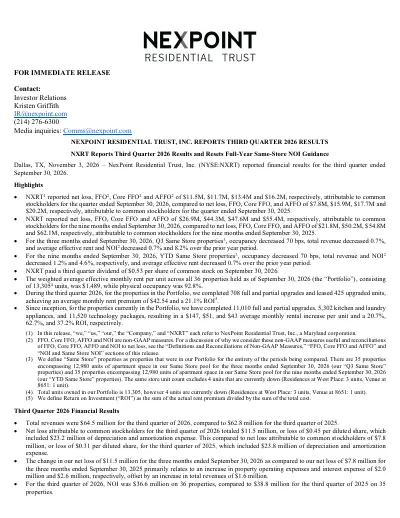
We're lowering our full-year core FFO midpoint to $2.22 from $2.45, and our same-store NOI midpoint to -4.3% and -1%. Third-quarter core FFO was $13.4 million, or 52 cents per diluted share, compared to 70 cents a year ago.
FFO was $11.7 million, or 46 cents a share, and AFFO was $16.2 million, or 63 cents. Net loss was $11.5 million, or 45 cents per diluted share, including $23.2 million of depreciation and amortization.
That compares to a net loss of $7.8 million, or 31 cents a share a year ago. Total revenue was $64.5 million, up from $62.8 million, with Sedona in the numbers.
Total NOI was $36.6 million across our 36 properties. On a same-store basis, 35 properties and about 98% of our units, revenue was down 70 basis points, expenses were up 11.2%, and NOI was down 8.2% to $35.6 million.
Occupancy ended the quarter at 92.9%, down 70 basis points, and average effective rent was $1,487, down 0.7%. Year to date, core FFO is $1.87 a share against $2.14 last year.
Expenses drove most of the quarter's NOI decline, about $2.7 million of the $3.2 million. Three specific items explain the decrease: First, Nashville real estate taxes.
Last year's third quarter carried a one-time real estate tax refund at Residences at Glenview Reserve, which equates to a swing of about $854,000 and does not reoccur. Excluding Nashville, real estate taxes were up less than 1%.
Second, resident amenity services, which is mostly our bulk fiber internet rollout. That line was up about $640,000 this quarter as we brought fiber online at about a dozen properties in Atlanta, Nashville, Phoenix, and South Florida.
Residents pay for that service, most of that cost comes back to us. Amenity fees rose about $387,000, and in Las Vegas, the equivalent fees now sit in rent under all-in pricing.
Net, the program cost roughly $100,000 more than last year, which is immaterial. Looking at the full program, including the smart connection fees residents pay, our amenity services brought in about $400,000 more than they cost this past quarter.
It's a net contributor to NOI, not a cost center. Third, controllable expenses, usually a reliable strength for us, ran higher through the quarter.
Interior and turnover repairs were up 14.9%, exterior and amenity repairs 13.8%, and landscaping 13.7%. Marketing was up more than 30% and office operations 14.2%, as properties below target occupancies spend to drive traffic.
Lastly, utilities rose 11.8%. Some of what was deliberate choice.
Given how soft this year has been, we pulled a lot of work forward into 2026 and spent capital where we think it attracts new residents: unit turns and readiness, move-in gifts, exterior and amenity projects such as pressure washing, vent and gutter cleaning, and in-unit upgrades like washer-dryers. We'd rather put that money in front of prospects now, even if it keeps expenses elevated for a quarter or two.
Other spending didn't earn its keep, and we're cutting it. Net of Nashville real estate tax swing, expenses grew about 7.3%.
Strip out resident amenity services as well, and it's about 5.1%. Part of that is by design, and part is noise in a seasonally heavy quarter, but it's more than this revenue environment supports over time.
Matt will walk through the specific actions we're taking. The bright spot is insurance, down 11.8% on our April renewal.
Moving on to year-to-date same-store. A single quarter can carry a lot of noise, the nine-month view is the better read on the run rate on the portfolio.
Year to date, same-store revenue was down 1.2%, expenses were up 3.9%, and NOI was down 4.6% to $109.3 million. That 3.9% includes fiber rollout and the marketing we put in front of prospects.
Excluding resident amenity services year to date, same-store expenses were up 1.6%. Normalizing for last year's Glenview tax refund as well, same-store expenses were up just 40 basis points year to date, apologies.
Underneath that, the core cost base is holding. Year to date, insurance was down 16.3%, real estate taxes were down 0.7%, payroll down 0.6%, and property management fees down 1.6%.
The pressure is concentrated in repairs and maintenance, up 16.4%, including the fiber program; utilities, up 7.2%; and marketing, up 39.4%. It's important to state clearly that the third quarter's -8.2% is not our run rate.
It carries a prior-year tax refund that won't reoccur, a fiber rollout that pays for itself upon penetration, and expense work we choose to pull forward. Our fourth-quarter guidance implies same-store NOI down about 3.3%, better than year-to-date pace and well under half of the third-quarter decline.
Now to interest expense, which we flagged since initial guidance. The step-down landed in September on schedule.
Swaps tagged to about $717.5 million of debt at a fixed rate near 1.14% reached their scheduled runoff. Today, we have about $192.5 million of swaps at a weighted average of 2.68%, which fixes about 13% of our floating-rate mortgage debt.
That's $92.5 million with KeyBank that runs through January 1st of next year and the $100 million JPMorgan swap at 3.49% that runs to 2030. Swap settlements contributed $5.2 million in the second quarter and $3.4 million in the third, and we expect about $0.6 million in the fourth.
Third-quarter interest expense was $18.1 million, up from $15.8 million in the second quarter. Full-year interest expense is now projected at about $71.8 million, close to the $71.2 million we discussed in August.
Our adjusted weighted average interest rate was 4.75% at quarter end against 3.58% at June 30th. The rate backdrop hasn't helped.
The Fed raised rates in September to a range of 3.75% to 4%, held last week with two members voting for another hike. The 10-year Treasury touched 5.3% in early October and sits near 4.9% today.
On maturities, our first mortgage maturity is October of 2028, and the rest of our mortgages run to 2031 and beyond. Total indebtedness was about $1.6 billion at quarter end.
On October 2nd, we acquired Midtown Crossing, a 228-unit, 1997-vintage community in Raleigh for $32 million, or about $140,000 a unit. Our all-in cash basis, including $1.9 million of CapEx funding, is about $152,600 a unit.
We bought it from an REO lender book, and the seller had already put about $3.1 million of capital into the property, the upside is operational. Raleigh is a market we all know well.
It's our strongest renewal market this quarter at positive 4.2%, with the smallest new lease decline in the portfolio at -0.9%. Midtown takes our Raleigh exposure from 625 to 853 units.
We are starting at a lower occupancy, and getting to 93% occupancy takes about 27 net leases. In-place rents sit about 10% below the Raleigh two- to four-star average, $1,325 versus $1,481.
We underwrite to grow rents to $1,403 by month 36, which grows NOI from $1.44 million to $2.15 million by year three, stabilizing north of a 7% cap rate. On returns, we project a 7% NOI CAGR, a mid-teens levered IRR, and a 2.1 times multiple on invested capital over a seven-year hold.
Balance sheet deleveraging. Our leverage is too high for the rate environment, and bringing it down is our first capital priority.
Here's the order: disposition proceeds to go to debt reduction first; share repurchases are funded through sale proceeds with no new borrowing; and we'll measure progress against our leverage targets. We're planning to pair Midtown with a disposition or two.
The proceeds are expected to retire the borrowings we used for Midtown, which keeps that trade roughly leverage-neutral, and any incremental amount creates capacity for buybacks. Disposition guidance stays at $0 to $200 million, with a $100 million midpoint.
Each sale at private market prices also supports our NAV. During the third quarter, we completed value-add initiatives on 708 units and leased 425 upgraded units at an average monthly premium of $42.54 and a 21.1% return.
The premium continues to run lower because the mix is targeted—scope has shifted. Most of the quarter's work was lighter, bespoke upgrades plus washer-dryer installs at lower-performing properties.
These upgrades cost less, reduce vacancy time related to the work being completed, and allow for a more targeted approach relative to individual competitive sets at each property. Since inception, for properties currently in the portfolio, we've completed 11,010 interior upgrades, 5,302 kitchen and laundry packages, and 11,520 tech packages.
They've earned average monthly premiums of $147, $51, and $43, and returns of 20.7%, 62.7%, and 37.2%, respectively. Our estimated net asset value at quarter end is $38.33 per share at the midpoint, using a cap rate range of 5.5% to 6% across the portfolio.
That's down $8.43 from $46.76 last quarter, and I want to take some time to explain the change. We moved our cap rate range up 25 basis points to reflect higher long-term rates and wider pricing on older assets.
That accounts for $4.45 of the decline. The rest comes from lower NOI expectations and other balance sheet changes.
Net leverage on our NAV midpoint is now 62%, up from 57%. We think the range is grounded.
Walker & Dunlop's third-quarter average cap rates in our markets range from 4.6% to 5.5%, and UDR's recent joint venture with Apollo valued a portfolio averaging 39 years old at about a 6% cap rate. Our range sits at or above those markets and in line with the UDR mark on older product.
At a price of $18.04, the stock trades about 53% below our midpoint and well below our low end of the range. Matt will cover how we're using the tools that have—we have to help close that gap.
On the dividend, the board declared a fourth-quarter dividend of 53 cents per share, payable December 31st. Third-quarter core FFO covered it almost one times.
With the swap repricing now in our run rate, fourth-quarter core FFO, at about 35 cents implied, will fall short of it. In setting the fourth-quarter dividend, the board weighed a lot of moving pieces, including the macro backdrop and the Fed path.
It will decide by its next meeting whether to reset the dividend at an appropriately covered level and will announce that decision when it's made. We're lowering full-year core FFO guidance at a range of $2.17 to $2.27 per diluted share, with a midpoint of $2.22, down from $2.45.
Same-store NOI guidance moved to a range of -5.1% to -3.6%, with a midpoint of -4.3%. Here's the bridge from $2.45 to $2.22 in five pieces: Same-store same-store revenue, down 10 cents.
Vacancy is the largest piece at 8 cents, then bad debt at 4 cents, and concessions at a penny, partly offset by a penny from each rent, fiber and revenue, and other income. Same-store expense, down 10 cents: 7 cents is controllable, led by repairs and maintenance at 5 cents, 3 cents is utilities and real estate taxes, and we're seeing fewer appeal settlements.
Interest expense, down 2 cents from additional floating-rate borrowings, including the financing of Midtown Crossing. Interest income, down a penny on a quicker repayment schedule on the DST loan than we had initially modeled.
Lastly, corporate G&A roughly flat. About 9 cents of that is third-quarter actuals, and about 11 cents is the lower fourth-quarter forecast.
The rest is interest. We'll give 2027 guidance in fourth-quarter results, but the pieces are visible today.
Financing line is visible in the contractual obligations table in our supplement, and it moves with SOFR because most of our debt now floats. Each 25-basis-point move in SOFR is worth about 14 cents a share once the KeyBank swap ends.
NOI is the swing factor, and that's our operating plan. Our expense work and disposition program are built to move.
Here's the full set of revised ranges: Earnings loss per diluted share: on the low end, -$1.72; midpoint, -$1.68; high end, -$1.63; with a prior midpoint of $1.54. Core FFO per diluted share: at the low end, $2.17; midpoint, $2.22; the high end, $2.27; and a prior midpoint of $2.45.
Acquisitions now range from $32 million to $200 million, with a $116 million midpoint that includes Midtown Crossing, which closed October 2nd. Dispositions remain $0 to $200 million, with a $100 million midpoint.
With that, I'll turn to Matt.
Matt McGraner
Thank you. Thank you, Paul.
On the revenue side, operations are still moving sideways, as he noted. We're grinding through it, and work is starting to show in renewals, retention, and conversion.
In August, our guidance assumed new lease pricing slightly negative in the third quarter and slightly positive in the fourth. We remained the summer to that plan.
We held asking rents and set minimum renewal increases of 1% to 3% from June through August for a significant portion of our assets. Turnover suffered, and anticipated demand did not sustain our previously strong occupancies.
Occupancy slipped from 93.6% at the end of June to 92.5% at the end of August. In September, we cut price and added concessions to win it back.
New lease trade-outs went from -3.3% in July to -6% in September, and concessions for the quarter were $634,000, up 74% from last year. Occupancy recovered to 92.9% by the end of the quarter, but came at cost—at a cost in effective rent.
RealPage puts occupancy on our submarkets at 94.3%. We ended the quarter about 140 basis points below that.
The good news is that our same-store portfolio is 94.6% leased today, and we expect physical occupancy to improve throughout the fourth quarter. Ultimately, the supply picture keeps improving.
In the third quarter, our submarkets absorbed 3,650 units against 3,234 units delivered. For the full year, RealPage has our submarkets roughly balanced.
Deliveries in our submarkets are 42% below the 2024 peak, and new starts are running 54% below last year's pace. Taking an—taking an even closer look, 28 of our 36 properties have fewer than 500 units delivering in 2027, and 2028 deliveries are on track to be the lowest of the cycle.
Deliveries are well off the peak, but there are—there are still about twice as many apartments in lease-up as normal, roughly 1.2 million units nationally in August. We believe that that as interest rates moved up this summer and into the fall, developers accelerated the depth of their concessions.
Modestly fewer properties are offering concessions, but the ones that do are offering the most in 15 years. RealPage has the average discount on stabilized units at 11.1% in September, close to six weeks free.
It's reached the older buildings like ours, about a quarter of units in 1990s-vintage buildings now offer concessions, up from 18% three years ago. Positives for the quarter were—there there were many.
Renewals were a bright spot for the quarter. Every market posted positive renewal growth outside of Las Vegas, where all-in pricing inflates the comparison.
Raleigh led at 4.2%, and Phoenix followed at 3.5%, both encouraging signs. In October, we lowered renewal increases on purpose to protect occupancy, and retention rose to 9- to 57.5% from 54.9% in September.
We also we also saw same-store same-store blended lease trade-outs rise quarter over quarter by 100 basis points and reach basically equilibrium for the quarter, another positive sign. Conversion improved.
Tour-to-application conversion was 39.3%, up up from 34.2% a year ago, and 40- 41% in October. Self-guided tours were almost half of all tours.
Fewer people are touring, but more of the ones who tour are signing leases. Credit held steady.
Bad debt was 80 basis points across of gross potential revenue, flat with last year. Rent-to-income across the portfolio is about 21% on average household income of about $86,500.
Atlanta's operations are stabilizing and provide a useful roadmap. NOI grew 5% there, with vacancy loss down 43% and concessions down 50% from last year.
Regional fundamentals can't be replicated overnight, but the trends in the in the in this bellwether Sunbelt market are encouraging for the remainder of our portfolio. Insurance, as Paul said, savings stuck, and other income grew 29%, mostly the fiber fees that offset the new amenity cost.
In October, leased occupancy was 90- 95.3% against 92.3% physical, and that gap is signed leases we expect to move up—move in over the coming weeks. Today, we're at 94.6% leased.
On the go-forward plan, at this point in the year, we're prioritizing occupancy first through the winter. We've reset renewal pricing, and October retention of 57.5% is the early result.
New lease pricing continues to target recovery of the 140-basis-point gap to submarket occupancies ahead of the spring leasing season. Our fourth-quarter guidance assumes average financial occupancy of 92.8% and concessions of 1.9% of gross potential rent.
We'd rather spend that now and start 2027 off with positive momentum in occupancy. We decided to pull pull a lot of expenses forward, as Paul said, into 2026 also.
That spending is aimed at winning new residents: turns, exterior, amenity work, and in-unit upgrades. It will keep expenses elevated for the final months of 2026, and we think that's the right trade in in a year this soft.
Regarding capital allocation, first, we'll pair Midtown Crossing with a couple of dispositions, as Paul mentioned, and are expected to retire the Midtown borrowings, and the incremental amount thereafter creates buyback capacity. Second, we'll buy back stock with sale pros- proceeds while we trade at roughly 7%—north of a 7% implied cap rate on our NOI guidance.
On October 26th, our board authorized up to $150 million of re- of repurchases over the next two years. Our disposition guidance is $0 to $200 million, and we're working the market to execute on one or two rifle-shot dispos in assets where we've made a lot of money and can transact at a healthy spread to our implied cap rate.
On the dividend, as Paul said, the board ha- has weighed a lot this fall, including the macro backdrop, recent Fed moves, midterm elections, and real estate fundamentals. By its first meeting in 2027, the board will decide whether to reset the dividend to a level that's appropriately covered.
The fourth-quarter dividend of 53 cents, already declared and payable by December 31st, is not affected. In closing, operations remain challenged in Q3 as we digest, again, 50-year highs in supply and a 30-year high in interest rates.
Lease-ups accounted—lease-ups discounted hard this summer, and we held rate a little too long into that tape. On expenses, we chose to spend this year to—chose to spend this year to win residents, and you'll see that for another quarter or two.
We're not panicking. We're not going to chase occupancy at any price, sell assets into a weak bid, or make a decision we'd regret when this cycle inevitably turns, which it will.
We'll continue to grind through this supply, operate the properties well, and protect their equity value. After all, the portfolio still throws off enormous cash flow.
On capital, we'll be methodical. We'll sell asset assets one or two at a time when the price reflects private market value, and put the proceeds to work in order: fund fund Midtown, reduce debt, and buy back stock at a discount.
Each sale sized and timed on its own merits. That's because we still believe this is a great business, and our portfolio is impossible to replicate at scale.
Deliveries in our submarkets are, again, down 42% from the peak. Starts are down about half.
And 2028 is set to be the the lightest year of the cycle. Once the lease-up backlog clears, pricing power come- comes back to well-located workforce housing in Sunbelt job markets.
The real estate's worth far more than the stock. Our NAV midpoint, 33- $38.33 a share, and the stock trades around 18 bucks.
We believe our largest asset, Avana at Pembroke Pines alone, is worth $8 to $9 a share, about half of our market cap today. We'd now like to open the call up and take your questions.
Operator?
Operator
We will now begin the question-and-answer session. If you would like to ask a question, please press star one to raise your hand.
To withdraw your question, press star one again. We ask that you pick up your handset when asking a question to allow for optimum sound quality.
If you are muted locally, please remember to unmute your device. Please stand by while we compile the Q&A roster.
Your first question comes from the line of Peter Abramowitz with Deutsche Bank. Your line is now open.
Please go ahead.
Peter Abramowitz
Thanks for taking the question, and I appreciate all the color in the prepared remarks. Just wanted to ask, I guess as you kind of approach year end and do your 2027 budgeting process, it's been a very challenging year.
As you kind of look across your markets in your footprint not only from a supply-demand perspective, but also an operational perspective, what kind of gives you confidence that things can potentially get better in 2027? How are you sort of thinking about that as you prepare for your budget process?
Matt McGraner
Hey Peter, thanks for the question. I think, I think the math gives us confidence.
We're doing a little work about the supply coming out of the GFC, and, it's it's almost it's almost the same story coming out of GFC that that I think we're seeing, coming out of out of this latest cycle. What happened after that is we had pricing power for a number of years, and, I think I think we see that same that same trend today.
We've we've been probably a little bit too optimistic in 2026 as as I think the rest of the, Sunbelt peers have also. We also didn't, forecast Iranian war, the AI the AI trade becoming what it is today, and then, a lot of the other macro factors that I don't think will replicate in 2027.
I I think, as we're not done with the budgets, but we're reviewing them now, and I think we see, reasons for optimism. Just from the supply picture alone, we think that migration into Sunbelt markets will continue.
There's certainly still robust job growth in our markets, and so, the macro backdrop for us is I think is good it has good as it has been in in five years going into next into next year. Then, hopefully the the units in in the markets will will will be absorbed.
I think, the midterm elections will maybe portend some new net international immigration, which will be, a helpful demand driver. Then I also think affordability continues to be another, demand driver for our portfolio that hasn't really mattered, and and I think it will I think it will in 2027.
Our units have, we we have great places, we have great assets to and in places to live, and and we've amenitized the assets and and now offer a, a great product at an affordable price, and and I think we'll see that next year show up to our benefit.
Peter Abramowitz
I appreciate that, Matt. Then you mentioned the fiber-optic rollout has had somewhat of an impact on the expense miss in the quarter, but I think you said it should come back to you in the form of revenue in the future.
Could you just sort of quantify how much the uplift could be, and how should we think about that from a timing perspective?
Matt McGraner
I think it's a net neutral effect on NOI, because but if you strip out the expenses, I don't know, Bonner, what did we say the expense was after— Yeah, 4.9%.
Bonner McDermett
The noise in terms of the roll-out and we're rolling it out in several of our major markets. The expense growth is offset, and it's actually captured in two revenue lines, it's a little bit more challenging.
It's in other revenue, and it's also in resident amenity fee income. The net effect, and we spoke to it on the call, our resident amenity service platform provides a margin, I believe, for the third quarter.
It was $400,000 operating profit on those expenses. The noise of it is just getting through the volume of new lease charges that we're applying to the resident base.
The typical structure is a 1-gig fiber program at about a $60 to $65 resident charge. You're seeing that growth in both revenue and expense.
There's some noise in the same-store year-over-year comparison because of that. Ultimately, our resident amenity service package does drive revenue growth and NOI growth.
Peter Abramowitz
All right, I appreciate that. Then a question on the dividend.
I think you said you may revisit that next quarter, but I guess just curious kind of why not reduce it now, put yourself in sort of a more conservative position? Just kind of curious how you're thinking about that.
Matt McGraner
It's ultimately, again, it's board decision. Management, we have a view.
I think why not now is because just literally the last kind of 30, 45 days have been incredibly volatile. You saw SOFR take up 100 basis points, the 10-year up 116 basis points in 60 days, and or something like that, something material.
You've got midterm elections today, and I think there's a lot of good views on the board that study this for a living. They appropriately, in my view, wanted to get through this period of time.
On an annualized basis, the dividend's covered. It won't be in the fourth quarter on a one-quarter spot in time, but I think that we'll have a clearer view in the first of the year in January to make a better decision.
We're already seeing with the CoreWeave bond issues and all the AI trade and demand and that whole story play out. The 10-year is off 40 basis points in a week.
Again, I think it goes back to where we're not panicking, and I think that if you look at the appropriate time to make that decision is when we have more information. I think that that's why they're not saying let's do something today.
We are focused on it. Like I said, the portfolio generates a tremendous amount of cash flow, and it's a tool that we'll use to buy us time and not degrade the portfolio by selling assets at a discount that don't make sense in this environment.
Because again, we think this is going to be a really good business still, and 2027 is going to be better than 2026, at least for us.
Peter Abramowitz
Right. I guess that leads me into the next question.
You mentioned, I think, Avana at Pembroke Pines. I believe you said you think it's worth $8 or $9 a share in the private market.
Just curious, what consideration have you given to exploring selling, especially some of those larger assets, where there could be more liquidity and more demand in the private market, particularly to address either capital needs or bring down leverage? Just kind of curious if you've given consideration if that discount is so wide, is that something that you're actively considering in terms of kind of addressing that discount near-term?
Matt McGraner
Yeah, 100%. We're looking at every asset every day, getting BOVs from the Eastdils, the Newmarks, the JLLs, the CBREs, and trying to figure out what the assets are worth.
I think right now, as we sit here today, spot cap rates are elevated because you have negative leverage across most value-add deals. I think at the first of the year, we can rifle-shot, as I said in my prepared remarks, a couple deals where we've made a ton of money and generate enough cash flow to pay off that debt.
It won't be Avana. That thing is a unicorn, we'll keep that and operate it well.
I think there's two or three deals of some size in markets that are doing well that we're actively getting BOVs on and trailing processes that are already in the market. For example, in Atlanta, there's a deal that's pretty similar to Terrell Mill.
Terrell Mill we've owned forever and have made a bunch of money there, and we can sell it and generate a lot of cash and feel good about where that could possibly trade in the near term. We're not worried about paying down this stub of debt on the facility.
Then to the extent that we can generate excess cash, we'll buy the stock aggressively like we have in the past. What we're not doing is trying to do something weird like doing all-stock deal or something down here, cuz we protect the equity.
Keep in mind we own 20% of the company as management and in a board. We're highly aligned to do the right thing.
Peter Abramowitz
Right. That's helpful.
Then last one for me on that point, I guess could you speak to kind of interest in the private market at the portfolio level? I know it's something you've kind of talked about if you don't get the cost of capital and the equity performance you're looking for, it's something you'd consider.
Just curious on your latest thoughts on that, and any conversations or interest that you're fielding from potential parties?
Matt McGraner
I think we have to again give ourselves the grace of getting through this 50-year high of supply. I think we've largely done that, and I think once you see new lease growth inflect, and you get blended lease growth that's positive sequentially for a few quarters, not even a few, just maybe one or two, enough to where the breadth is across the market, everyone's saying the same thing: RealPage is saying the same thing, Witten is saying the same thing, Parsons is saying the same thing, Burns is saying the same thing.
Then I think that's when you would look to monetize I think a portfolio like ours that again is hard to replicate in scale. I don't think we're too far off of that period.
I think, again, call me optimistic or hopeful or whatever, but I think the math in our markets points to absorption and points to better lease pricing in '27 than '28. It was better than in '26 than it was in '25.
I think it will happen, and we want to give ourselves a few quarters to bring the buyers back to market. There's not enough depth in the market as I sit here today to recommend doing anything in scale, especially given the volatility in the macro backdrop.
A Fed hiking into an economy that is really propped up on sort of one trade, and I think interest rates are likely to be potentially broken if we continue this path, so that's something else we're watching. We get any more retracement back in the risk-free rate, then that'll help our pricing in the private market and the public market.
I'd say we're, again, not doing anything right now, but looking forward to the back half of 2027 if something is attractive, we'll consider it.
Peter Abramowitz
All right, that's all for me. I appreciate the color, and thank you for the time.
Matt McGraner
You got it, Peter. Covered a lot.
Appreciate you.
Operator
Your next question comes from the line of Michael Lewis with Truist Securities. Your line is now open.
Please go ahead.
Michael Lewis
Thank you. My first question's a clarifying question on the operating expenses in the quarter and kind of what it means for the run rate going forward.
It sounds like you underestimated real estate taxes, but that number won't carry through into the future. Likewise, it sounded like the repairs and maintenance might not carry through more than a quarter or two, either.
Am I characterizing that right, that expenses should ease, or are they structurally higher now?
Bonner McDermett
I think that's right, and I'll hit both. The first is a little bit easier.
There's really two components that drive, if you just look at the Q3 real estate tax number. One is that pretty significant real estate tax refund we realized in Nashville last year, right?
It was great news then. It's a terrible comp today.
If you exclude that overall, I would say, our real estate tax control has been really good. I think year to date, excluding that, our real estate taxes are about 1% gross year over year.
In terms of the full-year outlook, there is a little bit of an impact, I think Paul mentioned, and kind of the bridge to full-year core. There's about 4 cents that I would say we were, in August, a little bit more optimistic for settlement of some appeals, right, Dallas County, Tarrant County, in Texas, a couple others.
We got since then our trim notices for our Florida valuations as well. All of that has really informed what we think that the full-year expectation is for tax settlement.
We're historically very aggressive in terms of fighting the counties. With kind of the softness in the market, we feel like we have even more ammunition to go and really drive some better outcomes on taxes.
I think a couple things we think are either slipping into Q1, particularly in Texas, right, or not getting to settlement as quickly as we would like. There could be a little bit of upside, maybe in the higher end of our range, but I think that we took down a couple refund expectations in the Q4, that probably moves into Q1.
It's not a structurally higher tax outlook. If anything, we feel better about this year and next year's taxes.
Then in terms of the repairs and maintenance, so, it kind of balances with what we're seeing with occupancy, right? We've talked about the amount of information we're collecting in terms of the NexPoint intelligence platform, the AI data points, the funnel, everything that we're gathering today is really informing.
When we are touring a prospect, we're surveying, we're getting that feedback. I think that some of what we've seen that we need to be doing a little bit better is building hygiene, maintenance, right?
We spent a little bit more heavily on contracted pressure washings, making sure that the landscaping is top-notch, right? As we compete more directly against some of these A, A-minus and new construction deals, we've got to make sure that our seasonal flowers are top-notch, our buildings are fully maintained, right?
We're not encountering cobwebs, things like that. I do think that, as we look to push pricing, we took some of that feedback and spent a little bit more on the repair and maintenance.
It's largely building and improvements, landscape, and it's kind of chunky in terms of the Q3 timing of it. I don't think that it's necessarily structural, but something that we're focused on resident and prospect satisfaction, and that goes to address those comments.
Michael Lewis
Thanks. Then, what should we read into the October portfolio trends, right?
The blended rent spread was 20 bips lower than in 3Q, occupancy fell 50 or 60 bips in the month, maybe some seasonality there as well. At one time you had been talking about kind of a hockey stick same-store revenue recovery in '27.
I understand your comments about supply and such, but it seems like we should take from these results that there's no reason to expect that now. Is that fair?
Matt McGraner
Sorry, no reason to expect what? A hockey stick?
Michael Lewis
Yeah. A sharp recovery in same-store revenue in '27?
Matt McGraner
A sharp recovery. I guess to what degree?
I think we're going to be incrementally positive on the revenue side and these numbers. We're not at all pleased with the occupancy numbers and the new lease numbers, and we were pleased with renewals.
I think it's fair to say, perhaps that the analyst community was right, but maybe for the wrong reasons. What I mean by that is the increase in interest rates that we saw over the last 60 days, we did feel concessions start to creep up right as we were basically recording in Q2.
The short term and the long end both rallied, and we saw the development community, and the ownership community in our markets, particularly in Sunbelt, starting to get really defensive. Maybe you could say that we didn't anticipate that.
Not sure that anyone did, but I don't think that's going to be the case in 2027. I do think, not putting a number on what revenue will be right now, but I don't see that happening again.
If anything, I think I see the opposite. We're very, very pleased with the job growth numbers in our markets.
That's to our benefit, and hopefully we can start getting some of the supply-demand balance back in our favor, finally.
Michael Lewis
Thanks. Then lastly for me, I just feel like this needs to be asked, and it's really kind of a how did this happen kind of question.
What I mean is how were you so exposed to interest rates and so naked to this increase in rates? I think you said every 25 bips in rates is now 14 cents on an FFO number that's expected to be $2.22.
SOFR is already higher than what you used when you projected your interest expense in the supplemental and forecasts go higher. What can you do now?
It sounds like maybe some asset sales. How do you manage leverage going forward now?
Matt McGraner
Yeah, yeah, it's it's it's a good kind of like, I guess, armchair quarterback question. When we, the truth is is, we were focused on, swapping a third to half of the portfolio, in February and March, and, didn't hit our targets.
Perhaps we're, penny-wise at the time, but we were ready to to swap a lot, in the range of, kind of 3.3 on the SOFR swap rate, which would be basically equilibrium on, on a 53-cent, dividend. That's that's what happened.
Then we weren't going to chase it, along the along the way, up, and and, kept getting away from from our target. I don't think that we believe the short term, is, stronger, than, the market believes.
What I mean by that is, rents have been negative for, several years, and that that's not showing up in the data yet. So, we we I think we have a lot of, intelligent people around around the company and around the firm, but we did miss target that that we internally set, and that has led to, some some unfortunate pain, and and and we feel it, as as as much as anyone.
What can we do? I don't think we're going to hedge here.
Again, given the given our outlook that I think it's more likely that the Fed continues to hike into, this economy and ignoring, the effects on the commercial real estate universe, and in the credit markets and regional banks, I think credit conditions will continue to get tight, and, I think I think that something is liable to break there. That's kind of our our near-term view.
I don't, I I don't think that, there's any appetite to to hedge at this point. The the tools in our toolbox, are sell assets or reduce the dividend.
I don't think we we would preferentially take, selling assets at a wide discount right now, against the backdrop that we think that is going to get better, for a lot of a lot of reasons, even though, some some are still bearish. Then, that the source of funds is the dividend, and like I said, we we still throw off, a lot of cash flow.
So, I think the plan is to, actively market actively monitor the swap market, do a disposition here, there that makes sense, and and not panic and throw our arms up and say, well, we lost. Cuz we don't think we lost.
We think that, this is a a spot in time, kind of had a bad quarter, bad quarter or two, but, we also think the, the windshield's larger than the rearview mirror for a reason. I'm, we're still optimistic.
And, and and that'll be, that'll be the plan.
Michael Lewis
Thank you. Really appreciate you answering the question.
Matt McGraner
You got it.
Operator
Reminder, if you would like to ask a question, please press star one to raise your hand. To withdraw a question, press star one again.
Your next question comes from the line of Buck Horne with Raymond James. Your line is now open.
Please go ahead.
Buck Horne
Hey guys, good morning. Appreciate all the color so far.
I kind of want to also follow up on those October trends just to clarify a little bit further. In terms of, correct me if I'm wrong, I think you guys mentioned that your 4Q assumptions are basically that occupancy will stabilize around a 92.8, but it looks like the occupancy trend through October is already trended through that number, at least by 50 basis points.
Maybe it's trending lower, correct me if that's incorrect. How do you intend to rebuild occupancy into the slower period?
What kind of levers do you need to pull in order to stabilize that number?
Matt McGraner
I'll start, and Bonner, you can add to this. October is better sequentially than September obviously, from new leases.
Ending occupancy down 50 basis points, but the trend in the renewal retention both are up. I think my comment was that the fourth quarter portends 90 1.
92.8% physical occupancy, and that maybe 9 91.8 financial occupancy. I think we feel good about the conversion rates on the lease trend, going into the fourth quarter.
Took a lot of pain in August and September, I think we like the last few months. I don't know, Bonner, if you have anything.
Bonner McDermett
I think that's fair to mark. The full quarter average financial occupancy 92.8, that's up a little bit obviously.
Have some work to do from the 9.30 number to fill that up. As we've mentioned, the portfolio today is about 94, 94.55, 94.6 leased.
There's a spread there, right? That's forward-looking lease assumptions.
There are some move-outs. I think that, in terms of what we're doing, closing the back door, right?
I think we feel really good about retention, trying to get back up to high 50s to 60% retention in Q4, really focused on just moving kind of the low payers there and the opportunity, taking a little bit off in a lower demand season on some of the higher payers in that subset. Then in terms of the front door, we've been heavily focused really for the last 90 days on making sure and every asset manager in each respective market as part of 2027 budgeting obviously, but also making sure that we really get back to basics in terms of fundamentals as much as we've highlighted and discussed the implementation and utilization of AI and the chat functions, right, the immediate response on an inbound call.
What I think we're recognizing and have recognized over the last 100 120 days is that just getting a chat response, right, you make get an instantaneous response, that might not be the warmest touch, right? It's kind of like every political donation text you're getting right now, right?
We have to be really thoughtful about what that messaging is, and making sure that it's followed up by a warm body in our office. Working on really the fundamentals on the front end to make sure that we can close.
We feel like the lead-to-tour, tour-to-app conversion ratios are healthy. We've done some incremental things, some special pricing on some units, there's certainly more concession activity in some of our lower ends, and that was I think reflected in the public commentary.
Then really just speaks to kind of moving the needle. I think that it's our goal certainly to finish the year at a much better cliff than 92.8, but starting from the base at 9.30, I think that we work up to probably peak occupancy around the end of the year is our goal.
That's what we're focused on, that's what our team's focused on. We also reference a little bit of additional ad spend, marketing, right?
That's kind of the other side of the concession and pricing, right? We've got to make sure in the shifting landscape where Google search was the leading driver of so much traffic over the course of the last 15, 20 years, right, that's really shifting a lot, where some of our younger tenants are going to ChatGPT and asking, I want this and that in this submarket of Phoenix, right?
We're having to kind of re-evaluate really everything that we're doing and making sure that we're top-notch. Our websites are AI-friendly, right, the photos on the website are attractive, we're capturing that exposure.
There's a little bit of a shift that we're focused on in the marketing side as well. I think that we can certainly do better there, but we're focused really across the board on driving occupancy into what we think will be a better year next year.
Matt McGraner
We took revenue down 10 cents, too, Buck, just to state it. It's not like we're maintaining an equilibrium.
Revenue guidance, as Paul bridged you, from $2.45 at the midpoint to $2.22, had 10 cents in that number.
Buck Horne
Got it. Okay.
That's helpful. Appreciate the color.
Just for clarification, just on this Wi-Fi expense, or added Wi-Fi, which line item in same-store expenses, is that going into utilities, or is that in the R&M expense line? Kind of where, and how much of the year-over-year increase is in either of those lines is driven by the Wi-Fi rollout?
Bonner McDermett
It's in the R&M. We're looking at it.
As it continues to grow, I think it's now about 20% of the total R&M spend for the year. It's getting to be significant and noisy, it may be something that we look at as we go into 10-Ks, annual audit season, that we might want to break out contract services, because it's getting a lot of scrutiny, right?
We're continuing to do it. We think that there's a lot of value in being able to provide 1-gig fiber for $60, $65.
We think that's fair value. We've done that across a significant chunk of the portfolio, but there's still a lot of opportunity left.
We'll have some visibility there, but again, it's something, as we're rolling those contracts on, from an expense side, we're also rolling in tenants that are paying for it. It is a net positive for the property and the P&L.
Buck Horne
Got it. Of that roughly 20% year-over-year increase in R&M is half of that driven by the Wi-Fi?
Bonner McDermett
Our our resident amenity services line specifically is up about 37% year over year. The full-year full year is about $2.4 million of of added, the the significant majority of that is the bulk fiber.
Buck Horne
Got it. Okay.
Very helpful. Thanks, guys.
Appreciate it.
Matt McGraner
Thanks, Buck.
Operator
There are no further questions at this time. This concludes today's call.
Thank you for attending. You may now disconnect.