OPAL Fuels Inc.
NNASDAQ:OPALQ4 FY2025 · Earnings Call TranscriptMarch 16, 2026
Operator
Today, and thank you for standing by. Welcome to the OPAL Fuels fourth-quarter and full-year 2025 earnings results conference call.
At this time, all participants are in a listen-only mode. After the speakers' presentation, there will be a question-and-answer session.
To ask a question during the session, you'll need to press *11 on your telephone. You will then hear an automated message advising your hand is raised.
To withdraw your question, please press *11 again. Please be advised that today's conference is being recorded.
I would now like to turn the conference over to your speaker for today, Todd Firestone, Vice President, Investor Relations. Please go ahead.
Todd Firestone
Thank you, and good morning, everyone. Welcome to the OPAL Fuels fourth-quarter and full-year 2025 earnings conference call.
With me today are co-CEOs, Adam Comora and Jonathan Maurer, as well as Kazi Hasan, OPAL's Chief Financial Officer. OPAL Fuels released financial and operating results for the fourth quarter and full-year 2025 this morning, and those results are available on the Investor Relations section of our website at opalfuels.com.
The presentation and access to the webcast for this call are also available on the website. After completion of today's call, a replay will be available for 90 days.
Before we begin, I'd like to remind you that our remarks, including answers to your questions, contain forward-looking statements, which involve risks, uncertainties, and assumptions. Forward-looking statements are not a guarantee of performance, and actual results could differ materially from what is contained in such statements.
Several state factors that could cause or contribute to such differences are described on slides two and three of our presentation. These forward-looking statements reflect our views as of the date of this call, and OPAL Fuels does not undertake any obligation to update forward-looking statements to reflect events or circumstances after the date of this call.
Additionally, this call will contain discussion on certain non-GAAP measures. A definition of non-GAAP measures used and a reconciliation of these measures to the nearest GAAP measures is included in an appendix of the release and presentation.
Adam will begin today's call by providing an overview of the quarter's results and recent highlights. John will then give a commercial and business development update, after which Kazi will review financial results.
We will then open the call for questions. Now I'll turn the call over to Adam Comora, co-CEO of OPAL Fuels.
Adam Comora
Good morning, everyone, and thank you for participating in OPAL Fuels' fourth-quarter and full-year 2025 earnings call. We are pleased to be here today and look forward to discussing our 2025 results, our outlook and plans for 2026, and the current macro and regulatory environment.
Starting with full-year and fourth-quarter results, we are pleased the year ended strongly, and adjusted EBITDA finished at $90.2 million, within our guidance. On the surface, 2025 adjusted EBITDA was a flat year versus 2024.
However, production grew 28%, which was masked in our financial results by several factors, including 22% lower RIN prices. Despite the macro headwinds faced by our Fuel Station Services segment throughout 2025, we are pleased we achieved strong growth in the segment.
I will offer some high-level thoughts here at the top of the call regarding our outlook for 2026, and Kazi will share more details later. For our RNG production outlook in 2026, we continue to be encouraged by our improved operations team, new opportunities to improve gas collection, and greater efficiencies of our plants, all driving incremental production growth from our existing assets.
For our Fuel Station Services segment, we are beginning to see improving macro conditions and have other factors that could make 2026 an inflection point for new fleet adoption of CNG and RNG in heavy-duty trucking. It is important to note that these business development activities would not necessarily have a direct benefit to 2026 financial results.
It typically takes us about a year to build a fueling station and begin selling fuel. For 2026, this segment will still be feeling the effects of the sluggish 2025 business development activity.
We are hopeful new fleet deployments will begin setting the segment up for stronger growth in 2027 and beyond. I do want to comment on some policy developments as well.
As many of you likely saw, on February 25th, the EPA sent to OMB the final set rule with updated 2026 and 2027 RVO targets. The rule is expected to be released shortly.
Although we have seen strengthening bipartisan support of RNG with proactive, positive tax policy from the Republican-led House and Senate, specifically the extension of the 45Z tax credits through 2029, in our view, the cellulosic category within the RFS has not been as much a focus for policymakers as liquid agricultural biofuels. That being said, we do believe the recent relative stability in the D3 RIN market will continue and could have an upward bias with the broader biofuels complex.
I also want to comment on our new $180 million preferred stock facility provided by Fortistar. The additional capital from this facility can be targeted for incremental infrastructure investments across the RNG value chain.
Our vertically integrated business model, from producing RNG to providing access to transportation fuel offtake for CNG and RNG, drives advantaged project returns relative to market peers and helps unlock the value of OPAL's project opportunities. In closing, I'd remind listeners, since going public nearly four years ago, our compounded annual growth rate for RNG production and adjusted EBITDA is 32% and 22%, respectively.
We are excited about where OPAL Fuels is positioned. Our integrated model is resilient, and our results demonstrate the value of controlling the product we sell, from production through dispensing to our customers.
With that, I'll turn it over to John. John?
Jonathan Maurer
Thank you, Adam, and good morning, everyone. 2025 and early 2026 were important periods for OPAL from an operational standpoint as well as in strengthening our capital structure and positioning the company for the next phase of growth.
Recently, we successfully completed a $180 million Series A preferred facility, which allowed us to fully repay an existing $100 million preferred investment and further strengthen the company's liquidity position. In addition, we drew approximately $128 million under our senior secured credit facility, which provides improved visibility to execute on our project portfolio.
On the upstream side, our focus remains on improving performance across our existing operating assets while advancing the next wave of RNG projects currently in construction and development. Production from facilities commissioned late in 2024 significantly increased during 2025 and sets up a stronger 2026 operating position when compared to this time last year.
I want to highlight that our upgraded operating teams have done well in bringing efficiencies to drive higher production. Despite an extraordinarily cold winter resulting in difficult operating conditions, same-facility sales growth has been meaningful, and we expect this trend to continue.
Also contributing to our 2026 production growth is a full year of operations at our Atlantic facility, which came online in late 2025 and which is performing well, ramping quicker compared with recent project experience driven by higher gas flows at the landfill, allowing us to operate at higher production levels entering 2026. Looking ahead, we continue to progress our projects in construction as we expect them to contribute to the next phase of growth for the company.
On the downstream side, we continue to expand our Fuel Station Services platform, which supports RNG and CNG fueling infrastructure for heavy-duty trucking fleets. At year-end, we've grown to 61 OPAL-owned stations.
While the trucking and logistics sector experienced macro softness during 2025, market fundamentals stabilized and have improved entering 2026. These improving macro fundamentals are supporting a re-engagement by fleets on their deferred truck purchases.
OPAL believes CNG and RNG is garnering more attention as a replacement for diesel due to lower and more stable fuel costs, regulatory clarity regarding combustion engines, and long-term tailwinds from sustainability initiatives. Many fleet operators remain highly focused on fuel cost stability and carbon reduction, and RNG and CNG continue to be one of the most practical solutions for large-scale heavy-duty fleet decarbonization.
As a reminder, CNG and RNG is fueling only 2% of the heavy-duty trucking market and represents a large growth opportunity. Our downstream platform provides critical services and infrastructure for the fleets as they transition.
Expanding this infrastructure also supports the long-term economics of our RNG production platform by providing direct access to transportation fuel markets. While large-scale deployments will take time to fully translate into financial results, the work we're doing today is positioning OPAL for meaningful growth in this segment over the coming years.
We continue allocating capital to the Fuel Station Services segment, positioning OPAL to deliver on our 2026 operating plan and beyond. I'll now turn the call over to Kazi to discuss the quarter's financial performance.
Kazi?
Kazi Hasan
Thank you, John. Good morning to everyone joining today's call.
This quarter showed continued operational progress across the platform. This morning, we issued our earnings press release, posted an updated investor presentation on our website, and filed our Form 10-K.
Before walking through the details, I would frame our financial performance around three key points. First, the resilience of our earnings despite commodity headwinds in 2025.
Second, continued operational growth across both our RNG and Fuel Station Services platforms. Third, the strengthening of our liquidity and capital position to support disciplined growth in 2026 and beyond.
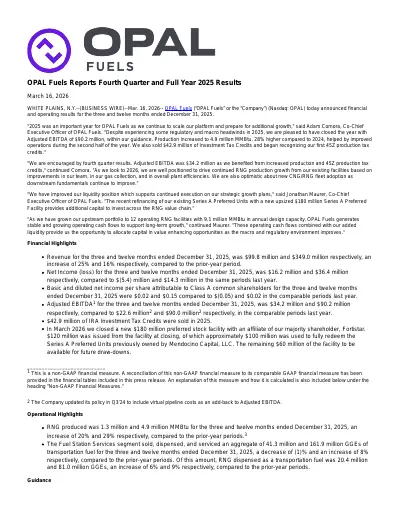
Our 2025 results demonstrate the strength of our platform. In the fourth quarter, revenue was $99.8 million, and adjusted EBITDA was $34.2 million, compared with $80 million and $22.6 million in the same period last year, driven primarily by increased production and recognition of 45Z tax credits.
For the full year, OPAL generated adjusted EBITDA of $90.2 million, essentially flat year-over-year despite declining environmental credit prices. D3 RIN pricing declined roughly 70 cents, equivalent to approximately $33 million in adjusted EBITDA, with our realized RIN price averaging $2.45 in 2025 compared to $3.13 in 2024.
This decline offset much of our operational progress achieved during the year. I'd also remind the listeners the ISCC pathway, which expired in November 2024, contributed in excess of $10 million to adjusted EBITDA in 2024.
Operational growth across the platform helped offset these headwinds. RNG production reached 4.9 million MMBtu in 2025, representing 28% growth year-over-year, with fourth-quarter production exceeding 1.3 million MMBtu, up approximately 24% from the fourth quarter of 2024.
As recently commissioned facilities moved through their first full year of operation, including a full year of Atlantic in 2026, we began to see the benefits of scale and EBITDA flow through embedded in the platform. Our Fuel Station Services segment continues to strengthen the stability of our earnings mix.
In 2025, segment EBITDA increased to $46.7 million from $38.4 million in 2024, 22% higher than 2024. Although this segment exhibited strong growth in 2025, it was below our guidance primarily by deferred investment decisions by our fleet partners regarding new stations and new truck purchases.
This quarter's results also reflect a restatement of our SG&A presentation, where facility-specific SG&A is now allocated to operating segments rather than corporate. We restated 2024 for comparability and will apply this approach going forward as we believe it better reflects segment economics.
Turning to liquidity and capital deployment. We ended the year with $184 million of total liquidity, including approximately $30 million of cash and short-term investments, $138 million of undrawn capacity under our term facility, and $16 million of revolver availability.
Capital expenditures and investments in joint venture projects for the quarter were approximately $16 million, primarily related to new RNG facilities and OPAL-owned fueling stations, and $90 million for full-year 2025. In 2025, we monetized approximately $43 million of investment tax credits.
Our current liquidity is further bolstered by the recent closing of $180 million Series A preferred facility, operating cash flow, and drawdown of the remaining $128 million of availability under our term loan facility. Looking ahead, we are providing 2026 adjusted EBITDA guidance of $95 million to $110 million, representing approximately 14% growth at the midpoint compared to 2025.
We expect RNG production between 5.4 million and 5.8 million MMBtu, representing more than 14% growth versus 2025, driven primarily by improved performance from our existing asset base, continued ramp of recently commissioned projects, and marginal contributions from projects entering service during 2026. Our guidance also considers what has been a challenging winter to start 2026.
Additionally, we are assuming approximately $15 to $20 million of 45Z credits during the year. Stepping back, our financial strategy remains clear.
We are focused on growing operating and free cash flow and allocating capital within the capacity of our operating cash flow, balance sheet strength, and access to capital markets. OPAL is generating an increasingly balanced and durable earnings base with the flexibility to accelerate growth where returns justify it.
With that, I'll turn the call back over to John for closing remarks. John?
Jonathan Maurer
In closing, we remain well-positioned for continued disciplined execution of our strategic growth objectives and the expansion of OPAL's vertically integrated platform. With that, I'll turn the call over to the operator for Q&A.
Thank you all for your interest in OPAL Fuels.
Operator
Thank you. As a reminder, if you would like to ask a question, please press *11 on your telephone.
You'll hear that automated message advising your hand is raised. We also ask that you please wait for your name and company to be announced before proceeding with your question.
One moment while we compile the Q&A roster. Our first question for today will be coming from the line of Derrick Whitfield of Texas Capital.
Your line is open.
Derrick Whitfield
Good morning, all, and congrats on a strong year-end update.
Jonathan Maurer
Thanks, Derrick.
Kazi Hasan
Thanks, Derrick. Good morning.
Derrick Whitfield
Starting with liquidity and your growth outlook on slide six, with the preferred financing behind you, could you speak to what the next phase of growth looks like for OPAL beyond the projects that are currently in your development queue? If you could also just comment on how much CapEx is required to bring those projects in your development queue online.
Adam Comora
Thanks, Derrick. This is Adam here.
Maybe I'll start, and then if Kazi or John want to fill in. I think hopefully most saw that we updated our liquidity position on March 10th and currently have about $160 million liquidity available to complete the projects that we had noted that are in construction.
It's about 2.8 million MMBtus of in-construction projects and some fuel station services, fueling stations as well. In addition to that liquidity position to complete what we've announced, we've also got $60 million unused drawn capacity on the preferred facility plus operating cash flows that continue to grow and is also available for new capital deployment.
We've got a number of robust project opportunities between new biogas rights, conversion projects on our renewable power. What we're really getting excited about is allocating more capital to the fuel station services business.
If you just look at what's in construction today and what that could contribute to EBITDA and cash flow, I think we always talk about rough guidance of $20 per MMBtu of EBITDA and cash flow from RNG production. If you do the math on what we've got in construction and earmarked with that 160 of liquidity that's available today, based on how these things come out of the gates, that could be another 2 million of production in their early days of production.
We think we're in a really good spot to grow our EBITDA and operating cash flow from what we've announced so far. We've got a number of projects on the upstream side that we think are really good candidates to deploy and invest capital.
Where we are always going to be mindful of our balance sheet and making sure that our liquidity and leverage ratios stay lockstep for the cash flow generation of the business. You should expect us to talk about some new projects on the RNG production side, and we're really hopeful and optimistic that a larger part of our capital will be getting deployed into fueling stations.
As I know there'll be some questions later on fleet conversions and what our outlook is there. You should think about OPAL Fuels as a growth company.
If you look at our four-year track record, we think we've got the capital in place and operating cash flow to continue to grow in those sorts of fashions as you look at us over the next several years.
Derrick Whitfield
Great. Then maybe perhaps for John, you guys accomplished a nice increase in your inlet utilization levels in 4Q.
Could you speak to some of the drivers and also highlight where you expect utilization levels to level out based on some of the captured opportunities Adam referenced in his prepared remarks?
Jonathan Maurer
Sure. Thanks for the question.
We're really proud of the team that we've been building on the operations side. We've been growing our capabilities both on the upstream and downstream side, and I think this is reflected over the course of the year.
First, in terms of the operations of these projects and that we measure through the efficiency and availability of the projects, which has increased over the course of 2025, kind of from the 70-ish percent level closer to the 80% level now that we're seeing. Really strong kudos to the team for doing that.
In terms of where we're headed with it and what the possibilities are, we really see the opportunity for continued improvement there, and we think about kind of an 85-86% utilization level as something that ought to be readily achievable, and in certain instances, we are able to beat that as well. You combine that utilization with our open and growing landfills that our projects are located on as well as the headroom for additional capacity, the projects are larger than the amount of gas coming out.
As a result, we see growth not only from operating the projects better, but also from the growth in the gas. That gives us a lot of optimism in 2026, and really you've hit on kind of a focus of ours this year where we're really going to be, I think, very focused on growing that utilization, growing the gas, and resulting in better output per project for each of the projects and for the whole portfolio in total.
We're looking forward to that. Thanks.
Derrick Whitfield
That's great, guys. Sounds like it's very capital-efficient growth for you in '26.
Operator
Thank you. One moment for the next question.
Our next question is coming from the line of Matthew Blair of TPH. Your line is open.
Matthew Blair
Thank you, and good morning, everyone. Maybe just to stack on to the last question, are there any specific examples of things that you're changing going forward to help improve operations?
Are there any specific assets where you're really looking to improve the overall utilization? Then also, I think there was a comment that most of the growth is coming from the existing asset base, but I just want to check, are Cottonwood and Burlington, are those still expected to start up in 2026?
I guess the idea would be that due to the ramp process, that wouldn't help out too much on 2026, that would really help out more on later years. Is that the right way to think about it?
Thank you.
Jonathan Maurer
Yep. Thank you very much.
First off, most of the growth in output that we're looking forward to this year is coming from the same-store sales. We've really incorporated very little from those projects into our guidance.
While we do continue to focus on those projects in construction and bringing them online, as I said, I think our focus really more is on operating efficiencies and availabilities for our existing projects. In terms of some specific examples, some of our projects, for example, have no nitrogen rejection units associated with them.
In projects like that, we're probably more focused on tuning gas to a higher quality methane, lower amount of nitrogen, oxygen. For other ones with nitrogen rejection, we're focused on increasing the amounts of the gas there.
In terms of the teams themselves, we're really focused on just training across the platform in each of the units. These are process-driven projects, and the processes require a balance across the quality of the gas, the quantity of the gas, the membrane, CO2 rejection, the nitrogen rejection, PSAs, etc.
Balancing that is, I think, been a bit of a learning process for the team over the last couple years, and that's why we're seeing the continued improvement there. Other projects that are closer to or at their nameplate capacity in terms of gas, we're really focused on again improving the quality of the inlet gas there so that whereas, for every unit of gas that comes in, if you have more methane in that unit of gas, then you'll have greater output.
We're focused on those aspects as well. We just see that focus continuing during the course of the year with our output increasing.
Adam Comora
I would just add there, this is Adam. There are no significant delays in either of those two projects.
We just think it's best to be conservative in terms of the exact timing and the exact ramp. We've focused our guidance around just improving the operations at the existing facilities.
Matthew Blair
Okay. Sounds good.
Thanks for the color. Then could you talk about the relationship going forward with NextEra?
They called the preferred, but I think they also have an equity ownership in OPAL and then a fairly extensive commercial relationship with you. Is anything changing on those fronts?
Adam Comora
I'll take that one on. NextEra's been a terrific partner of ours for a long period of time.
We do still work with them quite closely on that environmental credit trading agreement that you referenced. They still are 50% owners in our Noble and Pine Bend projects.
We continue to work with NextEra, continue to view them as a good partner. We advocate side by side with them on a lot of key issues, and don't see anything really materially changing from that perspective at this point.
Matthew Blair
Sounds good. Thank you.
Operator
Thank you. One moment for the next question.
Our next question will be coming from the line of Ryan Pfingst of B. Riley Securities.
Your line is open.
Ryan Pfingst
Hey, guys. Thanks for taking my questions.
Just curious about a KPI you've referenced in the past. Do you have a goal for how much MMBtu capacity you'd like to place into construction in 2026?
Adam Comora
This is Adam here, and I appreciate the question. We do see a significant, strong pipeline of new project opportunities to place into construction, both from new greenfield biogas rights that we've secured and also renewable power conversion projects, which we have a few sizable ones in our portfolio.
As I was trying to reference in an earlier question, we also see other opportunities on our Fuel Station Service segment to invest in fueling stations. We also see opportunistic M&A opportunities.
We will continue to invest capital in our business, being mindful of our balance sheet strength and liquidity. We just feel like as we're allocating capital across those different segments or different opportunities, may not be all on the production side.
It may be in these other areas of our business, which, by the way, there's so many reasons why we like the Fuel Station Services segment, between diversity of earning stream, between open-ended growth opportunity, where we think diesel to CNG could be really an interesting economic, large growth potential, and a little diversity away from some of the regulatory policy out there. We don't think it's really wise just to talk about one segment for where we're investing capital, but we do expect to put more RNG projects into construction.
Look, we have a large RNG production growth profile just from what we've announced already. That's how we're sort of thinking about it.
You should expect us to continue to invest in production assets.
Ryan Pfingst
Appreciate that color. Then leads up to my follow-up, which is around CapEx and that number for '26, looks like $154 million this year.
I was curious if you could give us a sense of the breakdown between RNG projects and fueling stations there.
Kazi Hasan
Let me give you a bit of a carryover from what Adam just mentioned. The $154 million primarily committed construction projects we have, and a little bit of a committed downstream dispensing station investments as well.
Lion's share production and a little bit smaller part the dispensing station. Now, I want to reiterate that, as you have heard from Adam, we would prefer to not provide a guidance specifically around where we are going to make the most of our investments.
I think every investments will be competing for the dollar that's available from our capital, operating cash flow, and the future capital availability from the capital markets. I think we're going to be a little bit more judicious.
That's where I'm going to end it.
Ryan Pfingst
Understood. I appreciate it, guys.
Operator
Thank you. One moment for the next question, please.
The next question will be coming from the line of Adam Bubes of Goldman Sachs. Your line is open.
Adam Bubes
Hi, good morning. Sounds like you're seeing some green shoots in fuel station services, but as you alluded to, because of the lag, that's maybe a 2027 story.
What level of growth are you embedding in guidance for fuel station services in 2026? Is low 20s the right way to think about margins in that segment on a sustained basis or any levers for margin expansion?
Adam Comora
Adam. This is Adam here.
A couple of things. Yes, you are correct.
There's always just like on our RNG project investments that take 18 months or so on average, when you invest the capital to when you start recognizing revenues and EBITDA and cash flow. Fuel station services has a slightly shorter cycle to it when we invest in new fueling stations.
We really think of 2026 as the biz dev activity that sets the stage for future growth. Our 2026, we aren't anticipating the same levels of growth in fuel station services that we've experienced after the next several.
We are really excited about some of those green shoots. We can go into what were those macros, where we see them alleviating, and some interesting, sort of market structure dynamics that we think we're breaking through there.
As for margin expansion, it is, from a margin perspective, higher-margin business when we own fueling stations, dispense RNG at those stations versus typical construction and service margins. We do anticipate, as we own more fueling stations, that the margins will naturally move higher in that segment, and that's where we see a lot more of the growth coming.
Adam Bubes
Then maybe as a—
Adam Comora
Oh, yeah. Kazi has a follow-up.
Sorry.
Kazi Hasan
I just want to follow up on Adam's. When we do the Fuel Station Services capital investments, we definitely rely on a base level of dispensing volumes.
In more cases than not where we see that embedded growth in those fuel dispensing and which, similar to that we have the growth in the production in the upstream side, we also do see the throughput going through these stations in the downstream side as well. There are similar type of growth embedded in there, and we do expect that to be realized.
Adam Comora
Yeah. You also understand that there is certain intersegments where there has been a tightening in the dispensing market, which also assists in margins on the fuel station service side.
Adam Bubes
Then maybe as the natural follow-up there, based on your conversations with customers, what you're seeing in the macro environment, what is giving you that underlying confidence and visibility on a potential inflection in 2027 and potential rise in natural gas vehicle adoption?
Adam Comora
No, I appreciate that question. It is something that I think about quite a bit as I look both to the US market and I think about what's happening overseas in places like China, which, by the way, China I think is deploying about 30,000 natural gas engines, the X15, each year, and China's on a path to have their heavy-duty trucking move up to 20-25% of their fuel mix.
We haven't gotten there yet in the US. We're at about 2%, which is really interesting when you think about it given the position the US has in natural gas as a commodity and the low cost and stable nature of that versus diesel and oil.
Specifically in 2025, there were macro headwinds that were affecting some of our largest customers in the logistics and trucking space. Started off being tariffs, a continued freight recession.
We had some regulatory overhang on combustion engines. We also had initial testing of the X15N-liter engine.
All of those factors did delay some investment decisions either around deferred new truck purchases or new station purchases. We think as we're now moving into 2026, a lot of those fleets have started acclimating to the macro environment and started thinking about new truck purchases and that sort of thing, and they're re-engaging.
You've now moved through the X15N testing phase, the fleets are more comfortable with the technology and the performance. The volatility and absolute price that folks are starting to see in diesel and oil is really making natural gas a lot more attractive.
Then you layer into the fact that it also assists those that are thinking about their sustainability metrics or emissions profiles and that sort of thing. It's really setting up for what we think some investment decisions here in '26 around this technology.
CNG and RNG have really proven themselves out as something that works for the fleets. Those are some of the things that have either alleviated or some new potential positive macros with what we've seen with diesel and oil prices.
One thing that's interesting about the US versus China is sort of the market structure, where here in the US, you still have to work through not only the engine price, the OEMs, and the dealerships in order to get that product to market. We're encouraged that a lot of those things are starting to break through.
One other interesting one here in the US I'll touch on is fuel surcharges, where the economics look pretty good on paper. Then fleets have to think about, okay, how do I deal with fuel surcharges and make sure that it doesn't disrupt how they're doing business.
We are seeing a movement across that whole spectrum of either macros or market structure here, and we are cautiously optimistic that biz dev activity will accelerate here in 2026 and then really provide some visibility into 2027 and beyond.
Adam Bubes
Very interesting. Thanks so much.
Operator
Thank you. If you would like to ask a question, please press *11 on your telephone.
One moment for the next question. Our next question is coming from the line of Betty Zhang of Scotiabank.
Your line is open.
Betty Zhang
Thanks. Good morning.
Thanks for taking my question. In your opening remarks, you mentioned the RFS.
Just wanted to get your take on the cellulosic side. Do you expect any impacts on D3 RINs, and just what your expectations are there?
Adam Comora
No, I appreciate that question. This is Adam again.
I think, as we had noted and people probably saw, the EPA did send their final rule over on '26 and '27 to OMB. We hope that recent geopolitical events don't slow down the process, as we have seen a little bit of an oil price shock and that sort of thing.
We hope that the EPA still sticks to ordinary course of business timing and it gets released pretty soon. What I'd say about the cellulosic category is we feel really good about the bipartisan support that we've got in the Congress as it pertains to tax policy and how they view RNG, sort of in the spectrum of smart or pragmatic policy on where folks should invest and that sort of thing.
What I would say is it still feels like the cellulosic category maybe isn't getting the same level of intention as liquid agricultural biofuels, where it seems apparent that there is clear focus to support those areas and really lean in. I would say from the cellulosic category, it's not a lean-out, it's not a lean-in, it's sort of business as usual.
I'd say I don't think we're really expecting any real surprises there, and though we sort of think the cellulosic category remains stable. As I said in the prepared remarks, there could be an upward bias to the D3 in the cellulosic category with the entire biofuels complex.
Just doesn't feel like it's the area of focus, and there are other areas where the EPA may be trying to emphasize.
Betty Zhang
Great. Appreciate the detailed answer.
For my follow-up, I wanted to ask on 2026 EBITDA guidance. Would you be able to share a bit more color between your different segments?
Adam Comora
No, I'm going to pass it over to Kazi in a moment here. No, because that'll also be driven by where we invest capital and that sort of thing.
We're not giving specific segment guidance, and I'll pass it over to Kazi. One thing I do want to caution folks to is the challenging operating environment that we've experienced so far in the first quarter, and I know there's another wave of storms that's rolling through right now.
It was factored into our guidance, but there was a challenging start to the year between the snowstorms, which impacts production a little bit and impacts your operating costs a little bit. We don't give specifically quarterly guidance, but I just wanted to caution folks on the first quarter.
I'll pass it over to Kazi.
Kazi Hasan
Thanks a lot, Adam. This is a great question.
I think we've got to sort of express this. More of a hard winter obviously is going to have an impact on our upstream production and likely going to be also how much we are dispensing through our dispensing network, too.
For the year, I would say is think about how much of the growth we have seen on upstream productions, similar type of growth we can expect. Downstream obviously, 2026, as Adam mentioned, it's going to be a bit of a more pivoting year for downstream.
Most likely, the growth would be somewhere around in 2027 onwards. I would stay away from giving a specific guidance, but you can look at our existing breakdown.
That should give you an understanding where we're heading.
Betty Zhang
Thank you.
Operator
Thank you. I'm not showing any more questions in the queue.
I would like to turn the call back over to Adam Comora for closing remarks. Please go ahead.
Adam Comora
No, we appreciate everybody logging in today, their interest in OPAL Fuels. We look forward to sharing more updates in the future.
Operator
This does conclude today's programming. Thank you all for joining.
You may now disconnect.