Owlet, Inc.
NNYSE:OWLTQ2 FY2026 · Earnings Call TranscriptAugust 11, 2026
Operator
I will now hand the conference over to Jay Gentzkow, Investor Relations. Jay, please go ahead.
Jay Gentzkow
Good afternoon, everyone, and thank you for joining us. Earlier today, Owlet released financial results for the second quarter ended June 30th, 2026.
I'm pleased to be joined today by Kurt Workman, Owlet's President, CEO, and Co-Founder, and Amanda Twede Crawford, Owlet's CFO. Before we begin, please note that our financial results press release and presentation slides referred to on this call are available under the Events and Presentations section of our Investor Relations website at investors.owletcare.com.
This call is also being webcast live with a link at the same website. The webcast and accompanying slides will be available for replay for 12 months following this call.
The content of today's call is the property of Owlet. It cannot be reproduced or transcribed without our prior consent.
Before we begin, I'd like to refer you to our safe harbor disclaimer on slide 3 of the presentation. Today's discussion will contain forward-looking statements based on the company's current views and expectations as of today's date.
These statements are only predictions and are subject to certain risks and uncertainties that could cause actual results to differ materially from those expressed or implied by such statements. These risks and uncertainties include, but are not limited to, those described in our most recent filings with the SEC and in the risk factors section of our annual report on Form 10-K, as updated in the company's quarterly reports on Form 10-Q and other filings with the SEC.
Please note that the company assumes no obligation to update any forward-looking statements whether as a result of new information, future events, or otherwise, except as required by law. With that, it's my pleasure to hand it off to Kurt.
Kurt Workman
Thanks, Jay, and good afternoon, everyone. Thank you for joining us.
Before we get to our record Q2 results, I want to step back and discuss where we are taking this business, the platform we're building to support the parenting journey, and the opportunity we see over the coming years. Every day, Owlet is evolving more and more into a data and services platform for the earliest years of a child's life.
Our products capture meaningful and unique information about a baby's sleep and health, turning that data into insights, guidance, and peace of mind for parents. Our vision is to bring together the best of what parents use today into a single Owlet experience: sleep, health monitoring, camera, and telehealth for a fraction of what separate apps and devices cost today.
Over time, we want all of our customers to get the best of what Owlet's platform has to offer, because engaging with Owlet increasingly means engaging with the service, not just the device. That leads to how we're thinking about the opportunity, and I want to keep our objectives simple.
First, firmly position Owlet as a data and services platform through subscription. Second, win roughly 1 million new customers per year.
Third, keep those families with us for at least 2 years. Put those together, and it points towards a recurring base over time of over 1 million subscribers.
This is the evolution from a one-time hardware-centric sale into a durable, multiyear subscription relationship. It's what the entire company is now organized around.
Let me give some more color to each. First, firmly position Owlet as a data and services platform through subscription.
Subscription is how we're positioning Owlet from a device families buy into a platform they rely on. We've clearly validated the subscription opportunity since launch early last year.
Today, over 30% of new US customers subscribe to Owlet 360 in the first year. This is an ideal category for a multiyear relationship, since the intensity of parenting lasts for years, not just months.
Our goal is to make subscription the obvious choice. We're expanding where parents can enroll, moving beyond in-app sign-up and toward the point of sale, and testing offers and bundles that make enrolling in subscription at purchase a no-brainer.
Another lever in subscription value proposition is inside Owlet 360 itself. Every new feature we add to sleep insights, camera intelligence, and telehealth enables us to partner with families for longer and is designed to extend our lifetime value.
Second, win roughly 1 million new customers per year. This year alone, Owlet will sell to 600 to 700,000 new customers.
Owlet's competitive moat gives us a dominant and secure position in our category. We're the first and only FDA-cleared baby monitor on the market.
We're consistently the market leader in dollar spent in the category, and we've built a brand that parents deeply trust in a pediatric health and wellness market that's still early. Given the size of our funnel, the consideration for Owlet is already massive.
Each year we see roughly 4 million unique visitors to owletcare.com and over 1 million baby registry additions. The opportunity isn't to invent demand; it's to convert more of the demand that already exists into new customers.
Millions of parents are already considering Owlet, and our job is to move more of them from consideration to purchase. Subscription is what makes this possible, because a subscriber's lifetime value is designed to extend well beyond the initial sale.
We're creating offerings that increase overall value, save families money up front, and still grow the economics of each customer over time. That is a winning funnel to drive conversion and LTV simultaneously.
Finally, keeping families with us for at least 2 years. Today, the average subscriber length of use is about 1 year.
Our goal is to continue to make Owlet more valuable the longer a family uses it, carrying them past the newborn window when safety is top of mind into years 1 and 2 when sleep, health, and wellness take focus. Owlet 360 subscription is the vehicle, a digital translator that turns real-time data from our products into insights for parents.
Many already use the camera well beyond 24 months, delivering the best of Owlet to every family naturally extends lifetime value. Underneath it all is what we believe is the largest pediatric health dataset in the world.
That foundation enables us to build increasingly personalized experiences across sleep, health, and wellness using AI to turn data into meaningful insights and guidance throughout the parenting journey. That's a very hard thing to walk away from.
Our long-term objective is to build toward a recurring base of more than 1 million subscribers by expanding our customer base, increasing subscription adoption, and extending subscriber relationships. Now turning to the second quarter update on slide 7, where we set records on many metrics.
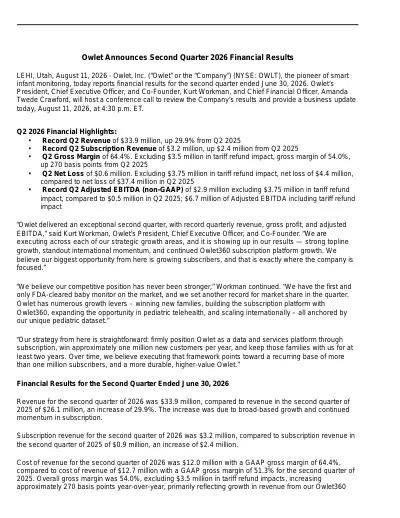
A record-breaking total revenue for the second quarter of $33.9 million, which represents 29.9% increase year-over-year. In the second quarter, Owlet received approximately $4 million in tariff refunds following the US Supreme Court's February decision invalidating tariffs imposed under the IEEPA.
Of that $4 million, we recognized a one-time $3.5 million benefit to COGS and a one-time $3.75 million benefit to adjusted EBITDA, with the remaining balance going to inventory. Q2 gross margin excluding the tariff refund was 54%, expanding 270 basis points versus Q2 2025.
Including the tariff refund, gross margins were 64.4% in Q2. Adjusted EBITDA excluding the one-time tariff refund was also a record for Owlet, $2.9 million, a $2.4 million increase compared to prior year.
Including the tariff refunds, adjusted EBITDA was $6.7 million. Owlet 360 subscription continues to thrive.
We ended Q2 with 130,000 paying subscribers, generating $3.2 million in revenue, up $2.4 million year-over-year. Subscription MRR increased sequentially, surpassing $1.1 million to end Q2.
Penetration rate for Dream Sock in the US increased to 36%. I'm really proud of the team's execution in Q2 and excited about our category leadership, which continues to deepen.
I want to address that with a recent development in our category that highlights our competitive differentiation. As you remember, in September of last year, the FDA issued a safety communication warning consumers against using over-the-counter infant monitors making unsubstantiated claims without having been reviewed for safety and effectiveness.
In early June, we received a letter from Amazon, and we're confident other companies in the baby monitor category did as well. The letter notified sellers of baby monitoring products that measure and monitor vital signs that any such product lacking FDA clearance would be deactivated on Amazon's platform effective August 10th, 2026, which was yesterday.
For Owlet, no additional action was required. Dream Sock has been and continues to be FDA-cleared, and Amazon already had our clearance documentation on file.
To our knowledge, no other baby monitor on the market today has secured this same clearance. If Amazon continues to enforce this requirement, we believe it could provide a longer-term competitive benefit for Owlet, as any company wishing to measure and monitor vital signs would need to go through the same rigor we underwent to secure FDA clearance in order to sell on Amazon's platform.
Following the letter, we observed aggressive discounting by several competitors, including products that we understand are subject to the new requirement ahead of the August 10th deadline. This pattern continued through Prime Day and after.
As a result, Owlet's units sold during Prime Day were down 8% versus last year's event, underperforming our expectations. Despite losing some units to the competition during Prime Day, we were still number one in baby monitoring and in the baby safety category.
We don't yet have full visibility into competitor pricing behavior post-August 10th deadline, but we anticipate Amazon's enforcement to be a long-term tailwind for the business. Continuing with the quarterly review, consistent with last quarter, I'd like to provide updates on our two core growth drivers: driving adoption of Dream Sock and Dream Duo in our core global markets, and expanding the subscription platform with Owlet 360 and Owlet On Call.
In the US, when adjusting for the shift in Prime Day, total sell-through units grew by 12%, including a 16.5% increase in Dream Sock and a 16% increase in Duo. Excluding Prime Day, Q2 total sell-through units grew by 20% year-over-year, with Dream Sock and Duo growth of 21% and 29%, respectively.
This gives us confidence that general sell-through is growing at a healthy rate, but Prime Day dynamics weighed on the quarter, as mentioned above. Owlet Dream Sock also remains a registry priority for expecting parents, with year-over-year registry additions growing 40%.
Finally, international was a standout in the quarter, with revenue growing 214% year-over-year. Recall that last year we had an unexpected timing shift in orders from Q2 to Q3 driven by the Dream Sight camera and Duo launch and the associated load-in to our distributors, positioning Q2 2025 as a favorable year-over-year comparable.
However, we also saw significant global momentum in the quarter. Excluding the Q3 2025 quarter that benefited from the significant load-in for the new camera, Q2 2026 was the highest international revenue quarter in Owlet history at $5.7 million.
This is further supported by strong international sell-through. Total sell-through unit growth was 38% year-over-year, and Prime Day sell-through outside of the US grew over 100% year-over-year.
Turning to Owlet 360 and Owlet On Call. We made real progress on the subscription platform this quarter.
We launched Owlet 360 subscription in a number of new, non-English-speaking international markets, now reaching an additional 5 to 10% of our user base that previously could not subscribe. We also began testing web pay, moving subscription enrollment and billing onto our own web-based checkout.
We will be rolling web pay out in Q3 and expect over time to improve our subscription margins by reducing the third-party payment fees we pay on in-app purchases, and it gives us more flexibility to enroll subscribers right at the point of purchase. Related, we began rolling out upfront subscription: the ability to sign up for Owlet 360 at the moment of purchase rather than later in the app.
It's already live on our own website and will be going live with Babylist soon. We also expect to offer subscription bundles to retail partners in the second half.
Our goal is to continually optimize the LTV per customer. Turning to Owlet On Call.
This remains a deliberate test-and-learn year to explore how Owlet can best bring our unique position in the category to pediatric telehealth. We launched with around 5% of users with access to on-call service, and now in Q3 we have begun to carefully expand access more broadly.
Where we are taking Owlet On Call is toward a more seamless and proactive experience that can help parents connect with clinical resources when appropriate. We're being intentional here, learning from real usage before we expand and begin to automate the offering.
We'll share more as we go, as we continue to believe this year's learning set up for a meaningful new revenue stream as we move into next year. It's an exciting time to be part of Owlet.
We are executing across our strategic growth areas, and it is showing up in our results: record revenue, standout international growth, and ongoing Owlet 360 momentum. We believe our biggest opportunity from here is growing subscribers, and that is exactly where we are focusing the company.
I'll now turn the call over to Amanda and walk through our Q2 financials. Amanda, take it away.
Amanda Twede Crawford
Thanks, Kurt. Turning to our second quarter 2026 financial performance on slide 11.
Unless noted otherwise, I will be comparing Q2 2026 to the results of Q2 2025. Q2 total revenue was a record of $33.9 million, up 29.9% year-over-year.
Growth was broad-based with strength in Dream Sock and Duo, and strong international performance and continued momentum in subscription. Subscription revenue grew to a record $3.2 million, up $2.4 million year-over-year as our Owlet 360 base continued to expand.
Q2 overall gross margin was 54% including the tariff refund, up approximately 270 basis points versus the prior year. Including the one-time $3.5 million tariff refund allocated to COGS, Q2 overall gross margin was 64.4%.
Subscription gross margin expanded again sequentially to 68.4%. Total operating expenses for the second quarter were $20.1 million compared to $15.1 million in the prior period, or approximately 59% of revenue.
The year-over-year increase was primarily driven by higher marketing spend as Prime Day promotional timing shifted from Q3 to Q2, as well as severance costs, including stock-based compensation. We remain committed to raising our level of operational efficiency and financial discipline through the balance of 2026.
Excluding the tariff refund, we experienced an operating loss of $1.8 million. Including the tariff refund, we saw operating income of $1.7 million.
Adjusted EBITDA excluding the one-time tariff refund was a record $2.9 million compared to $0.5 million in the prior year. Including the tariff refund, adjusted EBITDA was $6.7 million.
I want to note that our financial statements will include routine, immaterial revisions to prior-year amounts across certain line items, including revenue and operating expenses. I want to emphasize that these immaterial adjustments have no impact on our cash balance or cash flows.
Complete details will be provided in our upcoming Form 10-Q filing. During the quarter, we entered into a new $25 million asset-based revolving credit facility with Wells Fargo that refinances and replaces both our prior asset-based facility and term loan.
The new facility significantly reduces our cost of capital, lowering our interest rate margin to SOFR plus 2 to 2.25%, down from SOFR plus 7.5 to 8.5 under the prior asset-based facility, a reduction of at least 525 basis points. We expect this to meaningfully lower our annual interest expense going forward, including no minimum interest requirement.
These improved terms reduce our cost of capital and provide additional flexibility to continue investing in our strategic priorities while maintaining a disciplined approach to capital allocation. Turning to our balance sheet.
Cash and cash equivalents excluding restricted cash were $30.9 million as of June 30th, 2026, versus $35.5 million in the prior quarter, March 31st, 2026. The change in cash was primarily due to $2.7 million in debt payoff, CapEx investments, and working capital timing.
Combined with $7.5 million of availability under our new credit facility, total available liquidity was approximately $38.5 million. Turning to our guidance.
We are pleased with our first half performance, including a strong second quarter. At the same time, we are taking a deliberately measured view of the second half given the aggressive competitor discounting prior to the August 10th Amazon deadline and not having full visibility into competitor behavior post-deadline.
In addition, we are observing some broader macro signals we want to be cautious about. Prime Day's baby monitor category was down versus last year, with consumers appearing to spend more cautiously and prioritizing everyday essentials.
This is in line with what we've recently observed, with the category being roughly flat or down versus prior year for the last several large Amazon promotional events. For those reasons, rather than extrapolate our second quarter outperformance across the year, we believe it is prudent to absorb that near-term pressure within our existing range.
For the full year 2026, we are reaffirming our revenue outlook of $118 to $122 million. For Q3, we expect to decline both sequentially and versus Q3 2025, reflecting that deep competitor discounting discussed, together with a challenging comparison against last year's Dream Sight camera and Duo launch.
For Q4, we have two large events, and given our caution regarding the promotional event dynamics, we are maintaining our Q4 forecast. On gross margin, we are raising our full year outlook to a range of 53 to 55% from 50 to 52%, which reflects only the one-time $3.5 million reduction in COGS in the second quarter as a result of the tariff refund.
The tariff rate assumed in our second half guidance is 12.5%. We are not forecasting additional tariff refunds for 2026 nor repayment risk of the Q2 tariff refunds at this time.
Finally, we are raising our full year adjusted EBITDA outlook to a range of $10.75 to $12.75 million from $7 to $9 million. This increase reflects only the one-time $3.75 million tariff refund recognized in the second quarter.
Excluding the tariff refund, our underlying expectations for the year are essentially unchanged as we remain focused on driving operational efficiency and profitable growth. With that, we will now take your questions.
Operator
We will now begin the question-and-answer session. Please limit yourself to one question and one follow-up.
If you would like to ask a question, please press star one to raise your hand. To withdraw your question, press star one again.
We ask that you pick up your handset when asking a question to allow for optimum sound quality. If you are muted locally, please remember to unmute your device.
Please stand by while we compile the Q&A roster. Your first question comes from the line of Jonah Kim with TD Cowen.
Your line is open, please go ahead.
Julia Shalansky
Thank you, and good afternoon. This is Julia Shalansky on for Jonah Kim.
We have two questions this afternoon. First, we'd love to hear what has been the sell-through trends quarter-to-date and how is the gap between sell-in and sell-through at this point.
Second, could you update us on the attachment rates for subscription and what does retention look like as you continue to observe new cohorts? Thank you.
Amanda Twede Crawford
Thanks for joining, Julia. Just a quick clarification on that question.
Are you asking about Q3 quarter-to-date sell-in specifically or sell-through?
Julia Shalansky
Yes, that's correct. Yes, 3Q quarter-to-date, thanks.
Amanda Twede Crawford
Okay. First I'll take the other question while I pull up the data regarding Q3 sell-through.
From an attach perspective, so far what we're seeing with the subscription offering is that around 30% of parents are ultimately subscribing within that first year. We've shared as far as retention goes that we're seeing an average life of about 12 months for our subscribers.
Just a reminder that we launched about 18 months ago, we're just starting to see the cohorts mature.
Kurt Workman
I think what I would add to that, too, is that we're now seeing nearly 30% of new users in the trial period elect the annual plan, which is really exciting for us from an LTV perspective. We're seeing decent renewal rates on that plan, which is exciting.
36% of our whole sock customer base now has subscription. We're just getting started.
If you think about the cam feature rollout the second half, really exciting. That's more than half of our user base, and we're just starting on those features and AI capabilities.
They use the camera twice as long as they use the sock. It's half of the customer base using it twice as long.
It just represents a really big opportunity. Telehealth is expanding.
That's an exciting new position for us. The integration with AI and new AI features that are going into sleep and health and overall parenting guidance is creating a stickier and stickier product.
I think the second half you'll see more and more value released to the consumer. We're really excited about where we're at, and there's a lot of potential moving forward.
Julia Shalansky
Then just
Amanda Twede Crawford
regarding sell-through compared to last year is a little bit nuanced, especially if you're going back. I know that Jonah publishes the Nielsen data.
There's just a reminder that Prime Day shifted from Q3 to Q2 this year. Making year-over-year comparisons at this point is a little bit muddy in the quarter just because Prime Day last year was such a large quarter-to-date relative proportion of the quarter.
Operator
Your next question comes from the line of Steve Litman with William Blair. Your line is open, please go ahead.
Steve Litman
Thank you, and congratulations on the quarter. Kurt, I'm wondering, as telehealth continues to expand and you ratably grow that opportunity, how will this merge into 360 ultimately and be an additional driver of that subscription model?
I know they're separate now, but how are you thinking about that over the longer term?
Kurt Workman
That's a great question. I think when we think about telehealth, we think about it in tiers.
There's an element of telehealth in 360 today, obviously not connected to a doctor, but that gives parents additional health trends and health information. It allows them to share information with their doctor.
We're building out kind of the AI capabilities and automated features within 360. There will be another tier that gives access to physicians.
Right now it's on call that will morph and evolve as we test and learn this year. That's the purpose of this year: to make that more accessible, more affordable, and ultimately something that we want a majority of our users to be able to have access to.
When you look at the challenges with care for a newborn, so much of that is just a communication gap. When you chat with a pediatrician today without any data or context, and you tell them that your baby's congested, you're worried about their breathing, 100% of those visits turn into an ER visit if it's after hours or an extra pediatrician visit.
Now that we have FDA-cleared data at home that physicians can actually review and make decisions based on, we think it just totally changes the paradigm for at-home care and creates a new level of care, which is continued monitoring, routine data collection, and a check-in with a doctor from the comfort of your home. You're not exposing baby to more sickness.
There will be multiple tiers of telehealth. You'll have Owlet 360 and likely an Owlet 360 Plus plus the telehealth offering.
Steve Litman
That's helpful. Then just following up on the international strength, where are you seeing the most momentum today, and what do you see as the most ripe opportunities internationally looking out over the next few years?
Kurt Workman
I'm really excited about Europe. Europe continues to grow.
It's really very close to the pace that we set in the US if you look at year-by-year growth and penetration. Germany is expanding really well.
Everybody told us when we went into France it would take a few years and then you'd kind of see it spike. That's exactly what's happening.
We're seeing incredible growth in France. Eastern Europe is actually doing really well.
The Czech Republic and the countries around there actually have the highest penetration in terms of percent of parents that use monitoring. It's very similar to the US now, so that's really taken off.
Those are probably the areas that we're most excited about. Some of the longer-term markets like the UK and Australia and the Nordics continue to grow really well for us.
There's more babies born in Europe than the United States, and I just can't imagine a world where, as we say this all the time for the United States, every baby will have access to some sort of health-sensing technology when they leave the hospital. That's going to be just as true for Europe as it is for the US.
Steve Litman
Great. Thanks, Kurt.
Operator
Your next question comes from the line of Owen Rickert with Northland Capital Markets. Your line is open, please go ahead.
Owen Rickert
Hey, guys. Thanks for taking my questions here, and congrats on a pretty awesome quarter.
First for me, can you describe that AI parenting copilot offering for us? What does the product roadmap look like there?
How are you thinking about monetization? I guess, is this a feature within Owlet 360?
Is it separate or something else? Just anything there would be great.
Kurt Workman
I think the unique thing about Owlet is we're pulling together the most comprehensive and contextualized dataset of infant health that's ever existed. We've got obviously the largest set of biometrics.
We're bringing in access through the telehealth to health records and health interaction, parent logging and parent context, other device data, cross-device data between the sock, the camera, other devices potentially in the future. That becomes a very rich dataset that has a lot of context about your baby.
The more parents use it, the more context it has to help guide them. I can't imagine a world where Owlet has all of this rich context and I'm going to ChatGPT for answers about my baby, if that makes sense.
It's going to evolve over time. We're going to take the low-hanging fruits in AI and implement those quickly.
We have right now an AI morning report that takes all of your baby's sleep data, and just like a sleep coach would, it prepares a summary and gives recommendations for your child for that next day. It's really powerful.
85% of parents who use it engage with that daily and report that that's a really strong, powerful feature. That's just one example of taking this contextualized dataset and integrating it.
We see it as a component of Owlet 360. Owlet 360 may increase in price over time as we're able to grow the value.
We essentially want everybody on Owlet 360, and we want them to have an incredible experience that's really sticky over time that goes well beyond that first year.
Owen Rickert
Got it. Super helpful.
Then secondly for me, you mentioned Babylist as an upcoming channel for that upfront subscription enrollment. Are there any other retailer registry partners in the pipeline?
How important is the D2C channel versus third-party retail to the long-term subscription conversion strategy?
Kurt Workman
Babylist is unique because it's a gifting platform. That's the registry platform.
People are going on to get Owlet Duos. We generally see higher order values on Babylist than we see on our other platforms because gift givers are at a different stage of life.
We're selling annual memberships to 360. We'll bundle those memberships to Owlet 360 with the product so that grandparents can gift that to their kids.
You'll see that rollout across all of our retail channels: smart bundles like that, 360 being sold. It gives us a lot of flexibility in creating really smart offerings based on the consumer segment.
I think you'll see that continue to expand across all retail and especially on our website. We'll get smarter and smarter about optimizing that kind of live percentage versus LTV to drive growth for the business.
We want to meet parents where they're at. Registry is a big part of the parenting journey, and parents shop across all those retail channels.
That's where we want subscription to be. We want parents to think of Owlet as a service, not just as a product.
I think we're seeing that more and more come to reality.
Owen Rickert
Awesome. Thanks, guys.
Operator
Your next question comes from the line of Ben Haynor with Lake Street Capital Markets. Your line is open, please go ahead.
Ben Haynor
Good afternoon. Thanks for taking the questions.
First off for me, just thinking about the international subscription opportunities, I guess, are there any bigger countries that you're missing right now? I know you mentioned additional international subscribers were up 5 to 10% the availability, I guess it was there.
Maybe if you could just talk about that a little bit.
Kurt Workman
We've just completed the majority of our language translation and rollout for subscription across the majority of kind of our biggest markets and biggest countries. We feel like we're there in terms of availability.
Most of that rolled out at the end of the quarter. We should see some of those benefits in Q3 and beyond.
Ben Haynor
Fair enough. Then just curious on what subscriber count, called at year-end, does guidance embed or a range, anything that you can help with there would be?
Amanda Twede Crawford
We're not sharing a specific range as far as subscriber count goes. What we are considering is how we've been trending this year, and we've built that into our guidance in terms of subscribers.
Said a different way, if you look at the run rate and how many additional adds we've been seeing, essentially that's what we're modeling in our guide through the end of the year.
Ben Haynor
Fair enough. Then lastly on the web pay, does that take kind of the gross margin on subscriptions from kind of the 70% that you're able to get with or a little bit less out of the app stores to kind of mid to high 90s or what's the difference there?
Is it just credit card fees and that's it or is there more to it?
Amanda Twede Crawford
Essentially with the App Store, for the first 12 months of a subscriber life, we pay about 30% in fees. What the web pay allows for is for us to bypass those fees.
There's some small, immaterial credit card typical charges that are much more affordable in comparison. Then we have a small amount of software amortization for development costs, but it truly is something that would be significant to the margin.
I do have to remind, though, that a lot of our customers have already signed up through the App Store, it'll take time for that subscriber mix to change from an App Store purchase to web pay. This is something that will improve over time.
Ben Haynor
That's helpful. That's all I had.
Thanks for taking the questions, and congrats on the progress.
Operator
The next question comes from the line of [Ilya Kanekoza?] with Freedom Broker.
Your line is open, please go ahead.
Ilya Zubkov
Hi, Kurt. Hi, Amanda.
Thank you for the great quarter. I have one question left, and you have touched upon that quite slightly, and it's about web pay.
Web pay and upfront subscription at the point of purchase both went live this quarter and got one line each in the presentation deck you put. From where I sit, those look like the most economically significant things you announced.
Is that a fair read, or how are the early results tracking in that place?
Kurt Workman
That's a great point and a great call-out, actually. It is significant.
It may not be significant on this year's P&L because of what Amanda shared. It's going to take some time for the blend of our customer base to move toward direct web pay with Owlet.
It's significant for a few reasons over time: it expands our margin; it also allows us to essentially get the credit card at the point of purchase as people enroll in Owlet 360. They're pulling out their credit card once, not twice.
It has the ability to not only help us lift the overall percentage of our users that get Owlet 360, but increases the margin on Owlet 360, which is substantial and definitely substantial over time. That's right.
Ilya Zubkov
Thank you, that's it from me.
Operator
There are no further questions at this time. I will now turn the call back to Kurt for closing remarks.
Kurt Workman
Thanks again, everyone, for joining us. Just to wrap up, I'll leave you with the bigger picture.
Owlet has multiple clear pathways for sustainable growth: continuing to reach new families, expanding our recurring revenue through Owlet 360, scaling into our existing international markets, and growing the pediatric telehealth opportunity. We're well positioned for the road ahead, and we're excited about our momentum.
Very grateful for the continued partnership as we set the standard in pediatric care technology. Thank you, everybody, for being with us today.
Operator
This concludes today's call. Thank you for attending.
You may now disconnect.