PAVmed Inc.
NNASDAQ:PAVMQ1 FY2026 · Earnings Call TranscriptMay 15, 2026
Operator
Good morning, and welcome to the PAVmed first quarter 2026 business update conference call. At this time, all participants are in a listen-only mode.
There will be a question-and-answer session following the prepared remarks. Should you require operator assistance, please press *0.
Please note, this event is being recorded. I would now like to turn the conference call over to Matt Riley, PAVmed's Vice President of Investor Relations.
Please go ahead.
Matt Riley
Thank you, operator, and good morning, everyone. Thank you for participating in today's business update call.
Joining me today on the call are Dr. Lishan Aklog, Chairman and Chief Executive Officer of PAVmed, along with Dennis McGrath, Chief Financial Officer of PAVmed.
The press release announcing our business update and financial results is available on PAVmed's website. Please take a moment to read the disclaimers about forward-looking statements in the press release.
The business update press release and conference call all include forward-looking statements, and these forward-looking statements are subject to known and unknown risks and uncertainties that may cause actual results to differ materially from statements made. Factors that could cause actual results to differ are described in the disclaimer and in our filings with the SEC.
For a list and description of these and other important risks and uncertainties that may affect future operations, see Part I, Item 1A, entitled Risk Factors, in PAVmed's most recent annual report on Form 10-K filed with the SEC and any subsequent updates filed in quarterly reports on Form 10-Q and subsequent Forms 8-K. Except as required by law, PAVmed disclaims any intentions or obligations to publicly update or revise any forward-looking statements to reflect the changes in expectations or in events, conditions, or circumstances on which the expectations may be based, or that may affect the likelihood that actual results will differ from those contained in the forward-looking statements.
I would now like to turn the call over to Dr. Lishan Aklog, Chairman and CEO of PAVmed.
Lishan Aklog
Thank you, Matt, and good morning, everyone. Thank you for joining our quarterly update call today.
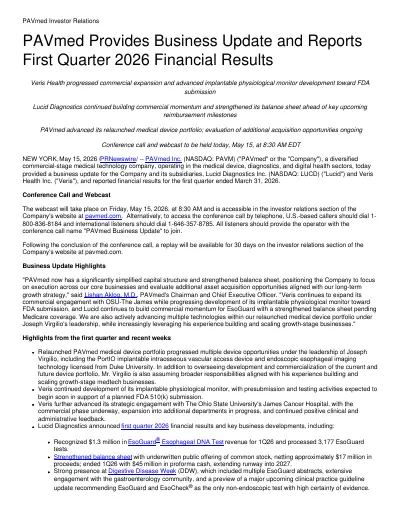
At our last business update call, we discussed the two-year process we undertook to permanently fix PAVmed's legacy capital structure and strengthen its balance sheet. The final step has been completed in the last couple of weeks, and the cap table is now clean.
Dennis will discuss this in more depth, but a cap table now just consists of common stock and term debt. With that, we now truly believe that PAVmed is really well-positioned to execute on its founding mission, for us to operate as a high-growth, diversified commercial life sciences company with multiple independently financed subsidiaries operating under our shared services model, and that we are well-positioned to [take?]
new opportunities that come along, and I'll talk a little bit about how that has accelerated since the restructuring took place. As we described on our last call, one major initiative that's followed this restructuring has been the relaunching of our medical device portfolio under Joe Virgilio.
He's been on board now and has hit the ground running. He's actively focusing on advancing multiple medical device opportunities, including PortIO and the endoscopic imaging technology we licensed from Duke under the Octeiris umbrella, as well as broader responsibilities across our entire medical device portfolio, utilizing his expertise in building and scaling early-stage businesses and raising capital for these individual medical device initiatives.
As I mentioned, the pipeline has definitely opened up. We are evaluating business development assets that are being brought forth to us.
We're on our second major diligence exercise. We did pass on the first opportunity, as attractive as it was, and we really do expect those to bear fruit and for us to be bringing in commercial assets into our portfolio.
Now let's move on to Lucid Diagnostics. Lucid is on the cusp of transformative milestones, including what we believe is impending Medicare coverage.
As we discussed on our previous call, we're awaiting Medicare. A bit of frustration that this has dragged on, but our confidence has not wavered, and I encourage you to listen to yesterday's Lucid business update call for greater details on this and other aspects of Lucid's business.
As a reminder, PAVmed remains Lucid's largest shareholder. Lucid's progress and upcoming major inflection points will benefit PAVmed.
Just a couple of highlights from the call yesterday, in addition to Medicare. It's clear that we're not remaining idle on the Lucid front.
As we discussed, the VA is off to a good start following us securing the Federal Supply Schedule and pricing. First orders are being placed, the pipeline is being expanded, and we look forward [to?]
revenue along that segment. We also discussed our direct engagement with commercial payers, that we have received positive coverage under one of the laboratory benefit managers, and that will be public soon.
Of course, with all that, Lucid was also able to successfully raise a round of capital that extended our runway well into 2027. Now let's move on to Veris.
As we discussed in our last call, Veris is now well into the commercial phase of our strategic engagement with the Ohio State University. That process is well underway.
The clinical rollout has been focused on the three clinical departments that had participated in the successful pilot study, and we're now on the cusp of adding additional departments according to our rollout schedule that OSU leadership developed in collaboration with us. As we announced last time, the EHR integration is now live.
It's working well, and just overall, the feedback, both on the clinical and administrative side, from our partners at OSU remains excellent, and we look forward to continuing to drive towards the targets that were established as part of our strategic partnership with them. Of course, a major focus right now is on the implantable physiologic monitor.
That development is progressing towards planned submission by the end of this year. As we discussed last time, we have a new contract development and manufacturing partner firm.
That partnership is going well, and that's Velentium, and the design and development efforts leading to design freeze and the transition to the final pre-submission development work and testing is going well. A lot of the recent efforts have been around the technical aspects of optimizing the battery life to get a full two-year two years of battery life, and we've made excellent progress on that, and look forward to continuing the work towards submitting by the end of the year.
We're also continuing to work on this expanded strategic vision for the company that we spent a bit of time on discussing during our last call. That includes ultimately expanding our commercial efforts beyond our single strategic partner, and a variety of initiatives that are focused on transforming Veris beyond simple remote patient monitoring into additional strategic areas.
When looking to leverage our commercial success at OSU to support this expansion into additional centers, the other aspects of this strategic transformation that we are working on, although within the limited confines of our capital resources today, are additional work on clinical support services and development efforts around AI-based projects beyond remote patient monitoring. With that, I'll hand the call over to Dennis for an update on the financials.
Dennis McGrath
Thanks, Lishan, and good morning, everyone. Our summary [results?]
for the first quarter were reported in our press release that has been distributed. On the next three slides, I'll emphasize a few key highlights from the first quarter, but I encourage you to consider those remarks in the context of the full disclosures covered in our quarterly report on Form 10-Q as filed with the SEC.
With regard to the balance sheet, you'll recall from our last investor update that in February we completed a $30 million Series D preferred stock offering. Concurrently, the company issued a $15 million senior secured note to an existing investor.
The company used the proceeds from these financings, consisting of $22.3 million cash payment and a $15 million senior secured note with a February 2029 maturity date, to redeem all of the outstanding shares of the Series C convertible preferred stock and fully retire its previously existing convertible debt. The $15 million replacement note nominally has a conversion price of $450 per share.
It was done this way to protect the investor's tax status, but in every substantive sense, this is a long-term three-year note with interest-only quarterly payments and a balloon payment at maturity in February of 2029. Upon shareholder approval obtained just a couple weeks back on March 27th, the newly issued Series D preferred were mandatorily converted to PAVmed common stock.
As a result, the Series D preferred stock has been eliminated. In connection with this financing, the company also issued $30 million in warrants, now convertible into common stock, which are callable by the company upon publication of a positive EsoGuard LCD.
A couple things to point out on each of these balance sheets: Cash at March 31st is $6.5 million, which obviously is not inclusive of the expected $30 million to be received upon the warrants being exercised post-LCD publication, nor does it reflect the $2.5 million from the Veris warrants issued last year that are callable upon the Veris implantable device being cleared by the FDA. The equity method investment balance of $36 million, that reflects the 31.3 million Lucid shares marked to market, indicative of a $1.9 million increase in the quarter.
At present, as Lishan indicated, PAVmed continues to be the single largest shareholder of Lucid Diagnostics with ownership of approximately 15% of the common shares outstanding. Although PAVmed no longer has voting control of Lucid, PAVmed, together with its board and management, still have a significant influence over Lucid with approximately a 25% voting interest.
Shares outstanding today, including unvested RSAs, are approximately 7.3 million shares. The GAAP quarter-ending outstanding shares of 6.3 million are reflected on the slide as well as on the face of the balance sheet in 10-Q.
You'll recall GAAP shares do not reflect unvested RSA amounts. Next slide.
Similar to past presentations, the P&L slide provides some GAAP and non-GAAP year-over-year quarterly comparisons. On a pro forma basis and purely for illustrative purposes on this slide only, the Veris revenue and the Lucid management fee income are combined, collectively more than $3 million per quarter, simply to visually align PAVmed's income sources versus operating expenses.
For SEC reporting purposes, the MSA income is a below-the-line item. Furthermore, for the first quarter, you see on the slide a GAAP net loss of $1.1 million before non-controlling interest and preferred dividends versus the prior-year profit of $18.6 million.
The driving force of this difference is the change in the fair value of the Lucid shares marked to market for each period. There are a few other income and expense non-cash pluses and minuses that all relate to the accounting for the securities issued versus the securities redeemed, but are largely non-cash items together with out-of-pocket financing costs related to the Series D issuance and the conversion to common shares.
The GAAP net loss attributable to PAVmed, as reflected in the 10-Q and also shown in the press release, is $60,000 for the quarter, and as disclosed, prior to the effect of the preferred dividends of approximately $6.9 million. The result after the preferred dividends is a GAAP loss per share of $4.42 per share.
Without the preferred dividends, the pro forma GAAP net loss per share would have been 4 cents per share. Next slide.
With regard to the non-GAAP operating expenses, on this slide you'll see a graphic illustration of our operating expenses over time, as presented in more detail in our press release. The first-quarter non-GAAP OpEx of $5.9 million is above the average of the previous four quarters by about $1.1 million, which reflects about $300,000 in incremental Veris R&D expenditures and the balance in G&A costs that were incurred in connection with the recapitalization financing and other professional fees.
OpEx increases moving forward are likely to be tied mostly to the R&D efforts to get the Veris implantable device submitted and cleared by the FDA, for which the 2025 Veris-related financings are supporting. With that, operator, let's open it up for questions.
Operator
Thank you. Ladies and gentlemen, we will now begin the question-and-answer session.
Should you have a question, please press the * followed by the 1 on your touchtone phone. Should you wish to cancel your request, you may press *2.
Once again, that is *1 should you wish to ask a question. Our first question is from Edward Woo from Ascendiant Capital.
Your lines are open.
Edward Woo
Thank you for taking my question, and congratulations on all the progress. As you guys are evolving possible new potential opportunities, have you considered looking at opportunities outside of North America or outside of the US?
Lishan Aklog
We've always been open. We have historically gotten inquiries from, particularly in Europe, on occasion.
I would say, and even in Israel, the source of most of the technologies that are brought forth to us come from the US. Many of them come from academic medical centers.
The founders of PAVmed, including myself, have strong history in academic medicine and have maintained those ties, so that's been a catalyst for inquiries. I'll remind people that Lucid Diagnostics came from a partnership with academic medicine, and the Octeiris technology that we're launching is in conjunction with Duke and investigators at UNC.
Also, the ecosystem for physician-led innovation also is particularly robust here as well. Those are the sources, but we're open to other sources, but the majority comes from within the US, including the ones that I had mentioned that we're actively pursuing.
As I mentioned, we've did a deep dive on one asset which we passed on and are in the process of doing another.
Edward Woo
Thank you. My last question is, have you guys decided to focus either on devices, diagnostic, or therapeutics, or are you open to all three areas?
Lishan Aklog
It's a great question, Ed. I think it's maybe a good opportunity to talk a little bit about the history of PAVmed and one of the things we're proud about, which is our willingness to be kind of bold and explore new areas.
PAVmed was launched initially exclusively to operate in the medical device space. The initial assets were all focused on traditional medical devices.
Because of the way that we had set things up and its structure, and, frankly, our mission was to be open to viewing and looking and evaluating opportunities across the life sciences, and just a few years after PAVmed was founded, the underlying Lucid were brought to us from relationships with an academic medical center. Even though this was in the diagnostic space, Lucid obviously has a cell collection device, which is a medical device, but at the heart of it, Lucid is a diagnostic company.
We chose to make that leap, and we're obviously happy we did. It continued on from there.
When the Veris opportunity was brought to us, again, although central to its future is an implantable medical device, at the end of the day, the foundation for it is around digital health and software, and the Veris platform is rooted in that. Similarly, we decided, okay, there's a big future here in digital health and expanding the way physicians care for patients with more aggressive monitoring, and we chose to expand our horizons from there into digital health.
Right now, digital health, devices, diagnostics are on the table, but I think I've said this on previous calls that we've been open to leverage our model, the shared services model and the resources that are concentrated within PAVmed that are available to its subsidiaries to therapeutics as well. One of our board members, Sandeep Agarwal, has deep experience in the therapeutics side, and we've relayed previously that we've looked at numerous, numerous assets in the therapeutic space.
We just haven't pulled the trigger on those. We expect to continue to look in the therapeutic space.
I think the opportunity there is that we have the infrastructure with regard to clinical research, the opportunity to acquire or license a therapeutic asset in a phase 1 or an early phase 2 situation. We have the resources to do that in terms of running the clinical trials necessary to create value there.
The challenge previously, prior to this restructuring, was that the availability of the capital needed to enter license fees and so forth, to acquire assets, our capital structure just didn't allow it. Now that we're in a better position, we feel like, yeah, we'll have an opportunity to look at therapeutic assets as well.
Edward Woo
Great. Thanks for answering my questions, and I wish you guys good luck.
Thank you.
Lishan Aklog
Thanks, Ed. Great questions.
Operator
Thank you. Your next question is from Jeremy Pearlman from Maxim Group.
Your lines are open.
Jeremy Pearlman
Good morning, Dennis. Good morning, Lishan.
How are you doing? Thank you for taking the question.
While we're talking about this, the new relaunched device portfolio, how does that differ from the incubator you had set up? Or is it the same thing just rebranded?
Just curious.
Lishan Aklog
I guess fair enough to call it that. The slight difference is as follows: that as we were going through this again two-year restructuring, ultimately recapitalization, we were obviously motivated to start taking product lines that had an IP and assets that we had put on the shelf during a riff about three years ago.
We're obviously motivated to do that, and what we sought to do initially was to put those assets, in that case, starting with PortIO, in an incubator, and that gave us the opportunity to go out and spin assets out of the incubator and try to raise capital accordingly. It was tough to do that, frankly.
We went through multiple angel processes and so forth to try to raise capital for PortIO, and the structure just didn't work. People who were investing in super early-stage technologies really want to know that there's someone dedicated and articulating our shared services model in that funding environment did not yield the results that we were hoping for.
Also, we were not well-positioned because we hadn't completed the restructuring and the recapitalization. Now that the latter is completed, we decided to tweak the relaunch of the medical device portfolio, learning the lessons that we acquired when we were trying to do this in the form of an incubator, and the importance of having an experienced highly skilled person at the helm for the entire portfolio.
That's why we went this route, and we were fortunate enough to be able to bring somebody with prior CEO experience and deep experience in the medical device industry in the form of Joe to manage that relaunch. He's working on PortIO, which, as I mentioned, was a technology that we were leading with when we were trying to do this in more of an incubator form, and in the interim, we've licensed Duke technology for imaging of dysplastic Barrett's esophagus, and there'll be other opportunities in medical device.
Very much integrated within the PAVmed infrastructure, Joe obviously has access to the full shared services model, but we have a dedicated person working on those technologies every day, and we expect that that will facilitate our ability to raise capital into subsidiaries that are advancing those individual medical device technologies.
Jeremy Pearlman
Understood. Thank you for all that information.
Maybe one more on this new device portfolio. What are some of the criteria you look for in a potential technology to license or to take into this portfolio?
Maybe just if you could share some, that would be helpful.
Lishan Aklog
We've always tried to be consistent with that from inception of this company. What's changed, as we talked about with that, is the expansion of our horizons into areas beyond traditional medical devices.
It's a little bit cliché, right? It's technologies that address meaningful unmet clinical need.
That's important. This is a physician-founded company, and we feel like we have really good perspectives on identifying what that is and getting to the heart of that.
We look for substantial market opportunities, which both Lucid and Veris have, and PortIO and Octeiris have as well. Our bias is towards high-margin, less-commoditized products because our infrastructure, we believe, is better suited to that.
Other than that, we're pretty open and flexible. I think that's one of our strengths, is that we're willing to look at assets.
Obviously, more broadly beyond medical devices, we have a substantial infrastructure through Lucid. We've been able to partner with Lucid in the molecular diagnostics space, so many of the assets that we've looked at recently have been really fascinating opportunities in the molecular diagnostic space.
Those are the areas. I think medical devices that fulfill the criteria that I mentioned, but also opportunities to synergize with the resources we have within Lucid on the diagnostics side.
I guess I'll add one other thing, which is obvious with Octeiris, that where we've evolved with Lucid and with Veris are two clinical areas, gastroenterology. Lucid is at the intersection between gastroenterology and cancer, oncology, and obviously Veris is focused on cancer.
Those technologies that intersect with those spaces obviously would have an advantage, and we'd have even more acute interest in those. I think the example of that is Octeiris, which is an imaging technology that enhances the diagnosis of a esophageal precancer, right?
That obviously the synergies there with the work we're doing in Lucid should be obvious.
Jeremy Pearlman
Understood. Great.
Then just maybe moving to the Veris platform, how many patients have you signed up? I think in the past, you mentioned you had a target enrollment by the end of this year of 1,000 patients.
How's the ramp trending? Any headwinds you see, or everything's smooth sailing?
Lishan Aklog
Yeah. We're not going to put forth specific numbers, but, yeah, it's trending and on target.
Once the pilot was completed and we launched the commercial phase of our strategic engagement with OSU, they put forth a very detailed rollout plan, to get to the target of 1,000 patients within the first year of the registry. Obviously that trajectory is not linear, right?
There were certain things at the beginning, particularly some of the delays with regard to getting EHR [integration?] , that took a bit more time than we had hoped for.
Overall, on target to hit those goals. As I mentioned, just a bit more specifically, we're very soon going to expand to the next phase of departments within the cancer center.
The first three departments that were launched in the commercial phase were the same departments that participated in the successful pilot, and now the next phase are new departments that did not participate in the pilot, again, all consistent with a well laid out rollout plan.
Jeremy Pearlman
Understood. I think you mentioned in your prepared remarks the feedback has been really positive.
Is there any feedback you're getting that's maybe not so positive that you're just using to enhance the platform that you might in the next iteration,
Lishan Aklog
or
Jeremy Pearlman
that's a constant learning process?
Lishan Aklog
Yeah. I would say the latter, right?
Because, just if you think about what we're doing here, to work within the capital constraints that Lucid has is to make sure that we're pushing full steam ahead on the implantable because, as we've said from the very beginning, the value proposition here is deeply rooted in both the software platform as well as the implantable. That's where the bulk of our capital resources is going right now.
We wanted to make sure during the period of time that development work and the pathway to submission and clearance was underway, that we were engaging with a single, large, third-largest cancer center to do exactly what you're saying, to show that we can create value, we can generate enthusiasm locally, we can ramp up to very meaningful numbers for a center of this size, and to get the kinks out with regard to the EHR integration, for example, other process issues about This is not trivial, right? You're taking patients who have newly diagnosed cancer entering into a system, complex therapies, complex clinical events that are going on, and how our platform communicates with the team.
There's a lot to be learned in just sort of the real-world use of that. One particular example with OSU is that they have a dedicated call center, all alerts go through a call center.
Just sort of how to manage that, how to staff that, how to get the flow of information correct in a way that optimizes care is, as I feel and describe it like you said, as a continuous learning process. We're focusing those lessons at one center so that when we are in a position, both from a development point of view, but also from a capital point of view, to expand commercially, subsequent centers will benefit from the lessons that we've learned in this initial commercial engagement with OSU.
Jeremy Pearlman
Great. Then just maybe last question, just segueing right off your last comments about further commercialization, maybe any sort of timeline you can give clarity on when you think that might be, when you could start?
Are you still engaged with conversations with other large cancer centers, or are you sort of
Lishan Aklog
putting
Jeremy Pearlman
that on the back burner as you focus...
Lishan Aklog
We have had conversations certainly with other academic medical centers. We've even had conversations with other entities that are engaged in the care of cancer patients, including, sort of practice networks, a lot of PE-backed practice networks of oncologists out there.
We've had plenty of discussions. We're unlikely to pull the trigger on another major engagement until we're in a position to raise additional capital that we can allocate so we can do it right, right?
The next phase with regard to commercialization will be aligned with our ability to raise additional capital to support an expanded commercial footprint. That could happen prior to the submission and clearance of the implantable.
We're not opposed to that. It really just depends on how well we're positioned to fund commercial expansion.
Jeremy Pearlman
Thank you so much for taking my questions, and I'll rejoin the queue.
Lishan Aklog
Great, Jeremy. Thanks a lot.
Operator
Thank you. There are no further questions at this time.
I will now hand the call back to Dr. Lishan Aklog for the closing remarks.
Lishan Aklog
Great. Thanks, operator, and thanks all of you for taking the time and for your attention this morning.
Obviously, really appreciate the questions and enjoy the opportunity to have substantive discussions with our covering analysts. Hopefully, that you all found that enlightening as well.
Just to kind of summarize, as we discussed, we believe we're really now in a strong position to advance PAVmed's strategic plan and original mission. Our two independently financed commercial subsidiaries, Lucid and Veris, are progressing well.
They're both approaching key milestones. As importantly, as we've really discussed in some depth, the completion of our restructuring and recapitalization process has allowed us to start beginning to expand our horizons, consistent with PAVmed's original mission.
Of course, this includes relaunching our medical device portfolio under Joe Virgilio and aggressively evaluating and pursuing additional assets and opportunities that align with our model and growth, just as we've just discussed with Jeremy and Ed. With that, as always, we encourage you to continue to keep abreast of our progress.
Please follow our news releases, these update calls, and continue to follow us on our website and through social media. As always, obviously, feel free to reach out with any specific questions.
With that, I hope everybody has a great day, and thanks for your participation.
Operator
Thank you, ladies and gentlemen. The conference has now ended.
Thank you all for joining. You may now disconnect your lines.