PAVmed Inc.
NNASDAQ:PAVMQ2 FY2026 · Earnings Call TranscriptAugust 14, 2026
Operator
Good morning, and welcome to the PAVmed Second Quarter 2026 Business Update Conference Call. At this time, all lines are in listen-only mode.
Following the presentation, we will conduct a question-and-answer session. If at any time during this call you require immediate assistance, please press *0 for the operator.
Please note, this event is being recorded. I would now like to turn the conference over to Matt Riley, PAVmed's Vice President of Investor Relations.
Please go ahead.
Matt Riley
Thank you, operator, and good morning, everyone. Thank you for participating in today's business update call.
Joining me today on the call are Dr. Lishan Aklog, Chairman and Chief Executive Officer of PAVmed, along with Dennis McGrath, Chief Financial Officer.
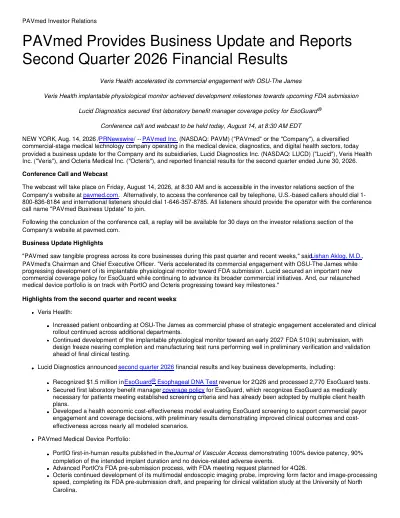
The press release announcing our business update and financial results is available on PAVmed's website. Please take a moment to read the disclaimers about forward-looking statements in the press release.
The business update press release and conference call all include forward-looking statements, and these forward-looking statements are subject to known and unknown risks and uncertainties that may cause actual results to differ materially from the statements made. Factors that could cause actual results to differ are described in the disclaimer and in our filings with the SEC.
For our listeners, a description of these and other important risks and uncertainties that may affect future operations, see Part I, Item 1A, entitled "Risk Factors," in PAVmed's most recent annual report on Form 10-K filed with the SEC, and any subsequent updates filed in quarterly reports on Form 10-Q and subsequent Forms 8-K. Except as required by law, PAVmed disclaims any intentions or obligations to publicly update or revise any forward-looking statements to reflect changes in expectations or in events, conditions, or circumstances on which these expectations may be based, or that may affect the likelihood that actual results will differ from those contained in the forward-looking statements.
I would now like to turn the call over to Dr. Lishan Aklog.
Lishan Aklog
Thank you, Matt, and good morning, everyone. Thank you for joining our quarterly update call.
We're seeing tangible progress across each of our core businesses. Lucid continues to advance key reimbursement and commercialization initiatives.
Veris is building commercial momentum while advancing its implantable towards FDA submission, and our relaunched medical device portfolio is moving Port IO and Octaphas forward under Joe [Briglio's?] leadership.
We believe this progress across our portfolio positions PAVmed to create meaningful long-term shareholder value. Let me walk through the key developments, beginning with Lucid.
Lucid continues to advance its reimbursement and commercial initiatives. As Lucid's largest shareholder, PAVmed remains well positioned to benefit from Lucid's continued progress and future value creation.
I encourage you to listen to yesterday's Lucid business update call for greater detail on these developments. Of course, Medicare coverage remains Lucid's most important near-term milestone, and we're confident that we will ultimately secure positive draft coverage.
Commercial coverage expanded recently with a new positive EsoGuard coverage policy from the laboratory benefit manager, LBM, Concert. Multiple client health plans of Concert have already adopted the policy.
VA commercialization is progressing well, and we expect success as the new federal budget cycle progresses. Continued progress across health systems and health economics is further strengthening the foundation for future growth.
Let's now move on to Veris. The commercial phase of our Ohio State University strategic engagement is accelerating, with patient onboarding steadily increasing since EHR integration went live.
We also secured a large purchase order to support ongoing commercial patient onboarding for the rest of the year. The clinical rollout is continuing across additional departments.
Approximately two-thirds of the planned departments have now been onboarded. Additional departments continue to move through the implementation process.
Our current efforts are focused on reducing workflow friction and driving adoption within participating departments. Our implantable physiologic monitor development is also progressing well.
We're targeting an early 2027 FDA 510(k) submission. Design enhancements have now increased the projected battery life beyond the two-year target, and design freeze remains targeted for this month, with full verification and validation testing to follow.
The long lead-time biocompatibility testing has already been initiated in line with our FDA pre-submission guidance. Our new contract manufacturer has successfully completed its trial build, with devices performing well in preliminary verification testing, and we completed our first phase of animal testing.
This was also successful. Now let's move on to our medical device portfolio, starting with Port IO.
As a reminder, Port IO is an implantable intraosseous port that's designed to provide long-term vascular access through the bone marrow cavity, particularly for patients with difficult or compromised venous access. The positive first-in-human results were published in the Journal of Vascular Access, supporting continued advancement of our regulatory strategy.
Briefly, the first-in-human study evaluated Port IO in 10 patients across multiple clinical sites, and demonstrated 100% device patency, with 90% of patients completing the full intended implant duration. No device-related adverse [unclear] were reported.
Peer-reviewed publication now provides us with an important foundation as we advance Port IO towards its next development and regulatory milestones. Primary focus right now is on the FDA pre-submission process, and we expect to submit a meeting request in the fourth quarter.
The history has been that the regulatory pathway, based on our prior engagement with FDA, it was our expectations that Port IO would be subject to the De Novo pathway. However, engagements with outside regulatory consultants suggest that the publication of our first-in-human studies may give us a shot at proceeding to a straight 510(k).
This would create a much shorter timeline and lower capital requirements to get to commercialization. Now let's finish up with Octaphas.
As a reminder, Octaphas is developing a multimodal endoscopic imaging platform licensed from Duke University that's designed to identify esophageal dysplasia during upper endoscopy and help guide more accurate biopsy and treatment. The multimodal imaging probe development work is ongoing at Duke.
There's continued refinement of the probe, processing speeds have improved substantially, and these improvements are intended to support real-time imaging and analysis during the procedure. These technical advances set the stage for our upcoming clinical validation work at USC, which we're preparing for.
IRB approval is expected in October, and our initial FDA pre-submission draft is completed, and the regulatory work is now focused on preparing for that submission. With that, I'll hand the call over to Dennis for an update on our financials.
Dennis McGrath
Thanks, Lishan, and good morning, everyone. Our summary financial results for the second quarter were reported in our press release that has been distributed.
On the next three slides, I'll emphasize a few key highlights from the second quarter, but I encourage you to consider those remarks in the context of the full disclosures covered in our quarterly report on Form 10-Q as filed with the SEC. With regard to the balance sheet, you will recall from our last investor update that in February, we completed a $30 million Series D preferred stock offering.
Currently, the company issued a $15 million senior secured note to an existing investor. The company used the proceeds from these financings, consisting of $22.3 million cash payment and $15 million senior secured note with a February 2029 maturity date, to redeem all the outstanding shares of its Series C convertible preferred stock and fully retire its previously existing convertible debt.
The $15 million replacement note nominally has a conversion price of $450 per share. It was done this way to protect the investor's tax status, but in every substantive sense is a long-term three-year term note with interest-only quarterly payments and a balloon payment at maturity in February 2029.
Upon shareholder approval obtained on March 27th, the Series D preferred shares were mandatorily converted into PAVmed common stock. As a result, the Series D preferred stock has been eliminated.
In connection with this financing, the company also issued $30 million in warrants now convertible into common stock, which are callable by the company upon publication of a positive EsoGuard LCD. Still a couple key things to point out on the balance sheet: cash at June 30th is $3.8 million, which obviously is not inclusive of the expected $30 million to be received upon the warrants being exercised post-LCD publication, nor does it reflect the $2.5 million from the Veris warrants issued last year that are callable upon the Veris implantable device being cleared by the FDA.
The equity method investment balance of $33 million reflects the 31.3 million Lucid shares mark-to-market indicative of a closing price of $1.07 on June 30th, down from $1.09 at year-end and $1.15 at March 31st. At present, PAVmed continues to be the single largest common shareholder of Lucid Diagnostics, with ownership of approximately 15% of the common shares outstanding.
Although PAVmed no longer has voting control, PAVmed, together with its board and management, still has significant influence over Lucid with approximately 25% voting interest. Shares outstanding today, including unvested RSA, are approximately 7.3 million shares.
The GAAP quarter-end outstanding shares of 6.3 million are reflected on the slide, as well as the face of the balance sheet in the 10-Q. GAAP shares do not reflect unvested RSA amounts.
Similar to past presentations, this P&L slide provides some GAAP and non-GAAP year-over-year quarterly comparisons. On a pro forma basis and purely for illustrative purposes on this slide only, the Veris revenue and the Lucid management fee are combined, collectively more than $3 million per quarter, to visually align PAVmed's income sources versus its operating expenses.
For SEC reporting purposes, the MSA, the Management Services Agreement, that income is recorded below the line. Furthermore, for the second quarter, you'll see on the slide a GAAP net loss of $6.6 million both before the NCI and preferred dividends, versus a prior-year loss of $12.3 million.
The driving force of this difference is the change in the fair value of the Lucid shares and the convertible debt, both non-cash amounts, reflecting a charge of approximately $3.1 million in the current quarter, compared to $10.8 million in the prior-year quarter. Other than the fair value changes, the most significant change between the reflected periods is the increased R&D expenses, largely for the Veris implantable device.
R&D on a non-GAAP increased by approximately $650,000 sequentially and $1.3 million year-over-year. The GAAP net loss attributable to PAVmed, as reflected in the 10-Q, is $5.5 million for the second quarter, or 87 cents per share.
On a non-GAAP basis, the loss is $1.7 million, or 27 cents per share. Next slide, please.
With regard to the non-GAAP operating expenses on this slide, you'll see a graphic illustration of our operating expenses over time as presented in more detail in our press release. Second quarter non-GAAP opex of $6.1 million is above the previous quarter by about $200,000, and above the average of the last four quarters by about $400,000, all of which reflects incremental Veris R&D expenditures.
Opex increases moving forward are likely to be tied mostly to the R&D efforts to get Veris implantable device submitted and cleared by the FDA. With that, operator, let's open it up for questions.
Operator
Thank you. Ladies and gentlemen, we will now begin the question-and-answer session.
Should you have a question, please press * followed by the 1 on your touch-tone phone. You will hear a prompt that your hand has been raised.
Should you wish to decline from the polling process, please press * followed by the 2. If you are using a speakerphone, please lift the handset before pressing any keys.
One moment, please, for your first question. Your first question comes from Ed Woo with Ascendiant Capital.
Your line is now open.
Lishan Aklog
Good morning, Ed.
Ed Woo
Congratulations on all the progress. You mentioned that you're going to have an FDA meeting with Port IO in the fourth quarter.
Do you anticipate news shortly thereafter, and what do you think that the regulatory pathway may be in 2027?
Lishan Aklog
Yeah. We'll be ready to submit for a request for a pre-submission meeting, the actual meeting may end up leaking into the beginning of 2027.
I will take the opportunity to kind of flesh out a little bit what I had said in my prepared comments about the regulatory pathway. Those of you who have been with us before and saw the progress we made on Port IO prior to us pausing that project, our previous engagements with FDA prior to our publication of the first-in-human data was firmly in the De Novo pathway, which is longer and takes more capital.
As we've been preparing with the relaunch of the portfolio and the relaunch of Port IO, as we've been preparing to update our regulatory strategy, and in consultation with some outside consultants as well as our very strong internal team, it appears that we may—there's no certainty yet—but that we may be able to pursue a 510(k) pathway with existing short-term intraosseous devices as a predicate. This would, again, based on the fact that we've in the interim had a successful first-in-human study.
This would be, and this is how we're going to pursue our re-engagement with the FDA. If that's successful, then, as I mentioned in my comments, that would be a big win, as we'll still need a clinical trial, but the costs and the time associated with that would be significantly less.
Ed Woo
That sounds good. The last question I would have is on Port IO, and also the probe with Duke.
Does those include global rights, or are they only rights in the US?
Lishan Aklog
Yeah. The Port IO is an internal IP, it's not a license, that PAVmed owns the full rights to that.
The license with Duke University for the Octaphas technology includes worldwide rights as well.
Ed Woo
Great. Thanks for answering my questions, and I wish you good luck.
Thank you.
Lishan Aklog
Thanks, Ed.
Operator
Ladies and gentlemen, as a reminder, should you have a question, please press *1. Your next question comes from Jeremy Pearlman with Maxim Group.
Your line is now open.
Lishan Aklog
Good morning, Jeremy.
Dennis McGrath
Hey, Jeremy.
Jeremy Pearlman
Good morning. How are you doing?
Lishan Aklog
Quick
Jeremy Pearlman
first question on the Veris platform. I know it seems like commercialization is going well.
Are there any metrics maybe you can provide, how many patients have been onboarded, how quickly the number growing, and then maybe what milestones investors should look forward to as they gauge the commercial traction of that platform?
Lishan Aklog
We're not providing hard numbers on that, but I can give you a pretty good qualitative sense. The agreement with the strategic partnership with OSU, The James, involves a commitment for them to enroll 1,000 patients in a registry.
These are all commercial patients, but enrolled within a registry over a year. The gun went off when EHR integration was completed in the spring.
Obviously, at the beginning, we started with a limited number of departments, two and then three departments that had participated in the previous pilot. Now we are accelerating with now two-thirds of the departments—The James is a very large cancer hospital—with two-thirds of the departments now onboarding and enrolling.
The target of getting to 1,000 patients within the first year is still both us and folks at OSU believe that's attainable, and we expect to reach that. The enrollment has really accelerated over the last couple of months, we're on a good path to get to that target.
Jeremy Pearlman
Great. Then maybe just skipping to the Octaphas, you mentioned you're preparing for clinical validation.
Just what specifically will the clinical validation study demonstrate, and how should we think about the timeline from that study to a potential FDA submission? Thanks.
Lishan Aklog
Yeah. Let me just provide a little bit more color on that.
At the time of our license, the work that had been done, there had been clinical work on a prototype probe that had demonstrated the fundamental findings and value of the technology in terms of its ability to measure the nuclear size within esophageal mucosal cells, and correlating that nuclear size to the presence or absence of the more advanced precancer, esophageal dysplasia. That work had been completed, the basic core principles around using this combination of advanced OCT to do those measurements and really outstanding ability to discriminate that have been well established.
After the license, the focus has been on modifying the probe, making it smaller and more and more user-friendly, and more applicable to the broad range of patient sizes. That's the active work that's going on now, and that will require a validation study, but also just sort of the ease of use in terms of the ergonomics for the clinician.
From that point on, there will still be additional product development work on the console, as well as transitioning the work out of the laboratory into a commercial setting. There is a reasonable amount of time.
The validation work is really a step in the process of getting to design freeze of the definitive probe on the probe side of things. We are considering doing some parallel work on the console depending on sort of our access to capital.
We may do some of that in parallel, but this overall project is still several years away.
Jeremy Pearlman
Understood. Then just last question: you mentioned that if you get a 510(k) pathway for the Port IO, it might speed up the potential approval, and do you have a commercialization plan in place for that?
Are you working on that, or is it still a little early?
Lishan Aklog
We've outlined a pretty clear plan. The Port IO commercialization is actually fairly straightforward.
The target physician specialties are pretty straightforward. They're folks who currently implant vascular access devices.
They tend to be vascular surgeons and interventional radiologists primarily. We have done internal work on pricing, on coding, and the opportunities, depending on sort of where PAVmed is, and again, sort of access to resources at the time, We have a lot of flexibility with regard to an early commercial launch that includes building a small sales team and partnering with distributors.
Distributors are very active in the vascular access space, there's a lot of options for us when it comes time to do the initial commercial launch.
Jeremy Pearlman
Great. Thank you for all the information.
I'll hop back in the queue. Have a nice day.
Lishan Aklog
Great. Thanks, Jeremy.
Operator
There are no further questions at this time. I will now turn the call over to Dr.
Lishan Aklog for closing remarks.
Lishan Aklog
Great. Thanks, operator, and thank you all for taking the time and for your attention this morning.
Obviously, appreciate the questions, and the opportunity to discuss our business and our technology with the covering analysts. Hopefully, you found that informative as well.
To summarize, we believe we remain in a strong position to advance PAVmed's strategic plan and its mission. Our two independently financed commercial subsidiaries, Lucid and Veris, are progressing well, and each are approaching key milestones.
Importantly, we're starting to see traction and we're quite excited on our relaunched medical device portfolio, including progress on Port IO and Octaphas. We remain firmly committed to PAVmed's diversified model, this model offering multiple opportunities, multiple shots on goal to enhance shareholder value, and we look forward to continued progress on all those fronts.
With that, as always, we encourage you to continue to keep abreast of our progress. Please follow our news releases, these update calls, and continue to follow us on our website and through social media.
As always, also feel free to reach out with any specific questions. With that, I hope everybody has a great day, and thank you so much for your participation.
Operator
Ladies and gentlemen, this concludes your conference call for today. We thank you for participating and ask that you please disconnect your lines.