Paymentus Holdings, Inc.
NNYSE:PAYQ1 FY2026 · Earnings Call TranscriptMay 4, 2026
Operator
Good day, and welcome to the first quarter 2026 Paymentus earnings conference call. At this time, all participants are in a listen-only mode.
After the speaker presentation, there will be a question-and-answer session. To ask a question during the session, you will need to press *11 on your telephone.
You will then hear an automated message advising your hand is raised. To withdraw your question, press *11 again.
Please be advised that today's conference is being recorded. I would now like to hand the conference over to your speaker, Mr.
David Hanover, Investor Relations. Please go ahead.
David Hanover
Thank you, operator. Good afternoon.
Welcome and thank you for joining the webcast to review our first quarter 2026 results. Our earnings release documents are available on the Investor Relations section of the paymentus.com website.
They include the earnings presentation that we'll make reference to during this webcast. This webcast is being recorded.
Hope everyone's had a chance to review those documents. Our founder and CEO, Dushyant Sharma, will make some opening remarks before Sanjay Kalra, our CFO, discusses the details of the first quarter and our guidance.
Following our prepared remarks, we'll take questions. Let me just remind you that we will make forward-looking statements within the meaning of the Private Securities Litigation Reform Act of 1995, and we refer to non-GAAP financial measures during this webcast.
Forward-looking statements are based on management's current expectations and assumptions that are subject to risks and uncertainties. Factors that may cause our actual results to differ materially from expectations are detailed in our earnings materials and in our SEC filings that are available on both the SEC and our websites.
Information about non-GAAP financials, including reconciliations to US GAAP, can also be found in our earnings materials that are available on the website. With that, I'd like to turn the webcast over to Dushyant Sharma.
Dushyant?
Dushyant Sharma
Thanks, David. We had a tremendous start to 2026 with record revenue and strong growth, exceeding our CAGR model across all key metrics.
We believe these results underscore the durability and long-term growth potential of our business model. That strength is driven by our platform, our ecosystem, our expertise and scale, our quality of service with support, security, availability, and compliance frameworks, along with a broad and continuously evolving innovation framework.
In addition to our very strong financial results, we also announced an important product launch today that we believe will transform how service providers interact with their customers. Today's agenda will proceed as follows.
First, I'll provide a brief overview of our results. Sanjay will then provide a detailed financial review and discuss our outlook.
I'll then come back and discuss the strategic product announcement we have made today. We'll then answer any questions.
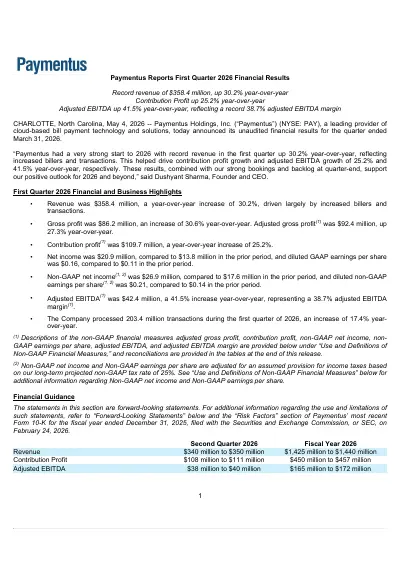
Let me start with financial highlights as shown on slide 3. First quarter revenue was a record $358.4 million, an increase of 30.2% year-over-year.
At the same time, contribution profit was $109.7 million, up 25.2% year-over-year. Adjusted EBITDA was a record $42.4 million in the quarter, representing 41.5% growth year-over-year and a 38.7% margin.
Once again, a majority of our year-over-year growth in contribution profit fell to our bottom line. We exceeded the Rule of 40 for the quarter again, coming in at 64 versus 61 in Q4.
This reflects our team's solid execution and our focus on delivering consistent revenue growth alongside high quality earnings. These results are exciting for multiple reasons.
Let me speak to two that will likely be on top of mind. First, they speak to the vertical diversification and our enhanced pricing strategy over the years, whereby the impact of elevated energy price index on our numbers has been materially reduced.
Second, as you've shared in the past, we operate on a two fiscal year horizon. Therefore, this outperformance is not just about one quarter.
It actually gives us confidence and additional visibility for the rest of the year, and when combined with our backlog and bookings, we are also feeling good about 2027 with our additional visibility. Now on to our business results on slide 4.
We continued our strong momentum in the first quarter with robust bookings and a very substantial pipeline. We also continued to expand and diversify our customer base by signing new clients in several industry verticals, including utilities, insurance, telecommunications, government agencies, property management, consumer finance, banking, education, and healthcare.
Complementing this, we signed channel partners in education and telecommunications verticals. Likewise, onboarding of our substantial backlog remains a priority for us.
Our team continues to demonstrate solid execution when it comes to onboarding activities. We also saw better-than-expected seasonal performance in the first quarter, largely from the large cohort of new customers that we added in the second half of last year.
In addition, during the first quarter, we onboarded clients throughout multiple verticals, including utilities, consumer finance, government agencies, telecommunications, banking, insurance, and education. With that, I'll turn it over to Sanjay to review our financial results in more detail.
Sanjay Kalra
Thanks, Dushyant, and thank you all for joining us today. Before I discuss our first quarter results and outlook, I'd like to remind everyone that the financial results I'll be referring to include non-GAAP financial measures.
Our Q1 press release and earnings presentation includes reconciliations of these non-GAAP financial measures to their corresponding GAAP measures. Both of these are available on our website.
Turning to slide 5, we delivered a strong start to the year with the first quarter results that came in much stronger than we had anticipated, driven by higher transaction activity from both new and existing billers. This helped drive strong double-digit growth for revenue, contribution profit, and adjusted EBITDA.
This, combined with our strong bookings, sizable backlog, and strong pipeline at quarter-end, supports our positive outlook for 2026. Our first quarter 2026 results included revenue of $358.4 million, contribution profit of $109.7 million, and adjusted EBITDA of $42.4 million.
On a Rule of 40 basis, we came in at 64, which we consider a solid result and a record for the company. We are encouraged by this achievement, specially given the macro backdrop we are operating in.
I'd like to also call out that we saw a sequential acceleration in the year-over-year growth rate for the number of transactions, revenue, and contribution profit, despite tough year-over-year comps and a challenging macroeconomic environment. Moreover, the sequential growth rate we saw for all of these three metrics in Q1 was greater than the sequential growth rate we saw during the same period last year.
Simply put, both our annual and sequential growth rates accelerated in Q1 2026, boosting our confidence for the full year 2026 outlook. I'll discuss the drivers of our outperformance and strong business momentum behind them shortly.
These strong results also enabled us to once again exit the quarter with a much stronger cash position and gave us the flexibility to allocate capital with a continuous focus on longer-term growth, which also contributed to robust bookings. Now let's review our first quarter financials in more detail.
As I mentioned earlier, first quarter 2026 revenue was $358.4 million, up 30.2% year-over-year. This growth was largely driven by the launch of new billers over the past year as well as increased same-store sales from existing billers.
We also processed a higher number of transactions during the first quarter, reaching 203.4 million, up 17.4% year-over-year. Our average revenue per transaction increased by approximately 11% to $1.76 in the first quarter, compared to $1.59 in the prior year period, continuing our robust trend of double-digit annual growth rate of revenue per transaction over the past seven quarters.
This was mainly due to the biller mix, or more specifically, the large enterprise billers that we launched during the second half of 2025 with higher average payment amounts. The first quarter guidance we previously provided did consider some of the anticipated upside from large enterprise accounts, but as you can see, it still exceeded our expectations.
First quarter 2026 contribution profit increased to $109.7 million, up 25.2% year-over-year. This increase also reflected the launch of new billers and higher transactions from existing billers.
Contribution margin was 30.6% for the first quarter, compared to 31.8% in the prior year period. The year-over-year reduction reflects the increased mix of large, high volume enterprise billers in our growing customer base.
This change in contribution margin was largely offset by a year-over-year reduction in operating expense margin, which resulted in a record adjusted EBITDA margin of 38.7%. This is consistent with our continued focus on profitability.
Contribution profit per transaction for the quarter was 54 cents, an improvement from 51 cents from prior year period, demonstrating our ability to expand market share without sacrificing comparable contribution profit per transaction. As you've noted before, variables that are outside our control, such as an increase in average payment amount or changes in the payment mix, can affect contribution profit on a quarter-to-quarter basis.
Therefore, we treat this as a secondary metric while our gross revenue and adjusted EBITDA remain primary metrics for us. First quarter 2026 adjusted gross profit was $92.4 million, up 27.3% year-over-year and ahead of our contribution profit growth rate as we achieve operational economies of scale.
As we anticipated, the first quarter 2026 non-GAAP operating expenses increased 16.3% year-over-year to $53 million. This increase was primarily due to higher sales and marketing expenses.
You may notice our OpEx year-over-year growth rate increased this past quarter. This is a positive leading indicator for our business as it means we are aggressively converting our substantial pipeline to bookings.
We expect to make similar investments throughout the year as we continue to execute our go-to-market strategy, calibrate operating expenses with contribution profit expansion, and deploy our growing cash balance to support further organic growth. These expectations are already incorporated into our guidance, which I'll review in more detail shortly.
First quarter 2026 non-GAAP net income was $26.9 million, or 21 cents per share, compared to non-GAAP net income of $17.6 million, or 14 cents per share, in the prior year period, reflecting an annual EPS growth rate of 50%. This EPS incorporates a non-GAAP tax rate of 25%, which is based on our current expectation of our long-term projected tax rate and is also reflected in our 2026 guidance.
First quarter 2026 adjusted EBITDA increased 41.5% to $42.4 million, compared to $30 million in the prior year period. Adjusted EBITDA also represented a record 38.7% of contribution profit, an annual improvement of 450 basis points, compared to 34.2% in the prior year period.
We believe this stronger adjusted EBITDA margin demonstrates the inherent operating leverage we have in the business. Please note our incremental adjusted EBITDA margin was approximately 56%.
Related to this, once again, we also exceeded the Rule of 40 for the quarter, coming in at 64, a record. Now I'll discuss our balance sheet and liquidity position on slide 6.
We ended the first quarter with total cash and cash equivalents of $342.1 million, compared to $324.5 million at the end of 2025. The $17.6 million sequential increase was primarily comprised of $30.5 million of cash generated from operations, partially offset by $9.4 million used in investing activities, primarily for capitalized software, and $3.3 million spent in net settlement of employee RSUs.
The company does not have any debt. Free cash flow generated during the quarter was $20.9 million.
This was primarily driven by strong adjusted EBITDA in the quarter, offset by investments in working capital, primarily in accounts receivable. Driving organic growth continues to be our primary focus.
Having said that, our strong cash position enables us to maintain financial flexibility to keep room for working capital investments as we scale. In addition, our ample liquidity allows us to explore attractive M&A opportunities that may arise in order to expand our growth prospects.
Our days sales outstanding at the end of the first quarter was 29, comparable to 28 days at the end of the prior quarter and much better than our expected range. Working capital at the end of the first quarter was approximately $365.4 million, an increase of approximately 6.7% sequentially.
We had 129.3 million diluted shares outstanding during the first quarter, pretty much comparable to the prior quarter. Now I'll turn to slide 7 to discuss our second quarter and full year 2026 raised guidance for revenue, contribution profit, and adjusted EBITDA.
Before discussing full year guidance, I want to mention that we are continuing to follow the same prudent approach to guidance that we have followed for the past three years, which has proven to be successful for us. As shown on the slide, for Q2 '26, we expect revenues in the range of $340 to $350 million, contribution profit in the range of $108 to $111 million, and adjusted EBITDA in the range of $38 to $40 million.
On a Rule of 40 basis for the second quarter of 2026, our guidance implies a range of 51 to 55. For the full year 2026, we now expect revenue in the range of $1.425 billion to $1.44 billion, an increase of 2.3% from midpoint of our previous guidance.
This guidance now represents a 19.7% annual growth at midpoint and 20.4% annual growth at the high end. Contribution profit in the range of $450 to $457 million, up 1.5% from midpoint of our previous guidance and now representing 17.4% annual growth at midpoint and 18.3% annual growth at the high end.
Adjusted EBITDA in the range of $165 to $172 million, up 4% from midpoint of our previous guidance and now representing 22.6% annual growth at the midpoint and 25.2% annual growth at the high end. A non-GAAP tax rate of 25%.
On the Rule of 40 basis, our guidance implies a range of 53 to 56 for the full year 2026. During our past few earning calls, we provided long-term growth targets for both revenue and adjusted EBITDA, our two primary financial metrics.
We stated that our goal was to grow revenue at approximately 20% and grow adjusted EBITDA between 20 to 30%. The full year updated 2026 guidance range we have provided today reflects the expected achievement of these long-term targets.
In summary, we are very pleased with our strong start to 2026, reflecting the continued momentum we've shown across the past several quarters. During this time, we have consistently demonstrated our ability to generate profitable growth.
This enabled us to end the first quarter with a substantial backlog and pipeline. Given our solid footing and strong visibility, we continue to believe we are well positioned for further growth in 2026 and beyond.
Thank you everyone for your attention today, and now I'll turn it back to Dushyant for final remarks before we open up the call for questions.
Dushyant Sharma
Thanks, Sanjay. After seeing the impact of our state-of-the-art platform and the ecosystem on the broader service economy, we find ourselves at an exciting juncture, similar to what we experienced at our inception.
As we looked at the economy broadly, we realized that almost all investments in commerce have gone towards product or retail commerce, with a focus on how to sell more to customers and having them checkout quickly. This product commerce paradigm is also retrofitted in service commerce, which at its core is not transactional, but instead relational.
This mismatched paradigm has led service commerce to lag behind as enterprises spend millions of dollars on a myriad of mismatched components and tools. At Paymentus, we realize that to truly solve the issue, we needed to bring about a paradigm shift with a full-stack, purpose-built, AI-native platform with service-native components.
Even before our IPO, employing our proactive thinking, we wanted to make sure that we not only build a platform with full-stack components, but also we incorporate AI, which we even knew then would become mainstream. Additionally, we also knew that we would need to seek patent protection on all major components, thereby creating a long-term moat and ecosystem.
In line with all what I've just talked about, today we announced that we are establishing a new category: AI-native service commerce, where every service interaction becomes intelligent, secure, and outcome-driven. As you can see from slide 9, there are three key gaps in service commerce.
First, there is no native payment method that preserves the service provider-customer relationship and identity. Second, static service and transactional documents must become intelligent and interactive.
Third, there is a lack of intelligent orchestration across fragmented systems. To address all these three pain points, as you can see on slide 10, we have created a new paradigm called Billio that has four key components, all of which have been patented.
First is BillWallet, a purpose-built digital wallet designed specifically for bill and service payments. Unlike traditional retail wallets that store cards for one-time purchases, BillWallet establishes a persistent, secure relationship identity between the customer and service provider, linking accounts, service relationships, and payment credentials into a unified layer.
BillWallet is designed to reduce time to complete a payment by approximately 75% and to work across all dimensions: agentic, digital, social, physical, and vocal. Second, Billio, which transforms static bills, invoices, and statements into intelligent, interactive experiences.
Billio enables consumers to understand charges, resolve issues, and take actions directly within the document itself. Third, AI360, an AI-based integration, orchestration, and data intelligence framework that powers both Billio and BillWallet and enables systems to automatically interpret, connect, and operate across disparate data sources.
AI360 also provides data visualization and business intelligence capabilities, replacing third-party BI tools. Fourth, all interactions are secured through Paymentus's patented, PCI-compliant Secure Service framework, which we believe will ensure end-to-end protection, trust, and compliance across every single every service interaction and payment flow.
Putting this all in context, in the past, we have mentioned the exciting opportunity to monetize interchange in the outer year in the outer years. By design, the interchange costs we incur today is big and getting bigger as we scale.
To us, that represents an incremental, untapped TAM, total addressable market. Additionally, we have also shared that with the advent of generative and agentic AI, the industry is predictably moving in our direction and has opened up opportunities far beyond bill payments with our existing and prospective clients, users of our platform, and in all our current and prospective verticals.
Let me discuss both in detail. BillWallet is an IPN-native wallet purpose-built for bill payments and service commerce.
As a result of BillWallet, a customer visiting the insurance company's website can complete their premium payment in seconds rather than minutes with their BillWallet ID. We believe that BillWallet will also significantly improve security and reduce fraud, whether the interaction takes place through an agent in a self-driven car, wearable technology, or any other traditional self-service or assisted channels.
It's also intended to work well in in a physical context. For example, at a government or utility walk-in center, a customer can pay their bill simply by providing their BillWallet ID, no card swipe, no manual entry, no POS terminals.
This establishes a new paradigm for service commerce away from the retail commerce paradigm. We believe that this would result in a massive improvement in convenience, speed, and security, and also create a more direct link between service providers and their customers.
As BillWallet scales in next several years, we also intend for it to include native funding capabilities, enabling us to participate in interchange economics while increasing transaction frequency and depth of engagement for our clients. BillWallet works in all aspects of the service economy, B2C and B2B.
Let me now discuss early success. As we reported that in December 2025, users on our platform numbered 53 million, which we believe represents approximately 40% of US households and possibly businesses.
Out of that customer base, we have made BillWallet available to a mere fraction of our end user base, but across various cities. Early BillWallet results are very impressive.
Within a few quarters, we have already enrolled 100,000 users across more than 1,000 cities with a very high conversion rate and no marketing spend. Not a single dollar of marketing from Paymentus.
We believe that these results speak to the pervasive nature of our platform, the power of the network effect, and the ease of use, unlocking an additional dimension to the durability and profitability of our longer-term growth algorithm. After seeing this early success, we are getting increasingly excited about exploring how BillWallet can be fully rolled out over next several years.
In addition, we recognized years ago that with the advent of AI, actual service documents like policies, bills, invoices, and other transactional documents, such as bank, credit card, loyalty, or mutual fund statements themselves must evolve to become more intelligent. As a result, we patented our technology called Billio that transforms traditional bills, invoices, and statements into AI-powered interactive experiences.
With Billio, a utility customer can simply ask Billio, "Why is my water bill higher this month?" Or a customer can interact with any other BillWallet and Billio-powered enabled service provider, such as a plumbing or HVAC service provider, and automatically schedule a visit and pay for it in advance based on rules set by the user.
Or a customer can interact with their Billio-powered mutual fund statement and ask why their portfolio returns are trending lower than the indexes. Billio is designed to answer, resolve, and execute, eliminating friction, driving faster payments, and reducing support costs for billers and other service providers.
Billio is also a full-stack service commerce platform, and with the help of BillWallet, it has the potential to transform legacy websites into multi-modal BillioSites, potentially ending the era of retail paradigm-based old school portals and replacing them with secure, interactive, and agentic BillioSites. Once a customer is recognized using BillWallet, the entire Billio-enabled website is hyper-personalized, and the payment can be made, but more importantly, many questions can be asked and answered, whether the interaction is from your car, your personal agent, wearable technology, or any other traditional mainstream channels such as your computer or mobile phone.
These are not just patents, but rather families of patents. All patent families referenced have granted patents in the US and some international jurisdictions, with additional patent applications pending in domestic and many major international markets.
As exciting as the depth and breadth of our further expanded moat is with our patent families, we want investors to know that this success is not an accident. We have a carefully crafted business strategy executed over the past several years, emanating from our mindset that the proverbial technological puck will be at a specific place in the future, and we want to take full advantage of it.
We believe this strategy will augment our already very strong growth algorithm, further helping Paymentus attain its goal of becoming a multi-billion dollar business and ensuring that our efforts are patent-protected, so that our customers, our partners, our employees, and of course our investors are able to enjoy the benefit of their trust in Paymentus. That concludes our prepared remarks.
I'll now open up the line for questions.
Operator
Thank you. As a reminder, to ask a question, please press *11 on your telephone and wait for your name to be announced.
To withdraw your question, press *11 again. Due to time constraints, we ask that you please limit yourself to one question and one follow-up question.
You may then return to the queue. Please stand by while we compile the Q&A roster.
Our first question will come from the line of Madison Suhr with Raymond James. Your line is open.
Madison Suhr
Hey, good afternoon, guys. I wanted to start on the new AI product announcements.
Really appreciate all the color around the technology, but I was hoping you could also provide a little more details on the economics. Do you expect any differences in gross or contribution dollars per transaction in the near term?
Then longer term, does this open up Paymentus to other revenue opportunities kind of outside of the traditional per-transaction model?
Dushyant Sharma
The revenue opportunities, yes, let me start with that, but not necessarily outside the transaction model. As you've shared previously, our paper-use pricing and success-based pricing model actually has withstood the test of time.
In our view, it is further validated with the advent of AI as the world moves towards paper-use models. Our approach here remains the same, where we want to offer more to our clients, and as they achieve success in reducing their costs to serve and improve their end user experience, we participate in those economies and as a result get the benefit.
We plan to still remain in consumption-based model. I think our clients love that model.
They can clearly understand exactly where the success is and exactly what the success KPIs are and how Paymentus will get paid. It does open up opportunities with tremendous, if you think about the combination of our approach to this is we're changing the paradigm of service economy.
If we were successful in getting the scale the way we expect to hopefully in years to come, Paymentus will not only be able to provide total service platform I'm just trying to think about exactly how I can describe quickly. If you think about in my examples I gave, if my Billio app, I should be able to do almost anything with it related to my service providers.
For example, ask a question and say, "Hey, my hot water heater is not working. Can you schedule someone to come in and take a look at it?"
That could include a payment transaction as well. All of those things could be factored in using our model.
In terms of the gross and net, long term the direct strategy here at play is to be able to convert the interchange expense into interchange revenue, and we believe BillWallet and Billio will play a big role in that.
Sanjay Kalra
If I may just add, Madison, I think your question also wanted to cover any near-term impacts. I would say in the near term, we remain committed to our CAGR model, which you've described, which means top line to grow 20% annually and bottom line between 20 and 30% throughout the quarters in the year.
As you've seen from our past performance, we remain committed to deliver not only this CAGR model, but deliver better results. The operating leverage on the business shines and has been shining since past few quarters.
We remain committed in the near term there should be no significant impacts here. Especially over the longer term as Dushyant described, we are going to get much better than where we are today.
Thank you.
Madison Suhr
Awesome for that. Then Sanjay, just a quick follow-up on free cash flow.
Obviously was down a little bit year-over-year. I understand the dynamics with working capital, but when do you expect some of that to kind of normalize, and maybe any color that you're willing to share on free cash flow expectations for the full year?
Thanks, guys.
Sanjay Kalra
Sure, Madison. In Q1, actually working capital is down compared to last year in Q1.
That's primarily working capital, as you correctly pointed out. If you look at our accounts receivable balance itself, we put in around $15 million into working capital.
Last year in Q1, we actually extracted around $19 or $20 million from working capital. That flip itself is $35 million.
Apples to apples, if the working capital position was exactly the same, I think our free cash flow would be more than $50 million in the quarter. That said, working capital is very very much temporary, as you know.
It could come back either in Q2 or Q3, but definitely within the year. We are navigating our way to capture the market at a very good pace.
We do get customers. At times, they get implemented towards the later part of the quarter versus a beginning part of the quarter.
That just creates this temporary difference, which dissipates over time and definitely over one or two quarters. We feel very good about where the business is progressing.
All the working capital is in very good shape. I would rather say, instead of focusing on free cash flow, the right way to understand our business, given the pace of march is at a very high pace, look at what the total working capital is increasing.
I pointed in my prepared remarks that working capital is up, I think, more than 6% year-over-year. Cash is just either it's in cash or accounts receivable, both are very good.
In fact, DSO of 29 days or 28 days is pretty awesome. It's much better than our model, which actually dictates 32 days or so.
We feel very good, not at all concerned. In fact, we feel very bullish about the free cash flow for the full year.
Last year, we generated around $125 million. This year, while we don't guide for cash flow ever, but I think as we are marching on the same path, except for working capital adjustments, which could be temporarily here or there, I think we are on the same path or better than last year.
Madison Suhr
Awesome. Thank you so much for the color, guys.
Dushyant Sharma
Thank you.
Operator
One moment for our next question. That will come from the line of David Koning with Baird.
Your line is open.
David Koning
Hey, guys. Thanks so much.
Great job. I guess my first question, the economics of the wallet, I think it's kind of the Paymentus trifecta here because if I load $1,000 every month, first of all, you get float revenue.
Now you're sitting on a nice customer balance. Secondly, if I make payments out of that, you get to keep the debit interchange instead of paying it out, as you mentioned.
Then thirdly, I think you would get the non-regulated debit interchange, cuz you're not an issuer or you're a sub-$10 billion issuer. There's three kind of nice combinations of economics, it seems, in my view.
Am I getting that right?
Dushyant Sharma
Yes, I think that's part of the strategy, but not immediate, but that's where we're marching towards.
David Koning
Love that.
Dushyant Sharma
There are other options as well. We may also have as we said, the BillWallet is an IPN-native instrument, we will also open it up potentially to be as a network player in this, and also there are fees coming from our clients for the services we're providing them.
BillWallet becomes part of that.
David Koning
No, that's great to hear. I guess secondly, when I just look at the cadence of revenue through the year, Q2 typically is up sequentially in contribution profit.
This year, you're guiding to flat. Is that related to fuel?
Maybe talk a little bit about fuel prices, etc., and how that's impacting numbers?
Sanjay Kalra
Sure, David. I think there are two pieces here.
Let me first talk about the Q2 guidance, and then I'll go to the energy prices. In terms of Q2 guidance, it's just seasonality in the business, as you would have observed from the past few years.
The seasonality of government billers effects. In Q2, generally we guide a little lower than Q1 because we don't know how the seasonality will play shape.
Although it could be similar to Q1 revenue or maybe slightly higher as well if all things come in the right path. At the same time, we have just onboarded a lot of large enterprise customers recently, some in Q1 as well and some in the past few quarters or said in second half of last year.
We really want to have a full year's history to forecast it accurately. We take a prudent approach when we come up with our forecast or which helps us come up with the guidance for next quarter.
I think prudence prevails on our thought process when we think about our future. That's one reason where you see a modest softness coming in Q2 compared to Q1 and at the same time that falls through to the bottom line as well.
That's one part of it. Going back to the energy prices, I think delivering a 25% growth in Q1 itself when energy prices are in news every day, I think it's pretty interesting to see.
One thing is that as we have marched on our market capture mode since past many years at a very good pace, we have seen a vertical diversification. Our enhanced pricing strategy over the years has really helped us reduce the impact of the elevated energy price index into our numbers.
Overall, even though energy prices impact only our utility business, but that too only a sub-sector or a very small segment of our utility business. It has just I wouldn't say it has fully dissipated over time, but as we have scaled, it has definitely lost its relevance and materiality to us.
I think it has just faded over time in our view. Even though it's only like what?
6%, I think CPI index improved in Q1 year-over-year. In the past years during COVID days, I think we took a pill for that problem.
I think we have kind of solved it, not fully, but solved it to the extent that even a significant impact on energy prices has a modest impact on our business. Our prudent guidance methodology already captures it.
We have not been surprised by this at all since last many quarters. We hope we will not be, given the prudence, given the modest impact it has, the diversification we had, and enhanced pricing strategies we are opting with our billers.
David Koning
Yep, great. Thanks.
Great job, guys.
Dushyant Sharma
Thank you.
Operator
One moment for our next question. That will come from the line of Steven Waldman with Wedbush Securities.
Your line is open.
Steven Wahrhaftig
Hey, good evening, guys. Congrats on a great quarter.
I have two questions if I may. First, I just wanted to get a little bit more color on the AI-native service commerce platform that you guys launched.
Got a lot of color around the pricing of the strategy, but can you talk a little bit about what's specifically in the pipeline for this product in the year? Can you talk about if there's any inclusion of revenue coming from this cohort in 2026 or is it strictly in 2027 and beyond?
Can you talk about the ramp of this AI-driven cohort moving forward?
Dushyant Sharma
As I mentioned that it will again be a transactional model. Our goal remains primarily to capture as many of the transactions for a given customer.
This would be applicable to all of our existing and prospective customers as well. The goal here really is to continue to build momentum using the patented technology we have created here by getting our customers to move away from the retail commerce-based paradigm to the service-native paradigm.
That will take time because there's still a lot of installed base. What we're actually going to see is, which we are already seeing, the continued momentum in market capture.
That's what the strategy is about. If I could summarize the strategy in two phases or two parallel streams, the stream number one is evangelize the marketplace with new paradigm so that more and more customers can sign up with Paymentus.
The second right behind that is monetize the transactions differently than they have been historically monetized. That's why it was very important for us to have actually patent protection on all this, because we knew that after analyzing billions of transactions and, frankly, in some ways, as we were preparing for IPO, I was very focused and the team was very focused on making sure that we are able to create shareholder value for our public shareholders as well as we were ramping up to be a public company.
These are some of the things we were working on at that time. We're very thankful that the market has moved in our direction.
This is a long-term play for us. We're not counting anything in 2026 from it, other than the fact that our market momentum will continue to be validated.
We're feeling good about 2027 in some ways as a result of the momentum we have in the market and the bookings we have had.
Steven Wahrhaftig
All right, got it. Thank you for the color.
Sanjay, just one for you, specifically tied to the full year guidance, specifically for revenue. You basically had a $20 million beat in Q1, but basically raising the midpoint of the full year guidance by about $30 million.
It really is implying a stronger back half of the year, and that includes the strong bookings and backlog. What's really holding you back from going after a larger full year '26 guidance raise?
Is it just the fact that you're being a little bit more conservative, or is there something tied to onboarding timelines? Then also the same thing for the Rule of 40 profile, because you came in at about 65% this quarter, and you're guiding for about 51 to 55% for full year '26.
Can you just break that down for me a little bit? Thank you so much.
Sanjay Kalra
Steven. I'll say that in past three years, we are following a consistent methodology for guidance, which definitely is dominated by prudence.
You answered the question in your question itself. Yes, prudence prevails, and we remain very cautious in terms of what's coming.
We want to deliver. We don't want to count the chickens before they hatch, and that has been consistent how we have delivered as well as how we have guided.
The business is very good. I would say the pipeline is very encouraging.
We are enthused by the bookings we are having, the diversified portfolio, the diversified verticals we are operating in, and the kind of household names we are getting into our biller base. We've got a lot of Fortune 500 companies as well.
We feel very good about where the business is not only going to be in '26, but even outer years. The comment we made regarding 2027 at the beginning of 2026 stems from the fact that our renewal rates are very strong.
Our customer contracts are for longer periods of time. It is now actually giving us visibility more for 2027 as well.
Said differently, previously we had visibility of say five quarters, now I think we have it for six quarters or so. I think we are feeling very good about '26 and definitely a big part of 27 2027 as well.
Dushyant Sharma
If I may also actually just add a quick point there, the reason we are prudent in our guidance principles is actually for the purpose of creating long-term shareholder value. Because you can erode value faster than you can build it by being somewhat irresponsible in guidance.
You have to make sure that you're paving a smooth road for successful execution of a very thoughtful strategy by having guidance principles. It takes a lot of discipline to be candid.
Just like every other company, we would love to be able to pound our chest going in, but that's far easier to do than to deliver good numbers. We believe that our interest is to create long-term shareholder value by creating a smooth road for execution by having a guidance philosophy which is prudent, but very aggressive execution behind it, and not create a noisy environment where folks cannot figure out exactly how to think about the company or the management team or the philosophy of where the business is headed.
We think this approach works better for the long-term shareholder value creation.
Steven Wahrhaftig
Great, got it. Appreciate the time, guys.
Thank you so much.
Dushyant Sharma
Thank you.
Operator
One moment for our next question. That will come from the line of Darrin Peller with Wolfe Research.
Your line is open.
Josefina Ruggieri
Hey, guys. This is Josefina Ruggieri?]
for Darrin Peller. Thank you for taking my question.
Just quickly wanted to ask, on your new products, Billio and BillWallet, do these products change who you compete against? Are there any incumbents that we should think about?
Then overall, have you noticed any changes in the competitive landscape recently? Thanks.
Dushyant Sharma
Sorry, you broke up. I just needed to clarify what the question was.
No, I think we are excited about where we are headed. The market is moving in our direction, as you can see, that we were actually prepared.
It's years in the making. It was not we woke up one morning and we saw a lot of press releases on AI, Paymentus is going to go ahead and put ours in the mix as well.
That's not Paymentus. That's not who we are.
It has taken us years to get to this point. We wanted to create a long-term value and long-term competitive moat for our investors, but more importantly for our customers, so that they can see that this is an innovative company, a champion who's willing to take the industry status quo after disrupting, if I may say this way, after disrupting the bill payment world.
When we started, banks used to have majority, maybe 75, 80% of the payments, and they're down to now 20, 25% of that, primarily because of the model we have championed here. We believe under pressure, the trends accelerate, and as the trends are accelerating in some ways in our favor, you will see a little bit more momentum here as the time goes by.
We have got our company ready for this. We wanted our investors, our partners, our customers, and our employees to benefit from the thoughtful and an innovative execution from up to this point and from here on out.
Josefina Ruggieri
Thanks. Then one quick follow-up.
When we think about your go-forward focus verticals, does utilities kind of still remain on the top of that list, or whether do you think they're going to contribute to this kind of new AI-centric model? Thank you.
Dushyant Sharma
Utilities will remain a key vertical for us, of course. It's the most complex, most sophisticated vertical, especially at the large scale, because of how much efficiencies utilities were forced to drive out of the paper process.
It was not easy to be able to drive more value for utilities customers, we had to be really good to be able to do that. Now, as you can see from our prepared remarks, we're signing customers in all of the verticals.
Our goal really is to go through a household and a business bills and take a look at all the bills they have and start making markets in each of those, but then make sure that in each of those markets we are in, we are capturing more and more of the transactions using the new paradigm of service commerce using Billio.
Josefina Ruggieri
Awesome. Thank you, guys.
Dushyant Sharma
Thank you.
Operator
One moment for our next question. Our next question will come from the line of Tien-Tsin Huang with JPMorgan.
Your line is open.
Tien-Tsin Huang
Hi, hope you can hear me. I'm at the airport here.
Good results. I hope this isn't an overdone question.
Just Dushyant, I wanted to ask also on Billio and BillWallet. Just to clarify, will you be managing the BillWallet ID, and is the idea to distribute it through consumer service providers?
I know subscription payments is really important, and I'm asking because I'm thinking about in an agent world, who would wear the risk? I know that's a big debate on the agent side, and I think subscription payments could be a big part of that, if you follow my question.
Thank you.
Dushyant Sharma
Yeah. Our approach, Tien-Tsin, is actually here, we are of the opinion that any technology, any service that is distancing the customers away from their own customers, any service provider getting disintermediated from their own customer, is not going to last too long.
It's not going to work out. Paymentus's approach to BillWallet is, regardless of the channel, the mode of communications, or interaction and so on, the BillWallet will allow the customers, the service providers to have direct relationship with their end user customers.
That is part of our goal and that is what we have done. Part of the benefit of BillWallet approach is not the way may I say this way, traditional retail-centric wallets have been created.
Here, the approach we have taken is that the billers themselves, the service providers themselves set the rules for identity. How they identify their own customers is set by the billers themselves.
That's how they authenticate the user. BillWallet enables that in all of the channels, whether you are using your intelligent glasses or you're using your car, whatever the mode of communication is, interaction is, you're using it through BillWallet.
Tien-Tsin Huang
Understood. The wearing of the risk then just in the agent example I gave, Dushyant, that would be borne then by Paymentus, given how you just described it?
Dushyant Sharma
Actually it would be in some ways yes, in some ways it would be actually between us and our clients.
Tien-Tsin Huang
Right. In terms of, right, who you're working with, I'm sure that would be arranged.
Okay. More to talk about it.
It's interesting. I think it's ambitious and it makes a lot of sense given the network you built.
Can I just ask one quick follow-up? I know it's a third question.
Sanjay, you mentioned seasonal impact in terms of the upside for the quarter. Can you just clarify that?
I heard the answer on the energy prices, but just thinking about the quarter itself and what the seasonal impact was, if any, that surprised you.
Sanjay Kalra
The impact is modest. I think if you look at our guidance, on the high end for Q2 is approximately 2% or so soft.
That's primarily as I said, prudence prevails, but at the same time, seasonality of government billers is a part of it. We need to experience the full year turnaround of new large billers which were implemented in second half of 2025.
All these three factors in a combination as of now is giving a modest softness in Q2 compared to Q1.
Tien-Tsin Huang
Understood. Done.
Great results. Thank you.
Dushyant Sharma
Thank you.
Operator
One moment for our next question. That will come from the line of Will Nance with Goldman Sachs.
Your line is open.
Will Nance
Hey, thank you for taking the question. If I could just follow up on the wallet product, I was wondering if you could just talk about distribution there and how to incentivize adoption by consumers over time.
How do you think about the marketing required to incentivize consumers to adopt a new wallet partnership given the competitive nature of the wallet landscape?
Dushyant Sharma
Yeah. I think from our perspective, I think the simplicity of how much time-saving and the simplicity it brings about to the end customers, what we have observed with a very small fractional four-customer base we launched it to, our conversion rate was pretty high.
We didn't have to spend a lot of money in marketing, in fact any money in marketing. We think that is the scale and the system and the platform we have in the ecosystem we have built at this stage is pretty pervasive at this point.
That itself would play a big role. Right now our focus is the technological advantage as the key reason for customers to sign up.
I don't want to remember how to log in, and where do I go, and how do I find my information if I'm talking to a service provider. Can I just use BillWallet ID to do that?
That I think it's that. That's why patent was important and that's why we wanted to make sure that that would remain one of the key themes.
We will create other incentives within the wallet itself for repeated use, of course.
Will Nance
Got it. Appreciate that.
If I could just go back to the commentary around energy prices, I was wondering if you could just remind us again what fundamentally changed about the enhanced approach to pricing that you guys adopted several years ago. Do you have contracts that automatically reprice in the face of higher energy costs and larger ticket sizes, and what is the actual mechanism that has reduced the exposure within the utilities vertical?
Then secondarily, I was wondering if you could just give us maybe a sense high level how much the utilities vertical has declined as a percentage of total over the last three or four years.
Dushyant Sharma
Let me start with the pricing strategy. I think you rightly called it out that in some cases it's autopriced based on as the average payment amount due to inflation is changing, and so is the pricing.
Our pricing is changing with that. That is one part.
We have also been able to move customers to different pricing models which are actually favorable to customers, favorable to us as well. Without going to the specifics of any of that, but I would just say it also was factoring in exactly the same situation which we were dealing with several years ago, where we did have the ability to change the pricing, but it was a little bit more later in the process than it is now.
Those are the pricing model changes. Then also on top of that, in the last remaining cohort where there is still some, as Sanjay mentioned, that there's some immaterial impact, where we have regular meetings with the clients to discuss all of the impact there and readjust pricings.
We're just a proactive company now than we used to be, and then as I said, the pricing models themselves have been adjusted.
Sanjay Kalra
I think it's one part of your question, Will, was how is utilities as a percentage of revenue. Traditionally it has been higher than 50%, but we are modestly less than 50%.
Still a substantial piece of our revenues, but I think overall as the pricing models have evolved, we are not seeing any impact of energy prices.
Dushyant Sharma
I would not say so that even though utilities is 50% of business, but I would not equate that in any way, shape, or form that 50% of the revenues of Paymentus is at risk with the energy pricing. That is not the type of business we are running or I would want to run.
That's not the case. What's happening instead is a very much smaller percentage.
Sanjay Kalra
Exactly. As I said earlier, I think, in one of the questions, a small subset of utilities business is the one where there might be a modest impact, but overall it's immaterial for us now.
Got it.
Operator
Thanks for all the detail. One moment for our next question.
As a reminder, if you would like to ask a question, please press *11. Our next question will come from the line of Craig Maurer with FT Partners.
Your line is open.
Craig Maurer
Hi, thanks for taking the question. I just wanted to quickly get your take on the acquisition of Kubra by Repay and how you think that might change the competitive dynamics in the space.
Dushyant Sharma
Oh, Kubra has been around for a long period of time. We know Kubra for long period of time.
We know Repay as well. From our perspective, as you've shared, the market has been moving in our direction, and we're excited about it.
We believe the customers and the prospects, they finally know where the innovations are coming from in this and who's taking the approach very seriously. I think we're very excited about our business.
No concerns or anything from that perspective. We wish them very well just like any other competitor.
We wish everyone the best.