PBF Energy Inc.
Q3 FY2026 · Earnings Call TranscriptOctober 29, 2026
Operator
Good day, everyone, and welcome to the PBF Energy Third Quarter 2026 Earnings Conference Call and Webcast. At this time, all participants have been placed in a listen-only mode, and the floor will open for questions following management's prepared remarks.
If anyone should require operator assistance during this conference, please press star zero on your telephone keypad. Please note this conference is being recorded.
It is now my pleasure to turn the floor over to Colin Murray of Investor Relations. Sir, you may begin.
Colin Murray
Thank you, Jeanie. Good morning, and welcome to today's call.
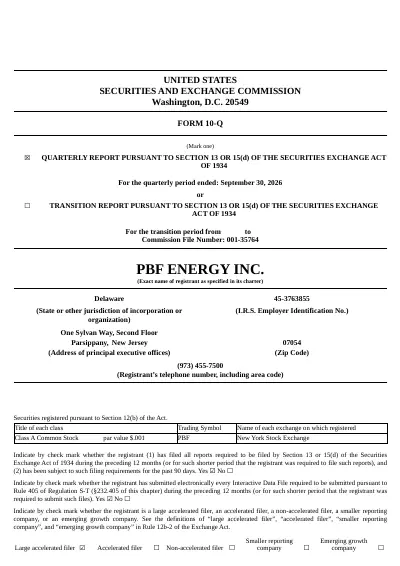
With me today are Matt Lucey, our President and CEO; Mike Bukowski, our Senior Vice President and Head of Refining; Joe Marino, our CFO; and several other members of our management team. Copies of today's earnings release and our 10-Q filing, including supplemental information, are available on our website.
Before getting started, I'd like to direct your attention to the safe harbor statement contained in today's press release. Statements expressing the company's or management's expectations or predictions of the future are forward-looking statements intended to be covered by the safe harbor provisions under federal securities laws.
Consistent with our prior periods, we'll discuss our results excluding special items, which are described in today's press release. Also included in the press release is forward-looking guidance information.
For any questions on these items or other follow-up questions, please contact Investor Relations. I'll now turn the call over to Matt Lucey.
Matt Lucey
Thanks, Colin. Good morning, everyone, and thanks for joining our call.
Third quarter earnings speak for themselves. We intend to convert those earnings into lasting improvements in our business.
The company reduced net debt by more than $1.2 billion during the quarter and by more than $2 billion this year. As Joe will detail, our balance sheet transformation has put the company on strongest financial footing since our formation.
Over the last seven years, markets have become increasingly volatile, with shorter cycles, as evidenced by the three once-in-a-generation events over that period. Prudence dictates a deeper balance sheet to navigate this new reality.
The company's focus is to execute, execute, execute. Execute our base business and do so efficiently, and importantly, through our business improvement initiatives, to improve the competitive positioning of each asset we own.
Extract incremental profitability through all cycles, up or down. We are investing in our assets to improve utilization, reliability, and yields, which will translate into stronger through-the-cycle cash flow and make our system more resilient.
By executing well on these priorities, we will maximize the resilience of our system, create greater long-term shareholder value, and increase our ability to return capital to shareholders. Turning to the market, the biggest disruptions to the oil market have materialized in the availability of refined products.
The disruptions have coincided with what was an already structurally tight refining market. On the crude side, the market has adapted reasonably given the circumstances.
Flows through the Strait of Hormuz have recovered to roughly three-quarters of prewar levels, with some recent weekly reports higher, but product flows remain well below prewar levels. Recently, the dramatic increase in freight rates has really put pressure on the Asian refiners.
Freight, coupled with rising natural gas costs overseas, is raising the cost to run international capacity. Headwinds that US refiners are less exposed to due to our shorter transit times and abundant domestic supply of natural gas.
Freight dynamics, paired with growing production of heavy crudes, has widened the light-heavy differentials. PBF's crude slate flexibility and close proximity production is a real tailwind going into the fourth quarter for our cost of crude.
The freight realities raise the bar for delivery of imports needed in our product-short coastal markets. PBF sells the majority of our products domestically, thereby avoiding costly transits.
The story on products remains a supply story. More than 5 million barrels a day of global capacity is offline, a portion of which with physical damage.
With global inventories roughly 500 million barrels below prewar levels, there is essentially zero cushion in the system. Policy responses can be helpful on the margin.
However, at the core, the world is simply short refined products. Benchmark cracks reflected the tightness.
The New York Harbor 2-1-1 averaged nearly $65 a barrel in the third quarter, compared with about $26 a year ago. Nowhere are current product dynamics more clear than our coasts, which are structurally short refining capacity and dependent on imports.
California alone imports roughly 250,000 barrels a day of gasoline, about 30% of its demand. The situation reinforces the point we have made for some time: US refining is critical infrastructure.
Looking ahead, demand has proven resilient, holding up well domestically. Peace may, and hopefully will, normalize trade flows, but it will not restore damaged capacity, rebuild depleted inventories, or reverse years of capacity rationalization.
Crude normalization will happen much quicker than stabilization in the product markets. Taken together, we believe that refining has entered a new, higher cycle, characterized by higher volatility, with a bias towards wider crude differentials.
Given our high-complexity coastal refining system, PBF is well positioned for this market environment. None of this changes what we can control.
To be successful and enhance value for our investors, we must operate safely, reliably, and responsibly, and we must execute on our process improvement initiatives to maximize market capture. With that, I'll turn the call over to Mike.
Mike Bukowski
Thank you, Matt. Good morning, everyone.
In the third quarter, our throughput averaged approximately 924,000 barrels a day across the system, which is in line with our overall guidance for the quarter. On the West Coast, we began the Martinez hydrocracker turnaround in September and completed it in October as planned.
Also in September, we closed the acquisition of the two hydrogen plants servicing our Torrance refinery from Air Products. Owning and operating those assets allows us to more closely integrate their operations, maintenance, and turnarounds with the refinery, which we expect will improve the overall reliability of Torrance.
On the East Coast, the Paulsboro crude unit turnaround also commenced in September and was completed in October as planned. Both the Martinez and Paulsboro turnarounds were within budget and industry benchmark targets.
With Paulsboro back online, we are well positioned to supply our markets as temperatures drop in the Northeast. At Chalmette, the pretreater and reformer that were taken offline in May are back in service.
Chalmette had no impact from Hurricane Isaías. With our turnarounds complete, we have a clear operational runway for the remainder of 2026.
For the fourth quarter, we expect total throughput of 900 to 20- 925,000 to 985,000 barrels per day. We continue to make progress on our refining business improvement program.
RBI generated in excess of $230 million of run-rate cost improvements that were included in our 2026 plans, and we expect that to grow to more than $350 million by year-end 2026. Some recent accomplishments: our turnaround performance continues to improve, as demonstrated by the execution of the Martinez and Paulsboro turnarounds this quarter.
Our RBI-driven 2026 capital reductions are tracking approximately $88 million versus $70 million versus our $70 million commitment, including approximately $54 million from turnarounds. Natural gas intensity across our system is down approximately 11% year-to-date, and for instance, Toledo has improved its overall energy intensity by 10% to 15%.
Our strategic sourcing organization has identified approximately $55 million per year of savings across three waves of contract renewals. As Matt mentioned, investing in our assets is a key pillar of our strategy to enhance the long-term value of our system.
We've identified a number of relatively small- to mid-scale projects that will improve utilization, yields, and reduce costs, and we've already begun executing this plan. In the third quarter, we completed the first phase of a jet fuel project at Chalmette.
By upgrading high-sulfur diesel, we are now producing approximately 10,000 barrels per day of jet fuel, and in 2027, we plan to increase that capability to 20,000 barrels per day. As a further example, we've identified a similar opportunity at Paulsboro, included in our 2027 plans, where upgrading lower-value intermediates will increase our gasoline yield and blending capability by about 10,000 barrels per day.
To be clear, these are yield-improvement projects, not capacity expansions. We are not pursuing high-cost megaprojects, and we have no intention of investing in large capacity expansions.
RBI is central to improving PBF's future performance, but it will not distract us from our obligation to operate in a safe, reliable, and environmentally responsible way every day. I'll now turn the call over to Joe Marino for our financial overview.
Joe Marino
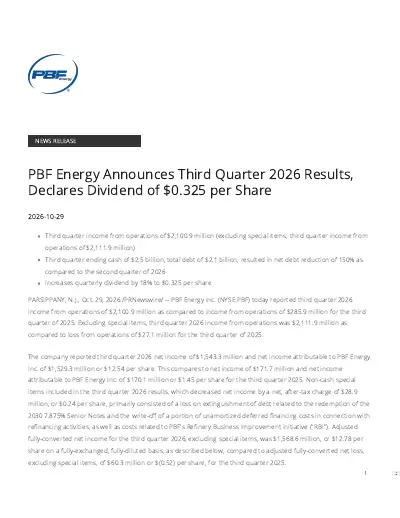
Thanks, Mike. For the third quarter, excluding special items, we reported adjusted net income of $12.78 per share and adjusted EBITDA of approximately $2.3 billion.
Our discussion of third quarter results excludes the net effect of special items, which decreased net income by a net after-tax charge of $29 million or 24 cents per share. These primarily consisted of approximately $11 million of costs associated with the RBI initiative and $28 million pretax loss on extinguishment of debt related to the redemption of our 7 and 7/8% senior notes due 2030 and the write-off of a portion of deferred financing costs in connection with refinancing activities.
PBF's results for the quarter are primarily a reflection of the strong product markets driven by tight supply and relatively firm demand. With our full system available this quarter, we were able to improve our capture in an elevated market environment.
On the Martinez insurance claim, total recoveries to date are 1 and 1/4 billion dollars, net of our deductibles and retention. As expected, we did not receive further payments in the third quarter, and we are working with our insurance group to finalize the claims process before year-end, with a final payment expected in a similar range to the recent precedents.
Also included in our results is $62 million of equity income from our investment in SBR, or approximately $72 million of EBITDA, as the renewable business continues to benefit from strong margins and higher credit prices. SBR produced an average of approximately 19,200 barrels per day of renewable diesel in the third quarter, at the upper end of our guidance range, and we expect fourth quarter production of 18,000 to 20,000 barrels per day.
PBF's cash from operations for the quarter was approximately $1.9 billion, which includes a modest working capital tailwind of $56 million, primarily driven by the timing and delivery of hydrocarbon purchases. Higher commodity prices are generally a tailwind to working capital, but as a significant portion of the price increases occurred late in the quarter, we are seeing benefits flow through in early Q4.
We also expect the cash tax payment to flow through working capital in the fourth quarter. However, the ultimate impact on Q4 working capital will depend on where prices go from here.
Cash invested in consolidated capex for the quarter was $177 million, which includes refining, corporate, and logistics. This amount excludes approximately $8 million related to Martinez rebuild and $46.5 million associated with the Air Products asset purchase.
Our guidance for 2026 capital expenditures remains $825 to $875 million, excluding capital related to the Martinez rebuild. Included in that guidance is funding for advanced purchases of materials for the turnaround scheduled for 2027.
We ended the quarter with approximately $2.5 billion of cash, approximately $2.1 billion of total debt, and $426 million of net cash, reducing net debt by more than $1.2 billion during the quarter. In September, we issued $550 million of 0% exchangeable notes due 2032 and used the proceeds and cash on hand to fully redeem the $500 million of 7 and 7/8% senior notes due 2030.
We also closed the acquisition of the Torrance hydrogen plants, which was financed with a seller's promissory note of approximately $340 million that is included in our total debt. Subsequent to quarter-end, we fully redeemed the outstanding $800 million 9 and 7/8% senior notes due 2030 using cash on hand.
Following this redemption, our gross debt is approximately $1.4 billion, inclusive of the Air Products promissory note. As a result of these actions, interest expense is coming down.
However, including refinancing costs, we expect 2026 interest expense to be within our guidance. Importantly, while we are still in the midst of our 2027 budgeting process, we expect this year's refinancing and debt paydown to reduce interest expense by at least $130 million in 2027.
We project using a substantial majority of our NOLs in 2026, and you can continue to use an effective tax rate of approximately 26% for modeling purposes. As Matt mentioned, our capital allocation framework is focused on strengthening the balance sheet, investing in our assets, and delivering long-term value and returns to shareholders.
While we do envision allocating capital to strategic and margin-enhancing spending at the refineries, our intention is to be prudent stewards of capital and allocate tactically for long-term strategic benefits. Today's 18% increase in our quarterly dividend reflects our confidence in that approach.
Operator, we've completed our opening remarks, and we'd be pleased to take any questions.
Operator
In a moment, we will open the call to questions. The company requests that all callers limit each turn to one question and one follow-up.
You may rejoin the queue with additional questions. If you would like to ask a question, please press star one on your telephone keypad.
A confirmation tone will indicate your line is in the question queue. You may press star one again if you would like to remove your question from the queue.
For participants using speaker equipment, it may be necessary to pick up your handset before pressing the star key. One moment, please, while we poll for questions.
Your first question comes from the line of Manav Gupta with UBS. Please go ahead.
Manav Gupta
Congrats, team, and great job. Dividend raised, debt lowered.
My first question is you are one of the biggest beneficiaries of quality discounts. We are seeing quality discounts widen across the world.
If you could talk about what is driving that and how PBF benefits from it. Again on the West Coast, a little tricky because ANS is sitting at a slight premium to Brent, I'm just trying to understand how you are managing your crude purchases on the West Coast, if you could talk about all those things.
Matt Lucey
Sure, thanks, Manav. Simply put, crude costs across our system in California, in Pad 1, and in the Gulf Coast look like real tailwinds for our system.
Our strength has always been on the back of our complexity, and as crude differentials widen out, we're certainly the beneficiary of that situation. California is a bit unique because the California grades in particular impact our West Coast system.
We're maximizing how much California crude we can run. Indeed, the dynamics in California are a bit unique, but we have a proprietary pipeline that has even a little space left, we try to gobble up as much California crude as we can.
The other aspect is the Gulf Coast and the East Coast will directly benefit from a widening light-heavy differential. Paul or Tom?
Tom O'Connor
The Latin American heavies are really driving the discounts that everybody is seeing and talking about. We're seeing freight drive the FOB valuations in South America much lower.
The Canadian markets are following that, and our system is taking advantage of that everywhere we can. We run a substantial amount of heavies, very beneficial.
Manav Gupta
Perfect. My second follow-up is a little more tricky.
I'm just trying to understand what's the right level of cash for a company like PBF to hold on the balance sheet. Look, too low of a cash is a problem, but too much of a cash on the balance sheet kind of makes you a very interesting acquisition target because you have a unique footprint, the world realizes the benefits of North American refining, and if you start getting to a point where 40, 50% of your market cap starts sitting as cash on the balance sheet, then you become a very interesting acquisition target.
I was just trying to understand what's the right amount of cash to be holding on the balance sheet.
Matt Lucey
It is a bit tricky because the volatility has been so severe in marketplace, as I commented, three once-in-a-generation, once-in-a-career events in seven years, it gives you pause. Obviously the upcycle, we've had downcycles on the back of the pandemic.
In refining, there's no replacement for a strong balance sheet, we intend to maintain that. The sort of percentages you were quoting there were a bit a ways from that, so that's not an issue for today.
If you take a step back and you get the balance sheet as strong as it possibly can be, then we just bring good, prudent, disciplined management of the capital that we have. We've increased our dividend.
We did that very methodically. We always look at our dividend this time of year, and we state it that we want it to be competitive, and maybe most importantly, sustainable through all markets.
Obviously we've completely reconfigured the debt side of the balance sheet, and so we have tremendous confidence in our dividend and the increase therefrom as sustainable through all markets. We've addressed the net debt, we increased the competitive dividend this quarter.
Share buybacks are always a critical component of shareholder return programs. We also think we can benefit significantly from low-hanging fruit.
If you think back to PBF's history, standing on our feet when we first became public and then growing, we're really at a moment now where as a company across our system, my guess of our inventory of low-hanging fruit is simply larger than others. When I say low-hanging fruit, I'm really implying no one in these halls are contemplating, as Mike said, megaprojects or massive expansions, but the example of what we did at Chalmette, where we're converting high-sulfur diesel into jet fuel, and we're doing that for under $20 million of capital.
That delta of high-sulfur diesel in the Gulf to jet is about 20 cents a gallon. If you want to say $8, $9 a barrel on 20,000 barrels a day, that really makes us a more resilient company, and that project has such a high return, that's the best allocation of that capital.
We have other projects like that through our system, and so we're going to be evaluating those very prudently, very cautiously, very disciplined, but we think we have a tremendous opportunity to deepen the keel. That's where our focus is.
Manav Gupta
Thank you, Matt. Very comprehensive.
Congrats on a great quarter, and looks like the fourth one will be very, very strong also. I'll turn it over.
Matt Lucey
Thanks, Manav.
Operator
Your next question comes from the line of Doug Leggate with Wolfe Research. Please go ahead.
Doug Leggate
Hi guys. Let me echo, Matt, what a turnaround in the last year after all you've been through.
If I don't mind I'm going to follow up on Manav's question and ask the question about cash a little differently. You've done this zero-cost coupon convertible.
You're basically looking it seems to keep some level of debt on the balance sheet, and you are still quite a volatile business just by the nature of the cost base and everything else. My question is, why keep any permanent financing?
You've taken the net debt to zero. Why have any permanent financing on the balance sheet?
Because all it does is it exacerbates the volatility of your business. That's my first question.
My second question is, I just wonder, coming out the other side of Martinez, can you give us a refresh on what you think the sustaining capital and the operating cost base of the business is, because on our numbers, your capacity to generate extraordinary free cash flow in this environment continues, but clearly the market is not giving you credit for that, we just want to figure out where the gap is. Thanks.
Matt Lucey
All right, in regards to why have any debt at all, we have a view that, again, it's prudent, it makes a lot of sense to maintain access to the capital markets. We have two pieces of paper now.
We have a $500 million bond and a $550 million convertible bond. What we've done over the last year is, if you look at our historical interest expense, it's been roughly $175 million a year.
The interest expense on those two pieces of paper is less than $40, $37.5 million a year. We've dramatically reduced the cost, the fixed charge of carrying the debt, and I think it's absolutely appropriate for our company to maintain access to the capital markets.
That is what really drove the decision to maintain the instruments that we have in place. I think it just makes the company stronger going forward and maximizes optionality going forward.
In regards to your second question, Martinez, the issue with Martinez is completely behind us. In fact, Martinez just completed its turnaround on its hydrocracker on time, and so in terms of having the full force and effect of our business, we have it.
We think we have real tailwinds. The required spending, there's no material change going forward.
'27 will be a heavier turnaround schedule than most years. It's never rateable.
It's never perfectly rateable, and we were able to move some turnarounds from this year because of the market we've been in. There's nothing changed.
I would say 20 2027 is probably a higher turnaround year. Actually, I know '28 is going to be a lighter turnaround year.
Was there anything else specific you wanted in regards to that?
Doug Leggate
I think really what I'm driving at, Matt, is obviously you've had your business optimization and the benefits coming through there, but we haven't really seen a clean year for capital with Martinez back up and running. What I was really trying to get to was what is the call on your cash flow to maintain the business, including turnarounds and the operating costs post the business improvement initiatives that you've had underway?
Matt Lucey
We
Doug Leggate
can take it offline if necessary, but I wanted to try. Sure.
Matt Lucey
No, I think it's important to address. Happy to.
Mike, why don't you speak to the success that we've had with RBI and how that will play out over '27.
Mike Bukowski
As we said, RBI was $230 million, and that was broken down between capital and opex. We said that roughly $70 million was going to come out of capital and $160 million was going to come out of opex.
Let's talk about opex first. Now, when we contemplated this program back in the tail end of 2024, there's a couple of things that happened that we didn't anticipate.
One, as you mentioned, was Martinez, and so that delayed some of the savings. Then the other thing that happened was the market that we've had in the past couple of months or past quarters or so.
As I look at the opex, we're maybe about 10%, maybe $8 to $10 million, of savings shy for this year. Then you flip that and look at the capital and the turnarounds, we're up about $20 million.
Net-net, we're meeting our commitment. Turnarounds is an interesting thing, and it's difficult to measure year on year, as Matt said, it's not usually rateable.
One thing that we look at is we benchmark every turnaround, and prior to kicking off RBI, we were in the bottom half of the industry in terms of our turnaround cost performance. We've put a lot of things together in place in 2024 to get better, to get predictable first and foremost, and then 2026 we focused on competitive, and now '26 turnaround performance is in the top half of the industry benchmarks.
Then when you look at sustaining capital, we took a baseline of where we were spending sustaining capital before, and it was about $230 million, and we saved about $25 to $30 million on that. It will change from year to year based on the size and the complexity of the turnarounds, it's not always rateable.
As Matt mentioned, next year is going to be one of our larger turnarounds because of our two two deferrals that we had into this year. We continue to make continuous improvement on both the opex and the capital side, so that's how we look at it.
Matt Lucey
Just one final comment in that regard, which is we're just stacking these wins, right? The reduction in interest expense, the RBI savings on the operating cost side, the RBI savings on the capital side, the margin improvement, projects such as the Chalmette jet production.
Each one of these is deepening the keel and making our company more resilient. Obviously, it will make us more profitable not only through downcycles, but through upcycles as well.
Doug Leggate
Appreciate the details, guys. I'll get into the details with Colin offline.
Thanks so much.
Matt Lucey
Thanks, Doug.
Operator
Your next question comes from the line of Joe Laetsch with Morgan Stanley. Please go ahead.
Joe Laetsch
Hey, good morning, Matt and team, and thanks for taking my questions. I wanted to start on the refining side, and within the regions, one of the areas that came in stronger than we'd expect was the West Coast.
Could you just talk a bit about how those assets are running post-turnaround, and then also what you're seeing just on the ground in that market from a demand perspective as well?
Matt Lucey
Paul, do you want to quickly comment on demand?
Paul Davis
Look, West Coast demand has been resilient. Even with these volatile prices that we've seen in the marketplace out there, it's been remarkably resilient.
Our wholesale numbers have gone up actually a little bit. We think that's probably some branded going to wholesale, but in general, from a demand standpoint, West Coast has been pretty steady over the last couple months.
Matt Lucey
I think broadly on the marketplace, now that we're fully up and running with a very clean runway, we're very, very well positioned in the marketplace. As we've talked about for multiple quarters, on the product side, it is a market that requires a massive imports into the state just to balance, but importantly on the crude side as well, where we have not only the two refineries, we have our M70 pipeline where we can maximize our access to California grade crudes.
Obviously some new production has come online this year. I think as a competitive positioning, PBF and our access and exposure to California looks very, very attractive going forward.
Joe Laetsch
Thanks, Matt. That's helpful.
Then just looking in the fourth quarter, I recognize it's still early in the quarter and there's a lot of volatility in the market, but could you maybe just walk through some of the puts and takes that you're thinking about on capture relative to 3Q, in particular as we think about the benefit from wider WCS differentials, if you have anything on crude backwardation, secondary product margins that you all are watching. Any color you could provide would be helpful.
Thank you.
Matt Lucey
Sure. We're further into the quarter on crude than we are on products, just because you buy your crude in advance.
I think my expectation for the fourth quarter is to have widening crude diffs, which obviously are quite impactful to our business. I think it would be folly for us to predict prompt cracks.
Obviously, one through third through the quarter have been quite strong, and indeed just my sneak peek into what October looks like, it looks quite strong. Going forward, as we talked about, if détente around the world is achieved today, none of the problems are solved on the product side.
That being said, prompt prices and prompt cracks can jump around, but the fourth quarter looks obviously very constructive with the backdrop we have.
Joe Laetsch
Great. Thanks.
That's helpful.
Operator
Your next question comes from the line of Phillip Jungwirth with BMO. Please go ahead.
Phillip Jungwirth
Thanks. Good morning, and really strong results.
Sticking with the fourth quarter, throughput guidance is really strong. I was looking back, and I think there's only one other quarter in PBF's history where you were above the midpoint.
Obviously no turnarounds planned, but was just hoping you could speak to the level of confidence in the system and just what's allowing you to run at a higher rate into year-end, and separately, is there the ability to run a heavier crude slate into 4Q, just given the continued weakness in differentials, and if so, could you push a higher distillate yield also?
Matt Lucey
I promise you, we will run the most economic grades that we can get our hand on and push our system in that regard. There's nothing to discuss on that front other than we will absolutely maximize our economic outcome based on the crudes that are available.
I'm sorry, your first question was in regards to throughput? The market is dictating it to a great degree.
Generally speaking, you do have turnarounds in the fourth quarter, and generally speaking, the market doesn't always incent max runs. Obviously the world is in desperate need for our products, and we intend to manufacture as many as we can in this period.
Phillip Jungwirth
Great. Then coming back to the sourcing of California crude, you referenced your advantageous pipeline in the Torrance.
More specifically, how would you see any San Pablo Bay pipeline restart changing crude sourcing at Martinez? Just with the election coming up, how would you characterize current regulatory environment in California and any expectation whether this could change for better or worse depending on the outcome of the governor election?
Matt Lucey
The pipeline one's a funny one only because as I mentioned before, we have space on our M70 pipeline. Now, I think the San Pablo pipeline has been sold, I don't yet know what the new owner's full intent is.
From PBF's perspective, we get this a fair amount in California, 'Well, when are we going to open San Pablo?' It's like if you own a hotel in a town and you've got 20% vacancy and someone is saying, 'Well, are you going to build a new hotel?'
When vacancy becomes a problem, we'll look to increase flows. Obviously, Martinez sits at the end of the San Pablo Bay pipeline, and to the degree that our M70 pipeline is full, we would certainly love to bring crudes up to Martinez.
At the moment, you've gotten a lot of legislation through California which has decreased the friction in getting permits for the producers, to the degree that production increases, I think the San Pablo Bay pipeline is sitting there in a perfect spot to take incremental grades that can't be taken south. Simply, egress is not the constraint at the moment as is production.
In regards to the election, it's not worth me prognosticating, but I don't see any material shift in the sort of the California political environment. I do think there's been a great awakening in terms of how important and impactful and how necessary our products are to the economy and to the welfare of all the people that live there.
I think that's a very good thing. I don't see that backtracking, and clearly, California was a microcosm of what the world is going through now.
We'll see where the election goes. We've had a tremendous partnership with the state over the last couple years sort of navigating all the changes that have existed, and we look forward to working with them going forward regardless whoever the administration is.
Phillip Jungwirth
Very helpful. Thank you.
Operator
Your next question comes from the line of Josiah Knight with Goldman Sachs. Please go ahead.
Josiah Knight
Good morning, team, and thank you for taking our question. Maybe just circling back on freight rates, can you talk about how exposed is your system to the elevated rates we're seeing in the market right now?
Then additionally, what steps have you been taking to mitigate these impacts?
Matt Lucey
If you think about freight rates for PBF, you think about supplying crude into the East Coast and Northern California. We have about half of our fleet on time charter, which has obviously insulated us from the massive gyrations that are occurring.
We have closer proximity than much of the rest of the world in regards to where we're delivering our crude from. Obviously, we are in a freight firestorm at the moment, I don't envision any material changes to that because this is not the time in which you want to go out and get more time charters.
To a great degree, and it's PBF for certain, and to a great degree US refining is dramatically in a better place than, say, Asia in that regard because of the distance that they have to go. As Tom O'Connor always points out, the Atlantic Basin has crude avails, and so our transit time is much shorter.
Josiah Knight
That's helpful. Then the follow-up is just on the delayed turnarounds at Chalmette and Toledo.
Could you just remind us of the decision-making process here, and then additionally, how should we framing out the impact to '27 throughput and then '27 capex?
Matt Lucey
We're not going to get into specific capex guidance yet. We usually put that out a different time.
We'll follow that. In regards to the turnarounds, it's no different than how we run our business every single day, which is evaluating the condition of our units, which are continuously and meticulously sort of evaluated on a day-by-day basis.
To the degree that we can optimize our turnarounds and our operations, that's what our job is. Mike, you want to comment in regards to anything else in regards to the turnarounds?
Mike Bukowski
I think you nailed it right there. In particular in Toledo, as we stated on the call the last time, we had some downtime, unplanned downtime in May, and we took advantage of going after a few things during that downtime to set us up to be in the position to defer this turnaround into next year.
There's an example of we're applying rigor and discipline, analyzing performance of the unit, fixing things, and then moving forward.
Josiah Knight
That's helpful. Thank you.
Operator
Your next question comes from the line of John Royall with Piper Sandler. Please go ahead.
John Royall
Hi, good morning. Thanks for taking my question.
My first question is on the performance of SBR. Obviously it's a very positive macro for RD, but looks like a really strong quarter on that equity earnings line for 3Q.
Could you talk about that unit kind of operationally, how it's running, and what feedstocks look like? Secondly, are you taking any dividend out of that JV right now?
Just trying to understand the cash impact given that business is having a more meaningful contribution right now.
Joe Marino
Sure, I'll start with the dividend. We did receive our first dividend distribution from SBR during the quarter of about $29 million that is reflected in the results.
As far as operations, it's been running well. You can see we're at the top end of our throughput guidance for Q3, everything going well there.
Our feedstock slate obviously changes over time, although we try to source the most economic feed there, and it'll move between the higher and lower CI, and I think for Q3 it was more on the lower CI level, which helped from a margin capture standpoint. Overall, as I said in my remarks, just the strong margins there, the tightening of the ho-bo spread, and the RINs price kind of maintaining at high levels has helped to really charge the earnings of that business.
John Royall
Great. Thank you.
Then my follow-up is on bringing the hydrogen plants back in-house, and I realize you touched on this in 2Q a little bit, but how should we expect to see the returns on that kind of investment? Is it just about reliability and reducing downtime?
Does it reduce opex overall? Just trying to understand maybe how to model that acquisition.
Also, I think there were a few others that were sold to Air Products when you did that initial transaction a few years ago. Was there any thought to bringing those back in-house as well?
Matt Lucey
Just on the last piece, I don't expect there to be any other. Torrance was a bit unique because of the way it was situated within our refinery and the way it was being operated.
Mike, why don't you walk through it.
Mike Bukowski
I'll jump on that point. The uniqueness of it was that they were so integrated to the operation of the facility where we shared utilities, the hydrogen plant was a major steam producer, for instance, for the refinery, and so any impact to the operation of the hydrogen plant, and because of that refinery so beholden to hydrogen in terms of being able to perform and maximize the refinery, had all kinds of impacts.
I would look at it like this: when we did the acquisition, it was firmly just based on increase in the utilization of the refinery. In the past, because of either planned or unplanned downtime associated with those hydrogen plants and the lack of integrated plans really drove the performance in the refinery, I would look at it's mainly just as utilization.
Joe Marino
One thing I would add from a modeling standpoint is nothing changed with the transaction as far as the cash flows go, our overall cash flows. It's just really it changed in the classification with now, in the past it was classified as operating leases and would flow through as such in the P&L.
Now it's going to be a debt promissory note that will flow through financing activities. The cash flows themselves remain the same.
John Royall
Thank you.
Operator
We have reached the end of the question and answer session. I will now turn the call over to Matt Lucey for closing remarks.
Matt Lucey
Thanks for everyone's attention today, and we look forward to speaking to you after a very solid fourth quarter. Have a great day.
Operator
This concludes today's conference, and you may disconnect your lines at this time. Thank you all for your participation.