PACCAR Inc.
Q3 FY2026 · Earnings Call TranscriptOctober 27, 2026
Operator
Good morning and welcome to PACCAR's third quarter 2026 earnings conference call. All lines will be in a listen-only mode until the question and answer session.
Today's call is being recorded and if anyone has an objection they should disconnect at this time. I would now like to introduce Mr.
Ken Hastings, PACCAR's Director of Investor Relations. Mr.
Hastings, please go ahead. We are now experiencing some technical difficulties.
Please stand by while we pause the broadcast. Just one moment.
Hello everyone and thank you for holding. Good morning and welcome to PACCAR's third quarter 2026 earnings conference call.
All lines will be in a listen-only mode until the question and answer session. Today's call is being recorded and if anyone has an objection they should disconnect at this time.
I would now like to introduce Mr. Ken Hastings, PACCAR's Director of Investor Relations.
Mr. Hastings, please go ahead.
Ken Hastings
Thank you Joel and good morning everyone. My name is Ken Hastings, PACCAR's Director of Investor Relations, and joining me this morning are Preston Feight, Chief Executive Officer; Kevin Baney, President; and Brice Poplawski, Senior Vice President and Chief Financial Officer.
As with prior conference calls, we ask that any members of the media on the line participate in a listen-only mode. Certain information presented today will be forward-looking and involve risks and uncertainties that may affect expected results.
For additional information, please see our SEC filings and the Investor Relations page of paccar.com. I would now like to introduce Preston Feight.
Preston Feight
Hey, thank you Ken and good morning everyone. Kevin, Brice, Ken, and I will update you on PACCAR's excellent third-quarter financial results and business highlights.
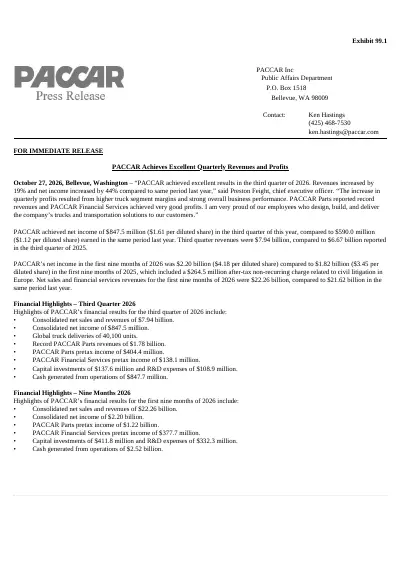
I'd like to start by thanking our wonderful employees all around the world who did a fantastic job of providing our customers with the highest quality trucks and transportation solutions in the industry. PACCAR delivered excellent revenues of $7.94 billion and net income of $847.5 million in the third quarter.
This is 19% revenue growth and 44% profit growth compared to the same period last year. PACCAR Parts had record quarterly revenues of $1.78 billion, and PACCAR Financial Services' $138 million in profit was an increase of 9.4% compared to the same period last year.
We estimate this year's US and Canadian Class 8 market to be in a range of 240 to 260,000 trucks and next year to grow and be in a range of 240 to 280,000. The US and Canadian truck market is being driven by economic growth, continued investments in infrastructure, and the general freight market recovery.
In Europe, we project this year's above 16-ton market to be in a range of 300 to 320,000 units and in a similar range for 2027. This represents continued truck replacement in a region with steady economic growth.
We estimate this year's South American above 16-ton truck market to be in the range of 100 to 105,000 vehicles, and next year to be up slightly and in the range of 105 to 115,000 trucks. PACCAR's premium trucks are performing very well for customers throughout all of Latin America.
Based on strong customer orders, PACCAR increased deliveries to 40,100 trucks in the third quarter. Delivery volume will increase in the fourth quarter as suppliers become more able to ramp up their production to meet continued strong customer demand.
Fourth-quarter deliveries are anticipated to increase and be in the range of 41 to 43,000. PACCAR's third-quarter truck, part, and other gross margins were a strong 14.5%.
Fourth-quarter gross margins should remain high and again be in the range of 14 to 15%. We look forward to a strong finish to this year and another very good year in 2027 as our customers benefit from PACCAR's excellent trucks and new transportation solutions.
Kevin Baney will now provide an update on PACCAR Parts, Financial Services, and other business highlights.
Kevin Baney
Thank you Preston. PACCAR Parts achieved record third-quarter revenue of $1.78 billion.
This record is the result of investments in parts distribution, growth of the TRP all-makes brand, expanding transportation solutions, and increasing dealer retail locations. We anticipate continued growth in the fourth quarter.
PACCAR Financial Services pretax income was a robust $138 million with 9.4% year-over-year growth. These excellent results reflect stable finance margins and higher used-truck pricing.
Similar to PACCAR Parts, PACCAR Financial provides steady foundational profitability during all phases of the business cycle. Last week, at the American Trucking Associations' truck conference, PACCAR proudly introduced its next-generation transportation solutions platform called PACCAR Connect.
This system provides a state-of-the-art technology platform in a beautifully integrated vehicle display. PACCAR Connect has the ability to bring together fleet telematics systems, PACCAR truck data, customer-specific productivity applications, Apple CarPlay, and electronic driver logs into a fully integrated system.
This system will serve as a unifying platform that will enhance customer productivity and create new revenue streams for PACCAR. This year's capital expenditures are projected to be between $650 and $700 million, and research and development expenses will be $440 to $460 million.
In 2027, we estimate the company will invest $650 to $700 million in capital projects and $460 to $500 million in research and development expenses. Key technology and innovation investments include next-generation clean diesel, hybrid and battery electric powertrains, growing the parts business, enhancing manufacturing capabilities, and expanding the connected vehicle offerings.
PACCAR's industry-leading trucks, best-in-class parts, and financial services businesses, and advanced technology strategy position the companies for an excellent future. We are pleased to answer your questions.
Operator
We will now begin the question and answer session. If you would like to ask a question, please press star one to raise your hand.
To withdraw your question, press star one again. We ask that you pick up your handset when asking a question to allow for optimum sound quality.
If you are muted locally, please remember to unmute your device. Please stand by while we compile the Q&A roster.
Your first question is from Steve Volkmann with Jefferies. Your line is now open.
Please go ahead.
Steve Volkmann
Great. Thank you guys.
Good morning.
Preston Feight
Good morning, Steve.
Steve Volkmann
A couple quick ones here for me and I'll pass it on. One, Preston, I think you mentioned that you expected sort of supply chain to kind of catch up, and I think your deliveries this quarter might have been slightly less than what you had projected.
Are you seeing supply chain constraints that are limiting that, or was that just kind of normal variability?
Preston Feight
Steve. That's a nice observation.
Our deliveries in the third quarter, 40,100, were somewhat affected by supply constraints. As they are, we and others are building more trucks.
I think the suppliers are trying to get up to speed on that. That's kind of what affected Q3 and what we think is improving in Q4 with the guide to 41 to 43,000 trucks.
We're working closely with our suppliers to make sure they get the parts to us and we can build trucks. Makes it a lot easier to build the trucks when we got the parts.
[Chuckles]
Steve Volkmann
Okay, that makes sense. Then the second one, I'm curious how you're sort of thinking about or how you're even interacting with customers relative to '27 now, because I'm imagining, but please correct me if I'm wrong, that it's actually hard to sort of price trucks for '27 when we don't know the NCPs yet.
That probably makes it hard to take orders. Are you taking orders for '27?
If so, can you provide any color as to sort of what people are actually ordering, relative to engines?
Preston Feight
Hey, Steve. That's great.
We made the observation of it's easier to build trucks if you've got parts and it's easier to price trucks if you know the costs. I think that the government's doing a very nice job, actually, of looking at the 2027 emissions regulations and figure out how they are able to set the NCP levels.
As you noted, they're not finalized yet, and I think that does give some customers pause about what their price will be. We've had excellent discussions with our customers.
We know them for many years, and ATA was a great opportunity to sit with a lot of them, and talk about what their needs are for 2027. I think they feel, everyone we met with, feels like they would like to keep buying the 200 mg engines, they have time to prove out the technology of the new engines, the lower NOx engines.
I think they are starting to place their orders. We're seeing good inquiry and increasing order intake, but obviously that'll likely increase as we have certainty around NCPs.
Steve Volkmann
Understood. Thank you so much.
Preston Feight
Yep.
Operator
Your next question is from Jerry Revich with Wells Fargo. Your line is now open.
Please go ahead.
Jerry Revich
Yes, hi. Good morning.
Good afternoon, everyone. I'm wondering if you could just talk about the lead indicators that you're tracking for the parts business.
What do you expect the outlook to be over the next couple of quarters normally? You folks have some visibility a couple of quarters out, given contract rates are moving higher.
I'm wondering if you could just give an update on how you're thinking about the cadence.
Kevin Baney
Jerry, this is Kevin. As we look at the parts business, right now in a smaller parts market, team's done a great job increasing volume, growing share.
Share is one of those things that we measure, and right now with customers have elevated operating costs, they've got higher diesel prices, they've got an increased number of unseated trucks. They're focused on really required maintenance at this point, and so we spend a lot of time working with them.
One of our key things we look at is our share of wallet with our customers, and we've been able to grow our share and increase while they're at elevated costs, and as things return to more normal conditions for them, we anticipate to keep growing.
Jerry Revich
When do you think that'll be? Based on what you're hearing, do you expect an acceleration exiting the fourth quarter or is it possible to get a sense, Kevin?
Kevin Baney
We anticipate continued growth in the fourth quarter. We have been able to grow share.
That's a key metric for us. I think we really provide ease of doing business with our customers.
We continue to grow the revenue with them, gain share, and anticipate that to continue.
Jerry Revich
Super. Can I ask the margin outlook, 14 to 15% for the fourth quarter.
What we're hearing is really good pricing for fourth quarter delivery slots and a sequential improvement from third-quarter pricing. Does the margin outlook embed some of the uncertainty on the part side versus improved profit per unit on the truck side, or can we just unpack the push and the pull there if you don't mind?
Preston Feight
Sure. I think a simpler way to think about it is when we're building trucks and we have to deliver or build them without all the parts, there is a cost adder in that.
That has some impact to price cost in the quarter as we think it might occur. Obviously, we're doing everything we can to minimize that.
I think the parts team is, as Kevin said, doing a great job of getting the market share gains and margin growth. We feel positive about how they're doing.
Then I think as we look at our pricing power, it has been good with our customers. There is a strong demand for the 200 mg engines, which we think carries into 2027 as well.
It feels pretty positive from that standpoint. It's really just about those efficiencies that we have to deal with in the fourth quarter.
I think the other part of it is, it's always a function that there's a lag factor between pricing a truck and your backlog, and so that sits into the factors as well.
Jerry Revich
I appreciate the discussion. Thank you.
Preston Feight
Great. Good talking with you, Jerry.
Operator
Your next question is from Tami Zakaria with JP Morgan. Your line is now open.
Please go ahead.
Tami Zakaria
Hey. Good afternoon.
Thank you so much. I'll ask one question today.
I heard you comment about the delays in how they're trying to decide what to order next year. As you are part of those discussions, are you getting a sense that customers are looking to buy the non-compliant engines and planning to pay a non penalty on it?
Or is there willingness to adopt a compliant platform even if it comes with a higher cost? Any color on which direction customers are leaning toward at the moment?
Preston Feight
Sure. I think, one of the things I'd start with, Tami, is to say that we have very good visibility right now.
Obviously, the year is full and we're filling the first quarter, so that's a pretty positive position to begin with. I think the customers are beginning to order, but it's just the beginning of that when they would expect the fleets to be thinking about their capital allocations for next year.
That's kind of a part one of your commentary. Then I would share, and I've said this a lot, is every customer we meet with is much more interested in proven, stable technology that they've had time to vet in their operations.
They're asking for us to deliver to them trucks with the 200 mg and an NCP because that makes their operations smoother compared to introducing new technology from any manufacturer that they haven't had enough time with. That's kind of where the world sits right now.
Tami Zakaria
Understood. Thank you.
Preston Feight
You bet.
Operator
Your next question is from Rob Wertheimer with Melius Research. Your line is now open.
Please go ahead.
Rob Wertheimer
Thank you. I think Kevin mentioned half a dozen things that could affect parts margin, which was down a little bit year-over-year this quarter, from mix to maybe people delaying some purchases to investments.
I wonder if you could just break that down. Is there any kind of price competition that's led to lower margin, or is it other factors?
Kevin Baney
Rob, it's just primarily mixed right now to the elevated operating costs that we see with the customers. We've got great trucks with a lot of proprietary content, the engine business.
I mentioned the connected, really see as the customer's operating conditions improve, we see a nice balance of that mix back between all-makes and proprietary.
Preston Feight
Rob, I just add on what Kevin said and echo it in a different way, is think about the way the enforcement of CDLs went in 2026 and that pulled a lot of trucks out of service. If a truck's pulled out of service and they're sitting against a wall, if you will, then that means that there's less miles driven on some of those newer trucks.
It's just postponing parts purchases. We think that'll come back obviously, and that's kind of what Kevin said with high fuel prices being the other factor.
That's just kind of the way the market is running. I'm so pleased with what the team's been able to do in terms of growing the parts business in a market which is kind of constrained.
They've done a really nice job in that factor.
Rob Wertheimer
All right, thank you. If I may sneak in another one, you mentioned a couple of times the launch of PACCAR Connect and potentially even new revenue streams that might come out of it.
What are the biggest kind of pain points, whatever you want to call it, that your customers are feeling that might be solved by this, and how does that evolve over time? I'll stop there.
Thank you.
Preston Feight
Thanks Rob. Great question.
We're really excited about this. The product is really cool.
I don't know if you had a chance to see it, but if you get in one of the new Peterbilt or Kenworth trucks with the integrated system, what you end up with in today's world is people install third-party telematics systems into their truck, which requires getting into the dash, cutting things, installing hardware, and this eliminates the need to do that. Step one is it gives us, PACCAR, an opportunity on the hardware side, because now we're doing that work for the customer in a much more integrated factory-direct manner.
They're all going to be excited about that. We hear that from them.
Then you think they get the choice of the telematics system they want to put in, as we're doing this in kind of an open-source system, and you can akin it to an iOS on your phone, an operating system on your phone where you can add applications that can be bespoke to a customer, specific to a customer, or they can be PACCAR applications, and those applications can be revenue accretive for PACCAR. They're also really beneficial to our customers, and you think about how it builds into the parts business in the future, as we understand what the truck is doing.
It gives us the opportunity to do predictive maintenance on the truck or direct it towards our dealerships. Integrating our businesses with our customers in a way that's beneficial for their profitability and ours feels like just an exciting time.
Kevin Baney
Just to add to it, it allows us to stay connected longer with the customer through their operating cycle, and so ease of doing business around the parts business will really help.
Rob Wertheimer
Thank you, perfect.
Operator
Your next question is from Lewis Merrick with BNP Paribas. Your line is now open.
Please go ahead.
Lewis Merrick
Yeah. Good morning, everyone.
Thank you for taking my question. Just one from my side.
A quick one on tariffs. Are you able to confirm there was still some one-off benefit from tariffs during the quarter?
If so, how much? Should we expect there to be further one-off benefits coming in 4Q?
Is 1Q then the point where we sort of get to a clean sort of point from a tariff perspective?
Preston Feight
Lewis, what we've seen is the tariffs have gotten a little more stable. We've still seen tariff costs that we incur as we're importing.
We've had some benefits as well, but it's really not been material to the results of our performance and so it's just kind of in the mix.
Lewis Merrick
Okay. Just to be clear, there wasn't any sort of one-off benefit in 3Q?
Preston Feight
No, it's kind of continuing as we sort through the tariff process and work with suppliers and work with the government and try to get clarification on it.
Brice Poplawski
Yeah. This is Brice, a comparable, I think we mentioned in the second quarter as well during the call, comparable kind of activity.
Lewis Merrick
Okay. All right.
Thanks very much.
Preston Feight
Thanks, Lewis.
Operator
Your next question is from David Raso with Evercore ISI. Your line is now open.
Please go ahead.
David Raso
Hi, thank you for the time. You used to speak to gross margins as the third-quarter guide and then further increases in the fourth quarter.
Just so we're clear, the change in now the third to fourth-quarter gross margins are more flattish as a base case, is that more because the truck margins aren't going to grow sequentially the way you would have thought due to the supplier-related inefficiencies, or is it also related to the parts margins being less than you thought? Then, I just had a quick follow-up on truck margins more broadly.
Preston Feight
David. Good to talk to you.
I would say that your first comment is more accurate than your second comment, in that it's just the cost of production right now is having some impact. We are seeing great truck pricing, but it is just that uncertainty there.
David Raso
That's what I wanted to back into the second question. The profitability per truck was the highest since the fourth quarter '24 and you did it with 3,800 less trucks delivered, right?
It appears very impressive. You did have more US-Canada mix this quarter than back then.
Price cost was negative back then. I'm not sure if you commented if price cost was still positive this quarter like last, maybe you can confirm that.
I think we're all just trying to level set, all right, maybe the supplier issue doesn't extend into '27. What do I do with the fourth-quarter margin as a launch pad thinking about '27?
I know there's a lot in there with penalty revenues on the trucks in '27 and how that dampens the margin. Again, just trying to think through this margin performance and how to think with the fourth-quarter launch for '27 thoughts.
Thank you.
Preston Feight
David, usually, you give these great questions. It's fun to talk with you.
You bring up a very important point is, if you think back at just a year ago in September of 2025, net income was $590 million and this quarter it's $847 million. The teams have just done a fantastic job each quarter increasing total profitability.
They've done that through truck pricing and through disciplined operating performance like PACCAR always does, and it sets us up really well for the future, puts us in a very strong position to look forward into things. Obviously, the more stable the market is and the more clean the production costs are, the easier it gets for us.
I think you asked or you mentioned, which I think was kind of an ask, about price cost, and price costs remained favorable in the quarter.
Kevin Baney
That was mostly due to on the price side, the favorable price realization we're getting on our truck price.
David Raso
I guess to ask the question without asking you for guidance for '27 truck margins, [Laughter] would you look at this fourth quarter then with again, the drag of maybe pass-through revenues with not much margin on the penalty, but assuming less supplier issues, just how would you want us to think about '27 truck margins versus this third, fourth-quarter kind of run rate?
Preston Feight
Yeah. Great, it's a great way to think about it.
If you think about 2027, we're calling the market up, and we're doing that without having the certainty of what the cost structure will be in 2027, which means we're pretty bullish. We remain our bullish position on 2027.
We think that any of the uncertainty will show up in the first part of the year, and then clarity will be through the second, third, fourth quarter. Then as we get towards the end of the year, we would expect it to even strengthen.
I think our general sense is the uncertainty will dissipate, and the market will become stronger as the year passes.
David Raso
I appreciate the time. Thank you.
Preston Feight
You bet. Thanks, David.
Operator
Your next question is from Chad Dillard with Bernstein. Your line is now open.
Please go ahead.
Chad Dillard
Hey. Good afternoon, guys.
Preston Feight
Hey, Chad.
Chad Dillard
I want to go back to the parts business. Can you update us on what the outlook is for '26?
Then I think you talked about seeing some out-growth and I recall from the Investor Day, you talked about a $3.5 billion parts opportunity. Just any color on just how fast you're out-growing and where you're tracking versus that goal.
Kevin Baney
Chad, this is Kevin. Outlook for '26, I mentioned the continued growth in the fourth quarter and we'll finish within the range that we had forecasted, the 3 to 5% we'd given previously.
Outlook for next year is continued growth. As we watch customer's operating conditions, as Preston mentioned, we forecast the market to increase.
We've got the connected platform out there and we see the continued growth. We mentioned in the Investor Day the opportunity with the second owner.
We mentioned the parts market now. Some of the growth that we've seen with our record revenue has come from growth in the second market.
We've grown with our fleet services program and then we've also grown the percent of our TRP and all-makes, and a portion of that comes from the second owner.
Chad Dillard
Got it, that's helpful. Then your North America guidance for '27 implies about a 4% increase at the midpoint.
I was hoping you could break down how you're thinking about the vocational versus tractor market as you go into next year.
Preston Feight
We kind of look at the markets and think that we have really run below replacement demand on the fleets. I think that they have had some relief from that because of the driver situation, but they recognize the high performance, great fuel economy, low operating cost, and driver appeal of new trucks.
I think they're very interested in getting new trucks and are starting down that pathway. Then I think that the general infrastructure investments that are happening in America are very good for the vocational market for the coming years, and since we're the leader in the vocational market with our 40% share there, we think that bodes well for us also, cuz those are good trucks for us to sell.
Chad Dillard
Great, thank you.
Preston Feight
You bet.
Operator
Your next question is from Kyle Menges with Citigroup. Your line is now open.
Please go ahead.
Kyle Menges
Thanks. I just wanted to follow up on Chad's parts question, and I think if I heard you correctly, you're still thinking that parts growth can be in the range of 3 to 5% for the full year.
I think that would imply parts growth of around high-single digits in the fourth quarter versus you've been tracking in the low-singles through the first 9 months of this year. What gives you confidence in that high-single-digit growth in the fourth quarter?
Preston Feight
I'd say we have a great team of people that are working closely with our dealers and our customers, and that the freight market's returning, and so those are the factors that push us into that confidence.
Kevin Baney
Kyle, and I'll add that we've seen a growth in our fleet services program. What that shows is that we continue to gain new customers, the ease of doing business with our parts programs.
We gain new customers and we continue to increase our share of wallet with our current customer base. We are planning for ongoing growth.
Kyle Menges
Got it, thanks. Then I also wanted to follow up on some of the earlier Q&A related to 2027.
It sounds like you're thinking second half might be a little bit stronger than first half. I'm curious if you think then that first half of 2027 could be a little bit softer just from a delivery perspective than where you'll be at in the second half of 2026 and then I guess you're expecting the second half of '27 to be a bit stronger.
Preston Feight
Kyle, I don't know if you might be putting a little too many words in my mouth. I think that we have to see what the NCP levels are set at.
I think that'll be very significant to how the market reacts at the beginning of the year. We've seen good interest, but we've seen obviously that customers would like to know what the NCP level is going to be.
We know they'd like to buy a truck that's durable, reliable, and proven for themselves, but we need to see NCP levels. Once those become finalized, and if they're set at a level which is helpful to the truckers who are already dealing with high fuel prices, and that'll be good for the market in the early part of the year.
Then obviously, as you get into the latter part of the year and customers get some time, we'll see what their reactions are. It gets a little bit tougher to predict a market in the second half when it's 9 months to a year from now.
Kyle Menges
Fair, thanks for the time.
Preston Feight
You bet. Good talking with you.
Operator
Your next question is from Jamie Cook with Truist Securities. Your line is now open.
Please go ahead.
Jamie Cook
Hi. Thanks for allowing me to ask a question.
I guess my first question, Preston, could you just speak to sort of your competitive positioning in the US with Section 232, how you're performing from a market share opportunity relative to your initial expectations, or do you think how you're balancing sort of market share for price in this type of environment? Can we get the Section 232 benefits dropping to the bottom line?
Then, I guess my second question, again, sorry to ask about next year, but I will anyway. Assuming the US market outperforms Europe next year, just thinking from a geographic mix perspective the impact on margins, would North America be accretive, or is there just sort of more noise associated with NCPs and supplier constraints and stuff like that?
Thank you.
Preston Feight
Now, looking at your first question, I would say probably the easiest thing to do is look at truck margin since December 2025 till now and say that it's gone from $240 to $570 million. I think that kind of answers the question of the positioning of what's happening, and it's holding market share as a relatively flat position.
Kevin Baney
Jamie. Just the comment about Europe.
We still forecast Europe to remain strong in that 300 to 320. DAF's done a great job maintaining its position and seen a increased in order activity in the back half of this year, and we've increased build commensurate with the increased orders.
Good forecast in Europe for next year.
Jamie Cook
Thank you.
Preston Feight
Thanks Jamie. Good talking to you.
Operator
Your next question is from Steven Fisher with UBS. Your line is now open.
Please go ahead. Hi.
Steven Fisher
Thanks. Good morning.
You were able to hit your margin targets despite the lower deliveries in the quarter. I guess I'm just curious what kind of helped that along.
Was it just some general conservatism at the beginning? Were there any particular mixed dynamics in there?
I think you already said that tariffs were not sort of a material benefit to it. Just curious what drove that hitting the margins despite the lower deliveries?
Preston Feight
Steven, the simple answer, and it's really true, is amazing people. When we have a great team of people all around PACCAR, and you've had the chance to be in our factories, you meet the people that work there, you watch what they do everyday and how well they can perform in spite of complications, it's super impressive.
It happens at every part of the business, the financial services business, the parts business. Those are the contributors more than anything else is to the performance in lieu of lower deliveries, and they just keep doing a great job.
That's probably the biggest thing.
Steven Fisher
Okay. Thank you.
Then obviously, there's a lot of talk about supply chain challenges on the call. Just curious how broad those challenges are.
Is that mostly within domestic markets? Is it related to imports?
Is it just a few, or is it more broad? Any help you can give on that, thanks.
Preston Feight
I think the easiest way to think about it at the macro level is, the build rates have gone up significantly, and they've gone up rather quickly. That just puts a tax on the system.
We have great suppliers. They do a good job of working with us.
It's just expecting them to go up this quickly in support of the total industry created some work for them and a few misses. All you have to do is miss a single part on a truck, and it becomes impactful.
Almost all of them are performing really well, but all it takes is one or two missed parts to make it meaningful. Our teams are working closely with them and we're making great progress.
Hence, the guide for higher deliveries in Q4.
Steven Fisher
Thank you very much.
Preston Feight
You bet. Good talking to you, Steven.
Operator
Your next question is from Angel Castillo with Morgan Stanley. Your line is now open.
Please go ahead.
Angel Castillo
Hi, good afternoon and thanks for taking my question. Preston, I wanted to ask a little bit of a bigger-picture question around autonomous.
Clearly, the trucker here is under quite a bit of pressure, ranging from drivers to high fuel prices. Just it was curious if you could elaborate or at least comment, I guess, in terms of what you're seeing in terms of customer's appetite for perhaps autonomous trucks given your work with your partners and, more perhaps more specific to the PACCAR, as you're seeing the market evolve and all these pressure points on that trucker, any changes as to your appetite or the pace at which you want to move in terms of some of these investments to develop autonomous solutions here that you might be able to deploy to both gain share, but more importantly, help your customer solve some of those issues?
Preston Feight
Great. I love the way you ended the question, Angel, and thinking about helping our customers because that's kind of what we try to do every day.
If we have the opportunity to develop safe, reliable technology that helps our customers. Then we see autonomy being able to do that, then that's the path we're on.
We're developing our own proprietary autonomous vehicle platform, which will make it easier for autonomous systems to be integrated into the truck in the factory. We think that's a significant advantage for the future going forward.
Our pace of play on this is really about safety first, right? These are 40-ton vehicles and we want to make sure that they are completely capable, fully validated with production parts, just like any new program we do, and that's determining the pace of our introductions.
We have good partners in Stack, Aurora, and others as we work forward with our customers and how to deploy that. We obviously think the deployment will happen somewhat gradually in lanes, in weather climes, and then it'll roll out in a progressive way.
I think, the other instructive thing to think at the macro level is, it's got to be a win for our customers, it's got to be a win for the developers, and it's got to be a win for PACCAR. When all those parties are winning, and we have a durable, reliable, safe system, then that's when it'll begin to deploy at scale.
That feels pretty good. I think the other thing that we look at in that is macroscopically, it's very good for PACCAR, because trucks are still going to need maintenance, and they're still going to need taking care of, and it's going to involve our dealers and support systems for those trucks because now there won't be a driver at that point, the PACCAR Connect system and all the information we have on trucks will integrate us more to the vehicle.
Angel Castillo
Very helpful, thank you. Then we've had I guess a lot of discussion around the P&L, but I was hoping to kind of pivot here to maybe the cash flow a little bit.
Can you just talk about what your expectation is for cash flow from operations and free cash flow for, I guess, or just cash flow from operations for the year. To the extent that you can kind of elaborate a little bit more on kind of the third quarter and year-to-date cash generation, is that kind of as expected?
Are there any puts and takes there that that maybe surprised or that we should be mindful of as we think about cash flow generation for the remainder of the year or in the third quarter that may or may not have kind of potentially caused it to be a little bit light? Just any, again, more color that you can provide on cash flow generation of this year, that'd be helpful.
Brice Poplawski
Sure, Angel. This is Brice.
I would just tell you, we feel pretty proud of the cash we generate. We generate cash in through the 9 months of $2.5 billion, which is greater than our net income, and a lot of companies can't say that.
It's very high quality of earnings. We're pretty proud about that result.
For the full year, we would expect a similar kind of scenario where the income would be generated through the cash from operations with the net income as the biggest driver. If you're commenting about last year's number, it had a one-off kind of a large effect, because our wholesale dealer flooring inventory was down.
That was a kind of a one-off, not a typical thing where dealer flooring changes that much in a given year.
Angel Castillo
Very helpful. Thank you.
Yep.
Operator
Your next question is from Scott Group with Wolfe Research. Your line is now open.
Please go ahead. Scott,
Preston Feight
are you out there? Joel.
I think we maybe can leave it there.
Operator
Sounds good. It looks like Oh, it does look like Scott has tried to dial in one more time.
Would you like me to put him onto the stage?
Preston Feight
Sure. Yes, please.
Operator
Great. This is Scott Group from Wolfe Research.
Your line is now open, Scott.
Scott Group
Hey guys, can you hear me now?
Preston Feight
We got you, Scott. Glad you got in.
Scott Group
All right, fantastic. Thank you.
Sounds like you guys were at ATA last week meeting with customers. Just wondering sort of the tenor of the conversations.
Truck rates going up a lot, driver market tight. Are you hearing about fleet growth?
Is it just replacement, and sort of how you think that plays out and maybe what you think that means for the used market going forward as well?
Preston Feight
I think we're sitting in a transition point where the fleets would like to be growing. They're still managing cash flow.
They've seen costs be high with fuel, fuel increase is a cash flow problem for them. They're managing driver costs.
That's a cash flow impact to them. They'd like to be growing their businesses.
Some of them are starting to see that ability, but it's really just beginning to be there. There's been some consolidation over the past few years, it's taking some absorption of fleet size into the market.
That's now, I think, finishing. It makes it feel like they'll begin to see increases in fleet size in the coming quarters.
Scott Group
That's helpful. Just on this idea of all this near-term uncertainty, I don't know if you guys can give any color.
What percentage of 1Q is sold out now? It sounds like pricing's really good in Q4.
Does that logically take a step back in Q1 if we have less stuff sold at this point, just any sort of near-term thoughts there? Thanks.
Preston Feight
Great question. I think when we look at it, just having the year filled as we sit here, and it's been filled for a little bit, gives us confidence that there is demand that's strong out there.
Now I think that as we're filling the Q1, it's pretty early. You think a lot of fleets come in to ATA, we were talking about ATA, and they're just starting to decide what capital to allocate and how they're going to do that, it's pretty early days for Q1 to have a real look yet.
I think we'll get a better view of that in the coming 4 to 8 weeks here. Obviously, getting certainty of NCPs, and if they're at a low level to support our customers wishes for the proven product, that will be advantageous to the build of Q1.
Scott Group
Okay. Then, just last thing real quick.
When do you actually think you're going to get that certainty on NCP? Is that in the next 4 to 8 weeks or could that get pushed out to next year even?
I don't even know.
Preston Feight
I think 4 to 8 weeks feels like a good number. Obviously, we don't make those rules, we just receive them, and we continue to have a great working relationship with the government trying to sort this out for the betterment of the industry, but the timing is unclear at this point.
Scott Group
Thank you, guys.
Preston Feight
Yeah. Have a great day.
Operator
There are no other questions in the queue at this time. Are there any additional remarks from the company?
Ken Hastings
Thank you Joel and thanks everyone for joining the call.
Operator
Ladies and gentlemen, this concludes PACCAR's earnings call. Thank you for participating.
You may now disconnect.