Piedmont Realty Trust, Inc.
NNYSE:PDMQ2 FY2026 · Earnings Call TranscriptJuly 29, 2026
Operator
Good day, everyone. Welcome to Piedmont Office Realty Trust, Inc.
Second Quarter 2026 Earnings Call. At this time, all participants have been placed on a listen-only mode, and the floor will be opened for questions and comments after the presentation.
It is now my pleasure to turn the floor over to your host, Laura Moon. Please go ahead.
Laura Moon
Thank you, operator, and good morning, everyone. We appreciate you joining us today for Piedmont's second quarter 2026 earnings conference call.
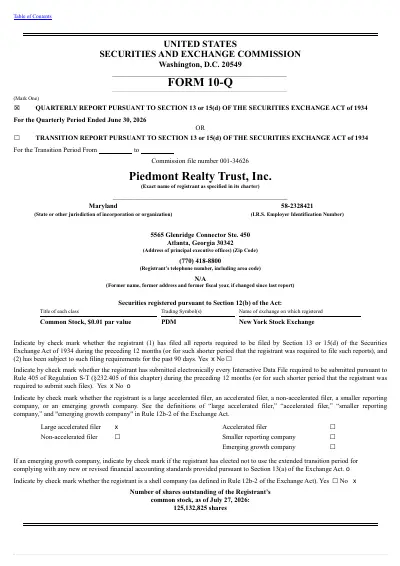
Last night, we filed our 10-Q and an 8-K that includes our earnings release and unaudited supplemental information for the second quarter of 2026. Both of these documents are available for your review on our website at piedmontreit.com under the Investor Relations section.
During this call, you will hear from senior officers at Piedmont. Their prepared remarks, followed by answers to your questions, will contain forward-looking statements as defined in the Private Securities Litigation Reform Act of 1995.
These forward-looking statements address matters which are subject to risks and uncertainties, and therefore, actual results may differ from those we anticipate and discuss today. The risks and uncertainties of these forward-looking statements are discussed in our supplemental information as well as our SEC filings.
We encourage everyone to review the more detailed discussion related to risks associated with forward-looking statements in our SEC filings. Examples of forward-looking statements include those related to Piedmont's future revenues and operating income, dividends and financial guidance, future financing, leasing, and investment activity, and the impacts of this activity on the company's financial and operational results.
You should not place any undue reliance on any of these forward-looking statements, and these statements are based upon the information and estimates we have reviewed as of the date the statements are made. Also on today's call, representatives of the company may refer to certain non-GAAP financial measures, such as FFO, Core FFO, AFFO, and Same Store NOI.
The definitions and reconciliations of these non-GAAP measures are contained in the supplemental financial information, which was filed last night. At this time, our President and Chief Executive Officer, Brent Smith, will provide some opening comments regarding second quarter 2026 operating results.
Brent?
Brent Smith
Thanks, Laura. Good morning, and thank you for joining us today as we review our second quarter 2026 results.
In addition to Laura, on the line with me this morning are George Wells and Alex Valente, our Chief Operating Officers; Chris Kollme, our EVP of Investments; and Sherry Rexroad, our Chief Financial Officer. We also have the usual full complement of our management team available to answer your questions.
Piedmont had a strong quarter, beating consensus by a penny due to operational outperformance and raising our 2026 outlook for the second quarter in a row, which Sherry will touch on more in a moment. Our Piedmont places are generating meaningful earnings and cash flow growth as office-using demand continues to strengthen for high-quality, well-located, amenitized assets.
The US office market is no longer defined by excess space, but rather by increasingly constrained supply at differentiated office buildings, driving higher occupancy, accelerating rent growth, and reducing tenant concessions. Leasing activity has reached post-pandemic highs as availability continues to decline across most major markets and is now broadening to more metros and submarkets.
While the development pipeline remains at historically low levels, with demand recovering and new supply scarce, our Piedmont places are benefiting from a more favorable operating environment and meaningful pricing power. As I noted on our last earnings call, Piedmont has materially increased asking rates across a substantial portion of the portfolio, in most cases more than 15% over the past 12 to 18 months.
Those rate increases, implemented across the portfolio in early 2026, are now being reflected in our quarterly lease metrics. During the quarter, we signed 460,000 square feet of leasing with rental rate increases of 14% on a cash basis and over 32% on an accrual basis.
In fact, over the last four quarters, the average rental rate increase on a cash basis has been 12%, which is representative of the rental mark-to-market and embedded growth in the portfolio. Having renovated 90% of the portfolio since 2020, our amenity-rich, hospitality-driven Piedmont places are among the best assets in their respective submarkets and are leasing at record high rental rates.
During Q2, we achieved the highest quarterly average net effective rent after CapEx in the company's history, now reaching the mid-$20s per square foot, up more than 20% over the prior trailing 12-month average. Even more encouraging is that our rents still remain 35% to 40% below new construction pricing, providing further runway to increase rental rates.
Additionally, Piedmont has leased over 80% of the portfolio since the pandemic, meaning the vast majority of our customers have already right-sized and upgraded their office space for the modern workforce. Our average tenant size across the approximately 16 million square foot portfolio is now just under 17,000 square feet, with customer and industry diversification providing insulation against potential workforce disruption from AI implementation.
Piedmont's customers with lease expirations several years out are also recognizing that the market for premium office space is tightening, particularly for tenants that occupy a full floor or greater. As a result, we are seeing customers approach us about renewals of their space well in advance of the expiration.
In the coming quarters, we anticipate early renewal discussions with existing tenancy to accelerate, which should bolster client retention ratios above our 60% to 70% historical average, with the ability to reduce free rent and tenant capital concessions. At Piedmont, we recognize the most effective way to reduce capital expenditures on leases is to retain our existing customers.
That's why we continue to invest in our team and technology to create the best office experience for our clients. This year, the team's hard work culminated in Piedmont being recognized by Kingsley as a top-five national office platform, the highest ranking among all public office companies.
For those who may not be familiar, Kingsley is a third-party research firm that conducts a national survey of office consumers to evaluate their landlord. Most of our public peers participate in the survey, we couldn't be more proud to be recognized as a top-five world-class operator.
Additionally, during the second quarter, nine projects throughout the portfolio won the Building Owners and Managers Association, or BOMA's, Outstanding Building of the Year Award in their respective size categories, a tangible testament to the quality of our product and service offerings. The strategic repositioning of the Piedmont portfolio, along with the substantial leasing we've accomplished over the past 12 months, is translating into improved operating metrics, including higher economic occupancy, now over 80% for our in-service portfolio with continued improvement in the coming quarters; Same Store Cash NOI growth, 10% on a cash basis for the first half of the year; and meaningful earnings growth, $0.02 for the first half of '26 when compared to the first half of '25.
Further, the portfolio is approaching 90% leased, and as of June 30th, inclusive of our out-of-service portfolio, had an executed pipeline of leases that have not commenced equal to approximately $39 million of annualized cash rents. That's the equivalent of 570 basis points of occupancy that will flow into earnings over the next several quarters.
The investment thesis in Piedmont is straightforward: demand for differentiated office product is increasing, while supply is shrinking. Return-to-office mandates are becoming more common and more enforceable.
Companies recognize that the office is critical to the four Cs: building culture, creativity, collaboration, and connectivity. At the same time, new office construction remains near zero, older buildings continue to be removed from inventory through conversion or demolition, and many financially constrained owners lack the capital to compete.
Piedmont is uniquely positioned for success in the marketplace. We're generating the highest earnings and cash flow growth in the office sector and trade at a very compelling valuation, with net effective rents after CapEx of $25 per square foot on a stock price that equates to a gross asset value of approximately $220 per square foot.
Furthermore, we currently have an outsized earnings backlog, great opportunities for occupancy absorption, 10% to 15% of embedded rental rate growth, and opportunities for accretive debt refinancings, which will all drive Core FFO higher in the near term. With that, I'll hand it over to George for further details on second quarter operational performance.
George?
George Wells
Thanks, Brent, and good morning, everyone. The operating environment for high-quality office remains constructive, and the Piedmont platform continued to perform well during the second quarter.
Leasing velocity continued its strong pace, with 42 transactions completed for approximately 460,000 square feet. New business activity was slightly more than half of that volume, with a large portion of that expected to translate into 2027 GAAP rent recognition.
Average new deal size was approximately 11,000 square feet, reflecting a good mix of small, medium, and large clients, and the weighted average lease term for new transactions was approximately 11 years, reflecting continued customer commitment to high-quality workplace environments. For the ninth consecutive quarter, expansions exceeded contractions in the portfolio.
That is an important signal. It shows that our customers are not simply maintaining space, but many are expanding to support growth, return-to-office requirements, and a renewed focus on collaboration.
During the quarter, we completed nine expansions for 22,000 square feet with no contractions. Lease economics remain strong.
As Brent noted, cash rents of space vacated one year or less increased by 14%, while accrual rents increased by 32%. Overall weighted average starting cash rent of $43.79 per square foot rose 5% from last quarter's $41.59 per square foot, and we anticipate more rental increases in the near term.
Leasing capital spend for the quarter was stable at $5.83 per square foot per year and in line with our trailing 12-month average of $5.97 per square foot. Tightening conditions for high-quality space are leading to stronger pricing power as net effective rents surged this quarter to $25.56 per square foot, up over 20% from the prior 12-month average, and we anticipate maintaining NERs in the mid-$20s per square foot or higher, supported by persistent demand for high-quality space and little to no new development in our submarkets.
Equally impressive, the portfolio generated 9% Same Store Cash NOI growth, driven by both burn-off of free rent and higher rental rates. We believe these very encouraging second quarter metrics will likely continue into the second half of the year.
In Northern Virginia, the RB Corridor has been experiencing an uptick in demand over the past few months, with the defense sector leading the way. Our local team captured the company's largest new deal of the quarter with a defense contractor for 73,000 square feet at our 4250 North Fairfax building.
This 12-year deal commences as soon as the space can be built and boasts a healthy annualized NER of $27 per square foot. Our NoVA assets are well-located within dense, highly amenitized, walkable environments, and sit adjacent to Metro rail stations.
The portfolio here is currently 80% leased, and we're projecting strong net positive occupancy and FFO growth over the near term. Atlanta was our most active market, with 11 deals for 130,000 square feet, and majority of that was new business and landed in each of our three vibrant submarkets of Central Perimeter, Cumberland, and Midtown.
Most noteworthy, we signed a 57,000 square foot, 15-year new lease at 1155 Perimeter Center West, preemptively backfilling a large portion of Broadcom's space. We continue to experience strong customer interest in our remaining Central Perimeter space.
Our Dallas team closed eight deals for 107,000 square feet, with Epsilon's 11-year extension driving most of that deal flow and yielding a hefty cash roll-up of 42%. Our pipeline for backfilling the balance of that space and pushing rate is deep, with multiple tenants competing at improving rents.
Over in the Lower Tollway submarket, the Dallas Mavericks announced plans to develop a multibillion-dollar arena and entertainment district at the 100-acre Valley View site, which sits a half a mile from our Galleria project. As we've experienced with The Battery Atlanta development, being adjacent to such a massive entertainment venue will likely see private, public reinvestments toward the neighborhood's infrastructure and elevate the desirability of an already healthy office submarket.
Today, Galleria Towers' asking net rent is $50 per square foot, up 40% from just two years ago when we completed the renovation, and we're excited for this 1.4 million square foot asset's trajectory and future earnings growth. At 60 Broad, we previously announced that we had agreed to terms with the new administration of the City of New York for substantially all of the space, and that a lease of this size will require other internal city reviews and a public hearing process before the transaction can be fully executed.
The city is steadily progressing to conclude the lease renewal; however, it is likely the process will not be wrapped up until the fourth quarter. Our redevelopment projects posted another strong quarter of deal flow with over 60,000 square feet of new transactions signed, increasing the out-of-service leased percentage from 76% to 83%.
During the second quarter, we placed 222 Orange Avenue back into service, and we're confident that the remainder of the out-of-service portfolio will reach stabilization around the end of 2026. Looking ahead, our leasing pipeline remains stout and now has over 700,000 square feet in a legal stage for the third quarter.
Outstanding proposals continue to hold steady at approximately 2 million square feet. Our supplemental report shows 927,000 square feet, or 6% of our operating portfolio, expiring in the second half of 2026, which is very manageable and even less exposure when you back out the pending New York City extension.
Assuming a typical run rate of 175,000 square feet of new transactions in each quarter and concluding known renewals, we're on a path to achieve our previously released guidance, with overall leased volume projected to reach the high end of that range, or 2 million square feet. We've never been more excited about the outlook for our business.
Tenants are choosing Piedmont because our buildings provide the right combination of location, amenities, service, and value that today's dynamic companies require. Our formula is working, and we believe it will continue to drive leasing, rent growth, and occupancy gains.
I'll now turn the call over to Chris Kollme for investment activity. Chris?
Chris Kollme
Thank you, George. From an investment perspective, our focus remains on optimizing the portfolio, preserving capital discipline, and positioning Piedmont to benefit from strengthening liquidity in the transaction market.
The office investment market is improving, driven by the steady increase in leasing demand coupled with the dwindling supply of high-quality space. That said, buyers remain cautious, and we see only limited institutional investors in the market.
The majority of transactions are being awarded to local operators, family offices, and private capital, with a focus on transactions less than $80 million. With limited well-capitalized operators in the market, Piedmont is well-positioned to compete for value-add acquisitions.
We're focused on opportunities within our existing markets which are accretive to our earnings and growth trajectory. A quick update on dispositions in process, specifically the two land parcels that we have mentioned previously.
Our Royal Lane land parcel in Dallas remains under contract, and we're feeling optimistic that it will close during the third quarter, generating approximately $12 million in net sale proceeds. The planned development will provide about 20,000 square feet of retail directly adjacent to our Connection Drive assets.
The other land parcel in Orlando continues to move forward, albeit slowly, as rezoning takes time, and will likely be a mid-2027 closing. Similarly, the land will be redeveloped into a mixed-use project containing multifamily, over 40,000 square feet of retail space, as well as several restaurants, all of which will benefit the environment next door to our Town Park assets in Lake Mary.
Aside from those two known sales, we continue to actively weigh the disposition of mature and/or non-core assets, which lack the growth profile of the balance of our portfolio. In short, Piedmont's opportunity to recycle capital is improving as liquidity returns to the sector, and our capital allocation priorities remain focused on high-return leasing capital, improving balance sheet flexibility, and acquisitions which improve our portfolio quality, are accretive, and are consistent with our long-term growth strategy.
With that, I'll pass it over to Sherry to cover our financial results.
Sherry Rexroad
Thank you, Chris. While we will be discussing some of this quarter's financial highlights today, please review the earnings release and accompanying supplemental financial information, which were filed yesterday, for more complete details.
Core FFO per diluted share for the second quarter of 2026 was $0.38 per diluted share, a penny ahead of consensus and $0.02 ahead of the second quarter of 2025. Growth was largely driven by higher rental rates and higher economic occupancy, partially offset by the sale of one project during the 12 months ended June 30th, 2026.
AFFO generated during the second quarter of '26 was approximately $31 million. Turning to the balance sheet, I'm pleased to report that during the second quarter, we successfully refinanced our term loan that was scheduled to mature in January of '27.
We increased the principal from $325 million to $400 million, pushed out the maturity to May of 2031, and tightened the spread by 15 basis points, we are very pleased with this execution. We used the net proceeds from the increase in principal to pay off the balance outstanding under our line of credit.
Consequently, we had the full $600 million capacity under the line, as well as around $17 million in cash, available as of June 30. As we've highlighted previously, we currently have no debt maturities until 2028, and our maturity ladder is now very smooth, at roughly 20% per year from 2028 to 2033.
Our overall weighted average cost of debt continues to decrease and is now at 5.5%. It's important to note that as the impact of the team's leasing success over the last 12 months ramps up in the second half of this year, our net debt-to-EBITDA ratio will trend below 7 times by the end of the year.
This trend will continue in 2027 as the balance of the nearly 900,000 square feet, or $39 million of leased revenue, commences. The current 570 basis point spread between leased and commenced occupancy will also compress to approximately 400 basis points by year-end.
We continue to think creatively as we evaluate balance sheet management options and look for opportunities to further reduce our interest costs and/or extend our maturity ladder. As Brent noted in his remarks, with year-to-date performance and visibility into second half lease commencements, we are increasing our 2026 annual Core FFO guidance to a range of $1.50 to $1.55 per diluted share, an increase of $0.025 per share at the midpoint when compared to our original 2026 guidance and equating to an earnings growth rate of over 8%.
We are also increasing our Same Store NOI, cash and GAAP, guidance range to 5% to 8%, a 200 basis point increase from original 2026 guidance. Please note that consistent with our standard practice, this guidance does not include any speculative acquisitions, dispositions, or refinancing activity.
We will adjust guidance if and when those types of transactions occur. The most important financial takeaway is that Piedmont's leasing activity is now converting into earnings and cash flow growth.
The $39 million of leased revenue still to commence that we discussed earlier will support higher Same Store NOI, higher Core FFO, lower net debt-to-EBITDA, and continued progress toward a more normalized economic occupancy level. With that, I will turn the call back over to Brent for closing comments.
Brent Smith
Thank you, George, Chris, and Sherry. To summarize, Piedmont is entering the next phase of the office cycle from a position of increasing strength.
The portfolio has been repositioned. Leasing demand remains broad and durable.
Signed leases are converting into cash flow. Rents are moving higher, with more room to run.
New supply is limited, and the leasing success will start to improve our balance sheet, providing the flexibility to efficiently recycle capital in an improving transactions market. We recognize that the office sector continues to face skepticism, but the data in our portfolio tells a different story.
Companies are returning to the office. They are prioritizing high-quality, amenitized environments and making long-term leasing commitments.
They're choosing Piedmont because our buildings offer the experience and service they demand at a compelling value relative to new construction. Our focus for the remainder of the year is to grow occupancy, increase rents, convert our leasing pipeline into cash flow, and continue to optimize the portfolio.
If we execute on these priorities, Piedmont is positioned to generate consistent organic FFO and cash flow growth for the remainder of 2026 and beyond. With that, I will now ask the operator to provide our listeners with instructions on how they can submit their questions.
Operator?
Operator
Certainly. The floor is now open for questions.
If you have any questions or comments, please press *1 on your phone at this time. We ask that while posing your question, you please pick up your handset if listening on a speakerphone to provide optimum sound quality.
Please hold for just a few moments while we poll for questions. Your first question is coming from Dylan Burzinski with Green Street.
Please pose your question, your line is live.
Dylan Burzinski
Hey, guys. Thanks for taking the question.
Maybe if you can just sort of talk a little bit or expand a little bit on the demand environment. Obviously, things continue to remain strong evidenced by Q2 leasing and leasing to date in July.
Maybe you can just talk about sort of, in your guys' mind, what is sort of causing this to continue to accelerate here given the sort of, I would say, more uncertainty over the macro backdrop.
George Wells
Good morning, Dylan. This is George.
Thank you for joining us. Listen, I think the leasing engine really continues to fire on all cylinders, right?
Employers that are looking for space want to move into a more compelling, inviting environment where you can see a lot of collaboration, space to be made, and for employees to reconnect from a cultural perspective. That trend is there.
That trend continues. When you look at overall demand today, I mentioned earlier that we're on 2 million square feet overall volume.
When you take a look at what's actually new deal activity, that's around 75% of that, or 1.5 million square feet. It's really great to see how that demand permeates overall our submarkets.
There's an overbalance of activities to be looking in for Atlanta and Dallas, as that's kind of where most of our exposure is in the near term.
Brent Smith
I would layer on to that. We just continue to see a constructive environment for our clients to continue to grow their business.
Yes, interest rates are elevated, but the investment in what seemed to be productivity gains out of AI are not cannibalizing jobs, and in actuality, we're starting to see it help companies grow. That component, if George noted in our prepared remarks, the number of expansions we're seeing versus contractions, I think that's generally fueled by that.
Also that our portfolio in particular is geared towards right now the sweet spot in terms of industry demand in the professional services realm, financial services, insurance. As we've talked about in the past, our designs, our floor plates, how we operate the buildings and service them are all geared to provide an elevated experience for those types of users.
We don't have a lot of tech exposure in the company, where you have seen less job growth. I think all in all, those factors, plus the desire to be in the most premium product at a very reasonable price, fits the Piedmont strategy greatly.
There are a lot of great buildings at high price points, but that can't be afforded by every tenant. A Piedmont building can, and that is really a unique point in the market, or place in segment, that we strive to, and we're seeing increased demand particularly for that segment.
Dylan Burzinski
That's very helpful. Thanks, guys.
Maybe just one more, if I could. Sherry, you mentioned getting to that sort of sub-7 times net debt-to-EBITDA range here shortly.
Do you guys sort of have a longer-term leverage target goal in mind as we sort of think about 2027, '28, and beyond?
Sherry Rexroad
The getting below 7 should happen by the end of this year. Then in the intermediate term, we'd like to get closer to the 6.5 range, and then in the longer term closer to 6.
Somewhere in the '27 to '28 timeframe is what I'm kind of calling the intermediate term of that 6.5 target.
Dylan Burzinski
Great. That's it for me.
Thanks so much.
Operator
Your next question is coming from Daniella de Armas Rosales with J.P. Morgan.
Please pose your question, your line is live.
Daniella de Armas Rosales
Hi, it's Daniella here. Thank you for taking my question.
On the demand pickup in Northern Virginia, how competitive is it to get deals done there, and do you think the activity there will persist?
Brent Smith
This is Brent. Good morning, Daniella.
Thank you for joining us. As you point out, NoVA has seen an uptick in transactional activity.
We did complete a larger, call it about 70,000 square foot lease with a defense contractor tenant. What we continue to see in that market are a couple of factors which give us the belief that we can continue to execute uniquely in the market.
That first one would be that we continue to see less and less blocks of space available as there has been a good bit of absorption, particularly from professional services. Then, as we noted as well, the components of the increased funding for I guess defense contractors continues, as well as the difficulties in the Middle East and the war in the Middle East continue to fund growth in those companies that really focus on advanced warfare.
This submarket has a large presence of companies that are also in that industry, and so therefore we continue to see a lot of demand. Very few landlords have the capital right now in that market to really create the environment and provide the necessary funds to build out unique space, and in some instances, SCIF space, if you're familiar with what that means.
They also really see a lot of demand for the young millennial workforce that resides in the RB Corridor in Northern Virginia. There's a couple of factors.
We think that demand continues to play out and bodes well for continuing to drive absorption in our buildings in the RB Corridor overall. I think you'll continue to hear us share positive news in the coming quarters.
Daniella de Armas Rosales
Thank you. That's really helpful insight.
I guess a second question from me: on the acquisition side, what opportunities are you guys seeing there, and what do those deals look like?
Brent Smith
Great question. We continue to canvas the market for off-market transactions.
There have been a few assets brought to market as well in the focus areas that we'd like to grow the business, that being primarily, as we talked about in the past, Dallas and Northern Virginia, which the reasons we just went through. We do like our other exposure in the Sunbelt, but Atlanta is already our largest market, and we see really good opportunities in Dallas.
We continue to focus on assets that are great bones, slightly older vintage, but are really well-located. We feel like location is the first amenity.
If it has the air and light, the ceiling clearance heights, and the right ground plane interaction, we really look for assets that are, call it 70% to 80% leased. They haven't been put through our program, we can create value either through lease-up, roll-up in rental rates, and putting our Piedmont place expertise to work and drive what would probably going-in yields in the call it 8.5% to 9.5%-ish range that would stabilize well north of a 10.5% into the 11s in terms of yield on cost.
Again, other profiles of those buildings, the existing occupancy would be longer-term, endurable. We would consider those assets ability to reposition and bring back to a trophy-level quality and demand the highest rents in the submarket.
Very much what you've seen us accomplish here over the last 5 years in our strategy and portfolio.
Daniella de Armas Rosales
All right. Thank you so much.
That's it for me.
Operator
Your next question is coming from Michael Lewis with Truist. Please pose your question, your line is live.
Michael Lewis
Thank you. You just answered a question about acquisition pricing for the types of assets you're looking at.
I wanted to ask about dispositions and are the improving fundamentals causing any changes in pricing? I know the New York asset is reliant on a lease, but may still have some upside on some upper floors.
I saw the Enclave won a TOBY Award. I saw two assets in Minnesota did as well.
Any change there on potential disposition pricing?
Brent Smith
Good morning, Michael. Thanks for joining us.
This is Brent. Great question, and as I think Chris alluded to in his prepared remarks, we are continuing to see more debt availability in the market as well as good leasing begets better underwriting, better rental rates, absorption, etc.
We are seeing the transaction market continue to unthaw, if you will. If you think about our dispositions and what we think about in a framework around that, as we've always said, we really want to cull kind of the most mature top 10% of our assets as well as what we would consider the bottom 10% in terms of quality, continuing to harvest value and continuing to grow the overall quality of the portfolio and earning stream.
As we think about not only dispositions of the here and now in terms of cap rates, but what is the growth profile of those assets going forward. Our dispositions, because those are two different buckets, they'll vary, but somewhere between probably the 8% to 10% cap range seems reasonable for most of those assets.
The overall desire would be to redeploy those proceeds into the Sunbelt. In terms of pricing, we would say it's probably more stabilized pricing and just getting more transactional activity.
I don't think we've seen a material movement overall pricing in the last 6 months for most of our markets, but Dallas would be one that we've seen a material move, I would say. Otherwise, everything else has been pretty stable.
We think that still gives an environment where with more transactions, we can start to recycle more capital. In the past, pre-pandemic, we historically did $300 to $400 million of recycling.
I don't think that's achievable today, but it is positive to see that that is starting to unlock more transactional activity overall. Great.
Then
Michael Lewis
my second question is a capital allocation question. The last time you paid a quarterly dividend, it was $0.125 in the first quarter of '25.
Your FAD this quarter was $0.24. You haven't been below $0.13 of FAD since the fourth quarter of 2013.
Even though you suspended that dividend, it's continued to be covered, but the stock has done well since you suspended it. When you think about that $31 million of FAD after CapEx in the second quarter, what's the best use of that, right?
You could bring the dividend back. I know you still have some TIs to pay, but again, this is extra cash flow.
The bond repurchases, those 9.25% bonds now trade at 5.5%. Maybe that's not as attractive anymore.
You could repurchase stock. I know you trade well below NAV.
I'm listing off options, but what I really want to hear is what you think the options are.
Brent Smith
Very good question. If you think about that $30 million after CapEx, a couple things I'd point out.
One, we're doing a lot of construction this year across the portfolio. As we talked about, we have a lot of commencements really take shape here in the third, fourth quarter.
We're spending capital today in those spaces. That capital will be lumpy through the remainder of the quarters of the year, we may not achieve that same $30 million level after CapEx every quarter.
As we think about, though, particularly this quarter, what would we use that excess cash flow for, plain and simple, continuing to focus on paying down debt near-term, with an eye towards continuing to drive debt-to-EBITDA, like Sherry noted, below 7 times by the end of the year. Once we get to those levels, I think we would continue to want to drive debt down further before the board would discuss and hopefully there is a determination as to when we would turn back on a dividend.
When it comes to debt paydown, I would say bond repurchases of those 9.25% would be the most impactful, we continue to have a specific eye towards that as our debt paydown instrument more near-term. The ability to use those excess proceeds to buy back stock is not a priority at the moment.
In fact, we do see, if anything, better opportunities from an acquisition standpoint for growth and even for near-term accretion over potentially investing or buying back stock, and we would not want to do so as lever up the company buying back stock. It obviously would have to be paired with disposition proceeds or excess cash flow that we knew were going to remain, and as I've noted before, this year is still going to be a little choppy in terms of excess cash flow through the quarter as we finish constructing a lot of space.
Sherry Rexroad
Michael, the AFFO number doesn't deduct all CapEx. It's not a true measure of cash flow.
Some of those TIs that we spend are in addition, the actual free cash flow number is lower.
Brent Smith
I would think, if the board is going to evaluate re-establishing a dividend, that would be in '27 as we've talked about at the earliest, and they would take the framework really first, need to have positive net income and showing that there's a need to pay a dividend. Then we'd obviously want to make sure we have significant cash flow after CapEx that would support turning on that dividend and being able to increase it over time.
Then so that really will again start to evaluate in '27.
Operator
Your next question is coming from Nick Thillman with Baird. Please pose your question, your line is live.
Hey,
Nick Thillman
good morning, guys. Maybe you want to just talk a little bit more on the lease pipeline.
You guys highlighted the 700,000 square feet, assuming that the 300,000 square feet included in that is the New York City lease. Maybe give the composition of that remaining 400,000 square feet that you guys have signed.
Then some updates on just New York City broadly. You guys mentioned fourth quarter.
I think in the past you've mentioned they did go into holdover rent this quarter, but you don't expect to be charging holdover rate on the near term as you work through discussions, more clarity there. Then just mixture on the remaining pipeline of signed to date.
George Wells
Nick, thank you for joining us. This is George here.
Listen, we talked about the 700,000 square feet as either signed or is in legal stage. Of course, it's weighed right now a little heavy towards renewals, right, because of the city.
Once you back that out of that particular column, you're kind of looking at pretty much an even balance between new and renewals. I know the previous quarters were a little bit more new-related, but I still believe we can get to that number that we've seen historically by hitting about 175,000 square feet of new business between this quarter and next quarter.
Some other characteristics about that demand, I would say we've got a couple of full floors that are in there, which again is pretty consistent with what we've seen historically. The sectors have been pretty consistent.
What we've constantly seen: legal, accounting, financial, banking, insurance prospects, and those continue to look at all of our spaces. I would say sales offices is another one that's coming up.
I would say, I know you've heard a lot about our defense sector coming back to life in Northern Virginia, but we're also seeing that in some of our other cities that we operate in as well. Brent, would you like to touch on New York City?
Yes.
Brent Smith
In terms of New York City, it is a live transaction, want to be careful and giving it too much detail. Given the delay in execution of the new lease, as you noted, New York City did enter a holdover.
Piedmont retains all of our rights per the existing lease, which does include some financial penalties among other remedies. We obviously continue to be very engaged on a long-term renewal with DCAS, the Department of Citywide Administrative Services.
Documentation is progressing. We and they have communicated they expect us to be complete in the fourth quarter.
Deal terms remain as we've discussed in the past, nothing new there. As you point out, the penalties under the lease are really meant to accelerate a decision by the tenant, and as we've noted, they've made that decision and they intend to stay at the building.
Typically holdover penalties have a short grace period and/or escalate over time. As we noted, that factor that they're in holdover did not impact the second quarter, and we really do not anticipate holdover is going to materially influence our 2026 earnings.
Hopefully that gives you a perspective. Again, we do anticipate it'll be executed in the fourth quarter.
No,
Nick Thillman
that's really helpful. Then, Brent, you made some interesting commentary on just early renewals and potentially pushing retention above 60— your traditional 60% to 70% on your in-place when you're looking out to '28 and '29.
You've also mentioned the ability to push leased percentage and occupancy into the low to mid-90s. As we just put those characteristics together, maybe what you think the embedded upside is as you start locking in these renewals for '28 and '29?
Then also with George's comments of what do you need to see from the new leasing for a sustainable level or bogey on a quarterly average just to continue to get to those low 90s from an occupancy standpoint?
Brent Smith
Great. Thanks, Nick.
Really the embedded upside from early renewals, it's an interesting story. We've started to see those '28 and '29 tenancy come to us early, there is embedded cash roll-ups within that.
I think our 12% is a pretty decent guide overall across the portfolio. There'll be some that are obviously much better in Atlanta and Dallas, and some that are a little struggle, but that's a fair average to say in terms of embedded upside and has strong data behind that.
Also part of that strategy of having early renewals will be also to leverage the fact that they've already got great space, and so with rates really high, we can offer rates that are modestly high and limited capital in that process. We're going to really think of it as an opportunity to start to reduce the capital spend and the amount of free rent concessions that we provide our tenancy, still giving them great space because they've already built it out, but leveraging better economics on the renewal in that process.
We still think we can achieve those great cash roll-ups that we've been generating in the 10% to 15% range and start to reduce capital spend as we get further into '27 particularly. Now then, in terms of quarterly average, I think, as George alluded to, that 175,000 square feet is the kind of sweet spot in terms of continued leasing of new tenancy.
We still see that in the pipeline and would expect that to continue given the space that we are having come back to us here in '26 is great, well-located, amenitized, and remodeled. The ability, as you point out, drive leased percentage into the 90s, low 90s, not quite mid-90s, but low 90s here is still the horizon.
We feel good about the ability to getting into the 90% in 2027 as we continue to drive absorption in the portfolio.
Nick Thillman
No, really appreciate it. Then, maybe just rounding it all out on the '27 large expirations, sounds like you had some progress in one of the assets in Atlanta, but maybe the coverage on those assets and the remaining larger blocks that you have within the portfolio.
It sounded like 100,000 square feet still in the Midtown asset at 999, half the Epsilon space, and then those two assets in Atlanta specifically.
George Wells
Sure, Nick, I'll take that. I mentioned a minute ago we had 1.5 million square feet in new leasing activity, and it's across all of our markets.
The larger portion of about a third of that really is coming through the Atlanta market, which bodes well, right? Because we already have some exposure right now currently with 999, although we've leased well over 100,000 square feet there for the past 12 months, and we have good activity there to chip away at that four four-floor block that's remaining.
Again, deals that we'll do there will show something close to 40% cash roll-up, we're pretty excited about the opportunity there. The other one you alluded to for 2027 is in the Central Perimeter market, our two assets, Glenridge Highlands and 1155, and I think we mentioned already that we preemptively chipped away at some of that exposure at 1155.
At Glenridge Highlands, I think it's really important to share with you the competitive features that this asset has, right? It's going to be the top part of very prominent tower that's well-located off an interchange.
The vacancy is at the higher end of the marketplace in the high-rise bank. It also will have an opportunity on the first floor to create a beautiful landing visitor space for that large user that could come into the market.
We also have top building signage to offer. Why that makes a lot of sense is Central Perimeter historically been that particular submarket that generates a lot or it attracts a lot of corporate relocations just because of centrality of the market to the workers around the city.
We're pretty excited about the opportunity there. You also mentioned what else is in '27.
We talked on Minneapolis last time. That exposure is largely in the suburbs.
It's on our one asset, Norman Pointe. That asset shows really well.
It's already been renovated. It's been stabilized for several years.
We're in conversation with that user today to retain them for some of that space, and we have several other prospects available to us that need some time to get to conclusion. Look, we've shown a tremendous amount of success in Minneapolis, right?
We've taken two buildings that were totally vacant in Crescent Ridge and Excelsior and leased them up to 83% over an 18-month horizon, and we think we can duplicate that at Norman Pointe as well.
Nick Thillman
No, appreciate it all. That's it for me.
Operator
Once again, if you do have any questions or comments, please press *1 at this time. Your next question is coming from Everest Schipper with Cantor Fitzgerald.
Please pose your question, your line is live.
Everest Schipper
Hello. Thank you for taking my question.
I know you guys mentioned that you wanted to reduce debt, also selling non-core assets to then reinvest in the Sunbelt. I was wondering if you could just kind of walk through your thought process there and what you're prioritizing in these new assets.
Brent Smith
Sorry, you trailed off at the end. What we're prioritizing in terms of?
Everest Schipper
If you're reinvesting in the Sunbelt, what are you prioritizing in these new properties and assets that you're acquiring? All right, and
Brent Smith
which properties. I guess in terms of capital allocation, as we've talked about, near term, we have the ability to pay down 9.25% bonds that frankly, if we were to refinance today, would probably be around a 6% interest rate.
That provides pretty certain accretion and deleveraging in the process. We are very focused on taking our debt-to-EBITDA down below 7 times, and so that will afford the ability to do that most quickly.
We do have some dispositions that are in the market, I would say. We hope to consummate them through the year, and that would immediately help to go pay down debt and drive us towards that debt-to-EBITDA.
That said, we also find some pretty interesting opportunities for acquisitions that would be accretive to those dispositions and add also to the EBITDA and earning stream and also help to reduce debt-to-EBITDA. We don't feel like they're necessarily mutually exclusive.
There are opportunities on both sides of the acquisition and debt paydown to drive earnings growth, to improve the balance sheet, and improve quality of the portfolio. Now then, in terms of which assets, as we've alluded to, we really like what we're seeing in terms of demand and our positions in Dallas and Northern Virginia, where we have pretty sizeable scale in terms of the platform today.
We'd like to drive, particularly in submarkets, we see pricing power when we get to about 25% of the market share for that trophy Class A properties. When we have those situations, which is kind of what we're targeting, we really have an opportunity to drive rental rate growth, which is ultimately what we want to do because that translates into cash flow growth.
We do think that we're in unique position at Piedmont in terms of our ability to start to aggregate assets in this environment. Some of our peers are much more focused on shiny, brand-new, glass buildings that are well-leased.
We feel that the opportunity set in unloved, but once really high-quality trophy buildings is one that we will continue to lean into, buying assets again that are 70% to 80% leased at higher yields in the high single digits and being able to drive that into the low double digits. That strategy also sometimes lends itself to taking on larger campus-style like a Galleria in Atlanta or Galleria in Dallas.
In those projects that are $200 million plus, we're seeing very little competition. That's really an opportunity set where we can create the environment of walkability and the kind of modern workplace that today's companies want.
We've done it several times, and we continue to believe that'll be a unique opportunity set for us in the coming years. Hopefully, that gives you some idea, Everistus, thank you.
Everest Schipper
Great. Thank you so much.
Operator
Thank you. There are no additional questions in queue at this time.
I would now like to turn the floor back over to Brent Smith for any closing remarks.
Brent Smith
Thank you, everyone, for joining us here today. I do want to thank particularly the Piedmont team and congratulate them again on achieving a Kingsley top five and numerous BOMA awards.
Piedmont continues to execute at a high level. Our premium Piedmont places are garnering a significant amount of demand, and we're excited about what the opportunity holds for Piedmont, not only the remainder of this year, but in the several years to come as we continue to execute on our strategy.
Thank you, everyone, and have a great day.
Operator
Thank you, everyone. This does conclude today's conference call.
You may disconnect your phone lines at this time, and have a wonderful day. Thank you for your participation.