Pebblebrook Hotel Trust
Q3 FY2026 · Earnings Call TranscriptOctober 30, 2026
Operator
Greetings, and welcome to Pebblebrook Hotel Trust third-quarter earnings conference call. At this time, all participants are on a listen-only mode.
A question-and-answer session will follow the formal presentation. If anyone requires operator assistance during the conference, please press *0 on your telephone keypad.
As a reminder, this conference is being recorded. It is now my pleasure to introduce your host, Raymond Martz, Co-President and Chief Financial Officer.
Thank you. You may begin.
Raymond Martz
Thank you, Donna, and good morning, everyone. Welcome to our third-quarter 2026 earnings call.
Joining me today are Jon Bortz, our Chairman and Chief Executive Officer; and Tom Fisher, our Co-President and Chief Investment Officer. Before we begin, I'd like to remind everyone today that our remarks are as of October 30th, 2026, and today's comments may include forward-looking statements that are subject to risks and uncertainties.
Please refer to our SEC filings for a detailed discussion of these risk factors and visit our website for reconciliations of any non-GAAP financial measures mentioned today. Now, let's get into the quarter.
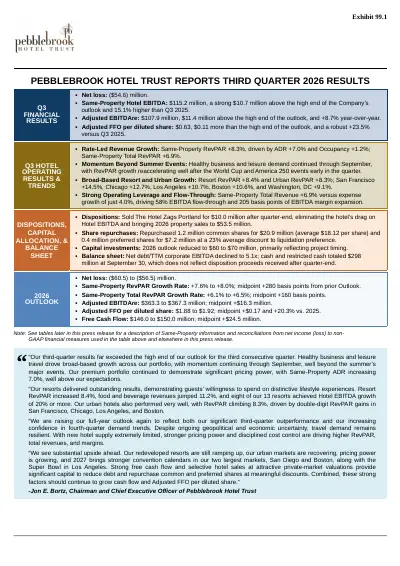
We're pleased to report that, for the third consecutive quarter, our results far exceeded the high end of our outlook across every major earnings and operating measure. Same-property hotel EBITDA increased 15.1% to $115.2 million, $10.7 million above the high end.
Adjusted EBITDA was $107.9 million, $11.4 million above the high end, and adjusted FFO per diluted share was 63 cents, or 11 cents above the top end of our outlook. Beyond the headline beat, the strength was broad-based across the portfolio.
ADR increases drove the bulk of our room revenue growth, and resorts generated strong out-of-room spending. Our hotel operating teams converted a substantial portion of those revenue gains into profit.
Same-property RevPAR grew a robust 8.3%, driven by a strong 7% increase in ADR and slightly more than 1% growth in occupied room nights. This is an important shift from earlier in the recovery, when filling rooms did most of the work.
We're achieving higher rates while still growing occupancy, and our business and leisure customers continue to spend while on property. Significantly higher transient revenue drove much of this quarter's improvement.
Transient ADR increased 8.5%, producing a very strong 9.1% growth in transient room revenues. Corporate transient ADR increased 9.4%.
Room nights also increased significantly in our higher price consortia channel, while certain discount channels declined. Overall, that means we had a stronger customer mix, not just higher prices in the same business.
Group room nights also grew over 3%, while group ADR increased 1.2%. The monthly trend was encouraging as well.
Same-property RevPAR grew 10.1% in July and 5.3% in August before rebounding to 9.4% in September. Importantly, the strength continued beyond the early summer events.
Based on our estimates, one-time events accounted for only about 40 basis points of Q3 RevPAR growth. Now, let me break down the portfolio performance, starting with the resorts.
Resort RevPAR increased 8.4%, while total RevPAR at our resorts grew 9.2%. Food and beverage revenue climbed 11.2%, reflecting very strong outlet, banquet, and catering demand.
8 of our 13 resorts generated hotel EBITDA growth of 20% or more, and our resort EBITDA margins expanded 250 basis points to 32.6%. All together, our resorts contributed $8.2 million of the $15.2 million increase in same-property hotel EBITDA.
These results demonstrate the continuing payoff from our strategic redevelopment investments. Newport Harbor Island is a terrific example of this.
RevPAR increased more than 14% in Q3, driven by an ADR increase of almost 20%. Total RevPAR grow even faster, and hotel EBITDA increased by more than $2 million, or 19%.
We didn't transform Newport simply to sell more room nights. We set out to create a higher quality resort that attracts guests willing to pay more and spend more throughout the resort.
That strategy is working at Newport, and we're seeing similar success elsewhere in the portfolio. L'Auberge Del Mar, Paradise Point Resort & Spa, and Estancia La Jolla also delivered significant improvements in profitability this quarter.
Turning to our urban markets, RevPAR grew 8.3%, generating almost $7 million of incremental hotel EBITDA versus last year. The largest positive contributors came from San Francisco, Boston, and Los Angeles, together adding $8.5 million of hotel EBITDA compared with last year.
Those gains were partly offset by weaker results in downtown San Diego, which I'll come back to shortly. San Francisco's strong recovery gained further momentum.
RevPAR increased 14.5% in Q3, and hotel EBITDA improved $3 million. At 1 hotel, San Francisco alone, RevPAR rose 21%, adding more than $1 million of EBITDA.
Based on our current full-year forecast, our San Francisco hotel EBITDA is on pace to grow a massive 65% in 2026, following a 59% increase last year. Even with that growth, year-end EBITDA will remain roughly $25 million below its pre-pandemic level, leaving substantial room for further recovery.
Boston was another major contributor, adding $2.7 million of incremental hotel EBITDA supported by 10.6% RevPAR growth. All five of our Boston hotels improved RevPAR despite a softer convention calendar.
The Liberty, W Boston, and Westin Copley each posted double-digit RevPAR gains, showing the strength was broad-based. Los Angeles RevPAR increased 10.7%, and hotel EBITDA climbed $2.8 million, or 60%.
Our full-year forecast still leaves our LA hotel EBITDA more than $23 million below its prior peak. With a favorable lineup of major events in 2027 and 2028, we see a meaningful runway in LA for continued earnings recovery.
San Diego had two very different stories. Our four resorts were exceptional, with RevPAR increasing 14% and hotel EBITDA growing $4.5 million.
Downtown San Diego was a different story. RevPAR declined 4.5%, and hotel EBITDA fell $1.6 million.
The soft convention calendar, especially in September, was the primary headwind for downtown, not a broader market concern. With a much stronger citywide calendar expected in 2027, we anticipate a significant rebound in downtown San Diego.
To put that opportunity in perspective on a comparable basis, our resorts generated $16.8 million more hotel EBITDA in this year's third quarter than in Q3 2019. Our urban hotels, meanwhile, were still $21.8 million below their 2019 third-quarter level.
That contrast captures our investment thesis rather well. We've created substantial resort value, in large part through our redevelopment projects, and there remains meaningful earnings recovery potential across our very well-positioned urban portfolio.
Across the portfolio, strong revenue growth translated into an even stronger profitability result. Our teams converted 58% of the $26 million increase in same-property total revenues into $15.2 million of incremental hotel EBITDA.
Total expenses increased just 4% compared with almost 7% revenue growth, and hotel EBITDA margins expanded 205 basis points to 28.8%. That reflects tremendous, disciplined execution by our operating teams and asset managers.
We also benefited from lower fixed costs, which are worth separating from day-to-day operating productivity. Property taxes declined by approximately $1 million, reflecting a property tax credit and lower property taxes in San Diego.
Property insurance costs were $1.6 million lower, and the lower property insurance premium run rate should also benefit in 2027. We also have a large number of property tax appeals outstanding, which we expect will generate additional savings, although the timing and magnitude are difficult to predict.
Those fixed-cost savings helped drive this quarter's 58% flow-through, but we wouldn't expect that run rate every quarter. The more important point is that our underlying operating efficiencies are consistently improving results.
Year-to-date results reinforce that point. Through September, same-property revenues increased 7.1%, hotel EBITDA rose 14.7%, and margins expanded almost 190 basis points.
We have increased margins in each of the first three quarters. At the corporate level, adjusted EBITDA increased 8.7% in Q3, and adjusted FFO grew 18.9%.
Adjusted FFO per diluted share increased 23.5%, benefiting from both stronger earnings and our reduced share count. Our free cash flow increased more than 24% to $55.6 million in Q3 and even more on a per-share basis.
Through September, free cash flow reached $143 million, 45% above last year, and that's after capital investments and common dividends. That growing cash generation gives us more flexibility to strengthen our balance sheet and allocate capital opportunistically.
We invested $14.8 million in the quarter during Q3 and lowered our full-year capital investment outlook by $5 million to a range of $60 to $70 million. The reduction primarily reflects timing.
We also continue to refine the portfolio through selective property sales. Earlier this month, after quarter end, we completed the sale of the Hotel Zags in Portland for $10 million.
The hotel generated $600,000 of negative EBITDA over the preceding 12 months, the sale improves our ongoing earnings profile while also generating cash for redeployment. We also recorded $77.3 million of non-cash impairment charges related to the sale of Hotel Zags and updated valuations for several other properties.
These adjustments reflect our ongoing review of potential dispositions as we work to optimize the portfolio and create value for shareholders. Over the past year, we've sold nearly $179 million of hotels at an aggregate 17.4 times trailing EBITDA multiple and a 3.9% NOI cap rate.
These transactions provide meaningful real-market valuation benchmarks, and each hotel was sold within our NAV ranges at the time. We also increased our estimated NAV by $1 per share from last quarter to a range of $23.50 to $27.50 per share.
The updated NAV reflects improved operating performance of our properties, the current transaction market, and the benefit of our common and preferred share buybacks. Speaking of buybacks, during Q3, we repurchased approximately 1.2 million of common shares at an attractive price of $18.12 per share and deployed $7.2 million to retire preferred shares at an average 23% discount to liquidation preference.
Our goal is to grow value per share, not simply to buy back securities. Our balance sheet continues to strengthen.
Net debt to trailing 12-month corporate EBITDA fell to 5.1 times from 5.9 times at year end. We finished September with $298 million of cash and restricted cash, $641 million of revolver availability, and another $90 million of undrawn term loan capacity.
The remaining $350 million of convertible notes due in December are fully funded by existing resources and expected cash flow. After that, we have no other debt maturities until 2028.
Stepping back, Q3 demonstrated how our strategies reinforce and build on each other. Our previous major strategic redevelopment investments are helping to drive pricing increases and higher on-property spending.
Our operating initiatives are converting more of that revenue into profit, while lower capital requirements are lifting free cash flow. With a meaningful urban recovery still ahead, we see a compelling path to even stronger FFO and free cash flow growth per share.
With that, I'll turn it back over to Jon to discuss the industry backdrop, our updated outlook for 2026, and the opportunities ahead in 2027. Jon?
Jon Bortz
Thanks, Ray. Since Ray covered our third-quarter performance in detail, I want to step back and talk about what we're seeing across the industry, why this strength is building, and what that could mean for Pebblebrook in 2027 and beyond.
As a reminder, the industry setup was very favorable for Q3. A better holiday calendar, an active major events calendar, and the ongoing reconnection between GDP growth and industry demand growth, they all delivered again in the third quarter just as they did in the second.
Going into the third quarter, our concerns continue to revolve around the potential for geopolitical or policy events that could negatively impact the economy and travel. Fortunately, the conflict in the Middle East and constantly changing trade policies don't seem to have negatively impacted the economy or US travel so far this year.
As a result, industry demand growth improved sequentially in the quarter as the economy accelerated, seemingly unaffected by global and geopolitical uncertainty. With little new supply being added, occupancies also rose sequentially.
We experienced more compression days, there was less price sensitivity by higher-end customers in particular, pricing confidence improved, and led to better segmentation, less discounting, and fewer promotions. As a result, ADR growth accelerated in the summer, with the industry averaging 4.3% while we achieved 7% from July through September.
We were pleasantly surprised and encouraged by this recent acceleration in demand and pricing. All of the major hotel demand segments were humming throughout the quarter.
Group, corporate transient, and leisure travel all grew, weekdays and weekends alike. Only international inbound failed to improve.
For Pebblebrook, we saw the same benefits as the industry did in Q3 and more, despite softer convention calendars in several of our major markets. During the third quarter, in the quarter for the quarter pickup was very strong, exceeding last year by $10.5 million.
This is an acceleration from Q2. In the year for the year pickup in Q3 increased by $15.3 million over last year's pickup, leading to the large increase in our RevPAR outlook for 2026.
Also on the positive side, we haven't seen any increase in group cancellations or attrition, and attendance levels for group meetings have been more predictable than last year. We continue to watch for signs of weakening, but pickup remains favorable across the month, quarter, full year, and into 2027.
Looking at the economy, business investment and corporate profitability growth are very strong and remain extremely supportive of travel. The consumer, and particularly the higher-end consumer, continues to be employed, is in very good financial condition, is benefiting from substantial increases in wealth, and continues to prioritize experiences, including travel.
Pebblebrook's concentration in upper upscale and luxury hotels positions us very favorably as this affluent traveler continues to spend. Given these very positive and visible factors driving demand growth, and with little new supply throughout the industry, there are fundamental reasons to be encouraged about this year's positive industry trends continuing through the rest of this year and next year.
Of course, there are risks. We remain concerned about the potential negative impacts from the protracted and widening Middle East conflict, policy changes and geopolitical instability, the potential impact of rising interest rates, and the possibility of another government shutdown following the elections.
Given the strong operating performance in Q3, and with October continuing that trend, we've increased our US industry RevPAR growth outlook by 175 basis points at the midpoint to a range of 5.5 to 6%. As we look beyond this year, we continue to believe we're at the beginning of a very strong multi-year upcycle for the hotel industry.
I think we can now confidently forecast that the new supply pipeline is significantly constrained and should remain so through the rest of this decade. Demand growth is supported by the major multi-year capital investment cycle related to both AI and the reshoring of manufacturing that has just begun.
We expect the creation and buildout of the robotics industry will provide an increasingly significant lift to business investment over the next decade, which supports demand growth even further into the future. We also expect large and growing benefits from the massive wealth that has been created over the last 15 years for both investors and employees, and from the largest transfer of wealth in global history as the baby boomers begin to pass on the wealth they've amassed.
We believe the prospects for healthy multi-year demand growth have never been stronger or clearer in the last 30 years, nor has supply growth been so limited at the same time. These are incredibly positive multi-year fundamentals.
The medium-term setup is very good, just like this year's setup was very good. Of course, a lot of things could still go wrong, as they did last year.
Before turning to Q4, let me explain why we're increasingly constructive about 2027, even with this year's strong results and comparisons. While some industry RevPAR forecasts for next year are constrained due to concerns about difficult comparisons to this year, our more constructive view rests on powerful fundamentals and cyclical trends and their benefits, including demand growth continuing to outpace very little new supply, which creates an improving overall pricing environment.
As I just mentioned, we expect the economy to remain strong and potentially accelerate as business capital investments ramp further next year, and corporate profit growth remains above historical levels. We believe the wealth effect will increasingly boost spending and travel, particularly for the affluent customer who continues to favor experiences.
Our portfolio is built around that customer. While we had a strong holiday calendar this year, it's pretty much just as favorable in 2027.
Even though the industry benefited meaningfully in June and early July from World Cup, and to a lesser extent, America250, we expect overall demand to materially outpace supply next year, which will drive occupancies higher, creating more compression and greater pricing power throughout 2027, which should more than offset the loss of this year's event-related benefits. I want to emphasize this point about favorable pricing, because I don't think investors and prognosticators focus on it, and they certainly haven't been very good at forecasting it.
Behavior and operating performance in prior cycles with growing demand and limited new supply demonstrate how pricing can accelerate through the favorable part of the industry cycle. We started to see it in Q2, and it has continued in Q3.
As an historical example of a period with consistent demand growth and limited supply growth, if we look at 2010 to 2016, ADR increased by a compounded annual growth rate of 4%, much faster than the CPI's compounded growth rate of just 1.6% over those same years. That was a 240 basis point average annual premium.
We believe we're just at the very beginning of a similar multi-year period of rates growing faster than inflation. Here's why.
When occupancies rise, you get more sold out or high-occupancy nights, which leads to higher average prices. Just as important, sustained occupancy growth gives operators and revenue managers the confidence to raise posted rates, shift business away from lower price channels, reduce discounting, and run fewer, less aggressive promotions.
Moreover, our industry has historically averaged a long-term compounded annual growth rate in prices higher than inflation. Due to the high inflation during the pandemic, average prices have fallen far behind the long-term trend line, and we believe the next few years offer the industry an opportunity to catch up through more rapid and significant price growth.
We've started to see this price growth accelerate as this year has progressed, and we expect it to continue next year and over the next few years, barring a negative event that substantially impacts the economy and travel. For Pebblebrook in 2027, there's more drivers of upside.
We expect our urban market recovery, led by San Francisco and Los Angeles, to keep rolling. This is coupled with more favorable convention calendars in San Diego, Boston, and Washington DC, which are expected to significantly improve the performance of those markets next year.
Importantly, the World Cup only provided a modest benefit to our revenue and EBITDA growth, we won't face the same event-related headwinds as the industry. We also have quite a number of significant events next year, including the Super Bowl moving from San Francisco to Los Angeles, NCAA men's basketball regional finals in LA, the NFL draft in Washington DC, the Star Wars 50th anniversary celebration in LA, the Major League Baseball All-Star Game in Chicago, the WNBA All-Star Game in San Francisco, and a significant amount of pre-Olympic travel into LA.
We should also see further upside from our redeveloped properties, including LaPlaya and Naples, as they ramp further and gain additional share. Finally, our resorts should continue to benefit from the strong economy and growing wealth of the higher-end consumer.
While the Super Bowl won't be in San Francisco next year, we still expect strong RevPAR growth in the city as conventions continue to return, and corporate transient travel continues to increase significantly, and does so at higher rates as corporate growth in San Francisco continues to boom. We also expect leisure travel to see further increases as the general impression of San Francisco's environment has turned positive over the last year.
Our broader indicators for next year are also looking favorable. Our portfolio-wide total group and transient revenue pace is currently ahead by almost 5% versus this year.
Q1 will be our most challenging quarter, with soft convention calendars in San Diego and Washington DC, the Super Bowl in LA versus San Francisco, and a big citywide in San Francisco shifting back from Q1 into Q2 next year. Our Q1 revenue pace is currently negative, but it's up 8% or more in each of quarters 2, 3, and 4.
Returning back to 2026, Q4 is off to a great start, with October proving to be stronger than we expected. October RevPAR growth is tracking towards 6% or more, driven by occupancy increases and healthy ADR improvement.
Corporate travel is also very strong and has surprised to the upside, as it did in Q3, and we think this indicates that businesses remain confident in their near-term prospects. Total group and transient revenue pace for the fourth quarter is also favorable, and is ahead of last year by $7.3 million, or 6%.
Year-over-year revenue growth continues to be led by transient, and overall ADR improvement represents more than half of our revenue pace increase over last year. For Q4, our outlook assumes same-property RevPAR growth of 4 to 6%, same-property hotel EBITDA of $73 to $77 million, adjusted EBITDA of $66 to $70 million, and adjusted FFO per share of 26 to 30 cents.
We're also raising our full-year outlook by more than the amount of our Q3 beat. At the midpoint, adjusted EBITDA is moving up $16.3 million.
$13.4 million of that increase reflects Q3's outperformance versus our prior midpoint, while the remaining $2.9 million comes from our higher expectations for Q4. We're clearly signaling that the positive trends are more than a feeling, and they've continued beyond September.
For the full year, we're now forecasting same-property RevPAR growth of 7.6% to 8%, who would have thunk it, with the midpoint increasing a strong 280 basis points from our last outlook. We're also forecasting same-property hotel EBITDA growth for the year of 12.9% to 14.1%, with the midpoint at 13.5%.
That's up 420 basis points from last quarter's outlook. These increases translate into an adjusted FFO outlook of $1.88 to $1.92 per share, an increase of 17 cents at the midpoint.
This year's $1.90 midpoint represents more than a 20% increase over last year's $1.58. These numbers clearly demonstrate the positive benefits of the operating and financial leverage in our business today.
That per-share growth is particularly meaningful, considering we owned more properties last year, and also received $12.7 million of business interruption insurance proceeds that are not recurring. As I indicated earlier, but worth repeating since it's been a long time since we could say this, current trends remain very favorable, which gives us increased confidence heading into Q4.
As we stated last quarter and at the beginning of this year, if geopolitical events, macroeconomic risks, and policy don't get in the way, the very positive fundamental setup for our industry and business should generate attractive results. That's exactly what's happened so far this year.
Our entire team at Pebblebrook is proud of our performance so far this year, and we remain intensely focused on delivering strong results in Q4, 2027, and the years ahead. With that, we'd now be happy to take your questions.
Donna, please proceed with the Q&A.
Operator
Thank you. The floor is now open for questions.
If you would like to ask a question, please press *1 on your telephone keypad at this time. A confirmation tone will indicate that your line is in the question queue.
You may press *2 if you would like to remove your question from the queue. For participants using speaker equipment, it may be necessary to pick up the handset before pressing the star keys.
We do ask that you please limit yourself to one question and one follow-up. Again, that is *1 if you would like to register a question at this time.
Our first question today is coming from Dewayne拓展? [Duane Pfennigwerth?]
of Evercore ISI. Please go ahead.
Duane Pfennigwerth
Hey, thanks, and good morning. Just one for me.
I wanted to ask you about investment pacing. Given the higher performance level of your portfolio and the increased comfort you obviously have that close-in demand is going to continue to show up, does it start to influence your thinking about the pacing of reinvestment back into the portfolio?
Maybe projects that did not clear your high hurdle rates over the last two years that now look more feasible? Maybe you can just kind of sketch out what the next few years look like.
Thank you.
Jon Bortz
Sure. Thanks, Duane.
Yes. There is some impact on I would say small- to medium-sized projects within the portfolio that we've deferred because investing capital into our shares was a more attractive way to create value and increase cash flow per share for the shareholders.
I think we'll increasingly look at those types of projects. They're not major projects in terms of redeveloping any of our assets, because we've been through that through the portfolio over the last 5 years, 6 years in total.
There are projects and potential upside for things like additional alternative accommodation types at Skamania, where we have nine treehouses and five glamping units and some cabins and villas. We may accelerate the expansion of the program there.
We could build another 150 to 175 units there, and that's not to say that we would do that all at once. In the past, we've been doing about three or four a year, and we may increase that pace as an example.
There's some other projects through the portfolio that we'll be evaluating for next year. Those may provide high enough returns.
We're certainly looking at a number of solar projects through the portfolio, particularly as electricity prices and peak electricity prices in particular continue to climb, and as frankly climate change has been increasing average prices around the United States and the globe. That's resulting in more periods of peak electricity.
Peak pricing. Those types of projects will certainly be moved up on our consideration calendar.
Duane Pfennigwerth
Thank you, Jon.
Jon Bortz
Thanks, Duane.
Operator
Thank you. The next question is coming from Jamie Feldman of Wells Fargo.
Please go ahead.
Hi, thank you. This is Connor on with Jamie.
Appreciate you taking my question. It looks like demand re-accelerated in September.
In October, RevPAR, I believe you said is at least 6% so far. Given this current pace, can you help me understand the 4Q deceleration within guide?
What you're watching for to get to the upper end or the lower end of your RevPAR range?
Jon Bortz
Sure. When you think about October, first of all, the one big negative impact for our portfolio compared to the overall industry is that Dreamforce moved from October last year to September this year.
In San Francisco, October is a softer period, and that brings down our average for the third quarter compared to the industry. Then, as we look at November and December, I think our view on that, and I hope we're being conservative, we'll see how it plays out, but there's fewer compression dates and days in overall in November and December.
As occupancies ramp down, our occupancy will ramp down 10 to 12 points from October to November as an example, and then another 8 to 10 points into December. That just generates, I think, fewer opportunities for pricing increases in the portfolio.
That may turn out to be conservative, but certainly, that's the way the compression days change. It's just a smaller percentage overall of compression days in the months of November and December.
Hey,
Raymond Martz
Jamie, it's also to remember, too, seasonality as well. You have more business travel in October.
That's about half the strength of the entire quarter. When you start getting into November, mid-November, Thanksgiving, and Christmas times, it tends to be, in general, less business travel relative to other quarters and more leisure travel.
Thank you. Really appreciate the insight.
Operator
Thank you. The next question is coming from Rich Hightower of Barclays.
Please go ahead.
Rich Hightower
Hey, good morning, guys. Jon, I just want to remark, I don't know that I've heard you sound this positive on a call in a long time of us doing these calls.
Just to point that out. Let me ask you this.
Given your kind of renewed forward view, as you made some comments on '27 and even beyond, and I still appreciate the fact that Pebblebrook is trading below its stated NAV, but at what point do you think it's time to start growing the portfolio again with acquisitions, kind of given your kind of capital availability in whatever source, and at different costs? How do you think about that at this point?
Jon Bortz
By the way, thanks for the positive comment about my positivity. It has been a long time.
We haven't really had a good growth year in the industry since 2016. So, '17 through '19 were the back half of last cycle and fairly typical, then we hit the pandemic and all the noise that surrounded that and the recovery.
We are enjoying our first good year in 10, which we hope we get back to a more normal cycle here, and certainly we think that the up part of that cycle has an opportunity to be normal or frankly better than normal in terms of an upcycle. I think in terms of how we allocate capital, we've always been opportunistic about the way we allocate it.
It's not about growing the company. It's about increasing value for the shareholder, increasing cash flow per share.
That's always been the focus. If the best opportunity is to buy assets in terms of use of our capital, whether it be assets that presumably we can add value to or in markets where we think the risk-return is more attractive, we will pivot to do that.
We've done that in the past, obviously. It doesn't mean we might not continue to prune the portfolio and move out of markets where we think the risk returns aren't attractive enough.
In terms of where we invest the capital, we're certainly going to be flexible in terms of where the best opportunity
Rich Hightower
is. That's great.
I guess just a follow-up on the capital side. Maybe from a modeling perspective, as I think about free cash flow and the dividend, is there anything that's going to change with dividend policy, anything on sort of the burn-off of previous NOLs that would sort of change the magnitude and the cadence of the dividend going forward?
Raymond Martz
Rich, and currently right now, we have flexibility because of net operating losses that we built up a lot, as through the pandemic and some through some sales we've had. Right now there's no immediate need in 2027 to have to increase the dividend for REIT tax purposes.
Now, that's also caveat that with it depends what assets we sell. We do have a number of assets in our portfolio that would generate significant taxable gains which could use it up.
Right now in terms of flexibility of free cash flow, I would not necessarily expect, again, it's a board decision, but that we would need to reinstitute a dividend in 2027. That allows us to retain more free cash flow for either buybacks or acquisitions or other sources depending on what the opportunities for use of capital is best at the time.
Jon Bortz
Rich, the one thing I'd add is, I think that our view and it's consistent with the feedback we've gotten from our shareholders is having the flexibility to use that capital the best way we can to create value and improve cash flow per share is preferred on the part of our shareholders. We think it's the right approach, obviously, as well.
Now that could change. Our view could change.
Their view could change. That's where we see it right now.
Rich Hightower
Makes sense. Thanks.
Jon Bortz
Thank you.
Operator
Thank you. The next question is coming from Smedes Rose of Citi.
Please go ahead.
Smedes Rose
Hi, thanks. Appreciate all your opening remarks, John.
I wanted to ask, maybe on the cost environment, kind of how you're thinking about the pacing of wages and benefits at the property level, and just kind of in general the availability of labor across the portfolio?
Jon Bortz
Sure. I think from a cost perspective, we feel like it's in general pretty well controlled.
The labor side, we're not having particular difficulty finding labor. Turnover's down through the portfolio.
Wages, as they did pre-pandemic throughout my whole career, they do continue to pace above inflation. They're running about 4%.
Yet, we've managed to continue to improve productivity in the portfolio. Cost per occupied room is growing slower than inflation.
We have a lot of initiatives with intense focus on how do we do things more efficiently? How do we use new technologies?
How do we both lower costs at the same time that we improve service? We're finding a lot of technologies that allow us to do that.
The other thing I would say is, I think what's fascinating about AI is, we've spent the last few years getting our data through our portfolio in a form that could be easily mined and utilized by AI. What we're finding is the ability to go through that data in detail and compare property to property, market to market, operator to operator, brand to brand, get into a level of detail of each line item of operating cost is something we were never really able to do at the same intensity that we can do it now.
What that mining of data has done is it highlights areas where there's opportunity that we've been able in many cases to move forward and implement and thereby reduce costs. We expect that to continue with the use of AI corporately.
Then over time, as technology and robotics, their usage increase at the property level, we think we'll see more and more advantage at the property level, as well.
Raymond Martz
Smedes, just to put a finer point on that, as we look at our FTEs this year versus last year, even with the occupancy increasing, our FTEs remains about constant. If we used the same operating model we had last year, that would have meant we would have had 10 12 more FTEs across our portfolio this year versus last year.
Through those efficiencies between technology, between our asset managers really getting into detail each of our properties with our hotel teams, finding efficiencies, and using things like AI to identify where do we reduce overtime, how do we do scheduling better, there's a lot of these things that we're just on the cutting edge of right now. We expect to make more and more progress as we go forward.
Smedes Rose
Thank you. Appreciate it.
Jon Bortz
Thank you.
Operator
Thank you. The next question is coming from Ari Klein of BMO Capital Markets.
Please go ahead.
Ari Klein
Thanks, and good morning. Just on pricing power, it kind of feels like a switch was flipped there.
Could you talk about the strategy on that front, what you're seeing because previously you had a little bit more of an occupancy-focused strategy? I think you also mentioned less price sensitivity at the high end and less discounting.
Hope you can elaborate somewhat on that. Thank you.
Jon Bortz
I think on on the first part of your question, I don't know if it was a a switch flipped, but it certainly happened faster than we thought. We just have started to see a lot more compression midweek from from, material increases in corporate travel.
As and and have seen with with the third-quarter GDP, the preliminary GDP report that came out, the the economy accelerated in the in the third quarter, and we saw the same thing with travel, particularly corporate travel in the third quarter. That shows up in in all of the weekday numbers.
I think what happened as the period went on and people recognized that the short-term demand was was so much stronger than what it had been, people started to price more aggressively and then more aggressively on a forward basis. It's interesting as we track our pickup on a monthly basis, in the month for the month pick up up until probably September, I would say, would go down from the beginning of the month our average rate would go down from the beginning of the month to the end of the month.
As you go back further into last year, we could go down as much as $15 or $20 in average rate from the beginning to the end, when when demand was not outrunning outpacing supply. As it began to outpace supply, that started to improve, and in September, it actually did flip.
It actually went up in September from the beginning to the end of the month. We're seeing that again in October, which is one of the obviously one of the stronger occupancy months of the year for us and the industry.
I think it just comes from it's human behavior. It's confidence, corporate travel because of corporate profits is not restricted.
We're getting to a point where we can we can close out corporate accounts again. Gosh, I haven't said that in a long time.
That that we used to do that. We push our corporate accounts into higher categories.
We've certainly seen the leisure customer head lean back towards suites, higher quality proper higher quality rooms, better views. A little bit like we saw in 2022, we're seeing more of that leisure customer make advance bookings and and book up those suites at our resorts before the regular rooms get filled up.
It's in so many areas, and then as we've seen this increase in demand, it's it's meant we haven't had to discount as much. We haven't had to push advertising in in in in OTA channels or wholesale channels.
It's it's a lot of things that we used to do when when demand outpaced supply. We just haven't had that scenario for a long time.
That's why we've been saying we think we're at the very beginning of this because, by human nature, it just takes time not only to build confidence, but to experiment and see what happens when you do these things. Do you lose occupancy?
How How sensitive is the customer to pricing? It's a learning period of time, and that's going to continue and hopefully accelerate into next year.
Raymond Martz
Ari, just to add to that, yeah, Jon talked about increased confidence. When you have increased confidence, in these markets our hotels are able to increase prices more because they feel good.
When you have feeling better, that's because we're having also more compression nights. For example, in our portfolio, our compression nights are up about 12% year-to-date from last year.
It's predominantly in San Francisco and LA showing the bigger increases, but it's across other markets as well. As we don't really have many like big box hotels.
Most of our hotels, particularly in markets like San Francisco, cater to the business transient side. Like we saw last cycle, when those compression nights went up, our properties benefited the most because that's where we play in that space.
That's another reason why we get increasingly confident next couple years as compression nights increase, demand increases, and prices further rise.
Ari Klein
Thanks for all that detail. Ray, just a quick one I had on the impairment charge.
I know the Zags is in there. Any other detail you can share about that?
Raymond Martz
No, just because one is we historically just don't provide detail because that shows you maybe what properties we're looking to sell. We want to talk about that after it happens.
Then if that happens, it will also sustain the price. We'd like to be just cautious there.
Just to provide you the confidence, the read-through to that should be we continue to be active looking to sell additional properties. No guarantee we're going to sell, but it's multiple.
It's not just the Hotel Zags. As the transaction market continues to improve, and the economy improves and results, hopefully, that'll be a better environment going forward for more transactions.
Jon Bortz
Ari, for your benefit and others on the call, keeping the names of any other properties that we might be looking to sell or active in the market is not to keep information from you. It's because it has a negative impact on the operations of our properties.
The teams can get concerned if they believe a property is being sold. Maybe they lose their jobs.
Other properties tend to pick off our better sales people or our operating people. A transaction may or may not happen.
We really don't want to create a negative environment down at the property level. It doesn't have anything to do with sort of controlling information from or to the investment community.
Ari Klein
Understood. Thank you.
Operator
Thank you. The next question is coming from Gregory Miller of Truist Securities.
Please go ahead.
Gregory Miller
Thank you very much, Donna. I thought to ask about the LA mayoral race, given tight polls as of late.
If the left-leaning candidate wins, would that change your view of your capital allocation in the market, and not just for hotels, but for other real estate asset classes given you have been very active in the business community in LA? Thanks.
Jon Bortz
Thanks, Greg. We don't get a lot of a lot of questions about our views on on on on elected races, but I think as it relates to LA, I don't think whichever candidate gets elected for mayor is going to change our view on the city.
I I think the key part of what's happening in LA is we've we have a community of business and and and and community groups who've kind are kind of fed up with the way the city's been run. Keep in mind, one of the candidates is the incumbent mayor, the other was on the city council.
Both are responsible for what's been happening in the city. In in one way, I suppose it's it's not great choices there.
Where we're we're more focused is on trying to improve the council in LA and in other markets. I I think we're going to have some success there in bringing on more confident, moderate, business-friendly, pragmatic representatives on the council, similar to what we did in San Francisco.
In a way, we've been we're more excited about investing in LA than we were 12 months ago because we see the progress being made. We know it's going to take multiple cycles.
The reason the council is more important is it's really the council that legislates. The the mayor in LA, and again, I think the general population in a lot of markets don't understand this.
The mayor in LA doesn't have a whole lot of power. Most of the power sits with the council.
The council is where we're focused. It's really not been on the mayoral election.
Gregory Miller
Thank you very much, Jon. I appreciate it.
Jon Bortz
Yep. Greg.
Operator
Thank you. The next question is coming from Michael Bellisario of Baird.
Please go ahead.
Michael Bellisario
Thanks. Good morning, everyone.
Jon, one more on pricing. I think you mentioned 4% compounded growth last cycle, and sort of looking ahead, you see similar potential.
Just sort of your thoughts on the total cost increases to customers versus the last cycle. It seems like we haven't really had the rooms inflation, but we've certainly had it outside the room, higher parking fees, resort amenity fees, etc.
Would just like your thoughts sort of on the holistic cost of a room night for a customer, what's left for you to push, and then sort of digging deeper into that, where you see leisure and group trending, which are certainly more price-sensitive than BT? Thanks.
Jon Bortz
Sure. I think I wouldn't be focused on the 4%.
I'd be focused on the 240 basis point premium over inflation, because we are running at a higher inflation rate, and so, we have this tendency to think about GDP and think, gee, that's what revenue ought to go up. GDP is net, right, of inflation.
Your nominal growth in the economy is running, much closer to 6 to 7% right now. In a way, revenue growth at that level shouldn't be all that surprising.
I think that's where the opportunity is, particularly as we go through more and more periods of time where the pie continues to get bigger, whereas supply is not getting bigger. Demand's going up, supply is not, more and more confidence, more compression nights, and so, while yes, we like a lot of other industries have added additional charges, I would say the hotel industry continues to run at a lower rate of growth in pricing overall than most other industries.
Particularly when it comes to travel, Mike, lodging is a much smaller part of somebody's overall travel cost, particularly when you get into business travel, because that has a lot more to do with airline costs and other costs of travel. If you take an Uber from an airport, it can cost $100 in New York, in some cases.
In Portland, that's about the rate that we were getting on our hotel, the Zags, it just goes to show that particularly in the urban markets, the overall hotel cost has been deflated over time, as opposed to inflated.
Michael Bellisario
Understood. Appreciate the thoughts.
Jon Bortz
Yeah.
Operator
Thank you. The next question is coming from Shaun Kelley of Bank of America.
Please go ahead.
Shaun Kelley
Hey, good morning. Thank you, everyone, for taking my question.
Jon and Ray, yeah, it's been a long time since we've been able to talk about this type of environment. I wanted to return back on the pricing dynamic to the discussion a little bit earlier, and just talk about occupancy.
Jon, I know you're a student of all of the cycles, and you've lived them as well. Just your thoughts on two things.
One, where do we sit industry-wide relative to sort of preceding occupancy levels when you had that confidence to push rate? Second of all, could you just walk us through a couple of the Pebblebrook markets, particularly San Francisco, but just sort of remind us of where some of your occupancy levels are, maybe how that's a little different this time around, because I think industry-wide we're still seeing a couple hundred basis points below where we were in 2019, but we're back to levels that weren't that far away from where we got to back in maybe 2007.
Thanks.
Jon Bortz
I think it's interesting. It's a little like the investment world, thinking about the second derivative of growth.
I think pricing confidence is on top of compression. We're not going to have the same level of compression that we were at in '19 or '16 in some of our markets that peaked in '16 like LA, for quite a while, right?
We're still somewhere between 700 and 900 basis points, maybe 1,000 basis points below where we were from an overall occupancy level in some of our markets, particularly the urban markets. Even the resorts are still running what, six 600 basis points or so below where we got to pre-pandemic.
When you have an environment where growth is in demand is well outpacing supply, that's where the other side of it comes from. That's where you get pricing growth from changing your mix, from doing the kinds of things I mentioned with your corporate accounts, from doing more experimenting with price increases.
It's really a lot of contributing factors from pricing. At least in my experience, don't get hung up over the overall level of occupancy as relates to pricing.
It's really what's going on in the environment that creates that opportunity for price increases. The other thing is, the reality is the industry's way behind from a pricing perspective and from a profits perspective, and that does motivate owners.
Now you need an environment for it, but I think we have that environment where we can push pricing more than we would have, again, in a level of occupancy that we're at, because that pricing's going to come from demand outpacing supply on a consistent basis.
Raymond Martz
Shaun, just to provide some numbers there, just as a reference, in 2019, our major urban markets, which we define as Boston, San Fran, San Diego, LA, and DC, ran about 85% occupancy in 2019. On a trailing 12-month basis in Q3, we're at 76%.
About just under 10 points down, which represents a lot of growth. Also recall in 2019, supply growth nationally was 2 to 3%.
In the urban markets, maybe not San Francisco, but a lot of urban markets, it was in the 3 to 4% range or higher. It's a much different dynamic we're heading into, and as I think Jon mentioned early in the call, we're not expecting supply increases for the rest of the decade.
Shaun Kelley
Thank you both.
Jon Bortz
Thanks, Shaun.
Operator
Thank you. The next question is coming from Jay Kornreich of Cantor Fitzgerald.
Please go ahead.
Jay Kornreich
Hey, thanks. Good morning.
Appreciate all the color so far. Just wanted to follow up and ask, you had a lot of broad-based demand with both resort and urban markets performing extremely well lately.
As you think about next year, do you expect kind of a similar broad-based demand approach to continue, or do you see demand tailwinds or comps favoring one side of the portfolio over the other?
Jon Bortz
We do expect it to be broad-based next year. Again, I wouldn't want to assume that international turns around next year.
Maybe a couple more years till that happens, although again, let's see what happens with the dollar. If the dollar were to weaken, that should help a little bit at least in terms of international inbound.
I think if the economy continues to hum along, both the consumer and businesses benefit. We would expect it to be very broad-based.
Obviously in our markets, convention calendars can have a positive or a negative impact on a year-to-year basis, but generally what we're seeing is pretty healthy levels of overall convention business. The growth is really being driven on an overall basis in the industry from corporate travel, both transient and group meetings.
Certainly getting people back to the office has been a help, and we think that trend will continue. On the leisure side, everybody's employed who I think generally wants to be employed.
They may not be as well-employed as they'd like to be, but as the economy continues to hum, there should be more opportunity there. The wealth creation thing, it's hard to overstate that.
It's a big, big factor in broadening and increasing the number of higher-end customers out there and, I would say, less price-sensitive customers. We would think next year would be very broad-based and again, but for international inbound.
Jay Kornreich
Appreciate the color.
Raymond Martz
Thanks, Jay.
Operator
Thank you. Our next question is coming from Jamie Feldman of Wells Fargo.
Please go ahead.
Hi, this is Connor with Jamie. Thank you for taking my follow-up.
Maybe from a higher level, your commentary paints a pretty positive 2027 setup as long as macro conditions remain supportive. I guess looking past midterms, are there any regulatory or policy changes you're watching closely?
If possible, how could they affect hotel demand or operating costs for your portfolio or the lodging industry more broadly?
Jon Bortz
There isn't anything that we're really focused on from a policy perspective, and assuming that we get to a split control of Congress and the administration, frankly, I don't think we're going to see a whole lot of change from what we have right now. I think from an industry perspective, one of the things we've been focused on is trying to eliminate a lot of the fraud that's going on online by a number of the online groups.
We've been working with the FTC on that, because customers will regularly see websites like quote hiltonreservation.com, except it's not Hilton. It's a third party.
Then when they don't get what they want, they complain to Hilton, but the issue was with the distributor. We're trying to be focused on that.
I think it's bipartisan. Nobody likes the consumer to have the wool pulled over their eyes.
I would say outside of that, we would expect the economy to continue to roll along. I think it's going to be hard to stop this multi-year very powerful capital investment cycle.
I think that's what's really pulling us through these other events, geopolitical war and changing policy. I don't think in general we think a change in leadership in Congress is going to have much of an impact on the industry overall.
Thank you.
Operator
Thank you. Our next question is coming from Chris Darling of Green Street.
Please go ahead.
Chris Darling
Hey, thanks. Good morning.
Hoping you could elaborate on any trends in the transaction market since the move up in rates here the last several months. Be helpful if you could speak to the level of buyer interest, different types of buyers, how that's evolving, and then any impact to pricing that you're seeing and how that may differ depending on the profile of specific assets?
Tom Fisher
Yeah. Thanks, Chris.
Listen, I think as we've talked about all year, the transaction market continues to be constructive, certainly with the backdrop of the improving fundamentals. As we've said all year, capital follows performance.
I think the difference between previous years and this year has been investors can start underwriting growth. I think you look at second-quarter results, you look at third-quarter results, I think there's more conviction.
You're going to continue to see, I think, strong bids for luxury, as you've seen all year, strong bids for resorts, upper upscale properties, and then obviously yielding assets. I think the pivot that we've seen over the course of the year given the backdrop in terms of the underwriting of growth is there's been more of a trend towards what I'll call pro forma or repositioned deals, or assets that have been maybe their capital structures is challenged, or they've been starved of capital.
There's a reinvestment opportunity, or a potential rebranding, or taking an independent hotel and putting it within a major brand flag and distribution. We've seen more opportunities like that, which I think again is kind of a broadening of the investment market from that perspective.
As it relates to your question on debt, I would say that overall, there's still a lot of debt liquidity. There's a lot of availability out there.
It's obviously they're focused on sponsors, etc. They're focused on debt yield.
I think that there's starting to be some chatter as it relates to increasing rates, but I think there's kind of that healthy tension right now between the growth in the operating fundamentals and the elevated financing costs. I think right now, at least what we're seeing, is if there continues to be the acceleration in demand and pricing that we've seen, we think that the growth side of that is going to outweigh, and people and investors right now are getting comfortable with the growth prospects and dealing with the increased costs.
I would also say that lenders have become more competitive, and you're starting also see a little more spread compression for the right deals. We are also seeing a broadening of the investors.
We're seeing more bidders, and I think brokers would tell you there's more bidders, and they're varied bidders. Certainly on the upper upscale and luxury stuff, you're seeing high-net-worth, you're seeing family office, you've seen a number of private equity groups get into the business or get back in and put their equity to work.
We're seeing owner-operators, and we're actually seeing some offshore groups. There's a lot of momentum, and I feel as if everything's kind of working, but I think there is a watchful eye just in terms of what the Fed does in the future, but the backdrop of the macro is winning the day today.
Chris Darling
Understood. Thanks for the detail there.
That's it for me.
Raymond Martz
Thank you, Chris.
Operator
Thank you. At this time, I'd like to turn the floor back over to Mr.
Bortz for closing comments.
Jon Bortz
Thank you, everybody, for participating today. We appreciate your interest, and we hope you have a great Halloween this weekend, a great New Year, and while I'm sure we'll talk to many of you down in Atlanta next month in a couple of weeks, if not, have a great New Year, and we'll speak again in February next year.
Thank you.
Operator
Ladies and gentlemen, this concludes today's event. You may disconnect your lines or log off the webcast at this time, and enjoy the rest of your day.