People Incorporated
Q3 FY2026 · Earnings Call TranscriptNovember 3, 2026
Operator
Good day, and welcome to the People Incorporated Third Quarter 2026 Earnings Conference Call. All participants will be in a listen-only mode.
Should you need assistance, please signal a conference specialist by pressing the star key followed by 0. After introductory remarks, there will be a question-and-answer session.
To ask a question, you may press * then 1 on your telephone keypad. To withdraw your question, please press * then 2.
Please note this event is being recorded. I would now like to turn the conference over to Mr.
Tim Quinn, People Incorporated's Chief Financial Officer. Please go ahead.
Tim Quinn
Thank you. Good morning, everyone.
This is Tim Quinn, CFO of People Incorporated, and I want to welcome you all to our third quarter earnings call. Joining me today are Barry Diller, Chairman and Senior Executive of People Incorporated, and Neil Vogel, Chief Executive Officer.
People Incorporated has published a presentation on the Investor Relations section of our website entitled Q3 Earnings Presentation. On this call, Barry, Neil, and I will provide some introductory remarks referencing that presentation and then open it up to Q&A.
Before we get into that, I'd like to remind you that during this presentation, we may make certain statements that are considered forward-looking under federal securities laws. These forward-looking statements may include statements related to our outlook, strategy, and future performance, and are based on our current expectations and on information currently available to us.
Actual outcomes and results may differ materially from the future results expressed or implied in these statements due to a number of risks and uncertainties, including those contained in our most recent annual report on Form 10-K and subsequent reports filed with the SEC. This information provided on this call should be considered in light of such risks.
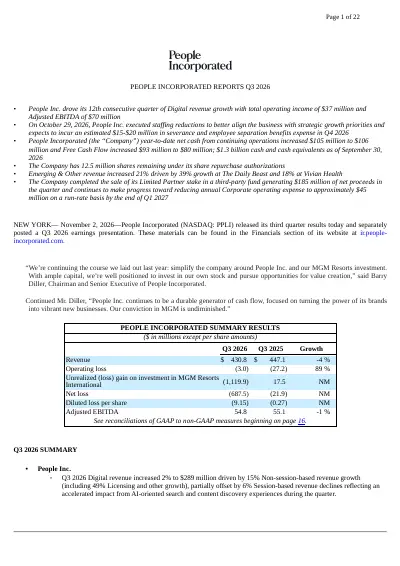
We also discuss certain non-GAAP measures, which as a reminder, include adjusted EBITDA, which we will refer to today as EBITDA for simplicity's sake during the call. I also refer you to our earnings release, investor presentations, and public filings with the SEC and on our Investor Relations section of our website for all comparable GAAP measures and full reconciliations for all non-GAAP measures.
With that, I will hand it over to Barry.
Barry Diller
Thank you, Tim. Good morning, everyone.
I'm going to be, as usual, fairly brief about just some opening remarks, much prefer to get to your questions. On MGM, as you all know, we spent a good many months this summer.
We went into a process where we announced that we were going to attempt to take MGM private for a whole host of reasons, structural. We, in the end, decided that now was not the time, if ever was the time, and we ended that process.
Then MGM came to us and said, how about if we buy People Inc.? While I was dubious, I said, well, if you want to make us a proposal, please do so.
They did so, and we quickly realized that was not in People's interest, for again, all sorts of reasons. I did not think that the time was right, nor do I think probably the time will ever be where someone will, quote, purchase the People entity.
As far as MGM is concerned, I am not dimmed at all in my belief in their business. I believe that they are the greatest play in a world of disintermediation.
I think that their prospects, both in their home market of Las Vegas, the regional markets, particularly in both China and the building of this giant resort in Japan, I think the prospects are great. Out of the process, when it ended, MGM is interested, as you can understand, I think, if you follow MGM or you're an investor in MGM, their security is quite undervalued, and they wanted to buy stock.
They felt that our position at 26% meant that there were issues, to speak, of creeping control. We entered into an agreement with them that gave certain rights, meaning voting rights in securities above 20 our 26%, if in fact it grows by virtue every share they buy increases our ownership thereby, that they wanted to be protected in that, and they wanted us to not purchase stock in excess of 29.9%.
I was fine with that. I don't intend to do so.
I think that it's more than likely, over time, that our 26% will grow way past 29% without our putting up any additional capital in our company. Our first priority, I think, is as we've not been able to purchase our own securities in some time because of the MGM discussions and blackout period, but we are, as they say, open to buy beginning, I think it is, tomorrow, and you will see us doing so.
As it relates to the publishing business, which Neil, of course, is going to talk in detail about and will probably be the many of your questions, our non-session-based revenue, which is what we're after, is growing quite well. The drag this year was in the sessions legacy business drag.
I have every expectation that we're going to continue on this path of displacing old legacy Google essentially search and concomitant revenue with non-session-based revenue from all of the things that we are doing inside all the books. The key to our publishing business is we've been on this path now 2.5 years, almost 3 years, of changing before actually it became critical loss of sessions.
We began to change and diversify our traffic. We're continuing to do so.
We're confident that we're going to be able to do that, and we're going to be able to get substantial growth, not single-digit growth. That is the goal.
That's what I think next year, I would be very disappointed if next year we do not reach that, but I'm sure you'll hear more about that. We've been simplifying the company, as you all know, I think.
We've taken our overhead down by, oof, $90 million to $25 million or so. We continue to simplify the business, sell assets that are non-core.
There are only two assets we have really. One is obviously MGM, and the other is our publishing business.
I think they balance each other extraordinarily well, and I'm very glad that we have them. Think about capital allocation.
Capital allocation is going to go towards strengthening that publishing business. We're not going to look outside that, but there are many opportunities within that, not big-scale, but relatively small-scale, but I think could be very additive to the publishing business and returning capital to shareholders.
With that, I'll turn the call back to Tim or to Neil, and we'll get to your questions as soon as they finish.
Neil Vogel
Great. Thanks, BD.
That was a great setup. Hopefully, Tim and I can provide some color to what BD just said.
Let's jump right in. If you're looking at the slides and you go to slide 3, we continue, as Barry said, to execute on our simplification strategy.
There again, there are three main drivers for us, and we've discussed this prior. First, we're focusing on the core assets, as Barry said, People Inc.
and our stake in MGM. For People, Q3 marks 12 straight quarters of digital revenue growth, and we're executing a strategy to accelerate that growth going forward.
As BD said for MGM, we're focused on using our ownership position to help MGM unlock its many opportunities. Second, we're continuing to opportunistically monetize our non-core assets, and we're making good progress here.
We'll be smart, seeking the right opportunities. Third, we're being thoughtful stewards of our capital.
As Barry said, we're in a strong position to opportunistically buy our own shares and fuel growth through M&A, specifically at the People Inc. operating business.
Page 4 will be familiar to many of you. People Incorporated continues to trade at a discount to the value of its MGM holdings plus cash.
That means investors are getting our People media business and all of our other stakes, including Turo, Vivian, and Daily Beast, as well as our real estate, effectively for free. The game plan we outlined is clear.
The goal is to unlock the value shown. Now on to People's media results for the quarter.
Q3 represents our 12th straight quarter of digital revenue growth, although not with the strength we would have hoped. Digital revenue grew 2%, down from 6% last quarter.
The trend for the quarter was clear. Our newer non-sessions-based revenues continued to grow at pace, while legacy sessions-based revenues were more of a drag than we expected.
Our future is the strength of our brands and the durability and diversity of our non-session-based businesses, as Barry introduced. Non-sessions-based revenues grew at a solid 15%, in line with Q2, with continued strength in licensing, content syndication, events, and social video.
In the last quarter alone, we launched MyRecipes+ and People VIP paid online subscription models, along with multiple new and expanded events across our food and home brands. We're up to 50-plus social video series across brands from InStyle to Travel + Leisure.
Legacy sessions-based revenues declined by 6% in Q3 versus 1% in Q2. That was driven by web session declines of 26%, up from 22% last quarter, primarily due to declines in Google referrals.
However, we continue to drive premium ad rates rooted in the quality of our brands, audiences, and execution, offsetting much of those declines on the web. We expect our digital revenue growth rate to increase in Q4 and to deliver on our EBITDA targets for the year.
We plan for digital growth to return to mid to high single digits in 2027, and our aspirations are in line with what BD outlined. We are aligning our resources to our biggest opportunities with disciplined cost efficiency.
Last week, we executed staffing reductions impacting 195 employees, about 6% of our workforce. We are optimizing headcount around our most important projects.
We continue to integrate AI across all work streams. We are reorienting essentially everything we do to embrace AI.
Most importantly, we're now playing offense, not defense. We are aggressively looking for acquisitions to accelerate our non-sessions-based businesses.
The next slide illustrates the macro changes in media and how we've evolved. Going to slide 6, our opportunity to reach audiences and serve marketers has never been larger, more diversified, or offered greater potential.
Since the Meredith acquisition 5 years ago, we have grown from website-based media with print roots, limited in scale and narrow in revenue streams, to brand-focused media reaching scaled audiences across digital and in real life. The growth of our non-sessions-based revenue is a direct result of the growth in these businesses.
World-class brands are our anchor. We have the gravitas of 50 or even 100 years of history, and our generational relationships with consumers transcend media tactics.
Our key objectives are twofold: to build direct relationships with consumers and to capitalize on our significantly larger addressable market. Whether it's social video hits like People's next Red Carpet Reporter, rapidly expanding events like BHG's Red Plaid Cafe, or content partnership with Apple News, we're successfully delivering new ways to connect with and delight consumers.
The next slide shows how we develop and grow properties specifically in today's brand-based era, focusing on People's 2026 Sexiest Man Alive, one of our most important franchises. Going on to the next slide, last week, People announced its pick for SMA, Noah Wyle from the hit show The Pitt.
I'm sure Noah is thrilled to be part of our earnings call. SMA is a 41-year-old franchise that has been re-energized by our new media mix, and we've increased its reach, cultural resonance, and economic potential.
What started as a magazine cover, then a web feature, has become a robust franchise that lives across Instagram, TikTok, YouTube, Apple News, our People app and VIP subscription, podcasts, and our distribution partners. The outcome is clear: we grew revenue associated with SMA this year 50% with significantly expanded audience reach and drove the cultural conversation.
We have opportunities like this across all of our key brands. Whether it's launching our own products like sweet tea at Southern Living, which is coming very soon, expanding our event franchises, launching subscription services, or creating new video-based IP, we have a blueprint for future growth.
Now turn it over to Tim to go over the financials.
Tim Quinn
Great. Turning to page 8, I want to frame in financial terms where we sit on our journey from a primarily web-centric business to a diversified, branded media company.
Our formula is to grow our non-sessions revenue about 15% to 20% over time. We have some room to go from the 15% we delivered this quarter, but as Neil said, we have plans to get there.
This part of our business will represent about half of our digital revenue by this time next year, and is where we are putting all of our time, energy, and resources. This is the future.
The other half of the business resides on the web and is the place where our consumers interact directly with our brands and often choose to transact. Because of this, we can combat the declines in web audiences better than most by focusing on the performance we deliver for advertisers and our commerce partners.
You saw this play out in the numbers very clearly this quarter. Digital revenue growth at People slowed to 2%, and that was primarily felt in our sessions-based ads business.
Total digital ads declined 8% in the quarter, and this was directly attributable to core session declines of 26%, the steepest we've seen yet. AI Overviews penetration on Google search queries are now found on over 90% of the searches we track, an increase even since Q3.
At the same time, the use of AI agents and other products continue to change consumer behavior in real time. Despite all of this, we delivered digital revenue growth for the 12th straight quarter.
Today, we make more content of all kinds than anyone in publishing, and that is accruing to our benefit, with our licensing revenue growing 49% in the quarter. This growth represents revenue from people consuming our content across all distributed platforms, including Apple News and AI.
Outside of publishing, the emerging and other segment also performed extremely well, with both Vivian and The Daily Beast posting strong revenue growth and improving margins and profitability. Overall, PPLI EBITDA, the holding company, was flat year-over-year, and digital EBITDA at People was down about a million dollars.
Turning to slide 9, this slide highlights the very strong cash position the business has built over the last year as we execute our corporate simplification strategy. This is an important part of the story, I want to take a moment to connect the dots.
We have two pieces to the strategy. First is growing operating cash flow.
At a time when many businesses making headlines are now cash flow negative, People the publisher generated $186 million of free cash flow after tax and debt service last year. At the same time, we've taken the necessary steps to reduce corporate expenses at the former IAC HoldCo level, and expect to be at about $45 million corporate expense run rate by the end of Q1 next year, cutting our former overhead burden by half.
Going forward, this will allow us to be even more efficient turning operating profit into cash. The second part of the equation is the simplification strategy.
This year, the sale of Care, the limited partner stake that was previously announced and closed in Q3, and smaller asset sales have together generated nearly a half a billion dollars of after-tax cash. Going forward, our remaining collection of assets also have real value, and include Turo, Vivian, The Daily Beast, each of which are growing nicely, and our IAC headquarters building.
For context, conservatively, the value of this collection of assets is at least similar to the cash proceeds generated this past year, it is material. Notably, this framing excludes any potential proceeds from the ongoing Google ad tech litigation, which we believe offers further meaningful upside.
Most importantly, our plan is to put that cash to good use. We've proven we are more than capable defending our business against all these well-documented threats.
Now is the time to go back on the offensive with our strengthening balance sheet and cash reserves. We have ample resources to continue to get back to buying our own stock, and will be actively looking to accelerate People growth through opportunistic M&A.
Finally, on slide 10, we are refining our guidance for the year given the current outlook for Q4. For People Inc., we expect EBITDA to be in the $330 million to $345 million range, and mid-single-digit revenue growth for the year.
For total PPLI EBITDA at the HoldCo, we are expecting EBITDA in the $263 million to $283 million range. To wrap it up, we remain focused on delivering our financial results for the year, while importantly positioning the business to execute on our ambitious growth plans for 2027.
With that, operator, we are ready for questions.
Operator
Thank you. We will now begin the question-and-answer session.
To ask a question, you may press * then 1 on your telephone keypad. If you are using a speakerphone, please pick up your handset before pressing the keys.
To withdraw your question, please press * then 2. Our first question for today will come from Justin Patterson with KeyBanc.
Please go ahead.
Justin Patterson
Great. Thank you very much.
Good morning. Two if I can.
First, could you talk about how AI impacted People traffic over the course of the quarter and the efforts you have to mitigate some of those headwinds? Then secondly, as you look toward 2027, and in an ad market where there's a lot of change going on, where do you see opportunities around product innovation to help advertisers navigate this environment?
Thank you.
Neil Vogel
Thanks, Justin. It's Neil.
I'll take these two, let Tim chime in with some color. The first question was, how did AI affect traffic?
I have two facts for you. It's not the last quarter, it's really the last few years, as Barry said.
We've lost nearly 70% of our Google search traffic over the last few years, and as Tim said, AIO is now over 90% of the queries that used on 90% of the queries that used to send us traffic from search. This has been ongoing.
Despite all this, we've still grown for 12 straight quarters. Mitigating this is not new to us, nor is this decline surprising.
I think in this quarter, decline may have been a little steeper than we anticipated, but none of it's surprising. We were using the term, and I don't want to take credit for this, we kind of made up the term Google Zero internally.
What we've been doing is we focused on our brands, their gravitas, our audiences to develop more durable and diversified ways to reach audiences and reach advertisers. We are not new to this, and it is why we've been able to grow through this to date, and it's why we're super optimistic.
The things we're doing it all show up essentially in our non-sessions-based revenue, and you can see that we had a strong quarter there that's growing healthily. The Google stuff showed up obviously in the sessions-based revenue.
The non-sessions-based things that we're doing to grow the business include events, social series, which has been a big success for us, programs across TikTok, Instagram, big audiences on YouTube, our Decipher product, which is not only open web, but has pivoted a lot into CTV, our success on Apple News, our AI licensing, our launch of apps and subscriptions, doing things like our consumer products like sweet tea. Each of our brands has a plan for the future, and we've been executing against it.
I think it's why Barry's so optimistic about our next year, it's why we feel so good about our return to good growth upcoming, and why we feel really good about this business. Our success is anchored in our iconic brands and reaching audiences in new ways, and I think we've proven we're pretty good at it.
Second question, which is a good question, is, as the internet changes, right, and it's not just like selling ads on a web, what ad innovation do we need to sell going forward? I think the one interesting thing is we have been building these audiences we talk about for longer than there have businesses to support these audiences.
What we've had to do for the last 3 years is work very hard to create models that actually work. We have no interest in audience that we can't effectively deliver value to both users and to advertisers.
A very good example is what we've done in episodic series. The Intern is a big hit series we have at InStyle.
It took off, and we had to find a model for it. The model for it now is essentially season-long branded content.
A season is seven 3-minute episodes, and what we do is we get a sponsor, and we weave that sponsor into the plotline with a wink in a way that users enjoy. Somebody buys an entire season.
Now, not only are they buying an entire season of The Intern, but they then have the opportunity to layer on that events at InStyle, events at People, media across YouTube and across Instagram and across all these other places, we're selling these really interesting packages. On their own, the social series are very lucrative and very high margin, and these things allow us to make packages that are very modern and very exciting for advertisers.
I think that is a lot why we've seen despite 26% sessions-based decline this quarter, even on the web, the non-said sessions-based revenue didn't go down, went down 6%. People really like what we're selling, our audiences really like what we're doing, and we're integrating things really, really well.
Between adapting Decipher to make it work for CTV, the things we're doing with our episodic shows, the clever things we're doing to advertise on social, the expansion of our events, we have a whole host of things we can sell people that we frankly didn't even have 12 or 18 months ago that's resonating in the market.
Tim Quinn
I agree that's well said, Neil, and the only point I would underscore is we have a very capable direct sales team that have relationships across basically all key advertising sectors, and we wouldn't be able to make this transition without that asset. It's core to what we're doing, and, as I say, it's really an asset for us to leverage.
Operator, next question?
Operator
The next question will come from John Blackledge with TD Cowen. Please go ahead.
John Blackledge
Great. Two questions.
First, now that the MGM situation is clarified, how should we think about the go-forward strategy to unlock shareholder value? Then second, can you further kind of unpack the 3Q digital revenue drivers and how should they trend in 4Q?
Thank you.
Tim Quinn
Barry, do you want to tackle the MGM question?
Barry Diller
I don't know about tackling. How do we unlock value?
MGM, I believe in the next years, is going to increase its value substantially. There are several catalysts for this.
The closer we get to Japan, the furtherance of all the exciting things we're doing in Las Vegas, etc. Las Vegas had a tough summer, but seems to be coming out of that now.
I have no worries about Las Vegas as a destination, as more attractions, sports, everything else imaginable in entertainment come into the city. Convention bookings are very strong, I think, for the fourth quarter.
The prospects for MGM, I think, are just excellent. That's how value will be unlocked over time.
Tim Quinn
Great. Thank you.
I'll tackle the Q3 question. The deceleration in revenue, as we've said, John, was directly attributable to the decline in sessions.
We are very clear-eyed. We are in the midst of a very real and fundamental transition in the business.
We have been on this path for several years now. As we've said repeatedly, we continue to grow through it.
Advertising, as I said, declined 8%. The traffic pressure intensified.
Yet, our direct-sold revenue and our programmatic rates are both growing really nicely. That strength reflects really the unique value we bring in the market, which is branded environments, real people, premium performance.
We are not counting on sessions to improve, yet we do expect advertising to improve in Q4. Again, that's off the backs of our premium sales capabilities and performance.
Performance marketing growth slowed from 13% to 2% in Q3. This was largely expected, something we previewed, and was in part due to timing of Prime Day, which was a drag of about 4 percentage points of growth that was shifted into Q2 from Q3.
We actually expect Q4 to improve back to sort of that mid to high single-digit levels that we would have seen in each of Q2 and Q3 when you adjust for the Prime Day impacts. Finally, the licensing revenue, as I said and as we saw, was really impressive.
We continue to have real success across Apple News, AI, and other content partnerships. In Q4, those growth rates will slow some as we lap the Meta AI deal that we announced last Q4.
We still expect full year growth to be about what we delivered in licensing in the first half, which translates to something roughly about 20% Q4 growth. Again, our focus is to get back to the growth we want and expect, as Neil said, mid to high single digits, and that gets us on a path to the double digits that Barry and we all aspire to.
Operator, next question?
Operator
The next question will come from Jason Helfstein with Oppenheimer. Please go ahead.
Jason Helfstein
Thanks. Can you just elaborate, I guess, more of a focus on next year, in the face of worsening search traffic, how are you thinking about growing non-session revenue next year?
More specifically, maybe talk about what's a reasonable expectation for licensing for next year? Then secondly, can we get an update on the Google lawsuit?
When do you expect it to be resolved? Are there legal costs still contemplated in the corporate run rate?
Do you have a way to tie this into a long-term licensing deal with Google versus just like a one-time settlement or payment from them? Thanks.
Neil Vogel
I'll let Tim do the Google question, and I'll take the non-sessions revenue question for next year. I think the non-sessions revenue answer is an extension of what I said prior.
I think as we get into next year, not only will we continue to launch new things, potentially girded a bit by some smaller acquisitions that give us some capabilities, but we should see the maturation of a lot of the things that we've launched this year and at the end of last year. I think we're pretty excited to see where these things go, and I think they give us confidence in our numbers.
In terms of Google, the math would say that we're probably on the other side of a lot of these declines, right? We've already lost 70% of our referrals, and AI is on 90% of searches.
Hopefully, at least in real numbers, that thing's going to stabilize even if it doesn't in percentage decline terms. We feel very good about next year.
We have, again, we talk about planting seeds. We've planted a lot of seeds that are starting to grow.
We have a lot more seeds to plant, and we feel very good about it.
Tim Quinn
I think that's right. 2027, Jason, is a little bit of the payoff for the last 2 years' worth of work.
I think we feel confident that we will continue to see success on Decipher, excited about these subscription products that we've launched. We have about 6 million downloads or registrations on our MyRecipes and People app product.
Now we're going to turn to monetizing those subscribers. That's the path to get back to the growth.
Talking about Google, switching gears to the Google ad tech litigation for a second, again, to remind people who haven't heard the story, we are relying on the government's findings that Google engaged in anti-competitive practices as relates to the ad market. The government's already found that to be the case.
We believe that we have substantial claims amongst the largest claims out there, given our lineage with Dotdash, Meredith, and Time Inc. The new information in this last few months is that a court date has been set for the USA TODAY litigation, which is the court set a date of April.
This is not our case, but is a precedent for us. We're kind of next in the queue after it, and it gives us a lot more confidence that a resolution to our case could occur in 2027.
Neil Vogel
The litigation, it's related only to damages, not to whether or not something was wrong.
Tim Quinn
Yeah. We're hopeful that it's a 2027 event, and we remain confident our claims could be at least nine figures when it's all said and done.
A lot of uncertainty, and a lot remains to be seen there. Operator, next question?
Operator
The next question will come from Dan Kurnos with StoneX. Please go ahead.
Dan Kurnos
Thanks. Good morning.
Neil, I guess, I know you've talked an awful lot about it already, but I think the concept, we all saw what Google reported this quarter, and now they're starting to aggressively monetize advertising within AI Overviews, and we're seeing that advertising is yielding less, but they're kind of being forced to kill their own golden goose, which they clearly cheated to grow back in the day. When you look at all the initiatives that you have forthcoming, and you kind of mentioned briefly Decipher, CTV, etc., just help us understand sort of where the best shots on goal are to help you kind of reaccelerate the non-sessions business into 2027.
I guess adjacent to that, you guys have made it pretty clear that M&A is firmly back on the table. You've got a great balance sheet, you generate a ton of free cash.
Can you size that for us? Would you do larger deals, and what kind of stuff are you guys looking at?
Thanks.
Tim Quinn
Sure. I'll take a shot at this, Tim can add color.
Let's go to the shots on goal question, which is actually a very good framing. I think we have real traction in a number of things we're doing that we think are going to be fairly high-probability shots on goal.
One is social series. The episodic work we're doing, we have more than 50 social series across our brands that is almost like the new TV for a new generation.
It has been a material part of our growth. We're very excited about that.
We are very excited about Decipher. Now, the open web has slowed a bit, which you would think would water down our excitement about Decipher, but what Decipher's data has proven very good for CTV.
Neil Vogel
Tim gave the time period, but recently, more than half of Decipher's business has been CTV targeting, which is a really interesting thing. Events are a little bit more linear growth, but we've had a lot of success in events, expanding our events and launching our events.
As Tim said, we're making our first foray into web-based subscriptions. Now, we have 9 or 10 million subscribers to our print magazines, we know how to do this.
We have launched two really interesting app products, one around MyRecipes, which is a recipe aggregator and it's going to be a whole bunch of other things, and what we call our People VIP app. Between the two of them, we've got over 6 million people that have already signed up for these things.
We just need to convert them to paying, which is a very good opportunity. We continue to do really well syndicating our content to places like Apple News and some other places.
We really have a really nice, healthy portfolio of things going forward that we're excited about. I think some of them are going to work really well, not all of them are going to work really well, but they don't all need to work really well to get back to double-digit growth.
We feel very good about that. The next question was M&A.
I think that is true, and something Barry is been very much encouraging us to do. I think to frame it, I think the expectation would be in the last 5, 6 months, we've made two small acquisitions.
We bought Feedfeed, which was an influencer network around food, and we bought something called Hot Luck, which was an event series, a food event series for Gen Z audiences. They're both very add-on.
They're both things we think we can really grow and expand given our sales team and our infrastructure and expertise. I would expect more things of that profile, add-on things.
If you're a private equity person, think of them as add-on acquisitions for things we're already doing, to really bolster our non-sessions-based revenue businesses. That would be the primary focus.
Tim Quinn
More direct connections to our users, places where we can leverage our advertiser relationships. These are not bet-the-company type of bets.
We want to allay any fears there. Go ahead, Barry.
Barry Diller
I'd only add one thing, which I don't think would surprise anyone, but the acquisitions that we are looking at are bolt-ons to our current publishing business. We're not looking outside of that.
I can't say that something won't come along opportunistically, but it's really unlikely. Also the size of these acquisitions will not, I also believe, be large.
Dan Kurnos
Thank you.
Tim Quinn
Great. Operator, next question, please.
Operator
The next question will come from Stephen Ju with UBS. Please go ahead.
All
Stephen Ju
right, thanks, guys, for taking the questions. It's kind of looking back over the last year, I think the licensing and other revenue has now risen to be about 20% of the digital revenue mix.
I was wondering if you could talk about the different components that live in that line, and in particular, I guess, the Apple News distribution and how that functions. It seems like there's probably other well-trafficked outlets like Apple News that you guys could probably lean into.
Thanks.
Tim Quinn
I'll take that one, and Neil can color in. Our licensing revenue has three components to it.
Think about it as content licensing, AI licensing, and kind of traditional product licensing. The majority of the growth that we have seen is coming from the content licensing line.
Again, to reiterate what I said earlier, we're making more high-quality content than anybody out there in publishing or otherwise, tech, written word, video, everything. We made a shift 2, 3 years ago to publish that content to as many places as we could.
One of the places where we've had great success is in Apple News. It is a traditional sort of browsing-like experience.
It relies heavily on our historical magazine presence and capability. You can consume the magazine in the Apple News experience, as well as our digital content.
That's been a great partnership. You asked how does it work.
Think about it as a revenue share based on time spent, based on how much content the user consumes. We like that model.
We are able to sell advertising on that as well, kind of to the extent that we can extend and our own capabilities. Apple News has been a great success.
They're not the only one, as you said. We continue to publish to places like Yahoo and MSN, and looking for YouTube and all sorts of other Netflix places where we can get our content in front of our consumers.
I think one advantage that we have, Stephen, in this realm is we are not a single-brand company. There are about 15 brands where we have success in these distributed environments, and that gives us multiple bites at the apple, and has allowed us to really scale.
The second part of the licensing line, of course, is AI licenses. We remain optimistic in that market, that that will continue to evolve, and that there's a big place for our content.
There's increasingly a place for recency, meaning new content in that marketplace. The third leg of the stool, to speak, is traditional product licensing, where we continue to have one of, if not the biggest, licensing deal at Walmart with our BHG line.
Licensing is a very high-margin, as you can see, fast-growing area of the business, and I think it is a function of sort of the quality of our brands and the level of investments that we're making in our content. With that, I'll turn it back over to the operator for the next question.
Operator
The next question will come from Eric Sheridan with Goldman Sachs. Please go ahead.
Eric Sheridan
Thanks so much for taking the question. With the revenue results you saw in some of the non-core operations, wanted to know if we could go a little bit deeper in some of the drivers of those results and how you increasingly think about the long-term future for those assets within the broader portfolio approach you guys have talked about so far.
Thanks so much.
Tim Quinn
Thanks, Eric. I can grab that.
Sort of Turo's the biggest and continues to perform extremely well. They had record first half results.
They continue to deliver double-digit revenue growth quarter in, quarter out, and recently announced they're pacing towards about a billion two of revenue for the year. Turo's in really good shape.
Again, we are a minority holder. We're anxious for an opportunity to monetize the good work that they're doing there, and we look to partner with them to find that path.
You can't really put a timing on it, but that's something that we're excited about, and the performance underwrites a really big opportunity there. Vivian, and Bill Coughlin and his team are doing a great job.
Vivian grew Q3 revenue 18% to about $12 million. They've really leaned in on subscription and usage-based revenue streams.
They launched an AI assistant subscription product in Q4 2025 that they're having real, measurable, tangible success on. We continue to be really thrilled with the performance over at Vivian, and they're really gaining some momentum there.
The Daily Beast revenue in Q3 grew 39%, an amazing quarter for the folks there, as well, to $8 million. Kind of most importantly, each one of these businesses is performing well.
Each one is worth more today than they were worth 6 months ago or a year ago. What we're looking to do is find the right home for these assets, obviously, and complement that with sort of maximizing value for us and our shareholders.
We're enthused about it, about the performance there, and it's really giving us confidence in the simplification strategy that we're embarked on. Operator, we can take the next question, please.
Operator
The next question will come from Brian Smilek with JP Morgan. Please go ahead.
Hi guys, this is Vignesh on for Brian. Thanks for taking the question.
I guess just on the ad market, I believe you called it maybe 6 out of 10 last quarter. Just curious where it is now, especially for food and beverage and CPG.
I guess secondly, what do you see for holiday spending and budgets kind of going into next quarter of 2027? Thanks.
Neil Vogel
Sure. I think this is going to be the third or fourth quarter in a row that we're going to tell you probably 6 out of 10.
Again, I think good enough to do our job. The economy's a little bit weird, right?
There's inflation and high gas prices, but so far, the American consumer is undefeated. I think strong categories for us, health and pharma has been really strong, beauty and style has been really strong.
We also have very good assets and very good sellers in those areas, there's probably some correlation there. Food for us has been challenged for a number of quarters, although it did return to modest growth in Q3.
We have some good programs, that might be part of it. CPG and food is still, I wouldn't call them growth, I would call them macro-exposed, they're a little bit more exposed to things.
Overall, I think 6 out of 10. Holiday spend, we haven't seen any signs that things are unusual yet.
I think we're booking business around how we'd expect. As we get closer, we'll know, but again, thematically, things are breaking later, but that's been a trend going on for years, so that's not really new.
I would say it's a boring answer, but 6 out of 10.
Tim Quinn
Great. Operator, next question, please.
Operator
The next question will come from Youssef Squali with Truist. Please go ahead.
Youssef Squali
Awesome, thank you for taking the questions. I have two.
Maybe the first is, within session-based ad revenues, is there a kind of a natural lower limit to how low that can go given the search issues? Neil, I think you talked about how you've already lost about 75% of Google traffic.
Should we look at 2027 as a year of normalization, or at least the start of normalization for that? Then maybe, Tim, the adjusted EBITDA guide for '26 implies a big step-up in margins in Q3 and Q4, assuming that flat guide.
Other than normal seasonality, can you just flesh out some of the drivers of that jump? Thank you.
Tim Quinn
I'll start with the margins, and then we'll tag-team on the sessions, because that's a little bit of a crystal ball question. We have real seasonality in this business in the back half of the year, you're going to see a real step-up.
I would look back to Q4 of '25 for what a margin profile looks like. We would expect margins to be similar in '26 as they were, EBITDA margins, digital EBITDA margins, as they were in '25.
Kind of overall, just some commentary on margins, our non-sessions-based revenue margins are strong. That's a place where people kind of keep looking to find a softness or weakness.
Really, the margin pressures that we saw here in Q3 were volume-related, very candidly. Licensing revenue margins are strong.
Our non-sessions-based ad margins are strong and comparable. Our Decipher margins have been kind of a pleasant surprise and strong.
We're continuing to try to manage to those healthy, sort of high 20s, target, say, 30% full year EBITDA margins. At the same time, we are investing in the future, we are investing in each of these products that Neil described today.
We've demonstrated for years that we're disciplined about those investments, that we really try to invest into success, not ahead of it. There's a couple, several million dollars sort of drag in Q3 as we stand up the infrastructure, preliminary marketing, even some AI costs associated with those new projects.
Again, it's being done thoughtfully. It's not going to ever get away from us.
As we referenced in the release, and Neil referenced in his remarks, we did a staff reduction in that we announced last week. It's never easy.
They're always hard to do. These are important colleagues that have helped us to get here, but we really felt like we needed to redeploy resources away from some of the legacy businesses like print and even the web towards these new growth initiatives.
That's another way that we kind of are mindful of our margins. On session-based, you want to--
Neil Vogel
You want to reread the session-based question again?
Youssef Squali
Just trying to get a sense of when do we trough with session-based ad revenues now that you've lost most of the traffic that, in theory, you should be losing to Google, right? I think you mentioned earlier--
Neil Vogel
Again, let's let's definition, what what session-based ad revenues actually means is revenues we get from web sessions, people who actually come to our websites. Even without Google, there is a substantial number of people that come to our websites, right?
We've lost 70% of our Google referrals, there's still a fairly large audience, 70% of our referrals from search. There's still a fairly large audience on the web that we can market to, and that will always be there.
The piece that we're dealing with is the remaining number of sessions that will be sent to us from Google. They are going to continue to decline over time, but we're on the other side of a lot of it at this point.
The percentage de- again, I'm just this is a math problem, right? The percentage declines might go down, but the aggregate numbers of of sessions are going to are going to go down less, because you're dealing with a with a smaller number up top.
The rest of the business, direct traffic, referrals, that's fairly healthy, doing okay. I I do think you'll see a leveling off.
I I do think you'll start to see it next year
Youssef Squali
in
Neil Vogel
in session traffic and session-based revenue. Remember, sessions were down 26% this quarter, but revenue was only down 6%.
If we can mitigate some of this, there is some opportunities in this side of the business to hold the line and have it as a nice underpinning of what we're doing.
Tim Quinn
I would just underscore, I think the absolute declines will continue. I think the percentage declines will definitely moderate, and that's just the math of it.
I do think we're closer to the other side of search. I think what makes the question challenging for us, you, and everyone is what's next?
Is it agentic? Where does the world go in terms of new consumer products?
Again, most of our traffic today comes directly to our sites or is not coming from Google, and so we'll manage whatever the future is. I guess the way to think of it is, we're not counting on an improvement, that's for sure.
We're preparing for the future as it is, and sort of optimistic that there'll be some moderation. Operator, next question?
Operator
The next question will come from Ron Josey with Citi. Please go ahead.
Jamesmichael Sherman Lewis
Good morning, this is Jamesmichael Sherman Lewis on for Ron. Thank you for taking my questions.
Two here, please. First, on the subject of reallocating investments towards People's biggest opportunities, can you elaborate more here on where you think about leaning in on spend to drive growth, not just the growth brands, but also how you plan on using AI here?
Then secondarily, on the capital allocation strategy, any update on the balance overall, maybe leaning in on share repurchases in the interim ahead of any potential M&A? Any color there would be helpful.
Thank you.
Neil Vogel
In looking at our investments, as Tim said, we will be responsible with our investing. I think, again, what we're doing here, there's not some new pivot this quarter.
We have been doing and operating under the assumption that Google traffic will be very challenged for a number of years. We have managed to deliver growth and margins in that context while we've launched all these new things.
We don't think anything in the macro of that look is going to change. As Tim said, we made some hard decisions.
We eliminated some jobs last week as part of a reallocation of resources. We will continue to do that.
I think most of our projects are much more people-intensive than capital-intensive. We're not doing data centers.
We don't have the challenges that our significantly larger competitors have. We're able to generate cash, generate margin, and invest in new things all at the same time, is what I would say.
Tim Quinn
In terms of AI, I think the last 6 months, we've seen an incredible improvement in kind of AI coding capabilities. I think our team's done a great job of embracing that.
Our software development process is as rapid as it's ever been. That allows us to very efficiently to launch these new products that we talked about today.
Neil Vogel
We've got 3,400, 3,500 employees, and 1,500 of them are burning tokens at some point during a month working on things.
Tim Quinn
We're embracing AI in that sense. I think the other way to think about our business is we really had great success in workflows.
I think that's where one of the highest and best uses for non-coding AI is today. That's everything from ingesting and interpreting RFPs on the sales side to research to kind of content topic research.
There's a lot of workflow work that we're doing. Again, that's all efficiencies that we're generating in the business that we can redeploy.
In terms of your second question, yeah, we're Sorry, go ahead, Barry.
Barry Diller
No, I was just going to say, let's take one last question.
Tim Quinn
Yeah. Operator, one last question.
Operator
The last question for today will come from Matt Condon with Citizens Bank. Please go ahead.
Matt Condon
Great. Thanks for taking my question.
I'll keep it short here. Just wanted to ask on this 26 billion of off-platform views this quarter.
How should we think about the monetization on a per-view basis going forward? Is there a lot of opportunity to grow that, and how do you do that?
Or is really the opportunity just about actually growing those off-platform views going forward? Thank you so much.
Neil Vogel
Two things. One, I'll let Tim answer the second half of the prior question.
The second, I'll take that first. I think when you look at the off-platform audience, that is such a diverse basket of things.
There are pieces of that audience that you get paid on a per-view basis, there are other pieces that are sponsorship-driven, there's a whole host of ways that we make money, and all the business models and different things we've been talking about here feed into that number. I think it's much more directional.
I think the way we've changed the business in the last 3 years, we have more than enough audience right now to do what we need to do for sponsors. We just have to keep it fresh and engaged and fun and interesting, which we're very, very good at.
That number is going to go up, and I think there's going to be a correlation with revenue going up. It's not like a direct line like a sell an ad on a web session.
I'll let Tim go back to the prior buy-up question.
Tim Quinn
We just wanted to end on a capital allocation question. I think the predominance of the money in the short to mid-term will be spent on share repurchase.
I think Barry was very clear and forthright in his opening comments. We'll be opportunistic on the M&A side, but we intend to get back into the share repurchase market kind of right here in short order.
I think with that, we will wrap it up. Unless, Barry, you have any final comments?
Barry Diller
Nope. Thank you all.
See you.
Tim Quinn
Thank you all. Bye.
Operator
The conference is now concluded. Thank you for attending today's presentation.
You may now disconnect.