Power Solutions International, Inc.
NNASDAQ:PSIXQ1 FY2026 · Earnings Call TranscriptMay 11, 2026
Operator
Good afternoon, and welcome to Power Solutions International first quarter 2026 earnings conference call. Currently, all participants are in a listen-only mode.
A question and answer session will follow the formal presentation. As a reminder, this conference call is being recorded.
I would now like to hand the conference over to Ken Janke, VP Corporate Controller, PSI. You may begin.
Ken Janke
Good afternoon, and welcome to Power Solutions International's first quarter 2026 earnings conference call. Joining me on today's call are Dino Xykis, Chief Executive Officer; Kenneth Li, Chief Financial Officer; and Dorothy Dew, General Counsel.
Statements made in today's discussion, as well as information provided from time to time by Power Solutions International, Inc., will include forward-looking statements within the meaning of the Private Securities Litigation Reform Act of 1995. Forward-looking statements are based on current expectations and assumptions and are subject to risks and uncertainties that could cause actual results to differ materially from those expressed or implied.
Among the factors that could cause actual results to differ materially are the timing and ultimate conversion of power systems orders, including data center-related orders; quarterly variability in our product mix and corresponding gross margin; the cost, pace, and outcome of capacity ramp-up activities at our Wisconsin operations; demand in the oil and gas end market; supply chain and component availability; macroeconomic, regulatory, and trade conditions; pending litigation and regulatory inquiries; and the other risks and uncertainties described in our most recent annual report on Form 10-K, our quarterly reports on Form 10-Q, and other filings with the SEC, all of which are incorporated by reference for purposes of today's call. The company undertakes no obligation to update any forward-looking statements except as required by law.
We will also reference certain non-GAAP financial measures on today's call. Reconciliations to the most directly comparable GAAP measures are available in our earnings release and SEC filings.
With that, I will turn the call over to Dino.
Dino Xykis
Good afternoon, everyone, and thank you for joining us. We appreciate your time today and your continued interest in PSI.
For many of you, this is the first earnings conference call you have heard from PSI since our December 2024 uplisting to the Nasdaq stock market. I will start with a brief overview of our company and will then turn the call over to Ken to walk through our financial performance and our outlook.
Company overview. Power Solutions International, founded in 1985 and headquartered in Wood Dale, Illinois, designs and manufactures emission-certified engines and integrated power systems across natural gas, propane, diesel, gasoline, and biofuels.
The company has produced more than 1.5 million engines over its history and operates manufacturing and engineering facilities across Illinois, Wisconsin, Texas, and Michigan. PSI serves OEM customers across power systems, industrial, and transportation end markets, including data centers, standby power, oil and gas, material handling, and specialized vehicles.
Over the past several years, PSI has improved profitability, reduced its debt, strengthened its balance sheet, refinanced its credit facility, and uplisted to Nasdaq in December of 2024. In 2025, the company was added to the Russell 3000, Russell 2000, Russell Microcap, and MSCI USA Small Cap indexes.
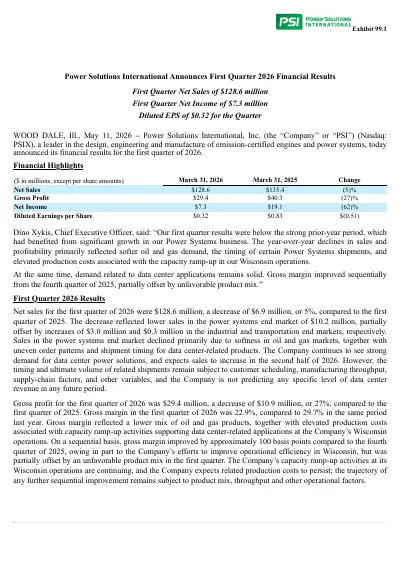
The first quarter. Turning to the quarter, as Ken will describe in more detail, our first quarter results were below the strong prior-year period, which had benefited from significant growth in our power systems business.
The year-over-year declines in sales and profitability primarily reflected softer oil and gas demand, the timing of certain power systems shipments, and elevated production costs associated with the capacity ramp-up in our Wisconsin operation. At the same time, demand related to data center applications remained solid, and gross margin improved sequentially from the fourth quarter of 2025, owing it in part to the company's efforts to improve operational efficiency in Wisconsin, but partially offset by unfavorable product mix.
With that, I will turn the call over to Ken.
Kenneth Li
Thank you, Dino, and good afternoon, everyone. I will walk through our financial performance for the first quarter, then provide some operational context, and updates on liquidity and our outlook framework for the balance of the year.
Net sales for the first quarter were $128.6 million, representing a decline of approximately 5% year-over-year. This decrease was primarily driven by lower sales in our power systems end market, reflecting uneven customer ordering patterns and the continued softness in the oil and gas markets.
These declines were partially offset by growth in our industrial and transportation end markets. Gross profit for the quarter was $29.4 million, compared to $40.3 million in the prior year, and gross margin was 22.9%, compared to 29.7% in the prior-year period.
The year-over-year decline in gross margin reflects a less favorable product mix in the period, including lower contributions from oil and gas products, together with elevated production costs associated with capacity ramp-up activities supporting data center-related applications. On a sequential basis, gross margin was approximately 100 basis points higher than the fourth quarter of 2025, which we believe shows early progress in reducing operational inefficiencies, though the gain was partially offset by an unfavorable product mix in the first quarter.
We caution that capacity ramp-up activities at our Wisconsin operations are continuing, and we expect elevated product costs related to that ramp-up to persist, with the trajectory of any further sequential improvements subject to product mix, throughput, and other operational factors. Operating expenses were $18 million, up approximately 15% year-over-year, reflecting continued investments in research and development to support new product initiatives, as well as increased selling and administrative expense to support growth.
Operating income for the quarter was $11.4 million, compared to $20.6 million in the prior-year period. Net income was $7.3 million, or 32 cents per diluted share, compared to $19.1 million, or 83 cents per diluted share, in the prior year.
Adjusted EBITDA was $13.9 million, reflecting the same underlying operational dynamics impacting profitability. Turning to cash flow, we generated $18.7 million of operating cash flow in the quarter, more than doubling compared to the prior-year period, and driven primarily by favorable working capital dynamics.
From a balance sheet perspective, we ended the quarter with $45.1 million of cash and cash equivalents, and approximately $103.4 million of total debt. Our balance sheet remains solid, and we continue to generate positive cash flow.
From a liquidity standpoint, we are well positioned. Our cash generation, combined with access to our $135 million revolving credit facility, provides flexibility to support our operations and ongoing investments.
We believe our current liquidity position is sufficient to meet our anticipated cash needs for at least the next 12 months. Turning to our priorities for 2026, our team is focused on operational execution, ongoing margin recovery, reliable delivery against customer commitments, and consistent communication with our investors.
Given ongoing variability in order timing and market conditions, the company is not providing formal full-year guidance at this time. Based on current visibility, the company currently expects second quarter 2026 revenue to be generally consistent with the first quarter on a sequential basis.
The company anticipates strong sales growth in the second half of 2026, approximately in line with sales in the second half of 2025, as larger power system orders move into production and are recognized as revenue. However, the timing and ultimate volume of those shipments remain subject to customer scheduling, manufacturing throughput, supply chain factors, and other variables.
There can be no assurance that those orders will translate to a uniformly strong second half. Continued softness in the oil and gas end market is expected to weigh on quarterly revenue trends, and the capacity ramp-up activities at the company's Wisconsin operations and their related cost effects on gross margin are expected to continue.
We continue to see ongoing demand for power infrastructure, particularly in data center and distributed power applications, and to invest in our manufacturing footprint and product platforms in support of that demand. Converting that demand into revenue depends on the operational and market factors I have described, and we will continue to update investors as the year progresses.
With that, operator, please open the line for questions.
Operator
Thank you. To ask a question, please press star one one on your telephone and wait for your name to be announced.
To withdraw your question, please press star one one again. Please stand by while we compile the Q&A roster.
Our first question comes from the line of Eric Stine with Craig-Hallum Capital Group. Your line is now open.
Eric Stine
Hi, Dino. Hi, Ken.
Kenneth Li
Hi, Eric.
Eric Stine
Hello. I'm wondering, on Q1, if you're able to, could you just give a little detail on specifically power systems and, maybe not exact, but talk about kind of the contribution from oil and gas.
Clearly that is something that you've talked about since late last year, have seen it, not really a surprise, but curious how do we view that, and then also view that you are ramping up the enclosure business. Then curious, are you expecting more of a ramp-up in Q2, what kind of goes into your Q2 view as well?
Kenneth Li
Eric, for the power system, the 1Q sales is about $96 million, and versus last year $107 million. As we mentioned, we start to notice the softness in the oil and gas later last year, right?
This softness extended to 1Q this year. Most of the sales decrease, this quarter versus last year 1Q is driven by the power system, the oil and gas, the softness, and also the uneven customer demand for other data center-related products.
Right now in the near term, we still assume the oil and gas will remain soft throughout the year. If there's some pickup, definitely it will be favorable for the sales and also margin perspective, right?
Now, for the Wisconsin operation, the company adding resource to support the Wisconsin operation, and we are doing lots of process improvements, time study. We see some notable improvements in the cost structure, labor overhead in the manufacturing cost if we compare this quarter versus 4Q last year.
The improvements is also reflected in our gross margin improvements, 100 basis points this quarter versus last quarter, right? Now, for the orders regarding to the data center products, as we indicates in the press release, we anticipate strong activity in the second half.
This based on some order we already received. Now we expect the second half the sales will be the same level as we had last year for the second half.
Again, the actual shipments timing and the volume is subject to the customer schedule,
Eric Stine
our throughput, and
Kenneth Li
also the supply chain, right.
Eric Stine
Yep. No, of course.
Kenneth Li
Then
Eric Stine
if I think about second quarter, cuz obviously you're coming out of this period where you're now starting to ramp up the enclosure business, you've got a number of ongoing improvements, I get that. If you're looking for a flat sequential quarter, looking for enclosure growth, would imply that you are expecting further weakening of oil and gas in Q2.
Curious if that is your intention or cuz it sounds like you haven't really seen an improvement there and don't expect to even if oil certainly has appreciated given what's going on in the Middle East, but it sounds like you don't necessarily think that that has a positive impact anytime soon.
Kenneth Li
You're right, Eric. Even though the oil price is very high and we're not seeing a significant ordering for oil and gas products.
For the second quarter, we expect it will be the same level as Q1.
Eric Stine
Yeah. Okay.
I may have missed it, but just on gross margins, I don't know if you said it, but I think you might have said that you expect that you're starting to see a little bit of improvement given all the steps that you took in Q4 and early in Q1, and that expect continued improvement throughout the year, and I'm not sure if you gave any indications of the magnitude.
Kenneth Li
The 1Q gross margin, 22.9%, and the 4Q was 21.9%, it's about 100 basis point improvements, right? As I said, we did see some notable improvements for Wisconsin operation.
Going forward, we expect the gross margin will be flat or slightly better than 1Q. Again, this also subject to for the product mix and also our cost structure improvement.
The 1Q gross margin was kind of negatively impact by product mix. Usually, our oil and gas products carry a high gross margin, this impacted by the oil and gas also for the 1Q.
Eric Stine
Cool. Okay.
Last one for me. Just curious, I know you're about a quarter in or a little bit over, but just would love some thoughts on the MTL acquisition, some of the benefits you're seeing, why you did it.
It's pretty straightforward, but would just love you to kind of give your thoughts on that acquisition in its early days.
Kenneth Li
Sure. We completed the MTL acquisition on January 9th this year.
MTL specialize in fabrication, welding, painting, and assembly of metal components, and it's also make the data center parts. MTL has been PSI supplier for a long time, more than 10 years.
They have been supplying us the fuel tank, right? This acquisition definitely help us to vertically integrate our supply chain, help us to reduce the lead time, and also PSI can have access to its UL certification.
Since the acquisition, the integration is underway, and we are exploring different opportunities to leverage the MTL asset base to help us to do other fabrications for the data center-related components. The revenue contribution from MTL is expect to be pretty modest in 2026.
In the near term, the team focus will be on the operational execution, throughput coordination, and the production consistency.
Eric Stine
Thank you very much.
Kenneth Li
Yeah. Thank you, Eric.
Operator
Our next question comes from the line of Alan Lau with Jefferies. Your line is now open.
Alan Lau
Thanks for taking my question. Would like to understand more on the growth outlook, especially from the enclosure business as the company ramps up the production.
Would like to know if you might share what's the capacity in dollar terms for the enclosure business and are you getting orders from major clients? Thanks.
Kenneth Li
Thank you, Alan. Alan, we serve our customer mainly in three kind of industry end markets, basically industrial, power system, and also transportation.
For the power system, we provide the products, microgrid, standby power, prime power, and also data center-related products like enclosure. In our financial statements, we do not break down the sales relates to the enclosure business, it's within our power system, the end user market.
What I say is we received some orders from our customer, and we anticipate strong activity in the second half of the year, and we expect the second half sales will be at the level we had, second half last year, right? We still have some pretty solid demand from our customer on our products.
Certainly, as I said, the actual shipments timing and the volume still subject to the customer schedule and how successful we can convert the orders to sales. Okay.
Alan Lau
Understood.
Kenneth Li
Would like to follow Go ahead.
Alan Lau
Would like to follow up on oil and gas because you mentioned that you expect second half of the revenue would be similar to last year. Would like to know if it's in terms of absolute terms, which means because second half last year, I think the revenue in total is roughly $4 billion.
Do you mean you expect second half, the revenue is approximately at $4 billion level?
Kenneth Li
Right now, our kind of general outlook in the second half sales will be similar last year second half, right? Because we anticipate strong demand for our products and activity in the second half, right?
That's our outlook based on the orders we have right now from our customer and also our forecast. Uh-huh.
Wonder if The oil and gas
Alan Lau
Go ahead. Yeah.
Thank you. What's the mix of oil and gas in second half last year?
Kenneth Li
Alan, we do not provide the mix information, particular products in the end market group, yeah.
Dino Xykis
We have never provided that split. It's under power systems.
So, then then
Alan Lau
would like to know, if, like any-, major clients, that, I understand maybe a bit a bit sensitive, but, like any major orders you you you get from, hyperscalers or, key contractors for hyperscalers?
Dino Xykis
We do not name individual customers. We never have.
Kenneth Li
We do not provide information on any specific customers, yeah.
Alan Lau
Understood. Wonder then, could you share the update on gas engine?
Because I think this gas engine for prime power is an upcoming trend. Wonder if you might share update on that front?
Kenneth Li
Yeah. PSI, we provide a very broad output portfolio of engines, right, starting from 1 L all the way to 88 L and 110 L.
We are using multiple fuel source, such as gas, propane, propylene, gasoline, diesel, and biofuel. We spend R&D to develop the products, right?
For the 1Q, we spend about $4.8 million. We continue to spend R&D to develop new products and emission certification and also develop a special application for our customers, right.
What I see is there's definitely activities going on on the gas side. We are working to develop the products to meet the industry demand.
That's what they're doing. I will say we have lots of current engineering activity includes ongoing work related to emission compliance, thermal management, packaging optimization, and all kind of customer-specific application requirements.
We also doing R&D to develop a larger diesel engine for the data center market, yeah.
Alan Lau
By bigger diesel engines, I wonder if it's above 3 MW?
Kenneth Li
I'm sorry. Could you repeat that question again?
Alan Lau
I wonder if the bigger diesel engines are above the typical 2 to 3 MW?
Kenneth Li
I think right now we have our 88 L. It's about 3 megawatt, 3 MW, yeah.
Alan Lau
Understood. Thank you.
I'll pass on. Thank you.
Kenneth Li
Yeah. Thank you.
Operator
Thank you. This concludes the Q&A session.
Thank you all for your participation. This does conclude today's call.
You may now