ProPetro Holding Corp.
NNYSE:PUMPQ3 FY2026 · Earnings Call TranscriptOctober 28, 2026
Operator
Welcome to the ProPetro Holding Corp. third quarter of 2026 conference call.
Please note that this event is being recorded. All lines have been placed on mute to prevent any background noise.
After the speakers' remarks, there will be a question-and-answer session. If you would like to ask a question during this time, simply press * followed by the number 1 on your telephone keypad.
If you would like to withdraw your question, simply press *1 again. I would now like to turn the call over to Matt Augustine, ProPetro's Vice President of Finance and Investor Relations.
Please go ahead.
Matt Augustine
Thank you, and good morning. We appreciate your participation in today's call.
With me are Chief Executive Officer Sam Sledge, Chief Financial Officer Caleb Weatherl, President and Chief Operating Officer Adam Muñoz, and President of PROPower Travis Simmering. This morning, we released our earnings results for the third quarter of 2026.
Please note that any comments we make on today's call regarding projections or our expectations for future events are forward-looking statements covered by the Private Securities Litigation Reform Act. Forward-looking statements are subject to several risks and uncertainties, many of which are beyond our control.
These risks and uncertainties can cause actual results to differ materially from our current expectations. We advise listeners to review our earnings release and risk factors discussed in our filings with the SEC.
Also, during today's call, we will reference certain non-GAAP financial measures. Reconciliations of these non-GAAP measures to the most directly comparable GAAP measures are included in our earnings release.
Finally, after our prepared remarks, we will hold a question-and-answer session. With that, I would like to turn the call over to Sam.
Sam Sledge
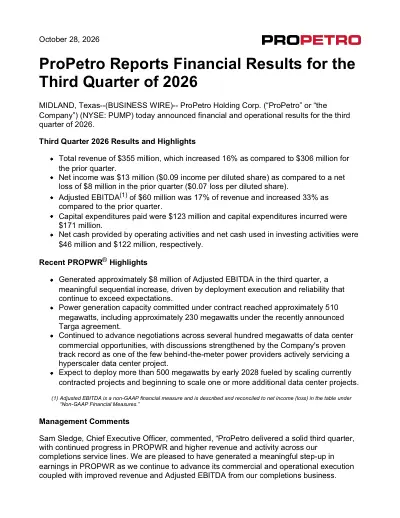
Thanks, Matt, and good morning, everyone. ProPetro delivered a solid third quarter: higher revenue, net income, and adjusted EBITDA in both our completions and PROPower businesses.
PROPower posted a meaningful sequential step-up as we continue to advance its commercial and operational execution, and activity in frac is inning and winning more. While the costs of rebuilding our completions capacity continue to weigh on margins, our fleet is now essentially sold out, positioned to re-contract into a tighter, better-priced market in 2027.
Let's start with PROPower. Since our last update, we've made significant progress across the business.
PROPower generated approximately $8 million of adjusted EBITDA in the third quarter, a meaningful sequential increase. Results and margin performance at the project level continue to meet our already high expectations, which reinforces our confidence in the earnings and return profile we have.
We expect to keep scaling deployments through year-end, reaching between approximately 250 and 270 megawatts deployed by the end of 2026, and stair-stepping to more than 500 megawatts by early 2028. We expect this growth to come from three sources: scaling our currently contracted capacity, deploying or preparing to deploy on the Targa award, which is scheduled to be fully deployed by early '28, and beginning to scale one or more additional data center projects over time.
Looking further ahead to 2027, much of our work will be preparing for larger, infrastructure-scale projects, including the Targa award and potential additional data center awards, which could begin deploying as early as late 2027. As a result, we expect '27 earnings to be weighted towards the latter part of the year, with growth following a stair-step pattern as projects come online, rather than a straight line throughout the year.
Projects of larger scale require significant lead time. We expect certain costs, including personnel, site preparation, and mobilization, will build ahead of these deployments, where the corresponding revenue and earnings are realized.
By emphasizing disciplined execution and actively de-risking these larger deployments, we are building on the strong operational foundation we established in 2026, and we remain confident in our PROPower guidance, the long-term earnings, and return profile of the business. On the commercial front, our recently announced agreement with Targa for approximately 230 megawatts brings our total capacity committed under contract to approximately 510 megawatts.
This award represents meaningful progress in our commercial effort. It also shows how broad power demand is across end markets, including oil and gas, midstream, and industrial, in addition to data centers.
Contract terms in these sectors are generally shorter than those in the data center arena. Pricing and expected return are very attractive.
That said, given the larger load requirements and longer contract durations in the data center arena, along with the depth of our pipeline there, we continue to expect to deploy the majority of our assets to data center projects over time. Of the approximately 2.6 gigawatts of power generation capacity we have secured, more than 1 gigawatt consists of Caterpillar's highly efficient 10-megawatt units that are part of our strategic framework agreement.
With supply chains for power generation equipment remaining very tight, we believe this agreement and our early-mover position provide a meaningful advantage. Beyond just securing supply, the 10-megawatt units themselves are highly efficient, stationary natural gas engines, purpose-built for permanent, high-density installations.
They maximize efficiency for our customers, while lowering our total cost of ownership. The vast majority of our fleet will be natural gas reciprocating engines ranging from 2 to 10 megawatts, which we believe are the ideal fit for every vertical we are currently pursuing.
Of note, our smaller units are also proving to be very successful. Our first data center deployment, which is live and operating today in the Midwest United States, is largely built on 2.6-megawatt units.
Reciprocating engines offer a number of advantages that we believe make them the right fit for our business. They are a proven technology with a long track record for both mechanical drive and power generation applications.
They are continuous-duty rated machines, trusted in high-availability environments, including data centers, oil and gas, mining and industrial operations, and marine and heavy transport, where uptime and performance are all critical. They provide flexibility, scaling in modular blocks alongside customer demand, with built-in redundancy.
They deliver high fuel efficiency, are cost-effective for both PROPower and our customers, and are emissions-friendly, which supports efficient permitting. These advantages apply across our entire fleet, our 10-megawatt units adding even greater scale for our customers' largest power needs.
In the data center arena, despite broader volatility and the noise in the AI market, we remain in advanced negotiations on several hundred megawatts and continue to progress a number of additional opportunities behind it. Pipeline also continues to grow, strengthening our conviction in our strategy and investments.
As we have noted previously, timelines have extended as we work through diligence with counterparties. These agreements involve long-term capital commitments on both sides, getting the risk-sharing provisions right is critical.
Strong demand for our assets can also lengthen, rather than shorten, the contracting process, because we are being deliberate about choosing the right long-term partners. In addition, changes in scope or timing on a project can make a previously unworkable opportunity viable, or free up capacity for customers who otherwise could not have supported it.
Because we're allocating capacity across multiple customers, individual deal timelines may shift as we determine how each opportunity fits within our broader portfolio. Accordingly, we remain very confident in the pipeline.
Importantly, we are currently deployed and operating on a hyperscaler project, and execution has gone exceptionally well. We are one of the very few behind-the-meter power providers live on a data center site today, and we believe this operating track record validates our strategy and helps accelerate our broader commercial efforts.
Our PROPower guidance also remains clear and unchanged. We continue to expect capital costs of approximately $1.4 million to $1.5 million per megawatt.
That figure includes balance of plant and expected inflation over the life of the Caterpillar framework agreement, and it reflects the advantage of our early-mover position. We continue to target payback periods of 4 to 6 years, with oil and gas and midstream projects closer to 4 years, given their generally shorter contract terms.
From a financing perspective, we have raised approximately $1.5 billion to support PROPower, including our highly successful $690 million convertible notes offering earlier in May, which largely addresses our near-term capital needs. Going forward, we will approach future capital decisions opportunistically, as we continue expanding our commercial footprint and executing against our strategy.
Now turning to completions. I want to address the costs that weighed on margins this quarter.
As activity declined during 2024 and '25, with tariff-related uncertainty and OPEC+ production increases adding to the pressure, we took decisive action to reduce operating costs and capital spending during those years. That protected free cash flow through a challenging market, but we have had to rebuild some of that capacity as demand has recovered this year.
Improved pricing and better visibility into the duration of work supported the reactivation of two fleets this year, bringing us to 13 active fleets today. The latest addition deployed in the third quarter, earlier than we originally anticipated.
We are now essentially sold out of available frac capacity. Supporting the increase in activity has required rehiring field personnel, restocking inventory and spare parts, and preparing additional pump equipment.
Higher utilization has also put pressure on our field operations and maintenance. While the costs of ramping back up have been higher than we originally anticipated, we are proud of how responsive our operations team have been in meeting increased customer demand.
We expect to maintain approximately 13 active fleets in the fourth quarter. That said, we expect meaningful seasonality in the fourth quarter from typical holiday slowdown, which will temporarily affect utilization and results, along with continued margin pressure from the rebuilding costs we experienced in the second and third quarter.
As activity stabilizes as we move into 2027, we expect to begin optimizing those costs, although the full benefit may take time. We're optimistic that our investments will pay off and create meaningful value for our shareholders as we re-contract the fleet.
The way we have managed through this period, flexing capacity up and down with the market while keeping our balance sheet strong, reflects our discipline, as well as the resiliency of our industrialized business. Now stepping back to the broader macro.
Conflict in the Middle East continues to influence commodity prices and customer activity, but it has also highlighted something that we've been talking about for several quarters: the amount of frac capacity that has already exited the market through consolidation and attrition. Smaller, less disciplined competitors could not sustain the downturn, and much of the excess capacity has disappeared.
As activity stabilizes, customers are increasingly recognizing that tighter supply environment, which is constructive for our business. To put some numbers around that, we estimate the active Permian frac fleet count is in the mid-70s today, and years of attrition have drastically reduced the supply of high-quality horsepower behind it.
On the demand side, even a modest increase in drilling activity, particularly from large public and independent operators, would be enough to fully tighten the market. On the supply side, we believe the industry could only bring back perhaps a handful more fleets in the Permian before it would need to make significant new investments to add capacity.
Given the capital discipline and focus on free cash flow across the completions space, we do not expect that investment to materialize anytime soon. In short, demand is poised to grow, and supply is not.
It bodes well for our long-term setup for our services. That tighter market is already showing up today in pricing.
We're seeing early pricing momentum led by next-generation, natural gas-burning fleets, which command a clear premium given today's spread between diesel and natural gas prices. Those fleets are effectively sold out industry-wide, and we expect that premium to hold regardless of how the conflict in the Middle East evolves, as limited supply and global refining constraints keep diesel prices elevated for the foreseeable future.
That pricing momentum is also relevant to the timing of re-pricing our contracted fleets. More than two-thirds of our active horsepower is contracted, with most agreements currently scheduled to renew in the first half of 2027.
Much of that equipment is next-generation and natural gas-burning, which positions us well for re-contracting, particularly for agreements signed in the more challenging pricing environment of the past two years. As that horsepower re-prices in a more constructive environment, we believe the completions business is poised to deliver improved results over time.
Before I hand it to Caleb, let me summarize how we are thinking about the outlook as we head into 2027. In completions, the setup is straightforward: sold-out fleet, tightening market, and early pricing momentum.
We still have work to do on the cost side as we absorb elevated expense of ramping the system back up, but as activity stabilizes, our focus shifts from rebuilding to optimizing, and we expect to bring those costs down as we move through 2027. In PROPower, our primary focus remains commercial and operational execution: converting our pipeline into signed, long-term contracts, and deploying and operating those assets reliably for our customers.
We've secured the equipment to support that growth, and our performance in the field is strengthening our commercial position as we advance additional data center opportunities. As I noted earlier, we expect 2027 to be a year of building towards larger, infrastructure-scale deployments, with growth weighted to the second half.
Across both businesses, we are doing what we said we would. We are excited about the opportunities ahead.
Completions market is moving in our favor, PROPower is executing and scaling, and we have the balance sheet, equipment, and the team to capture what is ahead. With that, turn it over to Caleb.
Caleb Weatherl
Thanks, Sam, and good morning, everyone. As Sam mentioned, both PROPower and our completions business delivered higher revenue, net income, and adjusted EBITDA this quarter, while completions margins reflected the costs of rebuilding the operational infrastructure needed to support higher activity.
During the third quarter, ProPetro generated total revenue of $355 million, an increase of 16% compared to the prior quarter. Net income totaled $13 million, or 9 cents income per diluted share, compared to a net loss of $8 million, or 7 cents loss per diluted share, in the prior quarter.
Adjusted EBITDA totaled $60 million, representing 17% of revenue, and increased 33% sequentially. The increase was primarily driven by higher utilization in the completions business and incremental deployments in PROPower, partially offset by higher costs associated with rebuilding capacity to support increased completions activity.
Adjusted EBITDA includes approximately $16 million of lease expense related to our electric fleets. Net cash provided by operating activities was $46 million, as compared to $66 million in the prior quarter.
The decrease is primarily attributable to working capital headwinds in the third quarter, which consumed approximately $15 million of cash, and working capital tailwinds in the prior quarter, which were an approximately $20 million source of cash, partially offset by higher adjusted EBITDA. During the third quarter, capital expenditures paid were $123 million, and capital expenditures incurred were $171 million, including approximately $43 million supporting the completions business and approximately $128 million supporting PROPower equipment orders.
Notably, the difference between incurred and paid capital expenditures is primarily comprised of PROPower-related capital expenditures that have been financed and paid directly by the financing partner, and unpaid capital expenditures included in accounts payable and accrued liabilities. Net cash used in investing activities, as shown on the statement of cash flows, during the third quarter of 2026 was $122 million, which included capital expenditures paid of $123 million, offset by $1 million in proceeds from certain asset sales.
Turning to our outlook, we anticipate full-year 2026 capital expenditures incurred to be between $525 and $575 million. Of this, the completions business is still expected to account for approximately $125 to $145 million, largely dependent on delivery timelines of certain CapEx-related items heading through year-end and into 2027.
We continue to expect buyout costs for our first FORCE electric fleet to be between $15 and $20 million, with at least three additional buyouts expected to occur in 2027. In addition, we anticipate incurred capital expenditures of approximately $400 to $430 million for our PROPower business in 2026, narrowed from prior guidance due to greater year-end visibility into the timing of additional equipment deliveries.
Notably, our previous guidance of approximately $1.4 to $1.5 million per megawatt, inclusive of balance of plant, remains unchanged. While these PROPower capital expenditure estimates reflect the total cost of the equipment, they do not reflect the impact of financing arrangements, which have and are expected to continue reducing our near-term actual cash outflows.
Looking ahead to 2027, we are aligning equipment delivery schedules under the Caterpillar framework agreement, and remain in active discussions on data center opportunities, both of which could affect the timing and amount of capital expenditures for the year. In particular, the size, timing, and structure of any new data center agreements could change when equipment is needed, and how much balance of plant investment is required next year.
However, we expect that any such changes would affect the timing and total amount of capital expenditures, rather than the cost per megawatt, which we continue to expect to remain within our guided range. That said, we expect 2027 PROPower capital expenditures to increase from 2026 levels, driven by the delivery of additional equipment and the funding of down payments and milestone payments under the Caterpillar framework agreement.
One more item on PROPower before I turn to the balance sheet. Certain PROPower contract structures may include reservation fees that are collected in cash upfront, but not recognized in revenue or adjusted EBITDA until the assets are deployed and generating power.
As a result, PROPower's revenue and adjusted EBITDA in a given period may trail the level implied by its contracted capacity and guidance, though the underlying contract economics remain intact. Importantly, our balance sheet remains a significant source of strength.
As of September 30th, 2026, cash and cash equivalents were $729 million, including net proceeds from the issuance of $690 million aggregate principal amount of convertible senior notes. Borrowings under our financing agreement with Caterpillar Financial Services Corporation were $172 million.
Total liquidity at the end of the third quarter of 2026 was $934 million, which included cash and cash equivalents, $185 million of available borrowing capacity under the ABL credit facility, and $20 million of availability under our Caterpillar equipment loan agreement. We currently have no outstanding borrowings under the ABL credit facility.
Finally, as Sam mentioned, we plan to continue approaching PROPower funding opportunistically, which gives us confidence in our ability to execute on future capital needs, as we expand our commercial footprint to drive our strategy forward. Sam, back over to you.
Sam Sledge
Thanks, Caleb. Before we open the line up for questions, want to leave you with a few additional thoughts.
ProPetro has been built into a resilient company over the last several years, one that has performed through even the most challenging markets, generated free cash flow when many in our industry could not, and used that period to reposition itself for what comes next. Today, we are entering a market that is turning in our favor: a tighter completions market and a power business that is scaling.
Our conviction in our business remains very strong. Let's start with completions.
Some unexpectedly higher rebuilding costs weighed on our margins in the second quarter and the third. Those costs are the price of standing the system back up to meet higher activity.
We're optimistic that 2027 will prove that an investment was well bought. Since the second quarter, underlying fundamentals have only strengthened.
Oil prices remain elevated, the conflict in the Middle East is ongoing, and expectations for incremental rig additions next year should further tighten the frac market from already high. None of this is theoretical, showing up right now in our 2027 activity and pricing conversations.
Our fleet is essentially sold out, demand is very high, and we are turning away opportunities today because we do not have the capacity to serve. We are seeing early pricing momentum, more of our contracted horsepower re-prices in the first half of next year.
Setup for our completions business is better today than it ever was six months ago. Now PROPower.
We believe the market is waiting on a transformational data center. We recognize this is a show-me story.
Candidly, accept that. Our conviction in landing those agreements has not changed.
We're in advanced stages commercially, and we're not going to ask anyone to take that on faith. We'd ask that you look at our track record.
Our message has not changed from one call to the next. We are executing on three fronts: commercially, operationally, and across our supply chain.
Commercially, that means strong contract wins with large, investment-grade partners, including Targa, that have taken our contracted base to approximately 510 megawatts. Operationally, it means real assets running in the field today, including a data center site and several Permian microgrids for oil and gas customers, each with excellent execution.
On supply chain, we are in a premium position relative to most competitors in this space. We moved early and secured our megawatts through the Caterpillar framework agreement.
The result is 2.6 gigawatts of secured equipment, including over 1 gigawatt of 10-megawatt Cat reciprocating engines purpose-built for data centers, locked in at advantaged costs. In a market where access to equipment has become the gating item, that is a real, durable advantage.
Behind all of this sits a strong execution support system: the people, the maintenance infrastructure, and the operating discipline we have built over years in the completions space and are now applying to power. We have not over-promised on contract timelines.
We've been deliberately disciplined in how we communicate with you. We would much rather under-promise and deliver than the reverse.
Simply put, we're doing exactly what we said we would do, and we're building a track record of execution one quarter at a time. We look forward to demonstrating that execution across every one of our service lines in the years ahead.
Let me leave you with this: this is a very strong company. We have a strong balance sheet and first-class customers across both completions and power, from leading operators in the Permian Basin to investment-grade midstream partners like Targa, to data center customers we are serving today, with more expected.
We are led and operated by first-class people. To our employees, thank you.
Your execution in the field, in the maintenance shop, and on the power sites is what gives this management team the confidence to move forward with this strategy. Every fleet we stood back up this year and every megawatt we've commissioned happened because of you.
We're excited about where the business is headed, and we're confident in the setup for 2027. We look forward to sharing more with you again soon.
With that, operator, let's open the line for questions.
Operator
Thank you. The floor is now open for questions.
If you have dialed in and would like to ask a question, please press *1 on your telephone keypad to raise your hand and join the queue. If you would like to withdraw your question, simply press *1 again.
If you're called upon to ask a question and are listening via loudspeaker on your device, please pick up your handset and ensure that your phone is not on mute when asking your question. Again, to join the queue, it is *1.
Your first question comes from the line of Saurabh Pant of Bank of America. Your line is open.
Saurabh Pant
Hi, thank you. Good morning, Sam and Caleb.
Sam Sledge
Morning, Saurabh.
Saurabh Pant
Sam, really good update on PROPower, especially the $8 million positive EBITDA, you're turning the corner there, so that's really good update. Then you also expect to deploy more than 500 megawatts by early 2028, and I noted that includes one or more additional data center contracts.
Just on that point, can you talk a little bit about where you are in your conversations with these data center customers on contracts? Then just from a timing standpoint, how should we think about timing of signing a contract relative to ordering the balance of plant equipment and then putting it all together for deployment starting in, I think, you're targeting late '27 or early '28, maybe if you can help us with that a little bit.
Sam Sledge
Thanks, Saurabh. I'll point out a couple things here real quickly, and then let Travis talk about the power contracts.
Look, just to reiterate what was at the end of my scripted remarks there, we're doing exactly what we said we would do, and we're really hitting our guidance, and executing well in the field. We're just really trying to overcommunicate the fact that, and I know you've been paying close attention, Saurabh, but this is all been in the plan for almost a year now from a guidance standpoint, we're excited to see it come to fruition.
Travis Simmering
Just to be clear on the capacity also, Saurabh, a data center contract would be incremental to that 500. That 500 reflects the 510 that we have contracted and have guided will be deployed in early '28.
As far as the conversations in the data center space, despite kind of the broader turmoil in the data center market, our specific conversations continue to be positive, headed in the right direction towards execution. As you mentioned, that includes balance of plant, equipment that needs to be ordered for these large infrastructure projects.
We or in the middle of ordering some of that already, have line of sight to anything that we might want on a project specific timeline, and just continue to make really good progress on those projects to deploy, potentially late '27, but for sure in early '28 at scale.
Saurabh Pant
Got it. No, thanks, Sam and Travis.
That's a good point, good clarification on the 500-plus data center number. Then for a quick follow-up, maybe Caleb, this one is more for you on the balance sheet, financing side of things.
Look, the good thing is that you have ample liquidity, like you noted, north of $900 million over there, which I think should be enough for all of 2027. As you sign these bigger data center contracts that Travis was talking about, what do you think makes the most sense for future potential sources of financing as you get these contracts and get deeper into the execution phase?
Then related to that, I think you mentioned this a little bit, Sam, but you were talking about some customers willing to give prepayments, some upfront cash reservation fees right now. Just maybe a little more color on that, especially I'm thinking about the bigger 10-megawatt Cat units, which would be much more desirable, I'm thinking, for these customers.
Caleb Weatherl
Thanks, Saurabh. Like you said, we feel really good from a liquidity standpoint, over $900 million of liquidity, over $700 million of cash.
That doesn't count the $350 million undrawn Stonebriar facility. We want to just continue to be opportunistic, and look at all available options and make the best choice when we need the capital.
We're going to evaluate all of our options when we need the capital and make the best choice. Of course, prepayments are part of the conversation on these larger power deals.
Saurabh Pant
Got it. Thank you, Caleb.
I'll turn it back.
Operator
Your next question comes from the line of Alexa Breño of Goldman Sachs. Your line is open.
Alexa Breño
Good morning, team, and thanks for taking our questions. On the power side, it sounds like you're seeing attractive returns across all different end markets.
Can you just talk about the varying economics of some of the shorter-duration contracts you mentioned versus maybe some of the potential data center contracts? Then how do you evaluate the opportunities from a return and capital requirement perspective?
Travis Simmering
Thanks. On the oil and gas and I'd say more midstream space, we're certainly seeing closer to that four-year or better payback.
Then on the larger long-term deals in the data center space with this larger infrastructure capital requirement, that's certainly probably towards the higher end of the 4 to 6 year payback. Ultimately, we're really continue to be excited about these two markets, and broader power markets in general, starting to levelize in terms of the contract requirements, the pricing structure.
We think that's going to continue into oil and gas midstream space where got longer tenors that will hopefully be coming in the future because that's the expectation on these highly efficient, larger infrastructure projects.
Alexa Breño
That's helpful. Then maybe just switching gears a little bit to the frac business.
Can you just talk about what you're seeing in the market, maybe more so from equipment bifurcation? How should we think about pricing for some of these more electric fleets, maybe some of the older-age ones?
Then how are you thinking about it as we go into maybe back half of '27 even?
Sam Sledge
I think you just kind of play off my comments in the opening remarks, it's really starting to set up really well. On the onset of the Iran conflict earlier this year, we might have originally thought that that tightness would have come sooner than it has, but it is really starting to gradually tighten.
The natural gas-burning equipment for us is, in the way of dual fuel, a little bit of direct drive, gas, and electric, has been sold out and has held its pricing a lot better than everything in our portfolio. It starts from a little bit of a higher basis.
That said, this whole dynamic with diesel right now, and the high price of diesel with the continued lower price of natural gas, continues to keep that equipment in very, very high demand. Frankly, some customers that have been more of a dual fuel or a diesel focus in the past are now much more curious about things like direct drive and electric, which really plays into our hands and kind of our re-contracting timelines going into next year.
The overall market is tightening. I would say the leading edge on the spot market is already very tight.
We're turning down a ton of work in that arena. All the meanwhile, we're still trying to manage all of our relationships and the market that we still play in into next year to create more consistency and stickiness with what we think are the top-tier customers to move forward with.
We're, as you can tell in our scripted remarks and my answer to your question here, we're pretty excited about the setup for '27.
Alexa Breño
That sounds great. Thank you.
We'll turn it back.
Operator
Your next question comes from the line of Derek Podhaizer of Piper Sandler. Your line is open.
Derek Podhaizer
Hey, good morning. I wanted to ask about your comments, the timelines extending with negotiating with these big power projects.
If you could just expand on those different drivers that's lengthening this process. Is it community pushback, moratoriums, or just maybe more on the commercial terms?
I'd have to imagine that your current 60-megawatt data center project helps de-risk some of the contracting structure and terms because it's something you can point to. Maybe help us understand more about the drivers behind these timelines being extended.
Travis Simmering
Thanks, Derek. It's really not any pushback type things you're talking about.
It's more the real contract risk exposure on both sides, it's liability, damages, when you're talking about this large of an installation for this long a period of time, and really kind of getting the scope right between the parties on these types of projects. The initial 60-megawatt contract certainly gives us a great starting point in these discussions, given that there's very few of us that have done this, right?
As they get a lot larger and longer in term, there's just a lot more scrutiny on both sides to get to the right answer.
Sam Sledge
Derek, I'll just add on to that. Watching Travis and his team work through all these commercial opportunities, the demand remains super strong.
We're very confident that the majority of our capacity is going to be placed in the data center market over time. They juggle a lot in this commercial pipeline.
At any one time are running several opportunities in parallel that could affect one another. As some of those opportunities that are running parallel to each other might speed up or slow down, sometimes it changes your focus a little bit, and then can change your timeline.
All the meanwhile, we're trying to make what is the next best decision for our company, our team members, and our shareholders, to create as much value in the future. A few weeks or a month on the front end to get the right long-term deal just makes sense to us to make sure that: one, we get the right deal, and two, we do it with the right amount of risk sharing, like Travis mentioned.
Derek Podhaizer
Right. No, that makes sense.
Appreciate the comments. Maybe just sticking on the equipment side of things, I'm just curious now that you mentioned the 10-megawatt recip from Cat, the bigger ones, just the interplay between the 10 megawatts and maybe the smaller, I don't know, 2 to 4-megawatt units of recips.
I know those are on your current data center project, but you're clearly leaning into the higher-density 10-megawatt recips. How do we think about the different applications that fit the 10-megawatt versus the smaller recips, or maybe are the smaller recips used to initially scale a project where the larger units take over for the longer term?
Maybe just some education on why leaning hard into the 10 megawatts and the interplay of the smaller units and how this is going to really fit inside of your portfolio as we look in the future of PROPower.
Travis Simmering
It's a great question. As the sites get larger, obviously, power density matters.
The 10-megawatt unit is really helpful. Efficiency matters.
I think these markets are getting more aware of how that efficiency can play into the overall cost structure. When we look at high-efficiency engines, they're anywhere from 20% to 40% more efficient than simple-cycle turbine-type solutions, which we think is extremely attractive.
Bolting on smaller modular units does help with the variability of load. It also helps with the redundancy story when you start thinking about providing significant redundancy on these sites.
The 10-megawatt units interplay with 2.6-megawatt engines as well as battery systems, we think is an extremely attractive power system to be able to deliver the most reliable, efficient solution, while always making sure that emissions are compliant, and allows to have the most capacity on site.
Derek Podhaizer
Great. Appreciate all the comments, guys.
I'll turn it back.
Operator
Your next question comes from the line of Josh Jayne of Daniel Energy Partners. Your line is open.
Josh Jayne
First question is a quick one, just on completions CapEx in '27. Could you just comment directionally if you hold a 30 if you hold a 13-fleet program steady, what that ultimately might look like in the next year?
Sam Sledge
It's probably a little early right now, Josh. We're heavy in kind of budget and forecasting season right now, we'll probably punt that question to next quarter.
Josh Jayne
That's fine. You highlighted the possibility of the market tightening from larger publics and independents.
Can you just describe those conversations today, how they've evolved over the last couple of months, as it seems obviously most of the uptick has been driven by the privates?
Sam Sledge
I was going to start my comments with what you just said right there at the end, that is a fact that most of the rig increases earlier this year have been with the privates, but in conversations with the larger independents and the publics, I think every day these commodity prices remain higher is another piece of confidence that they gain going into next year and in potentially increasing activity. That said, they're all pretty savvy.
I think they understand what's going on in the supply chains, and they'd like to be as least disruptive as possible. Judging off of our conversations and some other public commentary, we fully expect another batch of rigs to come into the system towards the end of this year going into next year.
We have seen all of those larger independents and privates to run operations that are extremely capital-efficient. Therefore, they're not going to drill wells to just let them sit around.
They're going to want to complete those wells and take advantage of the spot oil price as much as they can. It's kind of a combination of customer conversations and boots-on-the-ground intel out here that bolster that confidence that we have about the overall '27 market tightening.
I guess the other piece of it, that maybe sometimes we take for granted, but it's still important, we already mentioned in our opening remarks here this morning, is the equipment market just doesn't have anything left to give. It's tapped out.
We're tapped out. We've got no extra equipment as we sit here today.
We've heard several of our larger competitors say the exact same thing. There's no slack in the system in our larger private competitors, and there's not really anybody that's willing to underwrite any meaningful investments to fix that right now in our sector.
We think it's a good supply-demand equation, I think, in our favor going into next year.
Josh Jayne
That's helpful. Thanks.
Then if I could just squeeze one more. You alluded earlier in an earlier question that you were turning away work for 2027, but I assume you're not completely spoken for for the entire year.
For those opportunities that you are turning down, is it just more pricing you're holding out for? Is it a more comprehensive program, potentially with a larger operator?
Maybe just talk us through that a little bit, and then I'll turn it back. Thanks.
Sam Sledge
I'd say a lot of it's just spot market work that we just can't get to and and don't really prioritize in our dedicated fleet model. There there is definitely a demand for it, and I think that that's what's what's helping push pricing along across the entire sector.
'27, look, we we we historically, as I've already mentioned, like and prefer the dedicated fleet model. We don't like to jump around from customer to customer with any individual fleet.
We feel we already feel pretty good about the '27 calendar. I think it's not going to be a a, an effort to fill in gaps as we sit here today.
It's going to be more of a portfolio optimization to make sure that we have our teams and assets sitting with the best opportunities. That that's that's really what the task is from a '27 standpoint today.
Calendar's basically full. We just aren't convinced that it's full with the right work quite yet.
Josh Jayne
Understood. Thanks.
I'll turn it back.
Operator
Your next question comes from the line of Jason Kim of J.P. Morgan.
Your line is open.
Jason Kim
Good morning, team. Thanks for taking my question.
Just sticking on the frac side, you mentioned that more than two-thirds of horsepower is contracted. How much of the electric FORCE fleet is up for renewal in '27, and how does the pricing on those e-fleets compare to currently contracted rates?
Just to confirm, has any re-contracting not yet occurred? Just trying to think about how much upside might be remaining.
Thanks.
Sam Sledge
We've already we've already re-contracted a little bit of that with a customer that wanted to keep what they had and was commercial with pricing. It's just kind of like a click and drag.
Maybe half the fleet going into next year is going to re-contract, a little bit with the same customers and a little bit Oh, we we we expect some some same customers to stay, and we expect to have some new electric customers going into next year as well. I had It's a It's It's interesting timing, maybe a little bit of is it is luck, but almost a year ago, we had a chance to re-contract almost 100% of that electric equipment.
We chose not to do so, because we didn't like the pricing opportunities in the market. We sit here today with with, that that capacity that is, that we're we're in negotiations with new customers under new terms for the remainder of that capacity right now.
Everything's going to work in '27. We've got high confidence, almost zero doubt that any of that equipment is going to be stranded for even one second.
A lot of that has to do with how our team is performed with this electric equipment. I'd like to think, we might not be the biggest electric provider in the electric frac provider in the Permian Basin, but I'd put our operating stats really up against anybody in that arena.
That's been a huge help to our commercial efforts, and we expect that performance to continue and and to garner a very attractive price.
Jason Kim
Understood. Just as a very quick follow-up, directionally, is the FORCE premium over those Tier 4 DGB widening as diesel stays elevated?
Sam Sledge
Sorry, ask that question again.
Jason Kim
Is the FORCE premium over some of the dual fuel fleets widening as diesel stays elevated? It
Sam Sledge
it definitely helps, but the dual fuel, given its flexibility, modularity, has been very, very attractive tool and application for us and our customers. It's it's a little bit apples and oranges, but the high diesel prices are definitely helping anything that burns natural gas.
Jason Kim
Got it. I'll turn it back.
Operator
Your next question comes from the line of Eddie Kim of Barclays. Your line is open.
Eddie Kim
Good morning. You said the data center pipeline includes several hundred megawatts in advanced negotiations.
Can you frame for us how many distinct projects that represents? Just trying to get a sense if that's, 1 to 2 projects or maybe closer to 4, 4 to 5 maybe.
In these conversations with data center operators, are are you finding that these these operators would prefer that BTM providers like yourselves also provide the balance of plant equipment, or are they happy to to just lease the the power gen from you guys?
Sam Sledge
It's it's definitely, more than one opportunity. I would say there's two that are really active that we're excited about in that several hundred megawatt range.
We can't do everything in the pipeline right now, we've had to narrow our focus on the most realistic, executable deals in the timelines that we have available. As far as the balance of plant, that's a we get the question a lot.
We see that as a necessity. You can't build a power plant without the balance of plant equipment, whether it's electrical transformers, upfront gas conditioning, and distribution, as well as all of the emissions control.
Then whether the hyperscaler or customer asks to take on the battery system, that's that's a discussion on a project-by-project basis, but we're providing a full turnkey service. We're we're not interested in just dry leasing assets.
Assets Our business model is built on operating 24/7 and maintaining our assets in the reliability of that with that power plant.
Eddie Kim
Understood. Thanks.
Thanks for that color. Just shifting gears to the frac side of the business, you mentioned kind of the tightening market and that you guys are completely sold out.
Just to confirm, I think that implies that you guys don't have a 14th fleet to reactivate, even if you wanted to. If that's the case, do you think that pricing and economics could increase to to a level next year that might justify newbuild horsepower, or are we still far away from those levels?
Sam Sledge
We don't have any interest in working any more equipment than we're working today, nor do we have any interest in doing, making any CapEx investments above replacement, refurbishment of our existing fleet. I I I can't sit here and speculate about what if and would we would we invest differently.
We're just We're just not today. That's just That's just not in the conversation.
It's not something that we're really thinking about. Got it.
Eddie Kim
Got it. Just to confirm, you guys don't have a 14th fleet to be able to reactivate at this point, correct?
Sam Sledge
We have old, worn-out equipment that we don't plan to ever work again if that's what you're referring to. We don't And and look, all this is fungible, too.
Like 13, 14, like we could have a fleet go from simulfrac to zipper back to simulfrac. We're we're we're just trying to provide you clean guidance that's that's not confusing here.
This is
Eddie Kim
This is
Sam Sledge
Adam. I'll just add to that.
There's a happy There's a happy medium to run the equipment fleets, the amount that you have to, the maintenance rotation that reduces and keeps your NPT low, your maintenance costs low, we're we're measuring all those options on the table right now as well.
Eddie Kim
Appreciate the color. I'll turn it back.
Operator
Your next question comes from the line of Jeff LeBlanc of TPH. Your line is open.
Jeff LeBlanc
Good morning, Sam and team. Thank you for taking my question.
I wanted to see if you could talk more about the cadence of FORCE e-fleet buyouts over 2027, and how quickly it'll flow through the financial results.
Caleb Weatherl
We're we're still expecting three next year, and, as right now that e-fleet lease expense is impacting our EBITDA, so as we execute those buyouts, that will, begin to that will expense will begin to roll off when we do each buyout.
Jeff LeBlanc
Okay. Then separately on PROPower, I was flipping through the presentation, and for the power plants, you're targeting a 10 to 15-year term.
I guess two questions there are: a, does that include an optional period, and then b, where do you expect the average term in that range to be? Thank you.
Travis Simmering
For larger installations that you're seeing in the presentation, several hundred megawatts, we're we are only looking at 10-plus years. Options and and extensions are are all negotiable on the table if it makes sense for us, but ultimately, we want to get a long-term partner on those types of projects, and 10-plus is really kind of anywhere we're willing to
Jeff LeBlanc
land. Thank you very much.
I'll hand the call back to the operator.
Operator
Thank you. Again, if you have a question, it is *1 on your telephone keypad.
Your next question comes from the line of Don Crist of Johnson Rice. Your line is open.
Don Crist
Morning, guys. Hopefully, you all are doing well.
Sam, I wanted to ask about labor. We've been hearing some some anecdotes about people leaving to go build data centers and drive trucks for data centers.
Just any comments around labor and and upward momentum and and what you're paying for people?
Sam Sledge
That's a that's a good question, Don. We maybe we we take some of that for granted sometimes because it's just such a normal, everyday thing that our team is focused on and working through, trying to make sure that we're acquiring, maintaining first-class people.
It's it's hard, and, when when the when the broader economy pulls on a workforce, on a on a on a blue-collar workforce, it, I think we definitely feel it. It causes inflation.
We've not been without, our team's been able to acquire what we needed to do what we've done this year and standing up some more equipment across all of our oilfield service lines. It's something that we're having to keep a close eye on, and and and likely over time creates more and more labor inflation, not less.
We also have, just as a reminder, I know, Don, you probably know this, but, we have a fairly transient workforce, too. We have a lot of people traveling in and out to, work their shifts.
It's it's just as easy for them to commute from, maybe a West Texas frac site as it might be, a data center in the area as well. It it, the work kind of attracts a lot of the same people.
It's, just to summarize, it's it's something we're keeping our eye on, but it hasn't it totally inhibited us yet.
Don Crist
I appreciate that color. I don't know if you want to answer this or not, maybe you want to punt this question, but I'll ask anyway.
The the the 10-megawatt deliveries, is any way you could give us a schedule? Is it is it pretty even throughout, all of of the equipment that's on order, or is it kind of more back-weighted to to '28 and beyond versus earlier than that?
Travis Simmering
No, it's it's pretty even, but starts in the back half of '28, and then continues on a, evenly distributed capacity through the end of the framework agreement.
Don Crist
The the smaller units are earlier in the in the delivery cycle?
Travis Simmering
That's certainly what we have, what we have now that we're building. Obviously, these power nodes today that are working on on a data center and and other microgrid applications, while in parallel able to stand up some larger 10-megawatt units for these infrastructure-type projects we've we've mentioned.
Don Crist
I appreciate the color. I'll turn it back.
See you in a couple weeks.
Operator
Thank you. That concludes our Q&A session.
I will now turn the conference back over to Sam Sledge, Chief Executive Officer, for closing remarks.
Sam Sledge
Thanks, everybody, for your interest in the company. Thanks for joining us today.
Thanks again to all my ProPetro teammates that are making things happen. We hope to talk to you all soon.
Operator
This concludes today's conference call. You may now disconnect.