Quantum Corporation
Q2 FY2027 · Earnings Call TranscriptNovember 9, 2026
Operator
[As a?] reminder, this conference is being recorded for replay purposes.
It is now my pleasure to introduce your host, Quantum's General Counsel, Tara Ilges. Please go ahead.
Tara Ilges
Good afternoon, and thank you for joining today's conference call to discuss Quantum's fiscal second quarter 2027 financial results. With me on today's call are Hugues Meyrath, Quantum President and Chief Executive Officer, and Hiral Patel, our Chief Accounting Officer.
Following management's prepared remarks, we will open the call up to questions from analysts. Before we begin, I would like to remind you that comments made on today's call may include forward-looking statements.
All statements other than statements of historical fact should be viewed as forward-looking, including any projections of revenue, margins, expenses, adjusted EBITDA, adjusted net income, cash flows, or other financial, operational, or performance metrics, as well as statements regarding demand, backlog, supply constraints, growth, profitability, liquidity, interest expense, and our fiscal third quarter outlook. These statements are based on our current expectations and projections, and involve known and unknown risks and uncertainties that we refer to as risk factors.
Risk factors may cause our actual results to differ materially from our forecasts. For more information, please refer to the detailed descriptions we provide about these and additional risk factors under the Risk Factors section in our 10-K and 10-Qs filed with the Securities and Exchange Commission.
The company does not intend to update forward-looking statements once they are issued, whether as a result of new information, future events, or otherwise, except where required by applicable law. Please note that today's press release and management statements during today's call will include certain financial information in GAAP and non-GAAP measures.
We will include definitions and reconciliations of GAAP to non-GAAP items in our press release, which is available on the Investor Relations section of our website at quantum.com. With that, it's my pleasure to turn the call over to Quantum CEO, Hugues Meyrath.
Hugues Meyrath
Thank you, Tara, and thank you, everyone, for joining us today. Before I begin, I would like to officially welcome Jim Clancy as Quantum's new Chief Operating Officer.
As Jim served on our board of directors this past year. Jim and I also worked together at EMC, and his experience scaling businesses, driving execution, and leading high-performing organizations will be instrumental as we continue building Quantum into a significantly more valuable company.
We've also strengthened our finance organization with the addition of Hiral Patel as Chief Accounting Officer and Mehul Patel as head of financial planning and analysis. Jim, Hiral, and Mehul, welcome to Quantum.
We're excited to have you on board. One year ago, when I joined Quantum, our priorities were clear: strengthen execution, improve financial performance, simplify the business, and position the company for sustainable growth.
We've made meaningful progress across each of those areas. Our financial position is stronger, our operations and execution have improved, our ability to procure, build, and ship products has strengthened significantly, and we're seeing increasing validation of our strategy in the marketplace.
Perhaps the clearest evidence of that progress is profitability. In the second quarter, we generated more EBITDA than we did in the prior seven fiscal years combined.
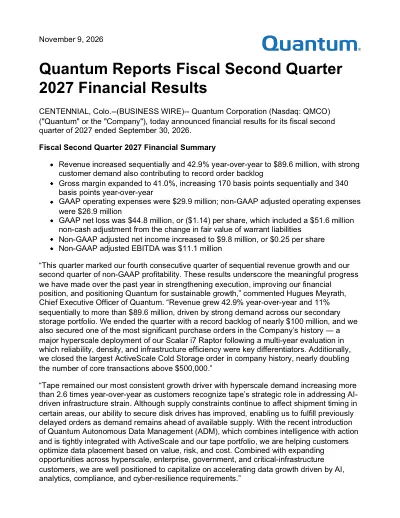
In fiscal Q2, revenue grew 43% year-over-year and 11% sequentially to more than $89 million, driven by strong demand across the business, particularly within our secondary storage portfolio. We achieved record core invoicing and ended the quarter with a record backlog of nearly $100 million.
Importantly, this growth was not concentrated in a single geography or customer segment. Revenue increased year-over-year across all regions, driven by secondary storage solutions.
Tape remained the most consistent growth driver across the business, complemented by exceptional demand from hyperscale customers, which increased more than 2.6 times year-over-year. Our strategy to evolve our distribution model in Asia is also working well.
For example, our partner in China grew from zero to well over $30 million in one year. We also saw continued momentum in ActiveScale Cold Storage, which uniquely combines object storage and tape within a single data lifecycle strategy to continuously optimize cost, efficiency, and accessibility.
During the quarter, we secured the largest ActiveScale order in company history and closed multiple seven-figure ActiveScale Cold Storage opportunities across a broad range of customer use cases. Another highlight was a major hyperscale deployment representing one of the most significant purchase orders in Quantum's history.
The customer selected Quantum's Scalar i7 Raptor following an evaluation process that spanned more than three years, with reliability, density, and infrastructure efficiency serving as key differentiators. This win reinforces our ability to support some of the world's largest and most demanding data environments.
We expect i7 Raptor production to ramp significantly in the coming quarters as it becomes a preferred choice for high-density, high-performance cold storage environments. Hyperscalers are becoming more aggressive in their use of tape.
We're now seeing multi-quarter demand planning from four customers, and we expect to add more accounts in the coming quarters. Tape's becoming increasingly strategic to their long-term growth as AI continues to place strain on infrastructure.
We're also encouraged that Fujifilm is recognizing the long-term opportunity. Fujifilm has announced plans to quintuple production in the coming years, further validating our view that tape is entering a sustained growth cycle.
We continue to see a shift towards larger, more strategic opportunities across the broad range of customer environments. We achieved record bookings in North America.
Compared with prior-year period, we closed nearly twice as many core transactions above $500,000, including 50% growth in deals exceeding $1 million. We're also seeing the benefits of the work we've done with our channel ecosystem.
Our core channel business grew approximately 30% year-over-year globally, reflecting continued strength in the enterprise business. Supply constraints continue to affect shipment timing.
However, our ability to secure hard disk drives improved during the quarter, allowing us to fulfill previously delayed hard disk drive orders. Demand remained ahead of available supply in certain areas, particularly media and tape.
This contributed to the record backlog and gives us greater planning visibility moving forward. We also continue to expand our success cross-selling additional Quantum technologies into accounts that had previously deployed only a single product line.
This is our strategy in action: establish a foundation around a critical customer requirement, then expand our footprint as needs evolve. More broadly, these wins demonstrate our ability to secure new accounts, deepen existing relationships, and increase our share of customer spending over time.
Across hyperscale, critical infrastructure, government, and enterprise environments, we're seeing more opportunities to bring the broader Quantum portfolio into strategic customer accounts. As organizations face accelerating data growth driven by AI, analytics, compliance, and cyber resilience requirements, they are under increasing pressure to control infrastructure costs while retaining more data for longer periods.
We believe this creates a significant market opportunity for intelligent data optimization. In response, during the quarter, we announced Quantum Autonomous Data Management, or ADM, which we believe is the most advanced data analytics and management platform available from a storage company.
Unlike solutions that stop at visibility, ADM combines intelligence with action. It's tightly integrated with ActiveScale Cold Storage and our tape portfolio, enabling customers to continuously optimize data placement based on value, risk, and cost.
This helps reduce infrastructure spending while maintaining accessibility, control, and security. One year ago, our focus was on fixing the fundamentals.
We believe this quarter's results demonstrate continued traction and the benefits of that work. More importantly, we're executing better.
We're building and shipping products more efficiently, fulfilling customer demand more effectively, and winning larger, more strategic opportunities. Combined with the market trends we're seeing around data growth, AI, and infrastructure efficiency, we believe Quantum has a strong foundation and is well-positioned for continued growth.
With that, I will turn the call over to Hiral Patel, our Chief Accounting Officer, who will review our financial results in more detail.
Hiral Patel
Thank you, Hugues. Good afternoon to those joining us on the phone and webcast.
I'll provide an overview of the company's GAAP and non-GAAP financial results for our fiscal second quarter that ended on September 30th, 2026. Revenue in the quarter was $89.6 million, increasing $8.8 million or approximately 11% sequentially from $80.8 million in the prior quarter, and an increase of approximately 43% over $62.7 million in the prior-year fiscal second quarter.
Revenue exceeded the high end of guidance range of $82 million, plus or minus $2 million, primarily due to price and volume mix. GAAP gross margin reached 41% in the second quarter, up 170 basis points sequentially and 340 basis points year-over-year.
The notable improvement in gross margin reflects a combination of stronger pricing and cost execution. While we are focused on driving further margin improvement, we expect pricing volatility related to ongoing component shortages to remain a headwind going forward.
GAAP operating expenses for the second quarter were $29.9 million, compared to $26.7 million in the prior quarter, and $31.7 million in the year-ago quarter. Operating expenses on a non-GAAP basis for the second quarter were $26.9 million, which was at the lower end of our guidance range of $27 million, plus or minus $1 million.
This compared to a non-GAAP operating expenses of $25.1 million in the prior quarter and to $24.8 million in the second quarter of fiscal year 2026. The sequential increase in non-GAAP opex primarily reflected a combination of incremental investment in R&D and higher sales commission associated with revenue growth in the quarter.
Operating income was $6.8 million on a GAAP basis and $9.9 million on a non-GAAP basis. This compared to a non-GAAP operating income of $6.6 million in the fiscal first quarter and a non-GAAP operating loss of $0.6 million in the prior-year quarter.
We generated approximately $14 million of operating cash flow in the quarter, compared to approximately $0.9 million in Q1, marking our second consecutive quarter of positive operating cash flow. The improvement reflects stronger operating performance, and operating cash flow also benefited from normal working capital timing during the quarter, including accounts payable.
GAAP net loss in the fiscal second quarter was $44.8 million, or a loss of $1.14 per share, which included a negative $51.5 million impact associated with change in fair value of warrant liabilities. This compares to a net loss of $155.3 million, or loss of $7.06 per share, in the previous quarter, which included multiple one-time items related to the extinguishment of company's debt and convertible notes totaling approximately $158 million, and a net loss of $46.5 million, or a loss of $3.49 per share, in the prior-year second quarter.
Excluding the change in fair value of warrant liabilities, as well as stock-based compensation, non-GAAP for the fiscal second quarter was $9.8 million, or income of $0.25 per share. This compares to net income of $4 million, or income of $0.18 per share, in the prior quarter, and a net loss of $7.1 million, or loss of $0.54 per share, in the prior fiscal second quarter.
The achievement of non-GAAP adjusted net income for the second quarter reflected the company's higher revenue as well as expanded gross margin. Adjusted EBITDA for the second quarter was a positive $11.1 million, which was $4.1 million above the high end of our guidance range.
This compares to a positive $8 million in the fiscal first quarter and a positive $0.5 million in the prior-year quarter. The year-over-year improvement in adjusted EBITDA of approximately $10.6 million came on $26.9 million of incremental revenue, reflecting the benefit of our previous restructuring and ongoing cost discipline.
Turning to debt and liquidity, cash and cash equivalents and restricted cash at the end of fiscal second quarter were approximately $67.5 million, up from $54.6 million at the end of fiscal first quarter 2027. Following the repayment of all outstanding debt in the fiscal first quarter, the company remains debt-free and we've incurred no interest expense during the fiscal second quarter.
Turning to the company's outlook for fiscal third quarter of 2027, as conveyed on today's call, we continue to see a strong demand from our customers. Coupled with our substantial backlog and continued strong bookings, we expect near-term revenue upside to be a function of our ability to secure components in a supply-constrained environment and ship incremental orders.
As such, we expect fiscal third quarter revenue to be approximately $91 million, plus or minus $2 million. At the midpoint, this represents approximately 22% growth year-over-year.
We expect third quarter non-GAAP operating expenses to be approximately $28 million, plus or minus $1 million, with the sequential increase reflecting sales commission on stronger performance and an increase in the pace of R&D hiring. As a result, non-GAAP net income per share for the third quarter is anticipated to be $0.20, plus or minus $0.10 per share, based on an estimated 39.5 million weighted average basic shares outstanding.
Adjusted EBITDA for the third quarter is expected to be $9.1 million, plus or minus $1 million. With that, I'll turn the call over to the operator for questions.
Operator
Thank you. We will now be conducting a question-and-answer session.
If you would like to ask a question, please press star one on your telephone keypad. A confirmation tone will indicate your line is in the question queue.
You may press star two if you would like to remove your question from the queue. For participants using speaker equipment, it may be necessary to pick up your handset before pressing the star keys.
Our first question will come from Brett Knoblauch with Cantor Fitzgerald.
Hey, thanks for taking our question. This is Ben on for Brett.
I guess I'm curious, any update as to revenue split by end market and how that has changed and how you expect it to change?
Hugues Meyrath
Basically if you were to go look at enterprise, hyperscaler, and mid-market, I would say the mid-market is slightly up to flat in revenue. It's getting a little harder to sell tape drives at those prices in the SMB space or the mid-market space.
Enterprise continues to be super robust, and hyperscalers going forward should see an increased share. It's not increased share in the past quarter, but going forward, we expect hyperscalers to come back and be a stronger part of the revenue.
Very helpful. Thank you.
Operator
Again, that is star one if you would like to ask a question. We'll go next to Jacob Stephan with Lake Street Capital Markets.
Jacob Stephan
Hey, guys. Congrats on a nice quarter here.
Maybe, Hugues, if you could just kind of touch on some of the supply constraints again. I know you said Fujifilm was quintupling capacity over the next several years.
Wondering how that relates to kind of IBM and how you see the kind of back half of your fiscal year playing out as it relates to supply?
Hugues Meyrath
Sure. I would say in the past quarter we've seen some relief on disk drives, which have helped us.
That was kind of a good sign. I'm not sure it's a forever sign of the market's getting better, but we had an easier time getting disk drives, albeit at a higher price.
With regards to tape drive, we expect production to continue to ramp year-over-year, but we just don't know how quickly IBM is going to ramp tape drives. That's the big unknown, right?
Their statement of direction is on a year-over-year basis they'll double, but they really can't tell us what happens in calendar Q4, calendar Q1 exactly either. That's a bit of an unknown.
We do expect to continue the trend up. With regards to media, we're seeing the two media vendors, Sony and Fuji.
We expect Sony to be flattish next year because they literally need investments to scale up. Fujifilm is making those investments, as they have mentioned, they're putting quite a bit of investments out there to quintuple capacity.
We think that that's going to bear its fruits sometime in the next year or so. It's good for the industry.
Jacob Stephan
Got it. Very helpful.
Maybe if you could just touch on the ActiveScale traction. It seems like the pipeline's expanding nicely here, but curious if you could kind of give us any more insight to how you see that product line ramping.
Hugues Meyrath
It's been consistent progress. It's ActiveScale Cold Storage, it's a combination of flash, disk, tape, kind of a solution that works out really, really well for enterprise customers.
I think it has potential for MSPs, it has potential for neoscalers in the future just because of the feature functionality it has and the ability to optimize the way infrastructure can operate with good SLAs at low power and low cost. Right now we are seeing ActiveScale really continue to shine really in the enterprise, but I think it can potentially move up in some of the MSPs and some of the neoscalers in the next year or so.
Jacob Stephan
Got it. Maybe just last one for me.
We've seen continued margin expansion over the last several quarters. I guess from your perspective, how do you feel like margins are trending?
Where do you think we can get to within the next 18 months or so?
Hugues Meyrath
In the next 18 months the goal is 43%. I think the problems are short-term, like short-term pipeline and cost and which deals we have.
There's just a lot of margin variability depending on what product line it is or whether it's enterprise or hyperscalers. There's a little bit of uncertainty still, I think in the market.
Going forward, the goal's always been to get back to closer to 43% as soon as possible.
Jacob Stephan
Very helpful. I appreciate it, Hugues.
Hugues Meyrath
Thank you.
Operator
A final reminder, if you'd like to ask a question, please press star one. We'll pause for just a moment.
This concludes our question-and-answer session and will conclude today's teleconference. We thank you for your participation.
You may disconnect at this time and have a wonderful day.