Quantum Computing Inc.
Q3 FY2026 · Earnings Call TranscriptNovember 9, 2026
Operator
Good day, ladies and gentlemen, and welcome to the Quantum Computing Inc. Third Quarter 2026 Shareholder Conference Call.
At this time, all participants are on a listen-only mode. Following today's prepared remarks, the line will be open for questions.
It is now my pleasure to introduce you to your host, David Moskowitz, Head of Investor Relations at QCI. David, please go ahead.
David Moskowitz
Thank you, operator, and welcome to QCI's Third Quarter 2026 Financial Results and Business Update Conference Call. Before we begin, please note that today's remarks include forward-looking statements, including statements about our expected results, plans, strategy, and market opportunities.
These statements are based on current expectations and involve risks and uncertainties that could cause actual results to differ materially. These risks are described in today's press release and in our SEC filings, including our most recent Forms 10-K and 10-Q.
These statements speak only as of today, and we undertake no obligation to update them, except as required by law. On the call today, we have Dr.
Yuping Huang, QCI's Chairman and Chief Executive Officer, and Chris Roberts, our CFO. The team will provide an update on the business, followed by a question-and-answer session.
I'll now turn the call over to Yuping. Please go ahead.
Yuping Huang
Thank you, David. Good afternoon, everyone, and thank you for joining us.
Looking at our third quarter and the year so far, I believe QCI is entering an important new stage. We have spent years building photonic-based quantum technology designed for the real world.
Now we are beginning to see our investments come together, and our attention is shifting from what we can build to what we can put to work for customers. That means getting our technologies into customers' hands, delivering on our commitments, and building a business that can grow sustainably.
Execution matters more than ever. Our third quarter results reflect progress in that direction.
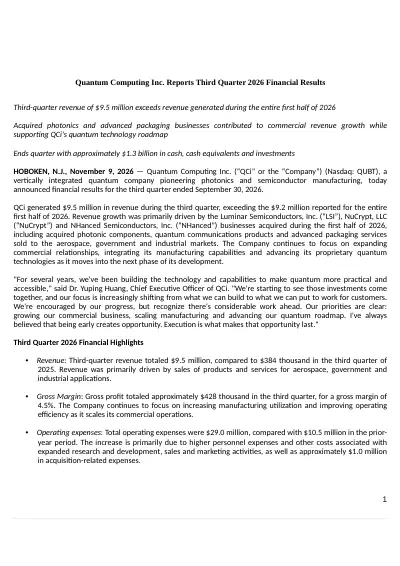
In Q3, we generated a record revenue of $9.5 million, led primarily by our expanded photonics business, which serves customers across a range of established markets. The acquisitions completed this year added established products and customer relationships, as well as manufacturing capabilities essential to our quantum roadmap.
That gives us commercial opportunities to grow revenue today, while supporting the technologies we are developing for the future. During the quarter, we provided cloud access to our Dirac-3 system to Hamad Bin Khalifa University in Qatar, supporting the research, education, and adoption of quantum computing and networking.
That builds on early progress, including the installation of a Dirac-3 optimization system at a leading global consulting firm and an agreement with Planck Dynamics for our neuron-wave reservoir computer in defense applications. More recently, we announced our next-generation Dirac-3S quantum optimization machine, which is designed to solve optimization problems with up to 9,980 variables, an important step in our quantum computing roadmap.
We expect the first customer shipment during the fourth quarter. As part of the announcement, we published benchmarking results involving problems with up to 9,980 variables, comparing the system's performance with leading classical optimization solvers.
We are encouraged by these results and what they tell us about the progress in developing increasingly capable quantum systems. There is still work to do as we evaluate performance across different applications, but advances like these bring us closer to solving larger, more complex problems for customers.
These are encouraging developments, for sure, but what matters most is what customers can ultimately do with our quantum technology. Our recently announced collaboration with ImmunoBio is a good example.
Our collaboration with ImmunoBio is exploring how Dirac optimization, AI, and conventional analytics could potentially identify new insights for clinical research data. It is early work, but it reflects what matters most to me: that the true measure of innovation is not just what a technology can do, but what it enables others to achieve.
That's exactly the thinking behind the broader platform we are building. Our quantum photonics platform extends beyond computing into sensing and communications as well.
Some applications are commercial today, while others need further development and validation. Our manufacturing capabilities connect these opportunities.
By combining photonics design, chip manufacturing, and advanced packaging at our North Carolina facility and our thin-film lithium niobate facility in Arizona, we gain greater control over development and production. This infrastructure serves two important purposes: supporting our proprietary quantum systems, and serving established photonics markets.
The task now is to integrate it effectively and deliver for customers. With that in mind, we are focused on three priorities over the next 12 to 24 months.
The first is growing our commercial business. We have an opportunity to build on the established businesses and the customer relationships we have added, while expanding the market for our quantum and advanced photonic systems.
Our photonics and advanced packaged businesses provide a commercial foundation we can grow today, while supporting the development of our quantum technologies. As those technologies mature, we see opportunities to introduce them to a broader range of customers.
Our goal is to turn growing interest in QCI into orders, a stronger backlog, deployments, and lasting customer relationships. Second is to scale manufacturing.
We are bringing operations together, expanding capacity, and improving efficiency. Reliable, repeatable production matters as our quantum technologies mature.
Our third priority is advancing our quantum portfolio. We have achieved all the objectives outlined in our 2024 to 2026 portfolio roadmap, we are moving into the new phase to scale our manufacturing and product lines.
Our goal is to make quantum systems smaller, more capable, and easier to deploy. A major part of that work involves integrating more of our technology onto photonic chips, which brings us closer to the compact, practical systems we envision for the future.
These three priorities are closely connected. Our quantum roadmap guides the technologies we develop.
Our manufacturing capabilities help us bring those technologies into production. Our commercial efforts help us understand where customers see value and where we should focus our resources.
It is how we move from building the technology to building a sustainable business around it. That brings me back to something fundamental about QCI and why we have chosen photonics as our approach.
I have believed for many years that light offers one of the most promising paths to making quantum technology practical and accessible. There are several approaches to quantum computing, as we all know, each with its own strengths and challenges.
We choose photonics because we believe it offers important advantages in bringing quantum technology into broad, real-world use. Our Dirac systems, for example, operate at room temperature with relatively low power requirements and without the specialized cryogenic infrastructure required by many other approaches.
That can make a meaningful difference in terms of cost and complexity. Photonics also allows us to build on decades of advances in optical technology and semiconductor manufacturing.
With the capabilities we have assembled at QCI, we are bringing more of that process under our own control. This is still considerable work ahead, but I believe this approach gives us a strong foundation for the future.
My ambition has always been to make quantum technology useful and accessible on a much broader scale, and I believe light offers a practical, near-term path toward that goal. We are taking the journey one step at a time, and I am encouraged by the progress we have made, with our solid Q3 results as evidence.
With that, I will turn the call over to Chris to review our third quarter financial results and how we are managing our resources to support the work ahead. Chris?
Christopher Roberts
Thank you, Yuping, and good afternoon, everyone. I'll now review our third quarter financial performance, our balance sheet, and how we're approaching capital allocation as we move into the next phase of QCI's development.
Starting with revenue, we generated $9.5 million in the third quarter, up from $384,000 in the same period last year. To put that growth in perspective, our third quarter revenue exceeded the $9.2 million of revenue generated during the entire first half of 2026.
Revenue was primarily driven by sales of photonic products serving aerospace, government, and industrial applications. The businesses we acquired earlier this year have expanded our commercial foundation and are contributing to our financial performance, while also supporting our longer-term quantum technology roadmap.
We generated $428,000 in gross profit during the quarter, for a gross margin of 4.5%. While margins remain modest, we're encouraged by the progress.
As revenue grows, we see opportunities to improve manufacturing utilization, increase operating efficiency, and expand margins over time. Turning now to expenses, our operating expenses totaled $29 million during the quarter, compared with $10.5 million in the same period last year.
The increase is largely due to higher personnel and related costs associated with our expanded R&D, sales, and marketing activity, as well as approximately $1 million in acquisition-related expenses. Interest and other income totaled $13 million during the third quarter, compared with $3.5 million a year ago, primarily reflecting interest earned on our larger cash and investment balances.
For the third quarter, we reported a net loss of $15.1 million, or 7 cents per basic share, compared with net income of $2.4 million, or 1 cent per basic share, in the prior year period. The change from net income to net loss is largely due to higher operating expenses as we've expanded the business and smaller mark-to-market gains on a warrant derivative, partially offset by increased revenue and interest income.
Turning now to the balance sheet, we ended the third quarter with approximately $1.3 billion in cash, cash equivalents, and investments, consistent with our position at the end of Q2. Total assets were approximately $1.6 billion at quarter-end, while total liabilities were $47.7 million.
We also ended the quarter with approximately $39.1 million in contract backlog, providing a foundation of business contracts as we expand customer relationships and convert opportunities into revenue. As of September 30, 2026, we had approximately $174.3 million in cash and cash equivalents, approximately $1.1 billion in investments, and approximately $916.9 million in working capital.
As a result, we believe our liquidity is sufficient to fund our operations for at least the next 12 months, giving us flexibility to support both our current operations and our longer-term technology development plans. At the same time, we're mindful of financial discipline as we move from building our capabilities to scaling the business.
The acquisitions completed earlier this year were designed to strengthen our technology and manufacturing foundation while adding established commercial operations. Our focus now is on integrating those businesses effectively, investing where we see opportunities for growth, and improving operating efficiency over time.
We will continue to evaluate opportunities, including potential acquisitions that can advance our strategy, but any future investment must support our priorities and make sound financial sense. We believe we have the resources and capabilities to execute on our plans, and the responsibility to deploy our capital thoughtfully to drive sustainable growth and long-term shareholder value.
With that, I'll turn the call back to Yuping.
Yuping Huang
Thank you, Chris. Before we go to questions, I wanted to return to an important point: how we are moving from building our capabilities to putting them to work in the real world.
I believe quantum technologies offer tremendous potential, but it is a young industry, and adoption will develop differently across markets and applications. Some customers need photonic technologies today, while others are exploring what quantum systems can enable as they become more capable and practical.
We need to understand these differences and be thoughtful about where we invest. As Chris outlined, our financial position gives us considerable flexibility, particularly in an industry where technology takes time to mature.
Having the resources to invest does not change our responsibility to use them wisely. We need to focus on where our technology can have the greatest impact, where customers see value, and where we can build a business that performs over time.
I'm proud of what our team has accomplished. We have brought together a remarkable group of people and capabilities, and I believe we are in a much stronger position today than we were just one year ago.
There's plenty of work ahead. I've always believed that being early creates opportunity, but execution is what makes the opportunity last.
For us, that means advancing the science while building products customers can depend on. It means growing commercial relationships, improving manufacturing, and following through on our roadmap.
It means being ambitious about what we can achieve, while remaining realistic about what it takes to get there. I believe we are moving in the right direction.
We are starting to see the results of our investments, and we have clear understanding of what QCI can create value. Thank you for your continued interest.
We are ready to take questions.
Operator
Certainly. The floor is now open for questions.
If you wish to join the queue to ask a question at this time, please press star, one. We do ask, if listening on a speakerphone, that you please pick up your handset while asking your question to provide optimal sound quality.
Once again, please press star, one on your phone at this time to join the queue to ask a question. Please hold for just a few moments while we poll for questions.
Your first question is coming from John McPeake with Rosenblatt. Please pose your question, your line is live.
John McPeake
Thank you. Thanks Yuping, Chris, and Dave.
Good work getting the company scaled here, you have some real revenues now. I have a few.
The first one on the Dirac-3S, congrats on the first customer shipment in 4Q. Can you comment at all or elaborate more on what the reception of the product has been like, any initial feedback from potential users here with the 10x variable count?
Yuping Huang
We received some very positive feedback, not only in the largely expanded capacity of the variables that the machine can support, but also in the quality of the solutions. In fact, John, as you probably have seen that our published result, and we actually got very good result, benchmarking result comparing with best-in-class solvers using the classical methods.
Our online customers have also started to see the performance that actually some feel pleasantly surprised. I'm very pleased with that.
Of course, our development will not stop here. Immediately after we release our Dirac-3S, actually, the team has started to further improve it.
Our goal is always that so we wanted to develop the quantum value to give our customers the high return on investment. I'm very happy with the first steps we have taken, and look forward to reporting our continued progress.
John McPeake
Great. I have one for Chris, if I could just have a quick follow-up.
The backlog was down just slightly from the June quarter. Any view as to how that might develop, and related there's the flip in the midterm states.
Do you think that might change the outlook for the pipeline at all and affect your backlog going forward, or how should I think about that, guys?
Christopher Roberts
That's a really good question. There's a lot to pack in there.
Let me take him one piece at a time. In our business, revenue and contract awards tend to be lumpy, I don't think there's much you can read in to the fact that our backlog was down, what, $2 million from where we were, $3 million from where we were at the end of last quarter.
I'm confident that we will, over the next few months, as we continue to bring in additional work, the backlog is going to fluctuate. Backlog is essentially the difference between contracted orders and revenue.
I think it's a good sign that backlog continues to be high, but we certainly generated a lot of revenue out of the backlog that we had at the end of last quarter. In terms of the impact of the political environment, it's a little early to really know where the new majority wants to go.
I don't think they've figured that out themselves. One thing that seems to be a consensus target is AI and particularly data centers, and I think that actually presents an opportunity for QCI because we've done some analysis on our own looking at the application of the Dirac optimization to improving the efficiency and the utilization of compute resources in data centers, and we think we can provide some advantages and some improvements.
If that bears out, then we may have a real market on the existing data centers, because we can provide more compute resource without building new data centers. Again, we'll have to see, but initial research internally has been rather encouraging.
I think this will present some opportunities, may also present some challenges. It's too early to make any predictions, and I'll leave the predictions to Kalshi.
John McPeake
All right. Thanks, team.
Yuping Huang
Thank you, John.
Operator
Your next question is coming from Max Michaelis with Lake Street Capital Markets. Please pose your question, your line is live.
Max Michaelis
Hey, guys. Thanks for taking my questions, and congrats on the solid quarter.
A question for me, kind of on your priorities going forward around commercial growth and manufacturing scale. What kind of milestones should we be looking for on the commercial growth side maybe over the next 12, 24 months?
Then I guess what are some of the bigger hurdles on the manufacturing scale side of the priority list here that we should be paying attention to?
Yuping Huang
Thanks, Max. I will take a first cut, and Chris will chime in later.
Over the next 12, 18 months, our priorities, as what I outlined in the call, right? We will continue to grow our business opportunities and revenue, continue to expand our manufacturing, right?
Also, we will continue to push our tech. As I said last time in the earnings call, QCI is really transitioning from a tech innovation company to a scalable manufacturing company.
It is very interesting, and it is the pathway that we have to take for us to grow big. The entire team is undertaken this challenge, and also there's a lot of opportunities there.
The acquisitions that we have made so far in this year, have been going very well for us, and the integration progress has been very well, we are actually developing a high synergy on a very deep engineering level as of now. I'm very confident on delivering on those priorities over the next 12 to 18 months.
Chris, do you have anything to add?
Christopher Roberts
Sure. Max, appreciate the question, and to pick up on what Yuping was saying, as we transition from the technology innovation phase to commercialization, we're going to see some lumpiness.
We're not giving guidance at this time because timing of orders and deliveries it's just difficult to predict. Quarter-over-quarter, we're likely to see some lumpiness, some bumpiness.
Over, say, 12, 15 months, we are confident that we'll have a strong finish to this year and we will have a solid backlog leading into '27. I think that in terms of maybe not milestones, but signs of progress, growing our backlog and bringing in additional orders from a broader range of customers is something that you should be looking for.
That would be signs that the market is validating our technology, and that we're on the right track.
Max Michaelis
All right, perfect. That was it.
Thanks for taking my questions, guys.
Yuping Huang
Thanks, Max.
Operator
Your next question is coming from Scott Buck with Titan Partners. Please pose your question, your line is live.
Scott Buck
Hi, good afternoon, guys. Appreciate the time.
Chris, I just want to follow up on backlog. How much of that converts over the next 12 months, and how does it split between kind of government, aerospace, and commercial?
Christopher Roberts
Okay. It's a good question, Scott.
The backlog typically will burn off over, I don't know, between 12 to 18 months. Most of that will be used up or is likely to be converted to revenue in the next 12 months, but there's a bunch that will take longer to materialize and deliver.
That is just the nature of the business when you're building small numbers of technologically very complex products, and it's hard to know whether it's going to be ready this week or a couple weeks from now. That can change when you recognize the revenue.
Sorry, I forgot the second part of your question.
Scott Buck
Oh, the split there between government, aerospace, and commercial?
Christopher Roberts
Oh, yes. Yes, yes, yes.
We're still largely aerospace and government, probably 70-ish percent, and most of that subcontracts. Over time, we're expecting that to balance out and be closer to 50/50.
In the near term, the market is government R&D-ish. Over time, we expect to see as the technologies mature and the market develops more confidence in the return on investment that you'll see more commercial sales.
Right now, we think that the mix is going to be predominantly government, and that's just consistent with every other company in the quantum sector.
Scott Buck
Great, that's helpful. Then I want to ask, the release refers to bringing manufacturing operations together.
Does that mean consolidating sites, or just kind of moving work between fabs? Uh...
Christopher Roberts
I think that has more to do with the integration of the company, although I defer to Yuping on exactly how to rephrase that. We have operations, as in eight states, 11 facilities, we are a bit spread out, and we're working on the integration of our accounting and manufacturing backbones so that we can move people, technology, subsystems smoothly between facilities.
For example, we do a lot of the chip fabrication and design work in Tempe, but we do a lot of the advanced testing in Hoboken. That's the way we're integrating the teams.
We invest in having people travel to other sites to make sure that with all the new people that have come into the company over the last year, that there's good working relationships between the teams. I think that's really what we're referring to.
We're not looking to consolidate the facilities. We're really trying to make sure that the team we have thinks and acts with a broad envelope that goes coast to coast and includes all of the sites and all the resources.
The best way to get people to understand what resources are available within the organization is to have people move around and coordinate and get to know each other.
Yuping Huang
Yes, Scott. Just as Chris said, there's no need, and no plan for consolidation.
In fact, from the beginning, we have very strategically acquired the sites so that each would fill in a gap that we need for our scalable manufacturing, and each site actually brings pretty complementary activities and capabilities to our quantum roadmap. Instead of consolidating, just as Chris said, what we are doing now is to build a very strong synergy from bottom to top, right, at all levels.
For example, one project that our team has been working on is that we fabricate some parts in our Santa Barbara site, and some parts in our Boston site, and so then we bring them to our Princeton site, and then the Princeton site is actually working with our North Carolina site. It is such the teamwork, it is such the synergy that we are building up very quickly.
Scott Buck
I appreciate the color, guys. That's very helpful.
If I can squeeze one last quick one in. Absent additional M&A, the current level of OpEx, is that a fair run rate moving forward, Chris, or are there some material OpEx increases expected into 2027?
Christopher Roberts
I think it's a reasonable number. We're continuing to hire.
I think at the end of the second quarter, we had a little over 300, 310, 320 people. We're 330-plus right now.
We're continuing to hire, but that OpEx level is a pretty good estimate of where we are right now. There's about $1 million of trailing M&A-type costs that are in there, but if you take that out, that number is about where we are in terms of burn rate.
The main driver is payroll, and followed by supplies, parts, laboratory stuff, and then facilities rent. As we increase our headcount, we can expect that to be some increase in the OpEx run rate, but not dramatic.
I think the third quarter numbers probably a pretty good predictor of the next quarter.
Scott Buck
Perfect. Sounds like a more natural increase than any kind of step function coming, so that's great.
I appreciate the time, guys. This has been very helpful.
Thank you.
Yuping Huang
Thank you, Scott.
Operator
Once again, if you do have any questions or comments, please press star, one on your phone now. Your next question is coming from Nehal Chokshi with Northland Capital Markets.
Please pose your question, your line is live.
Nehal Chokshi
Great. Thank you.
Fantastic to see the Dirac-3S be released. Could you compare that to other analog-based quantum computing systems out there from a performance perspective basically?
Yuping Huang
We compare that with the best solvers that we can possibly find as offered by the industry, by the market. As most other quantum platforms, they don't provide comparable or close to comparable performance than the best classical solvers.
We have focused only on comparing with the best solvers, and which is currently made by the non-quantum methods. My short answer to you is no, because we compare with the best.
Nehal Chokshi
Understood. I'm sorry, what is the classical solver that you compared to?
What's the best classical solver out there then that you compared to?
Yuping Huang
Chris, do you think that we can provide the name?
Christopher Roberts
I think we can. It's a commercial product and we can certainly say we tested it.
Yuping Huang
I'm sorry, I could not hear you.
Christopher Roberts
Yes. Sorry.
We can certainly disclose what we're benchmarking against.
Yuping Huang
Sure. Sure.
Yes, and we compared with Axeler, and which is a very well-known specialized optimization software company. In the meanwhile, for the specific benchmark problems that we have tested, we ducked into the literature results and we compared with those best algorithms that our team could find in the literature.
Nehal Chokshi
How did it actually compare to Axeler in terms of actual performance and how the benchmark is done in terms of performance?
Yuping Huang
As we reported in our paper that actually we posted online, the overall performance, we are better. There, of course, some problems that our machines are either comparable or less optimum in terms of getting the solutions, but for most problems, we do see a clear advantage of our machine in terms of both the time to solution and the quality of solution.
Nehal Chokshi
Got it, that's really helpful. Then, given this differentiation even relative to a classical solver, could you give some details around the pipeline that you're seeing for the Dirac-3S, either as a cloud computing instance or as the on-premise orders?
Yuping Huang
Yep. We will support both, and as reported in the call earlier, we are shipping out our first Dirac-3S to a customer.
In the meanwhile, we also have partners across the country, and so we are looking at opportunities of upgrading their existing system with this Dirac-3S. In the meanwhile, we continue to provide cloud access so that people can access our Dirac-3 from anywhere they like.
It looks like customers are pretty happy with the performance, and because it is indeed a much powerful machine, and with performance that often times we can see better than the classical solvers. I don't want to make a broad claim that we now have achieved the quantum supremacy, and it is not a good word anyway, but I think as of now with Dirac-3S, there is certainly a quantum advantages that customers can access today.
Nehal Chokshi
Can you compare perhaps maybe this pipeline relative to the prior generation of the Dirac?
Yuping Huang
Dirac-3S has just been released, right? We are still in the process of finding out how big the pipeline can grow.
I think a lot of customers that use Dirac-3 would be very happy to switch to Dirac-3S. Because of the much higher capacity and much higher performance in the quality of solutions, we should be expecting some significant growth in the pipeline and turn those into revenue in the future.
Nehal Chokshi
Okay. To be clear, sounds like the majority of the pipeline is coming from Dirac-3 customers, existing Dirac-3 customers.
Yuping Huang
As I said, that I think it's natural for the Dirac-3 customers to switch to Dirac-3S. Because of the much higher performance and much larger capacities, we should be able to attract more and more customers and probably in other application areas that we had not seen in Dirac-3.
Nehal Chokshi
All right. Thank you for that clarification.
Yuping Huang
Thank you.
Operator
Your next question is coming from Kieran McCabe with Cantor. Please pose your question, your line is live.
Kieran McCabe
Great, thank you for taking my question. It's Kieran McCabe on for Troy Jensen.
My first question is on the ImmunoBio announcement. You mentioned that it was the first customer in the pharma and biotech industry, and I noticed last quarter you had announced a new Chief Revenue Officer, Susan Hunt.
I was just kind of wondering sort of the strategy going forward. Are you looking at other industries outside of your traditional aerospace and defense areas, like biotech and pharma, to expand into?
Then when you kind of get into areas like biotech and pharma, are you looking to get deeper within organizations, or kind of spread within those vertical markets? I have a follow-up.
Yuping Huang
Yes, definitely. In the past, before working with ImmunoBio, we have already found the applications in the areas of drug discovery and patient scheduling.
Now with ImmunoBio, we actually realized that our Dirac-3 or Dirac-3S can also significantly contribute to clinical trial studies. As drug discovery itself is complex, and the trial studies are even more so.
There's a lot of data linked to biomarkers, for example, and they are Phase 1, Phase 2, Phase 3 studies. I'm excited, and also curious to see what Dirac-3S can contribute to the biotech sector from the clinical trial study angle.
Great,
Kieran McCabe
thank you. My follow-up is on the enhanced semiconductor acquisition.
I believe the rationale for that was really to accelerate the timeline for Fab 2. Providing more details on sort of the integration of enhanced and sort of the acceleration of that timeline, how's that proceeding?
Any kind of color you can provide on that?
Yuping Huang
Yes, and that's a very good question. If you recall last year when we first published our roadmap, right, our initial plan for Fab 2 was to use a greenfield approach, and in that approach, actually, we expected to complete our Fab 2 maybe at the end of 2028.
Now with Enhance, we have accelerated that roadmap quite a lot, and Enhance really launched our Fab 2. We will not stop here, and so what we are going to do is to build upon Enhance the very unique and leading-edge capabilities in advanced packaging and expand that to increase the manufacturing capacity, while turning some of those capabilities into direct support of our quantum products.
To that end, our internal PIC engineering team has worked with the Enhance manufacturing team very closely, and on developing heterogeneously integrated photonic circuits for our quantum technology. We have been making very fast, very fast progress on that front.
Kieran McCabe
Great, thank you so much for the color.
Yuping Huang
Thank you.
Operator
Your next question is coming from Ed Woo with Ascendiant Capital. Please pose your question, your line is live.
Edward Woo
Congratulations on the quarter. My question is on the pipeline.
How much of that is US business versus international, and what do you think the long-term revenue potential, pipeline potential could be for your business? Thank you.
Christopher Roberts
Hi, Ed. Thank you for the question.
At the present time, bulk of our sales are domestic. We're certainly looking at international opportunities.
We have made a few small sales overseas. We're continuing to market there, but the bulk of the backlog and our revenue is still really domestic.
In terms of if you're asking how big is the potential market, I not sure that was quite your question. I would have to refer you to a number of really well-written market studies by some of the big consulting firms.
We're really not in the business of doing market studies of that sort.
Edward Woo
What I meant was, right now it's mainly domestic, but going forward do you see yourself maybe a 50/50 type business, or do you see yourself focused on domestic for the next several years?
Christopher Roberts
We're certainly trying to generate sales around the world. As a practical matter, it's easier to sell domestically than it is overseas.
With the geopolitical climate and the fact that our technology is very advanced and arguably cutting-edge, there's a possibility that there could be export restrictions later on, ITAR and other things that could complicate the process of doing international sales. I want to stay away from making precise predictions of where our revenue could come from in the future when I don't know what the rules are going to be.
50/50 sounds aggressive, certainly in the near term, but we're certainly looking to expand our international footprint as much as possible to the extent we're able to support the customers that we sell to.
Edward Woo
Great, that's a great answer to my question, and I wish you guys good luck. Thank you.
Christopher Roberts
Thanks, Ed. Good to hear from you.
Operator
Your next question is coming from Jesse Sobelson with BTIG. Please pose your question, your line is live.
Jesse Sobelson
Hi, everyone. Thanks for taking my questions this afternoon.
A lot's been run through, but I do think maybe on the bigger picture here, I think most of the investment world still sees the various acquisitions across LSI, Enhance, Nucrypt, alongside the core business. I think a lot of investors see them as four separate businesses.
You've discussed integrating the teams on the back end, but can you help investors understand what the first wave of maybe flagship products or first integrated system on the roadmap is and what potential timeline there is to combine these technologies and providing an update for investors there?
Yuping Huang
Thank you, Jesse. Yes, those acquired facilities, they actually serve two important purposes here.
One is, of course, to support our quantum roadmap, and this is well underway. Our team actually has been working closely together across all the sites and to make some prototypes that are only possible after we have acquired and integrated those facilities.
On that front, we do hope that we can demonstrate some heterogeneous integrated circuits in the timeframe of 12 to 18 months, and it could be shorter. We will report the progress on that front.
The second important contribution of the sites are to contribute to our near-term revenue based on those quantum-enabling circuits and services. This is important because we believe that a sizeable number of customers of our quantum technology actually in the future will come from our existing customers already using our, for example, photonic components, foundry services.
We do hope to see that we will be able to tap onto the existing pipelines, not directly in the field of quantum, but eventually we will turn at least some of those into our quantum technology and product pipeline. That is also happening.
I think the third important is that as I said earlier, we are really looking to volume production of our quantum devices. We have already spent over 20 years in the quantum technology R&D, and now it is really the time for us to solve the scalable manufacturing challenge, so that we can mass-produce quantum product and to put quantum into the hands of many, many customers and to create a broad impact in multiple application field.
Jesse, I'm not sure if I answered your question, or you...
Jesse Sobelson
It sounds like there's a lot underway to enhance the quantum computers that you offer today with the technology you've acquired. It sounds like we can expect an update over the next 12 to 18 months.
Then, maybe just to wrap up here, you mentioned on the next phase of capital allocation with over $1 billion in cash, if there's any idea if you could disclose is there a timeline for spending that or guidance on how you're going to spend that, or at least is there a timeline for explaining to investors what the plan is going to be in the near future?
Yuping Huang
Let me quickly tell you our strategy, and then I will turn the podium to Chris for some details. Our strategy has always been that we make acquisitions to accelerate our quantum roadmap, and this is a very disciplined approach that we have followed for all the acquisitions that we have made.
In the meanwhile, we understand that this is a competitive industry and we have to move really fast. We will always be optimistically looking at opportunities, but all would be needed to pass our fundamental test, which is to accelerate our quantum roadmap.
With that, Chris, please chime in.
Christopher Roberts
Yes. Jesse, you're asking a really good question, and as I've said in previous calls, we've earmarked several hundred million dollars for CapEx, and the investment we're planning to make in Fab 2, if you call it that, is in the ballpark of $70 million to $80 million.
We've already begun ordering equipment. A lot of that spend will take place between now and March 31 of next year, in the second quarter.
We are continuing to evaluate capital and equipment needs, and as Yuping said, we're constantly reviewing deal flow and acquisition opportunities, recognizing that this is a capital-intensive business. While we're very much interested in growing, we want to grow in a focused manner and make sure we have sufficient working capital to ride through any periods of time when raising capital would be highly dilutive when our stock price is down.
We're looking to protect the investors and deploy the capital wisely. We've already done three acquisitions in just the last eight months, I think we're doing a pretty good job of putting the money to work, and we're going to continue to follow this path.
Jesse Sobelson
All right. Thank you.
Yuping Huang
Thank you, Jesse.
Christopher Roberts
Thanks for your interest, Jesse.
Operator
There are no questions in queue at this time. I would now like to turn the floor back over to management for any closing remarks.
Yuping Huang
Thank you, operator, and thanks to everyone who joined us today. I appreciate your interest in QCI, and look forward to updating you again next quarter.
Thank you, and have a good day.
Operator
Thank you, everyone. This does conclude today's conference call.
You may disconnect your phone lines at this time, and have a wonderful day. Thank you for your participation.