Repligen Corporation
Q3 FY2026 · Earnings Call TranscriptOctober 27, 2026
Operator
Good morning. Welcome to Repligen's third quarter of 2026 earnings conference call.
My name is Jillian, and I will be your operator. Following management's prepared remarks, we will open the call for questions.
If you would like to ask a question, please press star one to raise your hand. To withdraw your question, press star one again.
To provide an opportunity for as many participants as possible, we ask that callers limit themselves to one question. I will now turn the call over to Jacob Johnson, Vice President of Investor Relations for Repligen.
Jacob, please go ahead.
Jacob Johnson
Thank you, operator, and good morning, everyone. Welcome to Repligen's 2026 third quarter earnings call.
Joining me today are President and Chief Executive Officer, Olivier Loeillot, and Chief Financial Officer, Jason Garland. Earlier this morning, we issued our earnings release and supplemental presentation, which are available on the Investor Relations section of our website.
Before we begin, please note that today's discussion will include forward-looking statements and certain non-GAAP financial measures. Actual results may differ materially from those expressed or implied by these statements due to risks and uncertainties described in today's earnings release and our SEC filings.
Reconciliations of non-GAAP to GAAP measures are included in today's earnings release and supplemental materials. These adjusted financial measures should not be viewed as an alternative to GAAP measures, but are intended to best reflect the performance of our ongoing operations.
With that, I'll turn the call over to Olivier.
Olivier Loeillot
Thank you, Jacob. Good morning, everyone, and welcome to our 2026 third quarter call.
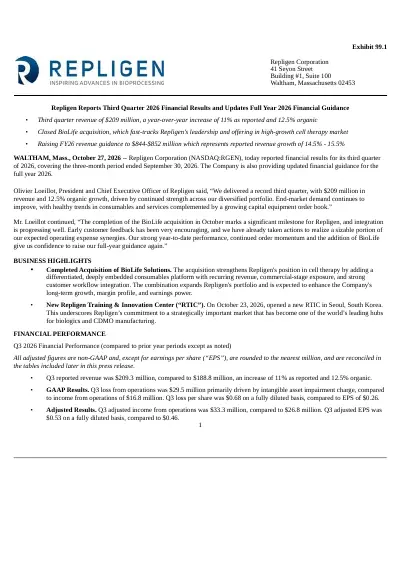
We had a record quarter with $209 million of revenue. This is a significant milestone, as we surpassed our prior peak in the second quarter of 2022.
We believe this is another proof point that the industry is poised for its next phase of growth. It also highlights the benefits of our diversified portfolio, as this was driven in part by proteins and chromatography.
In addition, we were delighted to close the acquisition of BioLife earlier this month. This combination further expands our capabilities in the rapidly growing cell therapy end market and strengthens our long-term growth platform.
We will discuss our initial observations and integration efforts in a moment. First, we delivered $209 million of revenue in the third quarter, which represented 12.5% organic growth, while expanding adjusted operating margins by 170 basis points compared to the prior year.
This was an excellent result, as we were lapping a very strong quarter in the prior year. Our ability to outpace market growth very significantly this quarter is a testament to our team's strong execution in a market that is still recovering.
Following these strong results and incorporating the BioLife acquisition, we're increasing our 2026 guidance. Jason will provide more details.
Our updated 2026 guidance includes an expected $24 million revenue contribution from BioLife for the period following deal close in our fourth quarter. This assumes BioLife annual 2026 revenue on a pro forma basis will be approximately $114 million USD, above the midpoint of BioLife's most recent guidance.
The business is performing well, and we are very confident about delivering our deal model for 2027 and beyond. With the recent acquisition and ongoing integration, we are taking a prudent approach to our initial assumptions for the remainder of 2026.
We're narrowing our organic growth outlook to 12% to 13%. At the midpoint, this represents a 50-basis-point increase, and assumes fourth quarter growth is within the full-year range.
This also means we will deliver again on our full-year commitments and outpacing markets significantly. As I reflect on our end markets, we remain encouraged by the continued improvement in the bioprocessing industry.
Importantly, our funnel and order activity continue to strengthen. This is particularly true for capital equipment.
Capital equipment orders increased mid-teens year over year, and was the highest orders quarter in five years, while revenue declined. The tap has not opened as quickly as we would have expected it this year.
However, we continue to see encouraging signs in our funnel and order book. We are building a backlog for 2027, and we'll enter next year in a better position than we did in 2026.
As a result, we remain encouraged that we're seeing a gradual improvement in capital equipment demand, with a notable pickup in orders for our systems. We are actively executing initiatives that will strengthen our equipment business and prepare us for the next phase of growth.
This includes continued investment in innovation, as well as strategic efforts designed to deepen customer engagement and support large-scale manufacturing expansion projects. One example is our integrated solution team, which is focused on addressing customer capacity expansion, such as onshoring.
Consumables demand remained outstanding, with 20% growth in the quarter. While services was even stronger, with greater than 20% growth.
Our services team continues to execute extremely well. Year-to-date, our services team has increased the number of systems under contract by nearly 40%, despite a muted capital equipment revenue environment.
In addition to the incremental service revenue, this allows us to be closer to our customers and provide further insights into their needs. Services represented 7% of our revenue in the quarter, and we expect it to become a larger mix of our business going forward.
In short, our base business remains strong, as highlighted by our 12.5% organic growth in the third quarter. Our funnel and orders suggest a continued improvement in the end market.
In addition, we continue to execute our innovation strategy to drive above-market growth. Moving to our performance by end markets, biopharma revenue drove growth, while CDMOs declined on a difficult comparison.
Year to date, we have seen similar trends for both customer bases. Biopharma growth was strong in all regions, as Europe returned to growth on a more favorable comparison, while year to date, biopharma growth has been driven by strengths in North America and Asia-Pacific.
Emerging biotech grew mid-single digits on a difficult comparison from last year. Demand trends remain healthy, as year-to-date emerging biotech revenue has increased in the high teens.
New modalities were relatively flat, but grew high-single digits excluding the impact of a certain gene therapy platform. This was led by nearly 30% growth in cell therapy.
In addition, gene therapy demand grew on an absolute basis, and north of 25% excluding that gene therapy headwind. We continue to believe new modalities will be accretive to our medium-term outlook, and we are excited to expand our capabilities with the addition of BioLife.
Moving to our strategy updates, I wanted to share some initial observation on our first few weeks of ownership of BioLife. I will leave you with the most important takeaway first.
We are even more excited about the strategic rationale of bringing our organizations together, and the value we will create for patients, customers, and shareholders. Jason and I were fortunate to spend time with our teams at BioLife sites, and I recently joined the BioLife team again in both Bothell and Indianapolis to celebrate the closing.
We walked away impressed by our shared culture of innovation and customer centricity. We are thrilled to expand our offerings for the cell therapy market.
Customer feedback has been very encouraging, and we have received a number of positive responses after the acquisition. After months of thoughtful planning, our combined teams are now focused on executing the integration plan and realizing the opportunities we identified ahead of closing.
In fact, our team are hosting an integration workshop in Waltham as we speak. We have already completed actions to deliver a sizable portion of our operating expense synergies.
This includes capturing public company and certain leadership costs, which represent more than half of our anticipated year one synergies. As it relates to costs of goods sold, our team is already hard at work, evaluating potential options to improve CryoStor scrap rate.
Finally, our commercial teams are now collaborating to achieve revenue synergies. We recently cross-trained both commercial teams.
We continue to believe our offerings will benefit from BioLife's trusted customer relationships. In addition, our Asia-Pacific team has begun to explore the opportunities to increase awareness of CryoStor in the region, particularly in China.
As we look ahead to 2027, we remain focused on outpacing market growth. Assuming the market is growing high-single digits, and with the acquisition of BioLife, we are positioned to grow our reported top line at least 25% next year, absent a material change in foreign exchange rates.
This will result in our revenue exceeding $1 billion USD, which represents another significant milestone for our company. Additionally, I wanted to spend some time on our Asia-Pacific strategy.
As Jason will discuss in more detail, we had another very strong quarter in China with greater than 40% growth. In China, we're advancing several strategic initiatives to strengthen our position in the market, including ongoing technology transfer with our OEM partner, as we work to recapture share.
Notably, China recently published its latest five-year biotech plan. The government expects the industry to grow at over 20% CAGR through 2030.
This speaks to the growing activity in this country, and we remain convinced China will be the fastest-growing biopharmaceutical market in coming years. Beyond China, there are significant growth opportunities in the broader Asia-Pacific region.
Last week, we opened a new Repligen training and innovation center in South Korea. This underscores our commitment to a strategically important market that has become one of the world's leading hubs for biologics and CDMO manufacturing.
Before I turn the call over to Jason, I'll provide some more detail on our franchise-level performance. I will note that all references to our 2026 expectations are on a reported basis.
Starting with filtration, as expected, the previously disclosed ATF headwind was most pronounced in the third quarter and resulted in an 11% decline in filtration revenues. I'll note this includes a 2-point headwind from our Polymem divestiture and foreign currency.
Though the decline was slightly greater than we expected, this was largely timing-related, with most of our systems order planned for delivery in 2027 per customers' request. We're encouraged by the hardware backlog we're building for next year.
We now expect filtration to be flat to slightly down for the year. This includes the inorganic impact from the sale of Polymem.
Turning to chromatography, revenue grew over 50%, with some help from a favorable comparison in the prior year. This was again driven by growth in OPUS columns, with continued growth from CDMO and biopharma customers.
In particular, we continue to see significant traction with large-scale columns. We now expect chromatography growth of at least 30% for the full year.
We had another great quarter in proteins, with more than 40% growth, again driven by strength across our portfolio, including positive traction in ligands, growth factors, and our custom and catalog resins. We are also pleased to share we recently extended our supply agreement with Ecolab and are excited about our continued partnership.
Our protein strategy is working marvelously, and we continue to expect mid-teen growth for the full year. Our analytics franchise had another record quarter, with 20% growth, a strong outcome given we face our most difficult prior-year comparison.
The growth was driven by a robust demand in consumables and services, while capital equipment remained healthy. Our downstream protein concentration analytics offerings were recently recognized in the USP Chapter <507> standard.
These are widely accepted quality standards used by biopharma manufacturers and regulators. This is a significant milestone that provides external validation of the technology and strengthens our credibility with biopharma customers.
From a commercial standpoint, this recognition should help us reduce barriers to adoption, support broader development of SoloVPE Plus across products and sites, and strengthen the longer-term opportunity for FlowVPX as customers adopt the technology more broadly. In addition, we have seen traction recently with our PAT-enabled systems, which further expands the FlowVPX opportunity.
As the industry continues its journey towards AI and digitization, we have engaged with several key customers who are sharing their AI-enabled process development and manufacturing strategies. This highlights the growing importance of our advanced PAT and digital twin capabilities.
Given momentum in downstream demand and a growing contribution from our upstream analytics, we now expect analytics growth of at least 30%. Before I hand the call over to Jason, I wanted to reiterate how proud we are of our Q3 results as we outpace industry growth again, and how excited we are about the growth opportunities in front of us.
This is especially true as we add BioLife's cell therapy capabilities to our portfolio. The progress we are making in delivering our strategy is increasingly reflected in our results.
This is a testament to our team's strong execution and hard work. We have several initiatives underway to drive future growth, including our integrated solution team and Asia-Pacific strategy.
Combined with our fit-for-growth investments and transformation office, these efforts are helping us build the capabilities and discipline needed to deliver profitable growth. Now, I'll turn the call over to Jason for the financial highlights.
Jason Garland
Thank you, Olivier. Good morning, everyone.
Today, we are happy to share another strong quarter results in Q3. These results from our continued execution, coupled with the strategic acquisition of BioLife, allow us to increase our guidance once again.
I look forward to sharing the details shortly. Before we discuss the quarter, let me highlight that, unless otherwise noted, all financial measures discussed reflect adjusted non-GAAP measures.
As shared in our press release, we delivered strong third quarter revenue of $209 million. This is reported year-over-year growth of 11%, or 12.5% growth on an organic basis, which excludes the impact of acquisitions, divestitures, and foreign exchange.
The previously announced sale of Polymem was slightly under a 1-point headwind to reported growth, and foreign currency was also just under a 1-point headwind, as the dollar has strengthened. For clarity, we recognized de minimis tariff refunds in the quarter.
As Olivier provided details on our product franchise performance, I'll now share more color on our regional performance. Starting with quarterly revenue mix: North America represented approximately 49% of our total, EMEA represented 34%, and Asia-Pacific and the rest of the world represented approximately 17%.
North America grew 6% driven by strength in proteins and analytics, while lapping our strongest quarter in the prior year. EMEA grew over 20% on broad-based strength and a favorable comparison.
Asia-Pacific declined slightly on a tough comparison with record sales in the third quarter of 2025. We continue to deliver on our strategic priority of Asia-Pacific growth, with third quarter orders breaking our prior record.
Asia-Pacific demand remains very healthy, with high-teens growth year to date. China demand was again robust, with greater than 40% revenue growth in the quarter and strong orders.
Year to date, China sales have grown greater than 50%. Transitioning to profit and margins: despite the anticipated mix headwind, we had strong margin performance in the third quarter.
Adjusted gross profit was $111 million, and adjusted gross margin was 53%. This was a 30-basis-point decline versus last year, and consistent with our expectation that the third quarter would represent the low point for gross margin in 2026.
Volume leverage and price execution were positive drivers of margin expansion, but were more than offset by product mix and inflation. Tariffs had a de minimis impact on margin, and year-to-date gross margin has increased 140 basis points versus last year.
Continuing through the P&L, our adjusted income from operations was $33 million in the third quarter, up 24% year over year. This translated to an adjusted operating margin of 15.9%, which was an increase of 170 basis points year over year.
Adjusted EBITDA was $44 million in the quarter, or 20.9% adjusted EBITDA margin. Underlying our margin expansion in the quarter was strong leverage, achieved with a modest adjusted OpEx growth of 5%.
Given recent trends, we plan to make some investments through the end of this year to support our expected growth in 2027. We will remain thoughtful about balancing investments in the business and expanding margins.
I would note our GAAP results include a $41 million intangible asset impairment related to an intellectual property license agreement that was signed many years ago that, unfortunately, did not lead to a positive outcome. As an unusual, non-cash, and one-time event, the impact of this charge is not included in our adjusted results.
Moving to the bottom line, adjusted net income was $30 million, a 16% year-over-year increase. Our third quarter adjusted effective tax rate was 25% due to the timing of a specific item in the quarter that we do not expect to repeat.
Our full-year outlook is unchanged at approximately 22%. Adjusted fully diluted earnings per share for the third quarter was 53 cents, compared to 46 cents in the same period in 2025, or an increase of 15%.
We continue to see strong earnings conversion from our robust revenue growth. Finally, our cash, cash equivalents, and marketable securities position at the end of the third quarter was $863 million, up $53 million sequentially from the second quarter.
This was driven by strong cash flow from operations, primarily offset by $5 million of CapEx in the quarter. In October, we deployed approximately $550 million of cash, including fees and net of cash received for the BioLife transaction.
As a result, our pro forma cash balance is currently greater than $300 million. I will now outline the improved outlook in our adjusted financial guidance.
For clarity, our guidance includes the contribution of BioLife for the period following the closing of the acquisition on October 6th. As Olivier mentioned, given the momentum of our underlying business and with the partial-quarter contribution from BioLife, we are increasing our guidance.
We are now guiding to $844 to $852 million of revenue, or $848 million at the midpoint. This represents 14.5% to 15.5% reported growth, or 12% to 13% organic.
This is an increase of 50 basis points at the midpoint versus our prior organic growth guidance. This assumes approximately $24 million of revenue from BioLife.
This is offset by approximately 1 point of headwind from the sale of our Polymem operations we announced earlier this year. In addition, we now assume neutral foreign currency, which had been a tailwind in our prior guidance.
Our reported growth of 14.5% to 15.5% assumes the following across our franchises: filtration is expected to be flat to slightly down; chromatography will grow greater than 30%; we expect proteins to grow mid-teens; analytics is expected to achieve more than 30% growth; and as I previously mentioned, we expect $24 million from a partial quarter contribution from BioLife. We will initially share BioLife revenue as a separate franchise, though over time, we may evaluate our overall franchise reporting structure.
We continue to expect 110 to 160 basis points of gross margin expansion for the year, though with BioLife, we will likely be above the midpoint of this range. We are raising our adjusted operating income guidance to a range of $135 to $139 million, and our adjusted operating margin guidance to 16% to 16.3%.
This represents 220 to 250 basis points of operating margin expansion. Our updated guidance reflects our strong year-to-date performance and includes BioLife, which is accretive to our operating margin.
We're extremely pleased with our margin performance this year. Our disciplined cost control and strong execution have allowed us to outperform our initial expectations.
As I mentioned previously, we do expect to make investments in the fourth quarter and into 2027 to support future growth. Moving to the income statement, our guidance assumes $18 million of adjusted other income.
This reflects favorable interest income trends due to rising rates, offset by the cash deployed for the BioLife acquisition. This will reduce interest income to approximately $1.5 million in the fourth quarter.
As mentioned earlier, we continue to assume an adjusted tax rate of approximately 22%. Putting this together, we expect adjusted fully diluted earnings per share to be between $2.05 and $2.09.
This is up 34 to 38 cents versus 2025, or up 21% at the midpoint. The midpoint reflects a 1-cent increase from our prior guidance.
This assumes BioLife is slightly dilutive to earnings, given we will recognize nearly a full quarter of expenses, but a less proportionate amount of revenue from BioLife in the quarter. As Olivier mentioned, we have already completed actions to deliver a sizable portion of our operating expense synergies.
As a result, we are well-positioned to deliver on at least 5 cents of year-one accretion in 2027. We expect CapEx spend to continue being approximately 3% to 4% of 2026 revenue.
For additional context, at the midpoint, our guidance assumes fourth quarter organic growth is in the range of our updated full-year outlook. We also expect fourth quarter gross margin to be within our full-year guidance.
We expect operating expenses to be up low-double-digit million sequentially, as we plan to make some investments in our base business, and it will include a contribution of nearly a full quarter of BioLife operating expenses. Before I close, I want to touch on our medium-term margin outlook, and also provide an update on our strategic IT investments and AI efforts.
First on margins, we have outlined a path to 30% EBITDA by 2030. We are not formally updating these targets, but as we have mentioned previously, BioLife will be accretive to our growth and margins.
With BioLife, we believe we could achieve this milestone earlier. This gives us the opportunity to explore reinvesting some of this benefit in areas that accelerate revenue growth instead of achieving this target sooner.
Potential investments include additional commercial resources and R&D innovation spending. As evidenced by our year-to-date performance, we are committed to margin expansion and have made good progress towards our goals this year.
We continue to see opportunities from volume leverage, productivity, and net pricing. We will balance this with the investments required to support and drive future growth.
One area we have invested in this year is strengthening our IT organization and modernizing our capabilities. We have world-class tools and have onboarded key talent this year, including a new CIO.
Our team is focused on optimizing our data infrastructure as the foundation for more broad-based internal AI deployment. We have made considerable progress on these efforts, including AI pilots which are showing tangible results.
We plan to leverage these initial learnings more broadly in our organization. In addition, we have launched regular training to empower our employees in their use of AI tools.
Finally, our operations team is working to drive productivity at our manufacturing sites through increased investments in automation. We are excited about the extensive list of opportunities ahead of us.
As we wrap up the call, Olivier and I would like to thank our global Repligen team for another quarter of strong execution. Our record results, increased guidance, progress on the BioLife integration, and continued investments in innovation and growth are all reflections of the team's hard work and commitment.
We believe we are well-positioned to continue outpacing the market and creating long-term value for our customers and shareholders. With that, I'll turn the call back to the operator and open the lines for questions.
Operator
We will now begin the question-and-answer session. Please limit yourself to one question.
If you would like to ask a question, please press star one to raise your hand. To withdraw your question, press star one again.
We ask that you pick up your handset when asking a question to allow for optimum sound quality. If you are muted locally, please remember to unmute your device.
Please stand by while we compile the Q&A roster. Your first question comes from the line of Brendan Smith with TD Cowen.
Brendan, your line is open. Please go ahead.
Brendan Smith
Great. Thanks for taking the questions, guys.
Maybe I wanted to ask one on kind of the combined Repligen-BioLife outlook. I guess how should we think about maybe the cadence of integration benefits here and really where you see the most potential maybe for immediate or near-term upside versus some other aspects that are likely to take a bit more time?
I guess how much of your vision for this integration is really contingent upon any reacceleration of cell therapies broadly, or do you kind of see the current state of that space enough to drive growth there kind of heading into next year? Just any color on your kind of underlying assumptions there would be great.
Thanks.
Olivier Loeillot
Hey, good morning, Brendan, and thanks for the question here. As far as the first part of the question is concerned, we have already completed actions to deliver a sizable portion of our operating expense synergies.
As we mentioned earlier, this really includes capturing some of the public company and certain leadership costs. Also, we are working on longer-term type of action, which is the bag opportunity.
As they had a pretty high scrap rate, and we're working on it with them to improve that, and that's a little bit more in the what I'd call mid- to long-term type of action here. As far as the cell therapy market is concerned, I think we mentioned in July when we signed the deal, we've made very careful assumptions as far as the growth of the business for the next 5 to 10 years, and we said we are capitalizing mostly on the current commercial drugs, a very high growth.
In fact, those commercial drugs have been growing more than 20% in sales over the last several quarters now. We've assumed, to be really on the safe side, that there could be no FDA approval of cell therapy for the first two years after we acquired the business.
As you certainly know, Brendan, there have been three cell therapy approved this year already. We are very confident about our ability to deliver on the business model for BioLife in '27 and beyond as well.
Jason Garland
I'd just add that there's no change in our view of being at least 5 cents accretive for that first 2027 year.
Brendan Smith
Great. Thanks, guys.
Operator
Your next question comes from the line of Matt Larew with标志 William Blair. Matt, your line is open.
Please go ahead.
Matt Larew
Hi, good morning. I wanted to ask on filtration.
You mentioned that was maybe slightly worse than expected for you in the quarter, but there was maybe some timing that affected that. Could you just talk about sort of what led to that?
Was it ATF, or other parts of the franchise? To the extent it wasn't ATF, just curious if you could comment on ATF and what your confidence is sort of looking into '27 given that there were some pushouts earlier this year.
Olivier Loeillot
Good morning, Matt. I'd like to say it's a testimony we have a really very diversified portfolio of products, because here where filtration was maybe a little bit weaker than we expected, the other three franchises have been doing extraordinarily well.
In fact, we had a record quarter for both analytics and chromatography in the history of the company. The revenue declined indeed as expected.
We have the headwind of the gene therapy program. We have the two customer headwind on the ATF side, and also we sold the Polymem business.
It has been a little bit higher than we thought, and reason is really simply because of the system business. Then you heard us saying we had the highest quarter of order in system for the last five years, which is fantastic news.
The less positive news was that these sales are going to come in 2027. The recognized sales of systems that are sitting under filtration, because it's a very broad portfolio of product under filtration, unfortunately are not going to happen either in quarter three or quarter four of this year, but they're all going to happen in 2027, which is why we are very confident filtration will be back to historical growth level in 2027.
Matt Larew
Okay. Thank you.
Operator
Your next question comes from the line of Dan Arias with Stifel. Dan, your line is open.
Please go ahead.
Dan Arias
Hey, good morning, guys. Thank you.
Jason, can you just maybe talk about product mix and how you think that sets you up into next year? I guess I'm thinking specifically about filtration and equipment.
Historically, I think filtration has been above average and equipment below average. How should we think about the impact of those contributions stepping up if you guys are right about seeing a rebound there?
Do you think the net effect mix is positive or negative as you look out a bit?
Jason Garland
No, thanks, Dan. Good morning.
First, just for clarity, the far majority of our equipment sits in the filtration franchise. The only thing that of meaning that's really outside of it would be our analytics business and we sell our equipment through there.
That really is one and the same sort of dynamic. Filtration overall, to your point, ends up being accretive because of the pieces of ATF and other elements, and some of the consumables flow that are above our margin.
For 2026, again, mix becomes a push, plus or minus, in terms of what we're seeing this year versus last year. We're still, as going through our budgeting process for '27, but see that that is a similar case.
Again, even as the systems piece of the equipment, which to your point would be lower than the average, we're going to have other pieces of filtration and the other segments that allow for a lift. Then you've got, of course, proteins, analytics that are accretive overall.
I think, again, in the end, mix becomes a plus or minus around the neutral level that we'll be able to continue to manage.
Operator
Your next question comes from the line of Doug Schenkel with UBS. Doug, your line is open.
Please go ahead.
Doug Schenkel
Good morning. I want to ask a couple of questions on equipment.
Revenue continues to lag expectations despite improving order trends and a growing backlog. Olivier or Jason, can you describe what's driving that disconnect?
Is it customer project delays, delivery timing, and any other factors that are worth calling out? Then can you talk a little bit about book-to-bill and how much of the backlog represents committed orders with defined delivery schedules?
I'm really trying to get at how much visibility and essentially what needs to happen for conversion into revenue to occur as we think about 2027. Thank you.
Olivier Loeillot
Yes, good morning, Doug. Yeah.
I'll start just by repeating we had the highest order intake of capital equipment in quarter three of this year since 2021, and this is not a light statement. It's something we've been waiting for a long time, and we think that's really setting us up for a really great year 2027.
We already know today, end of October of '26, that we're going to enter into '27 with a much stronger equipment backlog than we had when we entered in 2026. That's definitely really something we're extremely happy about.
The other good news is we don't think the equipment tap has really opened yet. If you think about it, we've been hoping to see it opening more than we have seen it so far, but even with the tap probably being only 5%, 10% open, we've managed to deliver the highest quarter of order ever in the history of Repligen.
It means when the tap finally opens, it's going to be really potentially gigantic for all of us here in the industry, and we are really looking forward to it. As far as revenue recognition are concerned, it's good and bad.
We probably won't recognize a lot of it this year, but it's all sitting in 2027. All of these orders that we've gotten so far, they're all going to be recognized in 2027, it doesn't go beyond.
To your question, is decision-making still being delayed? The answer is yes, absolutely.
We've got the highest funnel, even after all of these orders. We still have the highest funnel we ever had on the equipment side.
What is still not completely there is the velocity of decision-making, the speed at which customer really push the button of an order. The funnel is very high.
The order intake has been at the highest level. We are still very confident about what's coming next.
We want the tap to open more. That's the only piece here.
Doug Schenkel
Okay. That's super helpful.
Thank you very much.
Operator
Your next question comes from the line of Casey Woodring with JPMorgan. Casey, your line is open.
Please go ahead.
Casey Woodring
Great. Thank you for taking my questions.
I just wanted to clarify the '27 comments you made earlier. I guess what's the implied organic growth rate you're assuming?
Or maybe ask another way, what do you expect as far as M&A contribution from BioLife in '27? Just been trying to pin down where you expect organic to land next year.
Then, I guess on your assumption of the high-single-digit market growth rate for next year, that's the same you're assuming for this year. Things seem to be improving from an underlying perspective.
I guess the question there is just how conservative is that end market view from your perspective, and what could drive upside to that? Thank you.
Olivier Loeillot
Yes, good morning, Casey. Let me start with the first part of the question.
That framework is not a formal guidance for 2027, and you know that very well. We are only giving guidance towards the end of February, and we are aiming to do the same this year again.
We just wanted to highlight the very strong reported growth we are going to experience next year with the acquisition of BioLife and the fact we're going to exceed a billion USD sales threshold in 2027. That's a really big milestone for our company.
Obviously, who would have thought Repligen would be above a billion USD back a couple of years ago or so, and that's really why we decided to provide that data point. We are still going through budget exercise right now, and bear with us.
We've only consolidated BioLife now for about 20 days or so. We are still learning about the business and figuring out exactly how will 2027 play out.
What does remain exactly the same as before is we are still aiming to outpace market growth by more than 500 basis points, which, by the way, we've done for the whole of 2025 and we are very close to the 500 basis point above market in 2026, even though we said with the headwind we had, we might be only 300 basis point above. That's really staying exactly the same for next year.
As far as the market, overall market growth is concerned, we're just watching and listening to what people say right now, and it's fair to say at this stage people are pretty careful about how will 2027 play out. I think there are two big swing factors for the market growth, Casey, next year.
The first one is really going to be capital equipment pickup. Again, even though we had a fantastic order intake in quarter three, as I just mentioned to Doug, we really want to see the tap opening much more fully than we've seen right now.
That could be a huge swing factor for the overall market growth. The second one, I would just mention is probably FDA approval.
This year has played out pretty nicely so far on the cell and gene therapy side. It's a little bit lower on the monoclonal antibody side and biosimilar.
I've always said we want to see more FDA approval, and that could be another big swing factor for 2027.
Casey Woodring
Understood. Thank you.
Operator
Your next question comes from the line of Puneet Souda with Leerink Partners. Puneet, your line is open.
Please go ahead. Yeah.
Puneet Souda
Hi, guys. Thanks for the questions here.
I'll keep it to one just on key topic around onshoring. Wondering, Olivier, anything in the order book that you're seeing suggesting onshoring contribution right now?
What's the latest thought on that, and how do you think that plays out in '27 for you? Thank you.
Olivier Loeillot
Yeah. Thanks for the question, Puneet.
I think you heard us saying we've won several RFPs so far this year, which for us is a great sign because we didn't even have a seat at the table back a year ago. We won one RFP in quarter one, one RFP in quarter two, and two RFPs in quarter three, close to three, in fact.
We didn't count the number three because it was more going on the analytical side of the hardware portfolio. Anyway, we've won several RFPs.
Now, the question is, are they all onshoring-related or not? I'll tell you very openly, sometimes it's a little bit difficult to pinpoint, yeah, this is onshoring, or this is just something that would have happened anyway.
I can still tell you, I don't think we've seen the beginning of the onshoring project potential that I'm absolutely convinced we're going to see over the next few years now. When we entered into '26, I really thought we would see a lot of those RFPs that are purely onshoring-related coming our way, and we've probably only seen very few of these.
I do still believe we are going to see many more coming, once our customers, our big pharma companies, feel a bit more confident about how to split their capital between US, Europe, and Asia, and I really think this is going to come sooner than later now. Still very bullish about it.
It's fair to say we are probably 9 to 12 months delayed versus what I thought we would be to date, but certainly RFPs coming next year, orders probably next year, and then certainly some deliveries towards the end of next year and mostly in '28 and beyond here.
Puneet Souda
Got it. That's helpful.
Thank you.
Operator
Your next question comes from the line of Dan Leonard with RBC Capital. Dan, your line is open.
Please go ahead. Hi.
Dan Leonard
Thank you very much. I was hoping you could talk more about biosimilars as a growth driver.
We just saw the first biosimilar for Keytruda filed with the FDA, and with that context, can you speak to when the biosimilar inflection might occur for your business, and how do you feel about your wallet share in the biosimilar market more broadly?
Olivier Loeillot
Yeah. Good morning, Dan.
We are really excited about what's coming on the biosimilar side, and in fact, when you think about ATF, which, as has been a little bit more pressured this year with those two headwind with the two customers, we've had numerous good news on the ATF side. One of them being by the end of quarter three, we had won almost as many new products, as many new customers as we had for the full year of 2026, 2025, sorry.
Very importantly, a lot of these are going into biosimilars, and we've started to see a really notable pickup in biosimilar for ATF, and that's something we are really excited about, because for the reason you mentioned, there will be a lot of products falling the patent cliff over the next 2 to 3 years, and to be designed in multiple of these is going to be a very nice tailwind for us over the next several years, for sure.
Dan Leonard
Okay. Thank you.
Operator
Your next question comes from the line of Matt Hewitt with Craig-Hallum. Matt, your line is open.
Please go ahead.
Matt Hewitt
Good morning and congratulations on the strong quarter. I was hoping to touch on the margins a little bit.
I think you noted that you're seeing some higher inflationary pressures, and I'm just curious, is some of the investment that you're making internally on AI and some of the manufacturing efficiencies that you're investing in, is that a function of looking for ways to offset some of those inflationary pressures, or how are you addressing that? Thank you.
Jason Garland
Yeah. Hey, good morning, Matt.
It's a great question. Again, I think just like everyone else, the overall whether you stem it from oil or overall general inflationary pressures, we certainly have some of that as well.
First, I'd say our sourcing team is doing a fantastic job in finding offsets and helping to negotiate and work with suppliers to find the best solution. That's really our first line of defense on that.
I think then when you look at that broader overall, how do we expand our gross margin, how do we continue to drive productivity, that's where exactly the efforts that the team has been driving is jumping in, particularly on the AI side, whether it's more I'll say intelligent inspections to drive better quality. We've done a lot of work this year and will continue to do next year on automation itself, right, in terms of the advancements that we can generate.
We've had a lot of great focus from the manufacturing team to help that broader picture of continuing to drive 100-plus points of gross margin expansion like we target and are doing this year. The other great news is that we've added a lot of good IT leadership underneath and behind the manufacturing efforts to again add a different set of technologies, a different way to look at our data infrastructure to drive smarter decision-making.
Really excited about the progress we've made internally on our overall AI and I'll call it IT modernization and fit-for-growth execution. Thanks for the question, Matt.
Matt Hewitt
Thank you.
Operator
Your next question comes from the line of Mac Etoch with Stevens. Mack, your line is open.
Please go ahead.
Mac Etoch
Hey, good morning, and thank you for taking my questions. Maybe Olivier, sticking with the equipment and maybe one on analytics.
Just, I think recently you noted that 80% of systems sold over the prior last three months has included process analytics, up from maybe, call it 20% to 25% last year. Can you just provide us an update with how that attachment rate is trending in 3Q, and what's driving this setup?
Is it customer pull-through, is it integrated solutions bundling, onshoring RFP mix, etc.? Thank you.
Yeah.
Olivier Loeillot
Good morning, Mack. No, we are very excited about what's going on on the analytical side.
We had another record quarter, in fact, the record quarter ever for the company, with 20% growth. Interestingly enough, beyond equipment, we had very strong sales of both consumable, but also services.
You heard me saying earlier, we are now servicing 38% more of our system versus beginning of this year, and it's still a long runway, service is going to be really accretive to our growth over the next several years. One of the big event really that happened recently for us is the USP Chapter <507> recently recognized our SoloVPE Plus technology as being really the technology which is aligned with the official standard to measure protein concentration.
That's a really really big milestone for us, because where we knew people were using our technology mostly today for protein concentration, and as you just alluded to it, this is going to be another big accelerator for the FlowVPX side of the picture, which is really this in-line protein concentration tool that indeed our customers are using now much more broadly than they were a year ago. You're right, 75%, 80% of any system we are selling, there is a FlowVPX attached, and that's one of the other reason why this analytical business has been growing very nicely.
We love it obviously a lot, because beyond the growth of analytics, this is also enabling us to differentiate ourselves very very strongly on the equipment side, downstream equipment side. With the upcoming tap opening much more broadly, we think that's going to become a huge differentiating advantage for us.
A lot of great stuff happening on the analytical side. I'll just end up by saying, as we are in the upgrade cycle of the SoloVPE installed base, where we've seen quite a lot of upgrades already.
We're still pretty much at the beginning of this cycle here. We are really poised for several other great quarter of our analytical product portfolio.
Finally, on the 908 side, where I was always open saying the integration has taken us more time than probably expected initially, we are now really running full speed, and our funnel of opportunity has increased by 50% since the beginning of the year. This should be another really nice tailwind for our analytical business in 2027 and beyond as well.
Mac Etoch
I appreciate the color.
Operator
Your next question comes from the line of Justin Bowers with Deutsche Bank. Justin, your line is open.
Please go ahead.
Justin Bowers
Thank you. Good morning, everyone.
Olivier, just sticking with PAT, can you refresh us on the opportunity in terms of the replacement cycle for Flow? Then part two is just it sounds like systems are the primary driver of the filtration revisions.
Can you discuss how the consumables piece of the franchise is performing this year?
Olivier Loeillot
Yeah. On PAT, I kind of already answered quite a bit of your question with Mack earlier.
We think, I made the analogy to the iPhone when the first iPhone was launched with a camera, where nobody really thought why do I need a camera? I have my own camera.
It's beautiful. Now probably 80% of people buying a new iPhone is because of the better quality of the camera.
I think the analogy is like people didn't really realize there was a tool called FlowVPX that would enable them to measure protein concentration in-line. This now, that they've probably bought one or two system over the last two to three years, they realize that they love it, and that this is becoming a really big key differentiator, and that now they would not even imagine probably running a system without having the ability to measure protein concentration live.
According to that, this is becoming really a big differentiator for us. I forgot the second half of your question.
Can you repeat again?
Justin Bowers
It was just around filtration. It sounds like the systems is coming in a little lighter than what your expectations were, just trying to understand how the consumables piece is trending and versus expectations, and how that's performing this year?
Olivier Loeillot
No. Ex
Justin Bowers
some of the anticipated headwinds.
Olivier Loeillot
Exactly. The two are somewhat linked to each other, Justin, if you think about it.
Particularly on the ATF side, if people delay buying equipment and so on, then you might have a little bit less of a flow of new consumables coming. Where the flow of consumables from existing product that have been either on the market commercialized or in late phase is at a good level, it's fair to assume like there was less hardware installed over the last 6 to 12 months, and probably less new consumable order coming from this lack of new hardware.
As I mentioned earlier, in the first nine months of the year, we got as many new customer/new application win as we had for the full year of 20 2025, I'm really very confident that we are going to be back to very nice growth trend for ATF from '27 onwards. Then outside of ATF, we had a pretty good performance of our flat sheet cassette business, which is probably one of the few area where we really have direct competition, not a lot of differentiation, and it's fair to say we are gaining market share on that side because that part of the business has been doing really well this year.
Then finally, fluid management, where the growth overall has been nice, we were probably hoping to see even more growth than we have, which is maybe one of the other factor why filtration finally is a little bit lower than we thought. From a margin point of view, as fluid management margin are quite significantly lower anyway.
Justin Bowers
Thank you.
Operator
Your next question comes from the line of Michael Polark with Wolfe Research. Michael, your line is open.
Please go ahead.
Michael Polark
Hey, good morning. I want to better understand the BioLife fourth quarter guidance and what it might suggest for a good 2027 model input.
So, 24 million for the fourth quarter. You didn't own it for six days, almost a full quarter.
A year ago in fourth quarter '25 was about 25 million, it looks like you're modeling it flat to maybe up a little bit on a full-quarter basis, and it had otherwise been a 20% growth asset. I want to understand, is this just a normal model haircut, hey, you're learning a bunch more, let's model a little lower than where they were running, and or is there something specific about that adjustment?
Then the related question is just running into '27, is it the good number for now the 115, the current run rate, or is 135 kind of 20% growth still reasonable for modeling purposes? Thank you.
Jason Garland
No, great question. I think we just really need to impress that in those first days of October, they had a lot of shipments and responding to some very specific customer needs, and so on a, I'll say a run rate basis, there was a disproportionate amount of sales in those first days.
It really isn't the math of a flat year over year. I would caution you to take that view.
Of course, we'll continue to see how they'll deliver in the fourth quarter. Then into next year, again, I think you're thinking about all the pieces in the right way.
We, again, have just owned them for what did we say, 20 days? We're continuing to get our arms around their '27 outlook.
Certainly, we have our models and expectations, but before we finalize the budget and a guide on that, we're going to spend the right time to do it. Again, no change in the view overall though that they'll still be at least 5 cents accretive for us kind of top to bottom in the P&L.
Really excited about what we've learned, and Olivier highlighted that we're even more excited as we've spent more time there, and excited about the market. Some more to come to talk through that.
Olivier Loeillot
Mike, just to add to what Jason said, with the 24 million plus what they recognized during the first few days of October plus the quarter three results, we are aiming for a full-year 114 million USD sales for the BioLife business, which is above the midpoint of the last guidance Rod gave at the last earnings call he had for BioLife separately then.
Operator
Your next question comes from the line of Paul Knight with KeyBanc. Paul, your line is open.
Please go ahead.
Paul Knight
Thanks, Olivier. Could you talk to the Ecolab renewal?
Also, looking at this 40% proteins growth, is this to imply that we're now at kind of critical mass of the years of development in that particular product line, and 40% could happen again in the quarter or years ahead?
Olivier Loeillot
Good morning, Paul, yeah. Starting with Ecolab, yeah, we are indeed very pleased that we have just extended our supply agreement with them.
This is really building on the very strong and productive partnership we've had between the two companies. I've been with Repligen now for the last three years.
I have to say we're becoming closer and closer, supporting each other, and they have an incredible momentum. We see a really meaningful opportunity to build on that success in several years ahead of us.
As far as the broader protein franchise is concerned, you heard me saying, and I love all of my four big franchises, but this one, I think we've done a stunning job to just reinvent ourselves, because where we were a pure OEM supporter of three companies back a few years ago or so, beyond now the Purolite collaboration, we have our own destiny in our hand very broadly on both growth factors, but also on our own custom catalog resins for non-monoclonal antibody application. We've had incredible traction for the last several quarters now.
In fact, year to date, our protein business has been growing 34%. It's still a bit lumpy, which is why a quarter four will be a little bit more challenging.
We have high comp in quarter four for protein, but we've got so many opportunities across the entire protein franchise that the next several years are going to be extremely exciting for that franchise here.
Paul Knight
Thanks.
Operator
We have reached the end of the Q&A session. I will now turn the call back to Olivier Loeillot for closing remarks.
Olivier Loeillot
Thank you, Jillian, and thank you all for joining us today. We are really very pleased with our record third quarter results.
We are also very encouraged by the continued momentum we have across our business. With the addition of BioLife and the strategic investment we are making across our entire portfolio and all regions, we are extremely well-positioned to capitalize on the growth opportunities ahead of us.
Thank you again, and have a great day.
Operator
This concludes today's call. Thank you for attending.
You may now disconnect.