BRC Group Holdings, Inc.
Q4 FY2025 · Earnings Call TranscriptMarch 31, 2026
Operator
Good day, and welcome to the BRC Group Holdings fourth quarter and full year 2025 financial results conference call. My name is Isabelle, and I will be your Evercall moderator.
The format of the call includes prepared remarks from the company, followed by a question-and-answer session. Please note that all attendees will be on a listen-only mode until the Q&A portion of the call.
At this time, I will turn the call over to Bryant Riley from BRC Group Holdings. You may now begin.
Bryant Riley
Thank you, and good afternoon. We appreciate everyone joining us.
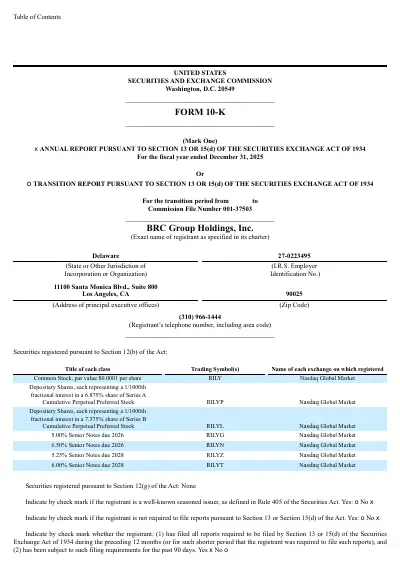
To start, we are pleased to report that our 10-K was filed on time. It's an important milestone for our counterparties, shareholders, and the organization as a whole.
With that, for nearly 30 years, BRC Group Holdings has been defined by a key principle: our willingness to be opportunistic. In the deals we took on, the capital we deployed, the companies we backed, and the businesses we built.
Over the years, our team has grown adept at rising to the challenges associated with capitalizing on those opportunities. The last two years required the firm to apply those same skills to itself: rebuilding our balance sheet, shifting operations, refocusing parts of the platform, and positioning BRCGH for what comes next.
We made some hard decisions along the way, but we made them deliberately, and we made them so that we could get back to doing what we do best. The bedrock of success of BRCGH's platform is our ability to bring together diverse companies, allowing them to partner creatively for our clients and building a collaborative ecosystem.
Advisory, capital markets, wealth management, principal investments, and businesses that generate recurring, spread, steady cash flow. That combination creates real value for clients and shareholders alike.
Over the past two years, we made the difficult decision to sell some of those businesses to strengthen our balance sheet. As we sit here today, the model is intact, as exemplified by our recent results.
Our Communication Business Group continues to generate consistent, predictable cash flow. Our broker-dealer executes complex transactions, raises significant capital for our clients, and continues to grow and add talent.
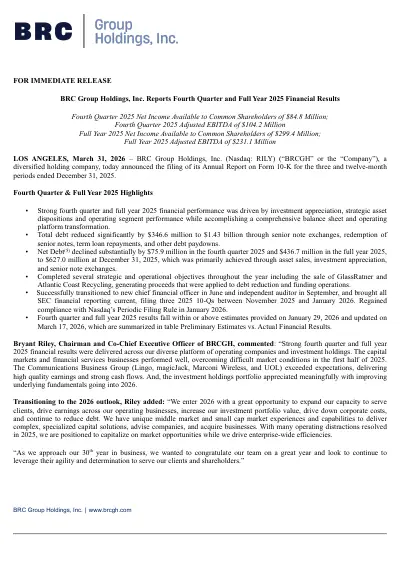
Our investment portfolio, anchored by our position in Babcock & Wilcox, delivered results that reflect the hands-on work our team put into our portfolio over many years. In 2025, we reported net income available to common shareholders of $299.4 million and earnings per share of $9.87.
We reduced net debt significantly and continue to invest in the businesses and people that drive the platform. We welcomed a new CFO, Scott Yessner, enhanced our finance staff, and transitioned to BDO as our auditing partner.
Looking at the opportunity in the market for BRCGH, the small- and mid-cap market we've always served is at an inflection point. Traditional lenders have pulled back, generalist firms can't cover the complexity, companies in the space need experienced partners who understand the capital structure, know the equity story, and can move with speed and certainty.
That's our lane, and it's been our lane for 30 years, and the demand for what we do is growing. To that end, yesterday we announced BRC Specialty Finance, a dedicated platform that addresses this exact issue, which is very exciting for us.
Also yesterday, the Delaware Court of Chancery dismissed in full the Marchner versus Riley derivative action, finding that the plaintiff failed to adequately plead demand futility. BRCGH believes this outcome reflects the integrity of its board and the governance processes.
We will not be commenting further on pending litigation. We're proud of what we accomplished in 2025, and we're committed to building upon these results.
We're laser-focused on continued growth and maximizing profitable outcomes. The world is changing fast, AI included, and we will continue to make the shifts necessary to stay relevant and competitive.
Finally, we need to take a moment to acknowledge our team. These past few years have been a demanding period for the firm.
Our people leaned in, stayed focused on clients, and kept us moving forward, showing exactly what the platform is built on. They are our competitive advantage: the continuity, the shared experience, institutional knowledge.
We could not be more proud of what this team has accomplished. I will now turn the call over to co-CEO Tom Kelleher for a few additional comments.
Tom Kelleher
Thanks, Bryant. As mentioned in our earnings release, we've completed a number of strategic and operational objectives throughout the year.
In March 2025, we closed the sale of Atlantic Coast Recycling for a purchase price of approximately $102 million, with net cash proceeds to BRCGH of approximately $69 million after adjustments. In April 2025, we sold a portion of our W-2 wealth management business, representing 36 financial advisors and approximately $4 billion in assets under management, for net consideration of $26 million.
In June 2025, we completed the sale of GlassRatner Advisory & Capital Group and B. Riley Farber Advisory, generating cash consideration of approximately $118 million.
While every one of these divestitures was a challenging decision to make, they fit with our strategy to deleverage the platform and focus the business going forward. With the GlassRatner sale, we executed a transition services agreement, or TSA, whereby we operationally supported that business through the end of 2025.
Similarly, we also executed a TSA with our 2024 partial sale of Great American, and that TSA was also completed at the end of 2025. In 2025, we also completed a multiyear project to consolidate the clearing arrangement for our wealth management business, which streamlines back-office operations and will materially lower costs.
Effective January 1st, 2026, we rebranded as BRC Group Holdings, reflecting our evolution from a financial services platform into a diversified portfolio of distinct businesses spanning financial services, communications, retail, and investments across equity, debt, and venture capital. Like many other firms, BRCGH has begun deploying artificial intelligence tools.
We standardized around Claude a year ago and are well-positioned to capitalize on the opportunities presented by this emerging technology. More than half our corporate staff is using AI tools.
Across our operating companies, AI adoption has accelerated, guided by a centralized team focused on developing and expanding these capabilities throughout the enterprise. The story heading into 2026 is straightforward: a stronger balance sheet, a growing business, and a market that needs exactly what we offer.
Our CFO, Scott Yessner, will now walk through the financials in detail. Scott, over to you.
Scott Yessner
Thank you. I'm pleased to share an update on our 2025 financial performance, investment holdings, and liquidity.
To start, I'd like to walk through our financial performance for the fourth quarter and full year 2025. Year-over-year fourth quarter revenues were $279 million compared to $179 million, and full year revenues were $968 million compared to $746 million.
The increase in fourth quarter year-over-year revenues was driven by $68 million on higher trading gains on investments, primarily in Babcock & Wilcox common stock, and by a loss of $72 million in fair value adjustments on loans receivable in 2024, which were offset by lower service and fee income of $33 million, which was comprised of $15 million in lower investment banking revenue and $20 million in revenues related to exited businesses. These fee declines were partially offset by higher net investment advisory fees related to a fund that holds SpaceX.
The full year 2025 revenue increase was driven by $183 million in higher trading gains due to $126 million in investment appreciation, primarily in Babcock & Wilcox, and a loss of $325 million on fair value adjustments on loans in 2024. The year-over-year revenue increase was offset by $150 million of lower service and fee revenues and $64 million in lower interest income from securities lending.
The components of lower service and fee revenue decline were $66 million lower revenue from exited businesses of Reval, Nogin, and the Stifel wealth sale, partially offset by higher net investment advisory fees related to a fund that holds SpaceX. Further, $44 million lower Communication Business Group subscription revenue, driven by subscriber attrition and a divestiture of a Lingo wholesale business, and finally, $22 million of lower investment banking revenue.
Fourth quarter operating expenses were $218 million compared to $345 million in 2024, and full year operating expenses in 2025 were $892 million compared to $1.24 billion in 2024. The $128 million fourth quarter year-over-year reduction of operating expenses was primarily due to costs from exited businesses and a $78 million goodwill impairment in 2024.
The $352 million full year reduction of operating expenses was due to $186 million from exited businesses and lower cost of sales linked to revenue declines, $61 million lower interest expense from securities lending, and a $104 million goodwill impairment in 2024. Our administrative costs have been elevated in the past two years, particularly on professional fees.
As we return to a normalized operating cadence, we expect to reduce these costs and will update in the future call. Continuing down the income statement, fourth quarter other income, excluding interest expense, was $38 million compared to a loss of $59 million in 2024, and full year other income, excluding interest expense, was $247 million compared to a loss of $270 million.
The $98 million fourth quarter year-over-year increase was primarily driven by fair value total markups of $66 million on Babcock & Wilcox stock and DoubleDown Interactive holdings. The $516 million full year year-over-year increase was due to gains of $86 million on gain on sale of deconsolidation businesses, $76 million in Babcock & Wilcox stock value increase, $67 million on senior note exchanges, $34 million in equity gains on the Joann's GA Group liquidation deal, and $273 million in investment markdowns in 2024.
Fourth quarter interest expense was $20 million compared to $31 million in 2024, and interest expense for the full year 2025 was $93 million compared to $133 million in 2024, which was driven by debt reduction of $347 million during 2025. These details culminate with fourth quarter net income attributable to common shareholders in 2025 of $85 million compared to $900,000 in 2024, and full year net income attributable to common shareholders in 2025 of $299 million compared to a net loss of $772 million in 2024.
Fourth quarter adjusted EBITDA in 2025 was $104 million compared to a loss of $114 million in 2024, and full year adjusted EBITDA in 2025 was $231 million compared to a loss of $568 million in 2024. Please refer to the reconciliation tables in our earnings press release for the adjusted EBITDA calculations.
Next, I'll review our segment operating performance. Our segment presentation has been revised with the following changes: our former communication segment has been separated into four reportable segments, which we aggregate and describe as the Communications Business Group.
In the capital markets segment had a few investment entities reclassified as non-reportable segments. These entities are now captured in corporate and other.
The capital markets segment, which is comprised solely of B. Riley Securities, had fourth quarter and full year revenues of $93 million and $265 million, and segment income of $53 million and $89 million.
The revenue and segment income increases are primarily due to fair value increase in Babcock & Wilcox in trading gains. Core investment banking revenues were lower by approximately $222 million in 2025, which was a result of lower banker headcount and reduced client engagement from, among things, late SEC filings at the corporate parent.
The wealth segment had fourth quarter and full year revenues of $47 million and $176 million, and operating segment income of $8 million and $15 million. After completing the sale of $4 billion in assets under management in April 2025, the wealth segment completed a back-office integration and cost reduction program.
Wealth ended 2025 with $13 billion in assets under management and 197 registered representatives. The Communications Business Group is the aggregate results of Lingo, MagicJack, Marconi, and United Online reportable segments.
The Communications Business Group had fourth quarter and full year aggregate revenues of $63 million and $250 million, and aggregate income for the fourth quarter and full year of $13 million and $47 million. The results exceeded our expectations in 2025.
While the communication services have a declining customer base, we have a strong team who does a very good job of servicing our customers and operating a very profitable and strong cash flow business. We will continue to evaluate opportunities to leverage this business model.
The Targus business, which comprises the consumer products segment, had fourth quarter and full year revenues of $49 million and $182 million, and operating segment loss of $4 million and $16 million. Lower revenues, inventory write-downs, goodwill impairments, and tariff costs led to the 2025 operating loss.
Tariff costs were approximately $4 million, which have been submitted for reimbursement. We'll update if the reimbursement is realized.
Tariffs, conflicts, chip shortages remain risks to the business in 2026. After several years of declining sales from the consumer product surge around the time of COVID, sales revenues have stabilized year-over-year in the fourth quarter of 2025 and into the first quarter of 2026.
We are evaluating options to refine our pricing model and cost structure as key opportunities in 2026. Next, I would like to provide an update on the company's investment holdings portfolio, which are reported on our balance sheet in securities and other investments, loans receivable at fair value, and equity investments.
Investments are held across consolidated entities where valuation changes are booked as revenue in either trading gains or realized and unrealized gains, depending on the entity. Securities and other investments increased by $165 million to $447 million at year-end 2025.
The increase was primarily driven by a $129 million value increase in Babcock & Wilcox, and a $28 million increase in partnership interest and other, related to our carried interest in funds that own SpaceX. At 12/31/2025, the Babcock & Wilcox stock price used in the valuation was $6.34.
The company owned approximately 27.5 million shares at December 31st, 2025, and at March 31st, 2026. The SpaceX carrying value was marked at $421 per share at 12/31/2025.
Securities and other investments are reported in the 10-K table with subtotals including public equities, private equities, corporate bonds, and other fixed-income securities, along with partnership interest and other. In the public equities, in addition to the Babcock & Wilcox valuation change, DoubleDown Interactive and Synchronoss were lower, primarily from selling a portion of the holdings with small changes in price.
The private equities subtotal amount, which has over 60 investments including the venture capital portfolio, had $34 million in new investments, $10 million in liquidations, and the balance of the year-over-year change due to valuation updates. The venture capital portfolio has a few maturing investments that may be realized in the next 12 to 24 months.
Corporate bonds increased $2.7 million, primarily due to an increase in value. Partnerships and other investments increased, primarily due to the SpaceX carried interest value increase identified earlier.
We operate the securities investment portfolio to maximize shareholder returns and to support operational funding and liquidity requirements. Continuing with investment holdings, loans receivable at fair value declined $64 million in 2025 to an ending balance of $26 million at 12/31/2025.
Loan lending activity included approximately $110 million of fundings and $170 million of repayments, primarily driving the balance decline. Exela Technologies represents $21 million of the remaining balance, of which approximately $15 million is due in 2026.
We expect to continue to fund loan and credit structures for clients in 2026. For the last balance sheet line item in our investment holdings, equity method investments were $90 million at 12/31/2025, increasing $5 million from December 31st, 2024.
The increase was primarily due to $4 million of investments transferred from partnerships. The GA Group investment, formerly Great American, comprises $83 million of the 12/31/2025 balance.
In 2025, the GA Group had good financial performance and hired new executives to support their expansion, including a new CEO. Due to the GA Group capital structure, we record the investment using the hypothetical liquidation at book value method.
While we don't anticipate this booking method will result in a significant movement in our balance sheet valuation periodically, we believe the value will grow over the next few years. Having grown GA Group since 2014, we know this business well.
We'll continue to update business performance periodically, and seek to participate in equity and debt deals as partners to GA Group, as we did in 2025 with the $34 million equity gain in the Joann's liquidation equity earnings, and the lending we provided to GA Group in 2025. Next, I'll provide an update and remarks on our liquidity and capital.
At year-end December 31st, 2025, cash, restricted cash, and cash equivalents balance was $229 million compared to $247 million at December 31st, 2024. In 2025, BRC Group reduced total debt by $347 million, which included a $147 million Riley M bond redemption on February 28th, 2025, $127 million in bond exchanges, and $98 million in paydowns of term loans, offset by $23 million of other increases in debt borrowings.
Net debt declined $437 million in 2025 to $627 million at December 31st, 2025. As we enter 2026, we have three senior note series maturing in 2026, for a total principal amount of $457 million, with an additional $16 million in scheduled paydowns on a subsidiary lending facility.
On March 30th, 2026, the Riley K senior notes were fully redeemed for approximately $96 million, inclusive of accrued interest. Remaining in 2026, and based on the balances at 12/31/2025, we have $178 million in principal amount of Riley N senior notes due September 30th, and $177 million in principal amount of Riley G notes due December 31st maturing.
On March 12th, we announced $38 million in senior note reductions through Section 3(a)(9) exchanges and buybacks, which were across the senior note series, including all three series in 2026. We will continue to use capital actions and also use cash generated from operations and investment liquidations to fund the scheduled senior note paydowns and support our operations.
Continuing, interest expense in 2025 totaled $93 million. In 2026, interest expense based on scheduled paydowns is estimated to be approximately $81 million, though expected to be lower due to the debt exchanges already announced and our anticipation of continuing these capital actions.
To conclude, our capital and liquidity plan in 2026 is to fund our emerging credit market opportunities, support our clients with capital and advisory services, support holding investments to their optimal exits, while funding the remaining senior note redemptions in 2026. Thank you for the opportunity to share this update today.
We look forward to answering your questions. I'll turn the call back to the operator for a Q&A session.
Operator
Thank you. At this time, we will conduct a question-and-answer session.
If you would like to ask a question, please press star one on your telephone keypad to enter the queue. Once again, that is star one on your telephone keypad to enter the queue.
We will pause here briefly to allow any questions to generate. Our first question comes from Amer with Imperial Capital.
Amer, your line is open, you may proceed.
Amer Tiwana
Thank you very much. Guys, first of all, congratulations on filing the 10-K.
Am I reading this correctly that the remaining 350 million you'll potentially use the investment portfolio as the primary source and some cash flow from operations, or there are other levers that you intend to pull as well?
Bryant Riley
Thanks for the questions. Scott, feel free to join in.
I think the way that we've worked over the last two years, if you tried to put in a playbook, you would have changed directions 15 times. Our portfolio is opportunistic.
You don't know it's going to pop up in different ways. I think that a year ago, it wasn't known that we had and we hadn't counted as much of a SpaceX partnership ownership that we had, and so it's a pretty big book, and we've got a fair amount of assets, and we're going to be opportunistic.
I wouldn't point to one thing or another. I would point to a combination of opportunities, whether it's bond swaps, which we've done a lot of, whether it's buying bonds in the market, or selling some investments.
All of those things will be considered. Scott or Tom, you want to add anything to that?
Scott Yessner
Thanks, Bryant. Really appreciate the question, and I think Bryant had summarized it very well.
The way we look at it is we have investments and assets at the company that we want to maximize the value to, and we also have opportunities to supply capital to our clients. We balance all those different factors and against our liquidity requirements for those bond redemptions, and so we have some high cash-flow-generating businesses and other opportunities, and then the capital actions that Bryant had levered on.
We'll be opportunistic and make the best decision for the shareholder, but we have many different levers of which to pay down the redemptions this year. I'd also just note that the redemptions, because we have had these capital actions so far this year, the principal balance on the Riley Ns due in September 30th is $157 million, and then the Riley Gs, which are due on December 31st, 2026, they're down to $170 million.
Those have already reduced from what reported in our 10-K.
Amer Tiwana
Oh, great. Thank you so much for that.
My next question is, when you guys look at BRS, I know you guys have talked about a SPAC transaction. Is there any sense of the timing for that?
Bryant Riley
If anyone talks about a SPAC transaction, we have not talked about a SPAC transaction. We have carved it out so that it is an entity that there's some equity ownership by the management team and some of the partners there, and it's a asset of BRC, and we're always evaluating our assets to maximize value.
It's very much an integrated part of our business as well. We still do feed off of each other in terms of creating opportunities, whether it's myself being involved on the BRS side or somebody at BRS helping on wealth management side.
We did have a carve-out to identify that asset a little more clearly. I would view those as still pretty integrated.
Amer Tiwana
Understood. I'll let others ask questions, and I'll go back in the queue.
Congratulations. You guys have accomplished an incredible amount over the last year or so, it's been pretty frantic in terms of things that have happened.
Seems like you guys have found yourself in a very good spot at this point in time, congratulations.
Bryant Riley
Thank you for that. We feel the same way, yeah.
Thank you very much.
Operator
Thank you. Our next question comes from Sean Haydon of Charles Lane Capital.
You may proceed with your question.
Sean Haydon
Hi, guys. Good afternoon.
Thanks for all the information and congrats on the recent developments. Bryant, in your prepared remarks, you spoke of, I believe you used the word, specialty finance platform.
Within the boundaries, could you kind of expand on that? Is that going to be something that's going to be on-balance-sheet, or shared with investors?
How should we kind of think about that going forward?
Bryant Riley
Sure. Thanks, Sean.
Nice to hear from you. This is not incredibly different from what we've done for a long time, helping facilitate transactions.
As we mentioned in our press release, there is a gap in the market for more short-term loans, especially around public companies, when you're willing to also underwrite not only the business, but the equity and all the assets of the estate. We did a loan, we completed a loan, I think it's done, maybe it was done today, but it was for a public company, a $10 million loan against receivables, and those receivables go directly to us, and we take a fee off of those, and they'll pay us back in 4 months.
They had a direct use for that, and there's not a lot of places you can go for that type of transaction. We certainly have a lot of relationships just like anyone does that has a loan business like that, where we will consider syndicating.
We have a dedicated family office that it's not formalized, but we have a high degree of confidence that that family office would be a participant to the extent we want to do some things bigger. On-balance-sheet, depending on timing, depending on size; syndicated, depending on timing, depending on size.
I think that the most proprietary thing and the reason that we wanted to make sure that we were in this business is, one, it's certain clients that are long-term clients, and we think we can put that in perspective. Two, we don't think it's a hugely competitive market because most lenders need a duration to their capital, and a defined moat, and can have very kind of strict mandates within their lending portfolio.
We think we can be opportunistic and also be really good partners, and so we're really excited about formalizing it, and we think we're already seeing, just from that press release, we're seeing opportunities. That's how that will work.
Did that answer your question?
Sean Haydon
Yeah. No, that was helpful.
Then kind of piggybacking on the first question from the previous person, where are you guys comfortable bringing the balance sheet in terms of net debt? Should we expect it to be lower, and how should we kind of think about it getting there?
Bryant Riley
It's a question every day based on your cash flows. Realize this year, our cash flows were hit quite a bit because of these expenses associated with the financials, and changing auditors, and all the legal things.
We expect to get some tailwinds there. We think that, from operations, obviously, there's going to be meaningful cash flows.
We look at it all the time. If you were to take and mark-to-market our portfolio now, the debt to EBITDA on a trailing basis would not be hugely uncomfortable.
That's net debt, right? We have to constantly look at these things.
I don't think there's a number in mind. We would just want to make sure that we can, one way or another, be on the offense, and helping our clients, and being able to utilize capital to do that.
We will always be mindful of that. We'll balance that against whether we need to utilize other methods, selling an asset or doing bond swaps.
I couldn't give you a target. I could tell you that we feel pretty good about where we are right now, obviously, relative to where we were 18 months ago, and we're just going to keep grinding away.
Sean Haydon
I guess, and obviously you don't have to get into specifics here, but directionally, when those maturities come up in the latter half of the year, should we expect a replenishment from that, or is that going to be the level we should expect going forward once they've matured?
Bryant Riley
I kind of answer the same way I answered the prior caller. If, in this business, 6 months and 9 months is equivalent of, I think, 5 years in a widget business, and things change 18 different ways.
I couldn't tell you exactly what the next steps are going to be, other than we feel really comfortable about 2026 and going forward. I would love to give you an exact linear description of the next steps, but we're just going to continue to think through what is best for the overall business and where we are in markets and how markets are and if we're seeing a ton of opportunities, as Scott said, to put money to work at really good rates or really good opportunities, then we'll be thoughtful of that.
It's similar to how we got to March. By the time we got to March, there was $96 million of maturities, and we had chipped away at them from a couple of different ways, and that's how I would think about September and December.
Sean Haydon
All right. I appreciate it, and again, congrats.
It's been a ride. I don't know if I'd say it was a fun one, but it's been a ride, I appreciate you guys having this call.
Thanks.
Bryant Riley
I know you've been on the ride, and we appreciate it, and we're going forward, and accomplished a lot and are just charging forward. Thank you.
Sean Haydon
Sounds good. Thank you.
Operator
Thank you, Sean. As a reminder, ladies and gentlemen, if you would like to ask a question, please press star one on your telephone keypad to enter the queue.
Once again, that's star, then one on your telephone keypad to enter the queue. We will pause here briefly to allow any further questions to generate.
Our next question is a follow-up from Amer of Imperial Capital. You may proceed with your question.
Amer Tiwana
Thank you. I just wanted to dig into the Great American business.
Can we talk a little bit about how do you guys value the business on your balance sheet? Secondly, you guys had invested some additional capital for the Joann liquidation.
Can you talk about what kind of return you got, or are expecting, on those investments?
Bryant Riley
Yeah. Scott, I'll start.
Scott Yessner
Amer, thank you so much. I'll start with
Bryant Riley
Go ahead.
Scott Yessner
I was going to just touch on the accounting and the booking, and that part of it, and then turn to Bryant. There's the nature of the capital structure at GA Group, after we had sold a portion and now have roughly 43%, 45% of that business.
Because of that structure, we have to use an accounting called hypothetical liquidation at book value method, and it just sort of gives you a book value of that company. When you think about the value of a firm like the GA Group, the balance sheet's not primarily the element to it.
It's a fantastic business which we've owned for well over a decade. The part of the reason for my remarks on the call was just to identify that, while we will communicate its performance as we are required through the 10-K, the valuation on the balance sheet won't move much, and we think that's helpful to communicate to our shareholders and analysts to understand that the performance of the business may not necessarily be reflective of a hypothetical liquidation at book value, which I know everyone is very good at understanding book value versus market value.
That's sort of how to think about is that we want to communicate the performance in its P&L sense, in earnings sense, but may not be able to reflect the actual valuation change in the balance sheet. With respect to the equity, the equity returns that we earned on the Joann's deal, those are very, very high.
That was a very, very successful deal for us, something that we were very comfortable being with, was part of our means of organizing that partnership with Oaktree, the majority owner now. Equity participations in transactions are something that we want to supply capital and continue to.
We'd also provided some lending last year to that business operation, and so we want to, outside of our ownership through that equity investment, provide additional capital to support the business. Bryant, I'll let you pick it up from there.
Bryant Riley
No, that was perfect. Yep, I wouldn't add anything more.
Amer Tiwana
Thank you, guys. That's all I have.
Bryant Riley
All right, thank you.
Operator
Thank you. Our next question comes from Jonathan of J.H.
Lane Partners. Jonathan, you may proceed with your question.
Jonathan Neiss
Hi, guys. Good afternoon.
Thanks very much for the call. Appreciate it.
I had a couple quick ones for you guys. Number one is, what is your ability to sell any of your shares in Babcock for liquidity purposes?
Are there any restrictions associated with that given your significant ownership stake in the company? I have two other follow-ups, maybe if you just want to answer that one first, and then I'm happy to get to the other questions.
Bryant Riley
We've been very involved in BW in a number of ways and advisory roles, etc. In terms of restrictions, outside of being restricted because we would have information, our shares are subject to 144(a) requirements, which means that because we own a fair amount of shares, we would have to measure volume per month of those shares.
The volume of that company is far more than the shares that we own. We do have a requirement to follow some volume restrictions based on our ownership, but they don't come into play with volumes here.
Jonathan Neiss
Great. Then just, I've been following the story for a little bit.
You guys have made obviously a lot of progress. Is there any general comments you could provide to the broader market about changes maybe at the governance level?
Given obviously it's obviously great that you got the positive litigation ruling today or yesterday. For some new to the story, and perhaps for people to just understand, there's a lot that went on here in the last couple of years.
Have you had changes to the board, other than changing your auditor, is the law firm that you had worked with closely over the last couple years still kind of involved in your company at all? How can we understand kind of OldCo and NewCo, just understanding that is this kind of a new company, new stage?
Obviously, some management have been the same, but is there any kind of fresh moves on the board, and just a sense of how we move away from OldCo and into this NewCo?
Bryant Riley
There hasn't been any new members of the board. I think you can tell, as you may know, we had a lot of governance around investigations and things like that.
I think that's entered into the story, and I certainly appreciate the dynamics around FRG. BW, which you spoke of, was not a dissimilar situation.
That's a 20-year relationship with a management team, and that company obviously with our help, and with the number of the management team, has really ended up having great returns for us. You're balancing things that you've done in the past and the way you look in the future and what is best for the business.
I think that certainly we have obviously Scott Yessner is here, and we've implemented I think the proper amount of procedures, and I think our board is incredibly additive, and we have a new auditor, which we're very thankful for. I think that's how I'd answer it.
I think I feel good about the procedures we have in place and balancing the opportunities with creating the right environment for everyone. I think the disclosures we're providing, that Scott's providing, is more and more, and we're trying to walk the right line between thinking about the dynamic of an FRG, but also realizing that a lot of the opportunities we have in front of us, we need to take advantage of.
Tom or Scott,
Jonathan Neiss
did you want to add anything? No, that's very helpful, and I appreciate it.
I just would note that obviously, in a situation like Babcock is just now such a meaningful part of the situation where in the past, obviously FRG ended up being a very significant part of the story. Obviously, not comparing the two, but just in terms of as a percentage of your value and assets, something cognizant from the as markets in terms of people that invest with you.
Obviously, that's, the more diversified you could be, I think, the better. Then the last question I had would be, is there any update on liquidity or can you give your cash position or something you could provide to us as of 3/31 or post those transactions you did and post the bond paydown that took place at the end of March, I guess, now?
Bryant Riley
We're going to be back on the phone hopefully in 5 weeks, right? I think my auditors are listening, so that's absolutely a hope, or 4 or 5 weeks.
We're not providing guidance right now, hopefully we'll be back on the phone soon.
Jonathan Neiss
No, that's okay. Okay.
I apologize. I wasn't looking for guidance, I was just looking for actual right now.
I won't lean for much forward. I appreciate the time, guys.
Thank you for the call.
Bryant Riley
Thank you.
Scott Yessner
Thank you.
Operator
Thank you, Jonathan. Once again, if you would like to ask a question, please press star one on your telephone keypad to enter the queue.
Once more, that's star, then one on your telephone keypad to enter the queue. We will pause here briefly to allow any further questions to generate.
One final call: that's star, then one on your telephone keypad to enter the queue.
Bryant Riley
Operator, I think we're good. Thank you.
Just before we go, I'll just speak personally, as we've gone through this last couple of years and where we are, and momentum we have, and I'm just humbled by the team that we work with every day. The new team members, it's been just an amazing experience to be able to be in a situation where you latch arms, and you go, and you battle, and we're seeing the rewards of that.
I think that the people that have been fighting through it are seeing the rewards of that. Very thankful for this team, very thankful for TK and Scott and everybody else from our team on the call, and we're excited to be able to have a quarterly earnings call that will be normal and normalized, and have a regular cadence.
Thank you very much, and really appreciate everyone for joining.
Operator
This concludes today's Evercall. A replay will be made available shortly after today's call.
Thank you, and have a great day.