Raymond James Financial, Inc.
Q4 FY2026 · Earnings Call TranscriptOctober 28, 2026
Kristie Waugh
Good evening, and welcome to Raymond James Financial's fourth-quarter and fiscal 2026 earnings call. This call is being recorded and will be available for replay for the next 30 days on the company's Investor Relations website.
I'm Kristie Waugh, Senior Vice President of Investor Relations. Thank you for joining us.
With me on the call today are Chief Executive Officer, Paul Shoukry, and Chief Financial Officer, Butch Oorlog. The presentation being reviewed today is available on Raymond James's Investor Relations website.
Following the prepared remarks, the operator will open the line for questions. Calling your attention to slide two, please note that certain statements made during this call may constitute forward-looking statements.
These statements include, but are not limited to, information concerning future strategic objectives, business prospects, financial results, industry or market conditions, anticipated timing and benefits of our acquisitions, and our level of success in integrating acquired businesses, anticipated future results of litigation and regulatory developments, and general economic conditions. In addition, words such as believes, expects, anticipates, intends, plans, estimates, projects, forecasts, and future or conditional verbs such as may, will, could, should, and would, as well as any other statement that necessarily depends on future events, are intended to identify forward-looking statements.
Please note that there can be no assurance that actual results will not differ materially from those expressed in these statements. We urge you to consider the risks described in our most recent Form 10-K and subsequent Forms 10-Q and Forms 8-K, which are available on our website.
Now, I'm happy to turn the call over to CEO Paul Shoukry. Paul?
Paul Shoukry
Thank you, Kristie. Good evening, and thank you for joining us.
Some people like to tailgate and eat hamburgers and hot dogs prior to World Series games. Others like to listen to a really good earnings call.
I want to thank all of you for being in that latter category and joining our call this evening. Us folks in Tampa Bay are rooting for the Rays to keep things alive tonight, but there are thousands of really great Brew Crew fans who have made the trip down and are ready to pop the champagne.
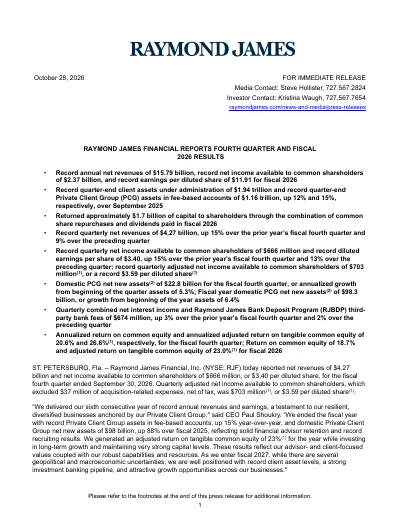
We'll see how things shake out in the next few hours, but first, our results. Raymond James delivered record net revenues and record net income for both the fourth quarter and fiscal year 2026.
This was our sixth consecutive year of record annual results, underscoring the strength of our long-term approach and resilient, diversified business model, and most importantly, reflecting the commitment of our financial advisors, bankers, and associates to serving clients with integrity and putting people first every single day. In the quarter, we generated record quarterly revenues of $4.27 billion, representing growth of 15% over the prior-year quarter and 9% above the preceding quarter.
Record pre-tax income of $862 million increased 18% over the year-ago quarter and 15% over the preceding quarter. What has always set Raymond James apart is our ability to invest for the long term without losing sight of the deeply personal relationships at the heart of our business.
That was evident this fiscal year as our investments across the organization in people, technology, and capabilities enabled advisors, bankers, and associates to meet the increasingly complex needs of their clients. In the Private Client Group, we had record quarter-end client assets under administration of $1.87 trillion, up 1% from the preceding quarter and 12% year-over-year.
Strong retention and continued recruiting momentum again demonstrated that Raymond James remains a destination of choice for financial advisors across our affiliation options, where our growth remains focused on quality over quantity. For the fiscal year, domestic PCG net new assets increased 88% to a record of more than $98 billion, representing 6.4% of beginning-of-year assets.
Contributing to the excellent net new asset results were not only our record recruiting results, which far surpassed the previous year's records, but also increased net new assets from existing advisors and strong advisor retention. Over the fiscal year, we recruited financial advisors to our domestic independent contractor and employee channels with trailing 12-month production totaling $538 million and more than $82 billion of client assets at their previous firms.
The source of this year's recruiting success, as well as our current pipeline, remains diverse across all of our affiliation channels. Throughout the year, we remained focused on expanding capabilities and empowering advisors.
For example, enhanced succession and capital solutions for advisors, streamlined branch workflows, and advisor productivity initiatives support practice continuity, growth planning, and advisor transitions. With regard to clients, we have expanded specialized resources available to business owners, high-net-worth families, and multigenerational households, helping advisors address clients' increasingly complex planning, succession, and liquidity needs.
Lastly, we continue advancing automation, process improvement, and AI as part of our more than $1.1 billion annual technology spend. These enhancements help advisors work more efficiently and deliver increasingly personalized advice, spending less time on administrative tasks and more time with clients.
Tools such as our proprietary AI assistant, Raymond, and AI-powered integrated CRM solution, Meeting Manager, improve access to institutional knowledge, client insights, and workflow support. In Capital Markets, revenues grew this quarter, driven primarily by stronger investment banking results as well as higher Affordable Housing Investments business revenues.
We generated record consolidated investment banking revenues of more than $1.1 billion for the fiscal year. We achieved this milestone despite economic and global challenges and uncertainty, including concerns about disruption from emerging technologies.
These results reflect the continued investments in our Capital Markets businesses. During the year, we acquired GreensLedge, which provides origination and structuring capabilities that complement our existing structured products distribution.
Additionally, we made strategic hires and expanded specialized practices to continue to deepen our expertise, including adding a Leveraged Finance and Debt Advisory practice and expanding our ESOP Advisory team in our Consumer franchise. In Public Finance, the addition of MBES Capital Markets increases our capabilities in land-secured finance and strengthens our ability to serve special districts, master-planned communities, and mixed-use developments.
Our investment banking pipeline remains strong, and as we saw this quarter, we believe we are well positioned for future growth. In the Asset Management segment, net inflows into managed fee-based programs in the Private Client Group were strong during the quarter.
This reflected the growth from our successful recruiting efforts, as well as a cross-business collaboration with PCG to provide high-quality investment offerings such as the newly launched Private Wealth Guided Portfolios that expand solutions for private wealth clients looking to add alternative investments in their managed portfolios. Additionally, we experienced solid net flows into Raymond James Investment Management, including the recently acquired Clark Capital, which continues to grow assets by serving advisor-oriented channels with high-touch asset management and model portfolio capabilities.
In the Bank segment, loans ended the quarter at a record $57.5 billion, driven predominantly by continued growth in securities-based lending balances. Those balances increased more than $6 billion, or 32%, from the year-ago period and 6% sequentially.
This growth continues to reflect the synergy with our expanding Private Client Group business as we deploy our balance sheet in support of clients. Importantly, credit quality across the loan portfolio remains strong.
Our capital deployment strategy remains disciplined and long-term focused, with priorities that include organic growth, technology and platform investments, strategic acquisitions, and returning capital to shareholders. Before I turn the call over to Butch, I want to highlight two things we are excited about.
First, and most importantly, our latest satisfaction survey showed that advisors' overall satisfaction with Raymond James's service levels reached an all-time high of 96%, with 87% of our advisors saying that they have experienced an improvement over our already strong service levels over the past year. These remarkable results reflect the collective efforts of our associates to serve advisors and their clients.
Also during the quarter, we announced a new partnership with the PGA Tour as a title sponsor of the GO by Raymond James golf tournament in Greensboro, North Carolina. One of the Tour's most historic tournaments, the event will become a championship-level competition featuring the best players in the world.
This partnership provides a unique opportunity to invest in our brand and deepen relationships with clients and prospects. Now, I'll turn the call over to Butch Oorlog to review our financial results in detail.
Butch?
Butch Oorlog
Thank you, Paul. I'll begin on slide six.
The firm reported record net revenues of $4.27 billion for the fiscal fourth quarter. Net income available to common shareholders was $666 million, with record earnings per diluted share of $3.40.
Adjusted net income available to common shareholders, which excludes acquisition-related expenses, equaled $703 million, resulting in record adjusted earnings per diluted share of $3.59. Our pre-tax margin for the quarter was 20.2%, and adjusted pre-tax margin was 21.3%.
We generated annualized return on common equity of 20.6% and annualized adjusted return on tangible common equity of 26.6%, strong results for the quarter, particularly given our conservative capital base. Turning to slide seven, the Private Client Group generated pre-tax income of $458 million on record quarterly net revenues of $3.06 billion.
Revenues grew 15% year-over-year, primarily driven by higher PCG assets under administration, resulting from market appreciation, strong retention, and the continued addition of net new assets. Pre-tax income grew 10% over the year-ago quarter, as the revenue growth was partially offset by higher financial advisor commissions tied to strong compensable revenue growth and increased expense supporting the record recruiting results Paul mentioned earlier.
The Capital Markets segment generated quarterly net revenues of $549 million and pre-tax income of $106 million. Segment net revenues increased year-over-year and sequentially, driven by higher M&A and advisory revenues.
This growth was partially offset by lower fixed income brokerage revenues, as rising interest rates and increased market volatility created a challenging environment, especially for municipal securities. Fourth-quarter results also benefited from seasonally high revenues in our Affordable Housing Investments business.
The Asset Management segment generated record pre-tax income of $170 million on record net revenues of $409 million. Results were largely driven by higher financial assets under management compared with the prior-year quarter, reflecting market appreciation over the past 12 months and strong net inflows into PCG fee-based accounts, as well as the addition of Clark Capital.
The Bank segment generated net revenues of $483 million and pre-tax income of $180 million. Segment net revenues increased 5% year-over-year, largely due to net loan growth over the period.
Results also benefited from a loan loss reserve release during the quarter, driven by continued strength in credit quality measures as the loan portfolio continues to shift towards lower-credit-risk securities-based loans and residential mortgages. Turning to consolidated revenues on slide eight, asset management and related administrative fees were $2.31 billion, up 23% over the prior year and 11% over the preceding quarter.
Record quarter-end PCG fee-based assets were $1.16 trillion, up 15% year-over-year and 1% over the preceding quarter. Looking ahead, we expect fiscal first-quarter 2027 asset management and related administrative fees to increase approximately 1% from the fourth-quarter level, driven by higher PCG assets and fee-based accounts at quarter-end.
Brokerage revenues were $614 million, down 2% from the preceding quarter as higher PCG retail brokerage revenues were more than offset by a decline in fixed income trading revenues described earlier. Moving to slide nine, clients' domestic cash sweep and Enhanced Savings Program balances ended the quarter at $58 billion, up 3% over the year-ago quarter and down 1% from the preceding quarter.
Our client deposit balance mix continues to highlight our diverse funding sources through both the sweep program and the Enhanced Savings Program through Raymond James Bank, as well as TriState Capital's deposit-gathering capabilities. Additionally, a portion of the sweep balances held off-balance sheet with third-party banks, which totaled over $16 billion at quarter-end, is immediately available to fund future loan growth as client demand warrants.
Turning to slide 10, combined net interest income and RJBDP fees from third-party banks were $674 million, up $16 million, or 2%, from the prior quarter. Fee revenues earned on RJBDP balances with third-party banks increased $12 million as a result of both an increase in average balances swept to third-party banks in the quarter, as well as a 6-basis-point increase in the yield on such balances to 2.81%.
Firm net interest income increased year-over-year and sequentially as higher interest income, driven primarily by higher Bank segment interest-earning assets, more than offset higher interest expense. Looking ahead, based on interest rates that include the full impact of the September rate increase and assuming unchanged quarter-end balances net of the fiscal first-quarter fee billing collection of $2.1 billion, we would expect aggregate NII and RJBDP fees from third-party banks in the first quarter to be up approximately 1% over the fourth-quarter level.
Keep in mind, actual results could be influenced by several variables, including any interest rate actions during the upcoming quarter, as well as changes in loan and deposit balances. Turning to consolidated expenses on slide 11, compensation expense was $2.77 billion, and the total compensation ratio for the quarter was 65%.
The adjusted compensation ratio, which excludes acquisition-related compensation expenses, was 64.6%, a really strong result given the business mix and robust compensable revenue growth in PCG. As we said at our Analyst Day in June, we expect to achieve an adjusted compensation ratio of approximately 65% based on our revenue mix, and as evident this quarter, improvement in that ratio can result from strong performance of the Capital Markets segment.
Non-compensation expenses were $633 million, up 5% from the year-ago quarter. Sequentially, non-compensation expenses increased 6%, driven primarily by a lower bank loan benefit for credit losses compared to the preceding quarter, as well as higher investment sub-advisory fees that align with higher fee-based assets.
Certain non-compensation expenses are tied directly to our growth, and many of those expenses, particularly those associated with successful recruiting, benefit future periods. For the fiscal year, we delivered adjusted non-compensation expenses, excluding the bank loan benefit for credit losses, of approximately $2.3 billion, in line with our target.
Importantly, we achieved this while absorbing incremental operating expenses from businesses acquired during the year, which were not contemplated in our target. Excluding those expenses, we would have come in below our target.
Looking ahead to fiscal 2027, we expect non-compensation expenses, excluding the bank loan loss provision for credit losses, non-GAAP adjustments presented in our non-GAAP financial measures, and any unexpected legal and regulatory items, to be approximately $2.5 billion, representing about an 8% increase year-over-year. This target reflects the full-year impact of the businesses acquired in fiscal 2026, contributing approximately 100 basis points of the expected expense increase.
Slide 12 presents the pre-tax margin trends for the past five quarters. This quarter, we achieved adjusted pre-tax margin of 21.3%, a strong result and above our guidance of approximately 20%, helped by higher Capital Markets results and also reflecting an increase in operating leverage in our PCG segment.
Our long-term trend in profitability continues to highlight the stability and strength of our diversified businesses to consistently generate strong margins throughout various market cycles. On slide 13, at quarter-end, our total assets were $94.4 billion, which approximated the preceding quarter-end level.
Record bank loans of $57.5 billion grew 11% over the year-ago quarter and 2% sequentially, with that loan growth largely in support of our clients. Securities-based loans and residential mortgages represent 65% of our total loans held for investment, reflecting 45% and 20% of the total, respectively.
RJF corporate cash at the parent ended the quarter at $2.9 billion, providing excess liquidity of $1.7 billion above our $1.2 billion target. With a Tier 1 leverage ratio of 12.1% and a total capital ratio of 24.2%, we remain well above regulatory requirements with approximately $1.9 billion of excess capital capacity to deploy before reaching our conservative Tier 1 leverage ratio target of 10%.
The effective tax rate for the year was 23%. Looking ahead, we estimate our effective tax rate for the fiscal 2027 to be approximately 25%, which excludes any impact the corporate-owned life insurance, or COLI, portfolio valuation could have on the rate during the year.
Slide 14 provides a summary of our capital actions. Through the combination of common dividends paid and share repurchases, we returned $154 million of capital to shareholders during the quarter.
In the quarter, we repurchased $50 million of common shares at an average price of $166 per share. Over the past 12 months, we repurchased 8 million common shares for approximately $1.25 billion.
Including dividends over that period, we returned $1.7 billion to common shareholders, representing 71% of earnings. Through successful execution on our capital deployment priorities over the past year, with strategic balance sheet growth, completion of acquisitions, and capital returned to shareholders, our Tier 1 leverage ratio has declined 100 basis points over that period to its still strong 12.1% level.
We remain committed to operating our businesses over the long run at capital levels consistent with our established targets. I'll now turn the call back to Paul for his final remarks.
Paul?
Paul Shoukry
Thank you, Butch. In summary, we finished fiscal 2026 with record results and an adjusted return on tangible common equity of 23% while investing in future growth.
We are entering fiscal 2027 with many tailwinds, including records for client assets and a strong investment banking pipeline. Of course, we also maintain a watchful eye on the uncertain geopolitical and macroeconomic environment, but we avoid trying to time the markets and instead focus on making investments to better support our advisors and their clients over the long term, while also maintaining a strong balance sheet with ample liquidity and capital to be nimble and opportunistic in a wide range of potential market environments.
Our leadership team believes what people want more than ever in this world of technology, AI, and social media, which I call anti-social media, is deeply personal relationships. Counterintuitively, what's harder to find than since our founding in 1962, across almost any industry, is a deeply personal relationship.
To that end, we are making significant investments in technology and AI, not with a focus on disintermediating our financial advisors, but instead with a focus on saving our advisors and associates time on administrative tasks so they can spend more time developing deeply personal relationships with their clients. We believe human financial advice grounded in these relationships will be an even bigger differentiator going forward.
I want to thank all of our advisors, bankers, and associates for helping Raymond James generate our sixth consecutive year of record results. This concludes our prepared remarks.
Operator, will you please open the line with questions?
Operator
We will now begin the question and answer session. Please limit yourself to one question.
Should you have a follow-up, please reenter the call queue, and we will get to it, should we have time. If you would like to ask a question, please press star, one to raise your hand.
To withdraw your question, press star, one again. We ask that you pick up your handset when asking a question to allow for optimum sound quality.
If you are muted locally, please remember to unmute your device. Please stand by while we compile the Q&A roster.
Your first question comes from David Smith with Truist Securities. Please go ahead.
David Smith
Hi. Good evening.
Paul Shoukry
Hey, David.
David Smith
You had a pretty healthy capital uptick to 12.1% Tier 1 leverage this quarter, but despite that, you really curtailed the buyback. Can you share more about that decision and whether there's been a shift in your capital allocation strategy right now?
I don't know if blackout periods just made it tough to take advantage of the leg down for the stock in September.
Paul Shoukry
No. Really what happened during the quarter was we were evaluating an M&A opportunity, and so we kind of suspended buybacks as we were evaluating that opportunity to see if we can get it to progress through the process.
That opportunity does not look like it will progress, and so as of right now, our plan is to resume buybacks at that $400 million-a-quarter level going forward.
David Smith
Okay. Not with a catch-up necessarily?
Paul Shoukry
No. We'll just continue the same level going forward.
Okay.
David Smith
Thank you.
Operator
Your next question comes from Bill Katz with TD Cowen. Please go ahead.
Bill Katz
Okay. Thank you very much for taking the question this evening.
I wanted to sort of hone in a little bit on the on-balance-sheet strategy from here. I heard you in terms of having some of that third-party sweep available to fund loan growth.
If I look at your balance sheet, it's about 90% funded loan-to-deposits. The NIM went down a little bit quarter-on-quarter.
Strategically, how are you thinking about managing the growth of the strong secured-based lending and the mortgage opportunity, and how might that sort of play through for the NIM outlook? Thank you.
Paul Shoukry
Bill. Good question.
Really, if you look at our overall cash availability, we have lots of flexibility. The loan-to-deposit ratio for us is not as relevant as a pure-play bank because we do have so much cash with third-party banks that provides a lot of flexibility.
Beyond that, we have diversified sources of deposits, both from Raymond James Bank and TriState Capital. We feel confident in our ability to continue supporting clients with the balance sheet, and to your point, we're really more focused on growing NII and BDP fees over time than optimizing NIM.
We're really focused on supporting clients and improving profitability over time, and that's how we think about the strategy going forward.
Operator
Your next question comes from Craig Siegenthaler with Bank of America. Please go ahead.
Craig Siegenthaler
Good evening, Paul, Butch. Hope everyone's doing well.
Paul Shoukry
Hey, Craig. How are you?
Craig Siegenthaler
I'm good. Just following up on the last one, does that mean the NIM is going down despite the fact the Fed's raising rates?
Because in the quarter, liability cost, as rose a lot faster than asset yields.
Paul Shoukry
I'll have Butch speak to the specifics on our near-term outlook, but I think what might be missing in the long-term perspective is that as deposit costs across the entire industry continues to increase on an incremental basis, you're going to see that reflected in loan pricing as well over time, whether it's in higher spreads and just loan pricing. The returns, I think, in the industry will keep up with the deposit costs over time.
Butch can speak to the near-term sort of outlook from the latest rate increase.
Butch Oorlog
One aspect of the NIM decline in the Bank segment this particular quarter was, you'll recall that we significantly increased our ESP deposit balances in Q3, and that was a ramp-up over the quarter. Basically in Q4, we experienced a full-quarter effect of the increase in those higher-cost deposits, and that was an impact on NIM.
I would also focus that with our third-party bank balances, we actually increased the yield from our third-party banks by 6 basis points, and kind of offsets the NIM. As Paul mentioned, we really think about it as managing the aggregate of NII and BDP.
Going forward, with future rate hikes, all things being equal, meaning no negative impact on balances, given the floating nature of our balance sheet, and the fact that we don't take interest rate bets, all things being equal, increases in short-term rates would have a positive impact on our NII, and typically on our NIM on a longer-term basis.
Craig Siegenthaler
Thank you, Butch.
Paul Shoukry
Thank you, Craig.
Operator
Your next question comes from Michael Cyprys with Morgan Stanley. Please go ahead.
Michael Cyprys
Hey. Good evening.
Thanks for taking the question. Just wanted to ask about the recruiting backdrop.
You've obviously had a very strong year here, and you've talked about the pipeline remaining healthy across the different affiliation options. I was hoping you could maybe give us a sense of how you see the competitive environment evolving, particularly around transition assistance, and how you're seeing the sort of advisors in motion evolving across the broader industry, and how are you thinking about sustainability of the sort of growth you put up here into fiscal '27?
Paul Shoukry
We feel really good about our pipelines across all of our affiliation options. I pop into a lot of these recruiting meetings, and there's a lot of them happening at our home office.
Again, it's from a wide variety of sources from different firms, and they're evaluating a wide variety of our affiliation options. It's a pretty balanced and strong pipeline.
I know there's a lot of questions around there about the competitive environment and the economics of recruiting right now, because I think there's been sort of a fallacy of assuming that the economics are binary and consistent across the industry. I can't speak for all the participants in the industry, but I can speak for Raymond James in that the recruiting environment and the way we recruit is very economically attractive for Raymond James.
I always say the proof is in the pudding. You see that this year with an adjusted ROTCE of 23% for Raymond James with consistently strong recruiting results, record results for us the last couple of years.
You may be wondering, well, why are you hearing different things across the industry? I think what makes recruiting attractive economically for Raymond James is really three things.
Most importantly, it's the value proposition. We call it the best of both worlds, where we tell advisors they own their book of business across all of our affiliation options, and we have a advisor- and client-focused culture and approach, which is getting harder to find across the industry.
We have a full-service offering. We have a bank, we have a trust company, we have equity research, all the things that advisors may want to help provide to their clients to provide the absolute best financial advice possible.
The second thing that's important in being profitable with recruiting is scale. We invest $1.1 billion in technology.
There's a lot of firms we compete with that just can't keep up with that level of investment given their size. It's harder to remain competitive, harder to provide that value proposition that I just described that's differentiated, and harder to keep up with the demands of clients and advisors.
Scale is really important. Then finally, it's a long-term time horizon that we have as a management team and as a company, and that we've always had as a management team as a company, because, like most growth investments, it actually creates a drag on near-term profitability.
If we're just focused on the next quarter or even the next year, recruiting may not be attractive on an incremental basis. We're making decisions for the next five years and beyond, and so with the value proposition that we have that's differentiated, the scale that we have, and our long-term time horizon, that's why we're so excited about the recruiting opportunity, and that's why it's economically attractive for Raymond James.
Michael Cyprys
Great. Thank you.
Operator
Your next question comes from Alex Blostein with Goldman Sachs. Please go ahead.
Hey,
Alex Blostein
guys. Just following up on that last discussion around recruiting and tying that back maybe to PCG comp rate and margins, I was hoping to double-click on a couple of things.
I guess, one, typically, the recruiting TA assistant comes a little ahead of revenues. Presumably that's still playing out.
Couple that with robust recruiting pipeline, Paul, that you alluded to, how should we think about PCG comp rate into '27 off of this kind of 75-ish percent range that you exited fiscal '26?
Paul Shoukry
To your point, we're going to continue investing in growth, and we've been ramping up as you know. We had net new assets this year of $98 billion, which was a record, up 88% year-over-year, which is remarkable when you think about the level of growth we invested in during the year.
All else being equal, that transition assistance as you ramp up, that does create a higher pressure on the comp ratio and on the margin. Again, we have scale, and we are being very disciplined on the investments we're making in non-comp.
Just as you saw this year, we're still able to grow pre-tax income in the Private Client Group business despite that investment in growth and also despite the pressure we had in interest rates during the year. We'll continue to focus on not what the pre-tax income does just next year, but over the next 5 to 10 years as we grow the business.
Alex Blostein
Gotcha. Just in terms of the pace of PCG comp rate trajectory, is that upward bias moderates from here, or does it stay at about the same pace?
Butch Oorlog
In terms of one way to think about the comp rate is it's impacted by our channel, our two channels, the employee channel and independent contractor channel. The payout on the independent contractor channel, on the financial advisor payout is higher.
The flip side of that, the other side of that is that they absorb their fixed costs and expenses. We get leverage in spite of a higher FA comp payout and FA comp ratio, we get leverage in the segment from lower non-comp expenses.
You're basically seeing that with relatively flat non-comp expenses in the PCG segment. Our ability to increase the margin in the segment 10 basis points to 15% this.
While we may see some increase in the comp ratio in the segment, there are other aspects that are creating leverage for the segment.
Alex Blostein
Great. Thank you.
Paul Shoukry
Thanks, Alex.
Operator
Your next question comes from Steven Chubak with Wolfe Research. Please go ahead.
Chris O'Brien
Hi, this is Chris O'Brien on for Steven. Thanks so much for taking our question.
I wanted to ask on the advisor movements, and sort of across the industry, we've seen at some of your competitors large advisory teams that are trying to become their own RIA. We were wondering what you're hearing from some of the larger advisors on your own platform and if you see any risk that advisors might move, become their own RIAs, and even if it stays within the RayJay platform, we're wondering what that might mean for your economics.
Paul Shoukry
We call it advisor choice, we have all the affiliation options. There's advisors that are attracted to our W-2 channel, our independent contractor channel, our custody channel where RIAs custody, as well as our Financial Institutions Division.
The key to advisor choice is truly being agnostic into which channel the advisor affiliates with. We want to really convince the advisor and the teams and their clients that we are the best destination as a firm, the culture, the capabilities, the best-of-both-worlds value proposition.
How they affiliate with us is there based on their individual preferences and how they want to run their business. We're seeing incredible interest across all of our affiliation options.
As Butch mentioned, the last couple years, the independent contractor channel in terms of dollar volume is where we've seen the most interest. The RIA custody division on a smaller base is growing at a high percentage rate as well.
A major benefit of Raymond James's long-standing multi-affiliation option is we have the largest total addressable market based on having all of the affiliation options at scale. When advisors are thinking about making a move, they don't have to think about whether or not Raymond James offers the channel, they know that we offer it.
They can really just understand whether or not we're a good fit for them culturally and in terms of the capabilities that we offer.
Chris O'Brien
Great. Thank you so much.
Operator
Your next question comes from Michael Cho with JPMorgan. Please go ahead.
Michael Cho
Hi. Good evening.
Thanks for taking my question. Paul, you mentioned M&A earlier in the call, and I just thought I'd ask given you've done a couple of acquisitions over the last 12 months.
You mentioned Clark Capital, GreensLedge is the other one. Maybe you can remind us again as we start fiscal '27 in terms of your priorities as it relates to M&A, and areas where you may want to either close a capability gap or maybe expand in terms of growth opportunities.
Thank you.
Paul Shoukry
Yeah. Our biggest business is the wealth management business, certainly that's an area that we look for good acquisitions.
When I say good acquisitions, for us, acquisitions have to be, first and foremost, a good cultural fit, where we really see ourselves working well with the people, and the people have aligned values to ours, where they put clients first, make decisions for the long term, and have integrity. That's the most critical aspect of evaluating any acquisition opportunity.
It has to be a good strategic fit where 1 plus 1 gives us a chance of being more than 2, the firm that's joining Raymond James better, and they make us better. We don't do acquisitions to slash costs, we do acquisitions to grow revenues and to be better firms together over time.
Then, of course, financially, it has to make sense for Raymond James and the sellers and everyone involved. Those are our criteria, which is a pretty strict set of criteria, but we think that's appropriate because acquisitions are inherently risky.
We evaluate acquisitions again in all of our businesses, wealth management being our biggest business. Within Capital Markets, particularly as it relates to M&A and advisory, some of the things that we've added already to fixed income have been good examples of advisory businesses that we like within Capital Markets.
Asset management's a much tougher business, but Clark was very unique in their focus on serving advisors. Then within the bank, we're not really pursuing traditional bank-type brick-and-mortar acquisitions.
That's a very competitive space. We're unique in that regard where we're really a utility bank serving our clients and the rest of the businesses for the most part.
Michael Cho
Great. Thank you.
Operator
Your next question comes from Dan Fannon with Jefferies. Please go ahead.
Hi,
Dan Fannon
thanks. Paul, I wanted to follow up on your comments around the investment banking pipeline.
Seems like the narrative is very similar to what you've said in the past, but curious if there's anything you'd call out that's different as you sit here in late October versus a quarter ago or a year ago in terms of the business activity or the type of business or client in terms of that interaction.
Paul Shoukry
No. The pipeline's been strong now for quite a while, and so it was just a matter of whether or not the deals would close and the revenues would be realized.
We had a very strong quarter this quarter. I think we are getting further and further away.
A lot of the portfolio companies, the majority of our M&A business is driven by financial sponsors, and a lot of these portfolio companies were portfolio companies that were acquired back in the early 2020s during COVID. Probably a lot of those investments are beyond the original intended holding period.
Even if multiples haven't gotten to where rebounded to where these financial sponsors have wanted the multiples to expand to, they've focused on increasing earnings and getting the cash-on-cash return hurdles that they've strived to achieve. Again, our pipeline continues to be strong.
We've done a lot to invest in the platform, even as recently as this quarter adding a pretty substantial team. We're going to continue to enhance and invest in the platform and hopefully continue to take share to provide really great service to our clients on both the buy and sell side.
Dan Fannon
Thanks. Good luck to your Rays.
Paul Shoukry
Thanks so much.
Operator
Your next question comes from Ben Budish with Barclays. Please go ahead.
Ben Budish
Hi. Good evening, and thanks for taking my question.
I wanted to follow up on some of the earlier commentary on the NIM outlook. Butch, you mentioned that with short-term rates going up, you should see NIM go up over time.
Curious if you could talk a little bit more about that, how much of the asset side floats, how long does it take for things to flow through, how should we think about future incremental changes on the liability side? Any color there would be helpful.
Thank you.
Butch Oorlog
Yeah. In the guidance that we provided of the aggregate BDP, NII guidance of up 1% in the upcoming quarter, we layered into that the full impact of the September 25-basis-point rate hike.
That assumes that those assets have repriced as of the 9/30 balance level, and the deposits repriced immediately. As you point out, the asset side takes more time to reprice.
That 1% guide takes that into account. The actual amount in terms of future rate hikes from here and the impact of that are really going to be dependent upon the deposit betas that are going to apply to those future cuts.
We're going to evaluate those under market conditions at the time. It's really hard to project exactly what impact future rate hikes would have on the NIM, but generally speaking, we would expect it to be a tailwind.
Paul Shoukry
Butch, just for the folks that have started covering us since 2023, we've always strived to maintain a pretty floating-rate balance sheet. The majority of our bank balance sheet assets are floating-rate assets because we want those to match the associated liabilities or the funding, which are the vast majority of those are floating rate as well.
Ben Budish
Great. Thank you, both.
Operator
Your next question comes from Brennan Hawken with BMO Capital Markets. Please go ahead.
Brennan Hawken
Hey, good afternoon. Thanks for taking my question.
I'd like to follow up on the question on banking activity. The pipelines have been building for a while, we saw that start to come through here this quarter.
Is the better-than-expected revenue trends that we saw here in this quarter sustainable? Are you beginning to see these sponsors reengage in a more durable way?
Is this the beginning of the recovery we've all been waiting for for so long, in other words? Thanks.
Paul Shoukry
Brennan, we hope so. There's always uncertainty quarter to quarter.
We had the tariffs a year ago, a year-plus ago, and then we had the AI concerns that impacted FinTech earlier this year. There's always something, and then there's geopolitical risks, who knows?
Right now, I would say, yes, the re-engagement's been strong. Now, this quarter seasonally and typically has been a very strong quarter for us in investment banking if you look at historically.
This is our September fourth quarter is historically amongst, if not our best, amongst the best quarter of the year for us. As we look at the full fiscal year going forward, we are optimistic about our pipelines and the activity levels we're seeing with our clients.
Until something happens, we remain optimistic about the ability to hopefully convert that pipeline to realized activity.
Brennan Hawken
Great. Thanks for that color.
Then just a couple questions on the deposit side. One, noticed that this week, the sort of public advertising or CD rates came down.
Was curious about whether or not there was any reason behind that or if it was just an oversight. Then, maybe, Butch, if we could get an update on October cash trends that you've seen here quarter to date?
Thanks.
Paul Shoukry
I would say monitoring the CD rates week to week or month to month, it just depends on the demand we have for different buckets of different tenures, I wouldn't read into that at all. Butch can speak to the cash trends so far in October.
Butch Oorlog
The fee billings this quarter were $2.1 billion. They have come out of the accounts earlier in the month, and as we sit here today, those balances are about $1.7 billion lower than the month-end.
They're $400 million better than that $2.1 billion outflow.
Brennan Hawken
Thanks for taking my questions.
Paul Shoukry
Thank you, sir.
Operator
Your next question comes from Devin Ryan with Citizens Bank. Please go ahead.
Devin Ryan
Hey, Paul. Hey, Butch.
How are you?
Paul Shoukry
Great. How are you doing, Devin?
Devin Ryan
Good. Coming back to PCG, obviously good discussion on recruiting, and I know these metrics don't line up perfectly, but the recruited assets really seem to be supporting the net new assets or driving a lot of it.
Can you help separate that from the same-store growth across the existing advisor base and how that's been evolving, and also just discuss kind of what could accelerate same-store growth from here? Maybe AI could help with that in identifying held-away assets, but just trying to understand what you're seeing there and then, if there's an opportunity to do more.
Paul Shoukry
Absolutely. We saw a pretty nice uptick in same-store sales, what we call it, in this fiscal year.
To your point, the technology and the products and the solutions that we're offering, which will be augmented by AI and has been augmented by AI, is really the opportunity for us to help advisors get more capacity, spend less time on administrative tasks and more time really understanding their client's situation and gaining share of wallet from their clients to increase the net new asset picture. On a same-store sales basis.
That is something, if you look at our technology investments that are focused on the front office and the AI focus, for example, we just have a rollout of what we call the Meeting Manager workflow, which is saving advisors hours and hours a week through AI to not only prepare for the meeting, but to summarize the meeting that they just had, to come up with the action items and the follow-up, and automatically integrate that into their CRM and to supervisory systems. That's all being enabled by AI and technology and automation.
Those type of investments help advisors, again, save time on those type of tasks in their teams so they can focus more on developing those deeply personal relationships and gaining share of wallet from their clients and having more visibility on what's in their wallet and on a consolidated basis.
Devin Ryan
Yeah. Appreciate that, Paul.
Maybe if I could just squeeze one for Butch just on the model. Getting some questions just on the fixed income brokerage.
I heard the comments on the muni side. I'm assuming the differential from last quarter, kind of the run rate closer to $100 million, is primarily just marks with higher interest rates.
Is that fair, and just want to clarify that? Then kind of how to think about that business going forward, just more broadly fixed income in a little bit higher interest rate backdrop?
Thanks.
Butch Oorlog
That's a fair assumption to say that decrease is really being driven by marks, especially on the muni portfolio and the muni trading inventory positions. We would expect, and history basically shows, that when that dislocation, that volatility clears, that typically that market recovers and so that can come back.
I think we would think, subject to what happens in the future in terms of the market, but we would think about that as a temporary dislocation, and that there's more certainty in those markets even in October than there was in September. Higher rates typically for the fixed income business.
Sorry about that, Devin.
Devin Ryan
Yep. No, that's great to hear.
I just wanted to clarify that. Thanks, guys.
Butch Oorlog
Thanks so much.
Operator
Your next question comes from Dan Welden with Wells Fargo. Please go ahead.
Dan Welden
Hi. Good evening.
Wondering if you could touch on how you're sort of approaching the opportunity to distribute evergreen or semi-liquid, kind of retail alt products through PCG, and how the sort of the economic share with those products works? Thanks.
Paul Shoukry
It's a relatively small part of our overall asset mix at the firm. We're competitive and we have a broad offering that's competitive with the industry, but it's not something, at Raymond James, we've never pushed products or mandated sales or influenced sales of products.
We want to have the offering and for the advisors and clients who demand those type of products, but again, it's a more organic process at Raymond James. Then in terms of the fees and the structure of the fees, I can't really get specific into that, and frankly, it varies across the different sponsors and product types.
I don't know how much more color we can add on the call around that.
Dan Welden
Got it. Thank you.
Paul Shoukry
Thank you.
Operator
Your final question comes from Bill Katz with TD Cowen. Please go ahead.
Bill Katz
Oh, great. Thanks for the follow-up opportunity.
Two-part question. Thank you for the October cash numbers.
Wondering if you could break that down between the sweep portfolio and ESP? Then, Paul, a bigger question for you, just sort of thinking through the comments today.
I'm just trying to understand what the algorithm is here to drive better operating leverage. If I look at the private client business, I think if I did the math right, segment margin is down about 50, 60 basis points year-on-year.
You guided to relatively sluggish NII growth sequentially and year-on-year. Is it really just the swing factor for the I-bank?
I also heard you're reinvesting back into the business there as well. How do we think about maybe the margin opportunity from here?
Thank you.
Paul Shoukry
Great. Listen, we've, big picture, Bill, the adjusted pre-tax margin finished the year at 20.3%, above our 20% target.
That is with significant growth investments, record growth investments in the Private Client Group business. Again, we are focused on expanding profitability over a long period of time.
That requires growth, that requires scale, that requires long-term investments. When you think about the the margin improvement opportunity and and the the return opportunity, again, our return for the year on the the adjusted return on tangible common equity for the year was 23%, and that's with strong capital levels and the investments I mentioned earlier.
We're really pleased with the profitability, with the returns. We're, of course, going to flatten the curve.
As Butch mentioned, we are flattening the curve on non-comp expenses, and technology and AI is helping us with that. We are looking at AI utilization across every function, and we're we are seeing efficiency improvements early innings there, but we are seeing the efficiency improvements even as we think about the budgets for next year, and that's incorporated in that non-comp growth.
As Butch mentioned, the non-comp growth a year ago was 9%. Even with acquisitions, we're looking at 8% guidance for this year, and if you exclude the acquisitions, it'd be 7%.
Again, that's with very high growth of the growth-related drivers in non-comp, including sub-advisory fees and fee-based accounts, for example. We are very focused on managing the controllable expenses, but what we're what we're not going to do is try to optimize margin at the at the expense of long-term growth and long-term investments.
That's the that's the pressure we constantly have to fight is we've got to continue to focus on investing over the next 5 or 10 years, even if that does hurt margins over the next quarter or the next year. We are our values are to be long-term oriented and to have integrity in that regard, and that's exactly what we're going to continue to do, because it it shows that it delivers superior earnings growth and shareholder growth over time.
I'll just add in terms of your initial question, that most of that comes out of the sweep program as opposed to ESP balances.
Bill Katz
Thank you for taking the extra questions.
Paul Shoukry
Yep. Thanks, Bill.
All right. It looks like there's no more questions.
I want to thank everybody for your time and interest in Raymond James. We certainly don't take it for granted.
Again, just want to reiterate my thanks to the advisors, bankers, associates, and clients for entrusting Raymond James and helping us deliver our 155th quarter of consecutive profitability, which is very, very unique, if not totally unique in the financial services industry, and we deliver that by focusing on the power of personal, the deeply personal relationships that will ultimately and continue to win the day. Thank you so much.
Have a great evening, and go Rays.
Operator
This concludes today's call. Thank you for attending.
You may now disconnect.