RxSight, Inc.
NNASDAQ:RXSTQ1 FY2026 · Earnings Call TranscriptMay 6, 2026
Operator
Hello, everyone. Thank you for joining us and welcome to the RxSight First Quarter 2026 Earnings Conference Call.
After today's prepared remarks, we will host a question-and-answer session. If you would like to ask a question, please press *1 to raise your hand.
To withdraw your question, press *1 again. I will now hand the conference over to Oliver Moravcevic, VP Investor Relations.
Please go ahead.
Oliver Moravcevic
Thank you, operator. With me on the call today are RxSight President and Chief Executive Officer, Dr.
Ron Kurtz, and Chief Financial Officer, Mark Wilterding. Earlier today, RxSight released financial results for the three months ended March 31st, 2026.
A copy of the press release is available on the company's website. Before we begin, I would like to remind you that the comments and responses to questions during today's call reflect management's views as of today and will include forward-looking and opinion statements, including predictions, estimates, plans, and expectations.
Actual results may differ materially from those expressed or implied as a result of certain risks and uncertainties. These risks and uncertainties are more fully described in our press release issued today and in our filings with the Securities and Exchange Commission, or SEC.
Our SEC filings can be found on the website or on SEC's website. Investors are cautioned not to place undue reliance on forward-looking statements, and we disclaim any obligation to update or revise these forward-looking statements, except as may be required by law.
We will also discuss certain non-GAAP financial measures. Disclosures regarding non-GAAP financial measures, including reconciliations with the most comparable GAAP measures, can be found in the press release.
Please note that this conference call will be available for audio replay on our Investor Relations website. With that, I'll turn the call over to Ron.
Ron?
Ron Kurtz
Good afternoon, everyone, and thank you for joining us today. Before Mark takes us through the Q1 numbers, I'd like to provide an overview of our commercial progress, starting with the annual meeting of the American Society of Cataract and Refractive Surgery, held just a few weeks ago in Washington, D.C.
As the largest U.S. meeting focused on refractive and premium cataract surgery, RxSight's Light Adjustable Lens technology continued to be a key focus for doctors.
Over 30 papers and posters were presented, and numerous podium discussions highlighted the consistency, precision, and versatility that the LAL brings to cataract surgeons and their patients. At the meeting, we also marked an important milestone: 300,000 LAL implants since commercialization in the U.S.
In addition, we launched our "I trusted it with my own eyes" campaign, featuring ophthalmologists who have chosen the Light Adjustable Lens for their own eyes. These doctor-as-patient stories reinforce what our survey data already shows: nearly 80% of ophthalmologists and optometrists say they would choose the LAL for themselves or a loved one, highlighting the level of confidence doctors have in the LAL's ability to deliver high-quality, customized binocular vision.
Our experiences at ASCRS reinforced what we are seeing in the real-world practices, namely that when doctors experience firsthand how they can predictably leverage postoperative adjustability to achieve such outcomes, it translates into greater confidence and drives the premium revenue that is critically important for the health of the practice, especially given recent reimbursement pressures. Entering the year, a key priority for our team was to continue to refine the customer re-engagement programs launched in the second half of 2025 and to accelerate these efforts in 2026 and beyond.
While we still have work to do, we're encouraged by the progress we have made so far this year. LAL volumes were consistent with prior-year levels, and utilization has now stabilized for the third consecutive quarter.
More importantly, we're starting to see clear early signs that these efforts are working, particularly in practices where we've re-engaged with physicians and staff through clinical outcome reviews, targeted IOL counseling training, refresher education, and in-person workflow support. Internationally, we remain committed to take a measured and thoughtful approach to expansion, with the goal of building a durable foundation for long-term growth outside the U.S.
We are focused on establishing the optimal clinical, commercial, and operational infrastructure in each market and on building relationships with leading surgeons who can help support adoption over time. As part of that effort, we were pleased to receive approval in New Zealand last month, which represents another step in expanding the global reach of the LAL system.
While we expect international contributions to remain modest in the near term, the opportunity outside the U.S. is significant and will become a more meaningful driver of growth in 2027 and beyond.
With that, I'll turn the call over to Mark, who will now go through our first-quarter financials and guidance for the remainder of the year.
Mark Wilterding
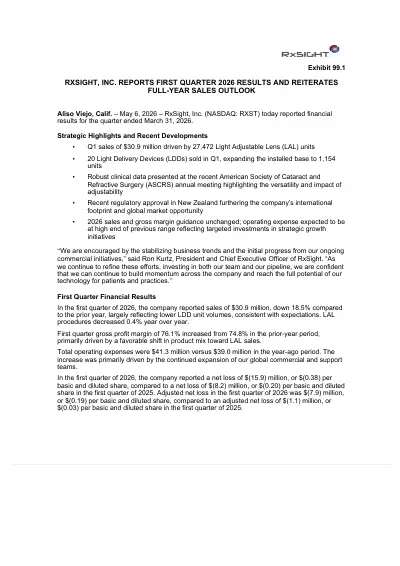
Thanks, Ron. Q1 sales of $30.9 million declined 18%, reflecting a year-over-year step-down in LDD unit volumes, consistent with expectations.
During the quarter, we sold 20 LDDs, which accounted for approximately $2 million of quarterly sales. We exited the quarter with an installed base of 1,154 LDD units.
Q1 LAL unit volumes of 27,472 were in line with the year-ago period and down 4% sequentially. This sequential decline was consistent with typical first-quarter seasonality.
LAL procedure volumes translated into Q1 sales of approximately $27 million, which represented 88% of total company sales in the first quarter. Higher LAL revenue mix contributed to a gross margin of 76.1% compared to 74.8% in the prior-year period.
First quarter 2026 SG&A expenses were $31.9 million, up 11% compared to the prior-year period, driven by personnel-related expenses as we continue to prioritize investments in new hires and ongoing expansion of our global commercial and support teams. First quarter research and development expenses were $9.5 million, down 9% year-over-year.
We reported a net loss in the first quarter of $15.9 million, or 38 cents per basic and diluted share, based on 41.3 million weighted average shares outstanding. Stock-based compensation was $7.9 million, resulting in an adjusted net loss of $7.9 million, or 19 cents per share.
Turning to 2026 guidance, we are reiterating our full-year 2026 revenue guidance of $120 to $135 million. Consistent with our February commentary, we anticipate that quarterly sales growth rates should improve throughout the year, based on our assumption of improving fundamentals and easing year-over-year comparisons.
As Ron discussed, we expect our international business to be a modest contributor to sales in 2026, primarily driven by early capital placements. We will continue to expand in the US out- outside the U.S.
in a measured and deliberate way to position the company for sustainable long-term growth. 2026 gross margin guidance of 70 to 72% also remains unchanged.
As previously communicated, the anticipated step-down from Q1 gross margin reflects the flow-through of higher-cost inventory manufactured in 2025. Over time, we expect manufacturing absorption to improve as production levels normalize.
We are forecasting 2026 operating expenses to be at the high end of our previous $150 to $160 million range, reflecting accelerated investments in our global commercial organization. From a phasing perspective, we expect quarterly operating expenses to follow a pattern similar to 2025, with more pronounced spend in the first half of the year.
Included in our costs, primarily in operating expenses, we continue to expect non-cash stock-based compensation in the range of $30 to $32 million. With that, I'll turn the call back to Ron.
Ron Kurtz
Thank you, Mark. In summary, the core clinical value proposition of LAL remains strong and clearly differentiated in the premium IOL market, with the ability to customize vision after surgery delivering superior patient outcomes and compelling economic benefits for practices.
Despite the introduction of numerous me-too fixed IOLs, nothing we are seeing changes our conviction that adjustability represents the next meaningful step forward. When I look at where we are today, the business appears to be stabilizing and our customer re-engagement programs are beginning to show initial progress, giving us confidence to continue refining the model and expanding it globally in a measured way.
At the same time, we're focusing on strengthening our team, improving execution, and driving technical innovations that further simplify implementation while delivering best-in-class outcomes. We look forward to sharing additional details on these planned commercial introductions that can help reduce adoption friction for both clinicians and patients by streamlining the clinical workup for post-op adjustments, reducing the number of required LDD treatments, and extending the range of correction.
With that, I'll ask the operator to open the call for questions.
Operator
We will now begin the question-and-answer session. Please limit yourself to one question and one follow-up.
If you would like to ask a question, please press *1 to raise your hand. To withdraw your question, press *1 again.
We ask that you pick up your handset once asking a question to allow for optimum sound quality. If you are muted locally, please remember to unmute your device.
Please stand by while we compile the Q&A roster. Our first question comes from Robert Marcus with JP Morgan.
Your line is now open. Please go ahead.
Robert Marcus
Great. Good afternoon and thank you very much for taking the questions.
It was good to see that you were able to kind of find footing and deliver a modest beat against consensus here. Maybe speak to what you're seeing in the field and how some of the elements of the turnaround are taking, how the reception is, and do you see any green shoots maybe into second quarter of continued improvement here?
Then I have a quick follow-up.
Ron Kurtz
Thank you, Robbie. I would say that, without commenting on Q2, which we're obviously in, the feedback that we're getting both from our customers and just as importantly from our team is very positive as we continue to roll out re-engagement programs, as I described, around some very specific actions, where we're able to review clinical outcomes and pearls that have been gained over the past several years as the technology's been rolled out across the U.S.
We now have confidence that continued refinement and expansion of those programs can result in further turnaround in terms of utilization with our customer base, which is quite large, as you know.
Robert Marcus
As I look through the year, it implies basically modest sequential improvement. How do you feel about your ability to grow in 2027?
Beyond some of the changes, what are you doing to really reinvigorate interest in LALs to return to a material growth rate to generate profitability again? Thanks a lot.
Mark Wilterding
Robbie, it's Mark. Thanks for the question.
We said that our expectation is for growth rates to improve over the course of the year, and it's a reflection of both our belief that fundamentals will improve based on some of the things that Ron just talked through, as well as easing comparisons. With respect to growth in 2027, we haven't, as given guidance that far out.
We think of ourselves as a growth company. We invest for long-term sustainable growth, and that includes 2027 and beyond.
Ron, anything else to add on that?
Ron Kurtz
I think the things that we've commented on, continued technological innovation, which will continue to simplify implementation of the LAL, both in the U.S. and then increasingly outside the U.S.
where we're starting to establish ourselves. I think both of those will be growth drivers.
I would also say that I wouldn't characterize what we've experienced as a lack of interest in the LAL. I think there's still quite a bit of interest in the LAL and we saw that, as I mentioned at the ASCRS meeting, where it continues to be a high area of interest in the medical community, but also at our booth with a lot of activity.
I think that it's focusing that interest into a growth through the programs that we've talked about.
Operator
Our next question comes from Ryan Zimmerman with BTIG. Your line is now open.
Please go ahead.
Ryan Zimmerman
Thank you and good afternoon, Ron, Mark, Oliver. Good to speak with you.
I want to follow up on Robbie's question a little bit. I'm curious, and this is a tough question, but how much do you think the stabilization in the LAL adoption is a reflection of just the cataract market holding steady, particularly on the ATIOL side, not deteriorating versus what we saw maybe a year ago relative to the efforts you're making in turning around commercial adoption?
I don't know if you can parse it out, but hoping you can kind of take a swing at that, Ron.
Ron Kurtz
As you indicated in your question, it's always hard to parse out what are all the contributors. I believe, based on the responses that we've gotten to date, that the actions that we're taking, all things being equal, are positive and are having an impact.
Of course, it's always great when the market is working in your direction as well, and we certainly hope that to be the case. Under the things that we can control, we think that we're having a positive impact and will continue to do so as we expand and refine these programs.
Ryan Zimmerman
Just to follow up, are you gating LDD sales at this point? Is there interest from customers that you're holding off on when you think about LDD sales, or is it just not prioritized amongst the sales force at this point?
Ron Kurtz
I would characterize as gating. I think that we are taking a more measured approach where we want customers to be fully ready to adopt the technology and to be successful with it.
Not that we weren't doing that before, but I think that just the novelty of the LAL and in those initial several years just drove a faster pace. Now we're into a more gradual, but still a lot of strong interest and we anticipate continuing to add LDDs, obviously OUS, but also in the U.S.
Operator
Our next question comes from David Saxon with Needham. Your line is now open.
Please go ahead.
David Saxon
Great. Hi, Ron and Mark and Oliver.
Thanks for taking my questions. Maybe one on guidance for Mark.
I think last quarter, you talked about expectations for low single-digit LAL volume growth for the year. You came in above consensus here in the first quarter, is low single digits a good way to think about 2026 or could we be pushing mid singles?
Then kind of the second part of the question is, where does that get us in terms of flushing out the higher-cost inventory, at low single digits, does that get us through all of that inventory that's on the balance sheet?
Mark Wilterding
Thanks for the question. I think it was, like I said, a little bit better than expected, but not to the degree where we felt like taking up guidance was warranted.
I think your assumption, based on what we said in February, is still accurate with respect to LAL growth being in that low single-digit range for the full year. Again, we expect growth rates to improve sequentially by quarter as we go through the year, as I mentioned earlier.
At this point in the year, too, it's always tricky, given where we're at kind of early to go out any further than that. I think it's good to take a more prudent approach, and that's what we've done there with that LAL guidance.
With respect to the inventory, no change to our assumptions there either. You see it primarily in that gross margin guidance that we gave.
We continue to believe that we'll finish the year in that 70 to 72% range. Q1, as expected and as communicated back in February, was not really impacted by some of those absorption issues, but we do expect them to show up in Qs 2 and for the remainder of this year.
We're monitoring it closely. We haven't said in terms of when that will lift and how that might look next year, but when we get closer to being in position to give guidance longer-term, we'll update that as well.
David Saxon
Thanks for that. Then the second question is just on the commercial pivot or re-engagement strategy.
Would love to understand what percent of accounts or territories you've gone out and actually implemented that, and then once you do that and get buy-in from the account, kind of how should we think about the resulting utilization in the months or quarters to follow? Thanks so much.
Ron Kurtz
I would say that we're still in early innings of reaching through the installed base, which is, as quite large, about 1,150 LDDs, 2,500 surgeons. That will continue throughout the year and into '27.
In terms of the results that we're seeing and what you would expect, of course, it'll be in the numbers that you'll see, it'll be more gradual because it has to extend through the installed base. On an individual basis, we are certainly seeing the impact and feel as though, as we continue to make refinements to both the programs and how we implement them, I think that that'll continue to accelerate.
Operator
Our next question comes from Larry Biegelsen with Wells Fargo. Your line is now open.
Please go ahead.
Larry Biegelsen
Good afternoon. Thanks for taking the question.
Ron, one domestic question, one international question. How are you thinking about increasing competition from premium IOLs?
We know of a few more coming this year, PureSee obviously from J&J, there's a BVI product, I think, Rayner's coming out. How have you incorporated that into the guidance?
I had one follow-up.
Ron Kurtz
Good question, Larry. I think that, fundamentally, there's not a lot new under the sun in terms of these new product introductions.
Of course, having multiple players in the marketplace, even if they have undifferentiated product, it still means that there's more voices out there. We're watching it, but we feel strongly that the clinical outcomes that are achievable with adjustability are superior and ultimately will win the day, though there can be, as there have been with past introductions, some transient impact from these efforts and the overall impact they have on other competitors as well.
Larry Biegelsen
Okay. Then, regarding international, I'd love to get an update on your international efforts.
Where are you starting to see some early kind of traction, if you will? When you say modest contribution, I think I heard modest contribution earlier on this call in '26, is that like $5, $10 million?
Thanks for taking the question.
Ron Kurtz
I'll let Mark comment on the dollar figure, but in terms of where we've previously said where we've gotten approvals, obviously that's the first step before you have a commercial introduction and then traction. We've had the most recent approvals and where we've been able to start primarily been in Asia, yeah, with Korea and smaller market Singapore, but an important market.
We just got approval in Europe more recently. Those efforts are starting as well, beginning to gain traction, especially in awareness across the larger countries in Europe, and then even more recently in Australia and now New Zealand.
I would say that those countries pretty well mirror where the premium IOL business has had the most success. We often see new product introductions follow a very similar pattern of introduction in countries like the major countries of Europe, Korea, Australia, etc.
Obviously, the countries with longer regulatory cycles that are still important, Japan, China, and India, those we're working through those processes.
Mark Wilterding
Just with respect to quantifying it, Larry, I know this is a question you've asked in the past. The team is working and driving hard there.
Great team in place, but it's not yet in terms of dollar amounts at a point where we feel like it's material enough to break out. When that changes, and it will, at some point in the future, we'll be sure to give you an update.
Operator
Our next question comes from Stephanie Elghazi with Bank of America. Your line is now open.
Please go ahead.
Stephanie Elghazi
Hi, thanks for taking the question. A competitor just reported recently and noted softness in the cataract market, curious if that's something you're seeing in the market overall, but maybe you see less of an impact given your premium offering.
Just curious any thoughts there.
Ron Kurtz
I think that the size of that competitor relative to ours gives them a lot of visibility on the overall market. I do think that their comments were more towards the non-premium segment of the market, the traditional cataract surgery portion of the market, and that they also noted continued growth in the premium segment, both in the U.S.
and internationally. Those would be consistent with our long-term view as well, based on the both clinical and economic benefits of premium IOL technology generally and more specifically, the LAL.
I don't think that we're seeing anything inconsistent. We saw some softness of the overall cataract market a year ago as well, and at that time, I think some people postulated whether those were some more macro affected because the patients in that sub-group do still have to pay copays, which can be relatively expensive depending on the demographic.
It's possible that that's impacting that segment first.
Stephanie Elghazi
Got it. Thank you.
Then wanted to follow up on the OpEx guide now pointing more towards the higher end of the range. Just curious what are the main areas of investment that are increasing, and how do you think about OpEx and time to benefit the top line?
Thank you.
Mark Wilterding
I think I just reiterate a little bit of what Ron had mentioned earlier with respect to the OpEx guide. We are very focused on providing what I'd say are the highest levels of clinical training and field support both here in the U.S.
and also abroad, and that requires investments. Supporting new and existing customers focused on penetrating these accounts is really key.
As a result, we're definitely focused on directing more resources towards things like that, in addition to customer support, education, sales and marketing, and also advancing our R&D pipeline, something that we've invested in for some time and not letting up there either. Those are the primary avenues of investment, I'd say, as you see that OpEx trend towards the higher end of the range.
Operator
Our next question comes from Adam Maeder with Piper Sandler. Your line is now open.
Please go ahead.
Kyle Winborne
Hi, this is Kyle Winborne on for Adam. Thanks for taking the questions.
I guess first, maybe just to continue on that thread with OpEx, maybe could this be a good opportunity for you to just remind us where the company sits today from a commercial headcount standpoint? It sounds like the plan is to maybe continue adding headcount, if I'm correct there, and then, should we kind of just think about OpEx kind of running at this pace for the foreseeable future while these efforts continue?
Then I have a follow-up. Thanks.
Ron Kurtz
We have about 150 fields, 130 to 150 field-facing employees, and we anticipate that, and that's continued to grow with our installed base, as well as with the more recent initiatives that we've talked about. Certainly we'll be making decisions based on both the success of those initiatives as well as other priorities in the business as to where we prioritize the additional spending, but that's always an ongoing decision that we have to manage.
Kyle Winborne
That's helpful color. Thank you.
I guess for the second question, you talked about innovation a little bit and gave some helpful color there for things on the come. Just wondering if you could double-click on any of those, anything that's particularly meaningful, and you mentioned that we might hear about some of those from later this year, it sounds like we should think about this as more having impact as we look into 2027?
Ron Kurtz
I would say that the things that I've mentioned are all things that have been seen as benefits to the technology moving forward, for quite some time, and they're areas that we've been working on. Those efforts take time.
We're a class III device, we have to go through the PMA supplement process, which we are. As we have visibility to commercialization, we will certainly share that and give visibility both to the investor community as well as to our customers.
Operator
Our next question comes from Young Li with Jefferies. Your line is now open.
Please go ahead.
Young Li
Great. Thanks for taking the questions.
I guess first one just on the customer re-engagement programs. Was wondering if you can share a bit more about what you're doing there with the practices.
You called out a few examples, but what's resonating more with the surgeons and their staff? What are the key issues that practices need your help in solving?
Ron Kurtz
I think it is variable, of course, depending on the practice. That's where our team is really key in assessing and discussing with the practice what are the most likely measures that are going to make them more successful, which is going to help them both clinically and financially.
It has to be viewed as a mutual benefit, and that's how I think it is being viewed and appreciated by our customer base that we're continuing to invest in their success. The specific measures that I mentioned, we have this unique ability to be able to track clinical results on essentially every patient, but that information is sometimes siloed in the practice.
Making clear to the entire practice, both optometrists who might be doing the LDD treatment, ophthalmologists who may not be seeing that post-operative patient as frequently, as well as the staff who may not be into the details, the clinical staff and the surgery counselors, just making that information more widely available, which we can uniquely do, is very motivating to see how impactful the adjustability is to the lives of their patients. They see that anecdotally, but to see that in a quantitative way, which again, no other IOL really can do other than doing a clinical study, which is typically not practical.
The other things that we're doing really depend on the practice. It can be workflow pearls that have been gleaned from peer practices that may be similar size, similar makeup, similar socioeconomic base, and how do they have the post-operative visits flow, the division of labor, how expectations are set and handled throughout the process.
These are all clinical skills and practice skills that didn't exist 5 years ago, and we and our customers have figured a lot of this stuff out, and now we have to go back and disseminate that information in various ways. Whether that's through our direct interactions with the practices, or whether it's through peer-to-peer interactions, or digital media, those are all ways that we're engaging with our customers.
Young Li
All right, great. That's very helpful.
Then I guess another question just wanted to hear a little bit on accounts that bought LDDs in the past year, or past three quarters, the ones with the 20 to 25 LDDs, versus prior periods that bought 70-plus per quarter. I'm just kind of curious, just given there's sort of less of them, presumably more focused or more motivated buyers, do you see any differences in their utilization or adoption curves from prior periods or cohorts?
Ron Kurtz
It's a good question. I think it's a little early, we're dealing, as you said, with the smaller N, and so we'll continue to track that.
Of course, we are incorporating all the things that we're doing with the re-engaged practices in our onboarding as well. Hopefully, we'll see those benefits in that group as well as we progress with their onboarding.
Operator
Our next question comes from Tom Stephan with Stifel. Your line is now open.
Please go ahead.
Tom Stephan
Great. Hey, guys.
Thanks for taking the questions. Apologies if any of this has been asked, just jumping between calls.
I'll start off on kind of competitive landscape, but more specific to adjustable. Ron, what's the latest you're hearing around adjustable competition, any incremental updates we should be aware of and curious if you can touch on Perfect Lens, which I think is expanding in Europe?
Then I'll have a follow-up.
Ron Kurtz
I don't have any specific updates. Obviously, we follow the field.
I would say that, to my knowledge, there's nothing getting close to a regulatory process, certainly not in the U.S. We know how high the bar is, and we've continued to raise that bar.
Then in addition to that, of course, we've got a large installed base and have got a lot of knowledge that has been developed in the community based on our technology. I don't want to be dismissive of competition.
I think people should be realistic about what the time scale of any potential competition could be.
Tom Stephan
Got it. That's great.
Then maybe to pivot a bit to, call it sort of the long term, but as you look at or think about utilization curves, adoption interest, how re-engagement is going here in the U.S., Ron, talk about your level of confidence today that LAL isn't niche in the U.S. and, more importantly, can perhaps durably grow above market over time and continue to gain share long term?
Thanks.
Ron Kurtz
I guess we referred earlier, I don't know if you were on the call, Tom, but somebody referred to one of the large competitor who also reported today, and of course, we listened to that call as well. I think that it was instructive in that they pointed out again, and they've done that before, that the premium market is incredibly important to ophthalmology.
Just the time spent on the premium market was impressive, even though it's a relatively small portion of the business for them. They projected that their view is that that premium market is going to go from the current 15 to 20%, depending on geography, to maybe the 30 to 40.
I think that that's probably accurate. They have good view on that.
Then where is that growth going to come from? We've had the multifocal technology and standard toric technology for 20 years.
It's got to come from somewhere, and I think that the LAL is unique in that it's broadly applicable to patients because it does preserve quality of vision, it's very flexible, and it appeals intuitively to this next generation of patients who not only want to maintain their function throughout many conditions, but they also want to have control and an input in the process. Those are all things that I think play well to the LAL and will help the field drive growth into that higher number.
Operator
There are no further questions at this time. I will now turn the call back over to Ron Kurtz for closing remarks.
Ron Kurtz
Thank you all for your interest in RxSight. We certainly look forward to updating you on our progress in future quarters.
Goodbye, and good evening.
Operator
This concludes today's call. Thank you for attending.
You may now disconnect.