SCOR SE
Q3 FY2026 · Earnings Call TranscriptOctober 30, 2026
Operator
Good afternoon, ladies and gentlemen, and welcome to the SCOR third quarter 2026 results conference call. Today's call is being recorded.
There will be an opportunity to ask questions after the presentation. In order to give all participants a chance to ask questions, we kindly ask you to limit the number of your questions to two.
At this time, I would now like to hand the call over to Mr. Thomas Fossard.
Please go ahead, sir.
Thomas Fossard
Good afternoon, everyone, and welcome to SCOR Q3 2026 results conference call. I'm joined on the call today by Thierry Léger, Group CEO, and Philipp Rüede, Group CFO, as well as other COMEX members.
On slide two, can I please ask you to consider the disclaimer of the presentation, and now I would like to hand over to Thierry.
Thierry Léger
Thank you, Thomas. Hello, everyone.
Thanks for joining the call. Before turning to our results, I would like to express our deepest sympathy to everyone affected by the tragic train accident in Spain.
Our thoughts are with those who have lost loved ones, the injured, and their families. We are pleased to report a strong and clean set of results for the third quarter this year.
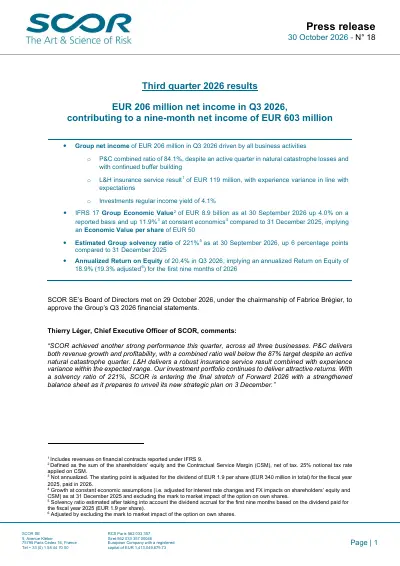
Group net income reaches €615 million in the first nine months, corresponding to an annualized return on equity of 19.3%. We achieved this despite increased competition in P&C, a negative one-off arbitration impact in life and health in the second quarter, and continued buffer building in P&C.
Our solvency ratio stands at 221%, up 6 percentage points compared to year-end 2025. This reflects the elevated operating capital generation of all our activities.
Year to date, economic value growth is 11.9% at constant economics, well above our 9% annual growth target set under Forward 2026. P&C delivered a strong combined ratio of 81.3% in the first nine months.
The attritional loss ratio is at an excellent low level, allowing us to build additional buffer in our reserves. This demonstrates the quality of our highly diversified P&C portfolio.
In life and health, performance has been in line with our expectations for seven consecutive quarters now, since the reset in 2024. That consistency strengthens my confidence in the quality of our life and health portfolio and its assumptions.
Investments continue to provide a stable and positive contribution to group earnings. Based on this strong set of results for the first nine months, I see SCOR well positioned to achieve our targets as we enter the final quarter of our three-year strategic plan.
Our teams are now fully focused on the 1st of January 2027 renewals. We expect competition to remain high and have a clear priority for our underwriters: margin and quality over volume.
Over recent years, we have strengthened our capital discipline, remaining very selective and deploying capital only when risk return is attractive. In recent years, for example, we announced that our direct insurance business would exit US casualty and space.
These lines of business lack adequate margins, and their negative outlook remains unchanged. Our Tier 1 franchise, technical expertise, and strategic allocation of capital to diversifying and profitable lines of business position us well to navigate market headwinds.
They also provide a strong foundation ahead of the next strategic cycle. Let me now address the recent events in France.
Over the past two weeks, France has experienced social unrest and political turmoil. Based on our current assessment, we expect the impact on SCOR to remain limited and manageable.
SCOR is a leader in the French market, and one-quarter of our workforce is based here. At the same time, our business is well diversified.
We are operating in more than 150 countries. We have a very conservative investment strategy, and our exposure to France accounts for approximately 5% of the group underwriting revenues.
Looking ahead, we will present our new strategic plan on 3rd of December as we enter a new strategic cycle. Building on the solid foundations we have put in place through Forward 2026, SCOR is in a much stronger position today and can aim higher.
We look forward to sharing our strategy with you, hopefully in person, in London soon. Philipp, over to you.
Philipp Rüede
Thank you, Thierry. Good afternoon, everyone.
Welcome to the presentation of SCOR's Q3 2026 results. The key message today is simple: SCOR continues to deliver on its Forward 2026 strategic plan and is approaching its next strategic chapter from a position of confidence and strength.
I'm particularly pleased that all three of our business activities delivered very strong results this quarter. Group net income reached €206 million for the quarter.
This translates into a Q3 ROE of 20.4%, well above our Forward 2026 target of 12%. Turning to P&C, we deliver a solid quarter despite several nat cat events.
The nat cat ratio remains within budget at 9.1% over the quarter, absorbing the impact of the Colombian earthquake, as well as several smaller events, including storms in Europe, fires in France, and the flood in Bangkok. As we always take a prudent approach when opening loss estimates for nat cat.
The combined ratio stands at 84.1%, below our 87% target, supported by a strong attritional performance, while we continue to build buffers. This performance clearly demonstrates the resilience of our P&C business.
We are also pleased with our P&C insurance revenue, which is up at constant FX by 2.3% and at current FX by 3.5%, respectively, supported by strong 2025 and 2026 renewals. This performance comes despite continued EGPI revisions, although they were smaller this quarter.
Over the first nine months, we maintain a stable new business CSM in P&C of 1.12 billion, a robust performance in the current soft market environment. On the one hand, we are benefiting from good business volumes and we are ceding less margin to our retrocessionaires, and on the other hand, this is offset by reduced margins on the assumed side.
Now Q3 new business CSM mostly reflects the timing of retrocession recognition, I invite you to look at the nine-month period. In life and health, performance continues to be in line with our expectations.
The insurance service result stands at a strong €119 million over the quarter, and includes a positive experience variance of €12 million. Both on a quarterly and a nine-month basis, the new business CSM in life and health is increasing year on year.
In investments, we continue to benefit from the higher interest rate environment. Our regular income yield reaches a high of 4.1%, and this is partly due to a larger private equity fund distribution this quarter, which is not recurring in nature.
The return on invested assets stands at 3.7%, while the reinvestment rate is attractive at 5% as of the 30th of September. SCOR's economic value stands at 8.9 billion, an increase of 11.9% at constant economics over the first nine months of the year.
Our balance sheet continues to strengthen, and our solvency ratio now reaches 221%, supported by a strong underlying capital generation year to date. Overall, Q3 sustains the strong momentum of recent quarters.
With all three business activities delivering strong results, we are entering the final phase of Forward 2026 with full confidence in our ability to deliver. Let's now move to Q&A.
Over to you, Thomas.
Thomas Fossard
Thank you, Philipp. Operator, we can start the Q&A, and we'll take the first question.
Thank you.
Operator
Thank you, sir. We will now begin the question and answer session.
Anyone who wishes to ask a question may press star and one on their touch-tone telephone. To remove yourself from the question queue, please press star and two.
First question is from Shanti Kang, Bank of America.
Shanti Kang
Hi. Thanks for taking my question.
Good afternoon. Just on the attritional loss ratio, that looked very strong, and that still included the buffers that you mentioned.
I guess that implies that the underlying run rate is even better. I was just wondering if you could help us quantify the additional buffer build that you've done here.
I presume that was on IBNRs and perhaps which lines they might have been distributed on. Then to follow that, I think at 1H you suggested that the very strong attritional performance should support earnings for several quarters forward.
How much visibility do you think that gives you on maintaining the combined ratio into 2027 despite the rate softening that we're seeing? Thank you.
Philipp Rüede
Thank you. For the second question, we continue to message that we think that we will still be able to build buffers into the future, but beyond that, I will have to refer to the CMD.
Then on your first question, with regards to the buffer build, we wouldn't comment on a quarterly basis, but I'll let Jean-Paul maybe add some commentary on the, as you rightly say, very strong attritional performance.
Jean-Paul Conoscente
Thank you, Philipp. I think this quarter was again quite active in terms of losses.
The loss environment, you have the Qatar energy loss in the Middle East. You had a few other energy and other man-made losses this quarter.
The good attritional performance is a reflection, first of all, strict underwriting discipline and deploying, I'd say controlled limits on high-risk areas. Secondly, very good price adequacy of the portfolio that we've underwritten in 2025 and 2026 earning through.
2026 despite the price decreases, as we mentioned before, we estimate the deterioration between '25 and '26 to be limited to approximately two points of combined ratio, and that's what we continue to see in the results so far.
Thierry Léger
Shanti, if I may add on the attritional, you might remember 2023 was the first year where, from an underwriting basis, the market really hardened dramatically. Despite that, on an earned-through basis, on an accounting basis, the attritional was still relatively high.
We have voiced that multiple times. In 2023, almost every quarter we said we are not satisfied, but I also emphasized that I expect slowly the more healthy environment to trickle through our accounting results.
What we see here is, yes, on the one hand, the results have deteriorated a little bit from an underwriting perspective, but they're still on a good level, and they still take time to trickle through the attritional. We always expect the attritional to be relatively sticky over time.
Shanti Kang
Thanks so much. Thanks.
Thomas Fossard
Thank you, Shanti. Can we move to the next question, please?
Operator
Next question is from Kamran Hossain, J.P. Morgan.
Kamran Hossain
Hi. Good afternoon.
Thanks for taking my questions. The first one is something you might not be able to give us exact details on right now, but you're obviously deep in the weeds on putting together the CMD plans.
As you said in your commentary, SCOR's in a much, much, much stronger position than it was, kind of a few years ago. The difference is kind of night and day.
Just wanted to kind of think about it in that you saw a peer who basically put out a strategic plan at the end of last year and I think we were all caught by surprise on how quickly some things got worse. Do you think when you're thinking about your new plan, you'll reflect a multi-year softening in the market and in your guidance, just trying to understand your thought process on what that might look like because I know you are quite a cautious guy.
The second question is on just an updated view on pricing. Clearly, at Monte Carlo everyone expected prices to go down.
Hurricane season has been a record quiet. Just interested in any kind of updated view on pricing, particularly in property cat, since Monte Carlo.
Thank you.
Thierry Léger
Kamran, I will take your first question and then Jean-Paul will cover the second. Thanks for the night and day comparison, and it's a little bit how it feels.
We do actually feel, as we said, in a much better position now. We are obviously eyes wide open with regard to the softening market on the P&C side.
We have a strategy. We have said it multiple times.
It's about diversifying growth in a market that we still see as attractive opportunities for us. When we look ahead, of course, you will have to wait for the CMD, but when we look ahead, we absolutely take into account the further softening in our prediction.
We absolutely don't assume a blue sky scenario that will most probably never happen. You have to expect us to come up with something very realistic, taking into account the current market environment.
Don't forget, however, there is also a life business that is important for us. There's an investment side that is important for us.
We will obviously have a plan not just in P&C, although a lot of focus is on that side. I can't emphasize enough how we see opportunities as well on the life and health side.
Kamran Hossain
Thank you.
Jean-Paul Conoscente
On your other question, it's still very early in the process. I think what we're seeing in terms of the treaty renewals, generally globally, it's a very late renewal, with many submissions not even yet sent to reinsurers.
On the few that we've seen so far, and discussions we've had in Baden-Baden and the last month, the focus has been really on pricing, and given the good, as you said, loss experience, we expect there to be continued pressure on pricing in cat in particular. Right now, it's a few European countries that are being quoted and probably final terms.
Here, we see price decreases, I'd say high single digit, low double digit is what we're seeing so far.
Kamran Hossain
Thanks very much.
Thomas Fossard
Thank you, Kamran. Can we move to the next question?
Operator
Next question is from Andrew Baker, Goldman Sachs.
Andrew Baker
Hi, thank you for taking my questions. First one, can I just come back to the attritional?
Clearly really strong, and thank you for outlining some of the drivers. I guess you didn't mention anything on mix effects.
Are you getting any material benefits coming through from the growth in the nat cat exposure this year? I guess if you are, why haven't we seen any offsetting impact from an increase in the cat budget?
Then, secondly, again still on P&C Re, if that's okay, are you able to just help me with the direction of the CSM amortization? It looks like year to date it's down about 7%, 3Q it was down 12%.
I appreciate there's probably a lot of moving pieces here, but can you just help me understand sort of direction of this CSM amortization on the P&C Re side? Then hopefully if I can just squeeze a third one in, on the life and health re risk adjustment, I notice this one declined from about 2.5 billion at full-year '25 to 2 billion at nine months, and 3Q again standalone declined.
Again, any help on understanding what's driving this would be really helpful. Thank you.
Thierry Léger
Andrew, we'll take the first one and Philipp the second and third. Jean-Paul, feel free to add.
On the attritional, absolutely the mix effect is there. It's a minor effect, but it has a positive impact for us, but it's not mainly because we grow into cat.
It's more visible because we actually don't grow or even shrink casualty US. That has the major mix impact.
We also profit from other lines where actually the development is quite nice. The shift that you mentioned to cat is not as dramatic as you would think.
We have been very clear with Jean-Paul that, on a net basis, we keep the ball relatively flat. There is some increase, but it's not changing the 10% guidance that we gave.
On the CSM side, Philipp.
Philipp Rüede
Maybe first on the life and health risk adjustment. This is actually mostly driven by foreign exchange and interest rates.
The risk adjustment follows our internal model, and the internal model, as you would expect, since that's the present value of future cash flow, is quite sensitive to interest rates and FX. Then a part is also the normal release of the risk adjustment as the uncertainty reduces over time.
This is kind of fully in line with what we would expect given the links to the economic environment, yeah. Then I have to say, for the CSM amortization in P&C, you would need to look at it on a nine-month basis, but I have to say we will get back to you on the exact figures.
We don't have it right now.
Andrew Baker
Perfect. Thank you so much.
Thierry Léger
Andrew, I just wanted to add to the attritional just a second because I said it has a minor impact, the mix, right, which is true, but the key impact is coming from the quality of the portfolio, just simply a portfolio that reflects the healthy nature of the business we have written in the last two years.
Jean-Paul Conoscente
Maybe just to add to this, as Thierry mentioned, we're taking an underweight position, I'd say proactively, on the US casualty given what we view as the price inadequacy. The rest of the portfolio is very well spread across different lines of business, and so when we have loss activity, it very rarely happens across all lines of business, and this is how we're generating the good attritional performance.
Andrew Baker
Thank you.
Thomas Fossard
Thank you, Andrew. Can we move to the next question?
Operator
Next question is from Vinit Malhotra, Mediobanca.
Vinit Malhotra
Yes, good afternoon. Thank you.
I'll just pick up one on the attritional again, apologies for that. It is a temptingly strong number, thank you and congrats.
One on attritional and one on the revenue trend. On the attritional, I think so my question is that the very strong print we are getting if we clean up for the prudence, maybe 72, 73 range attritional, is coming also from P&C being strong in the last two years and last time you commented that there was some pressure in Florida, but not really outside.
I'm just curious, and now you said Baden-Baden was mostly about pricing. I'm just curious, how should we read this P&C situation today?
Is it in fact that it is an important part of the strength that we can see, and are you seeing that people are holding up their discipline in P&C? That's my first question.
Second question is revenues between reinsurance and SPS, the trends were quite opposite to the previous quarter. I'm just curious if so we understand the cedent updates or EGPI revisions are better in Q3 versus Q2 or Q1 even.
Is there something structurally that explains that? Also on SPS, is that something we should know about this trend of slower growth because at Q2 I think the expectation was laid out that it will be a bigger number in terms of growth on SPS.
Sorry for that two topics, please. Thank you.
Jean-Paul Conoscente
On your first question, which was very broad, again, I'd say the renewal discussion really varies by line of business. We see some lines of business that have been loss-affected, for example, marine, energy, war, political violence.
There, the significant price increases, others that have been less loss-affected, there's pressure on pricing. It's really a matter of seeing where we are today from a price adequacy point of view and how much additional price is required or how much reductions are acceptable.
It's hard to give you an answer, Vinit, because it really varies by country, by line of business, but that's, I'd say, typically what we do every renewal. Overall, in the renewal update, we give you the overall view, which is sort of the agglomation of the price change by line of business and the portfolio mix effect.
That gives you a good idea overall. The outlook for '27 as it stands today, but we'll confirm this in a few months' time, would be something in line with what we saw in '26 so far.
On your second question, in terms of revenue, I think the revenue you saw this quarter is coming both from reinsurance and SPS. Reinsurance is the result of the strong renewals that we've reported on, this is consistent with what we saw.
Prior quarters were affected by EGPI revisions. This quarter, less so.
The EGPI revisions continue to be an issue for clients going forward, we're adding some conservatisms in our own EGPI estimates, and we take typically a haircut over what the clients will be estimating. This gives us a prudent vision of where EGPI will be going forward.
On the SPS side, the portfolio has been very concentrated in short-tail lines: in property, energy, construction. Those are the lines on the insurance side that have been the most under pressure in terms of rating.
That was the effect we saw at the beginning of the year. There's been a strong push from the teams to try to diversify the portfolio in other lines of business, and what we see in this quarter is basically a result of that diversification.
The expectation for SPS going forward will still be some growth. Have to remember that we exited a few lines of business, how that translates in the first quarters of 2027 will be affected by these exits, but overall the trajectory is for SPS to continue to be a good driver of revenue growth.
Thierry Léger
One additional thought, Vinit, I wanted to leave with you is to also think about retro. That we are large user of retrocessions, actions that we take on that side have an impact on our net margins and net revenues.
You have to expect that in this current market environment, we will be very active users of that to optimize our revenues and margins.
Vinit Malhotra
Perfect. Thank you very much.
Thomas Fossard
Thank you, Vinit. Can we move to the next question, please?
Operator
Next question is from Benoit Valleaux, ODDO BHF.
Benoit Valleaux
Yeah. Hi, good afternoon.
Thank you for taking my question. The first one is regarding still a follow-up on renewals.
When I look at Solvency II margin at the end of September, it seems that there is no real impact coming from any review on your expectation regarding January 1st renewal because in the past, we saw a few years ago, for example, that Solvency II is a 12-month forward view. Maybe I would say expectation on January 1st renewal might lead to have some impact on some gap on Q3 solvency margin versus Q2.
It's not the case this year. Can you confirm that there is no impact on renewals, even if it's late renewals, as you said?
At this stage, you expect these renewals to be broadly in line with your initial expectations. Two very short questions on tax rate, which returned to a bit more normal level Q2, [unclear] tax rate going forward, or is it still a bit too early?
Thirdly, regarding your asset allocation, do you plan to change anything in terms of breakdown between govies, corporate bonds, and whatever due to recent change in interest rate and spreads? Thank you.
Philipp Rüede
On the first one, your question is about the impact on solvency of renewal of the next plan, and there's no impact of any kind of that. Maybe just if we look at Q3, first of all, we didn't have good luck on the nat cat side, and we still accrue the dividend as we in any quarter, and the new business on the P&C side is light.
The 221 is absolutely in line with our expectation, considering that in terms of capital generation, this is typically a low quarter from that point of view. Then I'm sorry, you broke off a tiny bit when you asked your question on the effective tax rate, but what you see in this quarter is essentially driven by what we started in the second quarter, which is reducing our valuation allowance on the French deferred tax assets, and therefore you observe a lower figure as a result of that.
If I misunderstood your question, please clarify.
Benoit Valleaux
No, my point was just to know what could be a normalized tax rate going forward now. Do you have a view on that or is it...
Philipp Rüede
Yes, I have a view that we might share at the Investor Day.
Benoit Valleaux
Thank you.
Philipp Rüede
Good. Then on the asset allocation, no, the current interest rate environment would not have any impact on our strategic asset allocation or our likeness or dislikeness of risky assets.
We remain comfortable with our conservative investment portfolio. What you see is a bit more consequences of our ALM, where I remind you that we lengthened the duration, and to lengthen the duration, we had to buy certain government bonds.
It's a bit more driven, on a more granular level, it's driven by ALM. Just to remind you that we have no exposure to French government debt.
Benoit Valleaux
Thank you very much.
Thomas Fossard
Thank you, Benoit. Can we move to the next question, please?
Operator
Next question is from Iain Pearce, BNP Paribas.
Iain Pearce
Hi, afternoon. Thank you for taking my questions.
The first one's just on the impact of the retro that you flagged on the new business CSM. Can you just run me through this?
Because I don't really understand the seasonality point and why the retro is sort of negative for new business CSM. The second one is on life.
The life operating cash flow in Q3 looks super strong. Could you just flag sort of what's driving that?
Obviously, it's the first quarter we've had sort of post the Covea arbitration, anything sort of one-off in there, just sort of give us a bit of an idea for sort of what's been going on in the life cash flow number. Then the third one's a bit more of a general one, but obviously you're sort of seven quarters removed from the life reset, with generally sort of pretty solid experience variance since then.
Are you at a point now where you feel confident that that reset was sufficient, and that you're happy to grow? How long do you think you have to wait to see no negative experience variance before you're sort of confident that those assumptions are solid in the businesses and got strong footing to grow?
Thank you.
Philipp Rüede
On the P&C new business CSM, as I tried to already frame in my intro, you need to look at it on a year-to-date basis, because the timing between when we book the assumed new business CSM and when we book the retro new, well it's also new business CSM, but outwards, there's always kind of some timing effects between the quarter. Sometimes it's just not in sync exactly for multiple kind of reasons.
There's just noise in there, nothing more than you should read in it. I would just look at it on a year-to-date basis to take out some of that noise.
Then, just to remind you that when you looked at our communication in terms of the renewals, we said that the net deterioration was around two points and the gross was around one point, it does buffer some of the softening in the market as you can see when you look at the nine-month period. Then on your life and health cash flow question, indeed, that is a good question.
The cash flow is really volatile from quarter to quarter, some of the timing issues between premiums and claims and ordinary business cash movement. Inherently, there's a lot of volatility.
The Covea arbitration is only a small portion of the overall cash flow, you should not read into that a new run rate, rather that there is volatility, but, of course, on the positive side, we are now quite confident that in 2026 we will reach our objective of a neutral or positive cash flow on the life and health side. However, right, I would say, in isolation, it is really not a good indication for the distributable cash generation at the holding level.
As a matter of fact, a lot of our US business is in subsidiaries and therefore does not translate immediately in either direction in distributable cash at the holding company.
Thierry Léger
I suggest that Pilar answers your second question on life and health around where the business stands, the opportunities. It's true that so far we had a good run, and so Pilar, the question is, do we expect that to continue?
Pilar Santamaria
Yes indeed. We are satisfied with the set of results we are achieving this quarter, which is the continuation of a very positive year.
I think there are several positives that we need to take into consideration. The new business CSM is evolving very well.
Actually, if you compare the three quarters in 2026 with the previous year, you can observe that the business is growing, but as well the business mix within the new business CSM is as well improving, directionally following the focus that we want to take, which is reducing protection, increasing financial solutions, increasing longevity, and this can be seen in the mix. This quarter, the new business CSM, it's aligned with expectations, and actually it's incorporating a good contribution from financial solutions, despite typically Q3 is quieter, but it's a good indicator of how focused the teams are.
We said that it was going to take some time, right, to make financial longevity increase, however, we are very satisfied seeing the market dynamics, and we are very confident on the pipeline that we are building in. At the same time, the ISR is strong this quarter, all in all, we are quite confident on how the year could look like for life and health.
Thierry Léger
Thank you, Pilar. On your last question, Iain, we are, as you mentioned, now in the seventh quarter after the life and health reset in 2024.
At the time, I was very clear that we would want to wait eight quarters, one quarter more, and we said if during those eight quarters we will see a steady, in-line development of our business, we would really be finally comfortable with our assumptions that we have adapted at the time, but also in the way we run our business. I was very clear at the time that the reset had to do with assumptions, but also had to do with how we run and manage our in-force management.
Now, seven quarters in, with our performance in line with expectations, rather even a bit better than expected overall, I'm positive with regard to the eighth quarter, I'm today very positive that we will conclude that we have done what was needed and can now clearly go and hunt for the opportunities that Pilar was mentioning a minute ago.
Iain Pearce
Perfect. Thank you.
Thomas Fossard
Thank you, Iain. Can we move to the next question?
Operator
If you wish to register for a question, please press star one on your touch-tone telephone. Ladies and gentlemen, this concludes today Q&A session.
Sorry, we have one more question from Benoit Valleaux, ODDO BHF.
Benoit Valleaux
Sorry to bother with a follow-up question. Just to know, can you give us an update on your expectation from the Solvency II review impact?
Philipp Rüede
No, we would stick with the current guidance of 10% to 15%, and then, of course, give you an update at the Investor Day.
Benoit Valleaux
Okay. Thank you very much.
Philipp Rüede
Thank you, Benoit.
Operator
Ladies and gentlemen, this concludes today's Q&A session. At this time, I would like to hand the call back to our speakers for any additional or closing remarks.
Thank you.
Thomas Fossard
Thank you very much for attending the conference call. As a reminder, SCOR will release its new strategic plan at its Investor Day in London on the 3rd of December, please register and join us to enjoy the day.
With that, we wish you a good day. Thank you.
Operator
This concludes today's call. Thank you for your participation.
Ladies and gentlemen, you may now disconnect.