Sweetgreen, Inc.
NNYSE:SGQ4 FY2025 · Earnings Call TranscriptFebruary 26, 2026
Operator
Thank you for standing by. At this time, I would like to welcome everyone to the Sweetgreen, Inc.
Fourth Quarter 2025 Earnings Call. All lines have been placed on mute to prevent any background noise.
After the speakers' remarks, there will be a question-and-answer session. We do ask you limit yourself to one question and one follow-up.
If you would like to ask a question during this time, simply press *, followed by the number 1 on your telephone keypad. If you would like to withdraw your question, press *1 again.
Thank you. I would now like to turn the call over to Rebecca Nounou, VP, Head of Investor Relations.
You may begin.
Rebecca Nounou
Thank you, and good afternoon, everyone. Speaking on today's call will be Jonathan Neman, Co-Founder and Chief Executive Officer, and Jamie McConnell, Chief Financial Officer.
Both will be available for questions during the Q&A session following the prepared remarks. Today's call is being webcast live and recorded for replay.
The earnings release is available on the Investor Relations section of Sweetgreen's website at investor.sweetgreen.com. I'd like to remind everyone that the information under the heading Forward-Looking Statements included in our earnings release also applies to our comments made during the call.
These forward-looking statements are based on information as of today, and we assume no obligation to publicly update or revise our forward-looking statements. We also direct you to our earnings release for additional information regarding our use of non-GAAP financial measures, including reconciliations of our non-GAAP financial measures mentioned on the call with their corresponding GAAP measures.
Our earnings release can be found on our investor website. Now, I'll turn the call over to Jonathan to kick things off.
Jonathan Neman
Thank you, Rebecca, and thank you to everyone joining us this afternoon. Our team members are our most important ingredient.
They are the heart behind every meal we serve, from the people leading our restaurants and serving guests every day to the teams in our support center. Every team member plays a role in bringing our mission of connecting people to real food to life.
I want to thank our teams for staying disciplined and focused on the fundamentals during what has been a challenging operating environment. In that spirit, I want to recognize my co-founder and long-time partner, Nathaniel Ru.
From our first day at Georgetown to building Sweetgreen together, Nate has been a defining force behind our culture, our creativity, and our belief that the smallest details are what make the brand truly special. While Nate has stepped back from his day-to-day role, I'm grateful he'll continue to support us from the board as we build what's next for Sweetgreen.
Nate, Nick, and I are all confident that the team we have in place today is set up to navigate Sweetgreen through this moment and lead us into our next phase of growth. Our full-year results make it clear there is more work to do as we position the business for the future.
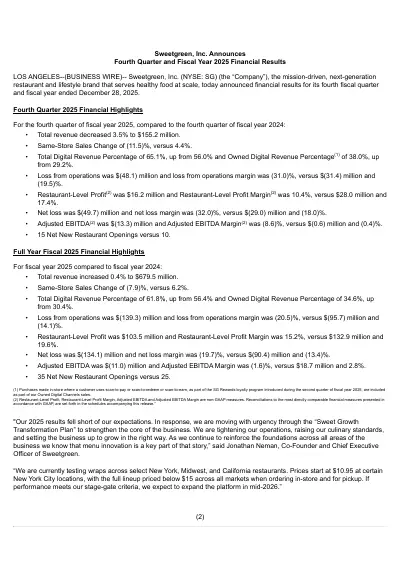
For fiscal year 2025, revenue was $679.5 million. We continue to experience traffic pressure.
Comparable sales for the year declined 7.9%. We opened 35 net new restaurants, ending the year with 281 locations.
Restaurant-level margin was 15.2%, and adjusted EBITDA was a loss of $11 million. I'll start with an update on our Sweet Growth transformation plan, and Jamie will walk through the financials in more detail.
We are executing with urgency across the business and are one quarter into our transformation plan, which is focused on five strategic priorities: one, operational excellence; two, food quality and menu innovation; three, personalized experience; four, brand relevance; and five, disciplined profitable investments. While the financial impact will take time to materialize, we are strengthening the foundation of the company.
We are improving operations, elevating food quality, accelerating menu innovation, and strengthening our value proposition, all guided by clear return thresholds. We are staying relentlessly focused on our guests and acting on what matters most to them.
As I walk through our strategic priorities, I'll share a few encouraging signs where the foundational work is beginning to show up in the business. Starting with operational excellence, which remains the foundation of our ability to win with guests, we are building the systems and discipline required to deliver consistent, high-quality execution across every restaurant every day.
Let me share where we are. Over the summer, we implemented Project One Best Way, our systemwide effort to elevate operational excellence through clear standards, performance-based leadership, and measured execution.
Today, approximately two-thirds of our restaurants are hitting our great bar based on our internal operational audits. What's most encouraging is the shift in the distribution this quarter, with more restaurants exceeding standard and fewer falling below, reflecting improved consistency across the fleet.
Importantly, great is not a static benchmark. As performance improves, we continue to raise the bar by increasing both the standard score and our expectations for what constitutes great.
Throughput is where operational discipline translates into results. In any great kitchen, mise en place means having everything in its place before the rush.
That same principle drives our rush ready before peak initiative, ensuring the right team members are in position, prep is complete, and stations are set before peak volume hits. We've just started to introduce real-time throughput visibility to our field teams, giving them the ability to see performance and adjust in the moment.
We know that speed and accuracy during peak periods are what drive both guest satisfaction and team confidence, and we're building the muscle memory across the system to deliver consistently. We've also strengthened how we measure and drive performance.
The restaurant scorecard we introduced last quarter gives teams clear visibility into a focused set of metrics: sales, throughput, customer satisfaction, labor, food quality, and people, they know exactly where we're winning and where we need to improve. During my restaurant visits, I review scorecards with our teams and walk the Sweet Path, a framework that breaks each restaurant into clear zones with simple, consistent standards for how we show up every day.
We're encouraged by the progress we're seeing, but we know there's more work to do. We're still seeing inconsistencies in areas like ingredient availability and ordering, as well as team scheduling, and we're addressing them directly, improving our tools, retraining teams systemwide, and realigning quarterly bonus incentives around the financial and operational metrics that matter most.
Our goal is to equip restaurant leaders with clear data and streamlined systems so they can think and act like owners, accountable for sales, margins, and the guest experience. Food quality and menu innovation are at the heart of who we are.
Our menu sets us apart, built on real culinary credibility and made from scratch with ingredients from farmers and partners we know and trust. Delivering delicious food executed consistently is non-negotiable.
It's how we compete, and it's how we win. A recent example is our internal miso-glazed salmon campaign, launched in December to sharpen execution and elevate salmon quality across the system.
We extended marinade times to deepen flavor and refined cooking and presentation, serving the fat side up for better caramelization and a more vibrant appearance. We took the same disciplined approach with chicken, updating our recipes for a juicier result, alongside upgrades to our golden quinoa, white rice, and Napa cabbage slaw that you can try in our restaurants today.
This is our culture of culinary technique and practice, constantly refining how we prep, cook, and present our food. Menu innovation, when supported by strong operational execution, can be a key driver of comp growth.
Our stage-gate process, implemented in 2025, guides this innovation by ensuring we test and learn while maintaining operational excellence in our restaurants. Today, we have the most robust innovation pipeline in Sweetgreen's history, designed to diversify menu occasions, expand categories, attract new customers, and drive frequency with existing ones.
We kicked off 2026 with two limited-time-only menus. The first was a collaboration with Function Health and their co-founder and chief medical officer, Dr.
Mark Hyman. Built entirely from existing ingredients, the menu was operationally simple to execute while reinforcing the quality and integrity of our offerings and demonstrated how we can deliver credible, wellness-forward innovation without adding complexity in our restaurants.
Our second limited-time menu launched February 3rd with the Winter Harvest Bowl, a seasonal take on our best-selling bowl, featuring maple glazed squash and the vegetable of the year, charred balsamic cabbage. At the same time, we brought back feta cheese to our core lineup, a frequently requested ingredient by loyal customers and brand fans.
Taken together with our innovation pipeline, the menu calendar reflects our focus on creating newness on the menu and bringing customers fresh, seasonal ingredients, and with compelling sourcing stories throughout the year. Our biggest menu expansion planned for 2026 is the launch of wraps, which began innovation testing in eight restaurants in the Los Angeles market in January.
As part of our stage-gate process, we're learning how to execute wraps at scale while protecting throughput. Operational details, like tortilla press placement, have been key focus areas in our eight-restaurant test, and we're actively iterating based on those insights.
Building on those learnings, we expanded wraps to a broader market pilot last week across select locations in Manhattan, the Midwest, and Los Angeles. The lineup, Classic Chicken Caesar, Chicken Salad Bacon Club, and Chicken Jalapeño Ranch, starts at $10.95 at select locations in New York City, and the full lineup is priced below $15 across all markets for in-store and pick-up orders.
The early feedback is encouraging, and if performance meets our stage-gate criteria for customer acquisition and retention, we expect to expand the platform in mid-2026. Improving value perception remains one of our highest priorities.
With guests increasingly focused on value and quality while pulling back on overall restaurant spending, we know Sweetgreen must deliver on both dimensions without compromising the experience that defines our brand. In 2025, we took important steps forward, including increasing protein portions, reintroducing lower-priced seasonal offerings, launching $12 Daily Greens, and leaning into the $10 'Tis the Season Harvest Bowl to meet guests where they are.
While these actions strengthened our value positioning, we recognize there is more work to do. Following a comprehensive review of our menu and pricing architecture, we have identified a focused set of initiatives to simplify and strengthen the overall experience.
Testing is underway, beginning with wraps pricing and loyalty entry price drops. We will also test a re-architected create-your-own platform designed to deliver greater price clarity and a more intuitive ordering experience, alongside clearly defined entry price entrees across our core menu categories later this year as we pace and sequence these moves over the next several quarters.
Together, these initiatives are designed to create a more transparent value ladder, giving guests confidence in what they are paying while supporting incremental traffic and transactions across a broader range of price points. At Sweetgreen, value has never been just about price.
It's rooted in the farmers we source from, the quality of their ingredients, scratch cooking, generous portions, and a consistent experience. Our 2026 initiatives are focused on making that value clear and easier to access at every touchpoint.
Our personalized digital experience strategy is built to increase customer frequency and spend through one-to-one messages and incentives. The $10 'Tis the Season Harvest Bowl promotion in December was a strong proof point for our loyalty-first approach to value and guest engagement.
By making the offer exclusive to loyalty members via the Sweetgreen app, we brought both new and reactivated guests directly into our ecosystem. It was our highest performing reactivation promotion to date.
We are listening to customers and followed this up with a $10 Chicken Avocado Ranch offer on February 9th. This continued to build momentum with the playbook we call Craving of the Month, a loyalty-exclusive, limited-time offer featuring a craveable menu item available only through the Sweetgreen app, designed to give members a compelling reason to engage with the brand every month.
Scan-to-pay now represents approximately 20% of frontline transactions, bringing in-store guests into our loyalty ecosystem and giving us full visibility into their Sweetgreen behavior and preferences. The impact is tangible.
Loyalty members who transact both digitally and in-store visit nearly 2x more frequently than digital-only customers. We believe this is a key lever to drive higher-frequency omnichannel behavior, and ultimately, the flywheel that builds lasting lifetime value among our most valuable guests.
At our best, our brand creates culture and makes the spaces we occupy more real, vibrant, and connected. In the fourth quarter, our protein-focused campaign resonated with guests seeking more filling, satisfying meals.
Built on the insight that protein stopped being about food, we cut through the noise with the launch of the PowerMax Protein Plate, delivering over 100 grams of protein from real ingredients like quinoa and chicken with no fillers, and generated strong social buzz and brand relevance. In February, we launched our expanded catering platform, including the Build-Your-Own Sweetgreen Bar, and are seeing strong early traction.
Anchored by our Here for the Bowl campaign and a big game activation at San Francisco's Ferry Building Farmers Market, the platform extends Sweetgreen into group occasions and serves as a meaningful new customer acquisition channel. Shifting to our last pillar, which is disciplined profitable investments.
In the fourth quarter, we opened 15 net new restaurants, including eight Infinite Kitchens. We also entered three new markets during the fourth quarter: Cincinnati, Sacramento with two Infinite Kitchen restaurants, and Arkansas.
We opened our Bentonville restaurant in Q4 and our Fayetteville restaurant in Q1 2026. We also expanded our presence in Arizona with a second location during the fourth quarter.
On the Infinite Kitchen front, the technology continues to deliver on its promise: faster throughput, improved order accuracy, and elevated food quality, all while creating a better experience for both guests and team members. In the quarter, established Infinite Kitchens delivered higher AUVs and labor savings of more than 700 basis points compared to their classic counterparts of similar age.
In November, we opened our first Infinite Kitchen Sweetlane location in Costa Mesa, California, expanding the technology into a new format designed to serve suburban markets and capture drive-thru occasions. The location is performing well, and we are excited to grow this format further.
We ended the year with 30 Infinite Kitchen locations. With the Spyce team now part of Wonder, we remain confident in the continuity and trajectory of the platform.
The partnership is working. Since the transition, we have successfully opened two new Infinite Kitchen locations in the first quarter: Long Beach and our first in the DMV market at Pike 7.
We continue to roll out software improvements, including new capabilities around greens portioning precision, demonstrating that development and deployment momentum remains firmly intact. Over the past year, we've strengthened the foundation of Sweetgreen by putting the guest at the center of every decision.
We've rebuilt discipline around the fundamentals that matter most: great food, speed, genuine hospitality, and clear restaurant-level ownership and accountability. Maintaining that standard consistently across the system remains a top priority, because delivering on these basics is what earns trust and keeps guests coming back.
At the same time, we are leaning into what makes Sweetgreen different. We are strengthening our core menu, delivering innovation in a disciplined way, building a more connected digital ecosystem, and investing in a brand rooted in the Sweetgreen lifestyle our guests choose to live every day.
Looking ahead, the work we need to do is clear: execute with discipline to improve performance quarter by quarter and build a stronger, more durable business. While there's still work to do, we're seeing encouraging signs that our efforts are taking hold.
I want to thank our team for navigating a challenging year and positioning Sweetgreen for more consistent performance ahead. Now, I'll turn over the call to Jamie to review our financial results in detail.
Jamie McConnell
Thank you, Jonathan, and good afternoon, everyone. As Jonathan outlined, the past year was challenging, but it brought clarity on our priorities and the path forward under the Sweet Growth transformation plan.
While we are still early, the actions we've taken and continue to take give us confidence in the opportunity ahead. Our objective is to build a more resilient operating model that supports consistent, long-term financial performance.
In my experience, sustained results come from staying relentlessly focused on the guest, empowering and holding our teams accountable, strengthening operational execution, and managing costs with discipline. These principles underpin our strategic priorities.
When those fundamentals are in place, growth, margin expansion, and cash flow follow. Across the P&L, we are taking a comprehensive, end-to-end approach to improve efficiency and ensure every dollar is working harder.
This includes reducing complexity and reinforcing clear ownership and accountability throughout the organization. As Jonathan mentioned, we have updated our field bonus plan to align incentives directly with restaurant-level performance, encouraging our leaders to think and act like owners with full accountability for sales and margin.
Turning to our fourth quarter results, sales were $155.2 million compared to $160.9 million a year ago, with comparable sales down 11.5%. Restaurant-level margin was 10.4%, down from 17.4% last year.
During the quarter, we opened 15 net new restaurants, including eight Infinite Kitchens, and ended the year with 281 restaurants. The comparable sales decline was driven by a 13.3% decrease in traffic and mix, partially offset by a 1.8% benefit from menu price increases.
The decline also reflects the transition from Sweetpass Plus to our new SG Rewards program, which eliminated subscription revenue and introduced a loyalty deferral. We expect the first quarter to be the most challenging of the year.
January same-store sales declined 11.8%, impacted by severe weather. In March, we will be lapping the launch of Ripple Fries.
The first quarter includes 70 basis points of price. 2025 carryover price fully rolled off in the middle of February.
Fourth quarter food, beverage, and packaging costs were 29.2% of revenue, an increase of 180 basis points year-over-year. The increase was primarily driven by higher ingredient usage and waste, including increased protein portions.
These impacts were partially offset by menu pricing and mix. Tariffs impacted the quarter by 20 basis points.
Fourth quarter labor and related expenses were 30.5% of revenue, an increase of 200 basis points year-over-year. This was primarily driven by deleverage from lower sales volumes and wage inflation, partially offset by menu price increases and lower bonus expense.
Other operating expenses were 19.1% of revenue, an increase of 170 basis points year-over-year, driven primarily by deleverage from lower sales volumes, higher marketing spend, and increased repairs and maintenance. G&A expense was $39.7 million in the quarter, an increase of $2.6 million year-over-year, primarily related to one-time stock-based compensation modifications made during the quarter.
For 2026, we expect underlying support center costs, excluding stock-based compensation and one-time expenses, to be approximately 13% of revenue, down from 15.3% in 2025, as we streamline the organization and drive greater cost discipline. Fourth quarter net loss was $49.7 million compared to a net loss of $29 million last year, reflecting the decline in restaurant-level profit.
Adjusted EBITDA was a loss of $13.3 million compared to a loss of $600,000 last year, also driven primarily by lower restaurant-level profit. We ended the quarter with $89.2 million in cash.
At the beginning of fiscal year 2026, we closed the sale of Spyce, receiving $100 million in cash proceeds. Now turning to fiscal year 2026 guidance.
We expect same-store sales to be a decline in the range of -4% to -2%. As comparisons ease, we expect same-store sales trends to improve throughout the year.
We expect restaurant-level margin to range from 14.2% to 14.7%, and adjusted EBITDA to range between $1 million and $6 million. On unit growth, we expect to open about 15 net new restaurants, with nearly half featuring Infinite Kitchen technology.
We also plan to enter two new markets: Nashville and Salt Lake City. Our development pipeline is weighted toward the back half of the year.
This is inclusive of a handful of closures at the end of their lease term where we see the opportunity to strengthen nearby locations. To close, the opportunity in front of us remains significant.
We are rebuilding the fundamentals, strengthening operations, elevating the guest experience, and improving restaurant-level economics. We are committed to building a stronger, more profitable Sweetgreen over the long term.
With that, I'll turn the call over to the operator to begin Q&A. Operator?
Operator
At this time, I would like to remind everyone, in order to ask a question, press *, then the number 1 on your telephone keypad. Your first question comes from the line of Jon Tower with Citi.
Please go ahead.
Jon Tower
Hey, great. Thanks for taking the question.
I guess maybe thinking through the comp guidance that you offered, it sounds like you're not going to be taking much price on the year, if any at all. Can you help us think through the puts and takes with respect to comp growth?
I know you provided the cadence, but what you're expecting for timing say of wraps if they make it through the stage-gate process in terms of when they may come through the year and any other drivers to the top line as you're thinking through the business for '26 and beyond?
Jamie McConnell
Yeah. Hi, John.
This is Jamie. We expect, like we said, guidance between -4% and -2%.
We've had a really choppy beginning of the year with the storms, January and February. However, we have seen a couple really good weeks.
We're being conservative given the economic backdrop, but we're excited about all the things that we have in place. Then we're also excited if wraps do well in test, which is looking great, that they do launch in Q2.
Jon Tower
Okay. In terms of pricing, do you plan on taking any more, or taking any during the year?
Jamie McConnell
We're being cautious given the consumer backdrop, but we'll reevaluate throughout the year. That's not in our guide.
Jon Tower
Okay. Then just last one.
In terms of thinking about the building blocks to returning store margins to kind of that high teens, low 20s rate, obviously sales are going to be a key component in it, but can you speak to any specific cost levers that you have already pulled or plan to pull in '26 to kind of work with you guys as the sales begin to improve?
Jamie McConnell
Yeah. There's a lot of things that we're working on for margins.
Sales leverage is obviously going to be the biggest piece, but there's also some operational inefficiencies that we're working on. One example would be around optimizing our order systems for our team members to make sure they're ordering the right items, and we're taking the guesswork out of it.
We're looking to streamline that tool and making sure we get rid of all those manual inputs so we're ordering correctly. We do see some opportunity there.
We also see opportunity within our supply chain, streamlining and doing some supplier diversification.
Jonathan Neman
Yeah. John, the only thing I'll add to that is we've continued to see encouraging signs around our head coach stability and reducing turnover.
We know when we get stable head coaches and reduce turnover, we have more productive teams, which also leads to higher margins. Obviously sales leverage will be the biggest component, but there's a number of operational moves that we're putting in place that, even without any sales leverage, we do have some margin gains to go for.
Jon Tower
Great. Thanks for taking the questions.
Jonathan Neman
Thanks, John.
Operator
Your next question comes from the line of Rahul Krotthapalli with JPMorgan. Please go ahead.
Rahul Krotthapalli
Good afternoon, guys. Can you discuss how the rollout of Project One Way, maybe the first iteration, understanding this is an ongoing process, is progressing, and specifically, can you share some metrics, maybe on store performances for the cohort of stores where the rollout has been the earliest, either on margin side or anything else, to give us more confidence that we are at the inflection or we're closer to the inflection, and I have a follow-up?
Jonathan Neman
Absolutely. Hi, Rahul.
We're very encouraged by the work we're doing from an operational excellence perspective, and huge shout out to our operations team and our field leadership. We've instituted Project One Best Way, and over two quarters you've seen the restaurants that have been scored great through our internal audits double just in two quarters.
We do see better comps and better return rates of customers in those stores as they perform better on those operational metrics. Those operational metrics are everything from our standards and process, but a lot in terms of hospitality and food quality as well, they're very in-depth studies.
We're going to continue pushing on that with a huge focus as we look forward not only on throughput, but on hospitality and continuing to elevate our food quality. One thing that I mentioned earlier in the prepared remarks was around a lot of the moves we've made around the quality of many of our core items.
We talked about the salmon where we've elevated the quality of the salmon through some of our culinary techniques, and we've seen salmon as an example increase its velocity by almost 20% as we've done that. Similarly, we've upgraded how we season the rice.
It's much more delicious. If you haven't tried it, I highly recommend.
We've upgraded our quinoa from a kind of a classic plain quinoa to a golden quinoa, and even changed how we cook our chicken in terms of the cycle time of how often we cook it and the way in which we cook it to be juicier. A huge focus on the guest and the product and elevating that, and we know when we do that, customers become more loyal and stay with us longer.
Rahul Krotthapalli
Thank you. Then reducing complexity is something you mentioned again in the prepared remarks.
Can we revisit this topic on what the top priority areas here in the store for 2026, and what kind of changes or impact we should see?
Jonathan Neman
In terms of what we actually do in the restaurant?
Rahul Krotthapalli
Yes, on the complexity reduction. Yeah.
Jonathan Neman
We're constantly looking at tools and processes as well as what we do in restaurant and where we can leverage value-added partners to make the work easier in our restaurants. Again, given our foodie sauce and focus on made from scratch, we're very, very careful on this.
One of the big rollouts last year was around destemmed kale as an example. We should see continued efficiencies from that.
There's a number of other opportunities, whether it be how we cook our steak is one thing that we're looking at, chicken protein marination is another one we're looking at, and we're constantly looking at which dressings and sauces could be upstreamed as long as they can be upstreamed in line with our values. We've really built this commercialization muscle over the past couple years, and we will continue to lean into that to make it easier for our team members to work in store, lower the prep hours, and move more of the hours to focus on hospitality and the guest experience.
Rahul Krotthapalli
Thank you.
Operator
Your next question comes from the line of Brian Bittner with Oppenheimer. Please go ahead.
Brian Bittner
Thank you. As it relates to the trends in the business, I realize the storms have had a huge impact obviously on the first quarter for the industry and particularly you, given where your store base is.
Have you attempted to perhaps strip out that headwind and think about the underlying trends and what those look like, or do you have an estimate perhaps of how big the impact from the storms could be for the first quarter so we can try to better think about the trends in the business?
Jamie McConnell
Yeah. January and February are choppy.
The impact of the storms to date is about 320 basis points, but that does not include this latest storm where we have a little over 100 restaurants. It's really hard to read the first quarter, given our Northeast densification.
What I can tell you is the weeks where we're not seeing any weather, we are seeing some momentum in the business, so that's been great to see.
Brian Bittner
Okay. That's helpful.
Just my follow-up question is related to the restaurant margin guidance for 2026. Maybe you can help unpack how to think about maybe the COGS and labor line items.
They've obviously been large sources of deleverage looking backwards, but I think in order to get to the guidance for '26, we need much more stable performance in those two line items, but you're not taking much price, and you are anticipate comps to be down 2% to 4%. Can you maybe shape expectations for the building blocks of that restaurant margin guidance?
Jamie McConnell
Absolutely. A little over half of it is sales deleverage, but then we do see opportunities when it comes to making up that protein portion, and that's through supplier diversification and some refinements that we're doing in the supply chain while making sure we keep the quality and our delicious ingredients.
Then also a lot of it's related to these operational inefficiencies. Jason's doing an awesome job with the team, but what we're realizing as we go out into these restaurants is that we're making things complicated for our team members.
It's really been a focus of getting into the restaurants and seeing how we can make their life easier. One of them was that predictive ordering tool that we're implementing and optimizing.
I think that that's probably going to be the other half is more the supply chain initiatives and the AET.
Jonathan Neman
Yeah. If I can just add one thing, we did put in a new labor management tool last year or new workforce management, and we're continuing to optimize that and make sure we have the right labor at the right time in order to capture sales, but also really just not wasting labor, reducing overtime.
Number of lovers for us to pull around operational efficiencies.
Jamie McConnell
Yeah.
Brian Bittner
Thank you.
Operator
Your next question comes from the line of Brian Mullan with Piper Sandler. Please go ahead.
Brian Mullan
Thank you. Question on the wraps.
I think this is something you've been contemplating for a long time. Is there a way to maybe frame up how big of an opportunity this could be even qualitatively, Jonathan, including as a customer acquisition tool if you get the product and the operations right?
Then separately, are you viewing this as a digital-only offering, or is this something you could envision walking the line and being able to order as well?
Jonathan Neman
Absolutely. We're very excited about wraps.
It's something we've been working on for a very, very long time, probably two years two years of of product development getting everything perfected, both the the flavors, getting the supply chain ready to, to have a really clean wrap, and and of course perfecting the operation. We went instituting our new stage-gate process, we went into our rapid ops test in January in eight stores in Los Angeles.
The main question we had was how is it going to impact our restaurants operationally, specifically any impacts to throughput. I'm very confident that it will will not be a drag on throughput, and that was that was a big question.
We've now moved on to a market test with about 68 restaurants featuring wraps started about a week ago. Results have been really really encouraging.
We have seen incidents tick up almost every every day since launch. The feedback we've gotten from guests is phenomenal.
It is really hitting a new occasion and in many ways a new customer. If you look at the addressable market, wraps, handhelds, there's, a huge segment of the population with being a bowl-only concept that we were not capturing.
This opens up the aperture a lot for the type of customers and occasions the type of customers and occasions that that we can see. The last thing I'll say is, we we have we we talked about in the prepared remarks, but wraps will all be sub-$15, starting at $10.95.
I think really disruptive from a price perspective. The other thing we we see is when people are, coming in at those lower prices, their second-order rates are significantly higher.
We expect to see the LT the, the lifetime value or the annual spend of guests increase as we do that. Overall, very encouraging, still perfecting things, getting ready for a mid-year launch as long as it passes stage-gate, but we do expect wraps to be a really big moment for us.
We will put significant marketing around it. I'll say it's I think it's going to be a huge moment for the brand.
Brian Mullan
Okay. That's great to hear.
Thanks.
Jonathan Neman
Oh, I didn't answer your question. Your last part of it was, will it be digital-only?
No, it will be available on all channels. Today even in test, I encourage everyone to go try them and please share your feedback.
We have three wraps. Today we may expand the lineup, but they're available across all owned channels, eventually will be available on all channels, including marketplace, but for right now, they're available both in-store, on pick-up, and through our pick-up channel.
Brian Mullan
Okay. That is exciting.
Thank you. Then follow-up just question on development.
Maybe you could just talk about what the team is focused on beyond this year. I know given the lead times, you'd normally be focused on '27, '28.
Maybe you don't want to sign as many leases as you normally would right now. Just talk about how you're managing striking the right balance of slowing down now, but not having a gap later in the pipeline if you want to accelerate.
Jonathan Neman
You kind of nailed the approach. It's making sure we have a healthy pipeline, we have the optionality to speed up as comps improve and we feel good about the unit economics.
However, keeping it not necessarily committing to too much to make sure we're disciplined from a cash perspective. We've learned a lot about where Sweetgreen really works.
We do have a really, really solid pipeline we feel very confident about for this year, and do have a really solid pipeline built for '27. Really kind of taking a wait-and-see approach in terms of signing too many deals as we really perfect the unit economics in the business.
Once we do see comps turn positive and the flywheel starts going, we do expect to begin to accelerate development back to our previous algorithm.
Brian Mullan
Thank you.
Operator
Your next question comes from the line of Dennis Geiger with UBS. Please go ahead.
Dennis Geiger
Great. Thanks, guys.
I wanted to touch on loyalty a little more if you could share a bit more on what you saw in the quarter, including the impact to the comp in the quarter first, and then just anything else on the customer observation, including those most frequent guests, how they're using the program, where they are right now versus the old program, if any updates on that front. Thank you.
Jonathan Neman
Absolutely. Overall, the program is doing well.
We're continuing to see weekly year-over-year growth with new members signing up for the program. We do see loyalty members on an annual spend at more than two times non-loyalty members.
It is definitely working. However, we also see a lot of opportunity.
You will see kind of a re-envisioning or an optimization of the program later this year, things like improving perks, adding tiers, boosting benefits of the program, for example, that we need more options at lower tiers. Then we also are seeing a lot of opportunities in how we can leverage AI and personalization around offers and communications, which we think will improve our targeting and continue to drive frequency.
Overall, feeling pretty good about the program, but more optimizations coming to really make it a best-in-class program. The best thing is about this versus the Sweetpass is it's much more broadly appealing.
Last thing I'll say is we introduced scan-to-pay in our restaurants last year, and I think we may be maybe the only restaurant that allows you to scan and pay with a single transaction, and that percentage inside of our restaurants has doubled over the past two quarters, we're now seeing about 20% of in-store transactions being a scan-to-pay transaction, and again, those are more customers that we can target with communications and offers.
Dennis Geiger
Great. Then just if I may, one more on IK, just as it relates to the higher AUVs that you called out.
Any additional comments there, high-level quantification, or perhaps anything on throughput metrics, etc., on the IK side of things? Thank you.
Jonathan Neman
IK continues to be encouraging. We're seeing similar results that we've talked about in the past, at least 700 700 basis points of leverage.
We did introduce our newer formats with the IK, much better from a customer experience perspective and from an operations perspective, and so we're going to continue to have that as a huge part of our toolkit. We opened two more stores with Infinite Kitchens this year in Q1, we're up to 32 stores featuring the Infinite Kitchen.
We continue to see the benefits around throughput, accuracy, wait times, and over time, we think that also gives us a lot of pricing power. Very encouraged by the IK, and we'll continue to use it, especially in our more high-volume locations.
Dennis Geiger
Thanks, Jonathan.
Operator
Your next question comes from the line of Sara Senatore with Bank of America. Please go ahead.
Oh,
Sara Senatore
thank you. Maybe just two follow-ups.
One is on the wraps. What is the implication for maybe operational complexity?
I think to your point about bowls, even the protein plates probably looked kind of similar in terms of the build or how they went down the make line. Is this going to add I don't know complexity?
I guess it sounds like probably not something that you can use the Infinite Kitchen for. As you're stage-gating, I assume you're looking at the operational implications, but just anything you can say on that.
Jonathan Neman
Absolutely. That was the major focus of our testing.
Even before our rapid ops testing, we did a lot of testing in single restaurants where we brought team members together, worked together to co-create the operation, things like where does tortilla placement go, how does the food move down the line. One of the things that we heard from customers in a lot of our surveys and focus groups was the product is better when the ingredients are mixed before wrapped, and the product is better when the wrap is cut.
Those were things that we wanted to ensure we brought to market, and luckily through a lot of hard work from our operations team, those are things that we've enabled, and are not seeing any slowdown on throughput. We do not expect any additional labor needs in order to do it.
It really works beautifully within our current workflows, and it actually does work with the IK. The Infinite Kitchen does put together all of the ingredients, and our team members wrap things up on the finishing station, it actually works beautifully in those locations as well.
Sara Senatore
Oh, okay. That's good to hear.
I guess then the second question was about some of your comments about marketing and value, and I guess you did invest in value in the fourth quarter, and I think you said you saw some initial good reactions, but then obviously, I think the quarter didn't end up where you had hoped. Is there an opportunity here to not just maybe improve the value proposition, but improve how you communicate it?
I don't know if it's something beyond what you do with the loyalty program or the in-app marketing, or just anything you have in terms of thinking about whether the communication maybe could be more effective as well as just the more introductory price points.
Jonathan Neman
Yeah. We see a lot of opportunities there, and we ran a lot of tests and pilots over the past six months to better understand the price-value equation, how that resonates with customers.
One was our $10 'Tis the Season Harvest Bowl, where we saw incredible reactivation rates, great customer acquisition, and interestingly, the reorder rate of holding those customers was really high. Very encouraging is that brought people into the brand, and then they stayed with us past that promo.
We followed that up this year with what we're calling our Craving of the Month, which is a value offering only for loyalty members, it really works in that loyalty flywheel of bringing people on the brand, and again, what we're seeing is not only are they coming, many people are reactivating or lapsed customers are reactivating or new customers are joining with it, but again, they're not just ordering there, they're sticking with us. There's a lot more work we're doing on value.
Wraps is something we've talked about with the anchor pricing on wraps, but in the prepared remarks, I mentioned a lot of the overall price-value architecture work that we're doing. We are going to test a new pricing structure for our make-your-own bowls, and we are also looking at our pricing ladders and where we have our opportunities for more entry-level pricing.
Of course, we want to be very careful not to dilute our margins as we do this, but what we've seen is having different options for different groups of consumers, ultimately, Sweetgreen's mission of connecting people to real food, we want to democratize real food and make it accessible to all, and so these pricing ladders give options for all different types of consumers, and you'll see a lot more work on the price side. At the same time, you're going to see a lot more work on offering more value.
Last year we increased our protein portions, we've upgraded a number of our ingredients, and we're improving the experience in our restaurants. The combination of those together, I think, will really start to get that flywheel of growth going for us, and we've seen some really really encouraging early signs.
Sara Senatore
Okay. Then just the marketing question, it sounds like you have a lot of initiatives, is there contemplation of maybe marketing outside of just the app more broadly, maybe to the more infrequent customers or the people, I don't know if it's point of purchase or how you do that.
I know you're relatively small, but just I guess my question was more you have good value, is there a way to communicate it more broadly?
Jonathan Neman
Yeah. I think you'll see more of that from us across many of our channels.
I think you'll also see we've reevaluated our marketing mix. We're spending a lot of our money lower funnel, and I think you'll start to see more top-of-funnel brand awareness.
We know as we do that, as we create more brand salience, it actually improves our return on ad spend lower in the funnel. If you go back to kind of what made Sweetgreen, going back to our roots, it was really a lot of that brand marketing and storytelling.
I think you'll see a healthy balance of the brand marketing top-of-funnel brand awareness, things like collaborations and ways we play into culture, as well as getting really efficient and optimized bottom funnel, whether that be our media spend and/or what we can do through our own channels in our loyalty program. Kudos to our marketing team really reinventing how we go to market and speak to more guests, and I think you'll only see that improve throughout the next couple quarters.
Sara Senatore
Okay. That makes a lot of sense.
Thank you very much.
Operator
Your next question comes from the line of Brian Harbour with Morgan Stanley. Please go ahead.
Brian Harbour
Good afternoon, guys. All right.
I guess on the IK retrofits at this point, I guess I'm just curious, because that's clearly something that kind of reduces complexity or is that not a focus at this point?
Jonathan Neman
It's not a huge focus for us. We have done a handful of them.
I think we will continue to look at them as leases come up when we're doing full renovations or relocations. For example, in the past few months, we did relocate two stores, one being our Union Square restaurant the lease was up, we moved to a better location on the avenue and opened with an IK.
Similarly, our first New York store at the Nomad moved across the street and opened it with an IK. You'll see it being done selectively, but the retrofit is not a huge focus for us right now.
Brian Harbour
Got it. Just the slight change to store openings this year, are those just getting delayed or you had to sort of sign some of those leases anyway, or I guess the broader question is, do you sort of have different views about where it makes sense to open at this point?
Jonathan Neman
I think we've seen a lot of success in our new and emerging markets, I think which proves the TAM question. This year, in the past couple quarters, we opened new markets such as Arkansas, Phoenix, which is doing incredibly well, and even, a place like Cincinnati.
You'll continue to see us go where we know it works. We're really trying to open places where we have a high degree of confidence, where we can both have the right real estate, have the people leadership there, support it from a supply chain perspective.
We have a high degree of confidence in the pipeline for this year, and we've gotten just a lot smarter about where to put new locations in what format. I also had it in the prepared remarks, but we have seen a lot of success with our Sweetlane.
We have our first one in Schaumburg, we opened another one in Costa Mesa, we have another one coming very soon, and obviously those are harder to find, but it's a really great format for us that we're continuing to lean into.
Operator
Your next question comes from the line of Andrew Charles with TD Cowen. Please go ahead.
Andrew Charles
Great. Thank you.
Jonathan, with your greater focus on protein and fiber, as part of the marketing efforts, is there any evidence that your efforts are resonating with GLP users via your loyalty program or any other data you can collect on this? Then I have a follow-up.
Jonathan Neman
It's hard to say, because our users don't tell us that they're on GLP-1s. It's hard to say, but clearly, many people are.
What I can tell you is, I do think long-term, as GLP-1 adoption increases, we will be a beneficiary. From all of our research, as people get on GLP-1s, they want more protein dense, they want fresher food, and I think William Blair put out a study a couple years ago about actually studying what customers want to eat once on GLP-1s, and I think we were the only one where actually frequency increased.
Overall, we do see as a tailwind, but we have no real evidence of it in our current data.
Andrew Charles
Okay. Then, Jamie, I know in 2025, the brand closed three restaurants that were near the end of their lease, and I'm curious if you had enough time in your role to review the portfolio to identify stores where it might make sense to be closed stores permanently before they're in the lease term as a way to improve same-store sales, margins, and free cash flow, as a way to help accelerate the turnaround.
Jamie McConnell
Yeah. No, we definitely are looking at that, and there was one that was closed in Q4, and we have a handful that are closing this year, but those are all near the lease term.
Absolutely, we're looking at the whole portfolio, and the ones that are not cash flow positive, we're taking a hard look at.
Andrew Charles
Thank you.
Operator
Your next question comes from the line of Chris Carril with KeyBanc Capital Markets. Please go ahead.
Chris Carril
Hi. Thanks for taking the question.
Can you maybe talk to the digital mix growth that you're seeing more recently, both across total and owned channels? Is that a function of increasing loyalty engagement or scan-to-pay, or is it maybe driven by non-digital customers reducing frequency?
If it is that latter guest, how do you plan to reengage those non-digital guests? Yeah.
Jamie McConnell
I will say that we're seeing some healthy pick up in our native business, our first-party channel, and I think that's part of some of the loyalty promotions that we're doing. Last year in marketplace, it was a tough environment.
There was a lot of value going on, but I think we intentionally put them through our own channels, and like Jonathan said, we're seeing the stickiness of those transactions and that second-order rate increase. However, we do see tremendous opportunity in the marketplace area and to grow our third party as well, so that's all work that's being underway.
Jonathan Neman
Yeah. On your question around the I I think you were referring to our in-store in-store business, it's it's it's in some ways our most important channel.
That's where we acquire so many of our guests. It's where you in in the the food quality, you're eating it fresh, you're getting that hospitality experience, you're learning about the brand.
Really focused on that, really from an hospitality perspective and a throughput perspective, and we've gotten very clear on how to measure the right metrics to show that we're on the right track. Really, there's so much around, that second-order rate of how do we how do we give, how do we incentivize teams around giving such a a great experience where those customers come back within 30 days.
When you have that customer come back within 30 days, their annual spend is significantly higher of when they don't. We know Sweetgreen is a frequency and loyalty, like it's a habitual play, and so that in-store experience is really a really important channel that that we're highly focused on this year.
Chris Carril
Got it. Thank you.
Then I guess as my follow-up, can you maybe comment on any differences you're seeing in sales trends across geographic regions, if any? Curious specifically if you're seeing any material differences between your legacy markets versus newer markets.
Thank you.
Jamie McConnell
Yeah. I would say Northeast is still under pressure, but I will tell you when I started in September, that was the first market that we visited as a management team, and there was a lot of work that's being done by Jason and team, and they've hired a new RGM.
We went back just this month, and it was encouraging to see all the work that's getting done and how delicious our food is and how operations is turning around. That's been promising of kind of the hope and future ahead.
One thing that's been great to see is our California market. That market has been under pressure.
If you think about last year, we had the fires and different things, but we are seeing some nice momentum in our business in California.
Chris Carril
Great. Thank you.
Operator
Your next question comes from the line of Jeffrey Bernstein with Barclays. Please go ahead.
Jeffrey Bernstein
Great. Thank you very much.
Jonathan, seem like over the past couple of quarters, there was lots of talk of trends by income, age, ethnicity. It does seem like, at least in recent months, perhaps there's some talking about maybe less bifurcation between those buckets and maybe less of a concern.
Just wondering if there's any update in terms of your trends by any of those cohorts, and if there is an income concern when I see talk more about value, how do you measure your value perception, maybe where do you score, you're willing to reset the margin target to be more aggressive pushing value? Then I had one follow-up.
Jamie McConnell
Yeah. In terms of cohorts, we're seeing similar data.
Oh, I'll speak up. For Q4, we did see a slight decline in all cohorts, but we are seeing a little bit of pick-up in Q1, which is great to see.
Then I'll let you comment on the value piece.
Jonathan Neman
Yeah. I think the goal here is obviously anything we do from a value perspective, we have to make up in transactions, we don't see the margin deleverage.
That's why we're looking very carefully at the price architecture. It's not a wholesale price decrease, it's more of a value ladder to have more options in, and we know as we do that, we see more frequency.
We're trying to do both, protect the margin as we offer more price value.
Jamie McConnell
We're definitely going to test every price move that we do to make sure we're getting those incremental transactions.
Jeffrey Bernstein
Got it. Then my follow-up, Jamie, you talked about for 2026 G&A reduction.
I know you never know when best to temper spend versus reinvest more. I think some were thinking maybe you'd see an uptick in spend to reinforce the brand positioning and the store-level support.
Just wondering how you guys think about it as a management team, which direction to go within G&A, and maybe can you share the largest buckets that are actually driving that reduction in spend in '26? Yeah.
Jamie McConnell
We've done a lot of work around G&A, and we will continue to lever that. What is most importantly is we're investing in things that are driving returns.
We're super focused on our Sweet Growth transformation plan. When it comes to marketing and now having Zip on board, we're really focused on that return and driving that value.
I would say you're going to see us investing heavily when there's a return, but you are going to see us reduce vendor spend in areas that are not creating returns and are not focused on our growth plan. It's really just cutting the dollars that were not creating returns, and then focus on the dollars that are creating returns for us.
There's a lot of opportunity. A lot of opportunity ahead, I would say, to lever that further.
Jeffrey Bernstein
Thank you.
Operator
Your next question comes from the line of Sharon Zackfia with William Blair. Please go ahead.
Sharon Zackfia
Hi. Thanks for taking the question.
I guess, Jonathan, I'm intrigued by the idea of simplifying the pricing architecture, particularly for the create-your-own. Can you remind us kind of what percent of your sales are create-your-own at this point, and kind of how simple can you make it?
It does feel like sometimes I need a quantum physics degree to figure out what my bowl might cost before I order it.
Jonathan Neman
Yes, we hear you on that. It's about a quarter of our business in terms of the make-your-own.
There's, obviously many more people are ordering signatures and modifying them, but in the true make-your-own, it's about a quarter of our business, it's very important segment for us. It's a little early to say exactly what we're doing, but it'll be radically simplified and I think better for the guests.
Today, to your point, it does maybe feel like you're getting nickeled and dimed down the line, we want to make it where you kind of know what you're getting for a very simple price, and making sure that is really competitive in the marketplace. More to come on that, that will be thoroughly tested through our stage-gate process, but I do think that will be a major lever for us as we simplify our pricing structure and offer better price value.
Sharon Zackfia
Is it fair to think that that would be anchored around the proteins on the pricing? Then it seems like you would give some margin up by doing that.
Would that be kind of I guess derailing some of that kind of clawback of the protein reinvestment or the increased portion sizes that you did last summer?
Jamie McConnell
I would say that we're looking at it in a couple pieces. We will be looking at those value ladders, but then we'll also be looking at the elasticity of other items to sort of offset that benefit.
All these will be carefully tested.
Sharon Zackfia
Thank you.
Jonathan Neman
Thanks, Sharon.
Operator
Your next question comes from the line of Logan Reich with RBC Capital Markets. Please go ahead.
Logan Reich
Hey, good evening. Thanks for taking the question.
I was just wondering if you could give an update on how new store productivities have been tracking through the year and for the Q4 openings. Yeah.
Jamie McConnell
I would say for the Q4 openings, it's hard to tell, right? There's been a deceleration in the business.
I would say it's something that we're continuing to monitor, and we're looking forward to make sure in 2026, we're only getting the best sites, and we're working on all of the things under the growth plan. I would say it's too early to comment on the 2025 productivity, but we are seeing some great things when you look at areas, some of the new markets like Arizona, that haven't been impacted by weather, very promising results there.
Logan Reich
Got it. Thank you.
Operator
There are no further questions at this time. Ladies and gentlemen, that concludes today's call.
Thank you all for joining. You may now disconnect.