Skye Bioscience, Inc.
NNASDAQ:SKYEQ4 FY2025 · Earnings Call TranscriptMarch 10, 2026
Operator
Good afternoon, and thank you for standing by. My name is Abby, and I will be your conference operator today.
At this time, I would like to welcome everyone to the Skye Bioscience 2025 fourth quarter financial results and business update call. All lines have been placed on mute to prevent any background noise.
After the speakers' remarks, there will be a question-and-answer session. If you would like to ask a question during that time, simply press star followed by the number 1 on your telephone keypad.
If you would like to withdraw your question, press star 1 again. Before we begin, please note that today's discussion includes forward-looking statements subject to risks and uncertainties described in Skye's SEC filings.
Actual results may differ materially. Thank you, and I would now like to turn the conference over to Punit Dhillon, Chief Executive Officer.
You may begin.
Punit Dhillon
Good afternoon, everyone. Thank you for joining us.
I'll start with what we've accomplished since our Q3 update. CBeyond established a potential path for nimacimab alongside existing incretin therapies, with additive weight loss, encouraging durability, and favorable tolerability.
At the same time, we strengthened the plan around the signal with 52-week combination data and a clearer high-dose rationale and a feasible subcutaneous path for delivery. We've continued the work on the regulatory alignment and target product profile.
In short, we've moved from a promising signal to a more coherent development case. That is the backdrop for the next question: what has objectively changed over the last 2 years?
Since launching nimacimab into an obesity-first indication, we've delivered a series of firsts for the CB1 field: a first-in-class allosteric GPCR antibody designed for peripheral inhibition; the first human obesity program to evaluate a CB1 monoclonal antibody and create a direct readout for the mechanism without any neuropsychiatric events; and three, the first test that mechanism in combination with a GLP-1. We also built the translational infrastructure and R&D infrastructure to support our clinical program, with a human CB1 knock-in, DIO workflow coupled with the quantitative biodistribution that really frames the CNS risk in a way that small molecules historically could not.
CBeyond has now given us three key learnings: 1, the combination signal is clinically meaningful and consistent with the mechanism. At 26 weeks, nimacimab plus semaglutide delivered a clinically meaningful 3% improvement in weight loss over semaglutide alone with no plateau observed, with statistically significant improvements in waist circumference and lean-to-fat mass ratio.
In the 52-week extension, the combination arm achieved 22.3% mean weight loss with no plateau observed. This is the first reported clinical CB1 plus GLP-1 combination data set and one of a few dual-target approaches that combine a peripherally targeted mechanism with a predominantly centrally driven incretin mimetic.
Number two, nimacimab 200 mg demonstrated a favorable safety profile with placebo-like tolerability. Through 52 weeks, we also saw no nimacimab-associated neuropsychiatric signal, and in combination with semaglutide, we did not see an additive GI burden.
The third point is that the monotherapy arm taught us a very solvable development variable: that the 200 mg weekly under-exposed peripheral tissues. That is why we're initiating a Part C expansion study of CBeyond to evaluate higher doses, and in parallel, enabling a practical, higher-exposure subcutaneous delivery with Halozyme's ENHANZE technology for our planned Phase 2b.
As a reminder, CB1 biology is clinically validated, but the first-generation approach failed for a specific reason: small molecules promoted central CB1 inhibition and carried unacceptable neuropsychiatric risk. Nimacimab is designed to improve energy metabolism by inhibiting CB1 in the periphery while minimizing brain exposure.
With that overall framing, I'll turn it over to Chris Twitty, our Chief Scientific Officer, to walk through the dosing and exposure-to-efficacy rationale and how it informs our near-term clinical plan.
Chris Twitty
Thanks, Punit. I'll focus on one question: why 200 mg weekly was a reasonable starting point for CBeyond, and what the translational data now tell us about the exposure required for robust efficacy.
Before Phase 2, we had robust Phase 1 SAD/MAD safety and PK data and sufficient drug product. The highest Phase 1 dose, approximately equivalent to 200 mg weekly, was well-tolerated and showed encouraging trends in NAFLD-related biomarkers.
While Phase 1 was not designed to show weight loss, it did provide a high-quality PK data set. Using that data set, we modeled Phase 2 steady-state C-trough levels and compared this exposure to the known IC90 concentration for nimacimab.
We also modeled published Phase 1 PK data for Novo Nordisk's small-molecule CB1 inhibitor, monlunabant, and compared its exposure to its IC90 concentration. On this basis, we projected that 200 mg weekly nimacimab dose to achieve approximately 7 times the IC90 concentration in the serum, comparable to the 20 mg once-daily mid-dose evaluated in Novo Nordisk's Phase 2 monlunabant study.
That made the 200 mg nimacimab dose a reasonable starting dose for our CBeyond trial. Despite similar projected levels of serum CB1 inhibition, clinical outcomes diverged.
Monlunabant at 20 mg daily achieved 6.3% weight loss at 16 weeks, whereas nimacimab at 200 mg weekly resulted in a more modest 1.5% reduction at 26 weeks. The key reason is distribution.
Small molecules and antibodies can show similar serum target engagement, yet deliver very different tissue exposure. Since CBeyond started, we have generated biodistribution data in our human CB1 knock-in obese mice.
These data show nimacimab distributes to key peripheral tissues relevant to metabolic efficacy, including adipose tissue, liver, GI tract, and muscle, while central nervous system exposure remains minimal, consistent with the clinical safety profile. When we integrate DIO dose response and biodistribution into a compartmental exposure model, we believe the conclusion is clear: at 200 mg weekly, peripheral tissue concentrations are below IC90, the level we require for full inhibition of CB1 signaling.
This translational work indicates that a half-log increase to approximately 600 mg allows for full tissue engagement to occur and allows for robust inhibition and productive metabolic activity, including meaningful changes in weight loss and associated mechanisms. Equally important, [cough] even with conservative assumptions for brain penetration, modeled central target engagement remains a fraction of IC90 both at 200 mg and 600 mg.
Maintaining that peripheral versus central separation is fundamental to nimacimab's therapeutic index. The takeaway is that CBeyond monotherapy result at 200 mg is an exposure question, not a pathway question.
The higher-dose expansion is designed to rapidly confirm PK and safety at higher exposures before we finalize dose selection for Phase 2b. Back to you, Punit.
Punit Dhillon
Thanks, Chris. With that exposure framework, our near-term work is: confirm safety and PK at higher doses, ensure a scalable subcutaneous path, and refine a Phase 2b clinical trial that is both regulatory informed and clinically relevant.
Our objective is to focus nimacimab where we believe an orthogonal mechanism can be most differentiated, particularly in patients already treated with GLP-1 who still need more weight loss. Tu, our Chief Operating Officer, will cover additional details and share updated durability data from our CBeyond program.
Tu Diep
Thank you, Punit. As we heard today, we believe that nimacimab has the potential to fill an important void in the current and future anti-obesity medicine landscape.
While our conviction is strong, we recognize that we must have the clinical data to back it up. With that context, our focus is straightforward.
First, we announced today an expansion of the CBeyond study to include new intravenous cohorts to rapidly generate safety and PK data at higher exposures, while specifically monitoring for neuropsychiatric events and continued safety monitoring through our independent DMC. Participants will enroll into 1 of 2 cohorts: 400 mg of nimacimab or placebo IV once weekly, or 600 mg nimacimab or placebo IV once weekly.
These groups will be randomized 3 to 1, with 6 participants receiving active drug and 2 receiving placebo, for total duration of 16 weeks. For context, it is important to note that compared to subcutaneous doses, the 400 mg and 600 mg IV doses represent approximately 700 mg and 1,000 mg subcutaneous doses, respectively.
Based on our biodistribution work in mice and non-human primates, we have concluded that nimacimab's brain-to-serum ratio is approximately 0.01%. Based on these data, we expect central target engagement to remain well below levels associated with neuropsychiatric risk observed historically with small-molecule CB1 antagonists.
Even so, this expansion is designed to provide a clean safety data set with doses we intend to take forward in future clinical trials. Second, in January, we announced a research and collaboration agreement with Halozyme to develop a co-formulation of nimacimab using their proprietary ENHANZE technology of recombinant human PH20 enzyme.
This collaboration will allow us to evaluate high-volume subcutaneous injections of nimacimab in our planned Phase 2b study. In parallel, we are advancing development of a high-concentration nimacimab formulation up to 200 mg/mL, and we see a longer-term opportunity for next-generation nimacimab with extended half-life through Fc domain modifications.
Taken together, these improvements could support the objective of reducing injection volume and further improve dose convenience for nimacimab. Lastly, we received written feedback from the FDA in response to our Type C meeting request, including comments on our proposed Phase 2b clinical trial design, and our questions regarding potential registration path, and on the data package relevant to potential combination therapy development for nimacimab with GLP-1s.
While we are still completing our review of the written minutes, the feedback has helped sharpen how we are evaluating dose, duration, endpoints, and inclusion criteria for Phase 2b. The agency's responses have provided insight into expectations for combination therapies.
It also provides a clearer framework for how we think about potentially studying nimacimab as a complementary, add-on therapy alongside incretins, particularly in settings where durability and persistence may matter. We are incorporating that input as we refine the Phase 2b protocol.
Before I pass it back to the team, I want to take the opportunity to share updated data from the CBeyond study. If you recall, we previously reported weight regain data from participants who did not participate in the extension study and instead went off therapy.
In this analysis, we showed that participants on semaglutide alone saw 38.7% of weight regained over 13 weeks, which is in line with what we have previously seen in the STEP 1 extension study. However, participants on the combination of nimacimab plus semaglutide only regained 17.8% over that same period.
These data are consistent with those we previously shared in our in vivo DIO studies, which we have shown durable weight loss for 20-plus days after stopping nimacimab. We believe that potential for nimacimab to drive more durable and tolerable weight loss for patients who may need to come off therapy because they go on holiday or lose access to therapy due to insurance limitations is a meaningful outcome, and is a primary opportunity in the current anti-obesity medicine landscape.
In the same follow-up population, we evaluated body composition during the 13-week off-therapy period, showing that while the main driver of weight regain in the combination cohort was lean mass gain, patients maintained their fat mass loss. These data suggest meaningful differences in body composition among patients who received nimacimab plus semaglutide, demonstrating that nimacimab's orthogonal mechanism of action has the potential to drive synergistic weight loss when combined with GLP-1s.
I will leave you with one last comment relating to the target product profile of nimacimab. As Skye has stated multiple times, nimacimab is being developed as complementary, not competitive, to GLP-1s.
We think that positioning is important because first-line obesity therapy will likely remain both crowded and increasingly price compressed. Against that backdrop, the more differentiated opportunity may be in the second-line add-on setting, particularly for GLP-1 experienced patients.
In that setting, nimacimab is not simply another incretin maintenance story. It is an add-on strategy intended to expand what the incretin base can achieve through an orthogonal mechanism.
We believe an important point in this category is that the opportunity extends beyond first-line induction. As the GLP-1 treatment population grows, does the number of patients who are unable to achieve their weight loss goal, plateau, become titration limited, or need another therapy to maintain their weight loss for a more durable period of time.
That is the setting where an orthogonal mechanism like nimacimab may have the clearest opportunity to matter if the data continues to support incremental efficacy without sacrificing tolerability. This distinction in positioning matters in a market where first-line incretin pricing is compressing, competition is increasing, and where persistence and quality of weight loss continue to drive real-world outcomes.
The blunt version of this is first-line incretin companies are trying to defend their installed base. Nimacimab is not wasting capital trying to dislodge that base; we are using that base as the entry point to address an unmet need.
Back to you, Punit.
Punit Dhillon
Sorry, I realized I was on mute. Thank you, Tu.
Actually, before I close, we want to highlight a separate R&D update that speaks to longer-term platform value, and it's our first antibody peptide conjugate program. Chris is going to offer more insight into the latest data on that program.
Chris Twitty
Thanks, Punit. Using both in vitro and in vivo systems, our R&D team has identified four distinct mechanistic pillars through which nimacimab modulates metabolic pathways that drive weight loss.
These pillars, include blunting obesity-related inflammation, improving glycemic control, modulating appetite-regulating hormones, and enhancing lipid metabolism, have been characterized in published research as well as our own preclinical models, giving us a high degree of confidence in this differentiated profile of this asset. While there is some overlap, nimacimab's mechanisms of action are primarily orthogonal to those of incretins, providing a strong rationale for a combinational approach.
Preclinical studies pairing nimacimab with either tirzepatide or semaglutide demonstrated additive and, in some cases, synergistic weight loss. Our Phase 2 clinical data reinforced this finding: even at suboptimal dose of nimacimab, the combination with semaglutide produced greater weight loss than either agent alone.
The mechanistic, preclinical, and even clinical evidence all converge on the same conclusion: combining CB1 inhibition with an incretin-based therapeutic has the potential to meaningfully raise the ceiling on safe, durable, and efficacious weight loss outcomes. Skye has taken that insight a step further.
I'm pleased to share early data on our first-generation antibody peptide conjugate, or APC, a molecule designed to unite nimacimab's unique mechanism of action and extended half-life with the power of a GLP-1 receptor agonist in a single unimolecular therapeutic. We have run two studies to date and are sharing data from the most recent experiment today.
Each study was designed to evaluate the individual components alongside the APC, with inclusion of controls to enable a clean interpretation of the results. Both nimacimab and the APC were dosed at 75 mg/kg every 3 days, with the APC additionally delivering 1 µmol/kg of a GLP-1 receptor agonist peptide on the same day 3 schedule.
Control arms included vehicle, an active dose of semaglutide at 10 nmol/kg daily, and SBI-403, that's our GLP-1 receptor agonist peptide engineered specifically for conjugation to the APC, delivered at 333 nmol/kg daily. While these studies capture a rich data set including caloric intake, body composition, rebound kinetics, or distribution plus pharmacokinetics, today we are focused on sharing weight loss during the active treatment phase.
Looking at vehicle-adjusted change in body weight from baseline, nimacimab produced approximately 14% weight loss, meaningful as a monotherapy, though somewhat less than semaglutide or the SBI-403, is that 21 and 23%, respectively. Consistent with our prior work and the orthogonal mechanisms we have outlined, both the mixed combination arm and the APC arm produced highly encouraging additive weight loss.
Most importantly, the APC dosed every 3 days achieved efficacy equivalent to the daily combination regimen, a compelling proof of concept for this approach and a meaningful step forward for the platform. We are excited by what these early results represent.
Our R&D team, working alongside leading experts in peptide chemistry and bioconjugation, continues to advance a growing pipeline of novel antibody peptide conjugates. These molecules are grounded in well-validated incretin biology, including GLP-1, and extend into peptidomic therapeutics beyond the incretin class, incorporating both stable and releasable conjugate chemistries tailored to the biology of each target.
I will now turn it back to Punit.
Punit Dhillon
Thanks, Chris. This is a very exciting new product category for our pipeline and the cardiometabolic landscape.
The takeaway is straightforward: we're seeing combination-like efficacy in a unimolecular construct, with the potential to simplify dosing while preserving the mechanistic complementarity we've emphasized, that's appetite plus energy balance. Importantly, this isn't a one-off molecule; it is the first proof point for a bioconjugation-enabled antibody platform designed to attach one or more active agents to an antibody scaffold, and is supporting multi-mechanism metabolic combinations beyond CB1 alone.
We view this as the first proof point for the platform, and we intend to use nimacimab as the initial scaffold for this work, leveraging a clinically characterized GPCR antibody backbone while preserving the program's central-sparing intent. The platform is mechanism flexible, and we're applying a disciplined selection framework, prioritizing candidates with clear pharmacology, developability, and translational readouts before advancing any conjugate into formal preclinical development.
All right. On to the business execution side, and capital discipline side: we took steps to align our cost structure with the work that matters the most over this last period.
As we discussed in our 10-K, we ended 2025 with $25.7 million in cash, cash equivalents, and short-term investments, and we've been managing our operating plan to extend our runway through Q4 2026, including now with the new clinical data set that we expect with the CBeyond expansion study and the higher-dose cohorts that we went over today. Let me close on two slides: the key takeaways from today and the anticipated catalysts through 2026.
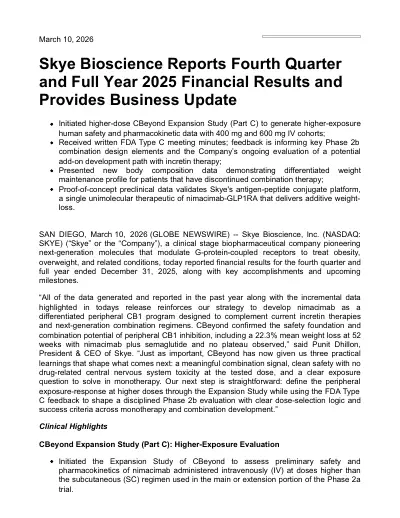
First, we initiated the CBeyond expansion study. This study is designed to rapidly generate safety and PK data at higher exposures that we intend to take forward in future clinical studies.
Second is the off-treatment follow-up suggests a differentiated mechanism of weight regain. Body composition data show that fat mass loss was maintained after 13 weeks off treatment, and is supporting our hypothesis that nimacimab is differentiated and orthogonal to GLP-1s and is well-suited for combination treatment.
Third, we delivered proof of principle for our APC program, a proprietary, unimolecular, dual-mechanism biologic designed to simplify dosing. Fourth, we are designing a very deliberate Phase 2b study, carefully selecting our TPP and development path in combination with an incretin.
Our product is not trying to out-incretin the incretin field, especially in the first-line indication. The winning lane for nimacimab is an add-on for the GLP-1 experienced patient who has already proven willingness to be treated and has reached or is approaching maximum incretin exposure and still has a residual problem of plateau, tolerability, durability, body composition quality, or even economics.
Then looking ahead, here are the anticipated catalysts throughout 2026: in Q1, we reported interim CBeyond extension data, we received the FDA Type C meeting minutes, and initiated the CBeyond expansion study, the Part C that we're referring to. We also expect to complete the ENHANZE compatibility and in-use study.
In Q2, we expect Cohort 2 to initiate enrollment and for enrollment to complete for both Cohort 1 and Cohort 2. We also plan to share additional preclinical bioconjugation data and complete the feasibility work on our high-concentration formulation program.
In Q4, we expect top-line clinical data from the expansion study alongside our planned Phase 2b final study design and overall execution readiness. That includes the final protocol and the operational plan we aim to complete once dose selection, regulatory input, and the drug product work are sufficiently mature, and that cadence is really designed to set up a clear dose selection decision and a practical subcutaneous path before we commit to the Phase 2b.
That's the plan. It does not require reproving the pathway, and we're not trying to displace what first-line incretins have already established.
Our objective is to determine whether peripheral CB1 inhibition can create meaningful value after incretin initiation. In 2026, our goal is to answer this very important value-driving question: what exposure and duration of peripheral CB1 engagement is required to produce clinically meaningful efficacy, and can we achieve that reliably with an acceptable safety margin?
The expansion study and the related endpoints are designed to set up a clear dose selection decision and a practical subcutaneous path before we move into the Phase 2b trial. All right.
That's it for today, and thank you so much. We will now open up the call for analysts' questions.
Operator
Thank you. We will now begin the question-and-answer session.
If you have dialed in and would like to ask a question, please press star 1 on your telephone keypad to raise your hand and join the queue. If you would like to withdraw your question, simply press star 1 a second time.
If you are called upon to ask your question and are listening via speakerphone on your device, please pick up your handset and ensure that your phone is not on mute when asking your question. Again, it is star 1 to ask a question.
Our first question comes from the line of Jay Olson with Oppenheimer. Your line is open.
Jay Olson
Oh, hey. Congrats on the progress, and thanks for taking our questions.
Can you talk about your plans to share data from the higher-dose cohorts above 200 mg? Also, can you just talk about the status of your formulation work using the Halozyme technology, and if you plan to use a subcutaneous self-administered pen in future studies?
Also, do you need to have that formulation available at higher doses before proceeding to Phase 2b? Thank you.
Punit Dhillon
All right, Jay. Thanks so much for joining and the questions.
I think the first part, as you heard today, we are expanding into Part C, this expansion study. That is the next important clinical data that we expect from the CBeyond study.
Our objective here is that the higher exposure produces a clear PK step-up. It preserves this CNS-sparing safety profile that we've seen, and shows directionally that the monotherapy activity is consistent with that exposure response that would materially change how that overall program shows activity relative to what we saw in the earlier 200 mg dose.
As we've gone over today, there's a very clear rationale of increasing that dose from what was in the 200 mg, which didn't get to the right peripheral exposure that we expected. That's what we would expect to have before the end of the year.
We're trying to generate that data as fast as possible, and everyone should expect that update from us as soon as that data is available, and right now we're guiding Q4 of 2026. With regards to the formulation work, I'm going to turn that over to Tu, and he can give you some updates regarding that.
Tu Diep
Thanks, Punit. Hey, Jay, thanks for the question.
I think you were asking just about the status of our co-formulation work with ENHANZE. That work is ongoing.
We do expect it to be ready in time for the Phase 2b study. We have disclosed in the past that the use of that co-formulation will be done through what was referred to as a mix-and-deliver approach, meaning that the two components will actually be mixed at the site and subcutaneously delivered at the site by either the patient or the participant or a nurse or a coordinator that's administering the drug.
As a part of the Type C meeting, we did submit some questions around the co-formulation work and what the expectations are by the FDA, and they have given us guidance around that. We are working very closely with Halozyme as well as a part of the collaboration.
They have obviously a lot of experience with this process, we're quite confident we'll be able to meet those requirements laid out by the FDA to be able to not just use the product in this mix-and-deliver approach for the Phase 2b study, but also be prepared to use it in a truly co-formulated formulation that will be delivered likely as a prefilled syringe first or something in that format. I think the second part of your question is whether or not the drug will be delivered in a autoinjector-type format as well.
Yes, that is obviously the intention from a commercial standpoint. All of that work will need to be completed and done and prepared in advance of any Phase 3 study.
Punit Dhillon
Jay, to answer your question on the timeline side of what Tu just answered, we're moving that work in parallel with the execution of the Phase 2b, but we would have the autoinjector component for the Phase 3 trial.
Jay Olson
Great, thanks for taking all the questions, and congrats again on the progress.
Punit Dhillon
Thank you.
Operator
Our next question comes from the line of Ted Tenthoff with Piper Sandler. Your line is open.
Ted Tenthoff
Great. Thank you very much for all of the updates and great to see the progress.
I'm wondering, when it comes to the expansion, do you think you're going high enough, and is there a reason to explore maybe even higher doses of nimacimab based on the low brain penetration that we saw and likely safe CNS, or are you worried about going beyond the doses that you laid out? Thank you.
Punit Dhillon
Thanks, Ted. Great to have you on the call.
I'll let Chris answer that from a dosing rationale. I can just set it up here: what we expect to see is a clean exposure separation with these doses that we've selected.
The exposure levels that we have outlined today in the call are consistent with what we've modeled in terms of peripheral target engagement, and that's what we would like to see in terms of that specific zone needed for the Phase 2b selection. We believe that's the bar.
Of course, we are continuing to evaluate higher dosing, but at the moment, we feel these two doses that have been selected are sufficient. Chris, do you want to elaborate?
Chris Twitty
I think you covered it well. I might just add a little bit of color.
There's a couple pieces that we've really delved into, and one is the actual CBeyond data itself. We have pretty robust preliminary models that are clearly demonstrating a dose response.
When those are getting finalized, we feel very confident that that data set alone speaks to increased dosing allowing for a more efficacious response. As I covered in the report in the earnings call itself, is that we've looked carefully at a series of both non-human primate, the published human data, as well as our own DIO data, and we're able to carefully translate that exposure, and critically, as Punit was saying, the exposure in the peripheral tissues really seems to be the fundamental driver of achieving that inhibition.
We know much better now the learnings from our study coupled with the biodistribution data tells us that we can get to that meaningful inhibition, really drive response. That's very clear from our DIO studies, and we see evidence of that in the non-human primate studies as well.
Ultimately, addressing the last piece of your question, very comfortable with that limited exposure in the CNS. That therapeutic index is really there.
We feel we can get, really beyond what, as you noted, we're potentially looking at and still have that very comfortable safety kind of built in to this approach. I think it's a great starting point.
We're going to see a nice dose response, and we should be able to maintain that safety even if we wanted to go up higher. Hopefully that adds a bit more color.
Ted Tenthoff
That's great. That's really, really helpful color.
I appreciate it. Then a quick question on the new program.
What do you sort of see as the profile for that? Is that the goal to improve in safety, efficacy, both?
It seems to me like safety is pretty clear at this point. What really is the goal, and how do you anticipate developing that?
Thanks.
Punit Dhillon
Ted, I'm sure Chris is going to love to go into a lot of detail on that. We're going to save a little bit for later on in the year because we will have opportunities to talk a lot more about that.
I'll just say that we're really treating it as long-term optionality. It's not a lead kind of near-term value driver.
Obviously, we're really betting on how we're moving forward their TPP on nimacimab is the near-term. As we've talked to you before, nimacimab remains that core value driver.
The APC data today that we showed is a really interesting scaffold that supports a much broader combination platform over time. We've alluded to this in the past, and now to finally start seeing data repeated coming out of the R&D group, it's been really exciting, and that adds to a significant upside.
Again, not to distract away from our near-term clinical data points. Chris, do you want to give any additional color to that?
Chris Twitty
No, I would just note that from a scientific perspective, it's just incredibly exciting, just so many directions we can go, and there's clearly benefits just from a, and Tu could probably comment better on this in terms of the strategic angle in terms of its clinical development, having this unimolecular asset, not only from an IP perspective, but just thinking about leveraging our favorable half-life and all the safety that comes with that, getting engagement with this GLP-1 receptor agonist in the periphery and seeing pretty comparable weight loss to something that is a true combination that can at face value engage in the centers of the brain and beyond that blood-brain barrier. Yet, we're able to achieve that with a 3-day dosing as opposed to the daily dosing with semaglutide or our own SBI-403.
It's really interesting. It really opens your eyes to what's possible with this platform.
We're looking at, as I said, not just GLP-1 receptor agonists or not even incretins, looking even beyond that. Just a huge sort of ability to look at all kinds of metabolic modulators.
The science is just super exciting for us. We'll have updates later on in the year.
It's incredibly exciting for our R&D group.
Ted Tenthoff
Very cool. Thanks, guys.
Operator
Our next question comes from the line of Michael DiFiore with Evercore ISI. Your line is open.
Michael DiFiore
Hi, guys. Thanks so much for taking my question.
Two questions from me. The first one is as we think about the monotherapy versus combination therapy options, I guess one way to interpret is that different peripheral compartments may contribute differently to efficacy.
That said, how do you think about which peripheral tissues are the most important for nimacimab's clinical effect? Does that differ, or might that differ, between monotherapy and combination therapy?
I have a follow-up.
Punit Dhillon
Hey, thanks for joining, Michael. I'll let Chris maybe take those questions.
Chris Twitty
No, that's a great question. Yes, the short answer is yes.
I think there's likely to be sort of a different profile in terms of the metabolic tissue that are most relevant to either a mono or a combo play. If we're just focused on nimacimab either monotherapy or even in combination, we really do think the adipose tissue is really critical in that one, we think the lipid metabolism, although we certainly see this in the liver, those two tissues kind of are both very important, but clearly adipose tissue is a big player there in the productive changes in lipid metabolism.
Also we think that controlling appetite is really important, and that is really maintaining and re-establishing leptin signaling. We know that nimacimab does a great job of bringing that back into play, controlling hyperleptinemia in a lot of our models, we see that clearly.
Adipose tissue is one of the key ones. We see huge improvements in glycemic improvement, control of glucose, and that sort of, whether you're prediabetic or even diabetic, that pathway is critical.
When we think about the monotherapy, those are key peripheral tissues that are dropped at critical. Now, if we think about the in the context of a combination, while still important, we think maybe that there's a sort of a leverage point around the complementary.
Maybe control of the hormone-regulating peptides, these hormones that can modulate appetite, maybe aren't as critical in the combination context, because we know that the incretins do a great job of that. Those may not be as relevant.
Engagement in the GI tract, which we know nimacimab can do, maybe not quite as well as the incretins, so that might not be the key engagement. Maybe more around enhanced energy expenditure and productive changes in body compositions, which we know are quite important, particularly in the context of sarcopenic obesity, etc.
Again, maybe thinking about more of the engagement in the adipose, in the liver compartment, those tissues might be a bit more relevant in terms of the combination with nimacimab, if that's helpful. Those would be some of the thoughts I would have that first part of your question.
Michael DiFiore
Very very helpful, Chris. Thank you.
Just my final question, it's just more of a I guess a housekeeping, clarify on why you're choosing to use IV in this Part C phase of the study instead of just using ENHANZE that's reconstituted at the site. Is it just simply too early to use ENHANZE at this point?
I would have thought that Part C would have just employed the on-site reconstitution with ENHANZE.
Punit Dhillon
Thanks, Michael. It's very good observation.
You're right. IV provides us the cleanest, the fastest way to generate that high-exposure PK and safety information.
We're not presenting IV as the end-state product, obviously. We're just using IV right now to get that program data as fast as possible and building a practical and subcutaneous path with ENHANZE for the Phase 2b.
We wouldn't have been able to start the expansion study as fast as we did if we had to rely only on ENHANZE. Instead, that'll be ready for Phase 2b.
Michael DiFiore
I see. Thanks again.
Operator
Our next question comes from the line of Andy Hsieh with William Blair. Your line is open.
Andy Hsieh
Thanks for taking our questions. Just two quick ones for the expansion study, Part C.
One is, I see that you kind of mentioned that 400 mg IV is equivalent to 6 or 700 mg subcutaneous. I was just curious about what is that based on.
Was there any sort of PK modeling that supports that? Just to clarify, Tu, you said 700, but then the presentation says 600.
I just want to make sure that which number was correct. Then the second part is, since now it's transitioned to an IV formulation, do you have a good sense of how long the infusion time will be, and then just the logistical things regarding how long the patients will be on the trial, site visits, all that kind of things for the Part C part of the expansion study?
Thank you.
Punit Dhillon
Tu, I'll put the slide up for you. Do you want to take that?
Tu Diep
That's a good catch, Andy. It is closer to 700 mg, you're right, not 600 mg.
We did conduct a bioavailability study in the past. This was an older study that was conducted to evaluate IV dosing versus subQ dosing.
In that study, it was determined that the subQ dose has a relative bioavailability compared to the IV of about 56%. That's what we base the sort of conversion factor on.
In terms of the actual operations of the IV dose, how long that's going to take and the sort of actual management of the patient at the clinical trial, we expect the IV dose to be about an hour in terms of the infusion time. The first few doses, we'll be asking patients to stay on-site a little bit longer to continue to evaluate safety, but after the first few doses, patients will generally be pretty much done within a couple hours after receiving the dose and doing some of the post-dose assessments.
Andy Hsieh
I see. Cool.
Thank you so much.
Operator
Our final question comes from the line of Albert Lowe with Craig-Hallum. Your line is open.
Albert Lowe
Hi. [cough] What do you see as the bar for success from the expansion study as far as the dose to be taken forward for monotherapy?
Punit Dhillon
Thanks, Albert. Right now our current posture is to be disciplined that the Part C is really primarily a PK and safety study, and the expectation here isn't an efficacy readout.
The expectation is whether the monotherapy directionality appears at the higher exposure in a way that validates the model that we just went over today. Every modest, emerging kind of signal really matters for us on the monotherapy activity, and it's obviously accompanied by this work that we put into understanding what we've learned from the 200 mg dose, as well as the DIO work and biodistribution work that Chris went over today.
It's expected that the PK and safety is going to be in line with that behavior. At the end of the day we're expecting it really helps finalize and reshape our Phase 2b dosing with that confidence.
Okay.
Albert Lowe
Do you still plan to share the full extension data with the 300 mg monotherapy patients?
Punit Dhillon
At the moment, based on the dosing rationale that we presented today, we wouldn't anchor any expectations on efficacy signal from the 300 mg dose. It's it's the it's likely value at the for us and what we are are are planning to review with that data once it's available is that it's going to improve our sensitivity of the PK model, sharpens our exposure response curve, and it's definitely not, to define the commercial intent of our efficacy zone that we're expecting with these doses that we plan on moving into with Phase 2b.
We we will, once that data is available, it'll it'll inform our PK and and that'll be shared as a part of our PK modeling.
Albert Lowe
Okay. Thanks for taking the questions.