SoundThinking, Inc.
Q4 FY2025 · Earnings Call TranscriptMarch 3, 2026
Operator
Good afternoon, and welcome to SoundThinking's fourth quarter and full year 2025 earnings conference call. My name is Diego, and I will be your operator for today's call.
Joining us are SoundThinking CEO, Ralph Clark, and CFO, Alan Stewart. Please note that certain information discussed on the call today will include forward-looking statements for our future events and SoundThinking's business strategy and future financial and operating performance.
These forward-looking statements are only predictions and are subject to risks and uncertainties that are difficult to predict and may cause actual results to differ materially from those stated or implied by those statements. Certain of these risks, uncertainties, and assumptions are discussed in SoundThinking's SEC filings, including its most recent annual report on Form 10-K and other SEC filings.
These forward-looking statements reflect management's beliefs, estimates, and predictions as of the date of this live broadcast, March 3rd, 2026, and SoundThinking undertakes no obligation to revise or update any forward-looking statements to reflect events or circumstances after the date of this call. In addition, our comments on the call today contain references to non-GAAP financial measures such as adjusted EBITDA and key business metrics such as annual recurring revenue.
Non-GAAP measures should be viewed in addition to, and not as an alternative for, the company's reported GAAP results. A reconciliation of these non-GAAP measures to their most directly comparable GAAP measures, as well as definitions of the key business metrics referenced and management's reasons for including the non-GAAP measures and key business metrics referenced, may be found in the press release.
Finally, I would like to remind everyone that this call will be recorded and made available for replay via a link available in the Investor Relations section of the company's website at ir.soundthinking.com. With that, I'll now turn the call over to Ralph.
Ralph Clark
Thank you, operator. Good afternoon, everyone, and thank you for joining us.
I'll begin with high-level commentary on the quarter and the year, along with an update on our near-term outlook and strategic progress. Alan will then walk through the financials in more detail and provide guidance before we open up the line for questions.
Let me start with some important context. The overall market for public safety solutions is constructive and growing.
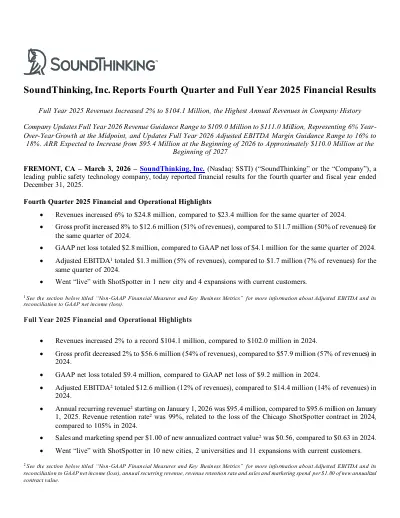
I'm incredibly proud of our team for executing through some of the headwinds we encountered in 2025. Despite some of those challenges, we delivered record full-year revenue of $104.1 million, representing a 2% increase over 2024.
We accomplished that while maintaining double-digit adjusted EBITDA margin profitability and while importantly making critical growth investments that we believe position us for the future. We went live with ShotSpotter in 10 new cities, 2 universities, and expanded with 11 current customers in 2025.
Additionally, we saw solid acceleration of our SafePoint business with $1.6 million of bookings from 11 customers, which we anticipate taking live in the first half of this year. We're exiting 2025 with ARR of $95.4 million, and we believe we're positioned to grow that ARR base by approximately 15% or $14.6 million, net of approximately $3.1 million of ARR attrition in 2026.
This puts us on path to enter 2027 with $110 million of ARR. I'll walk you through the expected ARR build toward the end of my commentary, but will highlight now that while corresponding GAAP revenue should ultimately follow that ARR growth, it is expected to lag because a meaningful portion of our ARR bookings are expected in the second half of the year.
Let me step back and frame what we're building here at SoundThinking and why we're so confident in our future within the public safety and security SaaS market. A big part of what we do is deploy connected physical infrastructure: acoustic sensors for gunshot detection through ShotSpotter, visual sensors for vehicle intelligence through PlateRanger, and passive magnetic field sensors for concealed weapons detection through SafePoint.
These devices operate in the real world, generating mission-critical data. What differentiates us is the unique data we're able to capture at the physical layer and the AI-based algorithms we apply against that data.
Our models detect, validate, and publish actionable signals: gunshots, vehicles of interest, concealed weapons, while filtering out the noise in real time and at scale. While we've been working on innovating and improving our ShotSpotter solution for decades, we've become more intentional recently to apply our prior learnings with new data aggregation and AI tools to our other connected device solutions.
Strategically, these solutions become embedded infrastructure for our customers. As we deploy more devices, we aggregate more data, which improves our AI models and increases value over time.
Because our alerts are integrated directly into customer workflows, from dispatch to investigation to emerging tools like drones as first responders, our systems become operationally embedded. This creates meaningful switching friction and drives strong retention.
The result is a durable recurring revenue base that is both profitable today and we believe will compound over the long term and create real long-term value. Our 2026 ARR growth is expected to come primarily from four major solutions comprising the SafetySmart platform.
First, ShotSpotter, which is our flagship offering and is still the leading acoustic gunshot detection solution in the market. We currently serve over 170 customers, comprising over 1,100 square miles, and exited 2025 with $67.6 million of ARR.
We believe we can add approximately $8.3 million of additional ARR, including the $2.7 million of ARR recapture of the Puerto Rico plus approximately $5.6 million of ARR from other new domestic and international customers, including expansions. This ARR growth does not include Chicago nor any ARR from our recently launched perimeter-based sniper solution, which is focused on critical infrastructure protection of utility substations and corporate campuses, with the potential to cover US embassy and forward operating base deployments.
We believe these opportunities represent additional upside. Second, we're very pleased with the market reception of our CrimeTracer Gen 3 solution, launched late last year at IACP.
CrimeTracer is a highly differentiated data aggregation business representing over 1 billion cross-jurisdictional CJIS records combined with Thomson Reuters CLEAR. That scale and breath of data create a powerful foundation for investigative intelligence.
With Gen 3, we're applying generative AI into that data environment to enable investigators and analysts to find what they're looking for more naturally, surface relevant connections that result in investigative leads faster, and help deliver justice to victims of crime. We're very excited about local law enforcement cross-jurisdictional task force collaborations to address gang violence and organized retail theft rings.
CrimeTracer exited 2025 with $8.1 million of ARR, and we estimate that we will add approximately another $3.1 million of ARR, including the $2.5 million of ARR from the execution of CrimeTracer across approximately 18 agencies within a new state, which has been delayed, but which we believe will happen no later than Q3 of this year. Third, our connected vehicle intelligence ALPR solution PlateRanger, which is powered by our partnership with Rekor, is gaining solid traction following its launch last year.
Given the recent controversy around a certain LPR vendor that has received a lot of well-documented attention, we believe this opens up a significant opportunity for new entrants like ourselves who take security and data governance as first principles versus an afterthought. We are modestly targeting $1.5 million of new ARR from PlateRanger this year.
Last but not least, SafePoint. We continue to see strong momentum as we believe the market is recognizing that SafePoint is just not another weapons detection system, but that it is a fundamentally different architecture.
Unlike legacy checkpoint-based systems that rely on active screening and create friction, SafePoint operates passively and discreetly in the natural flow of ingress and egress, leveraging advanced sensor fusion and AI to detect concealed weapons without slowing people down. We believe that frictionless experience helps drive higher adoption, stronger customer satisfaction, enhanced visitor dignity, and real operational scalability.
We're in the early innings here as leveraging passive sensor weapons detection by harnessing advanced AI capabilities is new and innovative. As we refine deployments and expand our sales capacity, we believe SafePoint is uniquely positioned at the intersection of physical security and AI in what we call physical world AI.
We are encouraged by the tight product market fit demonstrated with Q4 2025 bookings of approximately $800,000 across six customers that all have the capacity for potential expansion. Our model estimates that SafePoint could contribute another $4 million of ARR in 2026.
The balance of our overall ARR increase will come from our other products. An important element in our ability to deliver on our growth strategy is having the right team in place.
To that end, we've taken steps to bolster our sales execution capabilities by adding several new leaders with proven experience scaling successful go-to-market functions and driving durable, profitable growth. We've welcomed Kirk Arthur as our new senior VP of global sales.
Kirk brings a unique combination of commercial GovTech sales leadership he honed at Microsoft, combined with his executive leadership roles in public safety at the US Secret Service. We're thrilled to have him join our leadership team.
It's important to note that we operated at less than our full potential in 2025 without a permanent senior VP of global sales, Kirk's arrival is a meaningful step forward in strengthening execution, accountability, and pipeline discipline across the organization. In addition, Manuel Nyland has joined us as VP of sales and the sales leader for our SafePoint business.
Manny has a long and successful career of bringing new, innovative security solutions to market. We now have a fully built-out SafePoint sales team in place, which is something we did not have in place a year ago.
Lastly, we've added Bruna Ballarino as vice president in Brazil to help expand and accelerate our momentum in that key market. Importantly, Kirk's leadership also frees up Gary Bunyard, who did an outstanding job serving as interim senior VP of sales for Q4 2025.
He will now be able to focus on key large strategic opportunities, including pursuing the contract renewal with Puerto Rico, advancing a significant SafePoint potential opportunity with a global top five healthcare system, and potentially engaging Chicago based on their RFP response. Speaking of Chicago, as we've previously shared, the formal evaluation process has been completed, and we believe the recommendation has been transmitted to the appropriate procurement channels.
At this stage, the matter sits with the city's administrative process. We remain confident in the strength of our response and the technical, operational, and financial merits of our proposal.
Importantly, we believe nothing about the underlying need for acoustic gunshot detection technology has changed, given the formal line-item budget approval for gunshot detection. We continue to be respectful while the formal RFP is active.
While timing is ultimately outside of our control, we believe the fundamentals of performance outcomes and officer safety speak for themselves. We are in a wait-and-see posture.
On New York, we're pleased to see that the recently released fiscal year 2027 budget framework leaves our current three-year agreement with NYPD fully intact. There were no proposed reductions, no carve-outs, no structural changes to the program.
ShotSpotter remains embedded in the city's public safety architecture. It grows as NYPD integrates ShotSpotter with drones as first responders and crime gun intelligence.
This is notable. New York is one of the most scrutinized policing environments in the world, and if there were any operational concerns, budget pressures, or appetite for change, we believe you would see it reflected here first.
Instead, what you see is continuity. Our system continues to do what it is designed to do, which is to provide rapid, actionable intelligence to officers in the field.
The city's budget signals a steady support from our perspective that there is nothing unusual to interpret here; this is simply the steady execution of a long-standing partnership. Now to guidance.
We know from experience that recognized GAAP revenue timing can fluctuate based on procurement cycles, deployment schedules, the cadence of bookings, and the budget headwinds, which is why we're adjusting our full-year revenue guidance to $109 to $111 million. To be clear, we believe annual recurring revenue reflects the 2026 inflection point and underlying compounding economic engine of our business.
As we move into 2026, there are three items of focus for us. First, anticipated ARR growth: approximately 15% growth in our net ARR reflects expanding adoption and renewed momentum.
Second, introducing customers to more solutions within our platform and focus integration with complementary solutions. Multi-product customers represent a larger opportunity than a single-product deployment.
We're increasingly leading with workflow outcomes, not point solutions. Third, operating discipline: we're investing where the returns are strongest, particularly in growth areas like SafePoint and operational levers made possible by agentic AI capabilities.
As we continue to allocate resources toward our highest return opportunities, we're also focused on ensuring the organization is operating as effectively as possible. In that context, the board and management team are undertaking a review of the business to identify opportunities to drive efficiency across the organization.
Our objective is to create shareholder value and ensure the company is well-positioned in any market environment. We'll provide updates as the review progresses.
I'll now hand it over to Alan to talk about the numbers. Alan, over to you.
Alan Stewart
Thank you, Ralph, and good afternoon, everyone. In spite of the challenges mentioned by Ralph, our 2025 results had many positives.
Our financial performance reflects the success of our ongoing strategic initiatives, the growth of our largest products, and operational efficiency measures, which support our commitment to deliver value to our shareholders. In the fourth quarter, revenues were $24.8 million, representing a 6% increase over the prior year period.
Gross profit was $12.6 million or 51% of revenue versus $11.7 million or 50% of revenue for the prior year period. Our adjusted EBITDA was $1.3 million compared to $1.7 million in the prior year period.
Our adjusted EBITDA decrease was directly related to the delayed contracts from an anticipated deployment of CrimeTracer in a new state and our ShotSpotter renewal in Puerto Rico. As a reminder, adjusted EBITDA, a non-GAAP financial measure, is calculated by taking our GAAP net income or loss and adjusting out interest income or expense, income taxes, depreciation, amortization, and impairment, restructuring costs and losses including related fixed asset disposals, stock-based compensation expense, and acquisition-related expenses including adjustments to our contingent consideration obligations.
Our operating expenses were $15.1 million or 61% of revenue versus $15.5 million or 66% of revenue in the prior year period. Breaking down our expenses, sales and marketing expense in the fourth quarter was $6.5 million or 26% of total revenue, compared to $6.5 million or 28% of total revenue in the prior year period.
Our R&D expenses were $4 million or 16% of total revenue, compared to $3.5 million or 15% of total revenue in the prior year period. G&A expenses for the quarter were $4.5 million or 18% of total revenue, compared to $5.5 million or 24% of total revenue for the prior year period.
Our GAAP net loss was approximately $2.8 million or a loss of 22 cents per basic and diluted share for the quarter, based on 12.7 million basic and diluted weighted average shares outstanding. This compares to a net loss of $4.1 million or 32 cents per basic and diluted share based on 12.6 million basic and diluted weighted average shares outstanding for the prior year period.
Turning to our full-year 2025 results, revenues were a record $104.1 million, representing a 2% increase over the $102 million achieved in 2024. It should be noted that 2024 included approximately $9 million of revenue related to Chicago that was not renewed, but replaced by growth of other product sales across the company.
This Chicago revenue reduction also affected all 2025 profitability measures. Gross profit was $56.6 million or 54% of revenue, versus $57.9 million or 57% of revenue for the prior year.
Our adjusted EBITDA was $12.6 million compared to the $14.4 million we achieved in the prior year. Operating expenses decreased 1% to $65.4 million or 63% of revenue, versus $65.7 million or 64% of revenue in 2024.
Breaking down our expenses, sales and marketing expense in 2025 was $26.1 million or 25% of total revenue, compared to $28.1 million or 28% of total revenue in the prior year. Our R&D expenses were $15.9 million or 15% of total revenue, compared to $13.9 million or 14% of total revenue in the prior year.
G&A expenses for the year were $23.2 million or 22% of total revenue, compared to $23.9 million or 23% of total revenue for the prior year. As a reminder, we expect our G&A expenses to grow less than our revenue on a percentage basis as our company grows.
Our GAAP net loss was approximately $9.4 million or a loss of 74 cents per basic and diluted share for the year, based on 12.7 million basic and diluted weighted average shares outstanding. This compares to a net loss of $9.2 million or 72 cents per basic and diluted share, based on 12.7 million basic and diluted weighted average shares outstanding for the prior year period.
Deferred revenue as of December 31st, 2025, was $43.9 million, in line compared to the $43.9 million at the end of third quarter 2025. Revenue retention rate for 2025 achieved 99%, reduced due to the non-renewal of our Chicago ShotSpotter contract at the end of 2024.
Our sales and marketing spend per dollar of new annualized contract value was 56 cents, compared to 63 cents in 2024. We ended the year with $15.8 million in cash and cash equivalents, versus $11.8 million at the end of the third quarter of 2025.
We repurchased 225,334 of our shares at an average price of $13.15, for approximately $3 million throughout 2025. Our current cash balance is greater than $16 million, even after paying our annual company cash bonuses in February.
Currently, we have approximately $36 million available on our line of credit, as we have approximately $4 million in debt outstanding, all on our line of credit. Now turning to our guidance for the full year of 2026.
We are reducing our full-year revenue guidance range from $114 to $116 million to $109 to $111 million. This decrease is primarily attributable to delays in two expected bookings and deployments, which the timing of close is still unknown, we thought it appropriate to reduce the revenue expansion until they are executed.
The first relates to CrimeTracer. We had anticipated execution across approximately 18 agencies within a new state, representing approximately $2.5 million in revenue.
While this deployment has been delayed, we remain confident it will proceed in the near future. The second relates to our ShotSpotter renewal in Puerto Rico.
When executed, this contract is expected to add approximately $2.7 million in ARR, but similar to the CrimeTracer rollout in a new state, we're not clear on the timing of the contract execution. In total, these two items represent over $5 million in revenue that was originally expected to be recognized in 2025 and throughout 2026.
Even if recognition of revenue is delayed, provided these contracts are executed in 2026, they should significantly increase our ARR at the end of the year. It's also important to note that approximately 70% of the revenue related to these two items mentioned above will flow through to adjusted EBITDA.
While we believe these are temporary setbacks, we remain optimistic about the long-term value of these potential contracts and our ability to execute well as and when they get booked. We continue to monitor these developments closely.
We are reducing our full-year adjusted EBITDA margin guidance range from 18% to 20% to 16% to 18% to take into account the delay of these large contract executions as well as the investments that we continue to make in our AI modeling and tools that we are incorporating in our products and our internal operational use. As we look to 2026, we remain focused on execution and long-term value creation.
We are encouraged by our pipeline visibility for the rest of 2026, the strong renewal rate of our customer base, expanding strategic partnerships and integrations, increasing momentum into 2026, and our ability to generate consistent cash flow while investing for future accelerated growth. Overall, we're pleased with the progress we've made on each of our strategic initiatives and operational performance for business.
With that, we're now happy to open the call for questions. Operator, will you please open the line for the Q&A?
Operator
Thank you. At this time we will conduct our question and answer session.
If you would like to ask a question, please press star one on your telephone keypad. A confirmation tone will indicate your line is in the question queue.
You may press star two if you would like to remove your question from the queue. For participants using speaker equipment, it may be necessary to pick up your handset before pressing the star keys.
Once again, to ask a question, press star one. One moment while we poll for questions.
Your first question comes from Alex Latimore with Northland Capital Markets. Please state your question.
Alex Latimore
Hey, guys. Alex Latimore here on for Mike Latimore.
I appreciate the color in the quarter here, the ARR breakdown. ARR breakdown is very helpful for me.
I had one question here on SafePoint. Can you discuss which verticals are currently most prominent in the pipeline for SafePoint?
Ralph Clark
Thank you for that question. Can you hear me okay?
Alex Latimore
Yes.
Ralph Clark
Great. This is Ralph.
I would say the primary vertical for us where we've had a lot of success has been the healthcare vertical because they really do value the passive nature of our weapons detection system that allows for full ingress and egress without having a checkpoint or any kind of friction. That is really the vertical that we're leaning in on most, although we do have some other opportunities in other verticals, in corporate verticals, as an example.
Alex Latimore
Awesome. Thanks, Ralph.
I also was curious on the status of your CaseBuilder deployment, I believe in the NYPD Corrections Department. If you could give any insights there, that would be very helpful.
Ralph Clark
Great. This is Ralph again.
Thank you for that question. We're continuing to make really good progress in lighting up new applications to support new use cases at the New York City Department of Corrections deployment.
We also have a fairly significant Department of Corrections deployment in Orleans Parish as well. That's moving along very nicely for us.
Alex Latimore
Awesome. Then, one final question: what level of attrition are you assuming for ShotSpotter this year?
Alan Stewart
This is Alan. At this point, we're expecting a total ARR attrition of about $3 million, as Ralph mentioned.
We would expect that probably half to two-thirds of that would be related to ShotSpotter, only because we're getting ready for continued customer having some budget challenges. Far, we've been working through most of those and getting positive results, but it is best for us to be appropriate for a larger portion of that to come from budget issues.
Alex Latimore
Awesome. Ralph, Alan, thank you.
Thank you for the time. Thank you for taking my questions.
Operator
Your next question comes from Trevor Walsh with Citizens. Please state your question.
Trevor Walsh
Great. Hey, Ralph and Alan.
Thanks for taking the questions. Ralph, maybe for you: can you elaborate a little bit more on the comments you made at the end of your prepared remarks around the board review?
Is it essentially just sort of digging a closer look at cost-saving measures and kind of where you guys can be more efficient from that perspective? Maybe we just give a little bit more detail there, that'd be great.
Ralph Clark
I think it's a good governance practice to have the board kind of engage with the senior leadership team to really kind of pressure test, are we appropriately looking at opportunities to drive greater efficiencies? We're now over 300-plus employee organization.
We've made some critical investments in AI. We're seeing some positive benefits from agentic AI and think that that's going to drive a lot more productivity, and I think the board is appropriately engaged with us to see if there's more that can be gained from that.
More to come. It's still in the very early stages, but more to come.
Just know that we're going to be putting our heads together and seeing and asking the question, "Can we do things more efficiently?"
Trevor Walsh
Got it. Great.
Thanks, Ralph. Maybe just staying with you and then I've got one last follow-up for Alan.
I think there was a new disclosure, or at least kind of a new theme around the use case for sniper, kind of gunshot detection in a, I guess, embassy or more foreign-deployed type of environment. Just curious if that commentary is related to kind of actual opportunities that are in flight, and that would seem, obviously you've got some international type of capabilities around ShotSpotter proper, I'm wondering, are you just essentially pairing that use case with the boots-on-the-ground go-to-market-wise that are already doing that international business, or will this be a new motion with bodies that'll kind of, from a headcount perspective, to kind of, more fully pursue that opportunity?
Ralph Clark
Sure. Great question.
Just to step back for everyone that may not have kind of caught that the way that you caught it, we continue to innovate around our ShotSpotter technology, a solution. The team did a really good job developing a new use case and new technology architecture that now allows us to do kind of perimeter-based, sniper-based types of gunshot detection.
Principally, what that means is we're not just relying on muzzle blasts, but we're also relying on supersonic snap of a bullet kind of passing by a sensor, where you can co-locate the sensor along with the intended target. Our initial thoughts are to focus on utility substations.
We know that those utility substations have been subject to be attacked as a part of kind of bringing down the electric grid, having a perimeter-based solution kind of around protecting that substation so that a substation utility firm can be notified if someone was firing inside that perimeter into the substation seems like a natural use case. We're doing this through SoundThinking Labs.
We're not expecting or don't have any revenue allocated to this, although we are aggressively looking and are resourcing ourselves with a little bit of sales motion to go get some early trial customers within the substation utility market. In terms of forward operating bases and embassy, that would be kind of a next-layer type of thing; that's not our primary focus right now.
Our primary focus is to get this up and running and deployed with a couple utility companies this year and see where it goes from there.
Trevor Walsh
Got it. Thanks, Ralph.
Super helpful. Alan, last one for you: I'm just trying to bridge some of the comments that you both made specific to SafePoint.
I think you had said there was $1.5 million in bookings either in the quarter, or maybe that was for the full year for SafePoint, but then you I think expect $4 million in total for net new in fiscal '26. I guess two-part question: can you just help me bridge the 1.6 actually in bookings that you said?
I guess, what was the average duration around that contract? I'm just trying to understand kind of what does that look from an ARR perspective in '25, kind of moving to the potential for $4 million in '26?
Does that make sense, Alan?
Alan Stewart
It does. No, it makes perfect sense,
Trevor Walsh
and
Alan Stewart
a great question. I think that the biggest thing to take away is if you look at what we did for the entire year versus how things are ramping up, and what we did with the $800K in Q4, you can see that we have done investing appropriately in the product and how we're selling it, and we'll be adding more capability in terms of the sales team as well, where that $800,000 in Q4, we are expecting to be similar or greater as we go into each quarter in '26.
In terms of adding $4 million of ARR, we feel pretty confident about that. As Ralph mentioned earlier, over half of our customers are in the healthcare sector, and many of those are already saying, "Okay, we really like what you're doing, we're going to expand to this."
Some of those healthcare agencies have not just 10 or 20 hospitals, some of them have 100. We're feeling very positive about what we're doing in terms of setting expectations of the customer in terms of improving the product deployment.
Although it does take some time to deploy those once we've booked them, we believe that we'll be able to hit the ARR increase that we have talked about in the script.
Trevor Walsh
Got it. Perfect.
Thanks, both. Appreciate the questions.
Operator
Your next question comes from Elle Niebuhr with Lake Street Capital Markets. Please state your question.
Elle Niebuhr
Hey, guys. Thanks for taking my questions.
Wondering if you could comment on how things have changed with sales reps only selling the ShotSpotter or the PlateRanger, rather than the whole platform at once?
Ralph Clark
This is Ralph. Thank you for that question.
I'll start and Alan jump in and add and correct as appropriate. I think the first thing I would state is that we have a specialized, dedicated team to essentially sell SafePoint.
It's comprised and led by Manny, who I just mentioned on the call here, joined us as our VP of sales for SafePoint. Currently, he has three direct sales executives reporting to him, along with a pre-sales engineer.
It's a very tight, focused unit of Manny leading four individuals to go drive SafePoint business, which is very security-oriented. When you go to our public safety side of the business, it gets a little bit more complex, but I'll try to simplify it by saying that we have a number of field sales territory reps that are responsible for selling the full product suite.
Increasingly, you're going to see us tighten that up with a bundle. Think in terms of a ShotSpotter bundled with PlateRanger or PlateRanger bundled with CrimeTracer.
They basically own geographies, and they're developing new relationships with new customers as well as having conversations about expanding our footprint in existing customer relationships. On top of those folks, we have an overlay organization, and that's where we have a little bit more specialization with respect to the solutions.
You would find someone that is really, really smart about CrimeTracer, as an example, or CaseBuilder, or ShotSpotter, or PlateRanger. That's kind of the overlay organization that works collaboratively with our field sales organization.
That's all kind of led by our new senior VP of global sales, Kirk Arthur, who just joined us. He also has some ops capability in his organization as well.
These are the folks that are primarily responsible for renewal activities and proposal developments when we're responding to RFPs and the like. He works collaboratively with our customer success organization, which is led by senior VP Larry, who is leading the customer success organization.
Elle Niebuhr
Thanks. That's really helpful.
Ralph Clark
Thanks.
Elle Niebuhr
Yeah. Then, switching to the international segment, how did that trend in the quarter?
Then, can you comment at all on what you expect the international revenue to grow in 2026?
Alan Stewart
Sure, this is Alan. I'll go ahead and start, and Ralph can add or correct as well.
Although things did go a little slower than we thought in '25, it has picked up. We have several things that we are expecting in '26, that by the end of the year, there will probably be three new deployments in three separate countries.
We are deployed in all three of those right now, it is a bit expansion that we're expecting, but also very positive in terms of what we're doing. It's also why we hired a new sales VP directly in Brazil.
Brazil is a very large potential customer and country for us that has a lot of gun violence, and we're doing quite well in the Niterói deployment there. Uruguay is already expanded once, and we are expecting possibly another one, and then some more deployment in South Africa.
Elle Niebuhr
Perfect. Thank you.
I'll hop back in queue.
Operator
Thank you. Your next question comes from Jeremy Hamblin with Craig-Hallum.
Please state your question.
Jeremy Hamblin
Great. Thanks for taking the questions, guys.
I just want to start by kind of reconciling Q4 a little bit. The EBITDA came in quite a bit below the guidance issued in November.
Just wanted to understand, was that It looks like maybe gross margins were light of expectation, but you also did cut pretty aggressively in G&A. I wanted to marry where the kind of the $2.5 million discrepancy lay, and then, in thinking about the improvement for 2026, you've got about a $6 million revenue improvement, but almost $5 million improvement in EBITDA.
Just to understand the drivers of that.
Alan Stewart
Sure, this is Alan. I'll give you I think some of the focus areas I think might be important to understand.
We had expected to get Puerto Rico and the new CrimeTracer deal earlier than we have. That would have been included a portion of that in Q4, that did not happen.
I would say the other thing, though, that when we look at things across the board, you have some costs certainly maybe related to stock-based comp and things like that that ultimately affect our adjusted EBITDA. You can see that our stock-based comp actually went down, right, from that, as well as going down in the actual OpEx.
G&A went from $5.5 million in Q4 last year down to $4.4 million this year, $4.5 million, million dollars less. We are doing more things, we believe, to be appropriate in terms of how we're spending to make sure that we're doing the investment the right way, which is what Ralph answered one of the earlier questions about things that we evaluate on how we're doing them.
I think how does that go and look into '26, what you can expect is similar things for us in terms of looking at ways we can be more efficient, and hopefully as we're seeing SafePoint itself specifically increase, and ShotSpotter possibly increase in miles versus last year, you'll see the revenue going up without the OpEx actually going up too much, other than what we've already mentioned. Hopefully that answers your question, Jeremy.
Not sure.
Jeremy Hamblin
That's helpful. Then, G&A, should we be thinking about that as something that may be closer to flat on a year-over-year basis as you make kind of some decisions around kind of what you need to drive the organization, or because presumably the $4.5 million in Q4 is a bit of a depressed level, as you noted, maybe SBC got reversed or certainly was lighter than normal.
Just wanted to see if you could maybe clarify that a little bit as we think to '26.
Alan Stewart
No, that's also a great follow-up question. I would just kind of talk about years.
In '24, our G&A was $24 million. In '25, was down to $23.2 million.
I would expect that it may be slightly higher than 23.2 as we go into '26 as revenue grows, but possibly not much at all. We are expecting G&A to grow less than a percentage of revenue, our goal would be to control as many things as we can.
Sometimes there's things we can't control, like legal costs, et cetera, but other than that, things that we can control should keep our G&A relatively flat.
Jeremy Hamblin
Got it. Then, wanted to follow up on PlateRanger.
You noted fairly significant events that are occurring in the ALPR space. Seems like there's tremendous opportunity out there to potentially gain some contracts.
We've seen some other firms that have already flipped contracts. Wanted to understand progress that you're making with that product line and just how far down the line you are with potential deals that you might be able to win, whether they're new deals for municipalities that don't have this type of service already, or potentially wins that you might be able to take away from the vendor?
Ralph Clark
Sure, this is Alan. I'll go ahead and start, and Ralph can add or correct as well.
The good news is we had several pilots going into or starting the second half of last year. We've already converted five of those to actual customers, which is good.
We've got another probably four or five that we're looking at and working on them to convert them to actually customer contracts. From a revenue perspective, having no revenue at all really in '25, we believe we can get that $1.5 million in ARR by the end of the year.
The sooner we can get those converted, the higher the revenue will be.
Jeremy Hamblin
Got it. Thanks so much for taking my questions.
Best wishes.
Ralph Clark
Thank you.
Operator
Thank you. We have reached the end of the question and answer session.
I will now turn the call back over to Ralph Clark for closing remarks.
Ralph Clark
Great. Thank you very much, and thank you, everyone, for joining us today.
I want to express my sincere gratitude to our shareholders for your continued support as we've navigated through what was a fairly transformative year. Your partnership has been instrumental in enabling us to make the strategic investments and organizational adds that position us so well for future growth.
The trust that you've placed in our team and our vision to become the leading public safety technology partner for communities and enterprises nationwide drives us forward. To our clients, I also want to say thank you for choosing SoundThinking as your strategic partner in public safety and security operations.
SoundThinking remains committed to making communities safer through technology, transparency, and innovation that address real-world public safety challenges. As we look ahead into 2026, I'm energized by the opportunities before us and confident in our ability to deliver on our commitments to deliver shareholder value.
Thank you all, and have a great evening.
Operator
Thank you. This concludes today's call.
All parties may disconnect. Have a good day.