Sterling Infrastructure, Inc.
Q3 FY2026 · Earnings Call TranscriptOctober 29, 2026
Operator
Good morning, ladies and gentlemen, and welcome to the Sterling Infrastructure third quarter webcast and conference call. At this time, all lines are in listen-only mode.
Following the presentation, we will conduct a question-and-answer session. If at any time during this call you require immediate assistance, please press star zero for the operator.
As a reminder, this call is being recorded on Thursday, October 29th, 2026. I would now like to turn the conference over to Noel Dilts, Vice President, Investor Relations and Corporate Strategy.
Please go ahead.
Noel Dilts
Good morning, and welcome to Sterling Infrastructure's third quarter 2026 earnings conference call and webcast. I'm pleased to be here today to discuss our results with Joe Cutillo, Sterling's Chief Executive Officer, Nick Grindstaff, Sterling's Chief Financial Officer, and Dan Govin, Sterling's Chief Operating Officer.
As a reminder, accompanying slides are available in the Investor Relations section of our website and include additional information regarding our full year 2026 financial guidance. Our discussion today may include forward-looking statements.
Actual results could differ materially from the statements made today. Please refer to Sterling's most recent 10-K and 10-Q filings for a more complete description of risk factors that could affect these projections and assumptions.
The company assumes no obligation to update forward-looking statements as a result of new information, future events, or otherwise. Please note that management may reference certain historical, forward-looking, and non-GAAP financial measures.
Reconciliations of these non-GAAP financial measures to their most directly comparable GAAP financial measures are included in our earnings release and posted in the Investor Relations section of our website. Please refer to the press release for additional information regarding our forward-looking statements and non-GAAP financial measures.
Throughout today's discussion, all third quarter 2026 comparisons are to the third quarter of 2025 unless otherwise noted. I'll now turn the call over to our CEO, Joe Cutillo.
Joe Cutillo
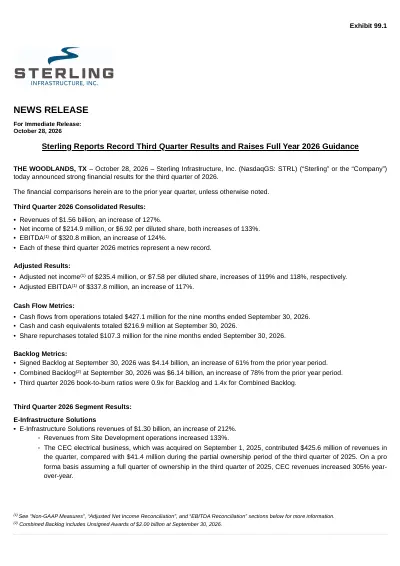
Thanks, Noel, and good morning, everyone. Sterling delivered another outstanding quarter as adjusted diluted EPS grew 118% to reach $7.58.
Revenue increased 127%, and adjusted EBITDA more than doubled. On top of this, our visibility continues to expand.
Our total scoped work, which includes signed backlog, unsigned awards, and the next phases being designed on our current projects, now totals nearly $8 billion, up approximately 90% year-over-year. These results demonstrate the strength of our market, the great execution of our teams, and the continued success of our strategy.
While the quarterly performance was exceptional, what's even more important is what these results tell us about the opportunity ahead. Throughout 2026, it has become increasingly clear to us that we are in the early stages of significant multi-year investment in large-scale, mission-critical infrastructure across the U.S.
Data centers remain a powerful growth driver, but the opportunity is much broader, spanning semiconductors, advanced manufacturing, energy infrastructure, and the broader build-out supporting the next generation of U.S. industrial growth.
The magnitude of this opportunity is driving us to think even bigger about how we position Sterling for long-term growth. We are focused on building the capacity, services, geographic reach, and customer relationships required to capture more share of this investment.
Importantly, the $8 billion of scoped work does not capture the full development potential of the campuses we are already working on today. Many of these projects span hundreds or even thousands of acres and are being developed in multiple phases over several years.
These are tangible opportunities backed by land, permits, and power commitments, and is on top of what we already have scoped. In total, these opportunities provide more than five years of additional work.
Sterling has never been in a better position. We have significant visibility into future growth, deep relationships with our customers, and the financial and operational resources to capitalize on the opportunities ahead.
We are excited about Sterling's future and confident in our ability to compound strong, profitable growth for years to come. Now, I'd like to hand the call over to Dan to discuss our segment results in more detail.
Dan?
Dan Govin
Thanks, Joe. I'll begin with E-Infrastructure Solutions, where mission-critical demand, accelerating project activity, and outstanding execution drove another excellent quarter.
Revenue increased 212% year-over-year, led by continued strength across data center and semiconductor campus projects. Within E-Infrastructure, site development operations more than doubled revenue organically, with strong growth across each of our geographies.
In the Southeast, customer demand remains robust, and projects continue to expand in acreage, number of phases, and complexity. This trend plays directly to our strengths, allowing us to leverage our broad self-perform capabilities and proven execution model.
In the Northeast, we continue to make excellent progress on our large semiconductor campus and remain ahead of schedule. Our execution on this large-scale project is strengthening our position and reputation in the semiconductor market.
Momentum is building in the Rocky Mountain region, where accelerating activity on recently awarded large projects fueled another quarter of exceptional growth. Our teams are delivering strong execution and are successfully redeploying transportation resources to capitalize on the expanding mission-critical opportunities.
Key customers are increasingly engaging us to support their capital plans in Texas, driving significant demand for our site development capabilities. Based on the opportunities we see today, we expect Texas to be a meaningful driver of growth over the next several years.
Turning to CEC, the electrical business delivered $426 million of revenue in the quarter, more than quadrupling its pro forma full quarter revenue in the third quarter of 2025. Accelerating work on major hyperscaler and large co-location projects drove growth.
CEC is scaling rapidly and maintaining strong execution. Year-to-date growth has significantly exceeded our initial expectations, and we now believe full year revenue could exceed $1 billion.
This momentum is extending beyond 2026, as CEC continues to build high-quality, longer-duration backlog with established customers, positioning the business for continued growth in 2027. The strong demand and execution across both CEC and site development are translating into significant profit growth for the segment.
In the quarter, E-Infrastructure Solutions adjusted operating income increased 171%, with adjusted operating margins of 23%. Margins declined year-over-year, reflecting the significantly higher revenue contribution from CEC, as it represented a third of the segment revenue in the quarter versus 10% in the prior year period.
Within the segment, site development operating margins remained strong, at first half 2026 levels, even though several of our large mission-critical projects are still in the early stages of construction. Margins typically expand as these multi-phase campuses move into later construction phases over the coming months and years.
CEC operating margins improved both year-over-year and sequentially, and we are encouraged by the margin improvement we are seeing in the core business. As we have previously discussed, we are in the process of winding down some non-core business lines identified during diligence, a process we expect to complete by year-end 2027.
We estimate that these non-core operations will be a drag of approximately 160 basis points on full year 2026 CEC margins, masking the roughly equivalent improvement in the core business. At the time of the CEC acquisition, we committed to achieving 300 to 500 basis points of run rate margin improvement at CEC over 18 to 24 months.
Progress in the core business and our planned exit from non-core work gives us confidence that we can deliver on this commitment. Looking ahead, the opportunity in front of E-Infrastructure continues to strengthen.
In aggregate, our scoped work now approaches $7 billion, an increase of more than 130% year-over-year. The vast majority of these opportunities are tied to mission-critical work, providing substantial visibility into continued growth.
Turning to Transportation Solutions, revenue declined 3%, reflecting the redeployment of resources from Transportation into higher-margin E-Infrastructure work. This transition continues to accelerate as E-Infrastructure activity builds in the Rocky Mountain and Texas regions.
This was the second consecutive quarter in which our Rocky Mountain operations generated more revenue from E-Infrastructure than Transportation. Despite the lower revenue, Transportation Solutions adjusted operating income grew 22%, and adjusted operating margins reached 19.7%.
This demonstrates the discipline we are applying to project selection. Transportation Solutions backlog ended the quarter at $964 million, up 31% year-over-year, largely driven by the conversion of unsigned backlog to signed.
On the combined backlog basis, the segment declined 22%, again reflecting the shift in resource allocation. In Building Solutions, segment revenue declined 5% as homebuilder activity slowed, and adjusted operating margin was 8%.
We expect residential market conditions to remain under pressure through the balance of 2026 and into 2027. We are managing the business carefully through the current environment while positioning the business to capture more market share when conditions improve.
Stepping back, the quarter provides clear evidence of Sterling's strategy in action. We are benefiting from exceptional demand in our highest return markets, becoming more selective about where we are deploying our resources, and building the foundation for multi-year growth.
With that, I'd like to turn it over to Nick to give you more details on some of our financial metrics and 2026 guidance. Nick?
Nick Grindstaff
Thanks, Dan, and good morning. I'll begin with our cash flow and balance sheet.
For the first nine months of 2026, cash flow from operating activities was $427 million, an increase of 68% compared with the prior year period. One item to note is the increase in accounts receivable at the end of the quarter.
Receivables were higher at the end of the quarter due to substantial growth in E-Infrastructure activity, combined with the timing of collections. However, we have already secured a major portion of these outstanding funds in early October, setting us up for robust operating cash flow in the fourth quarter.
Investing activities resulted in a $276 million outflow, including $115 million of capital expenditures. We now anticipate full year CapEx of approximately $140 million.
Financing activities resulted in a $325 million outflow year-to-date. On July 2nd, we closed on the extension and expansion of our revolving credit facilities to $1.5 billion and extended the maturity to July 2031.
We used this facility and cash on hand to pay off our existing term loan. The expanded facility further strengthens our financial flexibility and provides additional capacity to support both organic growth and M&A.
Financing activities included share repurchases of $107 million. At quarter end, $267 million remained available under our existing repurchase authorization.
We will continue to take an opportunistic and disciplined approach to share repurchases as part of our broader capital allocation strategy. Turning to the balance sheet, we ended the quarter with $217 million of cash and debt of $95 million, for a cash net of debt balance of $122 million.
Combined with our expanded revolving credit facility and strong cash generation, our balance sheet provides significant capacity to continue investing in the business and pursuing acquisitions. Moving to guidance, our performance through the first nine months and improved visibility into the fourth quarter give us greater confidence in our full year outlook.
We're raising our 2026 guidance ranges as follows: revenue of $4.63 billion to $4.73 billion, diluted EPS of $19.16 to $19.42, adjusted diluted EPS of $21.70 to $21.96, EBITDA of $905 million to $916 million, adjusted EBITDA of $970 million to $981 million. Now, I will turn the call back to Joe.
Joe Cutillo
Thanks, Nick. The trends we've highlighted over the past several quarters have not only continued, they have accelerated.
Projects are becoming larger, more technically complex, and longer in duration. Our execution continues to build trust and loyalty with our customers, and that is creating opportunities for Sterling to enter new markets, take on more responsibility, and have greater participation in our customers' long-term capital planning.
The opportunity in front of us is larger than ever. Increasingly, the question is not whether the opportunity is there, but how quickly we can add capacity to capture it.
We are investing in our people, equipment, and our capabilities while maintaining the execution discipline and focus on returns that have driven our success. As we look to the remainder of 2026, we are confident that we will deliver another record year.
The midpoints of our revised guidance ranges would represent 88% revenue growth year-over-year, 101% adjusted EPS growth, and 94% adjusted EBITDA growth. Our guidance continues to assume a more pronounced weather impact in the fourth quarter than we experienced in 2025.
Stepping back, our multi-year growth strategy is built around two complementary drivers: strong organic growth and disciplined strategic acquisitions. We are targeting annual organic profitability growth of 20% to 30% over the next several years, with M&A providing an additional opportunity to accelerate that growth.
Together, these drivers support an aspiration to grow earnings by approximately 50% per year. We believe 2027 is shaping up to be another year that beats or exceeds this organic framework.
On the acquisition front, we remain very active and encouraged by the quality of opportunities in the market. We will continue to pursue acquisitions that expand our capacity and geographic presence, and enhance the value we can bring to our customers.
Our strong balance sheet, significant cash generation, and disciplined approach to capital allocation give us the flexibility to fund organic growth and pursue strategic acquisitions, supporting our multi-year growth ambitions. We are confident in Sterling's ability to deliver sustained, profitable growth and long-term value to our shareholders.
With that, I'd like to turn it over for questions.
Operator
Thank you, sir. Ladies and gentlemen, we now begin the question-and-answer session.
If you would like to ask a question, please press star followed by the number one on your telephone keypad. If your question has been answered and you would like to withdraw from the queue, please press star followed by the number two.
If you are using a speakerphone, please lift your handset before pressing any keys. One moment, please, while we compile the roster.
The first question comes from Manish Somaiya with Cantor. Please go ahead.
Manish Somaiya
Good morning, gentlemen. Good morning, Noel.
Joe, when I look at the margin guidance for the full year, it implies 19% or so in the fourth quarter, and clearly that's down from 21.6% that you had in 3Q. I was just hoping if you can just help us bridge that.
I know you talked about the CEC shedding of non-core businesses, that's going to impact some margins. Then just staying on this topic, more specifically, would fourth quarter represent the trough in margins?
How should we sort of think about 2027 as we enter 2027 with a strong backlog and obviously to your point, 20% to 30% organic growth?
Joe Cutillo
Appreciate it, Manish. In the fourth quarter, we have a couple dynamics.
We have the natural seasonality that we go through, and we've done that every year. As we've said, we're being a little conservative on weather for the quarter compared to 2025.
Just to remind everybody, 2025 was about the easiest, softest winter we've had since I've been here. We basically didn't shut down anything, and were able to run through the entire winter.
We don't anticipate that happening again. If it does happen again, that's good, we'll have upside, we'll all be happy.
We have margin erosion just from the seasonality and that. We also have the growth of CEC, which I want to step back and talk about for a second here because everybody's looking at this is a negative.
It's really baffling to me. Some people have called it mix, and I wouldn't call it mix.
We have an electrical business which is very different than our site civil business. It requires a heck of a lot less capital, and we've been able to grow it significantly faster than we ever imagined.
That is a great thing. We've more than doubled the business, yet everybody is looking at it as a negative because it's bringing down the total margins.
We have invested almost very little to zero capital in the business to double it. We've been much more successful at hiring electricians than we ever anticipated, which is a great sign.
We've got the next phases and next levels of projects from our customers, we've been successful in executing and delivering, yet we're beat up for it. It makes no sense to me.
As we grow that business, look, we've had great growth in our site civil business, but as we grow that at a much greater rate, the bottom line is those margins are less. They will always be less.
A significant piece of their business is material, and you're not going to be able to get the margins on material that you get in executing the work. Now, another positive thing is we've made great progress in what we said early on is we were going to improve margins in that business 300 to 500 basis points in 18 to 24 months.
I will tell you we're a long way on that path, we're ahead of schedule, and if you remove the legacy business, which we know we have until the end of 2027, and hopefully we're able to do some things to get out of that a little quicker, if you remove that, we're on track, and we've seen over 150 basis points of improvement in CEC already. I just want to use this opportunity to talk a little bit about that, because I think people are really confusing kind of the goodness that's come out of the acquisition, and as a result are penalizing us for really no reason whatsoever.
The second question, can you repeat that, Manish?
Manish Somaiya
No, Joe, the second question I had was just on the trajectory of margins, would 4Q sort of represent a trough in margins, and how should we sort of think about margin trajectory as we enter 2027? I guess while I have the mic, if you can also just touch on backlog, how much of that unsigned backlog that you have, which is quite significant, can move into signed backlog?
What's sort of the cadence for that? Thank you.
Joe Cutillo
Let me start with the trough. We certainly have seasonality in our margins.
That will continue. Now as we grow the business and we grow in other regions, could that soften it a little bit or change it?
Sure, but we will have seasonality, we don't have a flat margin across four quarters. I will also say we have pretty high expectations for the site civil growth in 2027, but we also think electrical has the opportunity to continue some of these growth rates.
If that happens, again, the blended margin will be the blended margin. I can't predict it because I don't know what the revenues is going to be.
Theoretically, and I say theoretically, in reality, the margins of site will continue to improve, and the margins in electrical will continue to improve. Now whatever those revenues come out will determine the end margin, but we're very positive on the margin trajectory in each piece of our E-Infrastructure segment.
On the backlog, I wish somehow we could get out of backlog altogether, because it's really a meaningless number for us. We have to look at what we have in backlog, that's jobs that we're actively working on.
We have what we call unsigned, awarded contracts, that's predominantly in transportation and some in electrical, and what those are is those are jobs that we have been given, we're negotiating final pricing, or negotiating final terms and contracts. Those will roll into backlog, they could roll in the quarter, if there's some design work involved, they may take a couple quarters, but we have won those jobs, we're in the final negotiation, those will happen.
We have what we're calling the next phase or
Manish Somaiya
what Dan called
Joe Cutillo
phases in design, I guess, is what we're calling it. Apologize.
That's work that's really in the site civil side. That is work that we are in the design phase or in the pricing phase to customers that we know is coming straight after these existing phases end.
There's another piece that everybody's missing, and for those that were on the tour and they're on the call, we literally have thousands of acres of land that is permitted, powered, and ready to go, and when the existing phases end, they will design, build out those next phases. Those represent over five years of work for us.
When we talk about backlog, backlog represents a very small piece of work that we have sitting in front of us, and as we're talking about building capacity, I'm sure somebody's saying, 'Well, your backlog's not growing at the rate that your capacity build needs are saying.' It's because of that future land and that longevity of these projects that we know we're required to build this capacity to handle these new projects that are coming in.
I hope that helps, Manish.
Manish Somaiya
Thanks, Joe. Thank you so much.
Operator
Thank you. Your next question comes from Brent Thielman with Oppenheimer.
Please go ahead.
Brent Thielman
Hey, thanks. Good morning.
Great quarter. Hey, Joe, maybe just follow up on that last point on E-Infrastructure, and maybe to address some of the other concerns out there.
You've got all these campuses with phases going on for years. Presumably, those have power.
When you look at everything else out there, I guess just in terms of new campuses that could be potentially in your pipeline to work on, do those have power connections figured out as well? Just trying to address that concern.
Joe Cutillo
I'm not aware that we've ever started a campus that didn't already have power on it. These are all permitted, all powered, all ready to go, and as we're looking at the ones coming, they are obviously working on the permitting, the power, and as soon as that's released, they generally turn it over to us and we start working.
The incremental land that we're talking about is part of that package, and what we've seen in a lot of cases where they were able to get more power associated with the project, they're buying up incremental land around that area. A lot of these jobs are actually continuing to get bigger than they originally started when we started on the project.
That's not uncommon at all.
Brent Thielman
Okay. Then maybe on CEC, obviously massive growth here this year.
Joe, given some of the constraints out there, kind of help us think about how you get more out of this business, whether it's capacity investments, etc. I think ultimately what I'm trying to get to is what's sort of a realistic growth assumption when you think about that 20% to 30% you threw out there for a business like this, just given the demand
Joe Cutillo
environment
Brent Thielman
and supply side constraints?
Joe Cutillo
I'll tell you a couple things, Brent. We've been very happy with the ability of CEC to obtain electricians.
The last number I saw, we were hiring roughly 80 a week just in the state of Texas. We think we can continue to be successful at that into 2027.
I will tell you, we have some pretty aggressive growth opportunities with CEC in 2027. In addition, we're looking for small to mid-size, and if we found a large, that would be great, acquisitions that we can convert their labor force from what they're working on existingly, they may be working on small commercial projects or small industrial projects, where we can convert those labor forces to our mission-critical customers and add capacity there.
In addition, we talked about we triple the size, and we're building out our IMS facility, which does prefab and modules. Every time we can do prefabs or modules, it takes a significant amount of the work required out of the project, which in turn turns into capacity for us.
Those are the things that we're really focused on. We're happy with the progress.
I think CEC will have great growth numbers in 2027 as well.
Brent Thielman
Great. Last quick one, just on site development.
I think you mentioned maybe you didn't see the step-up in margin into 3Q from preceding quarters, just kind of given project timing, early-stage projects. Could you talk about maybe the other elements like new geographies you're ramping up on?
Are those a margin drag? Are they approaching kind of core legacy margins?
Just talk through that.
Joe Cutillo
The new geographies were certainly not near what I'll call our most established geographies margins, but we're seeing nice improvement in them. The other thing to keep in mind, we talked about the Micron project and the high burn in the quarter.
I don't know, Brent, if we've talked about this specifically with you, but one of the uniquenesses of that particular project is the first $600 million or so had 4 million cubic yards of rock that we had to buy and put on that. It was a large material purchase, and the margins are lower on the material side.
Their margins on that job are not at the levels of our traditional job. Now as we get into future phases, that turns into a more traditional job for us.
That definitely was lower as a blended margin. We're very happy with the progress of all the margins, because we were able even with that, even with the new geographies, to keep the site civil margins flat quarter-over-quarter.
It says we're making a lot of progress in a lot of areas. We would have thought, based on that burn of Micron, that the margins could have gone down for the quarter.
Brent Thielman
Yep. Very good.
I'll pass it on. Thank you.
Operator
Thank you. Your next question comes from Noel Levitz with William Blair.
Please go ahead.
Noel Levitz
Great. Good morning, Joe, Dan, Nick, and Noel.
Thanks for taking my questions. To start off, last quarter, you alluded to the softness in Q3 bookings, and then kind of a resurgence in Q4 and early 2027.
Sorry if I missed it, but can you give us some color on those potential bookings? Are they still expected to occur this quarter or early next year?
Then given that different customers award phases in different sizes, are you confident that these potential expected bookings are going to be as large, or is it just more confidence that they will occur in this time frame? Thanks.
Joe Cutillo
Here's what I'll tell you. This is, again, why we don't like backlog.
I could theoretically book a $1 billion project and put $10 million in backlog, and you wouldn't see the $900 and whatever million left, okay? What I can tell you is all the projects that we've talked about coming out in the fourth quarter and first quarter are still there, they're still coming out.
We will see timing. I always hate timing, because if something moved one week, it can miss a quarter and be in the next quarter, but those projects are still progressing and moving forward.
Those projects are bigger than projects that we've seen in the past and will last longer than projects have in the past. We're extremely optimistic that they will be contributors in 2027.
How fast they start and everything, it's the same typical thing, right? They're working through permits, they're working through all that, and as soon as they get everything done, they're going to pull the trigger and get us going as fast as possible.
Nothing's changed on the outlook there, nothing changed on the project types or size, and we're still moving forward. We feel very good about the prospects that are in front of us and the impact that's going to have on 2027.
Noel Levitz
Great. Thanks, that makes a ton of sense.
Then can can you give us just like drill down on on the geographic expansion, specifically like how has your penetration of Texas been going in light of the ERCOT audit, and then like differentiate between West Texas exposure with your your Rocky Mountains business, as well as I guess Stone Ridge has exposure there, and then your East Texas exposure with Plateau, and then also like have you already started to expand into the Pacific Northwest, or is that more of a 2027 event? You've you've talked about customers dragging you into that geography, as well as other geographies, just an update on on on specifically Texas, and then the Pacific Northwest, and then other ancillary geographies.
Thanks.
Joe Cutillo
Texas is going to be the biggest data center state in the next five years. The magnitude of projects coming out are huge.
They're in what I'll call the early phases of a lot of these projects, and that's what we see coming out potentially fourth quarter, first quarter next year, some of those, both in West Texas and what we call East Texas, which is really North Central Texas. We've made great progress on the ones we're on.
The CEC business has got the second phases, we continue with the site developments, we've got the total packages on those, and we continue to get asked by our customers to do more. We're very bullish on Texas.
Our bigger challenge right now is how do we grow capacity fast enough to capture as much of Texas as is being thrown at us, right? We've got more, I guess the simple way to put it is, we got more opportunity than we have capacity right now, and we're trying to figure out how to get more capacity to take that.
The upper Northwest, or Pacific Northwest, we're up there. We're doing work.
One of the first jobs we're doing work on happens to be a Micron chip plant up there. We got pulled into the Micron chip plant because of the work we've done in New York.
We see that as the beginning. The data centers we're talking about haven't come out yet.
We think that's going to be late 2027 or 2028 before we start seeing that activity. The good news is we're positioned with Stone Ridge, positioned with our RLW business and the work we're doing up in Idaho, and we'll be ready for that when it comes.
Noel Levitz
Great, thanks. Then just a final quick question.
You've guided to CapEx of $140 million for 2026, which implies $20 million sequential step-down. Given we're having a lot of conversations today about capacity, and then in the past, you've alluded to some of the heavy machinery providers having some supply tightness, is that kind of the attributor to why CapEx is stepping down sequentially, or how are you kind of looking at growth CapEx and kind of your ability to build capacity to meet all of this tremendous demand?
Thanks.
Joe Cutillo
I'll let Nick give you some color on it, but it's just timing. I wouldn't look at it as stepping down.
I think as we go to next year, we'll need more CapEx to help with our growth rates. Nick, you want to give some
Nick Grindstaff
Yeah. Look, we have other things in our toolbox here, too, as far as procuring equipment.
We've got a leasing program. Obviously, we've got rentals, too.
Even so, it's not all captured in the CapEx number. We'll supplement that CapEx with our leasing program.
Noel Levitz
Great. Thank you.
Operator
Thank you. Your next question comes from Kurt Yinger with D.A.
Davidson. Please go ahead.
Kurt Yinger
Great. Thank you, and good morning, everyone.
Just quickly on CEC, I think kind of year-to-date, that's a little bit over $800 million in revenue. I know you have kind of that $1 billion number out there.
I guess is there any reason to believe that Q3 kind of burn is maybe something that couldn't be repeated, or is that maybe just a little bit of conservatism thinking about kind of the end of the year?
Joe Cutillo
As we said, no, there's no reason that we can't do Q3 and other quarters. We have factored in some conservativeness on weather.
The other thing that people tend to forget is Q4, we have a couple big holidays called Thanksgiving and Christmas. Our guys work all year long and don't get vacation.
We try to force-schedule vacations around those holidays. It's a lot easier for us to manage.
Part of the seasonality is just labor management and resource management. It's a lot easier, frankly, for us to say we're going to shut down these two weeks, or reduce crews these two weeks, and reduce crews these two weeks, everybody gets their vacation in and can hit the ground running in the next year.
Nothing unique about Q3. What you're seeing is CEC's continued to have very strong bookings and grow.
They've got the next buildings of several projects within Texas, and you're just seeing that revenue kick in.
Kurt Yinger
Understood. Okay.
Then, second on just kind of the competitive environment more broadly in the site development side. You've talked about the desire to plant the flag on those projects that are longer in duration, making sure that you're aligned with the right customers.
I guess is there any trade-off you have to make from a margin perspective to extend that visibility and ensure you're partnered with those right customers, or is that service, speed, execution, all of those things still showing up in terms of the margin profile of the work that you're bidding or new work, to speak?
Joe Cutillo
A couple things to keep in mind. Our first phase is always our lowest-margin phase.
As these projects advance and we get further in phases, our margins go up over time, okay? In a lot of that, everybody thinks it's pricing, it's really about productivity and things we can do along the line in earlier phases, which either help us or eliminate things we have to do in future phases.
That's one. The other piece of it is if we plant a flag in Texas, where we're not 100% vertically integrated, those initial margins will be lower than in the Southeast, where we're vertically integrated and we perform everything.
However, we've talked strategically that once we get enough critical mass, and we're getting there very quickly, we will begin vertical integration in Texas, or in new geographies that we are, and continue to ramp up that margin profile. You get a double ramp.
You've got the natural progression of the phases over that five-year period or seven years, whatever that project takes, and then you've got an incremental ramp, which is around as we continue to vertically integrate the other ancillary services and stuff required on that project, you get another pickup. You look at it is this is the best way for us to have not only long-term growth, but also long-term margin expansion opportunities, because the margins will go up on those projects over time.
Kurt Yinger
Got it. Maybe just one quick follow-up on that.
You've talked about a lot of these new geographies, and Texas in particular. When you think about the timeline for kind of vertically integrating some of those new areas, is that something that you would kind of think about as a 2027 type timing, or probably think further out in terms of when that happens?
Joe Cutillo
It's it's unfortunately, it's not a toggle switch, it's kind of a duration time. It took us well, I would tell you, we're still not finished in the Southeast, where we continue to look at other services we can add that are parts of projects.
It's really it's 24 to 36-month kind of runway, if I was going to give kind of a ballpark average. What we have to do just to to kind of understand it is we got to have enough critical mass that when we we buy a company, we can keep them busy 100% of the time on our projects.
Otherwise, we'll have underutilization, negative productivity, and it'll actually drag down the margins. What we like to do, which makes it take a little more time, but it's a much more successful model, is we like to partner with subcontractors and test-drive them.
The ones that we think are the best, we then continue to grow until the point that they can't keep up with us, and then it's a logical time to buy them, right? It's good for them, and it's it's good for us.
We have great success rate not only on acquiring them, but we double or triple them in 12 to 18 months by putting more revenue and volume on. It's it's worked out really well.
As soon as we get enough critical mass, whether that's in blasting or soil stabilization, or I can name 10 other things, we'll start looking on how to vertically integrate that, or, in some cases, we may organically try to put a small business together to to support that.
Kurt Yinger
That makes sense. Thank you very much for the color.
Operator
Thank you. Your next question comes from Brian Brophy with Stifel.
Please go ahead.
Quinten Helmer
Hi, this is Quinten Helmer on for Brian Brophy. Stone Ridge outperformed quite meaningfully, it seems, and you touched a bit on drivers already.
Is this kind of a one-off because of the large project that you mentioned earlier, or what's kind of the trajectory we should be thinking about as you continue to execute on tuck-ins on the site development side? What are some things you're seeing there?
Any color will be appreciated.
Noel Dilts
I'm sorry, what was the question around Stone Ridge, you mentioned?
Quinten Helmer
Just kind of how it outperformed. Obviously, the Micron plant is part of it.
I'm kind of trying to see what's the trajectory we should be thinking about as you kind of continue to execute on these tuck-ins, and, yeah, any color there will be appreciated.
Joe Cutillo
Yeah. The Micron job really isn't related to Stone Ridge.
The reason we got that, how we got that, is the performance that we have on the New York job. If you guys remember, we delivered the September package in July, and we delivered the January-February package back in September.
We're several months ahead on that project. Not only was Micron impressed, but the GCs on there so impressed on how far ahead we were, we were asked to go take a look at the job that's taking place in Idaho, and since have started doing some work on that job.
We're actually using our RLW business on that. They were doing another data center up in that region, an area, we just moved them over there on that.
What was the next question?
Quinten Helmer
No, that was pretty much it. Thank you for the clarification.
That's very helpful. I'll pass it on.
Joe Cutillo
I think the important takeaway in that is exactly what we did in data centers, we're doing in semiconductors. The semiconductor tidal wave hits around 2030.
For us to have this much work today in semiconductors is a huge bonus, but more of a credit to our teams on the value they can bring to customers. We believe we will be the go-to company on the big semiconductor jobs for megacamps.
Operator
Thank you. Your next question comes from Sangita Jain with KeyBanc Capital Markets.
Please go ahead.
Sangita Jain
Great, thanks for taking my questions. Joe, can I ask you a bigger-picture question on the dynamics that you're seeing in the market right now with reference to the pushback to rural data center activity?
If that is changing in any way how you manage risks as you consider terms and conditions for these large bookings?
Joe Cutillo
A couple things. There is so much noise out there, and I can't wait for next week to be over, on permitting and everything else.
In fairness to our customers, we've got these projects, they've got them sitting there, they're ready to get going. They're trying to figure out is something going to change, right?
My answer is, I don't know, and they don't know. Right now, in some instances, I'll give you a perfect example, in Texas, there was all the buzz around permitting and having to go back through everything, and one of the things that was happening is TCEQ, who hands out all the water permits for the state of Texas, has an automated process for permits.
Guess what? Data centers were still submitting applications for permits through the automated system, and they were getting permits.
Some groups stepped in and said, 'Wait a second, this isn't what the governor said. You have to manually review the permits.'
TCEQ said, 'Well, we don't really have a process to manually review.' The customer said, 'I got permits.
Are they valid or not valid?' I will tell you, they're debating back and forth right now on whether they are, it's a little bit of limbo.
Are those projects going to go? Absolutely, are they going to go.
Is there confusion in the system right now for things like that? Absolutely, there is.
I think after the election, a lot of this goes away, and it'll become very clear. We're not seeing anybody backing off projects.
We're not seeing anybody change strategies or anything else. Let's just say we're all wrong.
Worst-case scenario, something like that happens, here's what's going to happen as a result: that 1,000 acres that I have left on a job that has power and permitting they are going to figure out how to either build that out faster, or buy more land around it until they get the other stuff worked out. We're sitting here looking at it with five-plus years of work in our grasp on projects we're working on, saying, could there be some noise?
Probably. Do we hear anything about the work slowing down or getting smaller?
The answer is absolutely not. We'll get through it, and it'll be fun.
Sangita Jain
Got it, thanks. Then if I can ask one on the entire margin discussion that has happened so far.
You spoke about site prep margins, the puts and takes. You're in early stages on several jobs, and those stages tend to be a little bit margin dilutive.
You're also moving into new geographies. Can you tell us how you're thinking about which one goes first, whether the existing jobs go into advanced stages and show more margin, or whether the geographic expansion takes over and we continue to see margins in this flattish range for a while?
Joe Cutillo
I'd have to do a pretty deep analysis on it. Here's what I would tell you, is in the quarter, you would have thought our margins would have gone down on site, and they didn't, which says the combination of the advancements in margins in the new geographic expansions are improving very nicely.
We're in the early phases of a lot of projects. I would have thought that would have brought it down, and the Micron project, which is a unique one.
We know that shifts into a different set of phases as we get into 2027, probably around the second quarter. We know we'll continue to make advancements.
I don't see us having site margins going backwards. The question is how fast do they go forward, right?
As those kick in, they're all positive tailwinds, not negative tailwinds, as we move forward.
Sangita Jain
Understood. Thank you so much.
Operator
Thank you. Your next question comes from Adam Thalhimer with Thompson Davis.
Please go ahead.
Adam Thalhimer
Hey, good morning, guys. Hey, Joe, you talked about growing earnings 50% plus with acquisitions.
Was that a multi-year comment, or a 2027 comment?
Joe Cutillo
Adam, over the last six years, we've grown at 48% on the bottom. I don't like to go backwards, and I think we have a multi-year opportunity here to continue to grow, based on what we're seeing coming out of the marketplace.
Everybody talks about data centers. We feel very bullish on what we're seeing over the next three to five years coming out of data centers.
We feel like we are positioning ourselves extremely well for the semiconductor wave that starts coming out around 2030. You start putting those together, plus nobody's talking about the one-off manufacturing plants here and there.
We've got the Rivian plant, they just announced the Scout plant, they just announced four or five others. We don't have those, but we'll see where they fall, and if we do them.
We're passing on the pharma plants right now, just because we don't have the capacity to go after them. We have plenty of opportunity to do that.
The biggest wild card is the acquisition front. I feel very good about our organic side.
The acquisitions are always a wild card. Can we find the right ones in the right place at the right price?
I feel very good about the market today. We've seen some high-quality businesses out there, both in site and electrical, and excited about 2027.
It's not 2027, this is what we think we can do over a multi-year.
Adam Thalhimer
Okay. Good color.
Then to what extent were margins negatively impacted in Q3 by diesel or other inflation?
Joe Cutillo
It's really interesting. Nobody's heard us talk about diesel.
Nobody's ever heard us talk about inflation. The reality is what we love about our contract structure and the way these things are phased is that really mitigates a big part of that risk.
If we won a billion, a seven-year, billion-dollar project and we put that all in backlog, we'd be whining and crying on every one of these calls about diesel prices, about concrete prices, about something else. It's a negative to the outside world because no one believes we have a billion dollars, but we know we do, it's a positive because the contract structure really mitigates the risk on that stuff.
I won't tell you that we've had zero impact, that would be false, but we're not going to talk about it because our job is to overcome it, and it's such a small impact, we're moving forward.
Adam Thalhimer
Perfect. Thanks, guys.
Operator
Thank you. Your next question comes from Julio Romero with Sidoti & Company.
Please go ahead.
Julio Romero
Hey, good morning. Thanks for taking my questions, Joe, Nick, Dan, Noel.
A lot of good questions about capacity today. Just over the next four to five years, how would you have us think about the pace of capacity adds and what kind of visibility you have to that pace?
Joe, you said that you've been very successful at hiring and adding electricians. You said CEC is a great returns business, relatively less fleet needed, more about adding head count.
Clearly, with the demand outlook being very strong and multi-year, it sounds more and more like the pace of capacity adds is increasingly important to the growth runway in, say, 2028, 2029, and the next decade. If you could speak to the pace and visibility of that.
Joe Cutillo
Yeah. Julio, it's a good question.
The question no one's asked, and I'm glad, because it's kind of a delusional question, is we've said over the next several years we can grow 20% to 30% organically, and feel comfortable with that. We've grown a hell of a lot more than that organically over the last couple years.
Now you can only keep that sort of pace for so long. We feel good on the 20% to 30% organic pace over the next several years.
Certainly internally, we're going to try to do a hell of a lot more than that, but you really start getting stretched on some of the internal resources and some of the capabilities. To beat that pace, it's really going to require us to do more on the acquisition front, and really add more capacity, whether that's in new geographies or within geographies that we're in.
For us to even come close to keeping up with the pace of stuff coming out of Texas, we're going to have to make those acquisitions. Now as we talked about in the site tour a couple weeks ago, there are things we can do with acquisitions that are not even in Texas that can help us with capacity in Texas.
What I mean by that is we have two two types of crews: we have traveling crews, and we have local crews. For us, a traveling crew, it doesn't matter if they're in Virginia or Texas or Ohio or wherever you want to pick, okay?
They travel and they do work. One of the things we're looking at is if we have a concentration of either a traveling crew that's on a megaproject and it's going to be there for a long period of time, or multiple traveling crews in a geography, does it make sense for us to make an acquisition within that geography, of which we can then lever to do the work of that traveling crew, and grow that business, quite substantially very quickly, and that then frees up the capacity of that traveling crew.
I can make an acquisition in an area, grow the business very rapidly, double it probably three years, free up a traveling crew that now frees up $500-plus million of capacity for me, and put them in a new geography. Those are some of the things we're looking at to increase the pace of growth beyond that 20% to 30% organically.
Julio Romero
Very helpful, thank you. Then have you seen any changes in how customers are financing or committing to future phases, or negotiating payment terms?
Just talk about more broadly how customer financial quality influences your customer selection process.
Joe Cutillo
No, we haven't seen anything. Look, the lion's share of our customers are the top-tier guys, one one tier down, and they're all financially very stable.
I know everybody panics when a Meta or Amazon or somebody goes and gets financing. I look at that as that's more money they're going to spend on us to build more stuff, right?
That's the greatest thing that can happen every time I see that happen. We have not seen anything along those lines.
The step-up in receivables in the quarter really is more timing and starting the first phase of a lot of these projects. As you can imagine, you start a project, you get going, even if you have a 30-day billing cycle, by the time you get everything done, billed, and in, it's 60 days minimum before you're going to get your first payment.
Unless you start those right at the beginning of the quarter, you're not going to see them. We had a pretty strong first couple weeks in October.
It just kind of playing out with what we've seen in the past.
Julio Romero
Great, thank you.
Operator
Thank you, Julio. There are no further questions on the phone line.
I'll turn it back to Joe for some closing comments.
Joe Cutillo
Great. Thanks, Bob.
I want to thank everybody again for joining the call today. If you have any follow-up questions, please contact Noel Dilts.
Her contact information is in the press release. I hope everybody has a great day, and we'll be talking to a lot of you this afternoon.
Thanks.
Operator
Ladies and gentlemen, this concludes your conference call for today. We thank you for participating, and ask that you please disconnect your lines.
Have a great day.