Thermal Energy International Inc.
Q1 FY2027 · Earnings Call TranscriptOctober 27, 2026
Operator
The meeting's started, Bill. We can begin.
William Crossland
Morning everyone. I'm William Crossland, CEO of Thermal Energy International.
Thank you for joining us for our fiscal 2027 first quarter results earnings call. Our news release, financial statements, and MD&A are available on our website and have been filed on SEDAR.
After my prepared remarks, we'll have a question and answer session at which time qualified equity research analysts and institutional investors joining us on MS Teams will be able to ask questions. If you're joining us online, you should be able to see our slide presentation on your screen now.
Next slide, please. Before we continue, as usual, I must point out that today's call may contain forward-looking statements within the meaning of applicable securities laws.
Forward-looking statements are subject to risks and uncertainties and undue reliance should not be placed on such statements. Certain material factors or assumptions are applied in making forward-looking statements, and actual results may differ materially from those expressed or implied in such statements.
For additional information, please refer to our financial statements and our MD&A for the quarter and other filings with Canadian securities regulators. Next slide, please.
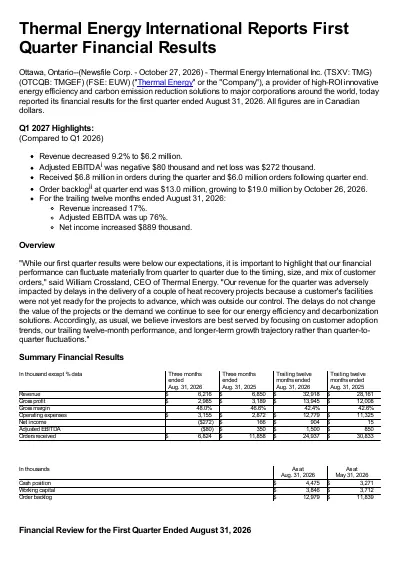
In terms of an overview, our first quarter results came in below our expectations, largely due to project timing. However, our results for the trailing 12 months ended August 31st remain strong with revenue, gross profit, adjusted EBITDA, and net income all being up significantly year-over-year.
We ended the quarter with a strong balance sheet. We received almost $13 million in orders so far in fiscal 2027, less than five months, from June 1st to now.
We're continuing to execute our strategy focused on scaling the business. Next slide, please.
Looking at revenue, our top-line performance in the first quarter, we had revenue of $6.2 million, which was down 9% year-over-year. The decrease was primarily due to project timing and revenue recognition.
First, the delivery of two heat recovery projects was delayed because customer facilities were not quite ready to advance to the next stage. The delays only affect project timing, not project value or the total revenue ultimately expected, we expect these projects to accelerate in the near term once these site-related issues are resolved.
Next, the GEM revenue was also lower due to shipment timing. Several large GEM trap shipments were dispatched before quarter-end, but arrived at the customers' sites after quarter-end, and under the shipping terms, revenue can't be recognized until the product actually arrives at the customers' sites.
Again, just a temporary timing issue. As I've said before, given the nature of our business, and given the timing-related nature of the factors impacting Q1, we believe investors should focus on trailing 12-month performance and our long-term growth trajectory, not temporary quarterly fluctuations that can happen from time to time as they have in this quarter and many other quarters.
Looking at the trailing 12 months ending Q1 2027, we had revenue of about $33 million, which was up 17% year-over-year and up 42% over the last three years. Next slide, please.
Given the timing-related issues we just described, our adjusted EBITDA swung to a loss of about $80,000 for the quarter. In addition to the lower revenue for the quarter, operating expenses increased about $283,000, primarily due to $122,000 foreign exchange variance, an unfavorable foreign exchange variance that is, and some other small general inflationary cost increases.
On a trailing 12-month basis, adjusted EBITDA increased 76% to $1.5 million. Next slide, please.
In addition to encouraging investors to focus more on long-term trends rather than quarter-to-quarter variances, we also view operating cash flow excluding changes in working capital items as a key indicator of performance and a key indicator of free cash flow generation. As you can see on the slide, we continue to generate strong operating cash flow and our operating cash flow excluding changes in working capital items tends to be significantly higher than net income.
In addition to both our trailing 12-month net income and operating cash flow improving from this time last year, over the past four years, we had a combined net income of $3.4 million, consistently profitable, and generated a total of almost $8 million in operating cash flow. Next slide, please.
The strong cash flow generation has resulted in a fairly strong balance sheet. Our cash position increased to $4.5 million.
Our working capital grew to $3.8 million at quarter-end. After fully paying off more than $3.2 million in bank loans over the last few years, in the first quarter, our US subsidiary took on a four-year loan for about $340,000 to fund the purchase of a plasma table for its production facility.
That's the only bank debt on our balance sheet at the current time. Next slide, please.
During the quarter, we received orders totaling almost $7 million. While this was down from the record quarter intake last year, first quarter intake last year, it's still the second highest order intake we've had in our first quarter.
A first quarter tends to be one of our weaker quarters because it's in the summer months. We ended the quarter with a backlog of about $13 million.
Since quarter-end, we've received another $6 million in orders, growing our order backlog to $19 million as of yesterday. Next slide, please.
The orders received during the quarter include three orders from a global nutrition company totaling $2.1 million. Those orders, which were announced on August 24th, were for two turnkey heat recovery projects and a major equipment package, which is one of the new offerings stemming from the strategy we announced a little over a year ago.
Including these three orders, we have done more than $16.8 million in business with this single customer since 2019. Moreover, we're continuing to work with them to uncover additional opportunities to support facilities throughout their global manufacturing network.
Next slide, please. Then just yesterday morning, we announced we had just received a $3.2 million order for a turnkey heat recovery project with a European agricultural and dairy cooperative.
This new customer for us in one of our key sectors, as you know food and beverage is a very key sector for us, and we look forward to delivering measurable results to this customer, and we hope to expand the relationship as we have with many others to uncover additional opportunities at this site and across their operations at other sites. Next slide, please.
Looking ahead, I wanted to provide a brief refresher and a few updates with regard to the strategic direction we announced a little over a year ago. After making substantial investments into the business in 2025 and 2026, our focus is now twofold.
First, we want to ensure we maximize the return on the investments made in the last few years. Second, we've developed a number of new strategies in order to scale the business more effectively.
One of these strategies is our streamlined HEATSPONGE turnkey offering launched last year. As I discussed last quarter, we've already had some early success, having delivered about $5 million in orders of this streamlined HEATSPONGE offering since launching.
With simplified installation, no controls, no requirement for project development agreement, this offering enables shorter sales cycle, faster project completion, and faster revenue recognition as well as typically stronger margins. Another example of making our solutions more scalable is we've been developing and promoting standardized equipment packages.
The thinking here is to reduce engineering and project development time as there would be no bespoke design or no turnkey installation required. In this case, we would again expect to benefit from faster sales and revenue cycle as our standardized equipment package could be quoted on and sold directly with data from our proprietary CREST survey app.
Far in fiscal 2027, we've already received about $1.3 million in orders under this initiative. Next slide, please.
We also see an opportunity to scale the business through indirect sales channels by developing and cultivating networks of independent manufacturers' representative companies, or MRIs for short, to pursue the smaller, standardized equipment sales opportunities. To support this initiative, we've recently hired two indirect sales channel managers, one for North America and one for Europe, to drive this strategy in their respective markets.
Finally, Europe continues to represent a substantial untapped opportunity for HEATSPONGE. Here, we're going to use a phased approach where we will initially support this market with our existing US production capacity, then as demand grows, we will transition to European contract manufacturing, lowering costs and shortening lead times.
We look forward to updating you on this initiative in the coming quarters. Next slide, please.
In summary, while our Q1 results were impacted by project timing and revenue recognition factors, for the trailing 12-month period, we had strong year-over-year increases in revenue, gross profit, adjusted EBITDA, and net income. Our balance sheet and cash-generating capability remain strong, and we're encouraged by our recent order intake as we continue to execute our strategy to scale the business.
Next slide, please. This, of course, concludes my prepared remarks.
I'd now like to open the call for questions, and for this portion of the call, I'll turn it over to Trevor Heisler at MBC Capital Market Advisors, who will moderate our Q&A. Please go ahead, Trevor.
Operator
Thank you, Bill. If you are a qualified equity analyst or institutional investor joining us on MS Teams and would like to ask a question, please notify me by using the raise your hand feature.
Your first question comes from the line of Russell Stanley at Beacon Securities. Please go ahead, Russ.
Russell Stanley
Thank you. Good morning, and thanks for the questions.
Maybe first just with respect to the delays that you saw, wondering if you can roughly quantify the impact on revenue and gross margins, understanding that heat recovery projects are usually a little bit lower gross margin than you see with the GEM steam traps. Any help there would be great.
William Crossland
I don't believe we've disclosed the amount of impact on revenue, just that the results were lower as a result. Gross margin hasn't changed.
Now, you look at the gross margin year-over-year, it's actually a little better than it was. I don't think it's really had any significant impact.
That impact didn't really have any significant impact on our gross margins. If we had have done those projects, the revenue would have been higher and the gross margin might have been a bit lower.
Generally, our margins stay fairly stable, as Russ. It does vary depending on product mix.
Usually, it's in the mid-40s to 50, sort of 45 to 50% range. That's what it was this quarter.
That's what it was last year at the same time.
Russell Stanley
Got it. Congrats on the contract win yesterday.
Especially given this is a new customer, I'm wondering if you can provide some color on how this contract or the opportunity developed.
William Crossland
It was through one of our key people in Europe, who's had sold some of these other heat recovery projects. It's in the dairy sector.
We have a fair bit of experience in the dairy sector. There's a lot of different food and beverage companies, but we've got a fair bit of experience in the dairy sector, and this was another dairy company.
That we had done other similar projects for other companies, and it was sort of a natural fit.
Russell Stanley
Got it. You've spoken to additional opportunities here.
I'm wondering if you can talk to how many other facilities this customer has that may be amenable to other heat recovery projects. Layering on that, wondering what other Thermal Energy solutions the customer might be interested in.
William Crossland
This isn't GEM trap, we haven't sold any GEM traps. This is a big site, as you can imagine with it's a $3 million $3.2 million project, it's a big site.
To be honest, this isn't a multinational company. It's more of a regional company.
They have more than this site, but they don't have tens of sites around the world or around Europe. Like I said, it's a European regional company.
They've got a few sites, we do look forward to more opportunity, but it's not one that's going to be there year after year like some of our customers. Two of our top key customers have been multi-millions of dollars every year for the last five to 10 years.
This is a great opportunity for us, but it is a smaller company.
Russell Stanley
Got it. Maybe my last question, just wondering if you can update us on acquisition opportunities, wondering what you're seeing with respect to targets in terms of their attractiveness and valuation.
William Crossland
We haven't really seen too much. We have had some recent experience with a couple of opportunities that were doing very well prior to COVID, and they seem to be struggling a bit now.
We're still trying to figure out whether that makes sense for us. We don't see the valuation changing too much.
Everything we've done up to this date has always been, for the most part, private companies or private sales, it's not influenced to the same degree by the current equity markets. In the private market, we haven't seen the multiples really change much.
We're continuing to keep our eye open, and we would gladly do it now that we sort of have reduced all our debt, we're in a strong position to be able to conclude a transaction. Strategically, our real focus continues to be making the most of what we've got.
We don't have imminent plans right now for any acquisitions, but you never know what might come up. Like I said, we're really focused on leveraging the investments we've made and scaling the business, and early signs is that both of those strategies seem to be quite successful.
Russell Stanley
All right. That's all for me.
Thanks for the color.
Operator
Thank you. Bill, your next questions come from Jesús Sánchez at Kasnor Investment Fund.
Please go ahead, Jesús.
Jesús Sánchez
Hi. Congrats, Bill, on landing that new customer.
I think it's great to see that, especially in Europe. My question is about actually that region, and maybe you can give us more color about the performance of Bristol and especially the order intake during this first quarter that we had in Europe.
William Crossland
Yeah. We don't We don't break down the order intake by region.
I I I can't remember whether we even announced whether this customer was in Europe, but it was. Like both of the both both North America and Europe, there's always And as I've said, quarter quarter to quarter, there is an ebb and a flow to the business.
It's that's even more so when you look at an individual market, whether it's Europe or North America. Europe was exceptionally strong in terms of projects, two years ago.
Last year, it wasn't quite as strong, but North America was. This year, it seems to be coming back fairly strongly.
It's we're feeling pretty pretty good about where we are. What What more Can you be a little bit more specific, Jesús, in in terms of what you're looking for, in case I'm not answering it?
Jesús Sánchez
Yeah. No, no, no.
You are answering, and I understand you cannot give the order intake by segments. I was just trying to get a picture of the performance of Europe, how is tracking.
There has been during the last 12 months a bit decline on that region. Now we sign up this new customer there.
Just trying to get a picture of how we are in Europe.
William Crossland
Yeah. It continues to be very strong for us and we're It continues to be a strong strategic market for us.
Just to give you a little bit of color, as going back historically, the center of excellence for for GEM was was Bristol. The center of excellence for heat recovery was Ottawa in North America.
Even to this day, the the our heat recovery capabilities are a little bit stronger in North America and our GEM capabilities are a little bit stronger in Europe. We try to operate as a one unified team as best we can, but that's sort of the history.
We, Europe had a great year in heat recovery, then it it went for a little while without many orders, and now it seems to be back. I could say it was just the opposite with North America and GEM.
It's, part of the advantage of having operations in both markets and capabilities of different products is there's some diversification, both geography and by product. Bottom line is we're very pleased with where Europe seems to be headed right now.
Like I said, they had some great results a year ago, and then last year was a little bit less, but it seems to be coming back strongly. We're encouraged by that, and we're feeling pretty good about the future.
Jesús Sánchez
Backlog tends to indicate the same as you are saying, agreed. My last question, I don't know, maybe for Julia, for yourself, is about the deferred revenue on goods and equipment.
It rose from $0.65 million to $2.8 million in this quarter. I was wondering what type of orders drove that increase in deferred revenue.
Is GEM shipments or turnkey projects or media or equipment that we need?
William Crossland
Which was that, Jesús? What increased?
What was the
Jesús Sánchez
figure? Deferred revenue on goods and equipment.
William Crossland
Oh, deferred revenue is when we get deposits. Julia, if you're available, you can jump in here and correct me if I'm wrong.
Deferred revenue generally is impacts by the deposit. We get the deposit, I think there's deferred revenue and we earn the revenue over the period of the contract.
Deferred revenue is usually turnkey projects.
Jesús Sánchez
Okay.
Julia Zhang
Correct.
Jesús Sánchez
Yes,
Julia Zhang
confirmed.
William Crossland
Yeah.
Jesús Sánchez
Thank you very much. That's all for my side.
William Crossland
Yeah. Jesús, just to confirm, with the turnkey projects, right, we get deposits up front, but we only earn the revenue on a percent complete basis as we execute the project, so that's why that results.
Jesús Sánchez
I was interested to see if they were GEM projects sales or turnkey projects or what type of They would be.
William Crossland
If it's deferred revenue, it would be turnkey projects.
Jesús Sánchez
Amazing. Thank you very much, Bill.
William Crossland
Okay. Thank you, Jesús.
Thank you for your continued support.
Operator
Thank you. It looks like we have time for a few questions submitted by investors through email.
Bill, what are your capital allocation priorities for the balance of the fiscal year? Should we expect the NCIB to continue at a similar pace, or does growth investments now take precedence over returning cash?
William Crossland
We don't have any plans, I think I've announced this before, we don't have any plans to continue. A year or so ago, we invested over $1 million annualized in SG&A, building the team, adding a new facility, or moving into a new facility in the UK, developing our CREST app.
We don't have any further plans to continue those sort of investments in the growth of the business. As I said, we want to maximize those investments, maximize the return on those investments.
Going forward, as Russell mentioned, we are always looking for acquisitions, we could be in a position to do an acquisition now that we don't have any debt. We will, where appropriate and when we feel we have lots of cash available for the foreseeable future, we will engage in normal course issuer bids, as we have in the past.
It sort of varies. It's either going to be normal course issuer bids or acquisitions, I would say.
Great.
Operator
With channel managers now in place for North America and Europe, has that started to show up in the pipeline? If not, what kind of a timeline do you have in mind for these channel managers to build a network of independent reps and start meaningfully contributing to results?
William Crossland
No, they're not in the pipeline yet. When you think about it, they have to find the channel partners, and they have to train the channel partners, and then the channel partners have to go out and find some customers of theirs that would like to buy our products and services.
It will take some time. It's not in the pipeline yet.
I would think this fiscal year will really be focused on trying to start to establish the network. Then next year, we would look to get some contribution, I would think.
Operator
Great.
William Crossland
Both the channel partners, they're both added at the tail end of last year, right at the very end. They're really just a few months into it now at this point.
Operator
Understood. Thank you.
Next question: What kind of a timeline do you see for establishing HEATSPONGE manufacturing in Europe? Do you expect HEATSPONGE penetration in Europe to be a potential contributor to fiscal 2027?
William Crossland
I do. Will it be a material contributor?
No. Do we expect an order or two?
Yes. The timeline is to start that right away, both through our own sales force as well as the network of independent reps as we develop it.
The strategy is to initially perhaps manufacture entirely in the US, then partially manufacture in the US and ship parts over for assembly, and then finally have total contract manufacturing. That will depend on how we roll it out and how many orders we start to get in.
I believe we will have a few orders this year for HEATSPONGE in Europe. Again, it won't be material to the bottom line or to the top line.
Operator
Great. It looks like we have time for one more question: Regarding the new simplified HEATSPONGE turnkey offering, can you provide some metrics regarding expected ROI, or what kind of revenues you expect this to help generate in the next three to five years?
William Crossland
ROI, I'm not sure whether you mean our return on investment or the customer's return on investment.
Operator
That would be for you, for the company.
William Crossland
For the return on our investment. We haven't invested a lot.
It was really we had the project, we had the technology, and we just came to the conclusion we could develop turnkey projects for that technology, the HEATSPONGE, much simpler than say the FLU-ACE. There isn't really an investment in it.
It's just an opportunity to sell different sort of project, which is slightly smaller, but much quicker. It's already contributing to revenue.
In my remarks, I talked about three heat recovery orders that we received from one of our major customers, and they totaled $2.1 million. Well, $2.1 million is a little bit smaller than traditional heat recovery orders, and the reason is because those three orders, two were for a simplified HEATSPONGE turnkey project, and one was a standardized equipment package.
That's why it was 2.1. We're already selling them.
There's another customer we've done it a couple of times as well, it's already multi-million dollars for the simplified HEATSPONGE turnkey projects. The interesting thing about the $2.1 million and three orders from the same customer, you can see that depending on the location, depending on the site, they might choose a standardized equipment package versus a turnkey project.
As an example, if it's an area where we may not necessarily want to do a turnkey project, if it's in Asia or it's a country where we don't have a significant presence, it would be easier if they just did it themselves. This allows us to sell it to them, and it allows us to give them the opportunity to decide how they want to buy the technology.
I think it's pretty unique and it's a great opportunity for us. Where there's no set way, and I think that's a really interesting example where the same customer decided to do it both ways and depending on the site that we're selling to.
It's already generating multi-million dollars worth of revenue, and we expect that and hope that to continue.
Operator
It looks like that's the end of the questions at this time. Please go ahead, Bill.
William Crossland
Okay. Thank you, everyone, for your continued support of Thermal Energy International.
We look forward to speaking to you again next quarter. Thanks so much for your time and interest, and have a great day.