Sixth Street Specialty Lending, Inc.
Q3 FY2026 · Earnings Call TranscriptNovember 4, 2026
Operator
Good morning, and welcome to the Sixth Street Specialty Lending, Inc.' s third quarter September 30th, 2026 earnings conference call.
At this time, all participants are in a listen-only mode. To ask a question during the session, you will need to press *11 on your telephone.
You will then hear an automated message advising that your hand is raised. To withdraw your questions, please press *11 again.
As a reminder, this conference is being recorded on Wednesday, November 4th, 2026. I will now turn the call over to Ms.
Cami Senatore, Head of Investor Relations.
Cami Senatore
Thank you. Before we begin today's call, I would like to remind our listeners that remarks made during the call may contain forward-looking statements.
Statements other than statements of historical facts made during this call may constitute forward-looking statements and are not guarantees of future performance or results, and involve a number of risks and uncertainties. Actual results may differ materially from those in the forward-looking statements as a result of a number of factors, including those described from time to time in Sixth Street Specialty Lending, Inc.'
s filings with the Securities and Exchange Commission. The company assumes no obligation to update any such forward-looking statements.
Yesterday, after the market closed, we issued our earnings press release for the third quarter ended September 30th, 2026, and posted a presentation to the Investor Resources section of our website, www.sixthstreetspecialtylending.com. The presentation should be reviewed in conjunction with our Form 10-Q filed yesterday with the SEC.
Sixth Street Specialty Lending, Inc.' s earnings release is also available on our website under the Investor Resources section.
Unless noted otherwise, all performance figures mentioned in today's prepared remarks are as of and for the third quarter ended September 30th, 2026. As a reminder, this call is being recorded for replay purposes.
I will now turn the call over to Bo Stanley, Chief Executive Officer of Sixth Street Specialty Lending, Inc.
Bo Stanley
Thank you, Cami. Good morning, everyone, and thank you for joining us.
With me today is our Head of Investment Strategy, Ross Bruck, and our CFO, Ian Simmonds. For our call, I will review our third quarter highlights and pass it to Ross to discuss investment activity in the portfolio.
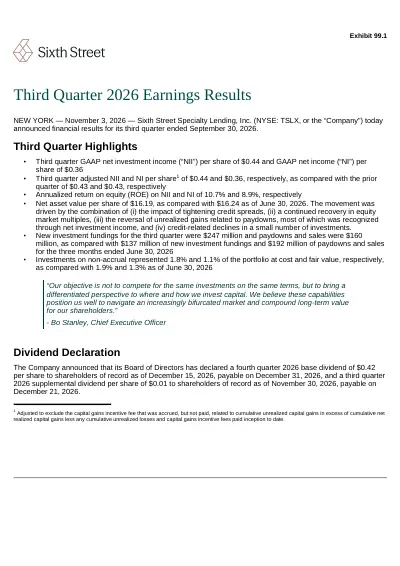
Ian will cover our financial performance in more detail, and I will conclude with final remarks before opening the call to Q&A. After the market closed yesterday, we reported third quarter net investment income of 44 cents per share, or an annualized return on equity of 10.7%, and net income of 36 cents per share, or an annualized return on equity of 8.9%.
Net asset value per share was $16.19 at quarter end, compared to $16.24 as of June 30th. Our third quarter net investment income per share exceeded our base dividend, representing a dividend coverage of 105%.
This overearning permitted the declaration of a supplemental dividend in accordance with our supplemental dividend framework. Net investment income has increased sequentially in each quarter of this year, driven by the combination of higher base interest rates and activity-based fee income.
Looking forward, we expect the earnings momentum to persist, supported by the shape of the forward interest rate curve and by stable spreads and credit quality across the portfolio. The current rate path is a net positive for our business, providing a tailwind to both earnings and dividend coverage.
We are also mindful of the impact on our borrowers, and we are confident in their capacity to absorb higher rates for two reasons. First, our portfolio is weighted heavily towards newer vintages.
As of September 30th, more than 85% of our portfolio by fair value was originated after the rate hiking cycle began. These capital structures were underwritten with an intentional margin of safety designed to absorb higher base rates, and borrowers entered into these credit facilities with visibility into the prevailing rate environment.
Subsequent growth in the underlying businesses has further supported the margin of safety. Second, our borrowers maintain strong interest coverage of 2.3x, providing them with operating flexibility to continue executing on their business plans.
This level of coverage provides a meaningful cushion to absorb higher interest rate expense. Our portfolio has also demonstrated resilience through a sustained period of elevated base rates.
From July 2023 through September 2024, when the federal funds rates remained above 5%, our portfolio companies maintained weighted average interest coverage of at least 2.0x. Turning back to our third quarter results, the difference between net investment income and net income of 8 cents per share reflects both the impact of tightening credit spreads and a continued recovery in equity market multiples, and offsets to the reversal of unrealized gains related to paydowns, most of which was recognized through net investment income, as well as credit-related declines in a small number of our investments.
Ian will walk through the NAV bridge in more detail momentarily. Yesterday, our board approved a base quarterly dividend of 42 cents per share to shareholders of record as of December 15th, payable on December 31st.
In addition, our board declared a supplemental dividend of 1 cent per share related to our third quarter earnings to shareholders of record as of November 30th, payable on December 21st. Net asset value per share adjusted for the impact of the supplemental dividend that was declared yesterday is $16.18.
With that, I'll now pass it over to Ross to discuss this quarter's investment activity.
Ross Bruck
Thanks, Bo. Beginning with the investment environment, the third quarter marked our highest level of funding activity so far in 2026.
We provided fundings of $247 million across four new investments, five upsizes to existing portfolio companies, and capital called by our joint venture. As you may remember from our earnings call in August, we were cautiously optimistic regarding conditions for a more robust M&A environment in the second half of the year.
In Q3, however, the persistence of macroeconomic volatility across interest rates, energy prices, and geopolitics resulted in a more subdued pace of M&A activity than we anticipated. This moderation was evident market-wide, with year-over-year direct lending volume to private equity-backed borrowers declining 47% in the third quarter and 32% on a year-to-date basis.
We saw some processes stall as bidders and sellers reevaluated transacting, despite a record-high 4.5-year average hold period across private equity portfolios, while other deals had timing shift into the fourth quarter, positioning us for an active finish to the year. Positively, we continue to identify compelling specialty lending opportunities that are not dependent on M&A transaction volumes and are fielding demand from companies seeking to raise growth capital and to refinance their existing capital structures alongside other off-the-run transactions.
This was the setup for two of the four new investments we made in Q3. These situations often require tailored financing solutions where Sixth Street's platform advantages set us apart.
Our sector expertise and structuring flexibility position us well to address these needs, providing borrowers with certainty of execution while maintaining our focus on attractive risk-adjusted returns and robust downside protection. All four new investments in Q3 were cross-platform transactions where Sixth Street's scale allowed us to take leadership roles by committing in size.
With competition remaining elevated for regular-way sponsor financings, given the limited supply dynamics previously mentioned, our ability to underwrite complexity and provide substantial capital commitments across our platform continues to be an important differentiator. Consistent with our comments on our prior earnings call, we've been seeing more attractive risk-return opportunities in the upper middle market.
Across our four new investments in Q3, weighted average borrower revenue was $662 million, approximately 40% above our total portfolio average of $479 million. Median borrower EBITDA was $98 million, compared to $55 million across the portfolio.
These investments also carried lower leverage, with weighted average net leverage of 4.6 times, compared to 5.2 times across the portfolio. Rather than a shift in our investment approach, our activity in 3Q highlights the rotational playbook by which we migrate across borrower characteristics, industry themes, and investment lanes to execute on the most compelling risk-return opportunities.
Pivoting to payoffs, total repayments in the third quarter were $160 million, down 17% sequentially, but in line with average quarterly repayments during the first half of 2026 overall. We had five full payoffs, along with the payoff of three structured credit investments.
Annualized portfolio turnover was 19% for both the quarter and year-to-date. Consistent with recent quarters, repayment activity across our four debt investment payoffs was driven by strong borrower performance, with these borrowers refinancing into lower-cost debt facilities, and one payoff occurring in connection with an acquisition by a strategic.
We received call protection on three of the four debt investments repaid, with a weighted average repayment price of 102.3%, reinforcing the value of the contractual protections we embed in our documentation to enhance returns upon early exit. An example payoff from this quarter was our investment in Labrie, a North American manufacturer of refuse collection vehicles and aftermarket parts.
In January, Sixth Street agented a senior secured facility to support a debt refinancing and shareholder dividend. In July, the facility was repaid in connection with the company's acquisition by HEICO Corporation.
Our embedded call protection contributed 3 cents per share of activity-based fees and drove a 19% gross unlevered IRR for TSLX shareholders. In Q3, we recapitalized NeuIntel, also known as PriceSpider, a provider of retail analytics for consumer brands, an end market that has faced competitive headwinds.
We are actively partnering with management to drive value creation initiatives, drawing on our previously successful playbooks and the deep operating capabilities of the broader Sixth Street platform. Moving on to portfolio metrics and yields, as of September 30th, the weighted average total yield on our debt and income-producing securities at amortized cost was 11.4%, up approximately 20 basis points compared to 11.2% as of June 30th.
The increase in portfolio yields primarily reflects higher benchmark rates. Given the typical one-quarter lag in borrower interest rate resets, we expect the positive asset sensitivity of our portfolio to support fourth earnings in the fourth quarter.
Across our core borrowers for whom these metrics are relevant, we continue to have conservative weighted average attachment and detachment leverage points of 0.4 times and 5.2 times, respectively, with weighted average interest coverage of 2.3 times. As of Q3 '26, the weighted average revenue and EBITDA of our core portfolio companies was $479 million and $136 million, respectively.
Median revenue and EBITDA were $181 million and $55 million. Finally, overall portfolio performance remains healthy, as evidenced by a weighted average internal investment rating of 1.25 out of a scale of 1 to 5, with 1 being the strongest.
Credit quality continues to be stable, and no new portfolio companies were added to non-accrual status during the quarter. As of September 30th, we had three portfolio companies on non-accrual status, representing 1.1% of the total portfolio at fair value.
Top-line growth has remained stable, while earnings growth has moderated slightly, still signaling a resilient demand environment and healthy operational scale across our end markets. For our core portfolio companies, LTM revenue and EBITDA growth were approximately 8% and 9%, respectively.
With that, I'd like to turn it over to Ian to cover our financial performance in more detail.
Ian Simmonds
Thank you, Ross. For Q3, we generated net investment income per share of 44 cents and net income per share of 36 cents.
Total investments were $3.4 billion, up from $3.3 billion in the prior quarter as a result of net funding activity. Total principal debt outstanding at quarter end was $1.9 billion, and net assets were $1.5 billion, or $16.19 per share, prior to the impact of the supplemental dividend that was declared yesterday.
Our average debt-to-equity ratio was 1.24 times, reflecting no change from the prior quarter. Our ending debt-to-equity ratio decreased from 1.27 times to 1.25 times quarter-over-quarter.
We continue to have significant liquidity for the size of our balance sheet, with nearly $812 million of unfunded revolver capacity at quarter end, representing more than 3.7 times our eligible unfunded portfolio company commitments. As of September 30th, our funding mix was represented by 64% unsecured debt.
Following the repayment of our 2026 unsecured notes that matured in August, we have no near-term maturities, with our nearest obligation being $300 million of unsecured notes in August of 2028. Our liquidity position is further supported by the permanent nature of our equity capital.
This allows us to manage our balance sheet with a long-term investment horizon. Additionally, we maintain a portfolio of liquid structured credit investments with a fair value of $82 million as of September 30th, which serves as an incremental source of liquidity that we can opportunistically rotate out of to fund new investments and as a tool to lower leverage.
We view our available liquidity as a strategic tool to capitalize on attractive investment opportunities, particularly when market conditions constrain other sources of capital. That flexibility allows us to remain patient and disciplined while preserving the capacity to play offense when we see compelling risk-adjusted returns.
That same discipline extends to raising new equity capital. Consistent with previous quarters, we did not issue any shares through our ATM program during Q3.
Pivoting to our presentation materials, slide 8 contains this quarter's NAV bridge. Walking through the main drivers of NAV movement, we added 44 cents per share from net investment income against our base dividend of 42 cents per share.
The slight impact of tightening credit spreads on the valuation of our portfolio increased net asset value by 7 cents per share. Net realized losses on investments reduced NAV by 10 cents per share, primarily reflecting the realized loss on the PriceSpider restructuring, partially offset by realized gains on our equity investment in Caris Life Sciences.
Other changes resulted in a 2 cent per share decline in NAV, primarily from net unrealized losses on investments. Moving on to our operating results detail on slide 9, we generated $99 million of total investment income for the quarter, up from $97.8 million in the prior quarter.
Interest and dividend income was $89.7 million, up from $88.5 million in the prior quarter. Other fees, representing prepayment fees and accelerated amortization of upfront fees from unscheduled paydowns, were also higher at $6.7 million, compared to $5.4 million in Q2, driven by the increase in prepayment fees earned during Q3.
Other income was $2.6 million, compared to $4 million in the prior quarter. Net expenses were $56.2 million, up modestly from $55.7 million in the prior quarter.
Our weighted average interest rate on average debt outstanding increased slightly from 5.6% to 5.7%. This was primarily the result of a shift in our funding mix and a marginal increase in daily average reference rates.
Lastly, on undistributed income, we estimate that to be approximately $1.08 per share as of the end of Q3. Before handing it back to Bo, I wanted to provide an update on our ROE metrics.
Through the first nine months of the year, we've generated annualized ROE based on net investment income of 10.1%, with annualized portfolio turnover of 19%. With three quarters of the year complete, our results remain consistent with our previously communicated full-year ROE range of 10% to 10.5%, assuming portfolio turnover remains below 20%.
The pace of repayments and associated activity-based fee income in the fourth quarter will be the primary drivers of our full-year performance relative to that range. With that, I'll turn it back to Bo for concluding remarks.
Bo Stanley
Before I turn the call over to questions, I'd like to briefly highlight an important evolution in our brand identity. You may have noticed an updated logo and website across TSLX and Sixth Street more broadly.
We introduced the updated brand identity at Sixth Street's annual LP conference two weeks ago. The 6 in the logo is rendered on a prism, reflecting multiple dimensions and perspectives.
That design is deliberate. We believe evaluating an investment from multiple angles, bringing together different sector insights, experiences, and perspectives, allow us to see risk and opportunities that may be less apparent through a single lens.
Challenging conventional thinking and testing our assumptions helps us develop a more complete understanding of a business, its capital needs, and the range of potential outcomes. This ability is particularly important in today's complex and competitive investing environment.
We expect ongoing credit normalization to drive greater dispersion in performance across both borrowers and managers, a trend increasingly accelerated by technological shifts that are redefining competitive dynamics across industries. Being on the right side of that dispersion requires a deeply nuanced understanding of underlying business models and a willingness to continue to challenge our own conclusions.
Bringing multiple perspectives to our investment process also allows us to look beyond standard financing solutions and identify opportunities where our insight and flexibility can make a meaningful difference. Our objective is not to compete for the same investments on the same terms, but to bring a differentiated perspective to where and how our capital is invested.
We believe these capabilities position us well to navigate an increasingly bifurcated market and compound long-term value for our shareholders. While our look has evolved, our strategy, value, culture, investment approach, and commitment to our shareholders remain unchanged.
With that, thank you for your time today. Operator, please open the line for questions.
Operator
Thank you. At this time, we will conduct a question-and-answer session.
As a reminder, to ask a question, you will need to press *11 on your telephone and wait for your name to be announced. To withdraw your question, please press *11 again.
Please stand by while we compile the Q&A roster. Our first call comes from the line of Rick Shane of J.P.
Morgan. Rick, your line is open.
Richard Shane
Thanks for taking my questions this morning, everybody. Look, it's a really interesting time in the space.
You guys are near the top of your leverage range. You are trading at a premium to NAV.
I am curious, last quarter you didn't issue anything off the ATM, and I know that you're very, very disciplined about the return thresholds associated with that. The question I have is the following: Ordinarily, it's sort of an internal analysis, but given how dislocated the sector is, and effectively the market is giving you a cost of funds or a lower hurdle rate advantage, does it make sense at this point to either extend leverage limits a little bit or take advantage of your multiple in the equity marketplace?
Ian Simmonds
Hey, Rick, it's Ian. I'll take this one.
Understand your point. I think we got a similar question last quarter from this group.
I think our job is to always look for opportunities to create shareholder value. If that means utilizing the way our stock trades relative to the sector, which obviously gives us an advantage, then that's something that we take into account.
Execution risk is always very much front of mind, so that plays into our considerations. When it comes to leverage, the comment that we've made for the last seven, eight years is that we're really committed to our investment-grade rating.
We're very committed to that segment of how we fund our balance sheet. It would have to be a really strong opportunity for us to want to go outside the parameters that we've previously communicated.
Our leverage range is at the top of the range, but it's not outside the range. It would have to be a really compelling opportunity for us to see a reason to go outside of that.
Does that help you, Rick?
Richard Shane
It does. Look, in some ways, I sit here and say, well, okay, the market's giving you this unique opportunity, why not take advantage of it?
On the other hand, I'm sitting here saying, okay, you guys have a really, really good track record, and who knows which piece you take out of the puzzle before it falls. I appreciate the discipline and the commitment to the strategy as well.
It makes a lot easier, frankly, as investors to understand what's going on.
Ian Simmonds
I think, Rick, the other element to that is that there's an embedded assumption that growth is good, and all growth is good. I think we take a slightly different perspective, which is let's focus on returns, and if the returns are generated, then the opportunity to grow will be there.
Growth is not the initial objective.
Richard Shane
Ian, as I've known you guys a really long time, and that has absolutely been the hallmark of your approach. Appreciate no change there.
Thank you.
Ian Simmonds
Thanks, Rick.
Operator
Thank you. One moment for our next question.
Our next question comes from the line of Finian O'Shea of WFS. Finian, your line is open.
Finian O'Shea
Hey everyone, good morning. I guess I'll sort of stick to that topic.
How much does the ramp of SSLP sort of get in the way of a TSLX equity offering? Then as an extension, this is something we've talked about a bit over the years, but we've seen sort of more language fallout this year around the co-investment order that protects deal flow for the BDCs.
Are there more funds sort of participating? Is all that sort of contributing to a slower growth opportunity for TSLX?
Bo Stanley
Hey, Fin, this is Bo. Thanks for the question.
The ramping of SSLP does not have any bearing on equity issuance at TSLX. As there's a focus on SSLP upper middle market, it's a different strategy than the pure middle market focus that has generally been the TSLX opportunity set.
As we've said in our script and Ross touched on, we continue to see better risk-adjusted returns in the upper middle market than we have seen traditionally in the lower middle market. We think there may be some catalyst for that to change over the coming quarters, and especially on some of the idiosyncratic originations that we've had traditionally.
As it relates to the exemptive relief in other funds, we've always used the platform as the ability to size up and do larger, more complex transactions across the platform, which has been a net beneficiary to TSLX and will continue to be a net beneficiary to TSLX in the future. That has always been accretive and will continue.
Hopefully, that answers your question.
Finian O'Shea
Yes, helpful, thank you. Just a small, I guess, sort of housekeeping item.
The NeuIntel reorg, was that a sort of an intra-quarter non-accrual or what was the sort of interest rate? Can you kind of walk us through the investment income versus prior and post-reorg capital stack, if you follow?
Ian Simmonds
I might jump in on this one, Fin. It's Ian.
On NeuIntel, that was a business that was actually going through a strategic transaction during the quarter. The fair value mark at the end of June was 90 and a quarter.
That strategic transaction did not play out as expected. As a result, we pivoted, but it wasn't a discussion about a non-accrual.
Bo Stanley
It was always paying interest throughout that time period. It's actually last dollars less than 6 times.
We had very tight covenants on this deal that allowed us to get to the table and force a sale process. There were some negative developments during the quarter that interrupted that sales process, and we pivoted to a full restructuring, which is what you see here post-quarter.
Finian O'Shea
Great. Thank you.
Operator
Thank you. One moment for our next question.
Our next question comes from the line of Mickey Schleien of Clear Street. Mickey, your line is open.
Mickey Schleien
Yes, good morning, everyone. Last quarter, you indicated that your technology portfolio continued to perform well, and I think you mentioned earnings growth of about 11%.
Has that performance continued in the third quarter? Have you seen any changes in metrics like customer retention, bookings, or general competitive pressure attributable to AI?
Can you update us, at least at a high level, the percentage of the portfolio in enterprise software companies?
Bo Stanley
Sure, I'll take that. Thanks for the questions.
There's been no change in the technology and software portfolio since last quarter, candidly, during the year. It's in line with the rest of the portfolio.
The rest of the portfolio grew revenue by about 8% this quarter, pretty consistent with last quarter. Earnings growth was 9%, which is slightly down.
There's probably more reinvestment in a lot of businesses as they continue to invest in agentic solutions, etc. What we're seeing across renewal rates, unit economics, and other key KPIs are stability and actually some slight improvement in those key core KPIs.
Bookings momentum across this portfolio and Sixth Street's technology portfolio in general seems to be actually quite good over the last couple quarters. We'll see what happens over the next quarter or two.
There's really been no change. I think the tails are still the tails.
There's been really no changes to any of the tails or the underperforming end markets within technology and software over the past two years, which I think is positive from AI. The last thing I'd mention is, although there hasn't been a broad opportunity set to invest in new activity in the sector, the emerging new opportunities you're seeing, if you have the platform to underwrite the nuances in today's environment, is a much more attractive environment.
We'll continue to be selective there. We do think you have to be incredibly nuanced and thinking about the transition of technology, not just in technology and software, but how AI is going to affect every end market and every industry.
We do think that is generally a better underwriting environment than it has been historically.
Mickey Schleien
In terms of being selective, can you update us on the percentage of the portfolio in software generally? Are you actively allowing that to run off?
I think you previously mentioned it was around 40%. Do you intend to keep it at that level?
Bo Stanley
There has been no change. In fact, it's probably slightly down only because the opportunity set of new deals has been skewed slightly to non-technology.
As I said three, four quarters ago, we look at the end market and think of software and technology as a product, not a sector. We do not have hard limits on where we're going to run the portfolio.
We think more holistically about risk management and tail management across end markets. That entails deeply, deeply nuanced underwriting and understanding of each ecosystem that these tools are serving.
We don't put a hard limit on that. I would say it's largely in line with where it was at the beginning of the year, maybe slightly down because the opportunity set has skewed a little bit more heavily to non-technology.
Mickey Schleien
I appreciate that. If I could follow up with one more question.
Spreads on your new investments declined 90 basis points quarter-to-quarter to still very nice 600 basis points. I think you've mentioned being very selective and nuanced several times.
How much of that decline reflects your investment mix versus competitive pressure in the sector generally?
Ross Bruck
This is Ross. I'll jump in to answer this question.
I'd say the quarter, our originations, if you look at it historically, were within the bounds of where we've originated. This number will inherently change quarter-to-quarter based on the opportunity set where we see risk-return being stronger or less compelling, and also just the timing of deals closing in one quarter versus a different one.
As we talked about in the prepared remarks, for this quarter, we generally saw opportunities at the upper end of the middle market and at lower leverage profiles, which led to the weighted average spread on originations in the quarter. I'd say the figure that we report just covers our floating-rate investments, it excludes income-producing investments that are not floating-rate.
If you include all of our income-producing investments originated in 3Q, there's about 100-basis-point uplift, which is reflected in looking at our total yield metrics, which, besides benefiting from base rates, also benefited from a stable effective yield in 3Q versus prior quarters.
Mickey Schleien
Thank you for that. That's really helpful.
Appreciate you taking my questions.
Ross Bruck
Thank you.
Operator
Thank you. Our next call comes from the line of Arren Cyganovich of Truist Securities.
Arren, your line is open.
Arren Cyganovich
Thanks. I just was hoping you could talk a little bit more about the investing environment and what are some of the aspects that you're seeing that makes the upper middle market more attractive?
Is it underwriting? Is it spread?
Is it just maybe some of those aspects? What does your investment pipeline looking like now for the platform?
Maybe not so much for the BDC since we're kind of already at a relatively high leverage level?
Bo Stanley
Thanks. I'll answer that.
Generally, we've been more constructive on the investment environment in 2026 than we were in 2024 and 2025, as we've stated on previous calls. I think what we're seeing is better access to management teams, better processes where you actually can do the deep level of due diligence that our platform requires to make investments.
You weren't seeing that as much in '24 and '25. There was just broad roll-up thing of processes that made it very difficult for us to play in particularly some of the sponsor processes.
It was for all issuers. We're generally seeing better access to data and to management to actually prove out a credit thesis, which I think is very helpful.
Documentation standards, though not perfect, have gotten better gradually over the year, and we're seeing better documents. We can still see some areas of improvement there, particularly around the definition of EBITDA, but we're able to invest in things that have documents that we believe protect our borrowers, and that's been a continued trend line.
Leverage levels are down generally. I would say a half turn, and sometimes almost a full turn, from what they were in previous years, which is helpful.
On the margin, spreads have been up probably 50 basis points, and fees have been up slightly as well. There may be some of that being given back with risk-free rates going up and people trading, at least for the best names, some spread for better documents, better pricing, and lower leverage.
I think that's a reasonable trade-off, but that's not been full-fledged. I still think it's better pricing, better structures, better access.
The last thing that I'll say is this migration that we talked about, better in the upper middle market, I think that is a direct consequence of capital coming out of the sector and there being less pressure of new money that is coming in. The middle market has been more insulated from that, I think.
It has made that a bit more competitive, but we're seeing early signs of that stabilizing. As we look forward to the pipeline, the pipeline feels good coming into Q4.
I would expect a decent mix of both middle market and upper middle market. We're also seeing some payoffs within the portfolio that kind of didn't happen in Q3 that are happening in Q4, that gives us capacity even without an equity raise to go out and take advantage of those opportunities.
Arren Cyganovich
Thank you.
Operator
Thank you very much. Our next question comes from the line of Kenneth Lee of RBC Capital Markets.
Kenneth, your line is open.
Kenneth Lee
Hey, good morning, and thanks for taking my question. Just one on the more specialized opportunities.
You mentioned four of the new investments in the quarter there. Wondering, at a high level, how would you characterize sort of the opportunities you're seeing?
Is it picking up a little bit versus last few quarters? Are there any particular areas of opportunity that's emerging there?
Thanks.
Ross Bruck
Hey, Ken, it's Ross. I'm happy to start here.
Look, I think there's a couple different dynamics at play. As we talked about, the M&A environment has been volatile, but generally resulting in lower transaction volumes this year.
Hold periods for sponsors are getting long. One general theme that we're seeing is just need to refinance as capital structures put in place closer to the COVID time frame need to be refinanced.
That's one theme. A second theme is the need for growth capital.
Many businesses are acquisitive or looking to invest in organic growth opportunities to continue value creation for equity holders. In some of those cases, incumbent lenders could be stretched or unwilling to extend terms.
That's a second catalyst. We're seeing this really across contractual opportunities as well as asset-based opportunities.
The areas where we are better positioned to play are those that line up with our investment themes, where we have strong domain expertise across the Sixth Street platform. It's really broad-based across those few things, which is need to refinance, need to continue investing, longer hold periods, and willingness of equity holders to consider different forms of financing, whether asset-based or similar.
Kenneth Lee
Great. Very helpful there.
That's all I had. Thanks.
Ross Bruck
Thank you. Thank you.
Operator
Our next question comes from the line of Chris Muller of Citizens. Chris, your line is open.
Chris Muller
Hey guys, thanks for taking the question. I guess following up on a prior question.
Spreads are trending lower, which you guys talked about, but yields have started inflecting higher. Given the September rate hike, which is not reflected in third quarter results, are you guys starting to see spreads widen out so you could start to see a double benefit from both higher base rates and wider spreads going forward?
Bo Stanley
I'll take that, Chris. Look, I think spreads have been largely stable throughout the year.
As I mentioned, you saw a bump of kind of 50 to 75 basis points in all-in yield early in the year that's, for the most part, withstood. I think for the best credits, there may be a bit of pressure on that on the edges, like 25 basis points.
We haven't, as of yet, seen spreads widening except for maybe in some of the specialty financed things that we do, restructurings. I think largely in 2024 and 2025, there wasn't a lot of good company, bad balance sheet, bad capital structured transactions that we've traditionally done to do, and the ones that were, you weren't getting paid for the complexity.
I think we're starting to see early signs in green shoots of getting better pricing on those more complex transactions, which should be a net beneficiary to the platform. We're also getting better duration, which is important as an investor in those as well.
For the most part, spreads are stable, but with the uplift in base rates, we are quite positive on the fourth quarter earnings outlook. That should be supportive, particularly with the new dividend policy at the beginning of the year.
Chris Muller
Got it. Then maybe just generally high-level, what do you guys expect spreads to do in a rising rate environment?
Should we expect things to tighten up, and is there any lag effect with that that you guys have seen historically?
Bo Stanley
Historically, you did see some slight tightening when rates went up in spreads. You certainly saw that in 2023 and 2024.
I think there's more discipline today in the market, and so I think that there would be a muted effect of any tightening. It's something that we'll watch.
Certainly no signs of that today. Anything on your side?
Ian Simmonds
I would just add, Chris, the observation from the last rate cycle is that it catalyzed a pretty significant rise in capital that flowed to the space. You saw a little bit of an offset with tightening spreads, even though rates were higher, because there was just so much capital that was raised to capture that higher overall yield environment.
Bo Stanley
You're seeing the opposite today with that, I think that, that that gives us that gives a positive sign of what what should be a stable spread environment at a minimum.
Chris Muller
Got it. It's very helpful.
Appreciate you guys taking the questions today.
Bo Stanley
Thank you.
Operator
Thank you. Our next call comes from the line of Robert Dodd of Raymond James.
Robert, your line is open.
Robert Dodd
Hi, everyone. Thanks for taking the question.
It's been touched on a couple of times here, the M&A environment's been volatile. Sponsors have been taking out longer hold positions.
How much of that would you attribute to, obviously, yeah, arguably overpaying in 2021 versus the level of uncertainties, right? There's macro, as I think Ross said in his prepared remarks, there's macro, there's geopolitical, etc., all those kind of levels of uncertainty, including rates.
One of them's gone away, at least, right? We now essentially know the election results, cuz it's all of those uncertainties accompanied by an election year, too.
Do you think the certainty on the results, do you think that's going to unlock any kind of appetite or rush towards year-end to get deals done? It kind of doesn't feel like it, but I just want your impression on that, that one of the kind of pronounced uncertainties seems to be off the table now, whatever you think of the results.
Bo Stanley
Thanks for the question. I think it always helps when political uncertainty is over.
You always see a pause in activity during election cycles, and that's no different coming into this year. I do think the economic uncertainty probably weighed on transactions more than the election cycle.
That's just my own gut feeling. In talking and speaking with folks, I think there's a lot going on with interest rates and energy prices and a general fragility feel to what is an otherwise strong economic environment.
I think it's going to be positive to have the election results behind us to transactions, I am bullish on activity. I'm not bullish that that happens by the end of the year.
These transactions take time. Gestation periods can be very quick, but generally speaking, I would think it would bode better for Q1 and Q2 of next year than it is for the remainder of this quarter.
I think a lot of the transaction activity that is going to happen this quarter is already in the works. It may result in stronger bids for deals that are in the market today and more certainty around transactions, on the margin it could help.
I think it would be more of a tailwind for Q1 and Q2, if that materializes. I would just add that, look, ultimately you need the bid side and the offer side to match to get a transaction done.
It's a little less relevant as to which side is catalyzing deals not happening. When you look at the processes that we ran hard at in 3Q, they were M&A-driven and that didn't wind up closing.
We saw deals fall away for really both sides of that. We saw bidders move value over the course of the process.
Some of that was idiosyncratic; some of that is more macroeconomic-driven. We also saw sellers who had actionable bids choose not to transact.
Ultimately you need both sides, and we just saw a number of opportunities in 3Q where alignment didn't happen.
Robert Dodd
Got it. Thank you.
Then if I can, one more. I'm picking up I think a little bit of a mixed message on spreads, maybe you can clarify it for me.
I think when you talked earlier about leverage levels are down half a turn, spreads are up 50 basis points, fees a little bit, too, but there's trade-offs, right, between structure versus spread. Then just now, you talked about spreads being stable.
Is it just frankly that spreads are all over the place, and it's so deal-dependent that it's hard to read into, or can you clarify what the trends are? Or is it spreads are up in complex situations, but stable in regular-way kind of M&A deals where those are happening?
I'm just trying to kind of clarify that.
Bo Stanley
Sorry if it was confusing. They're largely stable in regular-way transactions.
I think we see early signs of more complex situations there being a better spread environment. We thought in 2024 and 2025 that the premium that you're getting over a regular-way financing as far as spread and duration was not adequate for the complexity that we generally have underwritten in the past.
I think there's early signs that there's a better premium for those types of deals.
Robert Dodd
Got it. Thank you.
Bo Stanley
Thank you.
Operator
Our next call comes from the line of Paul Johnson of KBW. Paul, your line is open.
Paul Johnson
Good morning. Thanks for taking my questions.
Just on the simpler recapitalization deal this quarter, I understand it's a very small position in your portfolio, but I'd ask given you should have some insight into that transaction, do you read that as a sign those conversations are beginning to happen with those companies, and I guess does that provide a viable blueprint going forward for any, I guess, more highly leveraged SaaS company to raise additional capital?
Bo Stanley
As you mentioned, it's not a large position for us, and we weren't heavily involved in that, but we are familiar with the transaction, so that's correctly stated. I think it's a reasonable blueprint for businesses that have proven moats and still have equity value embedded in the capital structure.
We've said for quite some time that we think there's going to be a dispersion of outcomes within the sector, and frankly across all sector in the post-AI world. The vast majority of deals, we believe have a reason to exist and have the ability, with good management teams, to expand their TAMs and create long-term equity value.
I think this is an example of the sponsor believed in their ability to create equity value and preserve equity value, and willingness to delever the business. I don't think that's going to be true of every transaction in this sector.
I think it's a reasonable blueprint for those deals that are going to be on the right side of value creation and TAM expansion in the post-agentic world.
Paul Johnson
Thanks for that. Then I guess I'd also ask, just given the number of BDCs that have been actively looking for strategic alternatives and asset sales that we've seen in the space, is that potential area I guess of deployment in terms of secondary portfolio purchases or asset purchases that you think could potentially create value for shareholders, or I guess would that just be not something that you would be as interested at this point in time?
Bo Stanley
Look, we will continue to be interested in anything that we believe can be accretive to our shareholders on an earnings basis. I think it's a good sign that we're seeing some consolidation in the sector.
Look, we believe very firmly in operating in a healthy neighborhood. I think when you see the ability to consolidate underperforming managers that have not been good allocators of capital in the past, it's good for the space, and it can be good for shareholders.
Those transactions, whether it be portfolio sales or ability to consolidate, we would be very interested in if we believe it's accretive on an earnings basis. Generally, we think it's a good thing for the sector.
Paul Johnson
Got it. Thanks.
One last question, more of a technical one, but I was just curious, within your origination deployment number within investments funded this quarter, does that include investments that are coming out of restructuring into some sort of new entity?
Bo Stanley
No, it doesn't, Paul.
Paul Johnson
Okay. Thank you very much.
Operator
Our next question comes from the line of Derek Hewett of BofA. Derek, your line is open.
Derek Hewett
Good morning, everyone. Could you provide some additional color on the watch list?
I think those are the risk-rated 3 loans, which increased to looks like about 5% of the portfolio from nearly 2% last quarter. Then secondly, where do you expect the watch list to trend kind of longer term?
Bo Stanley
Sure, I'll take those. The change in risk ratings generally were across four four names.
I think you're talking about the movement from the 2s to the 3s or to the 3 bucket. I just want to make sure that we properly define that, which is these are investments that are paying as agreed.
We don't expect any payment default. We expect, at least in the coming quarters, a potential for a financial covenant default.
The great news is we have financial covenants in the vast majority of our portfolio, and they're set at levels that generally force growth and force deleveraging. The read-through to this would be that it gives us the opportunity to get back to the table, have discussions with management teams, re-underwrite our position, and frankly have a conversation with them and likely reprice.
That's not always the case; sometimes it's a simple covenant reset or further injection of capital into the business. They're all idiosyncratic.
I'd say there was one that went from a 1 to a 3. That deal was actually underwritten originally to a covenant default, that was in our base case, this is not a surprise to us, and that's the larger percentage of that.
We've been actively working with management, again in a situation that was underwritten to a covenant default, that the management team and the ownership were much more bullish on what they thought the forward growth trajectory. The business is still growing, but we set the covenant levels very tight.
It gives us, again, chance to get back to the table and reprice. As far as any change in the future, we're seeing broad strength across the portfolio.
We don't expect any material change to these in the future. Hopefully, that's helpful.
Derek Hewett
Great. Yes, thank you.
Operator
This concludes our question-and-answer session. I would now like to turn it back over to Bo Stanley for closing remarks.
Bo Stanley
Thanks, everybody. We're coming into the end of the year, I wish everybody a good end to 2026.
Hopefully, you'll get to spend time with their friends and family over the holidays. Thanks as always for the great questions and in the follow-up.
Ross Bruck
Thank you.
Operator
Thank you for your participation in today's conference. This concludes the program, and you may now disconnect.
Cami Senatore
Goodbye.