Titan International, Inc. (DE)
Q3 FY2026 · Earnings Call TranscriptOctober 29, 2026
Operator
Good morning, ladies and gentlemen, and welcome to the Titan International, Inc. third quarter 2026 earnings conference call.
At this time, all participants have been placed in a listen-only mode, and we will open the floor for your questions and comments after the presentation. If you need assistance during the call, please press * followed by 0 on your telephone keypad.
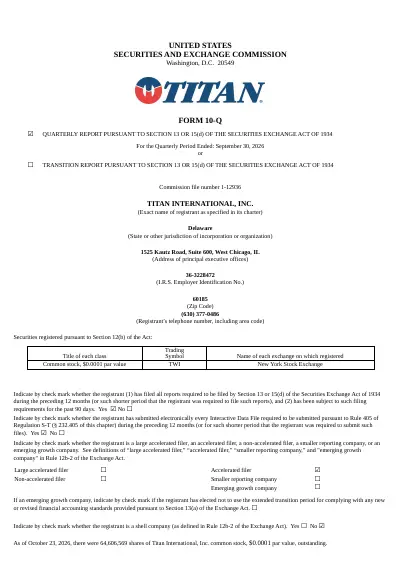
On the call today are Paul Reitz, Titan's President and CEO, and Tony Eheli, Titan's Senior Vice President and CFO. We'll begin with a reminder that the results management is about to review were presented in the earnings release issued this morning, along with Titan's Form 10-Q, which was also filed with the Securities and Exchange Commission this morning.
As a reminder, during this call, management will be discussing certain forward-looking information, including the company's plans and projections for the future that involve risks, uncertainties, and assumptions that could cause our actual results to differ materially from the forward-looking information. Additional information concerning factors that either individually or in the aggregate could cause actual results to differ materially from these forward-looking statements can be found within the safe harbor statement included in the earnings release attached to the company's Form 8-K filed earlier, as well as the latest Form 10-K and Forms 10-Q, all of which have been filed with the SEC.
In addition, today's remarks may refer to non-GAAP financial measures, which are intended to supplement, but not be a substitute for the most directly comparable GAAP measures. The earnings release which accompanies today's call contains financial and other quantitative information to be discussed today, as well as the reconciliation of the non-GAAP measures to the most comparable GAAP measures.
The Q3 earnings release is available on the company's website. A replay of this presentation, a copy of today's transcript, and the company's latest quarterly investor presentation will be available soon after the call on Titan's website.
I would now like to turn the call over to Paul.
Paul Reitz
Thanks, and good morning. Our third quarter results were solid.
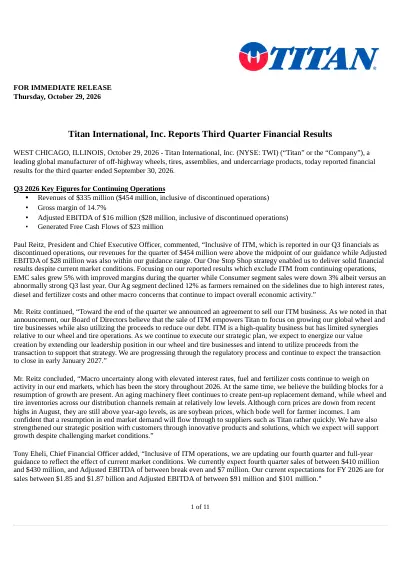
Revenue was $454 million and adjusted EBITDA was $28 million, both consistent with our guidance. Delivering within that range despite the prolonged cyclical downturn in our end markets reflects our focus on the factors we can control and the value our one-stop-shop strategy provides to our customers.
As we reported in mid-September, we signed a definitive agreement to divest our ITM undercarriage business. This transaction is an important step in our capital allocation and overall strategy as a focused tire and wheel company because it will allow us to reduce debt, invest in core growth initiatives, including M&A.
We expect the sale to close in January, subject to customary regulatory and closing conditions. Until then, we are managing ITM to contribute as much as possible to our overall results, even though accounting rules require us to report it as discontinued operations.
In particular, we expect ITM to generate positive cash flow during the fourth quarter. Tony will cover the financial details later.
ITM has been an important business for Titan, but its products and operating model do not offer the same natural synergies as our wheel and tire businesses, including those we have realized through the recent Carlstar acquisition. After evaluating the strategic fit and the offer presented by Usco, our board concluded that divesting ITM would better position Titan to grow its wheel and tire businesses organically, pursue potential synergistic acquisitions, and, of course, reduce debt.
We believe we can create greater long-term value by directing capital toward our strong position in off-road wheels and tires. In the press release announcing the transaction, we said we intend to use the ITM proceeds to reduce debt while pursuing accretive acquisitions and strategic partnerships that expand Titan's capabilities over time.
Let me dig into that just a little bit further. We do not have an imminent transaction on the scale of Carlstar pending.
We already hold strong positions in wheels and tires in North America, tires in South America, and wheels in Europe, supported by deep experience in those markets. Our focus is therefore on disciplined opportunities that expand our product footprint, strengthen our customer offering, and are accretive through organic investment or selective M&A.
I'll give you a recent example, which is the Roderas transaction that we mentioned last year and that illustrates that approach. Through that deal, we partnered with the second largest manufacturer of agriculture wheels in Brazil, investing only $4 million for an initial 20% ownership stake, and then committing to acquire the remaining 80% in 2029, with the final enterprise valuation based on financial performance criteria.
I use that Roderas example and our Titan Yuxiang joint venture to demonstrate the kind of opportunities we see ahead: targeted investments and partnerships that close product gaps, strengthen our market position, and expand our capabilities with disciplined capital commitments. With that being said, let's shift gears and spend some time discussing how we view our businesses strategically going forward.
We intend and will continue to report EMC as a reportable segment. During Q3, the segment revenues from continuing operations in EMC accounted for 17% of sales, so that is still a meaningful segment within the broader context of our business.
From a product perspective, our remaining EMC business consists of wheels and tires that are used primarily on construction and industrial equipment. Although steel undercarriage is the majority of revenue in that segment, there is still a good range of equipment in that area that we believe has growth potential within our wheels and tires businesses, and therefore is still a good, accretive business for Titan.
Shifting over to the Consumer segment, we delivered a solid quarter despite the difficult comparison with last year. End-market demand remains pressured by high interest rates and inflation, common stories.
Our sizable aftermarket business has been a bright spot because consumers continue to use and maintain existing equipment, even as demand for new equipment remains weak. On the OEM side, though, we have been winning new business with our product innovations, and that new business has been coming on both existing and new equipment platforms, and that was on full display at the Equip Expo in Louisville last week.
Those wins are supporting sales in 2026, despite the weaker OEM markets, and they will contribute even further to sales gains in 2027. Moving over to the Ag sector, we faced the strongest headwinds in this quarter of all our segments, driven by many of the same pressures affecting Consumer.
Although Ag has a sizable aftermarket business, our OEM sales represent a larger share of that segment's revenue, therefore resulting in a year-over-year decline for this quarter. Buyers remain on the sidelines this quarter, even as many industry participants view 2026 as a potential floor.
I think we agree with that comment, and we look to 2027 with cautious optimism. We believe the conditions for recovery are developing and that Titan would see demand rebound quickly when customers begin investing again.
Grain prices have improved from a year ago, that's a definite positive, and there are reports that farmers may use less fertilizer because of the remaining high costs of fertilizer. All else being equal, with that being said, lower fertilizer would reduce crop yields and, again, help further support crop prices.
Along with that, the government has announced continued support into the sector. Again, we do hold that position that this is a floor period in 2026, and look to 2027 with cautious optimism.
With all that being said as well, that's positive for farmer incomes. That enables them to replace aged equipment.
Interest rates are always tough to predict, they're changing daily. You do see an environment where interest rate cuts and a more improved environment for interest rates would be available and appropriate for 2027, and that would also spur demand.
In addition to the macro winds shifting to drive demand, we also note that low inventory levels throughout our channels mean that any uptick in demand should flow through to the orders for wheels and tires pretty quickly. As machinery is built, wheels and tires are normally fitted fairly earlier in the process.
They allow units to be moved through a plant station to station. Again, Titan would be well positioned to be early beneficiary of demand resumption.
Again, I want to remind everybody, we don't need the market to return to peak for us to benefit from a market. We need the market to improve, and the volumes and the flow-through will help us at the production absorption cost level quite meaningfully.
With that, to sum things up, the remainder of this year will remain challenging, but we expect to enter 2027 with optimism for two reasons. First, we expect the ITM sale to close in January, strengthening our balance sheet and positioning us to invest in core growth initiatives.
Secondly, as I was just talking about, the conditions for recovery are taking shape, and our market position and low channel inventories would allow Titan to respond quickly when demand returns. With that, I will turn it over to Tony.
Tony Eheli
Thank you, Paul. Good morning, everyone, and thank you for joining us today.
Against the macro backdrop, and inclusive of ITM, we delivered solid results with revenue above the midpoint of our guidance range, and adjusted EBITDA within our guidance range. The adjusted EBITDA was just below the midpoint of the guidance range due to the delayed receipt of some tariffs.
Key figures from the third quarter included sales of $454 million, gross margin of 15%, adjusted EBITDA of $28 million, and free cash flow of $10 million. As Paul noted, following the announced sale of ITM, we are reporting that business as discontinued operations in accordance with applicable accounting requirements.
My remarks on the third quarter business performance will therefore focus on continuing operations, that is, excluding ITM. Turning to segment performance, our Agriculture segment continued to face pressure from elevated financing, fuel, and fertilizer costs.
Segment sales declined 12% from the prior-year period as activity in the U.S. remained subdued, and Brazil slowed notably.
This impacted fixed-cost leverage, and together with higher input costs, resulted in segment gross margins of 7.6%, compared with 13.2% in the prior-year period. On a positive note, grain prices, particularly corn and soybeans, remain above prior-year levels, which could support farmer income in 2027.
Looking specifically to Brazil, we noted last quarter that activity levels were sluggish for several reasons, including uncertainties surrounding the presidential election, expected to significantly affect agricultural policy, along with the higher interest rates there, and broader inflationary pressures tied to the Iran war. Inventories also remain elevated, following a cautious approach many market participants adopted ahead of the Brazil presidential election, and we expect those inventories will need to clear before demand resumes.
Moving on to our Consumer segment, I want to first note that last year's third quarter benefited from strong sales due to the impact of U.S. trade policies and tariffs, and I've explained this during the last earnings call.
As those policies were implemented in the second quarter of 2025, many market participants focused on drawing down existing lower-cost inventory, thereby suppressing sales temporarily. As that inventory cleared, purchasing activity resumed in the third quarter, setting up a difficult comparison this year.
As a result, segment sales declined 3% year-over-year. The gross margin for the quarter expanded to 27.6%, and included $3.5 million of net tariff refunds.
Excluding those refunds, gross margin improved to 24.7% from 23.4% last year. For EMC, which now represents wheels and tires only, sales grew 5% to $57 million, driven primarily by growth in our Europe business, and complemented by U.S.
product sales sourced externally from our strategic suppliers. This is a growth strategy we had shared in the past.
We launched several of these new products this year, and these have been well received by the market and allow us to compete and gain market share in areas in which we previously did not participate. The EMC gross margin for the quarter improved to 7.1% from 6.1% last year.
SG&A, including R&D expenses, was $46 million for the quarter, compared with $49 million in the prior-year period, primarily due to our continued focus on cost reduction initiatives. As a percentage of sales, expenses were relatively flat, at 13.8%.
Operating cash flow from continuing operations was $29 million in the third quarter, compared with $19 million in the prior-year period. This favorable cash flow performance reflected focused execution by our team to optimize working capital investment.
Capital expenditures were $6 million in the third quarter, compared with $8 million in the prior-year period. Year to date, capital expenditures are $25 million, compared with $30 million in the prior-year period, as we continue to make prudent, measured investments in the business.
Tax expense was approximately $200,000 for the quarter, well below the $4 million to $5 million expectation we provided last quarter, and this is primarily due to the classification of ITM as discontinued operations. For the fourth quarter of 2026, we expect tax expense to be similar to the third quarter.
Inclusive of ITM, net debt was $406 million at the end of the quarter, down from $413 million at the end of the second quarter. Upon closing the ITM sale, we intend to use a significant portion of the proceeds to further reduce debt.
Turning now to our financial guidance, inclusive of ITM, for the fourth quarter of 2026, we expect revenue of $410 million to $430 million, and adjusted EBITDA of breakeven to $7 million. This fourth quarter guidance includes ITM's operations forecast of revenue of $115 million to $120 million, and adjusted EBITDA of around $10 million.
For fiscal year 2026, our revised financial guidance, inclusive of ITM, is revenue of $1.85 billion to $1.87 billion, and adjusted EBITDA of $91 million to $101 million. This full-year guidance includes ITM operations forecast of revenue of $465 million to $470 million, and adjusted EBITDA of around 40—$40 million.
With respect to additional tariff refunds, we expect approximately $6 million of refunds net. We currently expect to receive the refunds in the fourth quarter, but the timing remains subject to applicable government review and processing procedures.
We intend to reinvest the proceeds back into the business, with a focus on initiatives that enhance our product offerings and deliver greater value to our customers. Looking ahead, any improvement in macroeconomic conditions, including lower interest rates and easing input cost pressures, could support a more robust demand environment in 2027.
I will now turn it over to the operator for the Q&A session.
Operator
Thank you. We will now begin the question-and-answer session.
Please limit yourself to one question and one follow-up. If you would like to ask a question, please press *1 to raise your hand.
To withdraw your question, press *1 again. We ask that you pick up your handset when asking a question to allow for optimum sound quality.
If you are muted locally, please remember to unmute your device. Please stand by while we compile the Q&A roster.
Your first question comes from the line of Joe Gomes with Noble Capital. Your line is open, please go ahead.
Joe Gomes
Good morning, thanks for taking my questions.
Paul Reitz
Hey, good morning, Joe.
Joe Gomes
Just on the ITM, real quick kind of technical, when do you think you'll have out, I haven't seen them yet, the adjusted numbers for the first and second quarters? Yeah,
Tony Eheli
Joe, that's something we, haven't provided, and, looking at what we're supposed to provide, that's really not something we're looking at. However, but with full year, what we'll have, you have the full year for prior, prior year.
That will be able to give you the numbers for the full year, and you would be able to deduce, what, what to expect quarterly from that, I think. I think it would be very clear.
Joe Gomes
Thanks for that. On to the questions.
With the sale of ITM, how does that impact your previous $250 million mid-cycle adjusted EBITDA framework? Kind of where should we look at now as a mid-cycle base for adjusted EBITDA?
Tony Eheli
Thanks for that question. We are actually discussing that internally as we evaluate what the opportunities are going forward, and we will be coming up with an update on that.
Joe Gomes
Okay. Then, Paul, last year this time, it was thought that '25 was going to kind of be the bottom for the Ag cycle, and '26 we'd start to see some improvement.
Obviously, that hasn't come through. You gave us a list of things that you think give you cautious optimism into '27.
We had that same kind of cautious optimism going into '26, and I guess the question is, what's different this time? It's
Paul Reitz
really the duration. Like you alluded to in your question, Joe, it's the duration.
It's getting long in the tooth. When we talked about the market improving in 2026, it was based upon information that came from our customers and forecasts we had seen.
Obviously, that was a false start. We've seen this year have tremendous amount of ups and downs, with obviously the geopolitical environment, with the inflationary pressures of fuel, fertilizer, and then you throw in a volatile interest rate market, and so that's created some unusual trends in farmer sentiment.
We saw what I would call another false start, about a month ago, and one to three months before that, and so I think you look at it and go with the duration of all these false starts, eventually, it's going to be real. Again, all those factors that we've been discussing and listed again today are really good reasons why, when the market gets any type of footing, it will definitely go up.
We see the impact in our business, operating at these levels as others are. We feel very optimistic that with the additional volume, the flow-through will be strong to the bottom line, because operating where we are right now, taking days out of our schedule like we are in Q4, with the normal shutdowns that you have with the holidays, it's painful, and it's costly.
Again, I think with the market turning, we'll see a really nice, positive uptick on the flow-through when we can run our plants. Back to your question, we're feeling it around us.
Throughout the course of this year, we've seen drop-in orders at times. Again, I'm not calling them a start to a rebound.
There's been drop-in orders where people need inventory, and Titan's strength is we can fill those. We remain the leader in our space with our production capabilities, and so we've been servicing those drop-in orders both on OEM, and we've seen it on the aftermarket side.
We had some strong aftermarket results in October, that tell us the market has potential as inventories get low, people want to replenish them. Hopefully, we'll get back to a building cycle in 2027, and I think it will be, again, very positive for Titan because those inventory levels are low.
We're watching it closely. I'd love to tell you a definitive start date for when the market will turn, but I think all those variables do add up, Joe, to a period of time in 2027 where the markets will get better.
Joe Gomes
Great, thanks for that, Paul, appreciate it. I'll get back in queue.
Thank you.
Paul Reitz
Thanks, Joe.
Operator
Your next question comes from the line of Mike Shlisky with D.A. Davidson.
Your line is open, please go ahead.
Mike Shlisky
Hey, good morning. Thanks for taking my questions here.
Paul Reitz
Looking at your guidance
Mike Shlisky
for the fourth quarter—good morning, good morning, guys. Just, I was just looking at your guidance here in the fourth quarter, you basically have almost, it could be as as low as zero margin, but a pretty low margin in the fourth quarter.
Again, almost nothing. In the past, though, even just last fourth quarter, you you got EBITDA margins of at least, 3%, $10 million worth of EBITDA when sales were only about $410 million.
I'm curious as to kind of this year why you can't make any money at $410 to $430 million.
Tony Eheli
Mike, the environment is different this year versus last year, very different. Last year, we did not have the Iran war, with the level of energy cost increases and general inflation increases we're seeing, and the impact on business.
It's a very different operating environment. When we compare the two, there's material costs are a major piece of that, and we do what we can as a company to pass on those costs.
In some cases, as we've said before, our price lacks the material cost, and we've continued to see those energy costs and inflationary cost increases, continuing to lag in those, continuing to chase the material cost increase from a price perspective. However, realistically, as a business, we have to look at whether we can pass on 100%, and determine the right approach forward.
That's a big difference when we look at the performance. Of course, there's a volume impact of Brazil itself.
Brazil is significantly down, just given where the economy is at, year-over-year. That's a huge piece of the volume impact we're seeing year-over-year.
Even on the top line, you may see sales, a lot of that is price that relates to material costs that we have passed on already. There's still a lot that we need to pass on.
Mike Shlisky
It's
Tony Eheli
a lag.
Mike Shlisky
Got it. All right.
Then for my follow-up, I'm just curious whether are there any dissynergies or costs that were being absorbed by having ITM in the portfolio that you'll have to start bearing after ITM is out? Just trying to figure out whether there's any kind of margin impact to the rest of the business if ITM isn't there anymore, purchasing or run or
Tony Eheli
back-office, etc. Thanks for that.
The short answer is no. ITM was run as a very separate business, and that's why we said there's not a lot of synergies with it.
I think we're going to have opportunities going forward, but in terms of the cost, there's nothing like that in terms of the dissynergies.
Mike Shlisky
Perfect. Great, thanks so much, guys, I'll hop back in the queue.
Paul Reitz
Thanks, Mike.
Tony Eheli
Thank you.
Operator
Your next question comes from the line of Steve Ferazani with Sidoti. Your line is now open, please go ahead.
Steve Ferazani
Morning, Paul, morning, Tony. I know it's been a very busy few weeks for you guys, with a lot going on in all of your segments, and then to announce this transaction.
Paul, I just want to start with, because I've covered you for a few years now, and I know the first year I covered you, the ITM potential transaction was talked out a lot, particularly by investors. It sort of wasn't discussed so much the last couple of years, this was a little bit of a surprise.
Can you walk through the reason for the decision now? It sounds like you just got the offer you wanted, but was there anything more to it?
Paul Reitz
No, I think that is the best way to characterize it. The board put in strong governance around this process.
Like you said, the discussions have taken place over a period of time, and it continued to receive further valuations sort of off and on, that's why at times we would speak of it, and at times it would sort of go quiet. Not something that we were trying to force.
Again, with the strong governance by the board, the discussions gained steam throughout this year, and like you said, we reached a point where the valuation made sense, and strongly viewed as win-win for both sides, and the decision was made. That's really how the timing took place, there's not any other variables to it.
Steve Ferazani
I do want to follow up the last question you got previously, which was around obviously, when you sell a business that was generating this much revenue, and it was, I know, a pretty separately run business, you're going to have the impact of that negative operating leverage, the flip side being your balance sheet looks much, much better. How do you and the board think about that in terms of the new profile and sort of filling that gap?
I
Paul Reitz
look at it from three angles. First is keep that balance sheet strong, reduce debt, have a strong balance sheet like you said, and that will enable the opportunities to pursue growth initiatives.
We view we have a strong organic platform for growth. Going back to the question asked earlier, when we model that 250 mid-cycle, a lot of the growth and the benefits we saw to growth in sales in the future was coming from wheels and tires.
That's how we model that 250, it wasn't that ITM was going to grow at the same rate of wheels and tires. We feel strongly that there are organic growth initiatives, and we feel as well there are opportunities to pursue accretive and strategic M&A.
I'm careful when I say that, and I want to look to what we've done recently, and I highlighted in my comments with Roderas and Yuxiang, building up strong joint venture partnerships that require some equity with the potential to then go above either the 50% threshold or all the way up to 100, and then therefore consolidate the results, exists with both Yuxiang and Roderas, and they're very accretive businesses to Titan, especially Yuxiang. I've talked about that once, I won't belabor it.
I look at Carlstar, and the acquisition point multiple for that was attractive for Titan shareholders. The business has performed well, you see it in our Consumer segment.
Again, the future is bright for what we have done since we've acquired that business. Walk around the Equip Expo last week and see our products on OEM fitments that they weren't there a few years ago.
Again, we look at opportunities to take our product platform, our geographical production footprint, and grow within the wheel and tire space, but we're going to do it with the mindset that we got to protect our balance sheet. Our board is aligned with that, and so, again, I think all the reasons lined up to pursue the divestiture of ITM, believe we got it done, I know we got it done successfully at a good valuation, and now gives us the opportunity to protect the balance sheet and grow the business through our initiatives.
Again, it's how we always envisioned the company before, when we talked about a $250 million midpoint, again, we got to back out the ITM part and Tony already highlighted that, but our growth was coming from wheels and tires. Yep.
Steve Ferazani
Got it. Very helpful.
I do got to go back on the 4Q guidance, which is probably a little bit softer than a lot of us were looking at. Historically, if you are entering a better year on the Ag side, you'd start seeing it as early as 4Q.
It sounds based on this guide, though it sounds like you're seeing some impact on EMC as well, how do you think about the ability to recover if you aren't seeing strength early in 4Q for sort of the new model year? How do we need to think about that?
Should we be concerned?
Paul Reitz
There there is some recovery when you look at it sequentially, and year-over-year. We we are seeing some growth, and that does impact our Q4, meaning, we are going to have to in certain parts of our business build ahead, and and put it in inventory versus realize it as sales because, again, managing labor effectively, the best way to put it.
There is that there is some movement going on in Q4 that will be re- related to future sales in Q1, there is some growth. What we are seeing from customers, because of the geopolitical, inflationary, interest rate environment, everybody's being cautious.
We are not lacking growth for next year. There is growth available and being forecasted for next year, I want to be clear on that.
Again, some of those costs and the impact will be absorbed into Q4 because we do have some shut day shut down days built in, we got the holidays, and so we're going to be running our plants, with no sales related to that, in preparation for, again, some increase in in visibility into forecast for Q1.
Steve Ferazani
Certainly, we all heard it late summer when one of the biggest players called this year the bottom, in the Ag equipment. That was late summer, and now the Iran conflict continues, and I know you can't characterize that comment, but do you think the optimism, given the length this thing is going on and no clear end date depending on who you ask, we've got the government payments announced since, but how do you characterize the shift in your customers now versus say late August?
Have you seen a significant change?
Paul Reitz
I would just take out the adjective. There's been a positive change.
We feel it, as we go through our modeling for 2027, which we'll be doing in November, there is growth, and that's what we're modeling, that's what the expectations are, that's what we're feeling in the market from our customers. It's always with that word "cautious" in front of it.
Nobody is willing to put a significant growth. No, I do see a positive change, both internally and externally, from where we were in August to where we are today.
Despite what you saw in the Farmer Sentiment Index, where it went up and then it went back down, and crop prices have gyrated as well, I think it goes back to some of those things we've been talking about: the long duration, the low inventory levels, and really the reality is that something's going to change positively, that we hopefully, Steve, can put the word "significant" in front of that. We do see growth.
It would be great to say it's significant growth.
Steve Ferazani
Got it. Thanks, Paul, very helpful.
If I could jam one more in just in terms of, I guess, for Tony and for you, Paul. The next time we hear from you, you'll be reporting 4Q.
At that point, you're probably going to be offering up guidance without ITM, for us on this side, we've got to try to model 2027, as you can imagine, without it. Tony, any kind of tips you want to offer?
We can see your 3Q. Is there anything specific beyond the normal seasonality?
I know ITM is Europe-based, anything, and we have some 2025 numbers. Just anything you can offer, and we can follow up after the call to help us when we start thinking about 2027.
I know obviously, clearly don't want to guide right now, but anything you can help us, because we're going to have to model it.
Tony Eheli
I appreciate that question. Obviously, we can talk more after the call.
I think when we look at seasonality in the business, it's really the second half, it's really mainly Ag, there's some of that in Consumer. ITM is not as seasonal as the rest of our businesses in Q4.
The fact that we have Q3 and Q4 gives the perspective to what it's going to look like. The earlier parts of the years are not as seasonal, even when we look at ITM, so, I think that would be a good way for you to look at it as you think about next year.
Steve Ferazani
Got it. Thanks, Tony.
Thanks, Paul.
Paul Reitz
Thanks, Steve.
Tony Eheli
Thank you.
Operator
Your next question comes from the line of Kirk Ludtke. Your line is now open, please go ahead.
Hello, everyone. Thank you for the call.
Just a couple follow-ups. You mentioned Brazil was weak, and I'm curious if now, I'm sure it's early days, but do you have any early read as to how the election results might impact the business?
Paul Reitz
They're they're digesting it. We were just down there a couple weeks ago, pre-election, and, certainly, it was a surprise.
I I would say I would characterize it this way. The Brazilian Ag market, not talking again to the overall broader economy, but the Ag market was already expecting a very difficult Q4 and Q1 regardless of the election results.
I I don't think that perspective is going to be altered, and, we saw the Brazilian stock market go down 20%, but, from the Ag space, we were already, already planning and already scheduling to be shut down. Our customers had significant shutdowns planned for Q4, Q1.
We believe Brazil Ag will start off the year difficult. Tony talked about that in his comments, the impact that had on our business when you look at year- year-over-year Q4.
I see that going into Q1, and that's that's irrespective of the election results. Looking at it, again, from my vantage point, Ag's so important to that economy.
If I was leading a country, I would really not want to turn my back on the farmers in that community and and what it means to the overall broader economy. I don't think there was a ton of support in place already for farmers when you look at what's been going on the last 12 months.
Some of the some of the benefits they had for farmers in the past had been already pulled back, kind of all resulting, as I said, in a in a weaker Ag environment in Brazil. I I don't know how it gets worse, unless the they just don't like to eat in Brazil, and if you've been down there, they got great food.
I don't think that's going to happen. I I think so I think you're already seeing the worst of it, and we were already prepared, here at Titan, and and regardless of the election results, the impact that has on the broader economy could be negative, as as the market has indicated.
I think from the Ag space, it's already been, it's in our results, our forecast that we've discussed, and really all our preparations. Our team our team's exceptional in Brazil.
Kirk, they they are we've worked with them since year one of being down there. They know how to manage costs, make changes, and deal with a volatile market in Brazil, I'm I'm confident that Titan will will do that, and we were already prepared for that.
Got it. That's very helpful.
Thank you. Follow-up on ITM, are there any use of proceeds that you'd call out, any cash taxes, debt you have to pay down, any letters of credit you have to put up cash for, anything like that that might be a use of cash?
Tony Eheli
From the proceeds, we've said we're going to focus primarily first of all, we'll pay down debt, strengthen our balance sheet. That's going to be the first thing we're going to do.
In terms of taxes, we don't expect any significant tax leakage.
Got it. Thank you.
With respect to that guidance, I might have missed this, but did you break it out between the continuing and discontinued ops?
Tony Eheli
Yes, I did. I gave the guidance inclusive of ITM, but I also called out ITM's forecast for Q4 and the full year.
I can easily say it again. ITM's sales range for Q4 is $115 to $120 million, and around $10 million of EBITDA.
That's for the Q4. For the full year, it's $465 to $470 million on sales, and then for EBITDA, it's around $40 million.
Got it. Thank you.
I appreciate that. Then with respect to material costs, I remember over the years, you've emphasized contracts that were longer term and also had material pass-through provisions.
I'm just curious if that mitigates at all what you're seeing out there.
Tony Eheli
We have those, and we are getting the price on that. That's why I talked about the lag.
That's for our OE customers, our major OE customers, and that's why we have that lag. Because the prices with our OE customers do not adjust immediately every day or every week or monthly, but some adjust quarterly, some adjust twice a year, there is a lag.
When you have a situation where inflation is and cost increase are continuing to go up, yes, you have prices that you're getting, but you're kind of continually chasing the material cost increase with your price. At some point, when those cost increases stop and cost level out, then you will see that improvement in the margin, then you would see the benefit of, because you will then get price without a cost increase.
Yes, it is in our contracts, and we're executing on those.
Got it. I appreciate it.
Thank you. Then lastly, I remember ITM was, and this may have changed, but I remember that it was, you felt like it had a lot of working capital requirements.
I'm just curious if that changes when we forecast going forward, will the company's working capital requirements be less than they have been in the past because ITM's out of the mix?
Tony Eheli
Yes, it will be less. It will be less, just given that, like you said, the business uses more working capital than the other parts of our business.
Yes, that will be different going forward. Yeah.
You can see some of that, even in how we drove cash flow in the third quarter, you can see some of that there.
Got it. I appreciate it.
Thank you very much.
Paul Reitz
Thanks, Kirk. Thank you.
Operator
Your next question comes from Derek Soderberg with Cantor Fitzgerald. Your line is open, please go ahead.
Derek Soderberg
Hey, guys. Thanks for taking the questions.
Was wondering if you could talk a bit about competition, if you're seeing any change there, particularly from a low-cost importers. Are your customers importing more from China this year versus last?
Can you talk about any of that, or any change you're seeing in competition, and then I've got a follow-up.
Paul Reitz
I don't think there's been a change. It's always present, it's been a factor of our industry and our business for a period of time.
Has there been a dramatic change, no. Do they, especially India, operate unfairly at times, yes, we've proven that.
I've mentioned that a number of times on the calls, and you can go look at the judicial files will support that statement. We do see some tactics that, going beyond they have unfair practices, but we do see some tactics at times where they'll take containers and they'll drop them, and they'll give a year payment terms, etc.
That's been going on before. I don't consider that a change, I'm just kind of illustrating what the market is.
I don't think our business is being impacted by significant changes in how our competition operates. We do also employ a lot of low-cost manufacturing ourselves.
I'm kind of shift gears and bring it internal instead of external. It's a significant part of our business.
We have excellent operations in some low-cost countries, and we have strong partners that we use as third-party manufacturing in low-cost countries, because that's what our customers and the market dictates. What we have that's different than the competition or better than the competition is we have a combination of a strong production footprint that we control, therefore bringing risk mitigation, along with the strength we have of low-cost manufacturing and partners and joint ventures.
With that, we have incredible brands, incredible distribution relationships and partners there. The way we view the market, Derek, is that that is the way it is, and we are going to win and compete within it and adjust our business model accordingly.
One of the things we do see different now, internally versus five years ago, is how we operate as well. I'm not going to just say it's external, it's we've changed.
What our business model now and has been and it will be going forward is we're going to be the best of both worlds. We will win because we bring something to the table that the others don't, and that is, again, we can produce and mitigate risk to our customers.
You're not going to be relying on all the craziness that exists in the world with geopolitics, currencies, etc., because you can rely on Titan to say, "If you need low cost, we can do that, but guess what, we can also get you products made by ourselves directly to your plants with no risk." That's how we're going to win.
Derek Soderberg
Perfect. All my other questions have been asked, appreciate it.
Thanks.
Paul Reitz
Thanks, Derek.
Operator
There are no further questions at this time. I will now turn the call back to Mr.
Reitz for closing remarks.
Paul Reitz
I appreciate everybody's attention with our Q3 results and call today, and we will be back with you for Q4. Have yourself a great day, and appreciate it.
Operator
This concludes today's call. Thank you for attending.
You may now disconnect.