UDR, Inc.
Q3 FY2026 · Earnings Call TranscriptNovember 3, 2026
Operator
Greetings. Welcome to UDR third quarter 2026 earnings call.
If anyone should require operator assistance during the conference, please press *0 on your telephone keypad. As a reminder, this conference is being recorded.
It is now my pleasure to introduce your host, Vice President of Investor Relations, Trent Trujillo. Thank you, Mr.
Trujillo, you may begin.
Trent Trujillo
Thank you, and welcome to UDR's quarterly financial results conference call. Our press release and supplemental disclosure package were distributed yesterday afternoon and posted to the Investor Relations section of our website at ir.udr.com.
In the supplement, we have reconciled all non-GAAP financial measures to the most directly comparable GAAP measure in accordance with Reg G requirements. Statements made during this call which are not historical may constitute forward-looking statements.
Although we believe the expectations reflected in any forward-looking statements are based on reasonable assumptions, we can give no assurance that our expectations will be met. A discussion of risks and risk factors are detailed in our press release and included in our filings with the SEC.
We do not undertake a duty to update any forward-looking statements. When we get to the question and answer portion, to be respectful of everyone's time and in an attempt to complete our call within 1 hour, we will limit questions to one per analyst.
We kindly ask that you rejoin the queue if you have a follow-up question or additional items to discuss. Management will be available after the call to address any questions that did not get answered during the Q&A session today.
I will now turn the call over to UDR's Chairman, President, and CEO, Tom Toomey.
Tom Toomey
Thank you, Trent, and welcome to UDR's third quarter 2026 conference call. Presenting on the call with me today are Chief Operating Officer Mike Lacy, Chief Financial Officer Dave Bragg, and Senior Officer Chris Van Ens, who will be available during the Q&A portion of the call.
To begin, I'm pleased to announce that our previously announced $2 billion joint venture with Apollo has closed. To use a baseball term, with this strategic partnership, UDR has hit for the cycle, a rare feat.
With one transaction, we increased UDR's access to equity capital, reduced leverage, improved the asset quality of the wholly-owned portfolio, and drove earnings accretion. My sincere thanks go to the many UDR associates who made this a reality.
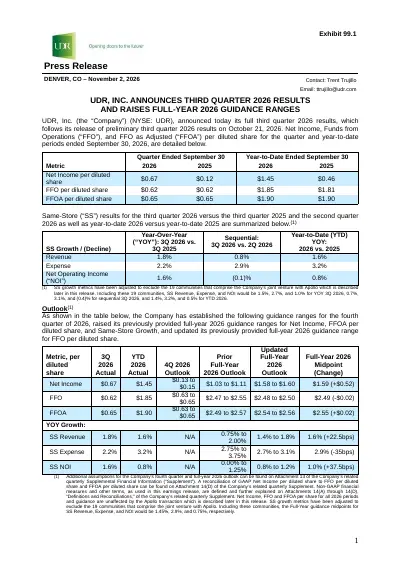
Dave will provide more details in his prepared remarks. Moving on to operations, UDR produced third quarter results that achieved the high end of our guidance expectations and led us to raise our full year same-store growth and FFOA per-share guidance for the second time this year.
This fall, the apartment sector has enjoyed a traditional leasing curve, a distinct improvement versus recent years. Mike will elaborate on how our data-driven capabilities, continuous innovation, and disciplined execution allow UDR to capitalize on the apartment operating landscape.
Next, I'd like to welcome Scott MacCollum to UDR as Chief Investment Officer. Scott joins us later this week and brings a wealth of investment experience and strategic insight and will work with us to further enhance UDR's access to capital and capital allocation acumen.
Additionally, last night, we published our eighth annual Corporate Responsibility Report detailing the efforts that led to UDR's recognition as a top workplace winner in the real estate industry for third consecutive year. I'm proud of all we have accomplished, and I look forward to sharing more successes in the years to come.
In conclusion, we are pleased with our year-to-date results across all three value creators, those being operational excellence, data-driven capital allocation, and access to capital. As we look forward, we plan for more of the same, supported by our stronger balance sheet and team.
With that, let me turn it over to Mike.
Mike Lacy
Thanks, Tom. Today, I'll cover our third quarter same-store results, our increased full year 2026 same-store growth guidance, including underlying assumptions and recent operating trends, as well as our strategic positioning.
My prepared comments will focus on our same-store pool after the removal of the communities contributed to the Apollo joint venture. With that, third quarter results reflected better late-quarter leasing trends as compared to recent years.
Specific to the quarter, year-over-year same-store revenue growth of 1.8% was driven by 2% blended lease rate growth, which was similar to the second quarter; robust year-over-year innovation income growth of approximately 7%; healthy occupancy in the mid-96% range; and delinquency of around 60 basis points, which is down 50 basis points year-over-year, reflective of our AI and data-enhanced approach to attract and retain credit-worthy residents. Additionally, resident retention of 52% represented an all-time third quarter high and was 370 basis points above the prior-year period.
Fewer move-outs supported blended lease growth and occupancy and kept same-store expense growth in check at only 2.2%. Beyond these revenue drivers, our third quarter rent-to-income ratio of 21% for new residents compares to the historical average of 23% and is reflective of the appeal of our communities to high-quality residents.
With these results, we have raised our full year 2026 same-store growth guidance for the second time this year. Same-store revenue growth was raised by 22.5 basis points at the midpoint to new range of positive 1.4 to 1.8%.
Improved revenue growth guidance reflects both year-to-date outperformance as well as higher quality portfolio after removing the apartment communities contributed to the Apollo partnership from our same-store pool. Recall that a year ago, we actively shifted approximately 25% of our fourth quarter lease expirations into higher demand leasing months.
This strategic shift is paying off. As compared to 2024 and 2025, we have experienced a stronger seasonal trend from the third quarter to the fourth quarter thus far this year, with renewal rate growth expected to be higher in the fourth quarter than the third quarter.
Accordingly, we expect fourth quarter blended lease rate growth to be in the range of 1.5 to 2%, which is consistent with the range we have achieved each quarter this year. Moving on to same-store expense growth, we've reduced our full year guidance midpoint by 35 basis points to 2.9%, with a range of 2.7% to 3.1%.
This was driven by constrained growth across repairs and maintenance, administrative and marketing, real estate taxes, and insurance. Combining our improved revenue and expense growth guidance, we increased our same-store NOI growth guidance by 37.5 basis points at the midpoint to a range of positive 0.8% to 1.2%.
Looking ahead, the building blocks for 2027 same-store growth are coming into focus. Based on our team's strong execution that drove our revised outlook and our expectations for fourth quarter blended lease rate growth, we expect a 2027 same-store revenue earn-in of 80 to 100 basis points, which compares favorably to our 2026 earn-in of 0 basis points.
Actual earn-in will depend on our results through the rest of the year, and we'll provide 2027 guidance in February. Turning to regional performance, third quarter results were again led by our coastal markets, which delivered blended lease rate growth of approximately 3% on average as compared to -1.5% in the Sunbelt.
More specifically, on the West Coast, San Francisco remains a standout market with the strongest revenue growth across our portfolio at 9%, driven by blended lease rate growth of approximately 13% and occupancy above 97%. Orange County, where we have a unique overweight exposure, also delivered attractive results, with blended lease rate growth and same-store revenue growth of 3%.
New York and Philadelphia continue to lead the East Coast, with weighted average same-store revenue growth of approximately 5%, driven by blended lease rate growth of 4.5% and occupancy above 97%. Dallas remained our strongest Sunbelt market, exhibiting positive revenue growth during the quarter.
Despite continued new lease rate growth weakness, Austin showed strong positive momentum and was our only Sunbelt market to deliver positive year-over-year NOI growth for the quarter. To conclude, we delivered third quarter results that exceeded our expectations and drove our full year guidance raise.
Our ability to leverage real-time data to tactically adjust operation strategies continues to drive resident satisfaction and cash flow growth. Our teams across the country have delivered strong results, and I'm confident we will continue to innovate, expand operating margin, and create memorable UDR resident experiences.
I'll now turn over the call to Dave.
Dave Bragg
Thank you, Mike. The topics I will cover today include our third quarter financial results and fourth quarter guidance, recent transactions and capital markets activity, and a balance sheet and liquidity update.
To begin, we produced third quarter FFO as adjusted per share of 65 cents, which is at the high end of our previously provided guidance range. The 1 penny per share sequential increase was driven primarily by accretion from investment activity, including prior share repurchases, and lower G&A.
As year-to-date results have exceeded our prior midpoint expectations, we have raised full year 2026 FFOA guidance by 2 pennies per share at the midpoint to $2.55. Looking ahead to the fourth quarter, our FFOA per-share guidance range is 63 cents to 65 cents.
The 64 cent midpoint contemplates the operating environment that Mike discussed. The Apollo transaction, while accretive to 2027 FFOA, is neutral to the fourth quarter due to the timing with which we will deploy the proceeds.
Next, capital allocation. This year has seen us take action on several fronts with the goals of derisking the enterprise, improving asset quality, and enhancing the earnings outlook.
My thanks to the finance, investment, legal, and operations teams, as we have executed on nearly $4 billion of year-to-date activity across acquisitions, dispositions, joint ventures, and share repurchases. Most recently, we announced our $2 billion strategic partnership with Apollo.
UDR contributed 19 apartment communities totaling more than 7,000 apartment homes to this new joint venture. The average age of the communities is 39 years, which compares to 26 for our wholly-owned portfolio, and monthly revenue per home of $2,058 compares to $2,772 for the wholly-owned portfolio.
The Apollo portfolio is approximately 60% Sunbelt and 40% coastal, with top markets including Florida at 44%, California at 13%, and Massachusetts at 13%. The portfolio was valued at a 6% cap rate.
In exchange for a two-thirds share in this portfolio, UDR received $1.34 billion of equity capital and retained a one-third interest in the venture. This transaction received permanent equity treatment from S&P and Moody's.
We will continue to operate and manage the portfolio for an asset management fee. There are two important features of the joint venture that provide UDR optionality over time.
First, we can substitute assets in and out of the venture in the effort to maximize the performance of our wholly-owned portfolio. The rent growth outlook from our proprietary predictive analytics tool, ORION, will play a role in those decisions.
Second, we have an option, but not an obligation, to repurchase Apollo's two-thirds interest in the venture at a 7.0% capped IRR to Apollo starting in year 5. Next, as it relates to the redeployment of proceeds, approximately one-third of the $1.3 billion has been directed towards debt reduction.
With the Apollo partnership insight, we chose not to refinance a $300 million unsecured note maturity in September that would price around 6% today. The remaining two-thirds of the Apollo proceeds will fund wholly-owned acquisitions and share buybacks.
Post deployment of Apollo proceeds, debt-to-EBITDA will settle in the low 5 times range, down from mid-5s at the end of the third quarter. We are equipped with a fortified balance sheet at a moment of capital markets volatility.
The earnings accretion from this transaction is subject to our deployment execution, and we will provide details next quarter, post deployment, in conjunction with 2027 guidance. Outside of our Apollo-related activities, we completed various additional transactions and capital markets activities during the third quarter and into the fourth.
First, we completed the sale of two apartment communities and are under contract to sell a third for a total gross proceeds of approximately $250 million. This will result in 2026 wholly-owned disposition activity of approximately $700 million at a mid-5% buyer cap rate.
We selected these assets for sale based on the same criteria that we focus on when investing, with great attention to property-level characteristics. These eight dispositions comprise a wide range of markets, but share commonalities of elevated CapEx profiles, margins that were optimized on our operational platform, and relatively lower forecasted rent growth per ORION.
These apartment communities on average are 35 years old and have average monthly rents nearly $900 below that of our wholly-owned portfolio, and they're expected to produce annual rent growth 100 basis points below the national average per ORION. Our operations team views them as maxed out in terms of margin potential, their removal and the subsequent investment into our shares or acquisitions enhances the long-term cash flow growth prospects of the enterprise.
Next, we continue to execute on the previously announced strategic decision to run off our debt and preferred equity book, or DPE. We utilized a portion of the disposition proceeds in a 1031 transaction to acquire a recently constructed lease-up property in the Inland Empire, California, that was formerly part of the DPE portfolio.
As an indication of the operational opportunity we see, under UDR's watch, the lease-up has accelerated to a rate of 30 homes per month. Additionally, we entered into an agreement with the same DPE partner to acquire a second lease-up apartment property, also in the Inland Empire, and we anticipate that this one will close in the first half of 2027.
With these two transactions, in addition to our previously reported acquisition of a former DPE investment in Portland, Oregon, at the beginning of the third quarter and a successful DPE repayment on an investment in Orlando, Florida, we are on track for our previously suggested DPE balance of approximately $250 million at the end of this year. The book will then decline to the low $200 million range in the first half of 2027.
At that time, the DPE portfolio will consist only of stabilized assets, and property-level cash flow will allow for more than two-thirds of our contractual return to be paid current in cash. Next, share buybacks.
Apartment REIT stocks continue to trade at an unusually wide discount to private market apartment pricing. Since quarter-end, we have acted upon this by repurchasing approximately 5.2 million shares for $185 million and at an average price of $35.48 per share.
This brings total repurchase activity since September of last year to 16.7 million shares for approximately $603 million at an average price of $36.06 per share, equating to a mid-6% implied cap rate. Following this activity, we have approximately 20.3 million shares remaining on our repurchase program, which we expanded earlier this year.
Lastly, we grew our joint venture with LaSalle to approximately $958 million by contributing a 360-home apartment community in Nashville, Tennessee, to the venture, while simultaneously placing debt on both the newly contributed community and an existing community in the venture. As a result, this transaction brought approximately $103 million in proceeds to UDR.
Considering our year-to-date activity, we have updated our full year capital sources and uses guidance, the details of which are provided in our supplemental financial information. It is important to note that we do not guide to share repurchases, which we evaluate and execute on an opportunistic basis.
In all, our capital allocation and balance sheet management strategies remain rooted in our data-driven and collaborative process that drives long-term cash flow per-share accretion. This includes our ORION analytics platform, our perspective on operating upside potential and CapEx, and the ability to leverage our dynamic capital allocation heat maps to inform sources and uses of capital.
By expanding our access to capital, our investment-grade balance sheet remains highly liquid and fully capable of funding our capital needs. With that, I will open up the call for Q&A.
Operator?
Operator
Thank you. We will now be conducting a question and answer session.
If you would like to ask a question, please press *1 on your telephone keypad. A confirmation tone will indicate your line is in the question queue.
You may press *2 if you would like to remove your question from the queue. For participants using speaker equipment, it may be necessary to pick up your handset before pressing the star keys.
As a reminder, please limit to just one question. Our first question is from Eric Wolfe with Citibank.
Please proceed.
Eric Wolfe
Hey, thanks for taking my question. Could you just talk through the fourth quarter trends that you're seeing thus far in terms of rent growth and occupancy?
As you look out to next year, do you think we need to see material better job growth for rent growth to accelerate from here, or is the sort of lower supply, the very high retention that you're seeing enough to see that acceleration into next year? Thanks.
Mike Lacy
Hey, Eric, it's Mike. I'd say first I want to start with we're really pleased with our third quarter results, and the strength has maintained into the fourth quarter.
Without getting into monthly ins and outs, I mentioned in my prepared remarks we do expect 1.5% to 2% blends in the fourth quarter, and I feel good about it. I'll tell you why.
There's a few stats that I'd like to point out. I think first, it starts with our strategy to lower our exposure during the weaker demand months, and we're right now right around 15% of our leases expiring in the fourth quarter, strong backdrop as it relates to lease expirations.
Second to that, what I've noticed over the last 60 days is our market rent has actually increased by about 50 basis points, and that compares to being down about 300 basis points the prior year. Again, much different backdrop as it relates to market rents today.
Then the third thing that this is kind of translated into is we've got a loss-to-lease today right around 2%, and that compares to a gain-to-lease last year of positive 2%. That's boding well for not negotiating on renewals.
As I've mentioned previously, we did send out renewals higher into the fourth quarter, we do expect that that's going to allow us to drive our rents as well. Ultimately, this is leading to that earn-in of about 80 to 100 basis points this year that compares to 0 last year and pretty significantly better than what we've experienced the last few years.
A much different backdrop, a lot of good positive signs. Maybe the last thing I'd point out is as we typically see going from the third quarter to the fourth quarter, blends usually drop approximately 200 basis points.
Last years, they actually dropped nearly 300. If we hold in that 1.5% to 2% range as we expect, we're going to be in pretty good shape as we go into next year.
That's all while holding occupancy probably in that 96.5% to 96.7% range, healthy occupancy as well.
Dave Bragg
This is Dave, following up with a macro perspective on your 2027 question. While we'll follow up in February and provide guidance, what I'd leave you with for now is no, we don't need material job growth improvement from here for rent growth to accelerate in 2027, based on how we see the landscape.
As we look into 2027, we see an incrementally favorable supply outlook. We see sustained high homeownership costs, and we see residents continuing to stay in place both for cyclical and structural reasons, so that will allow the rent growth outlook to skew disproportionately towards renewals away from new move-ins, as has already been the case.
Operator
Our next question is from Jana Galan with Bank of America. Please proceed.
Jana Galan
Thank you, and congrats on the quarter. With about $900 million earmarked for acquisitions or share buybacks, could you talk about the opportunities in the transaction market and any variance in the cap rates across your geographies?
Dave Bragg
Sure. Thank you for that question.
We are really intrigued by the opportunity to have capital to deploy here. The Apollo transaction closed last week.
That leaves us with ample capital to work with. You alluded to a $900 million number for acquisitions and buybacks.
I think that you're accurately capturing the first thing that we're doing, which is paying down debt, think about that as about one-third of the uses of capital. From there, we'll follow the heat maps and see what the opportunities bring us.
You saw in our press release that even since we announced the Apollo transaction, we've bought back $185 million of shares. That has been consistent with the playbook we've been operating with since last September in terms of selling assets and buying back stock.
That said, we're intrigued by the transaction market as well, and might pick our spots. What we're seeing over the last 60 days is that volume has declined.
There's a wider bid-ask spread as buyers and sellers adjust to what is perceived as a new regime in terms of higher interest rates. As a result, where we have observed trades, cap rates are up, and pricing is down.
Every trade that's on the market more or less right now is receiving an ask of a re-trade. Some sellers do capitulate, and when they do, we're seeing pricing off in the 3% to 5% range, and that varies a bit by market and asset quality.
In other cases, sellers are pulling back and hoping for a better day.
Operator
Our next question is from Steve Sakwa with Evercore ISI. Please proceed.
Steve Sakwa
Thanks. I know you've got sort of Scott joining soon as CIO, but given, I guess, the large discount to NAV, how should we just sort of think about kind of the capital allocation moving forward?
Should it be kind of more of the same, kind of these large joint ventures, or you think it's more kind of one-off asset sales into next year with additional share buybacks?
Dave Bragg
Hey, Steve, it's Dave. We're really excited for Scott to join.
He'll be with us starting this week. He brings with him a wealth of experience as it relates to multifamily transactions, and so the marriage of that experience with our data-driven capabilities around investing are exciting for the team here.
No change as it relates to the focus on capital deployment. We'll continue to follow the heat map, and to the extent that we just get better in terms of asset selection and finding the opportunities out there on the market, that will be terrific.
Operator
Our next question is from Jamie Feldman with Wells Fargo. Please proceed.
Jamie Feldman
Great, thank you. Appreciate some of the color you gave before on specific markets, including Austin's pickup.
As you think about the Sunbelt markets, can you talk us through which you think have bottomed and which you think have a ways to go?
Mike Lacy
Jamie, I'll jump on that, give you a little bit of color kind of how we're seeing it today. I think first, it's important just to kind of size Sunbelt for us, and then I can take a step back and give you a little bit more detail.
We're right around 20% of our NOI coming out of the Sunbelt. What we saw during the quarter was -1.5% blends compared to -2% in the two second quarter, starting to see a little momentum.
I've been talking about that for the past couple of months now. Still have a ways to go.
I think for us, specifically around Dallas, we've said that that's been an outperformer all year long. That's nearly 10% of our NOI, a lot of our Sunbelt exposure comes from Dallas.
We've experienced right around -1% blends for the last two quarters now, and we continue to see some positive momentum coming out of that part of the country. I'd say specific to Austin, I think it's good to remind everybody it's only 2% of our NOI.
We're really in that Cedar Park area, still dealing with a little bit of supply. We have seen the most momentum coming from Austin in terms of blends on a quarter-over-quarter basis, going from -5% back in the second quarter, and we're close to around -1%, -2% today.
You can see that rate of change is starting to pick up. We think that there's opportunities as we go into next year just given what we're seeing with supply coming down and in Texas.
Then Florida for us, it's less than 10% of our NOI at this point, mainly in Tampa compared to Orlando, given some of the properties we just put into the Apollo joint venture are coming from Orlando part of the country. I'm seeing right around -1% blends in Florida today.
That's far better than what we saw at the beginning of the year. I'd say specific to occupancy in the Sunbelt, it's right around 97 today.
We feel like we have a good positioning just in terms of occupancy, lower lease expirations in the fourth quarter. We're going to try to lean in and see if we can't push rents a little bit as we go into next year.
We'll see when that inflection happens, but we do feel better today about the Sunbelt than we have in a while.
Operator
Our next question is from Adam Kramer with Morgan Stanley. Please proceed.
Derek Metzler
Hi, good morning. This is Derek Metzler on for Adam.
I believe you said in your opening remarks that you'd give an update on the Apollo transaction accretion next quarter after the remaining proceeds are deployed. I just want to confirm the timing that you expect to deploy the remaining proceeds in 4Q.
If I can add a part two, can you share the contractual asset management fee percentage on Apollo's invested capital? How should we account for the incremental fee economics in FFOA?
Thanks.
Dave Bragg
Okay. Great questions.
I'll go a little bit out of the order here. The asset management fee, you can think about that as about 1.3% on Apollo's equity contributed of $1.34 billion.
As it relates to use of proceeds, we can tell you what we've done so far and provide some broad strokes in terms of what to expect going forward. We paid down the line to $0.
Typically, it's around $400 million. We're sitting on cash of about $400.
We did not do a debt deal in September when we had a maturity of about $300 million. Then we've done buybacks of about $185 million.
That adds you up to approximately $1.3 billion in terms of the cash that came in the door last week. As it relates to some math around the accretion that you could keep in mind, you have a $2 billion portfolio contributed at a 6% cap rate, so that's about $120 million of NOI.
Two-thirds of that goes to Apollo, that's $80 million. You have the management fee that I just mentioned.
The reinvestment plan will be determined as we execute over the coming months. If you want to simplistically think about it in terms of one-third, one-third, one-third, you could.
You could think about debt paid down of about 6% on the $300 million unsecured deal that we did not do, 4% payoff of a bit of the line. Then you have the acquisition market, where pricing is moving in our direction, and we'll see what that brings.
Then you have the share buyback. Ultimately, this will be a consolidated joint venture.
You will deduct Apollo's non-controlling interest on an HLBV basis to arrive at our results. That management fee will be eliminated in consolidation and show up as a lower non-controlling interest deduction.
Then lastly, we'd add back the proportionate share of depreciation to FFO. Hopefully that's helpful in terms of management fee, use of proceeds, potential FFO impact, and we'll circle up with you in February after we've made progress on deployment.
Operator
Our next question is from Ami Probandt with UBS. Please proceed.
Ami Probandt
Hi, thanks. You maintained your blended spread guide despite removing the Apollo assets and that having a positive impact on blends in the second quarter, or in the third quarter, sorry.
Does that suggest that you're now expecting a softer 4Q than you were previously expecting, or does that give you some cushion given some uncertainty in the macro?
Mike Lacy
I think originally we had that 1.5% to 2% blends for the back half of the year. We did come in at 2% during the third quarter.
We're still sticking to that 1.5% to 2% in the fourth quarter. We'll see how it transpires over the next, call it, 45 to 60 days.
Like I mentioned in one of the previous questions, feel really good about the backdrop, just in terms of loss-to-lease, market rents, and what we're sending out for renewals. Just want to see how it kind of shakes out over the next month or two.
Operator
Brad, your line is live.
Brad Heffern
Oh, sorry. Thanks.
Mike, you talked about all those really positive and counterseasonal trends that you've been seeing over the past few months. I guess what do you think is driving that, and is it broad-based or is it just driven by a few strong markets?
Mike Lacy
I think it's a few things. I think obviously go around the horn and just go market by market, and there's different dynamics.
Overall, the supply coming down is definitely helping out. That's more of a macro piece of it that's helping us.
I think specific to what we're doing here at UDR, it comes down to a couple things. I think first and foremost, it's pushing our rents in a period of time where we do have less exposure.
I think that's a difference-maker for us versus others. It allows us to get a little bit more aggressive.
I think you've been able to see that with some of the third-party data, just in terms of market rents. We've kind of changed that trajectory over the last 4 to 6 weeks, and that allows us to limit how much we're negotiating on renewals.
Send out higher renewals, ideally don't have to negotiate on much of it. That's stickier.
That's allowing us to drive our blends into a weaker period of demand, if you will. Then aside from that, it's just the things that we're doing with the customer experience.
You can see again in this quarter, we were down another 300 to 350 basis points in turnover on a year-over-year basis. We're doing something different than everybody else that's allowing us to just need less leases, if you will, drive our rents, all while maintaining a pretty high occupancy in that 96.5% to 96.7% range.
Some of it's market, some of it's region. I think a lot of it has to do with what UDR's doing specifically.
Operator
Our next question is from Julien Blouin with Goldman Sachs. Please proceed.
Julien Blouin
Hi, thank you for taking my question. Just on the Apollo JV, I was wondering, if you don't exercise your option to repurchase the properties in year 5, does Apollo retain the option to force a sale and realize their 7% IRR?
Dave Bragg
Julien, thanks for the question. That's a topic that I'm going to get to.
I want to just really go back to Tom's opening comments. They captured the benefits of the Apollo partnership so well, and your question pertains to just one piece of it.
First, we're able to access equity capital. It's attractive valuation for the assets that we contributed.
We received equity treatment from Moody's and S&P. We've already strengthened the balance sheet at an opportune moment in the debt capital markets.
We're out there looking to play offense at a moment when asset pricing is attractive both in the private market and as it relates to our shares. All this can, very importantly, be done in a tax-efficient manner, which is particularly appealing about this transaction.
Then we can add value during the life of the JV a couple ways. One is through the substitution opportunity.
We can look at an asset in the JV and have a perspective perhaps from ORION about potential underperformance, and we can pull that back onto the wholly-owned book. Then during the year 5 to 10 window, there's a call option.
We are pleased to announce last night that the IRR has been set at 7.0%. Then that includes step-ups of 30 basis points at year 7 and another 30 basis points at year 9.
That gets you to a capped IRR for Apollo at a maximum of 7.6%. Buyers today of multifamily tend to underwrite 8% to 9% unlevered IRRs.
We will enjoy all the upside in terms of the value creation above Apollo's capped IRR. Then all of this, including asset management fee, allows it to be accretive to earnings.
I talked about the call window that we have, and then beyond the call window, you get to year 10. After the call option expires, either party can choose to sell their interest with ROFO rights for the other party, or the partners can agree to liquidate the JV.
Either way, the return that both parties receive is based on the market value of the assets at that time on a pro rata basis.
Operator
Our next question is from Rich Hightower with Barclays. Please proceed.
Rich Hightower
Hey, guys. Thanks for taking the question.
Just to follow up on the last question. In the hypothetical scenario where performance of the assets in sort of, I guess, the always moving bucket of potential assets to go in it, if performance ever falters, what obligation does UDR have to make Apollo whole in terms of its IRR?
What's the range of possible downside from a capital perspective, or something else maybe we should be thinking of there?
Dave Bragg
This is Dave. I'll start, and other team members might want to contribute.
Apollo has no put rights, they have no right to convert into UDR equity. The 7.0% return, it's a target.
It's not a guarantee, it's not a floor. They do have risk.
That's part of the reason that this received equity treatment. Apollo cannot compel UDR to provide specific return.
If UDR does elect to exercise its call option and the conditions are favorable, Apollo may achieve the targeted return, but it's not assured. Then I would just add that there's no forced redemption scenarios that are outside of UDR's control.
Operator
Our next question is from Wes Golladay with Baird. Please proceed.
Wes Golladay
Hey, good morning, everyone. Looking at your acquisition platform, are there any markets really standing out on the platform, or the deals more likely to screen hey, this is a good deal at asset-level or submarket-level?
Dave Bragg
This is Dave. It's really a bottom-up process.
It might be different than others' view of investing across apartments. For each investment opportunity, first of all, we look at the heat map and see what the risk-adjusted return is on the use of capital.
Then we look at three top criteria that are very much so asset-level based, not market-level based. You have the predictive analytics outlook for rent growth: what's this asset going to do in terms of rent growth relative to the national average over the course of the next 6 years?
Second, what's the operating upside potential? We just have story after story of an asset that we've bought or brought onto the platform where Mike and team have been able to drive margins significantly higher.
Then lastly, we're mindful of CapEx, and directionally look for assets that require less CapEx than those that we have sold. As we think about investing, we approach it with that criteria in mind more so than a market-level decision.
The same thing applies to dispositions. We've sold seven assets so far this year with an eighth under contract.
Pleased to report that the timing was very fortuitous. All seven of those sales occurred before interest rates moved up.
Those follow the same playbook. What we've sold tends to have a lower outlook for rent growth per ORION, the predictive analytics tool; requires more CapEx; and the operating team feels as though we've squeezed the juice out of them from a margin perspective.
Tom Toomey
Hey, Wes, this is Toomey. I'd just add, we're all entering this window with AI enabling our enterprises.
This is where I would congratulate the team. We started on ORION—we had called it a lot of different things—years ago, about 6 years ago, and compiling data with respect to and back-testing it over 25 years to really find the formula to identify assets.
That's the power of AI and our past data and our experiences to create predictive models towards the future. It's not 100% certain, but it sure narrows the risk bandwidth and creates that opportunity.
I think businesses in the future that are able to demonstrate large datasets that are accurate, processing them to achieve higher cash flows, are going to be winning formulas. We're not market-oriented, we're asset-oriented in our decision-making.
I think that will lead to long-term outperformance.
Operator
Our next question is from Peter Abramowitz with Deutsche Bank. Please proceed.
Peter Abramowitz
Yes, thanks for taking the question. You've covered a lot today, but just wanted to ask about Seattle.
I'm curious how things feel on the ground there. I know there's kind of been a lot of conversation about AI job formation down in the Bay Area and kind of when it makes its way up the coast.
Just curious if you comment your latest thoughts on Seattle and just how demand feels on the ground.
Mike Lacy
Appreciate the question. I'll tell you how I'm looking at Seattle right now.
It's really broken down a couple ways. You look at the Eastside, we definitely do have some AI jobs that are helping with demand over there.
Then I'd say more specific to the Pacific Northwest, aerospace hiring has anchored demand, so that's helped us to some degree as well. Then in addition to the demand side, relatively low supply across Seattle has helped out quite a bit for us.
All that being said, blends are not what we're seeing down in San Francisco, right? We're seeing close to, call it, 12% to 13% blends in San Francisco.
I'd tell you Seattle's probably closer to 1% to 2%. Occupancy is still in the mid-96s, and I'm seeing probably more strength coming out of places like the U District, Renton, and then Bellevue.
Overall, Seattle's hanging in there.
Operator
Our next question is from Haendel St. Juste with Mizuho Securities.
Please proceed.
Haendel St. Juste
Hey, guys. Thanks for taking the question.
My question was, I guess, a bit of a follow to the last question from Peter there. Mike, the West Coast has been stronger the last couple of years.
San Francisco obviously has come roaring back. Seattle's shown some improvement.
I'm curious if the pendulum could be shifting back to the East Coast as we think about '27. I'm curious if you can share some color on the setup for your East Coast markets: New York City, Philly, DC, and Boston, and how that compares to San Francisco, Seattle, and SoCal.
Thanks.
Mike Lacy
It's a really good question, Haendel. I'll tell you, there's a few ways to look at it, and I think maybe just sticking with the West Coast, cuz I gave a little color on Seattle, I think it's important to really look at a place like San Francisco.
I mentioned, call it, 13% blends over the last couple of quarters. What I look at more right now is the continuation of low rent-to-income ratios.
We're still in that low 20% range. Still have some room to grow there.
There's still low supply coming for the foreseeable future. The fact that we've been capped on some of our renewals there, we think we have another kiss at it as we go into next year, just given what we see for loss-to-lease.
I think San Francisco obviously, they're going to have the highest earn-in for next year, a really strong building block, if you will. I still think they have a lot of room to grow, all else being equal, given what we're seeing with supply, demand, and just people returning to office.
I think San Francisco will still be the anchor for us out west. Then when you kind of jump over to the East Coast, New York's been the anchor all year long.
I think it's going to continue to do well as we go into next year. I'd say to kind of frame it, I'd look at it in terms of earn-in again.
They're going to have the second strongest earn-in across our portfolio as we go into next year. We're still seeing blends of plus or minus 4% to 5% even in kind of that lower demand period of time.
We do have a little bit of supply just with conversions down in Manhattan, but it really hasn't impacted us to date, and we think that we're going to continue to drive rents out there. I think there's some pretty big anchors both West Coast, East Coast.
It all comes back to that earn-in and that starting point, if you will. We're going through our budget process right now.
We'll assess kind of what we think we can get for rents, and that'll be the other building block. Then I think what you've seen from us for years now is continued growth on that other income line.
Quite frankly, you look at last year, we were growing other income by 9%. This year, it's growing at this quarter alone by 7%.
You're probably looking at mid-single digits as we go into next year again. Another strong building block, if you will, just based on us driving initiatives, getting the teams engaged, and really producing that outsized revenue growth at the end of the day.
Operator
Our next question is from John Pawlowski with Green Street. Please proceed.
John Pawlowski
Hey, thanks for the time. My first is a follow-up on the Apollo JV.
Dave, can you give us a sense for what percentage of the property cash flow actually flows to Apollo versus UDR in the first few years of the agreement, and then how it might step up in subsequent years?
Dave Bragg
Hey, John, thanks for the question. We appreciate the continued dialogue.
The return is targeted to Apollo. It's not guaranteed, and they bear the risk that growth or exit values could fall short.
They can earn up to that capped return, so that's 7% and then it steps up to 7.3% and 7.6% respectively at year 7 and year 9 in the call window. Only if the portfolio performs.
If it underperforms, Apollo could earn less. There's no coupon, no minimum distribution, no UDR guarantee.
As it relates to distributable cash flow, it's pro rata. It tracks the headline 67/33 ownership.
There's no coupon or minimum distribution. As it relates to partner's economics, I can say that vehicles like this, they can have mechanisms allowing for incremental cash flows to Apollo.
They are variable. They're based on performance.
They're not guaranteed. Then as that occurs, Apollo can get closer to its return along the way, allowing UDR to enjoy the value creation opportunity on the back end.
Operator
Our next question is from John Kim with BMO Capital Markets. Please proceed.
John Kim
Thank you. For the DPE assets that you acquired this quarter or about to acquire next year, can you just comment on the expected yields that you think you'll get either year one or on a stabilized basis?
Would you characterize these investments as long-term holds, given they are new assets, or are you really just looking to optimize your initial investment and then not really representative of your portfolio?
Dave Bragg
Hey, John, it's Dave. Two development projects with one partner to whom UDR provided mezz back in 2022.
We have an extensive history with these assets. We know them very well.
We underwrote them, financed them, and now managed them. Once we made the strategic decision to exit the DPE business and run off the book that we announced last quarter, we sought mutually beneficial resolutions with this partner on these assets because we are interested in owning them long term.
Taking control allows us to own high quality, newly built communities. It allows us to reduce the DPE book, which is a strategic objective.
You can see that the balance is now around 250 million. That's what we told you last quarter we would finish the year at, we are at the year-end level already.
We're also able to convert what was a fixed return on that investment into owned NOI with upside on our operating platform. Mike can speak to that now that he has them in his hands.
Together, these assets screen well on a couple things that are very important to us: operating upside potential and CapEx. There's a lease-up nature here of these assets, we're looking for them to stabilize around a 5.
Mike Lacy
Dave, if I could just add a couple things just since we've been able to get our hands on these, I think it's good just to look at the four deals we've taken over the last few months. When you look at that portfolio as a whole, we're actually exceeding our underwriting by about a million dollars, and a lot of that comes from beats in controllable expense savings.
Dave mentioned it, but the fact that we now have more scale and efficiency in places like Portland as well as in the Inland Empire, we're able to drive our costs down. That's paying dividends today.
I'd say in addition to that, we've been able to drive our occupancy up rather quickly, and we're getting that penetration up on some of these initiatives that are driving our other income. That's led to that million dollar beat just over the last few months.
I think specific to the deal out in Inland Empire, what we're excited about is that controllable operating margin. It's expected to be right around 85% when we get stabilized, and that's about 200 basis points better than our current existing same-store deals in that market.
There's room to try to drive some efficiencies there. Obviously, get that higher rent growth helps out.
I'd say in addition to that, just the Portland deals, we were able to quickly get in there, get SmartRent established, do our self-guided tours. It's really helped with the funnel, and so getting demands through the door, it's allowed us to keep concessions down, occupancy high, and we feel good about that market today.
Operator
Our next question is from Alex Kim with Zelman & Associates. Please proceed.
Alex Kim
Hey, guys. Thanks for taking my question.
This one maybe is for you, Dave, but you guys have emphasized reducing exposure to assets with higher capital requirements, and following the dispositions in Apollo transactions, how should we think about kind of a normalized run rate for recurring CapEx on the retained portfolio? After accounting for UDR's ongoing capital obligations in the JV and the newly consolidated DPE assets, how much improvement should we expect in that conversion from FFOA to AFFO?
Dave Bragg
It's a great topic, something that is a focus here. To answer your question, I really would focus on the dispositions that we've done this year, because I think they're emblematic of not just the focus on CapEx, but the focus on operating upside potential and the signal from ORION.
Let's dig in on CapEx. For these assets, I'm counting eight here, including the one that's under contract, average vintage is 1981, so that's 45 years old.
CapEx as share of revenue for these communities is 18%. That compares to about 11% is a decent estimate for the remaining portfolio.
CapEx can be lumpy, variable. We have a redevelopment team that is able to find opportunities and create a lot of value, in any given quarter or year, you're going to see up and down movement in CapEx.
I would tell you that directionally, we're very focused on enhancing the quality of the portfolio in various ways. One of them is through dispositions.
As we do that and then with those proceeds primarily, we bought back the stock, or with any selective acquisitions, such as the ones that we have done this year, you're enhancing the long-term cash flow prospects for the enterprise.
Operator
Our next question is from Alexander Goldfarb with Piper Sandler. Please proceed.
Alexander Goldfarb
Hey, good morning out there. David, a question on the Apollo, sort of a two-parter.
One, are there any restrictions on you guys doing joint ventures with other private equity firms? Then two, on the fee income side, on one hand, it seems like a nice additive to earnings.
On the other hand, it can be short-term, whereas NOI usually receives a higher multiple. Sort of curious how you guys think about increasing fee income versus NOI.
Then the first part of the question was if there's any exclusivity of Apollo for PE or if you can do other PE JVs.
Dave Bragg
Great questions. Thank you.
The first one's easy: no restrictions on our ability to partner with others. As it relates to fee income, we're grateful for the opportunity to drive earnings growth in various ways.
You're right that over the near term, via this vehicle, there's an opportunity for fee income. We're also utilizing the proceeds in a manner that allows us to enhance the long-term growth rate of the enterprise well beyond any presumable life of the joint venture, because we are paying down debt, we are repurchasing shares, which are generally of higher quality than what we've sold this year, and then we'll be out looking for opportunities to acquire assets that check the boxes that I walked through earlier in terms of the signal from ORION, operating upside, and relatively low CapEx.
This is a transaction that is accretive on day one, but also allows us to accomplish a number of strategic objectives, which both derisk the enterprise and enhance the long-term earnings outlook.
Operator
Our next question is from Rich Anderson with Cantor Fitzgerald. Please proceed.
Rich Anderson
Hey, thanks. Good afternoon.
I understand and appreciate all the flexibility and the uniqueness of the Apollo deal, and so no debate there. UDR in the just more distant past, was unwinding joint ventures in the name of simplifying the story.
I'm curious how you balanced all of what we're talking about here, which is taking up disproportionate amount of this conference call, with just the more complexity that it brings to the table. There is a value in simplicity.
I think we could all agree with that. I'm just curious how you thought about that broader thought as it relates to getting involved in this $2 billion deal.
Thanks.
Tom Toomey
Hey, Rich, I think I'll have some comments. This is Toomey.
Also ask Dave to weigh in on it. I guess this: yes, a lot of time on Apollo.
I'd congratulate the team, a very long, thoughtful process and a very good partner who thinks about real estate much like we do. When I think through the past, and mine is a long one, you're always trying to find the right capital partner who has the same philosophy you do.
I take, for example, Met, which has been an enterprise-level relationship at 16 years and thinks very much like real estate like we do, and we have gone from a $3 billion joint venture to built up to $8 billion together, and now sits right around 2.5 billion. I think always finding capital that matches your philosophical approach and skill set and we can get an outsized return for our shareholders is part of our job.
The capital markets in the public space come and go, but we also have to be able to play in the private capital world with a variety of skill sets that yield returns for our shareholders that are outsized. I think Apollo's that next step.
They think about it in a long-term view and are trying to achieve a very straightforward objective, and they've given a lot of control and options to us to help them achieve that goal. We are rewarded for 100% of the returns above 7.
That's a pretty big incentive in this world to drive not just their return, but our performance, and they're aligned. Our shareholders benefit immensely if we're able to achieve that, and we look forward to that type of relationship.
Boy, you do this long enough, I would tell you I think I'm excited about what Apollo can achieve for us, and I don't think we're done talking to them. Dave, anything else you'd add?
Dave Bragg
Sure. Tom, I agree.
The top objective is creating value for existing shareholders, and we believe that we've done that here by driving earnings growth and reducing leverage, which reduces risk. At the same time, our cost of capital in the public market is subject to the whims of the public markets.
There are days, and there will be days in the future, in which that cost of capital allows us to go out and grow on balance sheet and create value for shareholders, but that's not every day. What we do find every day is that there's private capital that's attracted to what UDR has to offer.
We have a top operating platform and a data-driven focus on investments. That's what we've heard out in the marketplace for many years, going back to the JVs that you've alluded to, and especially most recently.
We'll continue to look at various opportunities with that same overarching goal of maximizing value for shareholders.
Operator
Our final question is a follow-up from Ami Probandt with UBS. Please proceed.
Ami Probandt
Hi, thanks for the follow-up. I was just wondering how does it work for UDR to substitute assets into and out of the Apollo JV?
Is there a minimum amount of time for an asset to remain in the JV, kind of thinking about how that could impact comparability of different periods when we're looking at same-store trends? Then in terms of proceed redeployment timing, you already did $185 million of share repurchases in the past about 2 weeks.
How quickly could you complete share repurchases to the extent that you wanted to allocate capital there? Could you do, say, $400, $500 million by the end of the year?
Thanks.
Dave Bragg
Thanks, Amy. As it relates to substitutions, that opportunity is solely up to UDR, and we view it as an opportunity to play offense.
Let's say, for example, that our data-driven process suggests that an asset will significantly outperform over the coming years, we have the ability to go in and get that asset based on replacing the cash flow and replace it with another asset that should meet the base case plan for the joint venture. As we do that, we'll be sure to report on that with transparency there.
That's something that we'll keep an eye on and in the dialogue with you on. As it relates to share buybacks, we simply just don't provide guidance as it relates to share buybacks.
We're pleased to report the activity that we've had so far, and we'll follow up with you probably at the NAREIT conference and other opportunities to comment on buyback activity.
Operator
We have one more follow-up from John Pawlowski with Green Street. Please proceed.
John Pawlowski
Hey, thanks for taking the follow-up. I have a clarifying question on the distribution of cash flows in the Apollo JV.
Dave, you said it'll be in line, 65% of the property-level cash flow goes to Apollo, 30 roughly 35% UDR. Where does that percentage go beyond year 10 if the JV stays outstanding?
Dave Bragg
Beyond year 10, there is a slight adjustment to the cash flows in Apollo's favor.
Chris Van Ens
Hey, John, it's basically the 67/33 split right now, I believe goes up to about 70% in year 10 to obviously support those IRR step-ups that they get in year 7 and year 9 if the call option's not exercised.
Operator
We have reached the end of our question and answer session. I would like to turn the conference back over to Mr.
Toomey for closing remarks.
Tom Toomey
First, thank you for all your time and interest and support of UDR. We'll see many of you at upcoming NAREIT in a couple weeks, and always reach out if we can answer any questions and help you understand our business and the progress the team's making.
With that, take care.
Operator
Thank you. This will conclude today's conference.
You may disconnect your lines at this time, and thank you for your participation.