Frontier Group Holdings, Inc.
Q3 FY2026 · Earnings Call TranscriptOctober 28, 2026
Operator
Hello, everyone. Thank you for joining us, and welcome to Frontier Group Holdings Q3 2026 earnings call.
After today's prepared remarks, we will host a question-and-answer session. If you would like to ask a question, please press star one to raise your hand.
To withdraw your question, press star one again. I will now hand the conference over to David Erdman, Senior Director of Investor Relations.
David, please go ahead.
David Erdman
Thank you, and good morning. Welcome to our Frontier Group Holdings third-quarter 2026 earnings call.
Joining me today and speaking in order are Jimmy Dempsey, President, Chief Executive Officer, Bobby Schroeter, Chief Commercial Officer, and Mark Mitchell, Chief Financial Officer. Each will deliver brief prepared remarks, and then we'll open the call for questions.
However, before we begin, I'll remind you that today's discussion will include forward-looking statements subject to risks and uncertainties, and we will be referring to certain non-GAAP financial measures during the call. Reconciliations can be found in the earnings release issued earlier today and on our investor relations website.
We'll also be referencing stage-adjusted unit metrics, which are based on a conversion to 1,000 miles. I'll give the call over to Jimmy to begin his prepared remarks.
Jimmy?
Jimmy Dempsey
Thanks, David, and good morning, everyone. Our third-quarter results represent another meaningful step forward in Frontier's transformation.
The team delivered record revenue, exceptional unit revenue performance, and adjusted profitability in a high fuel price environment. This performance demonstrates that the changes we are making across the business are positioning the business for sustained profitability.
I want to begin by thanking Team Frontier for all their efforts in helping us to make progress and execute on our transformation plan. Their focus on safety, operational execution, and customer experience is fundamental to our success.
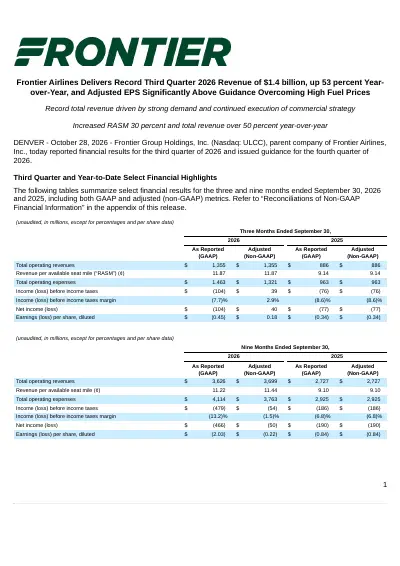
We are moving with urgency, but we are doing so with the discipline required to build a stronger and more durable airline. Third-quarter revenue of $1.4 billion was a company record, up 53% year-over-year, with RASM growth of 30% on an 18% increase in capacity.
Adjusted diluted earnings per share was 18 cents, above the high end of our guidance range, as our revenue performance more than absorbed the incremental fuel headwinds. Adjusted pre-tax margin improved nearly 12 percentage points year-over-year to 3%, despite absorbing a 56% increase in fuel price.
Our fleet rightsizing work is now substantially complete. During the quarter, we finalized agreements to early return 13 A320neo aircraft and replace that capacity with direct leases for 10 newer, larger, and more cost-efficient A321neo aircraft.
Our fleet rightsizing transactions ensure measured growth, considerably lower future maintenance obligations, lower financial leverage, and better gauge dynamics for the business. On cost discipline, we remained on track to deliver $200 million of annual run rate cost savings by 2027, including the benefits from a more productive fleet.
To this end, our adjusted unit costs, excluding fuel and sale-leaseback gains, are down approximately 2.5% year-over-year. Operationally, we are making meaningful progress to build a more reliable airline through improved maintenance planning, stronger station capabilities, and more consistent execution.
Following volatile weather in most of July and August, our completion factor in September and through October month-to-date ranked third among domestic carriers. While this demonstrates significant progress, we are focused on improving the level of consistency in the delivery of the operation.
The results we announced today also demonstrate the continued progress we are making with revenue management and customer loyalty, including the strong response to our premium offerings. First class seat installation begins this quarter, with Starlink Wi-Fi installation beginning in the first quarter, diversifying the revenue base and enhancing our value proposition.
Looking ahead, we expect the commercial momentum to continue. RASM for the fourth quarter is expected to be up over 20% on capacity growth of 5% to 6%, which would be our fourth consecutive quarter of double-digit unit revenue growth, helping us mitigate the elevated fuel costs expected during the fourth quarter.
Our performance reflects the successful progression of the company's strategic initiatives set out earlier this year, and it gives us confidence in our ability to translate our momentum into sustained profitability. With that, I'll turn the call over to Bobby.
Bobby Schroeter
Thanks, Jimmy. Third-quarter RASM increased 30% year-over-year to 11.87 cents on capacity growth of 18%.
Total revenue per passenger also rose 30% to approximately $138, while load factor declined modestly by 2 percentage points, highlighting our focus on proactively adjusting our strategy to maximize results in the current environment. Importantly, the strength in RASM extended across the week as we reintroduced off-peak capacity.
The positioning of our network has enabled us to take advantage of a more favorable supply-demand dynamic in our markets, and in conjunction with our continued revenue management discipline, is leading to an outsized revenue improvement. Importantly, we are delivering these results ahead of the first class and Starlink rollouts Jimmy mentioned.
Those investments will build on the progress we are already making, giving customers more choice and broadening our appeal to leisure and small business travelers. We see further opportunities to increase revenue per passenger and build loyalty, while maintaining the cost discipline that supports our low fares.
Contributing to our revenue performance is a 37% year-over-year improvement in loyalty-related revenue, supported by growth in our co-brand card and membership programs, along with higher engagement and spending. These programs give customers more reason to choose Frontier and return more often, and they provide recurring revenue streams that diversify our revenue mix and support more resilient earnings.
Jimmy Dempsey
Looking ahead, we expect our commercial momentum to continue into the fourth quarter, with RASM increasing more than 20% year-over-year on capacity growth of 5% to 6%. With that, I'll turn it over to Mark.
Mark Mitchell
Thanks, Bobby. Adjusted net income was $40 million during the third quarter, or 18 cents per diluted share, meaningfully above our previously issued guidance.
Fuel expense was $425 million at an average cost of $3.96 per gallon. The average cost per gallon reflects an increase of 56% versus the corresponding 2025 quarter, or approximately $150 million of incremental expense on current-quarter fuel consumption.
Adjusted operating expenses, excluding fuel, were $896 million, 7.4 cents stage-adjusted, 3% higher year-over-year. However, as Jimmy mentioned, excluding sale-leaseback gains, adjusted CASM ex-fuel declined approximately 2.5% on a stage-adjusted basis, driven by efficiencies from our fleet rightsizing and other cost savings initiatives.
We ended the quarter in a strong liquidity position, with $1.18 billion, up slightly from the end of the second quarter. Due in large part to our fleet rightsizing and other strategic initiatives, our leverage ratio declined meaningfully from 7 times adjusted EBITDAR at the end of 2025 to just over 4 times on a trailing 12-month basis at the end of September.
We ended the quarter with 164 Airbus aircraft following the delivery of 1 A320neo and 3 A321neo aircraft, 2 fewer than expected. We also returned all 13 A320neo aircraft under the most recent early return agreement, with 5 returns in the third quarter of 2026 and the remainder in October.
In the fourth quarter, we expect to take delivery of 2 A321neo aircraft from our order book, and 5 of the 10 A321neo aircraft under direct lease transactions with AerCap. The remaining 5 direct lease aircraft are expected in the first quarter of '27.
Separately, we expect to take delivery in the fourth quarter of 3 of the 11 aircraft being sold to Avolon, with the remaining 8 expected to be received and sold to Avolon in the first half of '27. The gains from the sale of the 11 aircraft to Avolon will be excluded from our non-GAAP results.
The fleet actions associated with the latest early return agreement resulted in non-recurring charges of $134 million in the third quarter, including lease return costs, accelerated depreciation related to capitalized maintenance due to shortened useful lives, and the write-off of non-recoverable capitalized prepaid maintenance balances. These non-recurring charges were excluded from our non-GAAP results.
Turning to guidance. We expect fourth-quarter adjusted diluted earnings per share to range from a loss of 15 cents to a profit of 5 cents, based on an expected average fuel cost of $4.75 per gallon, up $1.25 or over $100 million from our prior guidance, on capacity growth of 5 to 6 percentage points year-over-year.
RASM is expected to be up over 20% versus the prior-year quarter, which would be our fourth consecutive quarter of double-digit growth. Operator, we're ready to open the line for questions.
Operator
We will now begin the question-and-answer session. Please limit yourself to one question and one follow-up.
If you would like to ask a question, please press star one to raise your hand. To withdraw your question, press star one again.
We ask that you pick up your handset when asking a question to allow for optimum sound quality. If you are muted locally, please remember to unmute your device.
Please stand by while we compile the Q&A roster. Your first question comes from the line of Savi Syth with Raymond James.
Your line is open, please go ahead.
Savi Syth
Hey, good morning. Impressive revenue performance there and loyalty particularly.
I was curious, some time ago you talked about that loyalty opportunity on a kind of per-passenger basis, and I wondered if you could give an update on kind of where you are, credit card revenue or loyalty as a whole on a per-passenger basis, and again thoughts on where that can get to in kind of the next 12 to 18 months.
Jimmy Dempsey
I would actually build more towards three to five years. We're building a loyalty program, Savi, that we're creating a more stable, diversified revenue base for the airline.
We're certainly seeing the loyalty program perform exceptionally well. The year-over-year performance across all of our programs, the Barclays card credit card and then the membership programs is performing exceptionally well.
We're not going to give you exact targets over the next number of years, but we can certainly see on a per-passenger basis this going into double-digit territory in the next three to five years. I think the enhancement of premium products into the business will only improve the performance of the loyalty program.
Really what we're after as a business is creating reliability in our customers' eyes. Frontier has for many years struggled during peak periods with completion factor and A14.
One of the things that we set about at the beginning of this year was fixing the operation in the airline to create reliability into the airline. We're actually moving positively towards that.
During the summer, we had some noise around ATC and weather like every airline, and it showed the fragility of the operation where you had day after day of ATC and weather noise. That needs to be fixed in order to kind of create that reliability in the customers' eyes.
That then will drive real loyalty into the business going forward allied to premium products that we're bringing in. We're pretty excited about where we're going.
If you look at the last couple of months, the operation performed really well. You're seeing the revenue base of the airline perform exceptionally well, and loyalty is a big contributor to that year-over-year.
Savi Syth
Got it. If I might follow up on that, I think in a recent interview Jimmy, you had mentioned the complication of fixing the operation is just cuz you had to do it across the whole fleet and across bases.
Where are you in terms of is it kind of you go base by base, or is it just a little bit across all the bases, or what's the progress on getting that, and you still expected by the end of '27 to kind of get where you want to?
Jimmy Dempsey
We're getting into the weeds here, but I would say a couple of things, right? We planned on having a better, more capable maintenance footprint across the airline running into the summer.
The supply chain, it's not an excuse, but the supply chain got in the way of getting that competency into a lot of the airports that we have our base maintenance happening. We actually got that competency in place in late September, early October.
What we're seeing at the moment is really a step change. You're seeing our completion factor move into the top three across the industry.
Now, we've seen pretty benign weather over the last couple of months, but we're certainly seeing the completion factor in the airline perform really, really well. The next step is really to fix A14 and get the startup at the beginning of every day, the first wave, operating more efficiently and more effectively.
That's in progress. We're spending a lot of time modernizing the architecture of the airline in the background.
A lot of the stuff that you guys will never, ever see, but that'll take through the first half of next year. Look, my ambition is to have the airline operating platform in a really strong position going through next summer.
When I talk about competency in stations, I'm talking about parts and tooling and people in the stations and having them in place across the summer. That's all in a very strong position right now, and you're seeing the performance as a result of it.
Savi Syth
That's helpful. Thank you.
Operator
Your next question comes from the line of Atul Maheswari with UBS. Your line is open, please go ahead.
Atul Maheswari
Good morning. Thanks a lot for taking my question.
Jimmy, on the last call, you spoke about plans for high single to maybe 10% capacity growth for next year. Since then, fuel's obviously moved higher, I'm wondering if you have any updated thoughts on your capacity plans for next year.
Then related to that, where do you plan to deploy capacity growth next year? Is it primarily in previous Spirit markets, or have those opportunities already been tapped out?
Jimmy Dempsey
Look, I think we've got to go through planning for next year. We'll have a better sense of it when we come back in our next call in the new year.
I suspect it's somewhere in the 6%, 7%, 8% zone going into next year. It's obviously dependent on where fuel prices migrate to over the coming months and through next year.
We're very conscious of that. If you recall, earlier this year, we set about a plan of bringing productivity back into the airline across this year.
With the onset of the Iranian conflict and oil prices rising, we took some capacity out in order to manage through the summer period. We'll continue that dynamic of bringing productivity back into the airline where we see it makes sense, and also deploying the capacity growth to the airline.
I think, look, mid to high single digits makes sense. I don't know if we'll make it all the way to 10%.
I see it at about 5% to 7% capacity growth next year. On your second question of where, obviously we're going to mature our network that exists today and add to it.
With 5% to 7% capacity growth, you're not going to see meaningful change overall in the network deployment in the airline. We positioned the airline very effectively earlier this year to take advantage of continued reductions in capacity by Spirit Airlines.
That has proven to be very successful as we progressed through this year, and we'll continue to look at opportunities that exist as we roll into next year.
Atul Maheswari
Got it. That's very helpful.
Then, this my follow-up, just sticking to the Spirit topic. Are you able to quantify the RASM lift in the third quarter from lack of Spirit, and what's your expectation for the fourth quarter?
Then, really, what are you seeing in those ex-Spirit markets that you've entered from a competitive standpoint currently?
Jimmy Dempsey
We see supply-demand dynamic really positive across the business at the moment, both in ex-Spirit markets and just across the entire environment. About 30% of our business overlapped with Spirit earlier this year.
It's helpful to the business. I think the airline is moving beyond that structural change.
If you look at the performance from a RASM trajectory, we have done a lot in our revenue management systems to improve the delivery of better unit revenues into the business. That started this time last year, and we've seen real progress on that.
If you looked at the airline, I talked about this in the last call, if you looked at the airline running into the Iranian crisis, we were up high single, high teens in terms of RASM year-over-year in Q1. You've seen that obviously advance with the fare environment that's developed with higher fuel, and also the structural change that happened with Spirit.
We feel pretty good about where the airline sits today and moving forward. This is all prior, like Bobby mentioned this in his transcript, this is all prior to advancement in premium products that the airline is pushing towards.
We're eminently going to get first class seats in place across the airline. We delayed that process.
We've had those first class seats. We delayed that process in order to get the rightsizing in the fleet done this year, and so that process is happening as we speak.
Then, in addition, we add Starlink pretty soon, and I'm really excited about adding Starlink to the business. If you look at other airlines, they have connectivity, and they're moving to Starlink, or Amazon Leo, and that is a game changer in terms of connectivity.
If you look at our business, we have no connectivity today, and we're moving to the best product out there for connectivity on an aircraft in Starlink. We feel really excited that our existing customer base is going to embrace that product really, really successfully.
Then widen the aperture in terms of the addressable market for Frontier, providing really good value to customers across the US, and adding these premium products into the airline. We feel pretty good about the future in terms of unit revenues.
Atul Maheswari
Thank you.
Operator
Your next question comes from the line of Brandon Oglenski with Barclays Capital, Inc. Your line is open, please go ahead.
):
Brandon Oglenski
Hey, good morning, and thanks for taking the question. Jimmy, can you just help us out on the fleet now?
Because I think with all the transactions, you should be roughly flat from a shell count into next year. Is that correct?
Then maybe talk about expectations as we look out into '28 and '29.
Jimmy Dempsey
I'll let Mark bring you through in a second, Brandon. Look, the objective here in the airline was to have approximately the same fleet entering into 2026 that ends 2028, right?
What we're doing with capacity growth is really infilling productivity into the airline, and actually very successfully infilling productivity into the airline. If you're looking at the capacity growth this year, you're seeing us infill that capacity across the week.
You're not perfectly flat across the week, but you're certainly flattening the week in terms of activity during the week. That's the objective.
You build a productivity into the airline. We're a little bit behind on that because of the Iranian crisis in terms of driving productivity back into the airline.
We've made a big leap forward. We need to make a few leaps forward from here, and that's what drives your 7% or 6% growth next year, probably something similar in 2028, in that kind of 5%, 6%, 7%, 8% zone without actually adding that many aircraft to the fleet.
This is all basically utilization of the existing asset base, and so that's one of the reasons why we're getting such good productivity and unit cost improvement. If you exclude fuel, and exclude all the sale-leasebacks that happened last year and this year, we're actually seeing real productivity build back into the business from the benefit of having both higher-gauge aircraft and also more utilization.
Mark Mitchell
Just, yeah, to confirm, on top of what Jimmy just said, so, yeah, Brandon, the fleet, where we sit at the end of September, 164, based upon what's on the books, end of '27, similar number, just as you mentioned. Then, I think, just to give a little bit more color on the mix, we ended '25 with 46% of the fleet being 321s, the end of the third quarter 55%, and we'll end the year at about 60%.
Meaningful gauge improvement in the business, and then '28 is when we start taking deliveries again from our order book. ):
Brandon Oglenski
Appreciate that. Then, Mark, can you speak to liquidity, especially as you look out into '27?
I think you cash balance didn't change all that much into the third quarter. How do we think about ongoing CapEx, pre-delivery payments potentially, or lack thereof, as well as potential maintenance expense as well?
Thank you.
Mark Mitchell
I think as you look at liquidity, our liquidity is up slightly from the second quarter, we sit in a strong position with nearly $1.2 billion of total liquidity. We are not guiding '27, but based upon the trajectory we're on, and we think we're on a good trajectory, we're certainly focused on growing that liquidity balance.
When you think about the maintenance obligations, so as we continue to step forward, I think you'll see some measured growth in that CapEx, but I think it's important to understand that with the fleet transactions that we did, with all the fleet rightsizing, the 37 aircraft that have been returned this year, on a net basis over the next five years, that is somewhere in the neighborhood of $400 million of maintenance savings.
Operator
Your next question comes from the line of John Godyn with Citigroup. Your line is open, please go ahead.
John Godyn
Hey, guys. Thanks for taking my question.
It's not lost on people that the capacity trend is more conservative, the language around that is more conservative, and I think that resonates. I wanted to just maybe dialogue about that a little bit big picture.
Under new management, if you will, has the bigger-picture philosophy changed, and is there a margin target? Is there a return on invested capital target, or is it just generic conservatism?
I'm just trying to understand kind of what is driving the change, and how sticky and durable it could be, and how deep it's kind of gone through the organization. Thank you.
Jimmy Dempsey
Hi, John. Look, we clearly have learned from the last three or four years of growth in the airline.
The airline was growing at 20%, 25% per annum, adding significant aircraft into the fleet. That growth was diluting or creating volatility in your revenue base in the airline.
The concept behind slower growth is really to create stability in the revenue base of the airline, and also the operating platform of the airline that supports the revenue base of the airline, right? We set about this plan at the beginning of the year to rightsize the fleet, which was very, very important.
We had, in our calculation, somewhere around 40 to 45 aircraft that were unproductive in the airline, if you were to bring productivity back in. You had a choice to make: you either hired a lot of pilots and flight attendants, and went out and grabbed a lot of customers, and brought productivity into the airline, or you rightsized the fleet.
We chose the path of rightsizing the fleet because of an opportunity that existed in the engine world in the industry. I think that has been a very, very positive decision in the business, both internally and externally.
That does create a better platform for growing the business. We're not running away from growing the business; we're just growing at a much more moderate pace, which we think creates that stability in revenue that the airline needs as you move the airline to a bigger platform.
There's also benefits that the airline gets. In growing at that pace for, I don't know, 10 years or so, there's a catch-up that needs to happen in the background that we're going through at the moment.
Having shell count stay relatively similar over a two-year period allows us to modernize the foundation of the airline. As I mentioned earlier, all the systems that you don't see in the background in order to operate the airline in a more effective way.
You're seeing real progress in that area, and that's one of the areas that I'm really proud of the progress we've made so far this year where you can see the stability coming into the operation of the airline, which also then reflects well on the revenue performance in the business. Those two things are very, very important.
It's not necessarily a conservative approach to capacity. It's really focused on creating that stable revenue base, creating a stickiness to our customer base and a stickiness to our network that enables us to actually create loyalty in the business.
That's really what we're after. Obviously, the airline wants to generate profitability, it wants to generate free cash flow, it wants to get back to high performance in those measures.
We'll talk to you in February about what we feel about 2027. We feel really good about the direction the airline is going in right now.
John Godyn
Can I ask a follow-up just in terms of where the growth is going? This year benefited from Spirit and the distress associated with Spirit, and you guys did a fantastic job kind of orienting yourself to benefit from that.
I guess it's debatable if there's another financial distress event next year, but let's just assume there isn't. How are you thinking about the growth?
Are there new markets still to open? Is it layering in behind existing markets?
Maybe you could just help us think about the complexion of the growth.
Bobby Schroeter
Hey, this is Bobby. We look at the network as a portfolio.
We're going to look at what's the most accretive in terms of from a profitability perspective on routes. We've gone in, and in terms of just the Spirit opportunity, we've backfilled about a quarter of that.
It's a little around half when you talk about what other airlines have gone in and done. The opportunity still exists there for us to look at the routes and markets within that, and they've been very effective for us, frankly, both on the peak days and especially on the off-peak days as well within those markets.
As we go through, you've also seen we've actually increased our overall frequency within markets, we'll look at that continuing. How we provide not only more connectivity and capability for our flyers and our customers to fly throughout the week, but also helps what Jimmy was talking about on the operational side as we think about resiliency within the market.
Again, our network, we're continuously looking at it. It's a portfolio.
It's looking at how we optimize the overall profitability picture within that, and there's a lot of opportunity that still exists out there over the course of the next few years.
Jimmy Dempsey
Look, just to add to that, we'll be opportunistic if things crop up that we think is accretive to Frontier. We don't know what they are yet, right?
That's something that's certainly there, and adapting our capacity framework to chase something. What we've been doing this year, and we really started this in 2025, is actually picking the markets that we like where we've seen structural change happen.
That continues. I feel pretty good about the direction of the network and how it's actually building, and building some prominence in markets, and getting an element of loyalty and repeat customers into the business.
I can't stress enough the operational side of the business and improving that in order to support that network development.
John Godyn
Appreciate the color. Thanks, guys.
Operator
Your next question comes from the line of Duane Pfennigwerth with Evercore. Your line is open, please go ahead.
Duane Pfennigwerth
Hey, thanks. Good morning.
Maybe just to continue down that path, if it's possible, can you delineate between improvement in the overall fare environment in response to higher jet fuel, basically Frontier following the fare umbrella higher from a lower baseline, versus Frontier-specific initiatives? Jimmy, you've touched on some of those, but is there any way to delineate between the two?
Jimmy Dempsey
It is hard, right? That is a challenging question.
What I mentioned earlier was, look, we were up pre fuel crisis or Iranian conflict, up nearly 20% in RASM in Q1. There's both structural change in that, and also better performance by Frontier in managing its revenue.
I would shape it as, and the structural change we're getting was linked to Spirit. If you look at it, I would say it's about a third better revenue management, maybe about a third Spirit, and about a third fuel, and obviously the fare environment improving as a result of fuel.
That's kind of where we sit at the moment, and we'll see how it progresses. We feel really good that there's a lot of stickiness in this revenue image.
I mentioned it earlier, we're seeing this unit revenue improvement in advance of adding real premium products to the airline. We're really excited about where the unit revenues go next year and the year after as we establish these premium products in the airline.
Duane Pfennigwerth
Thank you. Then, relatedly, maybe you can speak to the variation of performance across your markets, maybe what you're seeing today versus what you saw historically.
Are there any themes in the profile of markets that are outperforming versus markets that are lagging? Is there any relationship to how big your footprint is?
When I think about in Orlando, and your footprint in Orlando, how does that look relative to the system? Thank you.
Jimmy Dempsey
There's always pluses and minuses that happen across the system. What we're seeing is just broad-based improvement in the business and how we run the business.
I'm not going to pick specific markets that are outperforming versus other markets. You can read into some of the language that we're using around structural change, we've certainly seen an improvement in markets where there was a significant overlap with Spirit, and we positioned the airline for that.
Outside of that, we're really seeing broad-based improvement in overall revenues.
Duane Pfennigwerth
Thank you.
Operator
Your next question comes from the line of Ravi Shanker with Morgan Stanley. Your line is open, please go ahead.
Hi, this is Madison on for Ravi. Thanks for taking the question.
First just wondering any thoughts on what larger carriers focusing on yield over load factor means for you guys in terms of spillover traffic, and if you're seeing any opportunities there moving into the next year.
Jimmy Dempsey
Hi, Madison. Look, what we're certainly doing in the airline at the moment is adapting to the environment that exists in front of us, right?
We don't control other airlines and their behaviorisms around pricing. We certainly look at our pricing and pricing tools with the objective of maximizing the revenue output that we get, and certainly if other airlines are chasing yield over volume, that's their prerequisite.
We like volume. We typically chase volume as a business, and there have been periods in the past where we've managed the airline for yield over volume, and then there's periods where we managed the airline for volume over yield.
It really depends on the environment that's there and the ability to maximize the overall revenue base of the airline. At the moment, we have a nice balance between yield and volume in our business given the supply-demand dynamic that exists in the environment.
We feel pretty good about it, and we feel pretty good about the stickiness of that going forward.
Got it. Thank you for that color.
Just wondering how you guys are viewing the jet fuel recovery participation across the industry, and do you think you can get to 100% recovery, and if so, when are you guys targeting that for?
Jimmy Dempsey
If you look at the last quarter, we effectively got there in the last quarter. Obviously, oil prices are significantly higher than they were in the last quarter, right now, we'll see how we perform across this quarter, but I think Frontier has performed phenomenally well in offsetting high oil prices with the revenue performance in the airline.
Got it. Thanks so much for the color.
Operator
Your next question comes from the line of Andrew Didora with Bank of America. Your line is open, please go ahead.
Andrew Didora
Hey, good morning, everyone. I guess, Jimmy or Bobby, just you've guided to over 20% RASM on the last couple of calls and have ultimately produced 28% and 30% RASM growth.
You're guiding to that again. I guess should we just view that as just a fairly broad kind of revenue outlook, cuz you do sound very constructive on the environment?
Or is there anything that you're seeing in your business today that suggests the underlying momentum has slowed a little bit, or any specific headwinds that would cause a RASM decel, particularly on much lower capacity growth?
Jimmy Dempsey
No, look, we've seen progress on RASM pretty successfully across the last whatever, 9, 10 months. Now, we do have some of the changes that we started a year ago in revenue management starting to really lap as you progress through the end of December, but what I see in the revenue environment at the moment is really constructive.
We anticipate the industry certainly has a strong appetite to pass on higher fuel with higher fares. We are participating in that clearly, and seeing how the business can perform within that environment, and we continue to see that.
We're quite comfortable about the outlook on RASM. For us to deliver double-digit RASM improvements pretty much in every quarter this year is testament to the improvements we've had in revenue management and some of the structural changes that have happened across the industry, and we don't see that changing.
Andrew Didora
Got it. Understood.
Then I guess as we're exiting 2026 here, obviously your sale-leaseback gains will be behind you. Seems like the fleet will be in the spot where you want it to be.
Any kind of underlying CASM framework you could provide into next year, particularly as you're basically utilization-driven? Maybe in that framework, speak to it in kind of that mid-single-digit capacity framework that you outlined earlier.
Thanks.
Jimmy Dempsey
It's hard to guide you at the moment. We'll come back in the new year with a guide for next year.
Just broadly, I would say, the productivity that's building in the airline largely offsets the sale-leaseback gains year-over-year. You're seeing some productivity come into the airline.
We got a 2.5% improvement in unit costs when you take out sale-leaseback gains. That gives you an insight into the direction that the airline is going heading into next year.
There's obviously inflation that exists across the United States that we've got to be conscious of and understand in the coming months. My objective is to try and get the airline in a place where you effectively, not perfectly, but effectively replace the sale-leaseback gains with better unit costs overall.
Mark, if you want to give some...
Mark Mitchell
No, I think you hit the nail on the head.
Andrew Didora
Thank you, Jimmy.
Jimmy Dempsey
Thanks, Andrew.
Operator
Your next question comes from the line of Michael Linenberg with Deutsche Bank. Your line is open, please go ahead.
Michael Linenberg
Oh, yeah. Hey, good morning, everyone.
Nice earnings beat this quarter, team. I guess my first out to Bobby.
Just on the premium product, when does first class start, I guess you said it starts rolling out, when do you start selling it? If you're already selling it, what are you seeing sort of fares up front as a multiple of maybe fares in the back?
As a related piece, the Starlink, which rolls out next year, most airlines, what we hear, have to offer it for free, it's part of the contract. I think a few out there have been able to negotiate the ability to sell the Starlink product in addition to offer it free to their customers who may have the credit card, or be part of a certain loyalty tier.
What sort of structure there do you have? Are you able to sell it?
Then I have a second one.
Bobby Schroeter
I'll hit on the first class question first. I think Jimmy talked about this a bit earlier around upfront plus and what gives us the confidence around this product and what we think it'll provide to our customers and to us in terms of revenue benefit.
That's upfront plus. We have been hitting about 80% paid load factor on that.
First class has been delayed a bit for a variety of reasons, but it's going to be starting to install imminently. What we'll do is, we'll start selling for the time period with which we believe all of that will be installed.
That's going to be sometime in the first quarter, towards the end of the first quarter, we'll actually have it for sale. It has not gone on sale yet, but it will go on sale, we believe again, imminently, as we start rolling the product out itself.
On Starlink, we obviously announced that. From a commercial perspective, we're not ready to roll out and talk about what that means from a commercial perspective, or how we're going to roll that out that way.
What we will say is, again, I'll reiterate what Jimmy said, this is something that's a game changer for us and our customers. We are putting on a product that we don't have today with Wi-Fi itself, and we're going from nothing to a product that's best in class, and is the best Wi-Fi in the sky.
If you haven't tried it, go out there and try it. It is as good as your home Wi-Fi service, yet you're in the sky.
We're quite excited to be able to roll that out in conjunction with first class. Starlink is going to start installing in the first quarter, and we'll roll that out, aircraft by aircraft, throughout 2027.
Michael Linenberg
Great. Thanks, Bobby.
No, I agree. Starlink is pretty awesome.
Just my second question to Mark. Mark, this is more of a modeling question.
The third quarter is your last quarter, I believe, of sale-leaseback gains, and then I do think we have three quarters of aircraft gains from the sale, right? I thought I heard you say that you are going to exclude them from your non-GAAP results, and so I was curious why you would exclude them.
Maybe you're not taking gains on them? Can you just explain maybe the discrepancy there?
Thanks for taking my question.
Mark Mitchell
There's a couple quick items. We do have two order book deliveries in the fourth quarter.
Those were supposed to be in the third, they got moved to the fourth. That number one.
Then specific to the tails that we're selling, that was part of our fleet rightsizing and consistent with the rest of that fleet rightsizing dynamic, we are adjusting those for non-GAAP purposes. We are expecting gains on those sales, but just as part of the entire fleet rightsizing, that's why we're excluding those for non-GAAP purposes.
Michael Linenberg
Okay. Thank you.
Operator
Your next question comes from the line of Jamie Baker with JP Morgan Securities LLC. Your line is open, please go ahead.
Jamie Baker
Hey, good morning, everybody. When demand started to recover after COVID and the financial pressures on the industry began to abate, one unintended consequence that we called out was the likelihood that unions would want to reengage and come back to the negotiating table, and labor costs would rise, and that's what happened.
I'm wondering if that's how you're thinking about things for Frontier. The revenue momentum is impressive.
We're assuming fuel declines at some point next year. Would it be prudent for analysts to pull forward the timing of a potential pilot contract?
Bobby Schroeter
Hi, Jamie. Quite frankly, I don't have a good answer to that question.
Jimmy Dempsey
We are continuing a process with the NMB in relation to mediating a pilot contract. Frontier ALPA has been changing some leadership, and so they're going through that process at the moment.
We just don't have clarity at the moment as to when we will get into really active negotiations with them. I would suspect it happens in the new year, and we can give you more insight into that as next year progresses, but I truly don't have a good answer as to when we will actually have a contract.
It's something that we want as a company to progress, and get through in the next 12 months, but I'm dependent on the NMB process and how fast or slow that goes.
Jamie Baker
No, that's still very helpful. I appreciate it.
Then, obviously, no liquidity issues at the moment, but kind of building on Brandon's question from earlier in the call, can you speak to what conventional capital-raising options you have? I emphasize conventional cuz, I'm not asking about equity or forward mileage sales or anything like that.
Just traditional, incremental debt capacity, unencumbered asset pools, that sort of thing. Thanks.
Mark Mitchell
Yep. No, thank you, Jamie.
The primary unencumbered asset that we have is the loyalty pool of assets that we've got. As we've talked about, those assets are continuing to gain in strength, with the loyalty revenue up 37% this quarter.
That portfolio does provide us opportunity as we look forward in the capital markets.
Jamie Baker
All right. Great.
Thanks, everybody.
Jimmy Dempsey
Thank you.
Operator
Your next question comes from the line of Chris Stathoulopoulos with SIG. Your line is open, please go ahead.
Chris Stathoulopoulos
Morning, everyone. Going back to your earlier questions around capacity for next year, I realize the 6% to 7%—6%, 7%, or 8% is a soft guide, fuel-dependent here, but if you could help frame the stage and gauge component of that.
Then also as we think about the deployment, what I heard was not much change, but maybe if you could contextualize the opportunity set or the inning that you believe that you're in in markets like MCO, Atlanta, and then on the West Coast, more load, yield, or loyalty opportunity there, just want to understand how you're thinking about those key markets under that kind of mid-single-digit capacity growth. Thanks.
Jimmy Dempsey
Maybe I'll answer the second part first, and look, obviously, your network evolves. Look, we're primarily a leisure airline, and so if you look at all the big leisure locations around the United States, we're pretty large in a lot of these locations.
We'll continue to add to that footprint as we go. If you look at Orlando or Las Vegas, and connecting those types of locations with the rest of the United States is kind of a fundamental part of our business.
We're clearly looking at some of the stuff that Spirit exited this year, and replacing some of that capacity. Not all of it, we are certainly replacing the stuff that we think is accretive to Frontier, and that's something that we'll continue to do.
We're looking at our network in relation to how it behaves and linked to the loyalty program. Bringing back flying on Tuesdays and Wednesdays has actually been quite accretive to the loyalty program, and improving the customer retention that we have in the business.
I think that's quite important, and that's been largely a fundamental portion of the growth that we've put in place, particularly in the last quarter. Like September '25 on off-peak days of the week, we were flying a couple hundred flights a day, when we were flying 700 flights a day on the peak days of the week.
Bringing that up to 500, 550 flights a day, infills into a network that already exists, and it helps the customer base that we have in the airline have more choices throughout the week. We've seen a really positive response to our existing customer base to those changes.
We'll continue to do that across the network as we build out next year. Obviously we can be quite selective because the level of growth is quite low.
It's 6%, 7% in comparison to years when we've done 20%, 25% new capacity growth, plus a redeployment of capacity that didn't work. You're dealing with immature markets in the 30% to 35% zone, and creating that instability in revenue.
I'm not going to guide you on exactly where we're going to deploy our network next year, but you can see the direction that the airline is going in. It's primarily leisure, maybe attaching to some small business opportunities that exist, and then focusing on markets that drive some loyalty into the business.
Chris Stathoulopoulos
Okay. Then, I guess, as a segue, you mentioned on the day-of-the-week shift and the uplift from loyalty, I don't think you mentioned what the delta looks like on peak versus off-peak RASM.
I know you spoke about utilization, but if you could give any color around what that looks like on unit revenues.
Jimmy Dempsey
Actually pretty consistent across the week, the improvement year-over-year.
Chris Stathoulopoulos
Okay. Thank you.
Jimmy Dempsey
You're seeing improvement both on peak and off-peak days.
Chris Stathoulopoulos
Thank you.
Jimmy Dempsey
Okay.
Operator
Your last question comes from the line of Daniel McKenzie with Seaport Group. Seaport Global.
Your line is open, please go ahead.
Daniel McKenzie
Oh. Thanks for squeezing me in here.
Couple questions here. First is, going back to '27 growth, if you can help us understand the character of the growth, and what I'm getting at is you're adding a bunch of premium seats, and so is that 6% to 8% primarily all premium seats, or is it 6% to 8% so mainline cabin inventory flat?
If you can just help us, or at least give us some perspective on what the nature kind of that premium versus mainline mix looks like, or even how it looks today, and how that should trend into next year.
Bobby Schroeter
What we talked about on premium is first class, and so when we talk about that, you have currently in those slots, you have UpFront Plus, and that blocks the middle seat. From a revenue base perspective, that actually doesn't take away a seat in that regard.
We are looking at how we could flex on UpFront Plus with the cabin we have, we're looking at that, that does play into it. Otherwise from a growth perspective, that's what we've announced, and we're looking toward is the first class introduction.
Daniel McKenzie
Understood. Okay.
Then, I guess just the second question here is just reconciling the schedule data with the guide that you're giving for the fourth quarter. It looks like schedule data is a little higher than what you're guiding to, I'm just wondering if you can reconcile that.
Then, I guess just the second sort of housekeeping question is just the reference to modernize the systems of the airline. I'm just wondering if you can help us understand where you've invested and what that IT journey looks like over the coming year.
Is there some incremental benefit that will either drive cost or revenue savings as you roll out upgrades or new systems over the coming year?
Jimmy Dempsey
Let me deal with the capacity. We're probably a little bit behind in terms of inducting aircraft in this quarter, and so there's some capacity to come out that we have on sale at the moment that will come out in the coming days, and then we'll progress through the next few weeks or so and see what the timing on inducting those aircraft are.
There's a little bit of noise in our scheduled on sale versus what we're actually going to achieve. You'll see that update over the coming days and weeks.
On modernizing the architecture of the airline, we are modernizing the operations center quite considerably, and really the maintenance planning side of the business, and then secondarily to that, modernizing or improving the customer interfaces that we have in the airline that will create much faster solutions to passengers when they're disrupted. There's a significant amount of work going on across all of those teams in both running to the day-to-day operation, and also changing how we operate the airline.
I'm pretty excited about it. It'll probably take mostly through 2027 to get this into a place where we're very comfortable with it.
The initial stages of it are quite interesting. We're obviously building better databases and platforms, and then layering tools on top of that to get better decision-making into the airline, and that's some AI improvements that are happening within the business, but also just pure blocking and tackling, planning improvements that we're making in the airline, that are making a significant difference to the output that the airline has every day.
Daniel McKenzie
The cost savings associated with that? Can you provide some perspective around that?
Jimmy Dempsey
Clearly, a better operation delivers lower costs, right, and actually better revenue output. I don't have that quantified for you at the moment, but if we can bring our completion factor up by a half a point, that's a significant revenue boost to the airline.
Obviously there's a cost of displacement that happens with customers that we would avoid. There's real, meaningful improvements that will come into the airline as a result of that.
It's very difficult to quantify it right now because the timing of getting these right is dependent also on things that are outside of our control, right? What I'm trying to get the airline to is recovering from weather and ATC issues in a quicker way in order to have more stability in the operation as you recover.
That's something that we're very focused on. That will improve the overall performance and the overall completion factor of the airline, which obviously delivers lower costs, but enhanced revenues.
Daniel McKenzie
Cool. Thanks for the time, you guys.
Jimmy Dempsey
All right. Thanks, Dan.
Operator
We've reached the end of the Q&A session. This concludes today's call.
Thank you for attending. You may now disconnect.