Upland Software, Inc.
NNASDAQ:UPLDQ4 FY2025 · Earnings Call TranscriptMarch 3, 2026
Operator
Thank you for standing by, and welcome to the Upland Software fourth quarter 2025 earnings call. At this time, all participants are in listen-only mode.
Later, we will conduct a question-and-answer session, and instructions for that will be given at that time. The conference call will be recorded and simultaneously webcast at investor.uplandsoftware.com, and a replay will be available there for 12 months.
By now, everyone should have access to the fourth quarter 2025 earnings release, which was distributed today at 8:05 AM Central Time. If you've not received the release, it's available on Upland's website.
I'd now like to turn the call over to Jack McDonald, Chairman and CEO of Upland Software. Please go ahead, sir.
Jack McDonald
All right, thank you, and welcome to our Q4 2025 earnings call. I'm joined today by Mike Hill, our CFO.
On today's call, I will start with a Q4 review, and following that, Mike will provide some detail on the Q4 numbers and our guidance. We'll then open the call up for Q&A, but before we get started, Mike will read the Safe Harbor statement.
Mike?
Mike Hill
Thank you, Jack. During today's call, we will include statements that are considered forward-looking within the meanings of the securities laws.
A detailed discussion of the risks and uncertainties associated with such statements is contained in our periodic reports filed with the SEC. The forward-looking statements made today are based on our views and assumptions and on information currently available to Upland management.
We do not intend or undertake any duty to release publicly any updates or revisions to any forward-looking statements. On this call, Upland will refer to non-GAAP financial measures that, when used in combination with GAAP results, provide Upland management with additional analytical tools to understand its operations.
Upland has provided reconciliations of non-GAAP measures to the most comparable GAAP measures in our press release announcing our financial results, which are available on the Investor Relations section of our website. Please note that we are unable to reconcile any forward-looking non-GAAP financial measures to their directly comparable GAAP financial measures because the information which is needed to complete a reconciliation is unavailable at this time without unreasonable effort.
With that, I'll turn the call back over to Jack.
Jack McDonald
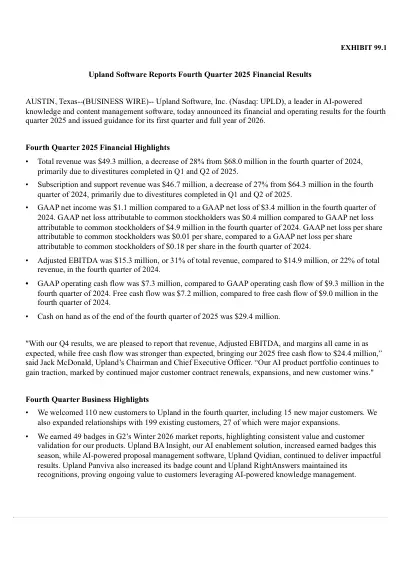
All right, thanks, Mike. The headlines in Q4: revenue, adjusted EBITDA, and margins came in roughly as expected.
Our Q4 core organic growth rate was flat due to a tough compare to Q4 2024, which contained some lumpy additional usage volume revenue. As we said on previous calls, our core organic growth rate will bounce around a bit from quarter to quarter.
The general trend has been improving. Growth rates were -2% three years ago, -1% two years ago, roughly 1% positive last year, and we're targeting 1% to 2% this year.
A generally improving trend. Annual net dollar retention rate was 96% in 2025, consistent with the prior year.
Q4 2025 adjusted EBITDA of $15.3 million resulted in an adjusted EBITDA margin of 31%. Free cash flow for Q4 was $7.2 million, stronger than expected due to successful collection efforts, which brought our full year 2025 free cash flow to $24.4 million, exceeding our $20 million target.
We welcomed 110 new customers to Upland in Q4, including 15 new major customers. We also expanded relationships with 199 existing customers, 27 of which were major expansions.
These new and expanded relationships continue to be spread across our AI-powered product portfolio. On the product front in Q4, I'd note that we continue to perform well based on insights from customers, as evidenced by earning 49 badges in G2's Winter 2026 market reports, highlighting consistent value and customer validation for our products.
Upland was recognized as a major player in the IDC MarketScape worldwide general purpose knowledge discovery software 2025 vendor assessment, which was published in November of 2025. Upland believes its recognition in this report highlights the value of our AI-powered knowledge management solution, Upland RightAnswers, which is driving scalable, smarter support for enterprise contact centers and help desks.
Upland was recognized in the Gartner Market Guide for RFP response management applications, which was published in October of 2025, and we believe our inclusion in that report showcases the impact of our AI-powered RFP response and proactive sales proposal creation software, Upland Qvidian. Our Q4 results support and illustrate improvements that we've made in the business.
Adjusted EBITDA margins expanded from 2024 and the first half of 2025, again, up to north of 30% in the fourth quarter. We continue to see healthy cash flow.
We are targeting, continued strong cash flow in the $20 million range for the year. In other important news, last week we announced the the fact that Sean Nathaniel is going to be joining Upland as our new CEO.
I will be transitioning to Chairman as a part of that. Just super happy to announce this news.
Sean has deep familiarity with our business and our operating model and our customers and our products, having been with Upland from 2013 to 2020, and previously serving as our CTO, but also serving in senior general management roles across a significant chunk of our product portfolio. Significantly, Sean brings highly relevant experience, particularly around AI initiatives that are focused on enterprise knowledge and content and data.
Welcome folks to take a look at some of the materials that Sean has published over the last few years on AI and the importance of solid knowledge and content and data foundations as a prerequisite for successful enterprise AI implementations. Sean's vision really centers on reinforcing Upland's role in enabling organizations to convert that knowledge and content and data into trusted operational intelligence to support AI and agent-driven operating models, which is obviously where the market is going.
Upland already has meaningful capabilities aligned with this vision, and Sean's priority moving forward is going to be to sharpen that execution and translate those capabilities into measurable customer and shareholder value. Sean will be joining us, will be on I think our next call, and then will be running the calls going forward.
You'll have an opportunity to hear directly from Sean his vision for the business going forward. Just super happy to welcome Sean back to Upland and to support him in executing his vision.
Looking forward to that. With that, I am going to turn the call back over to Mike.
Mike Hill
All right, thanks, Jack. I think Jack covered most of the main points in the financials for the quarter, but I'll just take a few make a few additional comments here.
For the Q4 income statement, revenues were as expected when taking into consideration our divestitures in Q1 and Q2 of 2025. Q4 gross margin continued to represent an increase from earlier in 2025, as expected, as a result of the higher margins realized on our ongoing product lines.
Our adjusted EBITDA and adjusted EBITDA margin came in as expected, with our adjusted EBITDA margin of 31%, up from 22% in the quarter, fourth quarter of 2024. Big improvement there.
For the fourth quarter 2025, GAAP operating cash flow was $7.3 million, and free cash flow was $7.2 million, making our free cash flow for the full year 2025 of $24.4 million. That exceeded our target free cash flow of $20 million.
On the balance sheet at the end of Q4, we had outstanding net debt of approximately $209 million, factoring in the approximate $29 million of cash on our balance sheet. At year-end, our net debt leverage was 3.6 times trailing adjusted EBITDA, which was which came in better than our target.
For guidance, for the quarter ending March 31st, 2026, we expect reported total revenue to be between $47 and $50 million, including subscription and support revenue between $44.8 and $47.3 million, for a decline in total revenue of 24% at the midpoint from the quarter ended March 31st, 2025. Just a reminder, this year-over-year decline is primarily due to the divestitures completed in Q1 and Q2 of 2025.
First quarter 2026 adjusted EBITDA is expected to be between $11.9 and $13.4 million, which at the midpoint is a decline of 3% from the quarter ended March 31st, 2025. First quarter 2026 adjusted EBITDA margin is expected to be 26% at the midpoint, which is a 500 basis point increase from the 21% adjusted EBITDA margin in the year-ago quarter.
For the full year ending December 31st, 2026, we expect reported total revenue to be between $194.2 and $206.2 million, including subscription and support revenue between $183.6 and $193.7 million, for a decline in total revenue of 8% at the midpoint from the year ended December 31st, 2025. This year-over-year decline, as I mentioned earlier, is primarily due to divestitures that we completed in Q1 and Q2 of 2025.
Full year 2026 adjusted EBITDA is expected to be between $52.6 and $58.6 million, which at the midpoint is a decline of 4% from the year ended December 31st, 2025. Full year 2026 adjusted EBITDA margin is expected to be 28% at the midpoint, which is a 100 basis point increase from the 27% adjusted EBITDA margin that we had for 2025.
To recap, we continue our product portfolio is now much more focused on around the KCM market, knowledge and content management market. As Jack mentioned, our core organic growth rate is in a positive multi-year uptrend, from -2% three years ago to -1% two years ago to roughly positive 1% last year in 2025, and we're targeting 1% to 2% positive here for 2026.
The big new customer wins during 2025 have validated our product-market fit in several key markets, and those major wins have validated our product AI strategies. Our adjusted EBITDA margin is significant is in a significant multi-year expansion trend, with adjusted EBITDA margins expanding from 20% in 2024 to 27% last year in '25 to our guidance midpoint of 28% here this year in 2026.
Cash flows, as we've mentioned, remained strong as we generated over $24 million of free cash flow in 2025, and we're targeting around $20 million of free cash flow here this year in 2026. I will note that we beat our 2025 free cash flow target by over $4 million, really due to early receivables collections, which would have otherwise occurred in 2026.
Without those early collections, our 2026 free cash flow target would have actually been higher. All right, and with that, I'll turn the call back to Jack.
Jack McDonald
All right, thanks, Mike. We're ready to open the call up for Q&A.
Operator
Fine. I would like to remind everyone, in order to ask a question, press star, then the number one on your telephone keypad.
We will pause for just a moment to compile the Q&A roster. Your first question comes from the line of DJ Hynes with Canaccord Genuity.
Please go ahead.
DJ Hynes
Hey, thank you, guys. Jack, congrats to you on the transition.
I know you're still going to remain involved in the business, but appreciate all the help over the years. Maybe we can just start on the customer metrics a bit.
Look, new customer adds flat year-over-year, majors were down, expansions down year-over-year. It's just hard to put context around those metrics given the business is different than it was a year ago with the divestitures.
Just how would you characterize sales execution in the quarter? Do you have comparable metrics for continuing ops?
I guess most importantly, what's the pipeline look like going into '26? Any color there would be helpful.
Jack McDonald
We had a stronger Q3 in terms of winning sizable, major deals. I would say that when we look at the pipe, a little bit disappointed in the Q4 bookings performance, but the pipeline for this year looks decent, particularly around some of the core knowledge management growth products where we are starting to build a healthier pipeline of larger deals.
We've got to execute against it. The Q4 numbers could have come in a little bit better than they did.
DJ Hynes
Okay. Then Mike, for you, just so EBITDA margins north of 31% the last couple quarters obviously shows the earnings power of kind of the new, leaner Upland.
I look at the guide for 28% margins. It's obviously a bit of a step down from where the business has been running the last couple quarters.
Can you just talk about what's contemplated in that guide and why we'd see a step down in margins from where the business has been running?
Mike Hill
DJ. As you may remember, typically the adjusted EBITDA margins through the course of the calendar year, we tend to exit the year at the highest margins and we start the year at the lowest margins.
Things like calendar-based payroll taxes kind of take a bigger hit in Q1 and Q2. We've always had sort of a tilted, if you will, calendar year ramp-up, and so that's mainly what we're seeing here this year again.
DJ Hynes
Okay. All right, got it.
Thank you, guys.
Operator
Your next question comes from the line of Scott Berg with Needham & Company. Please go ahead.
Scott Berg
Hi, everyone. Thanks for taking my questions, and I hope you can hear me okay.
It's quite windy where I'm at. Two questions.
First off, Jack, why step down now? Why the change in CEO and kind of leadership today in particular?
I didn't know if there was anything that drove the change specifically or was it just time to maybe relax on the beach a little bit?
Jack McDonald
I would say principle reason is that the business has changed, right? At one point, we were really about growth through acquisitions, and now the focus is really more on operations and advancing our AI-enabled product portfolio.
Sean is a product-centric and AI-focused CEO. I think he's the right person for the job.
He knows our products and our markets and our customers. From an operating perspective, I think that's the kind of executive we need driving the business.
Scott Berg
Got it. Understood.
Then, I know you all have made significant changes to your go-to-market kind of strategy the last couple years and with all the divestitures and whatnot. Where do you think you are with those changes?
Are we eighth or ninth inning? You're in full execution mode?
Is there any more that's still just some of the changes that need to be unveiled? Just help us understand with everything that's going on as you enter '26 is this the right I guess right horsepower, properly framed to really drive the growth and dollar savings?
Thanks.
Jack McDonald
Yeah. One of the things I wanted to get done before doing this transition was taking really the first phase of streamlining the business.
Obviously we sold a number of assets. We got the debt refinanced.
Really wanted to sort of clear the decks on that and hand over a business that is on firmer footing. It'll be interesting to see what the next few years bring with AI and its impact on enterprise SaaS.
I think we've got some products that can do well in this environment. We've got some other products that are going to face some headwinds.
I like Sean's vision, which I think aligns closely with what Dan Doman has been driving in the business and doing a great job on. I think we've got a core set of products that can do well in this environment.
I think there's obviously execution that needs to happen, and we're here to support those guys.
Scott Berg
Understood. Thanks for taking my questions.
Operator
Your last question comes from the line of Jeff Van Rhee with Craig-Hallum. Please go ahead.
Jeff Van Rhee
Great. Thanks for taking the questions.
Got a couple. First, maybe Jack, just trying to get a brief refresher on what the revenue mix is now in terms of the core capabilities.
How would you bucket the revenue streams by the focus of the underlying software, the underlying capability?
Mike Hill
Jeff, this is Mike.
Jack McDonald
Roughly two-thirds to three-quarters of our revenue, maybe even a little bit more than that as I think about it, is really our growth products versus our specialized markets products. Those growth products, most of those are AI-enabled, really the vast majority of our products are in this sort of knowledge and content management market area, and using the AI wins as a tailwind as opposed to a headwind.
Jeff Van Rhee
Yep, got it. Jack, when you look at AI, you mentioned it.
Obviously it's front and center for all SaaS companies right now trying to figure out winners and losers. High level, when you're looking at the SaaS landscape, and obviously we can compare to what you own, but when you look at the SaaS landscape, what models do you think are defensible and what do you think will ultimately get consumed by AI?
Jack McDonald
I think the products that we have that are systems of record, I think are going to have the strongest moat, and there are opportunities there to be a key part of larger enterprise AI implementations. Also, the products that we have that form an enabling layer of infrastructure, that intelligence layer that Sean calls it.
You think about products like BAI. I look back over the past year, and it's funny, Jeff, because, on the one hand, it's been a tougher market environment because of AI, but on the other hand, we landed over the past 12 months some of the biggest bookings we've had in the past few years when you look at major hospitality companies that are doing 40 million customer touches a year and spending big on agentic AI implementations, and then bringing in products like Upland RightAnswers because they need a trusted, auditable, governable knowledge layer to train that AI on so that you get the kind of output that you need.
That's one example. Or some of the work we've done with major consulting firms around global enterprise AI-driven portals for customers and for internal use.
Some of the bigger sales we've had to major hyperscalers for their own internal use, and then some of the partnerships that we've now got underway in the market with some of the brand-name hyperscalers to bring the capabilities of products like Upland RightAnswers and BAI into their customer base. It's sort of a tale of two markets in that regard.
I think those products that can get positioned as enabling tech or systems of record or, in some cases systems of process, will be more defensible, and others will not be.
Jeff Van Rhee
Yep, got it. Great, I'll leave it there.
Thanks so much.
Operator
That concludes our Q&A session. I will now turn the call back over to Jack McDonald.
Jack McDonald
All right, thank you so much, and we will see you on our next earnings call.
Operator
Ladies and gentlemen, that does conclude our conference call. Thank you all for joining, and you may now disconnect.
Everyone, have a great day.