Upland Software, Inc.
NNASDAQ:UPLDQ3 FY2026 · Earnings Call TranscriptNovember 5, 2026
Operator
Good morning, and welcome to the Upland Software third quarter 2026 earnings conference call. My name is John, and I will be coordinating your call today.
A question-and-answer session will follow the formal remarks. As a reminder, this conference is being recorded.
I will now turn the call over to the company's chief financial officer, Jennifer Simon, to begin. Jennifer, please go ahead.
Jennifer Simon
Good morning. Thank you for joining us for today's conference call in review of our results for the third quarter ended September 30th, 2026.
Joining me today to review the results is Upland's president and CEO, Sean Nathaniel. Yesterday afternoon, Upland issued its earnings release.
As a reminder, the earnings release and statements made during today's call will include statements that are considered forward-looking within the meanings of the securities laws. A detailed discussion of the risks and uncertainties associated with such statements is contained in our periodic reports filed with the SEC.
The forward-looking statements made today are based on our views and assumptions and on information currently available to Upland management. We do not intend or undertake any duty to release publicly any updates or revisions to any forward-looking statements.
On this call, we will refer to non-GAAP financial measures that, when used in combination with GAAP results, provide Upland management with additional analytical tools to understand its operations. Upland has provided reconciliations of non-GAAP measures to the most comparable GAAP measures in our press release announcing our financial results, which is available on the Investor Relations section of our website.
Please note that we are unable to reconcile any forward-looking non-GAAP financial measures to their directly comparable GAAP financial measures because the information which is needed to complete a reconciliation is unavailable at this time without unreasonable effort. With that, I'll turn the call over to Sean.
I will return later to discuss the Q3 financial results and updated financial outlook in more detail. Sean, over to you.
Sean Nathaniel
Thank you, Jennifer, and good morning, everyone. It's nice to be speaking with you today.
Now it's been several quarters since Upland last hosted an earnings call, and restoring a regular cadence of communication with our shareholders is a deliberate choice. Now I returned to Upland as CEO on May 1st with an unusual vantage point.
I know this company from the inside, and I've spent several of the last years working on the problem our customers most need solved. From 2013 to 2019, I was Upland's chief technology officer and part of the leadership team that took Upland public in 2014, and the leader of our workflow automation solutions business, which exceeded $100 million in ARR when I left.
Most recently, I was CEO of an enterprise data management company helping some of the world's largest organizations get their unstructured content under control. I know our products, I know many of our customers personally, and I know what it takes to make enterprise data ready for the AI age.
Let me start with where Upland is today. Our software is mission-critical.
It's embedded inside the daily workflows of more than 1,100 enterprise customers across knowledge management, content life cycle automation, and vertical-specific business processes. That position is our foundation.
We view Upland as the intelligence layer for the enterprise, one that unifies and contextualizes enterprise knowledge, content, and data that our customers already trust us with, and turn it into actionable, AI-powered outcomes for every human and every agent. We've organized our portfolio into three product groupings, each aligned to the market and customers it serves.
The product groupings are: knowledge and contact center management, content life cycle automation, and vertical solutions. As I noted in my letter to shareholders in July, already being inside these accounts is a rare advantage in the AI era.
Our customers' data, along with their valuable metadata, decades of business rules, and permissions already live in Upland products. Rebuilding workflows and institutional knowledge to adopt AI can be a risky and costly proposition.
Many are turning to us to activate what they already have to power AI and agentic strategies, and we're well positioned to help them do just that. I also want to remind everyone of how we got here.
Upland's first chapter was built through acquisitions at attractive multiples, with the business run for margin. That model served us well until multiples rose and niche consolidators crowded the market.
Our second chapter focused on finding organic growth levers across a wide portfolio of acquired businesses. The chapter we're in now is about aligning to where the market is headed.
Having HGGC as a long-term sponsor since 2022 gives us a stable foundation and the room to make deliberate choices. We have narrowed and focused our portfolio, and in the second quarter, we positioned our business around emerging AI use cases where we have a demonstrated right to win.
Let me lay out our roadmap for this chapter and how it creates value for our stakeholders. We're executing a three-phase plan.
Phase 1 is simplify and delever, which runs from now through early 2027. It covers reorganizing into our product groupings, rightsizing our cost structure, tiering the portfolio so that each product gets the investment that matches its role, and paying down debt.
Phase 2 is stabilize and expand in 2027. The focus shifts to retention, ramping our channel partnerships, selling AI capabilities into our installed base, and expanding adjusted EBITDA margins to our target of approximately 35% in the first half of 2028.
Phase 3 is growth in 2028 and beyond through expansion of the new AI-related use cases. Underpinning this plan are four operational pillars.
They're built directly on the priorities I laid out in my July shareholder letter, and they will guide our work for the rest of the year and into 2027. First, we need to protect the current customer base and deepen trusted relationships.
Retaining and expanding with existing customers is every bit as important as winning new logos. It's where AI gives us an advantage because deploying AI into an account we already serve costs a fraction of what new entrants pay to win that account.
I've spent much of my first six months engaging with customers and partners directly, and we're expanding executive outreach across our entire installed base. Second, we need to win new logos with emerging use cases, concentrating on areas where we have proven differentiation, such as knowledge for AI agents and document AI in financial services and healthcare.
Third, we need to scale our reach through channel partnerships. We see them as a primary near-term growth lever.
Partners are often involved in customer initiatives from the earliest stages of exploration, and they bring early access, deep domain expertise, and trusted customer relationships. As a result, they bring us into opportunities in the middle of the funnel rather than the top, which shortens sales cycles and puts our product in front of buyers we couldn't reach efficiently on our own.
For example, in August, we named Carahsoft our master government aggregator, opening the public sector to four of our products through its reseller network and contract vehicles. Fourth, expanding margins by reimagining how we operate with AI so that we continue to generate the cash to keep paying down debt.
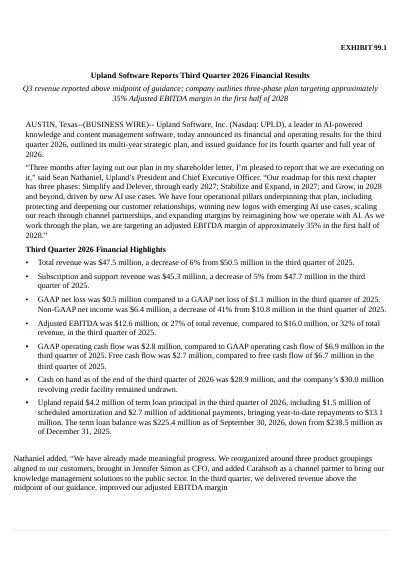
Now on to the third quarter. Total revenue was $47.5 million, above the midpoint of our guidance range of $45.7 to $48.7 million.
Subscription and support revenue was $45.3 million, also above the midpoint of guidance. Adjusted EBITDA was $12.6 million, essentially at the midpoint of our $11.9 to $13.4 million range, for an adjusted EBITDA margin of 27%, which was a quarter-over-quarter improvement from 26%.
We generated positive free cash flow again this quarter, and we continue to pay down debt. We also added 77 new customers in the quarter, including 10 new major customers, and we expanded our relationship with 185 existing customers, 14 of which were major expansions.
Equally, this quarter was also affected by three customer churn events. They came from two sources: First, some customers under financial pressure cut costs significantly, which led to large reduction in their use of internal applications.
The second, as customers shift from legacy use cases to AI-driven use cases, we grow with them where our AI capabilities fit, but we can lose revenue where legacy applications are retired. This is reflected in a more measured fourth quarter outlook Jennifer will walk you through.
Even with this impact, we delivered adjusted EBITDA at the midpoint of our guidance range, and protecting the base, our first pillar, is designed for exactly this situation. Now let me turn to some highlights from each of our product groupings.
In knowledge and contact center management, AI is bringing knowledge management back to the center of the enterprise. We were recently recognized in the Magic Quadrant for customer service knowledge management systems published by Gartner in July 2026.
The report evaluates vendors in the customer service knowledge management systems, or CSKMS, market. According to the report, the CSKMS market is undergoing a structural shift from passive content repositories to active, AI-driven reasoning layers powered by machine-readable knowledge.
We have an important part to play in that shift, and we see that shift in many of our customer conversations every day. The use case is moving from equipping human agents to equipping AI agents.
In fact, one of the largest enterprises in the world now uses Upland as their verified knowledge source that grounds its AI agents so that the answers those AI agents give are accurate, current, and approved. Moving to content life cycle automation, we're seeing strong results when we combine our technology with partners that bring deep customer relationships and industry expertise.
A great example is a major healthcare win where our AI-powered intelligent capture solution automated the intake, classification, and routing of complex patient documents that previously required manual review. By getting critical information into the right workflow more consistently and efficiently, the solution supports better patient safety while automating 94% of the millions of patient documents processed.
It's a strong example of how our AI enablement and commitment to the channel can deliver measurable customer outcomes. In vertical solutions, a strong example this quarter is a new six-figure ARR logo win with a large Canadian police force for our telecom expense management platform.
The Canadian public sector is a core vertical for this product, and the win shows our strategy at work. We lead from established domain strength to help government agencies manage and reduce their telecom spend, an area where we've helped Canadian government customers save millions.
We're also seeing momentum with large enterprise customers. In fact, this quarter, we signed a six-figure ARR expansion with a Big Four professional services firm with our BA Insight platform.
Professional services firms are a core market for this product, and the win is another sign of our strategy at work. We start from established domain strength in secure, permission-aware search, and make the retrieval foundation for a customer's internal AI platform.
Their employees get answers drawn from content across multiple systems, and every result respect that individual's access rights. Customers continue to validate our products.
We earned 43 badges in G2's Fall 2026 Market Report that's based on customer reviews. RightAnswers and Panviva, our AI-powered knowledge management solutions, earned the most badges, and BA Insight and Qvidian were also recognized.
Before I hand the call to Jennifer, I want to officially introduce her to our shareholder base. Jennifer joined us as CFO in mid-August, and she brings more than 20 years of finance leadership across software, technology, and private equity-backed companies.
She has led finance functions through growth, cost discipline, and capital structure transformation at companies of every size, she knows what scale looks like at both ends. Her background and experience will greatly benefit Upland as we move into this next chapter.
I will now turn the call over to Jennifer to further discuss our financial performance and outlook in even more detail. Jennifer?
Jennifer Simon
Thank you, Sean, and good morning, everyone. I am glad to be here.
I have been at Upland for about 11 weeks, and I would like to share why I joined and what I've seen so far. Three things stood out: First, this business has a strong balance sheet, produces strong free cash flow, and is servicing its debt at an accelerated pace.
We have paid down our debt by approximately 6% over the last 12 months through a combination of required payments and additional voluntary prepayments. Second, a clear cost opportunity, which is where Sean's fourth pillar, reimagining how we operate with AI, comes in.
Third, our durable recurring revenue base. Subscription and support revenue is 95% of our total revenue, and much of it comes from products that work as systems of records for our customers.
I am focused on bringing financial discipline to all three. With that, let me walk through our third quarter results.
Unless noted otherwise, all comparisons are to the third quarter of 2025. Total revenue was $47.5 million, down $3 million or 6% year-over-year, and above the midpoint of our guidance range.
Subscription and support revenue was $45.3 million, down 5%, and made up 95% of total revenue. Of the $3 million top-line decrease, approximately $0.6 million came from product lines we divested in 2025 and from sunset assets, which are non-strategic products and contracts we are winding down by design.
The remaining $2.4 million came from our core products: $1.8 million in subscription and support revenue and $0.6 million in professional services, both driven by the increased churn in certain core products that Sean described. Core organic growth was -3.9% in the third quarter.
Please note, this is also the last quarter we plan to report our core organic growth rate, as we designed this metric to show the underlying trend in the business while we were divesting product lines and winding down sunset assets. Our divestitures were completed in 2025, and starting in the fourth quarter, our year-over-year comparisons will no longer include any revenue from divested businesses.
Sunset assets are also now a small part of the business at about $1.7 million of revenue this quarter. Gross profit was $36 million for a gross margin of 76%, compared to 77% a year ago.
Cost of revenue was roughly flat at $11.5 million while revenue declined. With our core products, lower amortization of intangibles was offset by higher cloud hosting and computing infrastructure costs.
Turning to operating expenses: Total operating expenses, including depreciation and amortization, were $30.7 million, down $2.8 million or 8% from a year ago. Breaking that down further, sales and marketing expense was $9 million, down $0.7 million or 8%, primarily reflecting the disciplined cost management and continued alignment of our resources with the needs of our core product lines.
R&D expense was $7.8 million, essentially flat. We are holding our investment in product development steady while using AI to get more out of every dollar.
As Sean noted in his letter, our team recently finished an R&D project in about eight days that would typically take 9 to 12 months. General and administrative expense was $8.4 million, down $0.4 million or 4%.
That reflects $1.4 million lower non-cash stock-based compensation, partly offset by higher professional fees. Depreciation and amortization was $5.5 million, down $0.9 million, mainly from lower amortization of intangible assets tied to sunset assets.
Taken together, income from operations was $5.3 million, essentially unchanged from a year ago as lower operating expenses offset the impact of $3.0 million less revenue. Adjusted EBITDA was $12.6 million, essentially at the midpoint of our guidance range, for a margin of 27%, compared to $16 million or 32% a year ago.
The year-over-year decline primarily reflects the impact of lower revenue. Sequentially, our adjusted EBITDA margin improved from 26% in the second quarter of 2026 to 27% in the third quarter.
Below operating income, net interest expense was $5.1 million, up $0.9 million from a year ago. That increase is entirely non-cash.
It reflects $1.3 million of higher non-cash interest expense tied to interest rate swaps we exited in 2025. Cash interest expense actually declined by $0.4 million because of our lower debt balance.
GAAP net loss was $0.5 million, compared to a net loss of $1.1 million a year ago. After preferred stock dividends, net loss attributable to common shareholders was $2.0 million, or 67 cents per share.
Non-GAAP net income was $6.4 million, compared to $10.8 million a year ago. Turning to cash flow and the balance sheet: Operating cash flow was $2.8 million and free cash flow was $2.7 million, compared to $6.9 million and $6.7 million a year ago.
Third quarter cash flow was lower year-over-year, primarily reflecting the $5.4 million benefit from the sale of an interest rate swap in Q3 2025. For the first nine months of the year, operating cash flow was $13.7 million and free cash flow was $13.5 million.
We continue to put that cash to work paying down debt. In the third quarter, we repaid $4.2 million of term loan principal.
That included $1.5 million of scheduled amortization and $2.7 million of additional payments. Year-to-date, we have repaid $13.1 million, and we ended the quarter with $225.4 million outstanding on our term loan, down from $238.5 million at year-end.
Beginning this quarter, our scheduled amortization steps down from 2.5% to 1.75% per year of original principal, which leaves more of our free cash flow available for voluntary paydown. Our net leverage ratio was 3.7 times at quarter-end, and we remain in compliance with all of our covenants.
We ended the quarter with $28.9 million of unrestricted cash and cash equivalents and an undrawn $30 million revolving credit facility, providing us with solid liquidity to support the business. Total deferred revenue was $69.7 million at quarter-end, compared to $71.6 million at the end of the second quarter.
Remaining performance obligations were $164.4 million, and we expect to recognize about 65% of that over the next 12 months. During the quarter, we repurchased approximately 98,000 shares at an average price of $3.59 for a total of $0.35 million in cash deployed.
$9.65 million remained available for share repurchases under our existing stock repurchase plan as of September 30th. Debt reduction remains our primary capital allocation priority, and we will continue to treat share repurchases as opportunistic.
Now, I would also like to address our Nasdaq listing. As previously disclosed, in July 2026, we received a notice from Nasdaq that we no longer meet the $15 million minimum market value of publicly held shares requirement for continued listing on the Nasdaq Global Market, and we have until January 27, 2027 to regain compliance.
I want to be clear about how we view this: As a smaller public company with a significant sponsor investment from HGGC, we have long recognized that our profile in the public markets looks different from many of our peers. We remain a sponsor-backed company with a healthy balance sheet, and we do not expect any change in our listing status to affect our operations or our stakeholder relationships.
Now to our outlook: For the fourth quarter, we expect total revenue of $44.7 to $47.7 million, including subscription and support revenue of $42.3 to $44.8 million. That is a decline of 6% at the midpoint compared to the fourth quarter of 2025.
We expect adjusted EBITDA of $12.5 to $14 million for a margin of 29% at the midpoint, compared to 31% a year ago. For the full year 2026, we now expect total revenue of $190.1 to $193.1 million, including subscription and support revenue of $179.8 to $182.3 million.
We expect adjusted EBITDA of $50.5 to $52 million for a margin of about 27% at the midpoint, consistent with 2025. Overall, compared to our prior outlook, we have narrowed both ranges to account for the revenue impact of the churn events without giving up profitability.
That is the margin discipline we intend to show you every quarter. Looking ahead to 2027, we will provide formal guidance when we report fourth quarter and full year 2026 results in March.
Directionally, here is how we are thinking about the year: We expect the business to remain solidly free cash flow positive. On revenue, our priority is stabilization by improving retention in the base and ramping our channel partnerships.
We expect continued margin expansion as the cost actions underway take full effect, and we are targeting an adjusted EBITDA margin of approximately 35% in the first half of 2028. We expect to keep paying down debt every quarter.
Before I hand it back, I want to say that I am genuinely excited to be here. Upland has a durable recurring revenue base, healthy margin profile, strong cash generation, and a clear strategic plan to improve all three areas.
I'm looking forward to getting to know many of you in the months ahead. With that, I will turn the call back to Sean.
Sean Nathaniel
Thank you, Jennifer. I'm very excited about where Upland is headed.
We have a mission-critical set of products, more than 1,100 enterprise customers who trust us with their most important data, and a market that is moving toward exactly what we do. Upland is the intelligence layer.
We unify and contextualize enterprise knowledge, content, and data, and turn it into AI-powered outcomes for every human and every agent. The business generates free cash flow and services its debt responsibly, and we're building the next chapter.
With that, I'd like to pass the call back to the operator to begin the live Q&A portion of the call. Operator, please open the line for questions.
Operator
Thank you. We will now begin the question-and-answer session.
As a reminder, if you would like to ask a question, please press star followed by the number 1 to raise your hand. To withdraw your question, press star 1 again.
We ask that you pick up your handset when asking a question to allow for optimum sound quality. If you are muted locally, please remember to unmute your device.
Please stand by while we compile the Q&A roster. Our first question comes from the line of Scott Berg with Needham.
Please go ahead.
Scott Berg
Hi, Sean and Jennifer. Thanks for taking my questions here.
Lots to digest here. Obviously, Sean, it's your first kind of real public comments outside of the shareholder letter here, but let's take your fiscal '28 growth profile and, or at least your goals there to get to growth in fiscal 2028.
What does growth look like in your version of Upland here over the next two years? We certainly know what the growth profile on an organic basis has looked like historically.
We've covered obviously the stock since the IPO, but what's different or similar to how you start viewing '28 and beyond?
Sean Nathaniel
Hey, Scott. Thanks for that question.
It's great to be back at Upland and finish my first full quarter as CEO. Look, as we look at growth looking into 2028, we see our customer base going through a transition from legacy use cases and workflows into AI-driven use cases and workflows, and we see that the growth will come through those renewed use cases where we have a role to play in how enterprise knowledge, content, and data is used to feed those human and AI workflows.
Specific to growth numbers, we're not publicizing numbers yet, but we expect to, as the plans for 2027 materialize, you'll see more directionally where we're headed from a growth perspective.
Scott Berg
Understood. Thank you.
Then, Jennifer, I realize you've been there 11 weeks, this question might be a little bit heavy. On your adjusted EBITDA targets for '28 of 35%, the business has generated mid-30s adjusted EBITDA margins historically.
One of the questions I get frequently from different shareholders over the last year or two is, as the restructuring completes, why can't you get there kind of quicker and faster since it's been there? Can you help us understand what's required in that time frame over the next what's roughly a 15, 18 months to get to that target?
Why can't we see those margin targets a little bit ahead of that schedule?
Jennifer Simon
Scott, anytime you do a cost optimization, you have to be really thoughtful about how you do it. The last thing that you want to do is take cost out too quickly and jeopardize the business.
Sean really went through our focus. Our focus right now is on our customers, gaining momentum with AI-enabled niche opportunities in the market, expanding through the channel, and then really looking how we can wrap our cost structure around that to optimize it.
Right now, we're working through FY '27 plans. You'll see more what that journey looks like when we release guidance in March.
Scott Berg
Excellent. Thank you for taking my questions.
Jennifer Simon
Absolutely.
Operator
Thank you. At this time, we have no further questions.
That concludes our conference call. Thank you all for joining.
You may now disconnect. Everyone, have a great day.