voestalpine AG
Q2 FY2027 · Earnings Call TranscriptNovember 11, 2026
Operator
Ladies and gentlemen, welcome to the voestalpine AG publication first half of the business year 2026/27 conference call. I am Moira, the chorus call operator.
I would like to remind you that all participants will be in listen-only mode, and the conference is being recorded. The presentation will be followed by a Q&A session.
You can register for questions at any time by pressing * and 1 on your telephone. For operator assistance, please press * and 0.
The conference must not be recorded for publication or broadcast. At this time, it's my pleasure to hand over to Dino Malkic, Head of IR.
Please go ahead.
Dino Malkic
Welcome, ladies and gentlemen. Here is Dino Malkic, Head of Investor Relations of voestalpine AG.
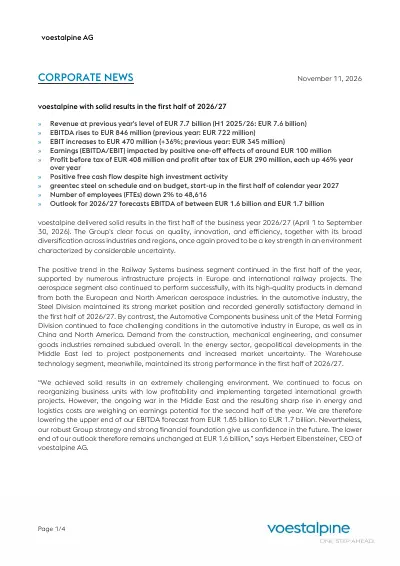
Thank you very much for participating today. We are here to give you an update about the figures of the first half of business year 2026/27, and the management will also provide you with an updated outlook.
After the management remarks, you will be able to ask your questions. With me today is Herbert Eibensteiner, our CEO, and Gerald Mayer, our CFO.
I want to hand over to you, Herbert. The stage is yours.
Herbert Eibensteiner
Thank you, Dino. Good afternoon, ladies and gentlemen.
We are pleased to present our results for the first half of our financial year. I just jump directly to the executive summary.
Yes, when we start on the left-hand side, despite these challenging market condition, we were able to achieve a solid result. Turnover remained virtually unchanged compared with the same period last year.
EBIT and EBITDA were above prior year's figures. When we look at our positive parts of our portfolio as the last time, Railway Systems very good.
Aerospace and power industries is still strong with very good order book. Also Warehouse & Rack Solutions is still very solid, long order book far into next year.
When you look at the steel market update, we think that the EU safeguard measures and CBAM turned out positive as a trade measure. On the negative side, especially with our Tubes & Sections business, was this additional US duties which were impacting this business most recently.
When we look at our reorganization activities, High Performance Metals is well on track and all these measures are almost completed. We see this first positive results out of that.
Also the reorganization in Automotive Body Parts is on track. There are some activities to do till the end of the year.
We will come after that also that we see that some additional measures we will have to implement it. greentec steel, it's as last time, everything is on time, on budget.
We will ramp up these first two electric arc furnaces in the first half of 2027. We have adjusted our guidance due to increased energy and logistic costs as well as additional tariffs in tubulars, as I mentioned before.
We had some logistic problems in steel. We have lowered the upper limit of the outlook whilst leaving the lower limit unchanged.
What is the macro view on our markets? I start with Europe.
Mentioned before, this logistic costs and, in particular, high energy costs. Since August, we see low water levels around our factories.
We have received these new tariffs and additional duties in tubulars. The positive thing in Europe is that we have these new safeguard measures in place with all the positive effects around it.
On the left-hand side, second biggest market, North America. Investments in technology and digitalization is driving economy.
Even for us as a local supplier and producer for steel products, we had negative effects by this very strict tariff regime. We were affected in summer with a steel shortage.
Far, it's not fully over, I would say. We are still struggling in some areas.
I think you know that in that context, the prices in the US has increased rapidly. In China, you know that stable growth mostly supported by exports all over the world but with a weak domestic economy.
When you look at Brazil, it's, I would say, a very low growth rates, high interest rates. Also deliveries from South America to the US are difficult.
They have the same tariff regime as we in Europe. The economy is impacted by Chinese imports.
greentec steel, again, on time, on budget everything is so far prepared for startup. Just to remind you, we will have this commissioning of the electric arc furnace in Linz and in Donawitz.
It's an investment of 1.5 billion. We are more or less on track.
At the end of next year, we will deliver greener steel to our customers. Let's jump to our divisions.
Strong performance in Steel Division. We had some cost inflations, energy costs, logistic cost driven by this Middle East conflict.
For us, it's mostly gas which has influenced our results and this higher logistic costs. From August onward, we had this difficulties with low water levels and some constraints in outbound logistics.
The outlook for Steel Division is that we see this higher costs. When it comes to heavy plate, further postponement of energy projects in the Middle East.
Safeguards, CBAM is positive. This price trend is supported by this activities.
We have a positive outlook in prices. Why?
We see a normalization of inventories, European inventories in the next weeks and months to come. We have positive signals for the negotiations in January 2027.
High Performance Metals, tooling business is worldwide business. It's more or less mixed development across the region, but improving.
We have a very robust demand in food and beverage and medtech and mining, which are smaller parts of this business. We have this very positive trend, especially in aerospace, with a good order book and a good performance of our production.
The outlook is soft positive signals across all segments. Reorganization is almost completed, as I mentioned before, and the result is that we see positive earnings also operational earnings development.
In Metal Engineering, Railway System, very good, strong order book also for next years. Again, this US duties were impacting especially our OCTG business in Austria.
The outlook is that all those duties will remain and affecting this tubulars business. We have reacted with a reduction of shifts and 150 150 less FTEs till March.
Also wire is confronted with a very weak demand in automotive business, and railway will stay very very well. We have promised you that we look a bit closer to Railway System.
The largest segment in railway is turnout. Again, we see a lot of positive development across regions: in EU, Germany; in US, Class 1, but also new activity in Canada; and also in China, we are in discussion for new high-speed projects.
Most of you know that the basis or the core of our business model there is replacement and maintenance. This is good.
This is the basics. There are some projects in the future for us as well.
Especially our signaling segment is very strong. Signaling is all these sensors and digitalization we do around the turnout system and axle counting and the detection of problems of the rail cars.
This is a growing business for us. As I mentioned before, order book is good and China and the US will also improving in the future.
Metal Forming, difficult, I have to say. We are in the middle of the reorganization of automotive components.
It's good, on track, on plan with positive effects, but there is a way to go. We have to reduce another 150 FTEs till the end of the business year.
This was the plan. Everything is so far on plan.
Due to the even lower than expected demand, we plan an additional project with another 500 500 people till 2028 to make redundant. Then we think we can achieve this 4%-5% EBIT in that area.
Tubes & Sections is a bit weaker than the years before. Some operational issues with this temporary steel shortage in North America and some complaints around new activities of new projects.
Warehouse & Rack, very good, good performance, good results, high return on capital employed and good order book. When you look at the outlook, we stick to this reorganization measures in automotive, and we are sure that we can stabilize this Tubes & Sections business.
We have measures in place. Now I would like to hand over to Gerald for his presentation.
Gerald Mayer
Thank you, Herbert. I would like to give you now some insights to our half-year performance and perhaps also add some guidance information to you.
Revenue, as Herbert mentioned before, we are roughly at the level of prior year. Going into a little bit more detail, you see that, in particular, HPM division is strongly above prior year.
The main reason there is that we had sharp increase in some alloying metals, which means raw material price increases drove, in particular, higher revenue. Also, the mix was positive.
In general, I will talk about this perhaps not just now, but repeat it so that we see some slight tailwinds there in HPM division. In general, Metal Forming was also good, in particular in Warehouse & Rack Solutions.
We see higher revenues. In Steel, we are slightly below prior year.
The main reason is less heavy plate projects, and we discussed about Middle East and energy projects there which are postponed. This is what we are seeing there.
On the other side, we saw positive impacts from CBAM and from safeguards. Of course, and this was also mentioned in the presentation of Herbert, we had dry weather here in Austria, and the water level of the river of Danube was fairly low.
We have been suffering and are still suffering in terms of logistical challenges, I would say, regarding outbound logistics, in particular for heavy plates. Profitability is fairly solid, €846 million, plus 17%.
Of course, this includes this one-off effect we reported in first quarter. It's unchanged, roughly €100 million-plus in our HPM division.
Going into a little bit more detail regarding profitability, you see that Steel Division is slightly above prior-year level, HPM also. On the one side, we had this one-off effect, but there was additional operational positive elements there so that we are outperformed last year significantly.
We are behind prior year in Metal Engineering. The main reason is tubulars, and Herbert talked about anti-dumping and countervailing before.
This is how we came up with €846 million. Free cash flow performance, €24 million.
Of course, in Q2, it was negative. One main driver that it was negative in Q2 was, again, the river of Danube.
There, yeah, thousands of tons where we were not able to ship it to our customers. If they were produced, we built up a stock there, and this had a significant impact in our working capital.
This is one of the reasons. On the other side, we have this high investments in our greentec steel projects.
We are totally on track there. I think cash flow for CapEx was €530 million roughly in the first half.
If you add this up or multiply it by two, you are at roughly our guidance of 1 150. This is still unchanged, we are on track there.
On the positive side, we had €150 cash in from the sale of Böhler Profil. Our guidance in free cash flow stays at €250, we reiterate what we said 3 months ago.
Of course, we have to do something and have to prove, but there we have many good reasons there, and I'm optimistic that we will end up with this 250. On the one side, I talked about the river of Danube, 100 more than 100 perhaps million impact, negative impact in the first half to our working capital.
On the other side, we are in the middle of organizational projects in HPM. They reduced throughput times, for example.
With tailwinds from the market where we are confident that we gain there again ground. In addition to that, we had a relinement, a major maintenance activity in Donawitz for one of our blast furnaces.
There we also had to build up stock during the year, and we will consume this stock until end of the year. There are some good reasons there.
Happy also to answer the questions if there's something left in the Q&A session. Let's talk a little bit about the bridge.
722 was the prior year first half. Now we are at €846 million.
Of course, we had higher price levels. I said in HPM, it was driven in particular by higher raw material prices.
We also saw higher price levels in Steel Division. I also mentioned the reasons there.
In raw materials, we also had positive FX effects in there. The gross margin increase was €100 million, mainly referring to Steel Division and HPM division.
Mix and volume is negative at €122 million. I would say roughly €70 million-plus refers to a weaker mix.
The rest is lower volumes. The miscellaneous, you see mainly two major effects.
One is the €100 million one-off, and I also mentioned it here at the comments. On the other side, you all know and you are aware that we have big reorganization measures.
We reduced full-time equivalents, excluding now this Böhler Profil transaction, of 1 850 people roughly. Of course, this comes with a positive impact also there.
The second bridge, here I would like to present you the deviations from our segments. You see, again, this 135 strong plus in HPM, but you also see there is that we had, in addition to this €135 million-plus there, this is tailwinds, optimized cost structure, of course, with a significant impact there.
We are really doing well there, I would say. Steel Division, plus 10 €10 million, at the level of our prior year.
I mentioned this energy projects before which are not accessible for us at the moment with the war in Middle East. On the other side, we had very positive developments also in our Steel Division.
Of course, there's still this higher logistic cost which we are, of course, facing like all the other players, I would say, out there. In Metal Engineering, minus €15 million, mainly driven this reduction by tubulars.
The rest is plus/minus stable. In Metal Forming, you see a slightly better profitability there.
I have to say we expected a little bit more there, but we were suffering a little bit in the US, and Herbert mentioned it before, from this steel shortage situation. We had a weaker market when we talk about roll forming business, and we also have some internal issues in some projects where we were not, let's say, or had some issues which we had to solve.
This is how we end up at €846 million. I would like to share with you, and some of you saw this slide or in a similar form during our Capital Markets Day some weeks ago.
In High Performance Metals division, we reduced the cost structure or optimized the cost structure substantially by €150 million. This is one of the reasons why we are doing better this year.
We completed more or less this warehouse consolidation activity. Until end of this business year, the bulk is done, and we do not expect additional reorganization measures necessary.
We're very confident that we will end up 28/29 means clean at this €400 million because this year will not be far away including this one-off. In Metal Forming division, you see a €70 million impact, also a substantial cost reduction impact, structural cost dramatically down there.
On the other side, of course, we all understand that the market and the situation for our customers is not easy. This is also the reason why there is still something to do for us.
Herbert mentioned some 500 people roughly before in his presentation. Until end of this year, we expect 250, but this is the old plan, this ordinary plan where we anyhow working on.
We are still confident to have this €400 million by end of 28/29. My last slide is our cash flow or capital allocation bridge.
Funds from operations were at 565, and then we had this negative impact from net working capital. I explained to you that I'm confident that we will improve there dramatically until year-end for good reasons.
One is the river of Danube. The others are this projects which are in place and where we walk the talk also in the last months in HPM division, in particular.
We had this blast furnace relining in Donawitz, where we will reduce inventory. Then there's another important one, this is tubulars.
As we started and went into this hibernation mode for tubulars after, in particular, and with more power after this anti-dumping and CVD news for us, we also reduce there inventory. We're confident that we will end up and go back perhaps not to zero net working capital change until year-end, but nearly.
This, again, brings us then mainly to this €250 million. Maintenance CapEx, 260, I would say a normal level for us.
Disposal, 158. This was Böhler Profil sale in Q1.
We had some growth CapEx there, minor, many small projects. In decarbonization, I mentioned that we're on time, on budget there.
I expect 400 until year-end in decarbonization projects. I reiterate this 1 150 for capital expenditures or investing cash outs until year-end.
The free cash flow now is at 2 €24 million-plus, and we expect around €250 million until year-end. This was it with my presentation, and I hand over to Herbert for the outlook.
Thank you.
Herbert Eibensteiner
The last slide is the outlook. I think we have already presented everything around that.
When you look at the positive factors, safeguards, CBAM, stock reduction is ongoing in the steel sector. We have this positive developments in railway technology, warehouse technology, and also in the aerospace business, on the other hand.
The self-help measures are more or less on plan. We have also this negative aspects: higher energy prices, high logistic costs, bottlenecks in logistic, and the waterway, it's not finally solved, I have to say; and also this additional tariffs working against that.
We have now a revised forecast with this lower upper end of the guidance, and we have left the lower limit unchanged. That's the guidance.
Thank you for your attention, and we are glad to answer your questions.
Operator
We will now begin the question-and-answer session. Anyone who wishes to ask a question may press * and 1 on their telephone.
You will hear a tone to confirm that you have entered the queue. If you wish to remove yourself from the question queue, you may press * and 2.
Questioners on the phone are requested to disable the loudspeaker mode while asking a question. Anyone who has a question may press * and 1 at this time.
The first question comes from the line of Tristan Gresser from BNP Paribas. Please go ahead.
Tristan Gresser
Yes, hi. Thank you for taking my questions.
The first one is on your cost performance within the Steel Division. If we look at your results, it looks pretty good.
You had weaker shipments, negative mix effects, but you still managed to keep EBITDA per ton stable quarter-on-quarter despite the energy and logistical costs you flagged. Wondering if you could discuss that and also maybe it comes down to those energy and logistical costs not being really present in Q2 and more into Q3.
If you could also touch a bit on the bridge for the Steel Division into Q3, that would be helpful. I'll start there.
Gerald Mayer
I think, Tristan, I I I try to give you perhaps a little bit more more insight there. I would say first quarter was excellent, second quarter in steel.
We had a fantastic production level. Unfortunately for us, the issue the main issue was was was shipments.
I would say outbound logistics was was really difficult. We we try to optimize that, but it was still a strong Q2, if you would compare it to prior periods, at at capacity utilization was very high.
In in Q3, I would say it will be this is our take, and it's normal as it is also the Christmas for us, the Christmas quarter, it should be weaker than Q2. There this these two reasons: first of all, it is the seasonal low; and the other side, and you mentioned cost inflation, the prices for natural gas started to increase sharply during Q2, and, of course, this has then an impact in the following quarter, in particular.
Our main, I would say, and this is unchanged, normally, we have a very good ability to pass on higher cost to our customers, but always with a time lag. This is what you will see there, and this is one of the the the reasons we have there that we are a little bit perhaps below some of the expectations from from from you guys.
This this is how it is. In Q4, we expect another solid and good quarter for for our Steel Division.
In general, I would say, the the demand from the markets are are healthy and are okay. It's throughout, everything which was positive stays positive.
Perhaps here and there, some some some positive signs, but not really but not not bad, healthy, I would say. This is this is, yeah, more or less the direction we are going with a lot of uncertainty.
No one knows how long this war takes. I hope this helps a little bit.
No,
Tristan Gresser
that's really helpful. I would just follow up on that.
Would you say the energy and logistical additional costs you saw in Q2, was that already the full run rate and you expect those costs to be relatively steady? Or you had only 50% of that in Q2 and 100% we'll see that in Q3 just to calibrate the cost inflation for the next quarter?
Also, given the shipments, would you expect shipments for the full fiscal year to be down for the Steel Division?
Gerald Mayer
I would say the shipments I would expect, always the assumption is that that we have a positive development there regarding the water levels at the river of Danube. This is very important for us now.
It is still not good. Given that we see a recovery there, we should have a better second half in terms of volume than first half in terms of volume for our Steel Division.
We should catch up a little bit from what we lost in the first half. This is with regard to volume.
In terms of cost, of course, we saw the costs sharply increasing, in particular in energy, during the second quarter. Means that we have a higher impact there what we expect in Q3.
This is simply the fact what we are facing at the moment. You all understand that we do some hedging, that we have a storage facility.
This softens this effect a little bit, the storage facility for natural gas. We are still affected to some cost inflation there, in particular for Q3.
Perhaps one reason is also that our customers still had fairly high stock levels at the beginning of this quarter. Of course, things are normalizing there.
This is also what we see. Things are improving, but it takes some time.
This is how I would summarize everything.
Tristan Gresser
Okay. That's clear.
My second question is on contracts. I think a year ago, it was a bit similar than today.
There were some optimism initially, but when contracts eventually settled in December and January, they probably settled a bit lower than the initial expectations. Do you think the situation today is different from a year ago from that perspective?
Would you say a triple-digit increase in contracts is very ambitious or is doable?
Gerald Mayer
When
Herbert Eibensteiner
I think that's a very good question. Last January, it was more or less driven by this expectation of CBAM and safeguards, I would say.
Now we see that the energy prices are higher and that the pressure from the market, the positive momentum is here, but the pressure on the market is maybe a bit less. It's mixed.
When you look at the higher energy prices and there is a clear plan to enlarge the margin, everybody have to go for these figures you mentioned.
Tristan Gresser
Okay. That's clear.
Thank you.
Herbert Eibensteiner
That's the plan. That's not the result so far.
Tristan Gresser
Okay. Okay.
No, then that's clear. Thank you.
Operator
The next question comes from the line of Dominic OKane from JP Morgan. Please go ahead.
Dominic OKane
Hello. Just two two quick questions on my side.
The first, just trying to differentiate between what is seasonal, cyclical, and structural, specifically on the cost side. Given that we have seen this big step-up in energy prices, and particularly gas prices, in the last 1 month, can you just talk to us about how you are positioned in terms as we look into calendar 2027 for energy pricing?
Are you required to start negotiating longer-term energy contracts at current market prices, or do you have flexibility to delay some of those conversations? Then my second question just with regards to the working capital build and specifically heavy plate during the period, I notice that you won't have a force majeure in place.
How can you talk us through how you will clear the inventory as we look forward? Will you be selling at the market price, or is there any risk to some lower revaluations as you look to clear those inventories in the next one to two quarters?
Gerald Mayer
Hi, Dominic. Regarding our energy, I think you said supply and how this is regarding cost, no?
In energy supply, just to give you rough numbers, for us, it takes roughly a little bit more than 6 terawatt hours per annum what we have to need to feed our plants. The bulk, of course, is here where we are at the moment here in Linz, for our Linz plant.
The second biggest consumer is then in Styria in Donawitz. What we have on the one side if we have supply contracts, we've fixed and secured supply.
The pricing is then a different animal. In pricing, our strategy is number one that we actually add it, price deviations, and give it to our customers, number one.
We have some smaller contracts where the energy prices are part of or an element also of our sales contracts. The bulk, in particular here in Linz, is that we normally manage, and this is historically proven, that we manage to hand over cost inflation here for energy contracts with a time lag to our customers.
Therefore, we also have some derivatives, but not too many. In addition to that, we have our gas storage facility as every megawatt-hour, every kilowatt-hour, or norm cubic meter we use from and consume at our sites, first we take it out from the storage.
On the other side, this cubic meter goes again into the storage at the new price. It helps us for some weeks to soften effects.
This is roughly as it is. Supply secured, pricing is flexible, and we have to adjust for the bulk the prices and add it to our customers and hand it over to our customers.
Back-to-back, of course, is our preferred method anyhow. This is something, of course, we do.
Working capital build in heavy plate, I think we sit roughly 80,000 tons more than expected in heavy plates here on our site in Linz. This is a rough number.
At the moment, our clear target there is to reduce this down dramatically until year-end. We do not expect negative impact there.
It's not just voestalpine which is affected by this situation, also many of our competitors and market players there and market participants. We, of course, in talks with our customers, it's not funny because we are a well-accepted and well-known supplier where delivery performance is one of our top priorities.
What we're actually doing at the moment, not just at the moment, we also did this in the past, we try to have other routes available, other ways and means how to transport, in particular, this very heavy stuff to our customers. We can do it to a certain extent by train using specialty equipment there.
The pity is that at the same moment when the river was very dry or is very dry, also we have this construction sites, in particular, northbound through Germany at the moment for the main train tracks. We are working on that, but we do not expect to make it short now here a major negative impact.
Dominic OKane
Just ask on the gas storage, what's the current level of gas storage you have?
Gerald Mayer
750 750 gigawatt hours, 0.75 terawatt.
Dominic OKane
Okay. The
Operator
next question comes from the line of Krishan Agarwal from Citigroup. Please go ahead.
Krishan Agarwal
Hi. Thanks a lot for taking my question.
A couple of them have been answered, but a follow-up question on the guidance cut. Is it a better way to understand that €150 million cut in the guidance from one 1.85 to 1.7 at the upper end that 50 million of incremental cost is already being seen into the Q2 of the business year, and then incremental 100 million cost actually comes into the December quarter?
Would that be a fair assessment to look at the guidance cut?
Gerald Mayer
I didn't think about it that way, but it does not seem for me at the first glance, it doesn't look too wrong. A part of it is definitely also part of our first half, for sure the case, yes.
I mentioned in my presentation that we expected, for example, more in Metal Forming and so on, and this is definitely the case there. Not too wrong.
Krishan Agarwal
Understand. Thanks a lot.
Then does it mean that if the energy cost stays persistently high, then March quarter probably will also be impacted from a higher level of energy cost in addition to the guidance cut which you have taken?
Gerald Mayer
I think as we mentioned before, our business model is that we have to hand over higher energy costs to our customers as a significant contracts are renegotiated quarterly or yearly contracts. We do everything now to negotiate that into this contract, and we should not be affected, perhaps a little bit.
As long as prices are rising, of course, this always is tricky. When they stay flat at this level as it is now, I would say, our clear target is that we have to hand this over to our customers.
Herbert Eibensteiner
We have most of these negotiations in January, and this is the time lag what we have normally in that context.
Krishan Agarwal
Thanks a lot. Then a quick follow-up on working capital.
You're saying there's a lot of plate inventory to be released in the Q3 and the Q4. How should we look at the full-year working capital picture?
Is it going to be a flat working capital or some kind of an investment? Then consequently, does that changes your free cash flow expectations for the business year '27?
Gerald Mayer
We roughly, let's say, added net working capital of €170 million or 250, I would say, in the I think it was Q2. From this one so it should be as I mentioned also before in my last slide in the bridge, we should go down to the direction zero so that it is flat again compared to start of the year.
This is our intention there with these projects and with this initiatives and simply with these facts. I try to explain like normalizing water levels, which should support us there.
It should be perhaps slightly negative compared to 1st of April, but not too bad. This is the expectation, and free cash flow means this is one of the reasons why we're also confident that we will reach this €250 million performance for this business year.
Krishan Agarwal
Understood.
Gerald Mayer
It was also we also needed it, I think, 2 years ago, 3 years 1 year ago, we had this strong rebound then in second half. It's not unrealistic.
Okay.
Krishan Agarwal
Okay. Understand.
Thanks a lot.
Operator
As a reminder, if you wish to register for a question, please press * and 1 on your telephone. The next question comes from the line of Bastian Synagowitz from Deutsche Bank.
Please go ahead.
Bastian Synagowitz
Yes, good afternoon, and thanks for taking my questions. A couple left.
Maybe firstly following up on energy cost, can I please follow up on the gas situation? Maybe could you please give us a bit more detail on how the price level in that reserve compares to the current gas price and how much benefit from this, if anything, is reflected in updated guidance?
Then the second question, just on restructuring, I think you basically indicating that you are stepping up your efforts a little bit in seamless and also Metal Forming. Is there anything we should be budgeting for in terms of restructuring provisions in each 2027 and '28?
Gerald Mayer
Regarding our natural gas reserve of 750 gigawatt hours, of course, everything what we saw and is also part of our guidance, there's nothing as reserve left. Otherwise, it would be part of our guidance and so on.
How it works is actually normally, we take out 1 kilowatt-hour from the storage, and on the other side, we fill this new cubic meters into the storage. This is how it works.
We consume at an average price, and this average price goes up in an increasing market and goes down step by step in a decreasing or falling market. The effect what we have there, as I said before, we have a little bit more than 6 terawatt hours we need annually for our operations.
750 is in there, I would say roughly half a quarter is what we can do with our gas storage facility, and this is also how we soften a little bit the impact for one quarter. This is how it works.
You're
Bastian Synagowitz
basically filling up again. Basically,
Gerald Mayer
you This is the idea. It is the reason that we have this gas storage is, in particular, secured supply.
We built it, and we bought it during the time when the war in the Ukraine start as we have direct lines and supply via Ukraine to Austria. In order to be safe there, we decided to build a bigger gas storage facility at this time, to buy one.
It was 1.5 terawatt in the past. With the things developing there and getting terminals for LNG in Europe and so on and so forth, we decided, I think, 1.5 years ago roughly, to reduce this 1.5 terawatts to 750 gigawatt hours.
The main reason is still unchanged. It is secured supply.
If something happened, then that we have at least something on our side. Of course, we also use it to soften such effects.
Technically, and also for accounting, it works that we always take the kilowatt-hours from the storage and refill it with new ones until we do a new decision regarding secured supply. This is the reason why we have it and how we do it.
Of course, it is in our guidance, yeah. Restructuring was the second question.
In Metal Forming, there's 250 people, FTEs left being reduced from our original projects. This brings us then from annual improved structural costs €70 million to roughly €90 million.
This is number one. What we added in this presentation that we assume that there will be something necessary, in particular, in addition to that, because the need from our customers is even lower.
Our expectation is that we have to further reduce step by step roughly five up to 500 FTEs. It's an estimate now in the next two business years, then, not this year, in the next two business years step by step using fluctuation, pensions, and so on.
No big extra restructuring is foreseen at the moment there, perhaps a little bit. In seamless tubes, what we did there is we announced this week, 2, 3 days ago, right after we were informed last week or 1.5 weeks ago by the authorities in the US about the level of anti-dumping.
In addition to countervailing, for us, it was clear that we have to do something there. We decided to reduce to exactly two shifts, minus 150 additional people until year-end.
Of course, we are negotiating there a plan with our employees. We started that.
We have experienced the same situation 1 year ago where we took out, I think, 190 people roughly or 70 people roughly. I think this will not be a big significant amount you have to expect, and is also part of our guidance.
This was one of the reasons why we took down the upper level. This is one of the reasons.
Bastian Synagowitz
Understood. Thanks.
Thanks for that. Then maybe just staying on the topic of seamless tubes, and I appreciate I asked that question already in the last call, but I think with the tariffs now, you definitely face another layer of headwinds for your US exposure, and I think you've generally lowered that already.
Firstly on the performance of seamless tubes, are you still around breakeven, or are you losing money already? Maybe you can give us a bit more color on that.
Gerald Mayer
Thank you. Thanks for this question.
I wanted to add this in my presentation. Our clear target is there, and we are confident that we will end up this business year at the free cash flow level of around zero.
The clear target there is not to burn money, and we are confident doing that this year. How are we doing that?
Of course, operationally, simply looking at an EBIT number, we are not positive at the moment. We expect a negative impact there.
This is part of our guidance. On the other side, as we reduced also business there, we will reduce inventories and so on, and we will have positive impact there.
Of course, we cut every type of and question every type of investment to do there and so on, the normal stuff you doing in being a fire brigade. We are in a clear hibernation mode situation there.
The pity is that the original plan for us this year was to shift more to other markets. The war situation in the Middle East, of course, is not really helpful for this strategy.
We are super confident that there is a bright future there for us. There are big projects in front of the door, but this war has to end.
No one knows when this ends. The strategy now is: reduce OCTG volumes which are shipped to the States until end of this year to a level of more or less zero.
This is our strategy: substitute smaller volumes with other in other markets, and therefore it's necessary to reduce our manning there. This is minus 150 people.
We are confident that we can achieve that. We're working hard.
People were actually anyhow preparing themselves a little bit for this situation. The outcome was even more severe than we expected.
This is what we have to say with this anti-dumping number.
Bastian Synagowitz
I suppose you've been really caught a little bit off guard and by surprise by I guess the magnitude of these tariffs. I guess when you talk about a negative EBITDA run rate this year, assuming everything just stays as it is, no relief, continuation of war, how far can you cut that loss into next year just by containment measures and whatever is in your control?
Gerald Mayer
No, we are confident. This will definitely not be a negative EBITDA, for sure not.
Bastian Synagowitz
Thank you. The
Operator
next question comes from the line of Patrick Steiner from ODDO BHF. Please go ahead.
Patrick Steiner
Good afternoon. Basically, one question left from my side.
You mentioned that the bulk of the reorganization process in HPM are done by the end of the business year, if I understood this correctly. Should we then expect the full benefits to be reflected firstly in the first quarter of 27/28?
Gerald Mayer
For full benefits, you also need market. Part of market is there.
Herbert Eibensteiner
No, I think it's normal that when you finish such a program and you have seen the figure of €150 million cost reduction, we will benefit from then. That's clear that this is coming gradually over the year.
Yes, that's the case, and that's the reason why we see so far good results from HPM. Otherwise, it would be loss-making.
Patrick Steiner
Perfect. Thank you very much.
Operator
The next question comes from the line of Dominic OKane from JP Morgan. Please go ahead.
Dominic OKane
Hello. I think my question's actually already been asked.
I guess my question was on the OCTG and the tariffs. When you've spoken about this previously, you were guiding back in March with the Q4 release that the products exposed to tariffs represented about, I think, 5% of Metal Forming sales.
I think from memory, that was around about $250 million. Are those numbers still broadly accurate?
Gerald Mayer
Even less. It is even less.
We say talking about our total numbers, I would say OCTG business is perhaps 1% of our total group-wide revenue. It was reduced throughout the year already.
Dominic OKane
Thank you. That's all.
Thank you.
Gerald Mayer
Welcome.
Operator
The next question comes from the line of Tristan Gresser from BNP Paribas. Please go ahead.
Mr. Gresser, your line is open.
Tristan Gresser
Sorry, I was on mute. Thank you for taking the follow-up.
Just on the OCTG business, would you expect, given the headwind, that the Metal Engineering division H2 EBITDA would be better than H1? Now
Gerald Mayer
I was on mute. I don't think so that it's doing operationally better and in terms of results H2 than H1.
Tristan Gresser
Sorry, H2 will be not as good as H1?
Gerald Mayer
Not better than H1.
Tristan Gresser
That's clear. Just on the heavy plate business, if we were to think of a best-case scenario, when does this business could come back?
I guess the lead times are also maybe long. I don't know, is that something you would contemplate at some point in fiscal 2028 to come back, or this could take longer?
Any thought there?
Herbert Eibensteiner
Not far away, I would say, huh? Yes.
Okay. No, that's clear.
Heavy plate is normally when it comes to energy business, it's a project business. All those projects we know and we would have expected in the last year are still available.
They are just postponed. They are frozen because of the situation in this Middle East area.
It's always a question of financing. There is no change in this projects as far as we know.
It's not that we have to wait 1 or 2 years. As soon as we see a solution of this situation, I think within a year or in the course of a year, we can see a pick up in this scenario.
I think that's nothing has canceled. That's the good news in this bad situation, I would say.
Tristan Gresser
Okay. That's clear.
Maybe last question on Metal Forming. It came a bit below I think what we had in Q2.
You mentioned that the market has been weaker than anticipated, need for more restructuring. If we look at the sequence into Q3 into Q4, we should still expect some gradual improvement quarter-over-quarter, or is there anything else to flag on the outlook for that division?
Gerald Mayer
This is our expectation. We expect some improvements here throughout the year for the rest of the year,
Herbert Eibensteiner
yeah. Normally, we think that Q4, as always, will be the best quarter even for Metal Forming.
Tristan Gresser
Okay. That's very clear.
Thank you. For
Operator
any further questions, please press * and 1 on your telephone. Ladies and gentlemen, that was the last question.
I would now like to turn the conference back over to Dino Malkic for any closing remarks.
Dino Malkic
Thank you, ladies and gentlemen, for the questions and for the fruitful discussion. Should you have any further questions left, please feel free to contact us.
Have a nice day. Thank you very much.
Herbert Eibensteiner
Thank you. Bye-bye.