VolitionRX Limited
AAMEX:VNRXQ2 FY2026 · Earnings Call TranscriptAugust 14, 2026
Operator
Welcome to VolitionRx Limited's Second Quarter 2026 Earnings Conference Call. During today's presentation, all parties will be in a listen-only mode.
Following the presentation, the conference call will be opened for questions. If you have a question, please press the star key followed by the number 1 on your touch-tone phone.
If you would like to withdraw your question, please press the star key followed by the number 2. If you're using speaker equipment, please lift the handset before making your selections.
This conference call is being recorded today, August 14th, 2026. I'd now like to turn the conference call over to Louise Batchelor, Group Chief Marketing and Communications Officer.
Please go ahead.
Louise Batchelor
Welcome, everyone, to today's earnings conference call for VolitionRx Limited. Before we begin, I'd like to remind everyone that some of the information discussed on this conference call will include forward-looking statements covered under the safe harbor provisions of the Private Securities Litigation Reform Act of 1995.
These statements are based on our beliefs, as well as assumptions we have used based upon information currently available to us. Because these statements reflect our current views concerning future events, these statements involve risks, uncertainties, and assumptions.
Actual future results may vary significantly based on a number of factors that may cause the actual results or events to be materially different from future results, performance, or achievements expressed or implied by these statements. We have identified various risk factors associated with our operations in our most recent annual report on Form 10-K, quarterly reports on Form 10-Q, and other filings with the Securities and Exchange Commission.
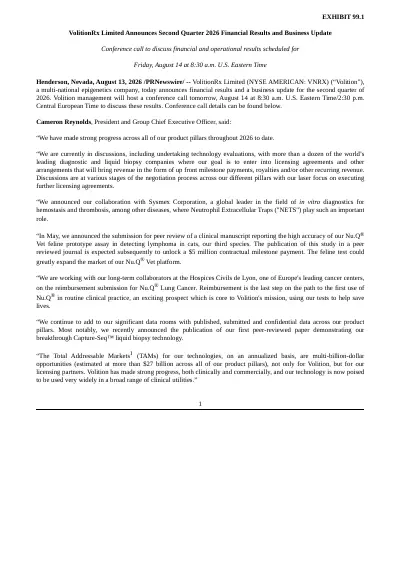
We do not undertake an obligation to update any forward-looking statements made during the course of this call. Cameron Reynolds, Group Chief Executive Officer, will open the call, providing a summary of key recent achievements, and will then hand over to Terig Hughes, Group Chief Financial Officer, to give a financial report, before returning to Cameron, who will discuss upcoming milestones.
We will then open the conference call to a question-and-answer session. With that, I'll turn the call over to Cameron.
Cameron Reynolds
Thanks, Lou. Thank you, everyone, for joining Volition's earnings call today.
As always, we very much appreciate your time given the busy earnings season. We have made strong progress across all our product pillars so far in 2026.
Taking each in turn, first, starting with Nu.Q NETs. Subsequent to quarter end, we issued a comprehensive video update and PDF showcasing the significant scientific and clinical evidence we have amassed relating to our Nu.Q NETs product and listing the extensive base of data now published.
Results have consistently demonstrated that our Nu.Q NETs H3.1 assay accurately distinguishes sepsis from non-infectious systemic inflammation, is highly correlated with disease severity, and provides excellent prognostic utility for outcomes such as organ failure and mortality. Moreover, Nu.Q NETs provides new and additional information above standard organ failure scores such as APACHE II and SOFA scores.
Professor Djillali Annane, one of the world's leading experts in sepsis, has stated that he believes Nu.Q NETs could become a game-changer in modifying a patient's trajectory, and that introducing Nu.Q NETs into hospitals would lead to new ways of treating sepsis, improving patient survival, and the quality of life of survivors. A very powerful testament indeed.
Excitingly for Nu.Q NETs, we've also made incredible progress in the development and evaluation of our lateral flow prototype assay. A little over a year ago, in July of 2025, we announced the quantification of nucleosomes in whole venous blood using our lateral flow prototype assay.
Then, in April of this year, we reported the technical breakthrough of being able to detect nucleosomes in capillary blood or blood from a finger-prick. Now, fast forward to earlier this week and our announcement that we have demonstrated the correlation of the lateral flow prototype assay and our established CE-marked automated Nu.Q NETs assay in samples of critically ill, confirmed sepsis patients in the intensive care unit.
The ability to rapidly identify high-risk patients at the point of care by quantifying their nucleosome levels using a finger-prick sample and simple lateral flow device aims to enable quicker clinical decision-making and, consequently, better patient outcomes. This prototype technology has the exciting potential to strengthen our product portfolio.
With recent estimates indicating approximately 166 million cases of sepsis worldwide, the potential addressable market is absolutely huge. All-cause sepsis-related death in 2021 represented 31.5% of total global deaths, with the highest burden of mortality in lower- and middle-income countries.
This is a potential game-changer, not only in diseases where time is critical, such as sepsis, but also in significantly expanding potential use cases beyond traditional hospital infrastructure. It also creates a compelling pathway into underserved lower-income countries where laboratory infrastructure may be weak or non-existent.
By enabling decentralized testing, our total addressable market expands. More on this later when I discuss upcoming milestones, but we have made and continue to make incredibly rapid progress in the development and evaluation of this finger-prick technology.
Outside of sepsis, but still with Nu.Q NETs and diseases associated with NETosis, we were delighted this quarter to announce our collaboration with Sysmex Corporation, a multi-billion-dollar market capitalization company listed on the Tokyo Stock Exchange. Sysmex is a global leader in the field of in vitro diagnostics for hemostasis and thrombosis, among other diseases, where neutrophil extracellular traps, NETs, play such an important role.
We have already successfully transferred our Nu.Q NETs assay onto Sysmex's platform, and we are delighted they have commenced the optimization phase in disease associated with NETosis. This collaboration is in addition to that announced last year with Werfen's Immunoassay Technology Center, a worldwide leader in specialized diagnostics.
That agreement concerned another NET-related disease, antiphospholipid syndrome, APS, and they too are making good progress. We believe that Volition's Nu.Q NETs test could provide not only improved diagnostic information to aid clinical decision-making and personalized care, but would also be a low-cost test to continue to monitor a patient's condition in many NET-related diseases.
Next up, Nu.Q Cancer, specifically Nu.Q Lung Cancer. Lung cancer is the major cause of cancer-related mortality worldwide.
We believe that Nu.Q Cancer represents a significant advancement in lung cancer patient management, offering clinicians an additional tool to enhance precision in treatment selection and monitoring. Research conducted by our long-term collaborators in Taiwan and Lyon in France demonstrated that our Nu.Q Cancer technology empowers clinicians to make more informed treatment decisions and provides valuable new monitoring capabilities throughout the patient journey.
Several manuscripts, conference posters, and presentations have already been published, and subsequent to quarter end, two further papers have been made available on preprint services, with a further manuscript due for submission by the NTU team in the coming weeks. This evidence provides the basis of our reimbursement submission supported by our long-term collaborators at Hospices Civils de Lyon, one of Europe's leading cancer centers.
This reimbursement is the next step on the path to the first use of Nu.Q in clinical practice, an exciting prospect which is core to Volition's mission, using our tests to save lives. This quarter, we participated in our first pre-submission meeting with the authorities, and anticipate a follow-up meeting and ultimately a submission by the third quarter of this year.
Reimbursement will be a major milestone for Volition in the commercialization and licensing of Nu.Q in the human cancer field, and, assuming achievement, we anticipate the introduction into routine clinical use in France, and then we'll set our sights on rolling it out in other countries. Staying with cancer, but moving on to our Capture-Seq technology, Volition is, I believe, the first company to demonstrate the isolation and analysis of greater than 99% pure circulating tumor-associated DNA.
Most current liquid biopsy methods involve deep sequencing of plasma DNA and bioinformatic analysis of the data produced to identify the presence of cancer in a patient. The biggest problem facing all liquid biopsy methods worldwide is that the vast majority of the circulating DNA in blood plasma samples from cancer patients comes from healthy cells, not from the cancer.
Volition's technology employs an entirely novel approach to liquid biopsy that has overcome this hurdle and produces pure cancer-associated plasma DNA sequence sets for liquid biopsy. Our clinical paper detailing this technology has been peer-reviewed and published subsequent to quarter end.
The manuscript describes a new liquid biopsy chemistry for isolating CTCF DNA from plasma. Our work on CTCF-bound DNA has revealed what we believe to be an unprecedented new discovery: that there is almost no CTCF-bound DNA in healthy plasma, and almost all CTCF bound in DNA in the blood of cancer patients is therefore derived from the cancer.
In the published paper, we report a new two-step method for preparing pure circulating tumor DNA data sets for cancer patients: firstly, through physical enrichment of the sample, and secondly, through bioinformatic removal of virtually all background non-tumor cell-free DNA sequences from the DNA sequence data set. These methodological and analytical breakthroughs represent a novel liquid biopsy method for a novel class of potentially thousands of liquid biopsy sequence biomarkers.
Capture-Seq shows potential for both a multi-cancer early detection approach, either alone or in combination with other tests, and the detection of minimal residual disease, MRD. Our goal is to secure a wide range of licensing agreements in human diagnostic space, mirroring our strategy in the vet market, and we anticipate diverse deal structures with potential for upfront and milestone payments and future recurring revenue.
We are in active discussions with several large liquid biopsy and diagnostic companies to accelerate the development of our Capture-Seq technology, and we are in the process of undertaking technical evaluations with potential licensors. We believe the potential use cases for Capture-Seq represent a significant commercial opportunity, with a total addressable market on an annualized basis of approximately $23 billion for the human multi-cancer early detection use, and should it prove useful, over $13 billion for MRD use.
From a Nu.Q Vet perspective, we made solid progress with our research into the use of Nu.Q in cats, most notably with our submission for peer review our clinical manuscript. This paper reports the high accuracy of our Nu.Q Vet feline prototype assay in detecting lymphoma in cats, the most common cancer in the species.
At 97% specificity, the assay detects 86% of feline lymphomas. This breakthrough marks the development of what we expect to be the world's first simple, affordable, blood-based liquid biopsy test for feline cancer, a significant unmet need in vet medicine.
This opens up the potential for cancer screening and monitoring in cats. There are more than 60 million cats in the US alone, 25% of which are senior cats and thereby suitable for an annual check.
We believe this represents a tremendous commercial opportunity for Volition. The publication of the study in a peer-reviewed journal is expected subsequently to unlock a $5 million contractual milestone payment, and we also expect to generate ongoing revenue in this large and growing market where our technology meets an unmet need.
We have made incredibly quick progress from a product development perspective given it was only in May of last year that we reported detecting nucleosomes in cats, the third species for Nu.Q. With that, I'll pass over to Terig for our financial report.
Terig Hughes
Thanks very much, Cameron, and hello, everyone. I am delighted to provide a financial report for the second quarter ended 30th of June, 2026.
After reporting first-quarter revenue of approximately $1 million with year-on-year growth of approximately 300%, second-quarter revenue performance was more subdued. We recorded approximately $0.4 million in the second quarter, broadly in line with approximately $0.4 million in the same period of 2025.
This result reflected higher Nu.Q Vet revenue offset by lower services revenue from Nu.Q Discover, partly reflecting the timing and lumpy nature of project delivery. Taking the first half in total, total revenue was $1.4 million and year-on-year growth was 112%.
As we have stated previously, at this early stage of commercialization, revenues remain fairly uneven and difficult to predict from one quarter to the next, and so while we remain confident of continuing to see solid growth year over year, we will not be providing revenue guidance for 2026 at this point in time. From an expenditure perspective, total operating expenses for the quarter were $4.6 million compared to $6.7 million in the same period last year, a 32% reduction year on year.
This reflected savings from our cost reduction program, including a 27% reduction in headcount compared to the same point in 2025. As we reported in the 10-K, looking at the trend over the last two years, we now operate at significantly lower levels of expenditure.
Furthermore, we have and will continue to take measures to reduce costs further in 2026. Net loss for the quarter was $7.3 million compared to $6.3 million in the same quarter in 2025.
This increase was primarily due to non-cash accounting charges of approximately $3 million related to the Lind convertible note, partially offset by the $2.1 million reduction in operating expenses noted above. Net cash used in operating activities for the quarter was $5.2 million compared with $6.3 million in the comparable 2025 quarter, reflecting the partial impact of cost savings noted above.
Cash and cash equivalents at the end of the quarter totaled approximately $2.8 million compared to $1.1 million as at December the 31st, 2025. Receipts in the second quarter of 2026 included approximately $1.2 million in net proceeds from our at-the-market, or ATM, facility, and approximately $4.1 million in net proceeds from a confidentially marketed public offering of shares and warrants through Maxim Group.
To summarize the finance report, second-quarter revenue was flat year on year, however up 112% year on year for the first half of the year. Operating expenses for the second quarter were 32% lower year on year.
Operating loss was 34% lower year on year for the second quarter, and we continue to work on reducing our underlying operating expenses. I will now pass over to Cameron for a look at what's to come in the second half of the year.
Cameron Reynolds
Thank you, Terig. Looking ahead, we have a lot of exciting milestones.
Starting with Nu.Q Vet, in addition to the anticipated publication of the feline paper, we also anticipate further development work of the assay as we prepare to commercialize the use of Nu.Q in cats. From a Capture-Seq point of view, we are fast-tracking its development, conducting further studies including competing conditions and larger sample sets, and working with oncology key opinion leaders.
We also anticipate additional publications and conference presentations in the coming months. Lastly, but certainly by no means least, we look forward to completing the ongoing and indeed proposed technical evaluations with potential licensing companies.
For Nu.Q Lung Cancer, our laser focus is on gaining reimbursement status for the product in France, but we also look forward to sharing emerging evidence about the use of Nu.Q Lung Cancer in identifying minimal residual disease, sharing another clinical paper from the NTU team, and completing the final validation study with Hospices Civils de Lyon. Lots to look out for.
Regarding Nu.Q NETs, our recent momentum will continue into the second half of the year and beyond. We are now actively targeting NGO partnerships and strategic collaborators with companies operating in low-income countries to accelerate the commercialization and market penetration of our breakthrough lateral flow assay.
Working with Professor Djillali Annane and team, we look forward not only to finalizing the 1,000-plus patient RIU study, but also starting the DETECT-SEP program planned for September. As a reminder, DETECT-SEP is a French government-sponsored real-world evaluation of early detection of sepsis, and Volition's Nu.Q NETs is the sole biomarker.
The DETECT-SEP program provides an opportunity to receive individualized or personalized care adjusted to the risk of deterioration and progression to sepsis. It is indeed a privilege to be involved in such a program, and we hope that through the earlier identification of sepsis, lives can be saved, the quality of life of survivors can be improved, and importantly, that the burden on health care systems can be reduced.
As a final note, to end on a high, I'm also enormously proud to announce our continued work with the world-renowned Mayo Clinic in yet another potentially significant use of our Nu.Q NETs assay beyond sepsis. You may recall the publication of a study at the Mayo Clinic in the SHOCK journal earlier this year.
The Mayo Clinic study of 674 trauma patients demonstrated that the nucleosome levels, as measured by Volition's Nu.Q H3.1 and Nu.Q H3R8cit, are elevated in people that have experienced a traumatic event and are even higher in those patients that go on to have complications from the trauma. The numbers are quite stark indeed and some of the most compelling data that I have seen.
H3.1 levels in healthy people were an average of 22.3 nanograms per mil. Those with trauma were 359.7 on average, and those that went on to get venous thromboembolism were 828.4, over 37 times the level of healthies.
The identification of reliable biomarkers in trauma patients is a clinical challenge and remains an unmet need in emergency and surgical settings. I'm absolutely delighted to confirm that we are now in the process of supplying the Mayo Clinic with an IDS-i10 automated analyzer, our established Nu.Q automated platform.
As Professor Park, principal investigator and senior author of the paper, says, "a first step into getting the Nu.Q NETs product into the Mayo Clinic's laboratories." Dr.
Park is an intensive care clinician and a translational researcher, and is looking to develop a trauma patient model utilizing H3.1 at admission. She estimates their clinic sees approximately 2,200 trauma patients per year.
She commented, "These biomarkers could aid in early risk identification and may inform targeted preventive strategies in trauma care." For my part, I believe this is a significant study with clear data not only for clinicians, patients, and their families, but also for Volition.
A peer-reviewed publication with the Mayo Clinic research team can only support our efforts to commercialize our Nu.Q NETs product. The i10 should be placed within the Mayo Clinic this quarter, and we very much look forward to sharing further updates in the coming months.
Finally, in drawing to a close, we have developed a truly remarkable, versatile platform and are working with governments, leading hospitals, KOLs, and some of the biggest diagnostic and liquid biopsy companies to make our technology available worldwide as quickly as possible. We set out 15 years ago to help save lives and improve outcomes for millions of patients worldwide, and we are making huge progress towards these goals.
With the first clinical use now imminent in both early sepsis detection and lung cancer management, we are about to be part of the solution through simple, easy-to-use, low-cost tests. Our vision is for our technology to be incorporated into tests that will be used first by millions and ultimately hundreds of millions of people and animals a year, with our platform licensed to a range of large diagnostic and liquid biopsy companies and governments worldwide.
Combining what we believe to be groundbreaking technology with their installed base of laboratories, analyzer machines, and sales forces around the world will achieve the optimal outcome for us. Large companies have the resources to realize the opportunities better than Volition does on its own.
We anticipate that the total addressable markets, TAMs, for our technologies on an annualized basis are multi-billion-dollar opportunities, not only for Volition, but for our licensing partners too. Volition has made strong progress, both clinically and commercially.
We are very active with a range of potential partners and are continuing our discussions with more than a dozen of the world's leading diagnostic and liquid biopsy companies to license and commercialize our very broad IP and product portfolio. These discussions are at various stages of the negotiation process across all our different pillars.
Our laser focus is on executing licensing agreements, and we will update you as they progress. Thank you for joining the call today.
We very much appreciate it. We will now take your questions.
Operator?
Operator
Thank you. We will now be conducting a question-and-answer session.
If you would like to ask a question, please press star 1 on your telephone keypad. A confirmation tone will indicate your line is in the question queue.
You may press star 2 if you would like to remove your question from the queue. For participants using speaker equipment, it may be necessary to pick up your handset before pressing the star keys.
Our first question will come from Michael Okunewitch with Maxim Group.
Michael Okunewitch
Hey guys, congrats on all the progress, and thanks so much for taking my questions today.
Cameron Reynolds
Thank you.
Michael Okunewitch
Just to start off, I wanted to ask about the lateral flow-based NETosis tests. Fairly impressive performance it seems compared to the venous draw.
If I am interpreting correctly, it does seem like there is a little bit of a loss of diagnostic accuracy, as would be expected for the format. My question is, how might this be applied versus the CE-marked central lab-based tests?
Cameron Reynolds
Very good question, Mike, and a very good one to go through. Ultimately in America and a lot of places, the most common test will probably be a lab test.
It's easy, part of your normal blood draw, it gives you the NETs numbers, and it goes off as part of the normal blood work. Very helpful, things like CRP, which are hundreds of millions of tests per year worldwide in labs, and I think we could certainly be more helpful than that.
A huge market. If you need a question answered very quickly, even a STAT in the busiest hospital will take an hour.
You can do a finger-prick test. Also in developing countries, it's extremely helpful where they have less infrastructure.
As we talked about, it could also be useful in things like Ebola, we talked about cytokine storms in a whole lot of areas. If you have a worried parent or someone who has a child that's sick, you could take it at home as a pinprick.
I think it greatly expands the market. The correlation was 90%, and if you look at the numbers from trauma, for example, that's extremely helpful, and actually is incredibly close for two completely different formats.
For example, I discussed the results for the trauma, the Mayo Clinic, amazing to be working with them. They really think this is a great test, not only where we think in sepsis and other things, but in trauma, which is what, 40 million people a year are admitted for trauma in the US.
The numbers are quite stark, from 22 to 800. A 90% correlation is obviously going to be very good in all those areas.
I think that the point of care opens up—it doesn't by any means replace a lab, that's the easiest, quickest way for most people to have the test, but I think it opens up a lot of other aspects. We're in discussions with groups to launch in developing countries, looking with large multinational organizations.
It's something which Volition could also keep a hold of. There's no way we're going to want to launch our own central lab test, that's done by Siemens and Roche and Abbott, and we don't want to compete with them.
However, it's something we could contract manufacture and sell quite easily. Because they correlate so well, it means it'll be much easier to get them regulatory approval once we have approval on the main platforms, as we have with Nu.Q NETs in Europe and the CE mark on the ReverCell machine.
It just makes everything easier if the two tests agree so well. They're not exactly the same, but that's 90% correlation or the high 80s is extremely good and as good as you could expect.
We're very excited. It opens up all the different markets for Nu.Q NETs.
I think it's particularly important for take-home tests and for the developing world. That was data which is incredibly encouraging, and we're hoping to have a lot more information on rolling that out, hopefully with large international organizations, in the coming months.
Michael Okunewitch
All right. Thank you.
I appreciate the additional clarity on that. Just to follow up, the point-of-care lateral flow format, right, could this be a proof of concept and have potential for development in other areas like your Nu.Q Cancer test or some of the other nucleosome-based tests that you're doing?
Cameron Reynolds
Absolutely. What we detect is H3.1, which is the basis for obviously the sepsis test.
In theory everything we develop in either humans or cancer or NETosis, sepsis, is applicable in animals, it's applicable in all of our range of all the nucleosome assays. We've got other assays for different things.
It certainly in concept, extremely. For example, the test which has been launched by Antech in the vet market could absolutely be used in humans or similar ones in humans.
Those little machines, as well as lateral flow, as well as the big machines. For example, the Japanese now have our vet test automated, that's on the Revity i10 machine, which is the same as the human machine.
We're working on cats, there's every reason to believe it'll also work on cats. Where H3.1 or other immunoassays work in humans, in NETs, in cancer, all of them should work in all the different use cases.
That shows yet again the amazing breadth of what we've developed. It all fits together very well.
Michael Okunewitch
Thank you. Then just one more for me before I hop back into the queue.
I wanted to ask about the feline cancer diagnostic, and specifically how the lower level of specific breeding in cats could impact that screening market, since it's not like dogs where you can take specific breeds that are at greater risk of certain cancers and much more general population with cats.
Cameron Reynolds
Very good question. People often say the cat market is the same as the dog market in size or even bigger.
That's a little optimistic because, I don't know if you have a cat, but they can be a little more cantankerous and they're not as inclined to go to the vet. Currently there are a lot less money to be made or visits by cats than dogs to veterinary.
I think that's also what vet companies are trying to improve. Everyone's looking to broaden the market and make more useful tests for more animals.
They're trying very hard to find reasons to bring cats into the vets and give them tests. As of today, there's absolutely no current market for any cancer test, there's no cancer test out there in the feline market.
What we're starting with is absolute the start, and it was in lymphoma, the data was awesome, 97% specificity, 86% sensitivity. That's even better than what was in dogs.
That was with some very world-renowned vets in different countries collecting the samples. I don't think it's fair to say it would double the market for the reasons you mentioned.
Also, there are less cat visits, but it's such a large market, there are tens of millions of eligible cats around the world. It would potentially be a very lucrative market.
They do tend to live longer than dogs, there's a time period. It's all something we're working on, but I think any way which you slice and dice it, it's millions or tens of millions of tests per year is the TAM worldwide.
As before, the cost of goods is very low compared to what can be charged for it, it's a very high-margin product and a big need. In all our areas, the margins are very good, but the exact size of the cat market, I guess we'll find out once the product's launched.
I would look at it as a smaller potential market than the dog market, but large nonetheless.
Michael Okunewitch
All right. Thank you very much, Cameron.
I really appreciate you taking my questions today.
Cameron Reynolds
Thank you. Take care.
Operator
Our next question will come from Justin Walsh with Jones Trading.
Justin Walsh
Hi, thanks for taking the question. It'd be great if you could provide some additional color on the reimbursement approval process relevant to Nu.Q Lung Cancer in France, any potential risks there, and how that process compares to comparable processes in other regions.
Cameron Reynolds
Yes, it is a different process, and there's always risks in reimbursement, nothing by any means is a fait accompli until it's done. The French government have several programs now where they're trying to encourage more tests to come on the market.
We had our first pre-submission meeting a few weeks ago, and we're still very hopeful of getting this first level approved. It's a bit different from the system in the US, and there's quite a few complications I can probably go through it all offline.
Several aspects to your question. We're very, very happy that we're in this process with the French government, and that will allow us to collect a large amount of data once the reimbursements are working in France and start helping people.
It is a different system to the US, it's probably take a half an hour to go through it all on this call, but it's a different process. It's something which we're very happy with how it's going.
As I said, we had the pre-submission meeting, and we expect to have the first news on that later this year, and be helping people in real life in France next year.
Justin Walsh
Thanks for taking the question.
Cameron Reynolds
Thank you.
Operator
We'll go next to Yi Chen with H.C. Wainwright.
Good morning. This is Katie on for Yi.
Thinking about your revenue quarter over quarter, how much of the first half's growth was one-time deferred revenue versus catch-up versus organic growth and ramp? What do you expect your underlying run-rate growth trajectory to be?
Cameron Reynolds
Terig, do you want to answer this question?
Terig Hughes
Thanks, Katie. This is Terig.
It's a good question. In the quarter, we did have probably a 50/50 split between deferred revenue and actual product revenue.
That deferred revenue is coming from the Heska agreement. As we ship tests in the vet space, we recognize a portion of that revenue, and that's over the life of the agreement.
We'd expect something similar going forward through the balance of the year. Again, we're not providing guidance on individual lines, but we would expect a similar performance over the balance of the year.
Does that answer your question?
Yes. Sorry.
Quick follow-up. Should we expect quarterly revenue to be inconsistent, or are we expecting it to smooth out over time?
Are there specific catalysts coming up that change H2?
Terig Hughes
At this stage, and that's why we're not giving guidance, it is particularly lumpy. We're not expecting it to smooth out anytime soon.
Part of it is shipping of large orders. Part of it is Discover services, which is dependent on project revenue being recognized, and that's where you saw we had a fairly flat quarter this quarter partly because of the timing of the project delivery in Discover services.
We do have a good pipeline of large projects, but we are subject to our partners' timelines to a certain extent in terms of how we recognize that. Again, we expect to see growth over the full year.
It's difficult to say one quarter to the next, but I'm confident that over the full year we will show growth.
Great. Thank you.
I appreciate it.
Terig Hughes
Thank you.
Operator
Our next question will come from Bruce Jackson with StoneX.
Bruce Jackson
Hi, good morning. Thanks for taking my questions.
First, could we get an update on the projects that are ongoing in Taiwan?
Louise Batchelor
You want me to take that, Cam?
Terig Hughes
I think Cameron must have dropped off.
Louise Batchelor
Oh, he might have dropped off. I can take that, Bruce.
It's Lou.
Bruce Jackson
Okay.
Louise Batchelor
In terms of Taiwan, I don't know if you recall, but they presented a poster at the NACLC in the US in December, and then also again at ELCC this March, and it was around prognostication. Actually they've really been focused around this risk stratification for patients ahead of surgery.
They've not completed the data analysis for the screening section yet of the study because they've been writing up the paper for the prognostication. This is really helping them.
They're looking to introduce it into routine clinical practice now, really looking at the measurement of H3K27 ahead of surgery to help identify those patients that they need to follow up more closely. That paper should be submitted within the next couple of weeks, and we'll put it up on a preprint service so people can see.
That's why we haven't yet reported the data on the screening study.
Bruce Jackson
Okay. Then, in terms of the feline milestone payment, what's your latest thinking on the timing of receiving that?
Terig Hughes
Shall I take that one? The paper has been submitted, as and it's still going through the peer review process.
We are waiting for reviewers' comments to come back. It is taking a little bit longer than we'd hoped, but I think it's just a matter of time before that gets published, and then yeah, that would complete our obligations in terms of the milestone.
Bruce Jackson
Okay. Perfect.
Thank you very much.
Terig Hughes
Thank you.
Louise Batchelor
Thanks, Bruce.
Operator
We'll go next to Steven Ralston with Zacks.
Steven Ralston
Good morning and good afternoon. I appreciated the update on the SUMMIT program.
Since the finger-prick sample roughly mirrors the accuracy of the Spearman and Pearson correlations, would clinical trials be required to prove the time-to-result benefit? In other words, what will be the regulatory pathway for this?
Louise Batchelor
I think the the next steps on that program, so as it's a a program that's funded by the Walloon Region, and so we're working together with a team there over in Belgium. The next steps are, cuz this has definitely been like the technology and the feasibility stage.
The the the next stage is that it'll then will make the assay into research-use-only status so that it's, goes through some more quality checks, etc., and then it will be tested again in three independent hospitals for clinical validation. That will then be the clinical validation stage that we hope to start in early 2027.
Cameron Reynolds
Hi, I'm back. Sorry, my phone conked out.
Yes, so, Steven, it's one of those things. Having things correlate very well makes the regulatory process much better for De Novo in different countries, and obviously it's much easier if it agrees with what's currently approved in Europe in the process, as you said, with a very strong correlation.
That's not to say that there's never going to be any more regulatory work for it, but it just makes it a lot easier if it agrees with the current tests which are in the lab tests. The gold standard will still be currently the ReverCell machine, and we're working on other companies to get that done.
At the moment, it's encouraging from a whole lot of ways. It means our platforms are both very stable, they're mostly measuring the same thing.
As I discussed briefly with Mike from Maxim, the numbers are quite huge difference when you're talking 37 times healthy level in the most extreme cases for thrombosis, for example, they both have worked extremely well. The short answer is there will still be regulatory work needed, but we're also looking to use it internationally.
Each one of those areas will have a slightly different path. In a lot of different ways, having it correlate so well with our current ReverCell machine, which is the gold standard, helps us tremendously in getting it out there.
Does that make sense?
Steven Ralston
Yes, thank you. Looking at it a different way, management has successfully reduced the quarterly operating expenses from well over $8 million per quarter back in 2023 to down to $5.2 million in the most recent quarter.
You've relayed some anticipated milestones that could bolster the cash runway in the near term. You've already entered into some agreements that provide upfront cash payments and milestone payments.
Have any of the discussions advanced to the level of codevelopmental funding?
Cameron Reynolds
Yeah. We've obviously got to be a little careful because there is a lot of different discussions going, and they are confidential.
I don't want to break any of the agreements we have. The agreements kind of—and this is probably a good chance just to review where we are with all the different people we're talking to—they kind of come into several categories.
There's the autoimmune agreements, which are with two, currently two, we're working on more, but two multi-billion-dollar companies, Werfen and Sysmex. As you said, they've progressed very well and are progressing through the stages of co-development.
They're working on their machines, and now we're working through the next phases. We do have a deal with Revity, which is obviously their machine and their co-marketing our CE-mark kits to dozens of hospitals in Europe.
It's a CE-mark kit they're selling, that's progressing well, and we're looking for a bigger agreement with them, and that's progressing well. We have an agreement with Hologic to help co-market our Nu.Q Discover, and as you probably know, Hologic, they're a very large company as well.
We're in discussion with several very large diagnostic companies on our Nu.Q NETs beyond autoimmune and those other ones which we've already signed. As you can see, the data is looking better and better with the Mayo Clinic, also with the large French DETECT-SEP starting collection next month, also expecting data from a very large study called RECORDS as well, which was over 1,000, also in France.
They're progressing, but they were waiting for some of this bigger data, but that's certainly starting to come through, hopeful of moving them along. There's a handful, actually more in the cancer space, on the Capture-Seq side, and some of the evaluation work is well and truly worked through.
Then there's a range of other things for licensing, but we'll go through that later. Then also there's all the commercialization, which is working on lung prognostic in Taiwan, in Lyon, and also actually we'll be going through some other stuff which is progressing very well in Japan as well.
Lots of different areas, and they're all at kind of different stages and processes. I guess everyone wants it to go as quick as it possibly can because that's what's going to get it out the other side of all the things going on and actually licensed.
We currently have four agreements signed with multi-billion-dollar companies: Werfen, Sysmex, Revity, and Hologic. We're working on over a dozen others in those three main areas and governments and large companies.
The secret to unlocking all that is more information on the human cancer side, which we're getting evaluations as well as for Capture-Seq as well as H3K27, all the Nu.Q NETs work in trauma and sepsis. As you heard, we're progressing very well with the Mayo Clinic, and an i10 is now being put in their lab so they can do a lot more work, and we're hopeful of them becoming a customer as well, a customer in the sense of running the tests for us as well commercially.
Everyone wants it to be quicker, of course, including us, but there's been a lot of progress in all those different fronts. Does that help answer your question as much as I can?
Steven Ralston
Yes. Thank you for the very meaty explanation of your pipeline here in the near future.
Thank you.
Cameron Reynolds
Excellent. Thank you.
Operator
We'll go next to Ilya Zubkov with Freedom Capital Markets.
Ilya Zubkov
Good afternoon, and thank you for taking this question. I have just a quick one, because Discover service revenue was zero in Q2, and you said it was because of project delivery timing.
I'm just wondering, were these projects expected in Q2 simply pushed into Q3, or has there been any change in the underlying size or conversion rate of Discover pipeline?
Cameron Reynolds
Terig, do you want to answer that?
Terig Hughes
Yep. Hi, this is Terig.
It's not that they were necessarily expected in Q2, but as I've said, it is always a challenge to predict when some of these projects will start. That we're dependent on the timelines of our partners when they start clinical trials or other projects, so that we can then deliver those and recognize the revenue.
That uncertainty doesn't change over the next couple of quarters, but like I said, we do have a pipeline of projects, and so yeah, it would be expected that some of those will drop, but it's very difficult to predict which ones will start in which quarters. Does that answer your question?
Ilya Zubkov
Yeah. Thank you very much.
Operator
That concludes our question-and-answer session. I would like to turn the floor back over to Cameron Reynolds for closing comments.
Cameron Reynolds
Thank you all for joining us today, and thank you for the analysts for all those great questions. I hope it's been helpful in outlining where we're going and the progress we're making on all the areas we're doing, and that we're very much focused on getting some of these deals.
We've progressed four multi-billion-dollar companies, as we talked about, but we're working on a lot of other and potentially much larger deals, and we hope to update you in short and medium term with how they're all going and some have been completed. Thank you for your time, and take care.
Operator
Ladies and gentlemen, thank you for your participation. This does conclude today's teleconference.
You may disconnect your lines, and have a great day.