VSE Corporation
Q3 FY2026 · Earnings Call TranscriptNovember 5, 2026
Operator
0process Operator: Good day, and thank you for standing by. Welcome to the VSE Corporation's Third Quarter 2026 Earnings Conference Call.
At this time, all participants are in a listen-only mode. After the speakers' presentation, there will be a question-and-answer session.
To ask a question during the session, you will need to press *11 on your telephone. You will then hear an automated message advising your hand is raised.
Please be advised that today's conference is being recorded. I would now like to hand the conference over to your first speaker today, Michael Perlman.
Please go ahead.
Michael Perlman
Thank you. Welcome to VSE Corporation's Third Quarter 2026 results conference call.
We will begin with remarks from John Cuomo, President and CEO, followed by a financial update from Adam Cohn, our Chief Financial Officer. The presentation we are sharing today is on our website, and we encourage you to follow along.
Today's discussion contains forward-looking statements about future business and financial expectations. Actual results may differ significantly from those projected in today's forward-looking statements due to various risks and uncertainties, including those described in our periodic reports filed with the SEC.
Except as required by law, we undertake no obligation to update our forward-looking statements. We are using non-GAAP financial measures in our presentation.
Where available, the appropriate GAAP financial reconciliations are incorporated into our presentation and posted on our website. All percentages in today's discussion refer to year-over-year progress, except where noted.
Before we begin, I'd like to remind participants that we will be hosting an Investor Day on Wednesday, December 9th, at Current, Pier 59 in New York City. Both in-person and webcast registration details can be found on our Investor Relations page on our website.
We hope that you will join us in person or by webcast as we discuss our strategy and long-term outlook in greater detail. At the conclusion of our prepared remarks, we will open the line for questions.
With that, I'd like to turn the call over to John.
John Cuomo
Good morning, everyone, and thank you for joining us today. We delivered an exceptional third quarter.
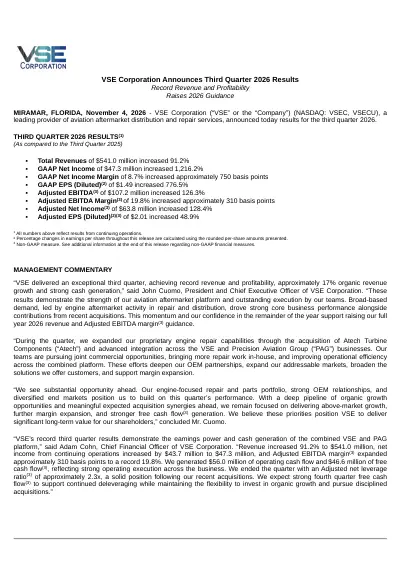
Revenue reached a record $541 million, adjusted EBITDA grew 126% to a record $107 million, and our adjusted EBITDA margin reached a record 19.8%. In addition, we delivered outstanding organic growth of approximately 17% and strong free cash flow of $47 million in the quarter.
These results demonstrate the strength of our aviation aftermarket platform and outstanding execution by our teams. The progress behind these numbers is just as important.
Our core businesses are gaining market share, integration synergies are contributing to margin expansion, and we're expanding our proprietary repair portfolio. That performance and our confidence in the rest of the year support raising both our full-year revenue and adjusted EBITDA margin guidance.
Let's now begin by reviewing three key quarterly highlights on slide 3. First, our operating results in the quarter.
Revenue grew 91% to $541 million, including 17% organic growth. Growth was broad-based across repair and distribution, led by strong engine aftermarket demand.
Contributions from new OEM distribution agreements and added repair capacity also supported the growth. Acquisitions accounted for the rest of the increase, with PAG being the largest contributor.
Adjusted EBITDA margin reached a new record of 19.8% in the quarter. Adjusted EBITDA grew 126%, significantly outpacing revenue growth.
Our core aviation business was the primary contributor behind the margin expansion. In addition, synergies from previously acquired businesses and contributions from PAG also supported the record margin.
We're raising our full-year 2026 revenue and adjusted EBITDA margin guidance. This reflects our outstanding third quarter results, continued strong demand, and confidence in the rest of the year.
Adam will walk through the details in a few minutes. Second, integration.
At VSE, integration means bringing our businesses together across systems, processes, controls, organizational structure, and branding. We do that while preserving the agility, customer focus, and center of excellence model.
All business integrations are tracking at or ahead of schedule. We've completed several acquisitions, and the integration work is substantial.
These businesses are already contributing meaningfully to our results. Synergy capture plans have exceeded initial estimates and supported our record third quarter margin performance.
We look forward to sharing more during our December Investor Day. Across VSE and PAG, our teams are pursuing joint commercial opportunities, bringing more repair work in-house, and improving operational efficiency.
As integration progresses, we expect synergy contributions to grow through 2027. Third, ATEC.
We acquired ATEC Turbine Components during the quarter. The business specializes in hot-section repairs for aircraft turbine engines, primarily on Pratt & Whitney Canada platforms.
ATEC expands our intellectual property portfolio and proprietary engine repair capabilities. It has OEM-approved repairs covering more than 300 part numbers.
We plan to continue to invest in capacity and technical capabilities to develop new repairs and support expanded organic growth. ATEC is a well-led business with a strong culture, deep OEM relationships, and a track record of execution.
Its strategy and capabilities are an excellent fit with VSE. Let me turn to the aviation aftermarket.
The economic, geopolitical, and fuel price environment remains uncertain. Far, higher oil prices have not had a meaningful effect on customer demand, order patterns, or operator behavior.
Customers continue to plan their maintenance and parts needs much as they have throughout the year. In commercial aviation, demand remains strong.
Aircraft and engines are staying in service longer and flying more. With new aircraft and engine deliveries still constrained, operators continue to rely on their existing fleet.
That supports demand for our parts and repair services. The engine aftermarket continues to lead, delivering the strongest growth across our core businesses in 2026.
We expect that strength to continue into 2027. Business and general aviation represents more than half of our business.
Demand was healthy in the third quarter, with flight activity and utilization above last year. The active fleet continues to grow, and the used aircraft market remains tight.
As in commercial aviation, engine aftermarket demand is particularly strong and is leading growth across our business and general aviation portfolio. These aircraft are essential to the customers who operate them.
The breadth of that customer base supports durable demand for our parts and repair services. Overall, the aftermarket environment remains supportive.
Our exposure to both commercial and business and general aviation gives us a broad customer base. Serving those customers through both repair and distribution adds to the durability of our business.
We will share 2027 guidance and forward outlook during our December Investor Day. Let's now walk through our third quarter 2026 financial highlights on slide 4.
We delivered record revenue and profitability in the quarter, a result of strong execution by our core aviation business, robust organic growth, and contributions from recent acquisitions. Revenue of $541 million was up 91%.
Organic growth was approximately 17% in the quarter. Acquisitions also contributed, including a full quarter of PAG.
Adjusted EBITDA reached $107 million in the quarter. Margin expanded approximately 310 basis points to a record 19.8%.
That reflects core business margin expansion, integration synergies, and acquisition contributions. Adjusted net income grew 120% to $64 million in the quarter.
Adjusted diluted earnings per share increased 49% to $2.01 in the quarter. I'll now turn the call over to Adam for the financial details.
Adam Cohn
Thank you, John. Let's turn to slide 5 of the conference call materials, where I will provide an overview of our third quarter consolidated financial results.
Third quarter revenue was $541 million, up 91%. Excluding recent acquisitions, organic revenue grew approximately 17%, with similar growth across MRO and distribution.
This reflects strong underlying demand and the resilience of our core businesses. Including contributions from recent acquisitions, MRO revenue increased 198%, and distribution revenue increased 27% year-over-year.
The 198% increase in MRO activity was driven by expanded repair capabilities and capacity, strong growth in engine content across commercial and business and general aviation, market share gains, increased share of wallet with existing OEM partners, and contributions from recent acquisitions, primarily PAG and Aero3. The 27% increase in distribution revenue was driven by solid execution on new business wins, product line expansion, market share gains, strong engine end-market demand, and contributions from the Aero3 acquisition.
Consolidated adjusted EBITDA increased 126% to $107 million. Adjusted EBITDA margin was a record 19.8%, an increase of approximately 310 basis points from the prior-year period.
The expansion can be primarily attributed to our core aviation business, driven by greater mix of higher-margin product and repair activity, and synergies from previously acquired businesses, complemented by contributions from PAG. Adjusted net income was $64 million, and adjusted diluted earnings per share was $2.01.
Turning to slide 6 and our balance sheet. Our third quarter results demonstrate continued progress in reducing leverage and increasing cash generation.
We ended the quarter with adjusted net leverage of 2.3 times, down from 2.4 times at the end of the second quarter. We achieved this reduction while completing the ATEC acquisition.
Operating cash flow was $56 million, and free cash flow was approximately $47 million. Free cash flow increased from $19 million in the second quarter and $18 million in the prior-year period.
This improvement reflects record profitability, a greater mix of MRO revenue, and better working capital performance. Free cash flow represented approximately 44% of adjusted EBITDA.
At quarter-end, net debt was approximately $894 million. We had $66 million of cash and $479 million of availability under our revolving credit facility.
We expect strong cash flow in the fourth quarter to support continued deleveraging. Our liquidity position also provides the flexibility to invest in organic growth and pursue disciplined acquisitions.
Let's turn to slide 7 and our updated full-year outlook. Our strong third quarter and positive outlook for the rest of the year support an increase in guidance.
We now expect full-year revenue growth of 65% to 66.5%, up from our prior outlook of 61% to 64%. Our updated guidance reflects expected seasonality, with fourth quarter revenue anticipated to be lower sequentially compared to the third quarter.
We are increasing our full-year 2026 adjusted EBITDA margin outlook, reflecting record third quarter profitability and continued operating execution on our recent acquisitions. We now expect full-year adjusted EBITDA margin of 18.9% to 19.1%, compared with our prior outlook of 18.7% to 19%.
We expect another strong quarter of free cash flow, supported by earnings growth, better working capital efficiency, and returns on earlier program investments. Our additional modeling assumptions are in the appendix.
For the full year 2026, we expect interest expense net, excluding interest income on the note receivable, projected at approximately $36 to $38 million. Depreciation and amortization are expected to be approximately $96 to $100 million in aggregate.
The effective tax rate is projected to be approximately 25% blended for the full year. Stock-based compensation is expected to be approximately $18 to $19 million.
Capital expenditures are expected to be approximately 2% to 2.25% of revenue. With that, I'll turn the call back over to John.
John Cuomo
Thanks, Adam. Let me close with our priorities on slide 8.
First, integration and synergies. Our joint commercial work across VSE and PAG has moved from planning to specific opportunities.
PAG's capabilities and market position strengthen our approach to new and existing customer and OEM relationships. We're also focused on insourcing and operating efficiencies.
We expect these benefits to build through 2027 as we launch the complete integration plan in the first quarter of 2027. Second, new distribution and OEM programs.
Our Pratt & Whitney Canada APU agreement is fully ramped and contributing to distribution results. It exceeded our expectations in the third quarter.
Our CFM56 engines purchased earlier this year are at different stages of teardown and repair within our operations. Sales have begun, and we expect contributions to build in the fourth quarter and continue into 2027.
Third, engine repair capacity and technical capabilities. Capacity added earlier this year contributed to third quarter MRO growth.
We also signed new OEM licenses during the quarter, expanding the range of repairs we can now perform. We're working with our OEM partners on opportunities to develop new proprietary repairs and have a robust outlook for 2027.
Fourth, organic growth. Several business opportunities we have pursued for some time were signed in the third quarter.
New supplier relationships also added authorized positions. We expanded our commercial coverage, including in Europe, and that work is already producing results.
Our focus now is turning the next set of opportunities into new business. Fifth, systems and processes.
We're strengthening both to support growth and future integrations. That includes using AI tools to work more efficiently and make better decisions.
Sixth, cash generation. We focused on generating strong free cash flow and continued to deleverage while funding disciplined growth.
I'm proud of our third quarter performance and the outstanding global team that delivered it. We delivered record results this quarter.
We generated strong cash flow, reduced adjusted net leverage, and raised our full-year guidance. Our core businesses are performing well, our market positions are strengthening, and our expanded platform gives us more opportunities for growth and margin expansion.
We look forward to sharing more at our Investor Day in New York City on December 9th. Registration details are on our Investor Relations page.
Thank you for your continued support and confidence in VSE. Operator, we're ready to take questions.
Operator
Thank you. As a reminder, to ask a question, please press *11 on your telephone and wait for your name to be announced.
To withdraw your question, please press *11 again. One moment while we compile our Q&A roster.
Our first question will come from Ken Herbert from RBC Capital Markets. Your line is open.
Ken Herbert
Good morning, John, Adam, and Michael. Nice results.
John Cuomo
Thank you.
Ken Herbert
Maybe just to start, I wanted to follow up, maybe Adam, on your comments around the margin expansion in the quarter. I think you specifically called out the core business as the key driver with mix and synergy from prior M&A.
I'm wondering if you can give a little bit more detail or quantify how much sort of the core business saw margin expansion in the quarter as we think about that relative to M&A and synergy on the PAG deal.
Adam Cohn
It's a good question, Ken. I'd say as we said, a majority of the expansion is really coming from the core business.
Of the core business, that really includes multiple things. One is just we continue to see very strong organic growth, especially in the higher-margin engine aftermarket businesses.
A few of those businesses are some of the legacy acquisitions that we've acquired, like a TCI or a Kellstrom, which are more focused on the commercial engine aftermarket. We've seen very strong growth in those businesses above the organic growth that we're reporting, and also very strong margin expansion.
I'd say that that's a combination of the growth and then the integration of those businesses into one VSE. It's a combination.
We continue to focus on insourcing activities both on the distribution and the repair side, which is contributing to higher margin percentages. Then obviously, PAG is contributing as well given the margin profile of that business.
That's less than a majority of the overall margin increase year on year. It's a combination of all those factors.
Ken Herbert
Great. Thanks, Adam.
If I could, the fourth quarter guide implies a fairly material sort of step-down in organic growth. You call out seasonality.
I'm just curious, is that seasonality predominantly isolated to the PAG business, and that's what's driving some of the conservatism on the fourth quarter, because it doesn't look like historically the core business had much seasonality. Maybe if you could talk about just conservatism or anything else in particular we should keep in mind as we think about fourth quarter and the implied growth.
Adam Cohn
No changes in the demand environment or anything like that. It is more about seasonality and just some of the quarterly variability.
Like you mentioned PAG. That business tends to be a little bit more seasonal.
Aero3 in particular tends to be more seasonal, where their Q4 historically has been lower than their Q3. Then our business historically predominantly distribution, that is flipped to repair.
The repair business tends to be a little bit more seasonal in the fourth quarter. I think it's just really about the mix and the shift.
Adam,
John Cuomo
the last thing I'd add is we had a very, very odd fourth quarter of December of last year, meaning that it was probably one of the strongest Decembers in the seven years I've been in the business. It was just extremely kind of out of character, and there's just a little caution around that December comp year over year.
Were there one-off sales, or are we going to see a level of consistency in December demand in '26 compared to '25? That December '25 demand was extremely, extremely high and kind of uncharacteristic.
It's just a little comp issue. No concerns on kind of organic growth for the fourth quarter.
A little bit of conservatism, I guess.
Ken Herbert
Perfect. Thanks, John.
If I could, just one final question, John. You talk about a focus on new distribution agreements.
You specifically called out, obviously, Pratt Canada and CFM56 and some of the other work. Are you getting any indication that you're seeing slower pull through your distribution channel or there's any elevated destocking or inventory risk as we head into '27?
Thank you.
John Cuomo
No, it's a great question. Our business isn't as much subject to destocking as maybe some other businesses are because north of 80, 85% of our distribution revenue is exclusive, we're controlling that market.
There's not a lot of inventory that we kind of allow to just flow in the market that would allow destocking. We have things like tires, tubes, batteries, those types of things.
Those are areas I would tell you I can give you some trends, but we're not seeing any destocking there. Then on our USM business is not core to us.
It's a critical part and necessary part of our exchange programs with our repairs. As if retirements pick up a bit and there's that supply-demand curve shifts a bit, we won't be overly subject to any risk there.
That's on the VSE side. On the market side, though, we're not seeing kind of any destocking concerns, just market in general in a generalized comment for '27 at this point.
Ken Herbert
Great. Thank you.
Operator
Thank you. Our next question will come from Sheila Kahyaoglu from Jefferies.
Your line is open.
Sheila Kahyaoglu
Good morning, guys, and great quarter, as always. Maybe if I could ask first on organic growth.
It accelerated sequentially by three points, and I know, John, you called out it was equal across the MRO business, repairs, and distribution. Maybe if you could give us a little bit more color, perhaps, on commercial versus distribution and engine and non-engine?
John Cuomo
I was going to highlight that. I don't have the precise percentages.
I don't know, Adam, if you have just kind of a range for Sheila just to get a feel, but I would tell you that the core business non-engine was still performing well, think kind of high single digits to low double-digit growth, depending on the capability set. Then the engine business, commercial faster than business and general aviation, but both of them still having strong growth in the quarter.
Those were the businesses that you saw closer to that, let's say the high end, closer to that 20% growth in the quarter. We have parts that are on kind of legacy engines as well as LEAP.
We have repairs that support both, and it was quite consistent. I don't have the exact percentage off the top of my head, Adam, I don't know if you want to give any more color on that.
Adam Cohn
No, I think the percentages that you gave are directionally correct.
Sheila Kahyaoglu
Okay. Perfect.
Then if I could ask one more question, and I know, John, you'll release this Chapter 3 of your book on December 9th, but since you acquired ATEC in the quarter, and the theme has been between PAG and ATEC to meaningfully expand the portfolio of potential repairs, can you talk about what ATEC adds that you didn't previously have when it comes to engine repair and capability, and how we think about the margin profile of that business?
John Cuomo
I'll show you I think I've kind of shown it before, kind of how we look at the business with repair and distribution capabilities and then our proprietary solutions business, which we'll talk a lot more about during our Investor Day, and that's obviously on the higher end of the margin profile because we own the IP. ATEC is building proprietary repairs.
They're very OEM-aligned in how they're building them, but there's about 300 repairs where they essentially own the IP, they're creating the repair, and they're in the manual. You think of them more at the high end of an IP-profile business rather than as a commoditized profile business.
I didn't give the exact margins, but I would tell you well north of where we're performing today.
Sheila Kahyaoglu
Great. Thank you.
Operator
Thank you. Our next question will come from Louis DiPalma from William Blair.
Your line is now open.
Louis DiPalma
John and Adam and Michael, good morning. Congrats on another quarter.
It was very like the Miami Hurricanes. In the past
John Cuomo
We got an injury now though, Louis, I'm a little nervous about the Hurricanes.
Louis DiPalma
I think they'll be okay. In the past, John, you discussed your land-and-expand strategy with your existing OEM partners, Pratt & Whitney Canada, Eaton, TransDigm, and Honeywell, and often you've been able to win distribution deals without them coming out to bid.
Has this continued in terms of your organic growth strategy, and what do you see in terms of the pipeline for other distribution and MRO deals over the next year or so?
John Cuomo
The pipeline looks good. When I look at kind of what the pipeline looks like, how I feel about it, I feel great.
I think that it still remains 75%-plus of the work, I think, is work where we're solving problems rather than going through a competitive RFP process. Where I caution is just it's difficult to always time the execution and when you can convert those into actual contracts, and then when you can convert those contracts into revenue and earnings.
That's kind of the color we have to get around. When we look at the next three years, and as the OEMs continue to shift their focus onto next-gen platforms, we see both opportunities to support them there, and as some of the legacy work becomes more non-core, to continue to expand our share with those OEMs on those legacy platforms as well.
Louis DiPalma
John, and for Adam, I know that the team has discussed how increasing proprietary content will be a major source of margin expansion for the next three years, and you're going to provide more commentary on this on December 9th. How much more margin potential is there also with just scaling MRO in terms of the traditional insourcing driver that you discussed as one of the main synergies with the PAG acquisition?
John Cuomo
You can run a low-20s EBITDA margin business with kind of commoditized-type work if you can optimize price and efficiencies on the SG&A line. You run a good business, you can break that 20% barrier.
You want to start to move into the big leagues on the margin percentage and move more towards that mid-20s, mix becomes a bigger conversation. Having more proprietary content definitely becomes a bigger discussion.
Louis DiPalma
Great. That's it for me.
Thanks, everyone.
John Cuomo
Thank you.
Operator
Thank you. Our next question will come from John Godyn from Citi.
Your line is open.
John Godyn
Hey, guys. Thanks for taking my question.
I wanted to just talk a bit more about M&A. Normally, we all ask for a temperature check on the M&A pipeline, which I would love to get, but I also wanted to chat about whether your experience with PAG, which is just such a strong example of your ability to integrate transformational deals, and that's not something every company can do, has perhaps reframed the art of the possible for you?
Has it opened up the aperture in a way that maybe a year ago, you would have been shier about?
John Cuomo
That's a good philosophical question to think through. I'd say absolutely.
I think, on the positive side, I think that we have a very and we'll talk more about this at the Investor Day, as we build kind of the framework and the platform for how do you become a business that's doing, let's say, $800 million of EBITDA. We feel very confident in the platform that we can build that can kind of not just double revenue, but double-plus earnings, right?
I think that the model where it drives concern is the pace in which we can do deals that need to be integrated because you can only integrate so much at a given time. We constantly are looking at prioritization, which businesses can operate kind of on their own and can be at the back end of the integration cycle versus which ones need to be at the forefront, where we potentially have cracks in the foundation that we need to fill, and then what does that framework look like so that we can start to really look at kind of doubling the business in the next kind of chapter.
Absolutely, I think it's developed a level of confidence in that integration muscle and our ability from an organizational design perspective as well to put the right capabilities together. I'd add one more thing that what PAG showed me is the optionality in the strategy.
The strategy is still very tight in what we want to do, but it's broad in terms of customer base, capability sets. It does give us a lot more optionality, and it's kind of opened my aperture a bit on M&A pipeline as well.
John Godyn
Okay. Great.
I'm sure we'll hear more about that at the Investor Day. Can I just ask one more on visibility?
When we just kind of think about the stock this year, if oil prices go up, the stock goes down. If oil prices go down, the stock goes up, and investors seem to tie visibility and organic growth to the price of oil.
I was hoping maybe you could just sort of reflect on that, and maybe offer some data points on the visibility that you guys have going forward, because clearly your results have not been as sensitive to macro as maybe the stock would suggest.
John Cuomo
It's tough to post a quarter like we're posting today knowing that fuel prices and kind of global wars and such kind of create a cloud over results as strong as we've posted today. We look at kind of near 30, 60, 90, 180-day demand and kind of what that looks like from our customers.
We look at kind of how OEMs are investing in us and in their own aftermarket, and the trend data that they see. Then we look at kind of the longer tail kind of heavy checks, both in terms of airframe and in terms of engines, and none of those trends have shifted.
What you see in terms of airlines kind of modifying schedules or slowing down of RTKs, that was all going to happen regardless of the war. I think one of the things to clarify, and everyone's got their own data on how they're looking at the market, but as we've kind of recovered from COVID, as the markets have scaled, we've all been able to post kind of low to mid double-digit growth rates organically.
Regardless of anything on the global economic situation, we saw those growth rates kind of moderating a bit, not in a bad way, it's still nice high single-digit growth rates. I believe that's going to be consistent for the next two to three years, subject to no kind of global recessionary impacts.
I think that what we had kind of forecasted out over the, let's say a year, a year and a half ago as we looked at the next three to four years, we don't see any change near term in that demand profile.
John Godyn
Great. Appreciate the color.
Thank you.
Operator
Thank you. Our next question will come from Scott Deuschle from Deutsche Bank.
Your line is open.
Scott Deuschle
Hi. Good morning.
John or Adam, can you say how much BGA engine aftermarket has been growing in recent quarters, and how that compares to commercial engine?
John Cuomo
We don't break it out precisely. I would tell you that the commercial is definitely growing at a faster pace, think more above where we posted for the quarter is where the commercial is, and slightly below where we posted, but still double-digit growth rate on the B&GA side.
There is a difference there, but if you're ranking them, it's kind of commercial engines, B&GA engines, and then the airframe work for the two together kind of is the third bucket.
Scott Deuschle
Okay. That's helpful.
Then, Adam, can you walk through what drove the continued growth in the inventory balance in the third quarter? I think the burn is $150 million year to date.
Then should inventory be a source of cash in the fourth quarter?
Adam Cohn
Yeah. Thanks for the question.
It was really just aligning with our growth, some of the opportunistic buys that we had in the quarter, more kind of ordinary course growth, nothing out of the ordinary. Typical replenishment on some of the inventory distribution programs, and then just more the ordinary course.
I wouldn't say it will completely be a source of cash in Q4, given where we've been growing organically. I think it'll be flatter, maybe a slight use, but much less so than what we've seen in the first half and in the third quarter.
Obviously, third quarter was an improvement over the first two quarters of the year, but still a use of cash in that quarter.
Scott Deuschle
Okay. Then, John, where does free cash flow rank on your list of priorities for financial metrics over the coming years?
John Cuomo
It's a good question because, I've joked in the past that we were building a business with only two legs of a three-legged stool, and it wasn't a key priority for the business. It is definitely, I would say, equal weight in terms of priorities at this point.
We always look at how do we continue to drive above-market revenue with quality revenue, how do we continue to focus on margin expansion to get our margin, we want to break that 20% margin barrier, adjusted EBITDA consolidated margin. Then really free cash flow has become kind of equal weight in terms of focus, and you'll see much more of that focus as we get into '27 as well.
I'd say as the business is maturing, it's become a much more balanced, equal-weighted business, and you'll see it in our incentive plans and metrics as well.
Scott Deuschle
Thank you.
Operator
Thank you. Our next question will come from Kristine Liwag from Morgan Stanley.
Your line is open.
Kristine Liwag
Hey, good morning, everyone. I wanted to follow up on PAG.
Hey, John. You guys recorded approximately $34 million of contingent consideration at the acquisition, and I think that was against a maximum contract of $125 million.
When we look at 3Q, we saw that you've recognized about $8.9 million in reduction in fair value for this earnout contingency. Can you walk us through what drove that remeasurement, particularly how is PAG tracking against that original 2026 adjusted EBITDA assumption, and how should we think about the current expected payout relative to that initial $34 million versus the $125 million maximum?
Adam Cohn
I can take that one, Kristine. I would say the entirety of the fair value adjustment is because of the mathematical modeling, essentially rerun a Monte Carlo simulation.
As you get further through the year, there's less of a projected period, and so the models run less upside scenarios. That's strictly a function of the mathematical modeling.
Our expectations in the business have really not changed at all. Performance has been very consistent with our expectations.
That's entirely what's driving that change in the fair value.
Kristine Liwag
I see. Then when we look at 4Q, when you think about the performance where the upside might be a little bit lower than what you would have expected, are there areas that you could highlight that if it would have gone better, maybe this adjustment wouldn't have occurred?
What were those considerations, and what would have had to happen for that $125 million maximum payout to have occurred?
Adam Cohn
We talked about in the past. That payout was really aligned to, when you go through these processes, you have a sell-side forecast and a buy-side forecast.
The earnout was really to give the opportunity for payout relative to that sell-side forecast. Like I said, our buy-side forecast has really been unchanged.
The business is performing very consistent to what we expected.
Kristine Liwag
Great. Thank you.
John Cuomo
Thanks, Kristine.
Operator
Thank you. Our next question will come from Jeff Van Sinderen from B.
Riley Securities. Your line is open.
Jeff Van Sinderen
Hi. Good morning, everyone, and let me add my congratulations on the strong metrics for the quarter.
John, could you maybe speak more on your latest thoughts regarding leaning into the proprietary nature of some parts of your business as we head into 2027? Also, would incremental acquisitions emphasize proprietary, and are you seeing targets with that quality in the pipeline?
John Cuomo
It absolutely is core to our next chapter to think through kind of the and we'll walk much more through this at the Investor Day, the three kind of buckets, for lack of a better word, of proprietary solutions where we are focusing on repairs, manufacturing, and parts, where we want to focus the next phase of growth. It will come from a balance of organic and inorganic.
ATEC was an absolutely outstanding acquisition. Rita is an amazing leader and thrilled to have her on the team.
Those are absolutely the core type of deals that we'd like to have out there. I'd say we feel good about the inorganic pipeline as well as the organic pipeline.
It'll be slow and steady kind of growth, and as a percentage of total sales, the goal is how do you double that percentage of sales that come from the proprietary solutions bucket over the next chapter. Expect it to be kind of a combination of organic and inorganic.
Jeff Van Sinderen
Okay. Great.
Thanks for taking my question. I'll take the rest offline.
Operator
Thank you. Our next question will come from Louis Raffetto from Wolfe Research.
Your line is open.
Louis Raffetto
Hey, good morning.
John Cuomo
Morning.
Adam Cohn
Hey. Maybe,
Louis Raffetto
Adam, just to follow up on the free cash flow. I guess, is there any reason that you mentioned it will be strong in the fourth quarter.
Any reason we don't see acceleration like we saw 3Q to 4Q last year?
Adam Cohn
I don't want to say acceleration. The third quarter was very, very strong result for us, much stronger than last year's third quarter.
I think we were up close to $30 million free cash flow. I would say strong.
We're going to expect to see continued earnings growth, obviously, working capital continues to be less of a use, just naturally. Then, obviously, the business has shifted to less working capital intensive MRO, especially with PAG.
We're expecting another strong result. I don't want to say above third quarter, but it'll be a good result.
Louis Raffetto
Okay. Then maybe just on the interest expense, just trying to understand what drives the sequential pick-up there, given you generated cash in the third quarter and the fourth quarter.
Is there something that's driving up that expense sequentially?
Adam Cohn
No, it's really just the timing of the ATEC acquisition, increasing our debt for that purchase, and then just some of the interest rates that have been going up. We're seeing some sequential increase.
There's probably a little bit of conservatism in the implied 4Q guide, but you should see some sequential increase.
Louis Raffetto
All right. Perfect.
Thank you.
John Cuomo
Thank you.
Operator
Thank you. Our next question comes from Jonathan Siegmann from Stifel.
Your line is open.
Jonathan Siegmann
Hey, good morning. Thanks for taking my question.
Great results. Last quarter, you talked about supply availability improving in some areas and getting worse in others.
Just how's the stay of the land now? What's getting better?
What's getting worse?
John Cuomo
It's the same this quarter. I'd say we saw a few areas of improvement where kind of our pipeline of products are stronger.
Bearings is a recurring issue and a hot topic inside of our business, and specifically in our MRO shops today. I would say the concept of overall market improvement on supply chain, we at VSE are not specifically seeing.
It's still that whack-a-mole game, and we still tend to see the bearing and a few other products continuing to be the most concerning for us in the pipeline.
Jonathan Siegmann
Thank you. Maybe just as a follow-up at a higher level, John.
We're probably causing some of your procurement guys headaches, but you guys are making some deals based on solving the problems for the OEMs. Just, can you talk about those two countervailing forces, and just are you cheering for these kind of industry positions to persist?
Is it more positive versus negative, anything on that? Thank you.
John Cuomo
I'm a believer in you want the large OEMs to always be successful because you want to have a healthy market. You want the airlines to be successful and profitable because that drives a healthy market.
I think some people feel that when the OEMs struggle or the airlines struggle more than normal, they need more of our parts and services. I don't necessarily come from that ilk.
I think that there's plenty of work for us when there's a healthy market, and retirements have been at record lows, having the OEMs build more airplanes and meeting demand is not necessarily a bad thing for us in totality. I'm kind of agnostic.
Our job is to stay ahead of it and make sure, as things happen, that we can pivot faster than anybody else to continue to support both the end users and the OEM partners as needed.
Jonathan Siegmann
Look forward to December 9th. Thank you.
John Cuomo
Thank you. Appreciate it.
Operator
Thank you. Our next question will come from Michael Leshock from KeyBanc Capital Markets.
Your line is open.
Michael Leshock
Hey, good morning. Just wanted to follow up on the fuel prices.
You had mentioned you're not seeing any demand disruption at all from that. I know the situation remains dynamic, but do you have a sense of how much longer an extended duration of higher fuel prices would have to last before you'd start seeing an impact?
Did you initially expect demand would remain this strong in light of higher fuel prices for the better part of a year? Was this a surprise to you, or consistent with what you've seen in past cycles?
John Cuomo
I think there's a couple of differences in this cycle. I think it all starts with the end-user demand and the profitability of the airlines.
I think the profitability of the airlines concerns me more right now than the end-user demand. I think it's all about how many conferences do you go to a year?
How many vacations do you take a year, and when do you change your decision-making point because ticket prices are too high? The biggest difference in this cycle is there's just not the knee-jerk reaction from anybody because we all went through that in the past, and what we've learned is turning the spigot off is easy, turning it back on is difficult.
I think there's a lot more disciplined approach to how to manage a slight downturn if it happens. That's kind of what I anticipate.
As I said a little bit earlier to another question, I believed that the market was going to moderate slightly to kind of a high single-digit growth rate market in '27, '28 anyway. Right now, those trends are holding tight.
I do think that if fuel prices stay high and inflation stays high, eventually you have some consumer decision-making points that can impact the market. I would say, though, that if the markets are impacted in a low single-digit percentage in terms of fleet, whether it's hold and rotate aircraft, holding on schedules, it's not going to have a dramatic impact on a business like ours.
Will it slow growth 100 basis points, maybe, but it's not going to really negatively impact my revenue or earning forecast that I put out there. For us, we need to see a little bit more of a significant slowdown, and at this point, right now we don't see that impact at this point.
Michael Leshock
Great. Then just on the footprint, wanted to ask on your current capacity and slated expansions that you've talked about.
What's the latest on where you stand today in that regard, and any new thoughts on expansions or any additional areas of capacity that you might be contemplating over the mid to longer term? Thank you.
John Cuomo
We'll lay out kind of the capital allocation strategy both for organic and inorganic in December, but just to give you a preview, we have some of our commercial and business and general aviation engine business markets that we think will be the most resilient regardless of kind of downturn or continued kind of robust market that we will invest in, where we're a little bit more capacity-constrained. Then there's some of our international opportunities that we believe it's kind of easier and more financially beneficial for us to do it organically versus inorganically.
We'll talk about those markets as well. Expect to be more engine-focused and a little bit of international, and mostly on the repair side is where we'll add capacity.
Michael Leshock
Great. Thanks so much.
John Cuomo
No, thank you. Appreciate the question.
Operator
Thank you. As a reminder, to ask a question, please press *11.
Our next question will come from Michael Ciarmoli from Guggenheim Securities. Your line is open.
Michael Ciarmoli
Hey, morning, guys. Nice results.
Thanks for taking the question. John, you're clearly not building a commoditized aftermarket big business, not to put the cart ahead of the horse here, but if you want to get to the big leagues and do mid-20% margins, are there any holes in the portfolio that you need to fill?
Do you think you've got sort of what it takes currently? I think maybe I've asked this before of you guys, do you think you need defense aftermarket?
Is that something you would add to the portfolio? Even I don't think pricing came up as it related to margins currently in this quarter, or how to think about pricing in terms of margin expansion going forward?
John Cuomo
You got two questions in there. I think first, on the capabilities, what's unique about what we're building is it's far more of a center of excellence model than an exact tip-to-tail model.
There are areas, whether they're on airframes or engines, more on legacy products, that we think we can provide more of a tip-to-tail model to some of our end users, where they want it, and we think it's the right model for us because the margin profile across that capability set makes sense for us. For other capabilities or customer bases, we don't think it makes sense for us or for the market for us to provide a tip-to-tail market, we'll have more of a center of excellence model where it's capability by capability or airframe or engine by airframe or engine.
What that allows us to do is be far more disciplined about what we add, and it also brings a broader perspective. There's nothing I need, it's just finding what's the right fit, and continuing to look at where we actually add value, where the OEMs and the end users are very comfortable with our positioning and the IP that we will kind of own and bring to the market.
I know it's a generalized answer, but that's kind of more how we approach it than I say, I need this to get to a 20-X percent margin. That's not the way we look at the business or what we need.
With regard to defense aftermarket, there are many areas of defense And by the way, we've been growing our defense business organically. The PAG team has done an outstanding job, they had a great quarter in terms of their defense aftermarket business.
We continue to look at that as opportunities. You just haven't seen me make a big play inorganically.
There's a few assets that really are high quality that I think would really propel us in the right direction. If the stars align there, it works.
If not, we'll continue our organic approach. There are things just like on the commercial side that we want to do in defense, and things that don't fit us for a number of reasons in areas that we don't want to play.
I wouldn't say it's a necessity, but if and when we find the right opportunities, I think it would be a nice diversification strategy in terms of customer mix. The last question on price, I'd say where we looked at price-volume mix very much in the aggregate, we are a every part has a story business.
Let's just say, as you were coming out of COVID, inflationary issues on both labor and product costs, price might have been 60% plus of the total revenue growth. It's moderating to 50-50, or even slightly less than that in terms of total growth.
Michael Ciarmoli
Got it. Helpful.
I'll take the rest offline. Thanks, guys.
John Cuomo
Talk to you later, Mike. Thank you.
Michael Ciarmoli
Thanks.
Operator
Thank you. I am showing no further questions from our phone lines.
I'll now like to turn the conference back over to John Cuomo for any closing remarks.
John Cuomo
Thanks, Crystal. Appreciate the support today.
Thank you to our investors, to our shareholders, to our customer and supplier partners, and most importantly, to our teams for delivering an outstanding quarter, and the confidence in VSE, specifically during these slightly turbulent kind of global times. We continue to remain extremely focused and disciplined on our strategy and execution, and look forward to seeing and talking to many of you during our Investor Day in December.
Have a great rest of the day, great rest of the week. Thanks, everyone.
Operator
Thank you for participating in today's conference. This does conclude the program, and you may now disconnect.
Everyone, have a wonderful day.