VirTra, Inc.
NNASDAQ:VTSIQ4 FY2025 · Earnings Call TranscriptMarch 26, 2026
Operator
Good afternoon, and welcome to VirTra's fourth quarter and full-year 2025 earnings conference call. My name is Diego, and I will be your operator for today's call.
Joining us for today's presentation are the company's CEO, John Givens, and CFO, Alanna Boudreau. Following the remarks, we will open the call for questions.
Before we begin the call, I would like to provide VirTra's safe harbor statement that includes cautions regarding forward-looking statements made during this call. During this presentation, management may discuss financial projections, information, or expectations about the company's products and services or markets, or otherwise make statements about the future, which are forward-looking and subject to a number of risks and uncertainties that could cause actual results to differ materially from the statements made.
The company does not undertake any obligation to update them as required by law. Finally, I'd like to remind everyone that this call will be made available for replay via a link in the Investor Relations section on the company's website at www.virtra.com.
Now, I'd like to turn the call over to VirTra CEO, Mr. John Givens.
Thank you. You may proceed, sir.
John Givens
Thank you, Diego, and thank you, everyone, for joining us this afternoon. After the market closed today, we issued the press release that provided our financial results for the fourth quarter and the full year ending December 31st, 2025, along with an update of our business and operating environment.
2025 was defined by an extended and highly atypical disruption in federal funding. These delays affected the timing of awards, procurement activities, and ultimately system deliveries across our core markets.
As a result, our reported revenue does not fully reflect the level of underlying demand or activity across the business. What I want to do this afternoon is walk you through what drove the disconnect, what we are seeing change in the funding environment, and how we are positioned as these conditions begin to normalize.
Let me start with the funding environment because that has been the primary driver for our results. The federal funding freeze that began in 2024 was unlike anything that we've seen.
Budget approvals that were expected to flow in fiscal year '25 were held, and agencies were limited to their ability to move forward with procurement. That dynamic persisted through the fourth quarter.
What has changed more recently, in the last several days, is that we are now seeing those programs begin to reopen. Specifically, just in the past week, the Justice Assistance Grant, or JAG, and the COPS fund have both reopened for applications.
Importantly, this includes fiscal year 2025 funding that was approved in the federal budget back in October of 2024 and has been frozen since. It is only now being made available, but that gives you an indication of the extent of the delays we've been operating through.
Behind that, additional funding cycles are progressing as fiscal year 2026 and expected fiscal year 2027 allocations are moving through the system at the exact same time. As a result, we are seeing a meaningful increase in customer engagement and applications across our base.
We are actively working alongside those customers as they move through the grant application and approval process. As we've noted before, this remains a multi-step process.
Customers must apply, awards must be determined, and purchase orders must be issued, and then the systems must be delivered and accepted. We are staying closely engaged throughout the process to help conversions wherever we can.
Based on what we're seeing today, that process is likely to play out over the coming quarters rather than all at once. While the environment is clearly improving, the timing of revenue conversions will continue to be driven by those external funding timelines.
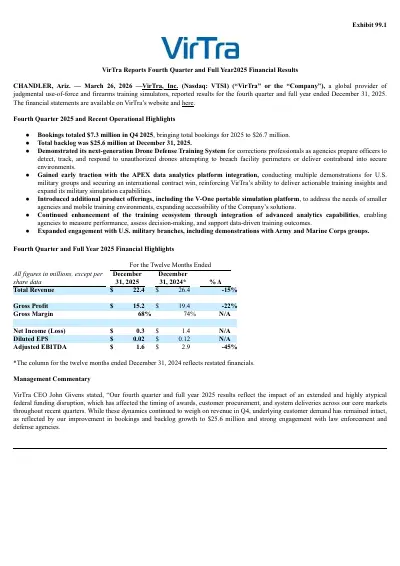
One point I want to be clear on is that demand has remained strong throughout the period. We closed 2025 with $25.6 million in backlog and generated $26.7 million in bookings during the year.
In many cases, orders have been already placed, but customers are not yet in a position to take delivery, either due to funding timing or the readiness on their end with buildings and space. We are also seeing this dynamic internationally, where contracts are in place across markets in EMEA and Latin America, but deliveries are tied to customer-side funding or operational readiness to accept.
The core dynamic we've been operating in is not a lack of demand, but the delay in conversion. We are ready for that conversion.
We have used this period to align our operations, inventory, production capacity so that we can fulfill orders quickly as they come through. Our inventory levels are where they need to be, our production processes are optimized, and our team is positioned to execute.
As funding is secured and purchase orders are issued, we expect to be able to move quickly from order to delivery. At the same time, we have made targeted investments in our sales organization in recent quarters.
We are adding a second dedicated federal sales resource to increase coverage in that channel, which has a longer and more relationship-driven sales cycle. This allows the rest of our team to stay focused on law enforcement, where we already are seeing reengagement as the grant programs open.
We have also recently added an experienced director of marketing with deep simulation and defense industry roots. Our marketing cadence has increased meaningfully at the start of 2026, building on the website redesign we completed last fall.
We are seeing early signs of improved engagement, including higher volumes of inbound activity and demo requests, increased time spent on our website, and more qualified leads. We're also planning to expand our presence at key industry events to further strengthen visibility and pipeline development in 2026.
Additionally, we continue to progress through the GSA reentry process, which we believe should be completed by Q3 and will shorten the path for agencies from interest to order once completed. We are continuing to engage with federal training stakeholders, including agencies with DHS, where we believe our solutions align well with evolving use cases around immersive judgment, de-escalation, and scenario-based readiness training.
On the product side, our focus has been on increasing the value of our platform and delivering the best possible training outcomes in the industry. I want to highlight several developments that I believe are meaningful for our competitive position and long-term growth.
First, our Apex analytics platform is now integrated across our system, enabling customers to capture and analyze performance data in real time and generate actionable insight around accuracy, reaction time, and decision-making. Apex is a meaningful step forward from traditional training environments and has already been a strong differentiator in recent customer wins.
Apex also created the opportunity for ongoing engagement through customization and servicing, which could support a meaningful additional revenue model over time. We've also continued to advance our integration with VBS4, allowing for more flexibility and customized training environments tailored to specific customer requirements.
We've demonstrated these capabilities with multiple U.S. military groups in real-world training settings where feedback has been encouraging and highlights the relevance of our platform in a more advanced training use case.
Over time, this integration should further expand our role within the military training ecosystem and support additional services and development opportunities. In addition, we've introduced a drone defense training solution recently, which is designed for corrections professionals, helping agencies prepare for the growing threat of unauthorized drones in secure environments.
This represents an expansion of our addressable market into a new and evolving use case where we are beginning to see early interest and engagement. Adoption of the V-XR platform continues to grow as well, with multiple systems sold in recent months and additional demand building in the pipeline.
Across our product initiatives, the common theme is improving the value of our platform and deepening integration into agencies' training workflow. Our military pipeline continues to develop, with active programs and evaluations underway across the Army, Navy, and Marine Corps.
We currently have multiple opportunities in process, including demonstrations of our capability in real-world training environments. These opportunities are supported by our enhanced reporting, analytics, and customizable training environments.
In this period of lower revenue conversions, we have been focused on ensuring our solutions remain aligned with evolving military programs and requirements. To summarize, 2025 was challenging year driven by external funding disruptions that impacted timing.
We are now seeing clear signs that funding is moving again with multiple cycles in progress. We've maintained a strong customer engagement, built backlog, strengthened our commercial organization, and prepared our operations to execute.
As those fund cycles translate into awards and purchase orders, our focus is on converting that activity into revenue in a disciplined but efficient way. With that, I'll turn the call over to Alanna for detailed financial review.
Alanna?
Alanna Boudreau
Thank you, John, and good afternoon, everyone. Now let's review our audited financial results for the fourth quarter and full year ended December 31st, 2025.
Our total revenue for the fourth quarter was $2.9 million, compared to $4.7 million in the prior-year period. The decrease was driven by those continued delays in government funding, the timing of customer procurement cycles, and deferred deliveries across both domestic and international customers.
For the full year, our total revenue was $22.4 million, compared to $26.4 million in 2024. The decline was primarily due to extending funding delays throughout the year.
Breaking our full revenue down by market, our government revenue for the year was $17.8 million, compared to $22.9 million in 2024. International revenue for the year was $4.2 million, compared to $3.1 million in 2024.
Commercial revenue was approximately $400,000, consistent year-over-year. Our gross profit for the fourth quarter was $1.7 million, or 58% of total revenue, compared to $2.9 million, or 62%, in the prior-year period.
The decline was primarily due to that lower revenue volume. For the full year, gross profit totaled $15.2 million, or 68% of revenue, compared to $19.4 million, or 74%, in 2024.
Our net operating expense for the fourth quarter was $3.3 million, a 23% decrease from $4.2 million in the prior-year period. For the full year, net operating expense was $14.8 million, compared to $17.4 million in 2024, representing a 15% reduction as we actively managed costs while continuing to invest in key areas of the business to help reaccelerate our growth.
Operating loss for the fourth quarter was $1.6 million, compared to $1.3 million in the prior-year period. For the full year, operating income was $0.4 million, compared to $2 million in 2024.
Net loss for the fourth quarter was $1 million, or 9 cents per diluted share, consistent with the prior-year period. For the full year, net income was $0.3 million, or 2 cents per diluted share, compared to $1.4 million, or 12 cents per diluted share, in 2024.
Our adjusted EBITDA for the full year was $1.6 million, compared to $2.9 million in the prior-year period. As we turn to the balance sheet, we ended the year with $18.6 million in cash and $30.8 million in working capital.
This provides flexibility to navigate the current timing dynamics in the business. VirTra defines our bookings as the total of newly signed contracts, awarded RFPs, and purchase orders received in a given period.
Our bookings for the fourth quarter totaled $7.3 million, contributing to the full-year bookings of $26.7 million. VirTra defines our backlog as the accumulations of bookings from signed contracts and purchase orders that are not yet started, or are incomplete in their performance obligations, and therefore cannot be recognized as revenue until delivery in a future period.
We segment that backlog into three primary categories: Capital, which includes our simulators, accessories, installation, training, custom content, and our design work; Service, which is primarily extended warranty and support contracts; STEP, which is our long-term subscription-based program. Our backlog at December 31st, 2025, stood at $25.6 million.
That included $13.8 million in Capital, $5.1 million in Service, and $6.7 million in STEP contracts. That concludes my prepared remarks, and I'll turn the call back over to John for his closing comments.
John?
John Givens
Thank you, Alanna. At the start of 2026, we are beginning to see the macro conditions shift, with funding moving back into the system and activity increasing.
We have used this period to strengthen our sales and marketing execution and enhance our product capabilities. With a robust backlog, continued supportive engagement, and the operational infrastructure and processes in place to scale, our focus is on converting that activity into revenue in a disciplined and efficient manner.
That concludes my prepared marks. Operator?
Operator
Thank you. At this time, we will conduct the question-and-answer session.
If you would like to ask a question at this time, please press star one on your telephone keypad. A confirmation tone will indicate that your line is in the question queue.
You may press star two if you would like to remove your question from the queue. For participants using speaker equipment, it may be necessary to pick up your handset before pressing the star keys.
We'll pause for a moment while we poll for questions. Your first question comes from Jaeson Schmidt with Lake Street Capital Markets.
Please state your question.
Jaeson Schmidt
Hey, guys, thanks for taking my questions. John, just hoping you can expand a little bit about your commentary on the expansion of engagements with the military market.
Just curious if that is expanding into different programs, is it kind of additional systems being trialed, or how should we think about that?
John Givens
Though all of those are accurate. We have multiple engagements across Army, several, and Navy, and in the Marine Corps.
We've engaged with them to find out exactly what they're looking for on the systems. My commentary previous about how we are focusing on the systems and making them military-ready, it hardened them for LE as well, but there is a different dynamic in which the military requires a very dynamic, adaptive as they think and learn on a system, so that's where VBS came into play.
There's no secret. They're out there as the SVT, the Soldier Virtual Trainer.
There's several others that are out there as well, and extending some of the ones that we currently have with ADMRE and with Special Operations. Navy has contracts coming up, and our engagements at I/ITSEC, the large show in Orlando, was quite a hit.
We have one box called our V-100 Next Generation, which puts everything in one box, it's portable, and it's a hit, and they're looking to replace some aging systems and ones that have lack of technology and aren't nearly as mobile out there in the field. We've really honed our training and also our system to meet those needs, and they're all benefiting.
There are programs out there that you can look up that I've mentioned on these calls before. That's there.
We also have several other military groups that they're taking our systems and they're doing evaluations with their staff, like gunnery sergeants and those sorts of things, and looking at it as a replacement. The activity is quite robust right now.
Much longer sales cycles, but we've been at it for a bit, we're looking forward to those coming to fruition.
Jaeson Schmidt
Great. That's good to hear.
Then understanding that the funding environment remains challenging, just curious what you're seeing from sort of a quoting activity standpoint so far this year and just overall kind of sales touchpoints even against this kind of more challenging backdrop?
John Givens
As I stated, the demand has remained high, and I would say is even higher. What our focus has been is a lot of these agencies have relied on multiple different grants that came from multiple places.
As I stated, it's been unfortunate because none of the money that was allocated in these grants for fiscal year '25, which was awarded in October of '24 and then subsequently '26 is in October of '25, those have just been released. I've been on Capitol Hill, and we've been going through why it's important, and we've been in front of legislators and said they need to release the money.
What we do expect is a pretty regimented release of funding. The only caveat to that I would say is, the quoting has increased.
We've got the quotes out there, and they're just sitting. Then, unfortunately, because we can't legally submit these grants, we help them in any way that we can and stay side-by-side with them.
We have people in-house that were giving them the information that they need about the system and helping what we can, and they still have to submit it and then they still have to be down-selected. There still is a bit of a process, but we haven't even had that process moving for the last two years.
That's a great sign. As far as other activity, we're also starting to see, on the same timeframe, our international market, we're starting to see those moneys flow as well.
The only moneys that are not flowing is DHS. As we have DHS with Customs and Border Patrol is our customer, and we have Secret Service, our customer, and we have Coast Guard, and so as we talk about them as their upcoming upgrades and purchasing new systems, all that's come to a grinding halt.
That's the only one that we're down that path and it just came to a halt. There's other agencies as well, as you know about, that are also engaged with us wanting systems.
The orders, the interest, the demand, it's all there. Just got to free up the funding.
We're doing everything we can to help move that forward.
Jaeson Schmidt
Gotcha. That's really helpful.
I'll jump back into queue. Thank you.
John Givens
Thank you, Jaeson, for your questions.
Operator
Thank you. A reminder to the audience, to ask a question, press star one on your phone, and to withdraw your question, press star two on your phone.
Your next question comes from Richard Baldry with ROTH Capital Partners. Please state your question.
Richard Baldry
Thanks. Sort of following on that, and building on what you've talked about during the call, could you look even more detail at sort of the process it'll take to get the money to move?
While it's been held, have people been building sort of grant documentation so that could move across the table very quickly? Did they, for some reason, not start that so that process still has to fully take place?
Are there any timelines around from submission to approvals, things that you've seen in the past under normal circumstances to give us a feel for how slow or quickly it could take to start to see some of these things move?
John Givens
That's the crystal ball, right? Mid and end of April, several of these grants are due.
Two and a half months, almost three months ago, we have what we call a grant stage in our CRM and Salesforce. What we've done is all the sales folks have been working with them on a regular basis and constant.
They all have quotes. They already like the system.
They want the system. They have the training need.
They just don't have the funds. As soon as we knew that there was something coming out, all the sales folks started that process, and that process is just that, whether it's demographics or geographics or certain types of training, there are specifications.
We've grouped each of those and helped them identify which grant that they would most likely be a good candidate for, with a higher success rate. We've done that.
That grant stage consists of a number of police departments across the country. Then there's things like, what does the system do?
We have a lot of that information that's just block information that we can give them, and then they have to fill out an application and then they have other items and things that we have no visibility on. Once that's complete, then they submit it by the timeline.
Once it goes there, unfortunately, Rich, I can't tell you what the timeline is. We've seen it three months, and then we've seen it a year, and then we've seen it 18 months.
It does vary, and it also varies based on the number of submissions they get and the level of staffing that they have of the administrators of those particular grants. Not all grants are created equal, cuz they're coming out of different departments, but sometimes for the same thing.
Then there's a level of priority for what they're looking for. If it's immigration and those sorts of things, if they have scenarios and things that they need to in their certain geographic area, they may have a priority or precedence.
It's uncertain who the source selection committee is and how they determine that. The best thing I can tell you is, at least we have a deadline right now of submission, and we have our team that's working directly with all those customers that have had active quotes for a while, and we're working them through and helping them, telling what they have to do and reading all the documentations and kind of walking them through as much as we can, and then it would be up to them.
After that, when it's all collected, they have a source selection committee that review all of them, and I don't know always how they choose the different groups, but what we do is we collect all that data and then we start normalizing it so if anybody else in the queue and someone with a certain geographic or demographic or size agency or training-specific need, we then look for folks in our grant stage and then we'll start pushing them towards those grants. We do have a methodology that we're doing with as much as we can, but there are a lot of variables.
That's a great question. I wish I knew all the answers, Rich.
Richard Baldry
If I looked at your backlog, if I put the service and STEP together, is it fair to view that as those two combined and then divide by four or whatever? Is that an annual sort of baseline, or even the service and STEP can be multi-year, you can't really think of it that way?
John Givens
The latter. I'm going to let Alanna do some commentary.
Backlog, as you said, is three components. You can have services and warranty.
On a Capital system, you also have the maintenance and warranty, it could be multiple years as well. We may have larger concentration in year two and three or one and two.
One might be coming off, another one going on. It's very hard to break that down to just say, look, you got $25 million in backlog, clearly not all of it, even if we were incredibly efficient and everything cleared up, you're not going to get $25 million.
I think the Cap was, what did you say, was $12 million, $13 million? It's hard to say that.
Alanna, did you want to make commentary on that?
Alanna Boudreau
I was just going to say the problem is the bookings and backlog, especially for the STEP. We have STEP contracts that we've signed this year that are three years long, and then we have STEP that we've signed the year before or whatever that were five years long.
That revenue and some of those weren't the guarantee, those are in our future STEP revenue, as opposed to what we just talked about on the call. If you look in the K, we think that on top of that backlog we have additional $2.5 million that hasn't been resigned or committed to, that can also be part of that, but that is in another year or two.
STEP can be anywhere from one year from now to all the way up to four years from now for revenue conversion. The same goes for the warranty service plans.
Some people sign one-year agreements. Some people sign three-year agreements.
Occasionally, somebody will allow somebody to sign a five-year agreement. It's not quite as easy as just divide by four, because there's a mix in those numbers.
The Capital extends out a little as well, because some of that Capital are for what we talked about, our international customers, or development work that isn't going to convert until later in 2026 through early 2027, depending on when they can accept those items.
John Givens
I think, Rich, and Alanna, you can correct me, but if you did want to do a quick number and you want to be on the conservative side, taking the STEP and dividing it by four would give you a very conservative number.
Richard Baldry
Got it. Sort of backing into fourth quarter numbers using your full year, I don't know if I heard this or not, can you tell me what the fourth quarter adjusted EBITDA number was as a stand-alone?
Alanna Boudreau
I don't have that reported in the K or the thing, it'll give me a minute to get that for you. Feel free to move on if you want to another question for John.
Richard Baldry
Yeah. The last thing for me would be, are there any upcoming important milestones on the military side that we would see on our side of the table or is it sort of in a status where we're going to have to wait until something larger is announced by one of the other contractors maybe?
John Givens
That's a good question. That's a mix of both.
There are larger contracts where we are a smaller component of that we're partnering with others to go after. Then there's larger contracts that are coming out that are more specific to us that will be the prime contractor on that we're bidding.
Those you can see there's quite a few of them in all different branches of the service have several that are out there. The one thing that we do see, I will mention this, is because of what happened with DOD and then some of the military has done at least the Army has done in their Acquisition Corps has just done a massive restructuring and taken one entity down and created a new one and moved them around on who's responsible.
There is something of a speculation that some of these marksmanship training simulators, some of these programs may be combined, may end up being a much larger one. We're well positioned for those.
The larger ones may require that we actually take on a sub that may have staffing and those sorts of things because it's across the world, not just the US.
Richard Baldry
Maybe one more last one for me. A big topic across any of my software-driven companies is really AI these days.
Maybe can you talk about to what extent you think AI is a threat, what extent you think it's perhaps able to be monetized in maybe incremental offerings, and, third, what extent you could use it internally to streamline processes, make things more efficient? Thanks.
John Givens
That's a fantastic question, Rich, and I don't see it as a threat. I see it as a igniter, and what I mean by that is we're able to do a lot more with less.
What's happening in the AI world right now is they're coming out with AI skill sets and they're coming out with AI models. We're taking advantage of the models and the skill sets.
A skill set might be is that if it's programming facial recognition in a gaming environment with textured characters, so that could be one, and we're taking advantage of those. One, we'll give you an example is we do video shoots.
They're like Hollywood movies, basically, to be able to get our scenarios. That's why they're so good.
The team took one of these AI models, and they took all of the scenes and scenarios that they had recorded, and then they had this AI model, and they actually made an opening trailer for this scene with assets that they couldn't record on. It was quite amazing.
Even the team was amazed, and they've been at this, for some of them, for 30 years in this industry. We're also using it as far as comparative as you start writing software and code, what it was kind of made for.
As you find bugs and you find things inside your software, doing a comparative analysis sometimes took a long time to thread through all these millions of lines of code. The AI model, this skill set for programming would be able to identify a potential area of this code.
You still need that skill set, a very strong skill set to identify, but it narrowed it down and we were able to fix a few things and identify performance-related issues in a matter of days rather than a matter of months or maybe even through two or three different releases of software. That is pretty significant.
The other one that's really coming around is the AI tutor. What do I mean by that?
If you go to a weapons range and you shoot at a target and you shoot a grouping of five shots in one area, but you have one or two that are out on the side, unless an instructor's there watching you, they would normally say, "Oh, well, you didn't breathe right. You pulled the trigger.
You blinked your eyes." Whatever that is.
Now what we're able to do is take standard operating procedures, instructor's notes, cognitive performance studies, whatever it is, throw it into that AI model. Then once the shot is taken, We can have AI look at all the information that we've put into that model and then analyze the results and give suggestions of what may happen.
There's that AI tutor as well. It's not a replacement, but at least gets you, because what our systems have always done is it presents a target just like you're on the range, it shows you your results of what you've done, but then there's no one there to give an analysis.
This section of AI that we're using now is it's able to do the analysis as well. Then there's a multitude of other areas that we're taking AI and looking at.
It's performance enhancement. Monetizing is a different story in ours.
We're looking at ways to monetize AI in that regard. That's a little tougher question, a little bit harder look.
What we are doing is we're seeing our bottom line, we're seeing cost savings across the board because of our implementation of these AI models and these AI skill sets.
Richard Baldry
Got it. Thanks.
John Givens
No worries. Alanna, did you get that?
Alanna Boudreau
Rich, yep, it's a negative 0.9.
Operator
Thank you. Ladies and gentlemen, at this time, this concludes our question-and-answer session.
Thank you for joining us today for VirTra's fourth quarter and full-year 2025 conference call. You may now disconnect.