Wajax Corporation
Q3 FY2026 · Earnings Call TranscriptNovember 3, 2026
Operator
Thank you for attending Wajax Corporation's 2026 third quarter financial results webcast. On today's webcast will be Mr.
George McClean, President and Chief Executive Officer; Ms. Tania Casadinho, Chief Financial Officer.
Please be advised that this webcast is being recorded. Please note that this webcast contains forward-looking statements.
Actual future results may differ from expected results. I will now turn the call over to Tania Casadinho.
Tania Casadinho
Thank you, operator. Good afternoon, and thank you for participating in our third quarter results call.
This afternoon, we will be following a webcast, which includes a summary presentation of Wajax's Q3 2026 financial results. The presentation can be found on our website under Investor Relations, Events and Presentations.
To begin, I would like to draw your attention to our cautionary statement regarding forward-looking information on slide 2 and the non-GAAP and other financial measures on slide 3. Please turn to slide 4, and at this point, I'll turn the call over to George.
George McClean
Thank you, Tania. Thank you, everyone, for joining us today.
Before we get into the quarter, I want to spend a moment on where we are as a company and where we're headed. Wajax is building from existing strengths and targeting investment where it will accelerate growth.
We have a continued focus on operational excellence with a strong balance sheet and prudent capital allocation. We are proud of our long-standing customer relationships built over the decades, our established partnerships with leading equipment and product suppliers, and our technical service capability and skilled technician base.
Our areas of targeted investment include technician recruitment and development, leadership training, sales capabilities, digital and e-commerce tools, selected supply chain and facilities investments. These targeted investment priorities are expected to support profitable growth going forward.
This slide provides an overview of Wajax. The corporation has more than 167 years of Canadian operating history and operates across 104 branches with a team of about 3,000 employees.
During the quarter, our heavy equipment categories and revenue sources made up approximately 56% of our total revenue, while industrial products and ERS generated approximately 44%. Turning to slide 5, 2027 strategy roadmap.
This slide provides an overview of our 2027 strategy roadmap, which is new, and it was announced on October 8th, 2026. Wajax's long-term vision is: by 2031, Wajax will be Canada's fastest-growing provider of industrial products, equipment, and services.
We are seeking to advance this vision through our 2027 strategy roadmap and our winning with Wajax—better, smarter, faster approach, and that defines how we bring our values to life and execute our strategy. Our ambition is to make Wajax a great place to work, develop strong leaders and teams, help our customers and supplier partners succeed, contribute meaningfully to the communities in which we operate and support the continued growth and development of Canada, while delivering sustainable, profitable growth and long-term shareholder value.
As we enter into 2027, our strategy roadmap is organized around the four interconnected priorities that you see on the slide: building the best team, customer and supplier partner focus, supporting our communities, and delivering on our commitments. Together, these priorities are intended to strengthen the capabilities and relationships required to support profitable growth and enhance Wajax's competitive position.
The roadmap will guide our priorities, investments, and organizational initiatives as we focus on our people and leadership, customer and supplier partnerships, communities, operational excellence, and disciplined capital allocation. Turning to slide 6, winning with Wajax.
This slide provides an overview of our winning ways and how we work. To summarize, winning with Wajax connects what we believe with how we work.
Safety and well-being come first alongside developing our people and delivering an exceptional customer experience. We expect people to act with integrity and sound judgment; doing the right thing consistently builds the trust that supports lasting relationships.
We need to understand what our customers need, work together to solve their problems, and follow through on our commitments. Customers should experience that commitment in every interaction.
Further, moving quickly means setting clear priorities, making decisions, and adapting with purpose. Continuous improvement requires us to challenge existing practices and learn from our mistakes.
Our strength comes from sharing knowledge across teams, building trusted partnerships, and recognizing results. This is how we build on a legacy that began in 1858.
Turning to slide 7, highlights, third quarter. In the third quarter of 2026, Wajax continued to operate against a mixed economic backdrop with demand conditions varying by region and end market.
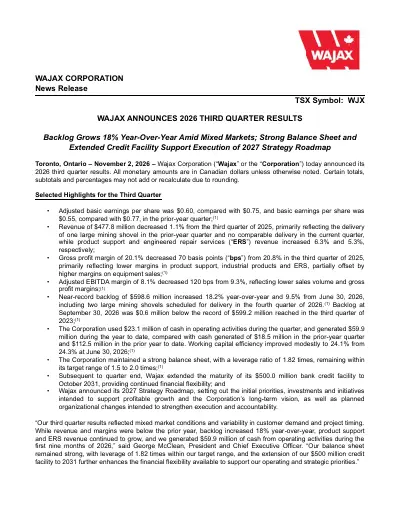
Revenue of $477.8 million decreased $5.3 million or 1.1% in the quarter. The decrease was driven by the delivery of one large mining shovel primarily in the third quarter of 2025 compared with no such delivery in the current quarter.
Additionally, a year-over-year decrease in industrial products volume was more than offset by an improvement in product support and ERS revenue. Gross profit margin of 20.1% decreased 70 basis points compared to the same period of 2025.
This decrease in margin was primarily due to lower margins realized on product support, industrial products, and ERS revenue, partially offset by higher margins on equipment sales. Selling and administrative expenses as a percentage of revenue increased to 15% in the third quarter of 2026 from 14.7% in the same period of 2025, driven by the year-over-year decline in revenue.
Excluding the adjustments noted on the slide, adjusted selling and administrative expenses increased $2.3 million in the third quarter of 2026 compared with the same period in the prior year, due primarily to higher personnel, travel and entertainment, and supplies and marketing costs. Management remains focused on gross profit discipline, effectively managing costs, and improving operating leverage, while continuing to invest selectively in capabilities that support the long-term growth and competitiveness of the business.
Adjusted EBITDA margin of 8.1% in the third quarter of 2026 decreased from 9.3% compared to the same period of 2025, and decreased from 8.9% in the second quarter of 2026. Adjusted EBITDA of $38.9 million decreased $5.9 million or 13.2% from the third quarter of 2025, noting the adjustments recorded on this chart.
The decrease reflects lower sales volumes, lower gross profit margins, and $4.1 million in restructuring and other related costs in the third quarter of 2026. Adjusted net earnings of 60 cents per share decreased 19% or 15 cents per share from the third quarter of 2025, noting the adjustments recorded on this chart.
Backlog reached a near-record level of $598.6 million, up 18.2% year-over-year and 9.5% from Q2, just below the record set in 2023. Sequential growth across construction and forestry, industrial products, and ERS provides a solid foundation for future revenue.
Safety continues to be Wajax's number one priority, and management is committed to continuously improving our safety programs to improve on this result. We thank everyone on the team for their ongoing dedication to workplace safety.
Turning to slide 8, revenue by region. The revenue decrease of 1.1% in the third quarter resulted from lower revenue in Western and Central Canada.
Western Canada sales of $206 million decreased 2.1% on the quarter, due primarily to lower mining equipment sales, including the delivery of a large mining shovel in the third quarter of the prior year with no comparable delivery in the third quarter of the current year. This decrease was partially offset by higher product support sales in the mining category and higher construction and forestry equipment sales.
Central Canada sales of $80 million decreased 12% in the quarter due to lower sales in all categories, but most notably in material handling, industrial products, and ERS. Eastern Canada sales of $191 million increased 5.5% in the quarter, due primarily to higher equipment sales in the construction and forestry and power systems categories.
Please turn to slide 9, equipment and product support revenue. An update on equipment and product support sales and year-over-year variances are shown on this page.
Equipment sales of $126 million decreased $5.2 million or 4% compared to last year, due primarily to lower mining equipment sales in Western Canada, including the delivery of a large mining shovel in the third quarter of the prior year with no comparable delivery in the third quarter of the current year. This decrease was partially offset by higher construction and forestry equipment sales in Western and Eastern Canada.
Product support sales of $131 million increased $7.7 million or 6.3% compared to last year, due primarily to strong mining revenue in Western Canada. Please turn to slide 10, industrial products and ERS revenue.
An update on industrial products and ERS sales and year-over-year variances are shown on this page. Industrial products sales of approximately $127 million decreased $9.1 million or 6.7% compared to last year, with lower sales in all regions driven by competitive and uncertain market conditions as customers continued to be impacted by tariff and macroeconomic uncertainty.
ERS sales of approximately $85 million increased $4.3 million or 5.3% compared to the prior year, due primarily to higher sales in Western and Eastern Canada, driven largely by the timing of large projects. Turning to slide 11, revenue by category.
The slide summarizes sales at category level for our company's overall groupings of heavy equipment and industrial products and ERS. In the third quarter, the heavy equipment categories decreased $0.6 million or 0.2%.
The industrial products and ERS categories decreased $4.8 million or 2.2%, due to lower industrial products sales in all regions, offset partially by higher ERS sales in Western and Eastern Canada. I will now turn the call back over to Tania for commentary on backlog, inventory, and the balance sheet.
Tania Casadinho
Thank you, George. Please turn to slide 12 for my comments on backlog and inventory.
Our Q3 backlog of $598.6 million increased $52 million compared to backlog of $546.6 million at Q2, and increased $92.1 million on a year-over-year basis. The sequential increase was due primarily to higher construction and forestry backlog and higher industrial products and ERS backlog.
The year-over-year increase was due primarily to an increase in power systems backlog driven by the River-class destroyer subcontract entered into with Irving Shipbuilding Inc. during the fourth quarter of 2025, and higher construction and forestry and ERS backlogs.
These increases were partially offset by lower mining backlog, driven largely by the delivery of three large mining shovels since September 30th, 2025. Backlog at September 30th, 2026 included two large mining shovels scheduled for delivery in the fourth quarter of 2026.
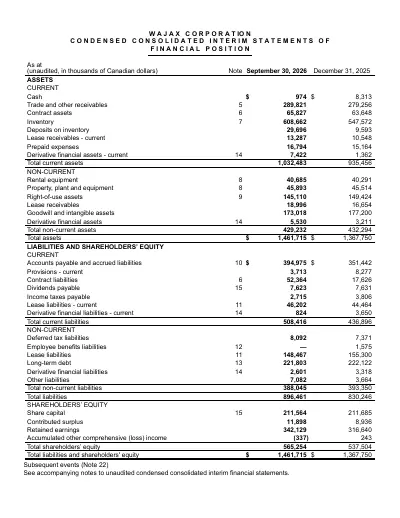
Inventory increased $18.4 million compared to Q2 2026, while inventory increased $3 million compared to Q3 of 2025. The sequential increase was due primarily to higher mining equipment inventory in the quarter.
Inventory was down $143.1 million from its peak level in March 2024, and management believes that inventory levels are within normal operating range. Please turn to slide 13, where I will provide an update on cash flow, leverage, and working capital.
Cash flows used in operating activities in the current quarter of $23.1 million compared with cash generated from operating activities of $18.5 million in the same quarter of the prior year. The decrease in cash generated of $41.6 million was mainly attributable to an increase in inventory of $18.4 million during the quarter compared to an increase of $3 million in the same quarter of the prior year, an increase in trade and other receivables of $19.9 million during the quarter compared to an increase of $7.5 million in the same period of the prior year, and a decrease in accounts payable and accrued liabilities of $12.9 million compared to a decrease of $1.9 million in the same period of the prior year.
Our Q3 leverage ratio increased to 1.82 times from 1.38 times in Q2, due to higher debt levels from working capital timing and lower trailing 12-month pro forma adjusted EBITDA. Our available credit capacity at the end of Q3 was $276.4 million, which is sufficient to meet short-term normal course working capital and maintenance capital requirements, and fund our planned strategic initiatives.
Finally, on October 22nd, 2026, the corporation extended the maturity of its $500 million bank credit facility from October 24th, 2029 to October 22nd, 2031. This extension enhances financial flexibility in support of Wajax's strategic priorities.
We continue to focus on working capital efficiency, which is a key component in managing our overall leverage target. The Q3 working capital efficiency was 24.1%, an improvement in efficiency of 20 basis points from 24.3% at June 30th, 2026, due to lower trailing four-quarter average working capital.
Inventory turns of 2.4 times have remained stable from Q2 of 2026, and improved marginally from 2.3 times in Q3 of 2025, due primarily to lower average inventory levels offset partially by lower sales. The optimization of inventory, improvement in working capital efficiency, and meaningful reduction in leverage reflect management's disciplined execution.
Finally, the board has approved our fourth quarter 2026 dividend of 35 cents per share, payable on January 5th, 2027 to shareholders of record on December 15th, 2026. Please turn to slide 14, and at this point, I will now turn the call back to George.
George McClean
Thanks, Tania. Our outlook is summarized on slide 14.
Our third quarter results reflected mixed market conditions and variability in customer demand and project timing. While revenue and margins were below the prior year, backlog increased 18% year-over-year, product support and ERS revenue continued to grow, and we generated $59.9 million of cash from operating activities during the first nine months of 2026.
Our balance sheet remained strong with leverage of 1.82 times within our target range, and the extension of our $500 million credit facility to 2031 further enhancing the financial flexibility available to support our operating and strategic priorities. As we prepare to enter 2027, our priorities are clear, and our focus is on executing our strategy roadmap and implementing our announced organizational changes.
This includes discipline on margin performance, costs, and working capital, and increasing operating leverage. At the same time, we will make targeted investments in our people and the commercial, digital, and operational capabilities required to grow.
Together with greater accountability and a stronger focus on our customers and supplier partners, we believe these actions will strengthen Wajax's competitive position and support sustainable, profitable growth over the long term. Looking ahead, market conditions are expected to remain mixed across certain end markets and regions with continued variability in customer demand and project timing.
Broader macroeconomic uncertainty is likely to continue to weigh on customer confidence and investment decisions. The corporation's diversified exposure across equipment, product support, industrial products, and engineered repair services, together with its national footprint and supplier relationships, provides a broad platform from which to navigate these conditions and pursue opportunities for growth.
On October 8th, 2026, Wajax announced the strategy roadmap organized around the four priorities covered earlier. Wajax also announced planned organizational changes, including the planned appointments of a President of Equipment, Parts and Service; a President of Industrial Products and Engineered Repair Services; and a Chief Value Officer.
All of these are intended to provide greater role clarity and accountability in several areas such as sales, sales force effectiveness, and supply chain. The intention is to strengthen our focus on profitable sales growth, efficient distribution, and customer and supplier partner relationships.
Management believes the disciplined execution of the strategy roadmap and the planned organizational changes will strengthen Wajax's competitiveness, support profitable growth, and create sustainable, long-term value for shareholders. Thank you very much for your interest and your continued interest in Wajax, and would now ask Joanna, please, to open the line for questions.
Operator
Thank you. Ladies and gentlemen, we will now begin the question-and-answer session.
Should you have a question, please press the star followed by the 1 on your touch-tone phone. You will hear a prompt that your hand has been raised.
If you wish to decline from the polling process, please press star followed by the 2. If you are using a speakerphone, please lift the handset before pressing any keys.
First question from Devin Dodge with BMO Capital Markets. Please go ahead.
Devin Dodge
Thanks. Hi, George.
Hi, Tania. Thanks for taking my questions.
George McClean
Hi, Devin.
Devin Dodge
The outlook in Q3 dropped some language related to more specific sector commentary. You talk about the various end markets and if there are any changes versus earlier this year.
George McClean
I think the dropped language was more of a formatting issue and not an intentional move, but certainly in terms of end market, it remains mixed, but we have strength in mining, utilities, and energy, and infrastructure. Certainly, customers are continuing to approach capital spending selectively, and equipment utilization, maintenance requirements, asset life extension supports parts and service demand.
Quotation activity is actually really encouraging in several markets. The timing, obviously, is unknown, but we certainly feel confident in that.
Mining is strong. Forestry is selling through and solid.
Certainly government, utilities, and power is solid as well. That's their overall outlook on the market.
Our main goal at this stage is to make sure Wajax is well placed in terms of strength in good times and tough times, and that's why we're launching the roadmap. We're launching our organizational design changes effective January 1st, but in play now to get great leaders into the right roles and take full advantage of all the positive macro trends in Canada today with Build Canada and infrastructure design.
Pretty confident about the changes we're making to take advantage of those macro trends.
Devin Dodge
Good color. Just a bit of a follow-up, and I think you've touched on this in your answer there, but are you seeing improving demand signals in construction in forestry?
Because I think when we look at your commentary, I think equipment sales in these end markets were higher year-over-year and the backlog increase is attributed to construction and forestry. Just wondering what you're seeing there and are we off the bottom now?
George McClean
Thanks, Devin. Certainly construction is mixed, and we're encouraged by the additional lineup improvements from Hitachi that are coming next year.
That'll be helpful as well in terms of a compact track loader and the articulated dump truck. That's good news as well.
We're looking forward to determining when and how we can introduce those in Canada. Very confident about that.
The forestry sector definitely has some green shoots, and there's obviously been a lot of change in the market and the cross-border activity there, but we feel good about forestry as well. What we're doing going forward is having this new organizational design which has a President of Equipment and Parts and Product Support, and then a Vice President responsible for sales in each of these segments.
We'll have front to back responsibility and clarity around sales, and then we'll also have service operations under that president as well. We'll show up much more as a stronger pure-play competitor in that space and be much more competitive given that front to back sales responsibility versus the entangled nature historically of sales and operations and various segments through a regional approach.
Very excited about that org design, which will give us better line of sight to construction and forestry, for example, and also a much more focused, clear approach to growing those specific segments across the board.
Devin Dodge
Good color. Thanks for that.
Last one for me. Margins on product support, industrial products, and in ERS, I think were lower year-over-year.
Just trying to get a sense if this was due to increased competitive activity, inflationary pressures that couldn't be passed through, or mix of work, or something else. Which should we attribute that softness to?
Tania Casadinho
Thanks for the question, Devin. Gross margin on a year-over-year basis declined 70 basis points.
It's important to note that within the types of revenue, there is a product mix impact as well. When we're comparing quarter-over-quarter, if that mix shifts in any way, shape, or form, then that becomes a bit of a harder comparison.
The way we're looking at margins is, if you look at the full year, our margins are up on a year-over-year basis. Our year-to-date, we're at 20.5% versus last year, which is a 90 basis points improvement.
Can't say necessarily that it's anything specifically driving that is concerning to us, but on a year-over-year basis, we are still seeing some of our margin initiatives and improvements flow through. On a nine-month period, being at 20.5% does show an improvement to earlier 2025 and where we're at at the end of 2024.
Devin Dodge
Makes sense. I'll turn it over.
Thank you.
George McClean
Thanks, Devin.
Operator
Thank you. Next question from Pat Sullivan with TD Cowen.
Please go ahead.
Pat Sullivan
Hi, good afternoon. Thanks for taking my questions.
I guess the first one is, obviously there's a bit of movement around the performance of the three three key regions you outlined, but it does seem like Central Canada is a bit of a notable laggard. What end markets, I guess, are contributing to that weakness?
Is there any kind of line of sight to green shoots or potential inflection there?
George McClean
Thanks for the question. In terms of the regions, we have historically over the last number of months had some gaps in leadership in Ontario in particular, and we've had some people covering on an interim basis.
With our new org design, and as we fill the president roles, the Chief Value Officer roles, and then the various vice presidents in segments, we will cover those gaps very quickly. I think we know that that's part of the challenge for us has been gaps and changes in leadership through some normal attrition and departures.
We're filling those gaps quickly, and we'll have a full complement of sales and operations leaders in both of those key areas of the business: equipment and product support, and IP and ERS.
Pat Sullivan
Thank you. That's great.
I guess the other thing I was wondering about is industrial parts does seem to have kind of shown some or been an area of underperformance for several quarters now. I guess just what are you seeing as the main challenges in that area?
I guess is there anything in the 2027 strategy that sort of aims to address that?
George McClean
On industrial products, it's obviously an important segment in our business, and it actually provides a nice complementary approach to the market we have in equipment and product support. Really nice rounded portfolio, we believe that we can take full advantage of.
We have a really good set of suppliers, and we have great relationships there, and we have a good customer set as well. As we improve the org design and get a president named for Industrial Products and ERS, it'll provide us with much better focus.
We've got good people on that team today, but they're in various category groups, sales groups, specialists groups, and we need to get that organized and moving forward. There's nothing fundamentally challenged there other than the org design and getting fully aligned to get sales, operations, category management, supplier relationships, all lined up in industrial products, but we've got the really good basis for that.
In addition, we have distribution centers across the country and branches that house industrial products, but we're not as efficient as we can be. We've named a few new roles in the company, as in terms of sales force effectiveness.
Our VP Sales Enablement and Marketing has joined the company with a lot of experience, and then more recently, we have a Vice President of Supply Chain and Inventory Management. Already speaking with her, we know there's opportunities in supply chain and our ability to utilize those distribution centers fully for industrial products, and the branch footprint, and deciding how we can deliver same-day, next-day to our customers in the most effective way.
There's a number of areas there we know we can improve in industrial products. Nothing fundamentally in terms of any major change over the last few months, but we just need to make sure that we're investing and focused because we think there's a lot of potential there in terms of the suppliers we have, the segments we support, and the history we have with customers.
Pat Sullivan
Awesome. Thank you.
I did have one more. You alluded to this before, but I did see in Hitachi's earnings release last week that they highlighted some new truck offerings for North America coming in 2027.
I guess, could you tell us a little bit more of that? Is this a larger class offering that's going to be available to you in 2027, and then I guess, do you think there's customer appetite in Canada for that?
George McClean
There's two types of trucks that Hitachi offers. The first is built in Guelph, Ontario in Canada today, which is a great offer from a heavy-haul mining perspective.
We are actively quoting on that truck today to a number of customers, and looking forward to converting those to sales in a decent way. On the other side of it, you mentioned Bell Trucks, which is an articulated dump truck which actually articulates at the center of the vehicle and is used for different environments where articulation and agility is critically important.
We actually sell today and have the distribution network for Bell Trucks in Canada. As that partnership is announced and rolled out, we feel we're in a good position to provide continued support to that truck, and something we've done for many, many years.
It's a nice addition under the Hitachi brand, and provides clarity there for the customer around the increasing portfolio offered by Hitachi and Wajax in Canada.
Pat Sullivan
Great. Thanks.
Get back in the queue.
George McClean
Thanks, Pat.
Operator
Thank you. Next question from Maxim Sytchev with National Bank Capital Markets.
Please go ahead.
Maxim Sytchev
Yes, hi, good afternoon. I just wanted to circle back to your roadmap ambitions of accelerating growth and obviously, we're seeing revenue declines for the time being.
When we think on a prospective basis, could you maybe talk about how much of that improvement has to come from macro getting better versus some of the variables that you can control internally. Maybe you can talk about three or four factors that you're going to be spending most of your time on again to show that accelerating growth across the platform on a prospective basis.
George McClean
Hello, Max. Thanks for the question.
In terms of accelerating growth, certainly we're looking forward to the macro trends, and we're following them carefully, whether it's the current Build Canada work or elections in British Columbia and the announcements that have been made there. I think those are all helpful for us, and we're watching those carefully.
In terms of internal variables, certainly there's a lot we can cover, and a lot of that's in the strategy roadmap, and also behind the scenes in terms of the project plan we're working on right now for 2027. A few things come to mind: certainly sales force effectiveness.
We have a team of sales people inside, outside, and support across the country that do a good job, but we can increase our productivity there in terms of pipeline management, our use of our CRM Salesforce.com, and actually setting standards for call volumes and activity within the marketplace. Obviously, in the sales world, the more activity, the more calls, as those filter down on a percentage basis, it results in more sales.
There's lots we can do there. We need to get our arms better around national accounts and government accounts.
We've got some work underway now where we're gathering all the major projects, companies, and government divisions that are investing in Canada today, and so we'll get our arms around that and then assign that to the sales teams as we go forward, and that's a really sort of open opportunity for us at Wajax, which is something I've certainly done before at Grainger and in other organizations, and can result in a lot more earlier and more focused approaches on those projects and companies. Again, with the portfolio we have, from excavators to loaders, to crane utility, material handling, power on-road and off-road, our ERS services, etc., we have a lot to offer to those existing and new customers.
That's on the SFE side, and the national account side. The third would be supply chain.
Today we have 104 locations, three distribution centers, and there's an opportunity to optimize that. Today, the branches are often filled with service bays and great activity from technicians there, but we also have industrial products going out the back door of branches in some situations.
In some cases, that makes sense, and in other cases, we need to rely more heavily on our central distribution center network across the country and optimize that with warehouse management system, with automation, and with probably introducing a hub-and-spoke model, and perhaps doing more same-day, next-day from those distribution centers instead of from branches where it's less efficient and we're less efficient on an inventory basis as well. We do, as I said, have a VP of Supply Chain and Inventory Management.
She's new, has decades of experience in large organizations, and we're already seeing good benefits there. Then the final area that's important for sales is actually technician experience and making sure that we attract and retain the best technicians.
It is a battleground in Canada today for labor and talented labor, and we have an effort, as in that segment to make sure we appoint a leader of technician experience, understand all the attributes and elements that attract and retain the best technicians, from compensation to tools and equipment and training, and make sure we're great there. That not only sells our service of service, but it actually creates better conditions for selling new equipment as we build solid relationships with customers.
Those are the internal variables or the main ones we're focused on, all lined up within the strategy roadmap, and all rolling out into and through 2027.
Maxim Sytchev
That's very encouraging. Thank you for that.
You made a comment earlier around the quoting activity being quite active. Do you mind talking a little bit about more in terms of which maybe geographies and which end markets specifically?
George McClean
I think it's pretty much across the board as I see it. I don't have data to share with you, but as I travel the country and meet with teams, certainly there's a lot of activity happening in the mining sector, in oil and gas, and resources.
Then, as more and more infrastructure projects are underway. As we think about how we show up in the marketplace with that portfolio of products and services, we're sometimes a primary supplier in terms of the power generation for a facility or a data center.
Sometimes we're secondary in terms of helping to build the roads to those new infrastructure platforms or natural gas pipelines, or we're tertiary around the industrial products, filtration, bearings, power transmission, etc. We are showing up in all those places and we are seeing good quoting activity.
We have introduced and are piloting an approach to faster use of data and faster bid responses, and we're already seeing very early on a higher success rate on those bids. More to share there in the future as we convert that from pilot to implementation, but certainly we see that as an important battleground to make sure that we are fast, accurate, and complete in terms of our quotes, and we'll win more often.
It is across the board. Obviously, something like the mining sector and quoting to majors in Canada is a much more extended cycle all the way down to bearings and filtration, which could turn around in 20 minutes.
We need to be great at all of those, and we have good experience, and as I said, increasing focus and better tools in that area.
Maxim Sytchev
That's very helpful. Just one small one I guess for Tania, if I may.
In terms of the Irving contract, can you talk maybe a little bit when it comes to the phasing? Should we expect any sort of revenue in 2027 or is it more going to be spread out in out-years?
Thank you.
Tania Casadinho
Good question. The RCD contract or the contract with Irving is a long-term contract.
We obviously had a portion of it in 2026. The majority of it will probably go out into 2028.
A portion of it is in our backlog, and then a smaller portion of it actually extends out even beyond that, just depending on the milestones. For 2027, we do have a portion of that in backlog.
Without giving numbers away, I would say total contract maybe divided over the course of 3 years with a stronger emphasis on 2027.
Maxim Sytchev
That's very helpful. Thank you so much.
Tania Casadinho
No problem.
Operator
Thank you. Next question comes from Ian Gillies with Stifel.
Please go ahead.
Ian Gillies
Good afternoon, everyone.
George McClean
Hello.
Ian Gillies
I was hoping to start on the industrial product side with the combination, I guess, of a few of the previous questions focused on that segment. George, you've obviously had a chance to review it for six or eight months now.
When you look at what's going on in that business, do you think you can fix the organic revenue contraction solely through self-help measures, or is there something structural in the macro, whether it be tariffs or some other geopolitical item I might not be highlighting, that's causing issues to lead to that revenue contraction?
George McClean
Thanks, Ian. Appreciate the question.
In terms of industrial products, I do have a fair background in there starting at Grainger in 2006 for 10 years, and feel comfortable that I understand that space well. We also have others in the business, of course, who understand it also.
I think there is a lot we can do internally. We have a good business today that's sizeable.
It is a critical mass size business across the country, and we do have it in all of our distribution centers and many branches. We have good supplier relationships as well.
What we need to do is get much more efficient around our supply chain and make sure that we have the right product in the right place at the right time for the right price. The drill, and making sure that we do that more often.
We're okay there, but we need to get better. Our pricing does need to be improved.
We have a team working on it and in place for a while now, but we need to make sure that we deliver on those results, and part of that is working upstream to make sure our data is accurate. We've got a master data team in place now and doing planning in terms of work that needs to be done in terms of thousands of SKUs that we get from suppliers and duplications, redundancies, and inaccuracies that slow us down in terms of pricing and going to market.
Supply chain's critical, pricing's critical. We do have good supplier relations with many great suppliers like Danfoss and SKF, and we need to continue to nurture those relationships.
I've met with all the top 12 suppliers across the board a number of times by video and in person. We've rolled out the strategy roadmap and the org design to all of those key suppliers as well to make sure that they're on side, and they're very supportive and excited about the focus in the respective areas.
That will help as well. Then, most importantly, the org design, we are appointing a president of IP and ERS.
We'll have a VP of sales in that group, a VP of operations, we'll have a VP of supplier relations. We'll have all the elements of a pure-play industrial products business in place to go to market better and faster.
Then at that point, to your question around revenue, that's where we start to look at adjacent categories that are offered by our existing top suppliers or other non-conflicting adjacent categories that we can add to the industrial products group. There's no magic or bright line in terms of what's industrial products and what's not, and obviously Motion, Applied, Grainger, Fastenal, and others, and Gregg's, for example, they all take a different approach to what industrial products is.
We've been a little more reactive, I think, and passive around that, and we need to be much more aggressive and proactive around our categories, adjacent categories, profitable markets, where we can help our customers, where we can drive synergies relative to our other ERS sales and equipment sales, and so that's a pretty exciting opportunity as well. Obviously macro trends help, and they always do, but as I said earlier, we want to make sure we build Wajax to be resilient and profitable in good times and tough times, and industrial products is an awesome place to be for that.
Ian Gillies
That's very helpful. With respect to restructuring costs, do you anticipate this will be an ongoing theme over the next 12 months, and how should we be thinking about how Wajax is measuring return on investment for that spend?
George McClean
In terms of restructuring, many companies, including Wajax, have taken an approach where they're either growing or they're finding efficiencies, and we are absolutely determined, and we've talked to the full team about this, we're determined to grow and invest while we find efficiencies. I think you'll find this is going to be an ongoing practice to find those efficiencies, whether it's in terms of placing the right people in the right roles, enabling them further through AI, making sure that we're investing in adjacent categories and more sales, more customer-facing, more technicians, and more revenue-generating activities.
I think you'll find that's ongoing. We don't expect anything major, but we do certainly have a target or a perspective in terms of finding efficiencies through the end of the year and into 2027 and beyond, all as part of investing and growing, promoting people internally, and bringing people in from the outside.
I think you'll find that's a discipline we'll have going forward, and it won't be an ad hoc or an event, it will be an ongoing discipline. In terms of return, that was the second part, you'll find that, again, we're investing in certain areas like supply chain, sales force effectiveness, the new org design, and those efficiencies help to pay for that.
I wouldn't attribute a direct cost reduction for the ones that occurred already or efficiencies we find in the future. It's more about funding growth and investments into the areas that customers care about most.
Ian Gillies
That's helpful. Maybe last one, are you able to provide any, I guess, initial insight on how you're thinking about the order book for large mining shovels as we move into 2027, just given how much they can swing new equipment sales?
Tania Casadinho
What I can speak to is the large mining shovels that we currently have in backlog. We have two in backlog and they're both scheduled for conversion in Q4.
In terms of ongoing outlook, as George mentioned earlier, the quoting activity in that space is quite active. It just comes down to when the customers pull the trigger on accepting the quote and moving towards an order or delaying that decision.
Ian Gillies
Understood. Thanks very much.
I'll turn it back over.
George McClean
Thanks, Ian.
Operator
Thank you. Next question from Jonathan Goldman with Scotiabank.
Please go ahead.
Jonathan Goldman
Hey, good afternoon, team, and thanks for taking my questions. My apologies if this was answered earlier, not quite sure if I caught it, but it seemed like the language in the outlook was a little more cautious this time talking about some maybe potentially mixed or headwinds here in markets.
Did that read as I'm interpreting it, and have things got incrementally worse in your end markets, and I'm thinking this also in conjunction with the results themselves?
George McClean
Thanks for that question. We did mention it earlier, but happy to discuss it for sure.
The change was really just a matter of formatting, and it wasn't an intentional indication of any concerns around end markets. In fact, we feel pretty good about mining in particular, government, utilities, power, and certainly forestry is also stable and solid, and obviously faces certain challenges, but seems stable nevertheless.
We remain certainly cautiously optimistic about the Canadian economy, very positive about the long-term macro trends. As you look at the various plays in the marketplace, whether it's infrastructure, taking things out of ground, as the economists say, mining, Ring of Fire, etc., we're involved from a primary perspective, secondary, and tertiary, whether it's excavators, loaders, building roads, crane utility booms that are helping with the electrical supply, the industrial products at a tertiary level for various infrastructure installments.
We're really available and involved across the board and pretty excited about it all. Engineered repair services in particular, rotating group in Delom does a lot of work on energy production, whether it's wind turbine or hydroelectric, and Tundra does a lot of work in terms of what you're seeing on pipelines and valve testing and the expansion you're seeing there.
Overall, whether it's the BC election, or Build Canada, or the work on defense and infrastructure, Ring of Fire, etc., we're quite positive on the macro trends. Timing is, of course, always the question, but it seems to us based on all indications, outside advisors plus customers and suppliers, that this is real and it's coming.
We're generally encouraged and no intent to change that outlook.
Jonathan Goldman
Got it. Thanks for the color.
Maybe for Tania, one for you. How should we think about SG&A rate for the balance of the year and going into next year?
It seems to be trending, I guess, a bit higher than the previously talked about range. Maybe there's some reasons for that, but it can swing earnings around quite a bit.
How should we think about the appropriate run rate?
Tania Casadinho
Thanks for the question. Yes, on an SG&A perspective, I think when we look at the full year, year-to-date, in an absolute dollar perspective, that hasn't changed materially on a year-over-year basis.
As I've said previously, the efficiency rate or the SG&A ratio will, obviously, be impacted by the volume and sales number, so that's what we're seeing this year. Moving into the fourth quarter, I would say probably similar levels at this point in time.
As George did mention, we are and will continue to reinvest in certain areas of the business, we have added a couple roles that will impact that as well. As we move forward into 2027, we're still finalizing all those plans, but we will be investing in some areas.
At this point, I think it might be safe to say that we are planning to operate towards the higher end of our range until we see some of the revenue come through as well for that one.
George McClean
Just to build on what Tania said, which is all true and accurate, we are going to be very disciplined about people and SG&A. Certainly we need to add investments to take full advantage of the market opportunities, be very competitive with technicians and salespeople, customer-facing and customer-valued areas, and also find efficiencies as we go.
It won't be a growth without discipline. We'll be very focused on headcount and overall cost, and investing where it makes sense for the short and long term to drive value.
That's the key for us, and we've got that on our executive leadership team scorecard and we'll be looking at it every month and actually more often than that. It may come that we're investing more, as Tania said, but it will be in a very, very disciplined way, watching every headcount and every cost.
Jonathan Goldman
That makes sense. I guess, maybe relatedly or more high level, it seems like restructuring might be an ongoing trend, we'll probably adjust that out.
How should we think about the paybacks on those restructuring activities or what sort of KPIs should we be tracking? Is this like a ROIC, is it a sales growth metric?
I guess it's related to the new strategic kind of initiatives to be the fastest-growing company by 2020 or 2031. What sort of metrics should we be looking at as investors to see if you're progressing towards plan?
George McClean
There's obviously all those metrics, and some of them are leading and some of them are lagging. As I said, we have an ELT scorecard and we're building an enterprise PMO to make sure we're tracking really well.
Really, the bottom line's the bottom line. We're looking at growing earnings and growing ROIC, and that's what we're assessing every project on.
Different areas will have different timelines. We're focused on our supplier relations, and for example, I'm leading that.
We're already making further inroads into good relationships to make them even better. That's inexpensive and happens fast.
Sales force effectiveness, we have a leader in place, as I mentioned, and we're forming a training plan, pulling our sales leaders together. We've already done that virtually, and we'll do that in the new year in person, and set a new standard around a selling process and use of pipeline, use of CRM, and call productivity, call volume for our salespeople and our use of support.
Some things will take medium term, and then there'll be longer-term investments if we were to invest, for example, in a distribution center. That obviously has some capex and opex, but will pay very good returns over time as is the case for Gregg's and Grainger and others, but that's a longer time frame.
We will build that out over time and give you updates quarter by quarter, but essentially looking at return and earnings, and making sure it's truly accretive in value to the company. Sales are always good, but profitable sales are critical.
Then we've got to watch the opex, the SG&A, and make sure we're delivering on the bottom line. That's how we look at it and that's how it's all contained in our scorecards and internal metrics.
Jonathan Goldman
Thanks for the color. I'll get back in queue.
George McClean
Thanks, Jonathan.
Operator
Thank you. We have no further questions, I will turn the call back over for closing comments.
George McClean
Thank you very much for everyone who joined. We appreciate it.
Certainly, the results aren't where we wanted to see them in the quarter, but if you look over the longer term, both historically and going forward, we certainly have a good handle and good assessment of where we are, where we have strengths, and where we need to move forward. We've worked with the executive leadership team, the strategy working group, and now the Wajax leadership group, which is a broader team, and then all 3,000 employees across the country to roll out the strategy roadmap and the investments behind it.
We will be prudent and thoughtful and disciplined around those investments, and we'll give more updates as we progress in the quarters to come. We are very excited about the macro trends and about the changes to make Wajax great beyond the good status we are today, and have a really good plan to do so.
Again, we'll be disciplined and we'll update you on a regular basis. Thanks again for your interest, thanks for participating, and really appreciate the questions.
Looking forward to speaking again in the future. Have a good day.
Bye.
Operator
Thank you. Ladies and gentlemen, this concludes your conference call for today.
We thank you for participating, and we ask that you please disconnect your lines.