Wabash National Corporation
Q3 FY2026 · Earnings Call TranscriptOctober 29, 2026
Brent Yeagy
Good afternoon, everyone, and thank you for joining us today. I'd like to start, as always, with safety, because it's fundamental to how we operate Wabash.
We saw continued improvement in total recordable injury rates, with metrics tracking 26% favorable to the prior quarter and 42% favorable to the prior year. Q3 marks our fifth consecutive quarter of improvement.
Meaningful progress is continuing even as working hours and the number of new hires increase. This is evidence that the proactive work we undertook over the past several years to reduce workplace hazards, as well as recently strengthening our onboarding processes ahead of increased dry van production, is working.
We have maintained a steadfast focus on safety while preparing the organization for higher production, and we are seeing the benefit, not only in safety performance, but in overall ramp execution. Moving on to third-quarter results.
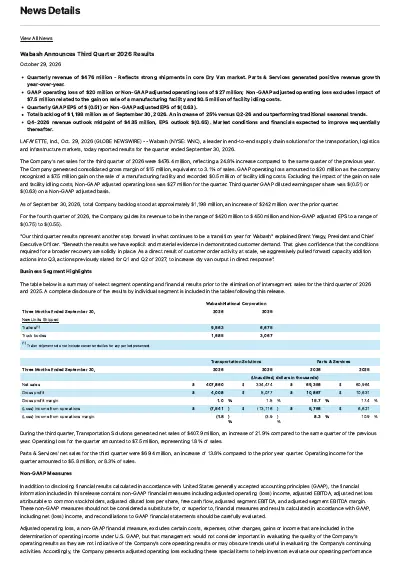
Financials represent another step forward in what continues to be a transition year for Wabash. Revenue for the quarter was over $476 million, with non-GAAP adjusted EPS of -$0.63.
More importantly, beneath these results, we have explicit and material evidence of demonstrated customer demand. That gives us confidence that the conditions required for a broader recovery are solidly in place.
As a direct result of customer order activity at scale, we aggressively pulled forward capacity addition actions into Q3, actions previously slated for Q1 and Q2 of 2027, to increase dry van output in direct response to that customer demand. 2026 has been a transition year.
Since late June, we have quickly moved from enduring through a very difficult demand environment, having a liquidity preservation posture and a cost minimization mindset, to fully mobilizing Wabash for a dry van cycle recovery. Our teams have been doing exactly that.
This ranges from the convertible debt acquired last quarter to ensure we have the net working capital availability to operational actions, including securing strong, long-term agreements with critical suppliers and then adding people and shifts to support the dry van volume we see ahead in 2027. I want to reiterate and make one important point about Q3 and the remainder of 2026.
Our confidence in 2027 has increased. We've elected to incur certain costs in 2026 that otherwise would have occurred in early 2027.
These include primarily labor and other production readiness costs associated with preparing our operations for improved demand. Simply put, the required investments that advance the overall ability of Wabash to generate more profitable conversion of higher levels of demand sooner than later, investments we are happy to have been able to make.
That distinction is important. These expenditures affect the timing of earnings, and they also reflect increased confidence in our underlying view of the dry van market.
We are making deliberate decisions today because our confidence in the opportunity ahead has strengthened through direct evidence called orders. As a result of absorbing these costs now, our positive EBITDA projections for late 2026 no longer are correct.
We will now have a rapid sequential improvement through 2027, reaching a level of quarterly profitability by Q2 consistent with our annualized EBITDA run rate between $150 and $170 million, instead of being in the second half of the year as previously assumed. That is despite assuming the truck body market remains depressed for longer, as we do not yet see meaningful green shoots in that segment.
At the same time, we remain disciplined. This is not indiscriminate spending ahead of a hoped-for recovery.
We've spent the last several quarters taking structural costs out of the business and improving the flexibility of our manufacturing footprint. Those actions were designed to preserve our ability to scale efficiently as demand improves, consistent with how we have framed our cost structure and capacity entering into this recovery.
On a more constructive view of demand, and our outlook entering into 2027 compared with prior quarters, it has been driven by both market-leading indicators and momentum within our backlog. We continue to see progress across freight indicators that ultimately support equipment demand, improving spot and rejection rates, carrier profitability, and fleet sentiment.
Alongside an aging equipment base and deferred replacement cycles are contributing to a more robust setup. That does not mean we expect a straight-line recovery.
What it does mean is that the balance of evidence is moving earlier, at scale, and in the right direction. Just prior to quarter-end, we released evidence of our improving backlog, which stood at over 12,000 dry van trailers for 2027.
That pace did not let up. It took off.
That number was almost 16,000 units by the end of the quarter. By mid-October, it was almost 20,000 units, with more orders in the process of closing.
Across the organization, our total backlog has reached $1.3 billion by mid-October, and with more 2027 demand to play out. Early movers remain steadfast in their buying decisions and continue to become more constructive.
Improving freight economics combined with significant replacement needs are bringing equipment decisions forward at an increasing pace. Customers continue to place significant value on their long-standing relationships with Wabash, and those conversations increasingly point toward a more consistent replacement cadence and additional catch-up demand over the coming years, even without a traditional demand-driven recovery.
At the same time, a number of customers remain early in their budget and planning cycles, giving us further confidence in the opportunity for order activity to build over the coming months. While still relatively early in the 2027 sales cycle, historical order patterns would suggest that we're on track for a dry van volume in the 35,000 to 38,000 range at Wabash.
That would align with our expected market size in the initial replacement cycle phase and our target market share percentage in the plus or minus 25% range. The current pace of backlog intake would suggest a higher volume case in the low 40,000 unit range.
While we are not modeling this level of demand, we feel the effective capacity we are adding in Q3 and Q4 of 2026 would enable our execution of that possibility. Critically, forward-looking pricing remains constructive, giving Wabash the opportunity to convert that demand into progressively higher levels of unit profitability.
Our announcement prior to the quarter-end referenced weighted-average 2027 material margin exceeding Q2 of 2026 by 500 basis points. Our backlog portfolio now averages over 600 basis points in excess of Q2 2026, highlighting how improving freight economics and carrier profitability are supporting pricing that is better aligned with our actual cost base.
Our proactive and thoughtful approach to this market inflection, coupled with strong supplier partnerships and an ability to expand our hourly workforce, provide high confidence in Wabash's ability to win the early and mid-innings of the new cycle we are in, further enabled by executing aggressively to meet our customer needs with highly effective trailer capacity, thus giving Wabash the ability to fully capitalize on demand momentum. Trade is another important part of the bridge between the environment we have operated through and the one we see developing.
We've previously discussed the impact of Section 232 and antidumping and countervailing duty actions. We believe these measures can favorably change industry dynamics into 2027.
This is consistent with our prior framing of trade actions as helping level the competitive playing field and support pricing discipline following years of oversupply. Recently, on the 25th of September, the United States International Trade Commission made their final affirmative determinations that imports of van-type trailers and subassemblies from China materially injure the US industry.
The antidumping rate is almost 130%, while the countervailing duty rate is almost 135%. Stacking with the 25% associated with Section 232 tariffs results in an effective rate of approximately 290%.
Meanwhile, Canada and Mexico have preliminary affirmative determinations and are posting cash deposits today at the preliminary rates, with a combined antidumping countervailing duty rate of approximately 10.2% being applied to the competitor Hyundai. Final commerce decisions are expected by mid-December and final International Trade Committee votes by early 2027.
Again, stacking the 25% associated with Section 232 tariffs results in an effective rate of approximately 35%. Our view is simple: Wabash should compete at a level playing field.
We have an extensive US manufacturing footprint, a highly capable workforce, and substantial installed capacity. We believe an environment in which all participants compete under fair trade conditions is good for our customers, good for American manufacturing, and good for Wabash.
Importantly, we already have the physical capacity to participate in an improving dry van market. Our south plant expanded our scalable dry van capability by approximately 10,000 units compared with prior upcycles, giving us the ability to respond without requiring another major capital investment.
Now, turning to the fourth quarter. We expect Q4 revenue to be between $420 million and $450 million, adjusted operating margin of -8% to -5%, and adjusted EPS of -$0.75 to -$0.55.
Embedded in that outlook is labor and production readiness expense deliberately pulled from 2027. During Q3, we increased our dry van hourly workforce by 15%, and we'll continue to add shifts during the fourth quarter that were originally planned for the first quarter of 2027.
Effectively, by the end of the year, all second-shift production will be turned on. Of course, some of the inefficiencies are expected to lag into Q1 of 2027.
While we continue to monitor demand, we maintain a high degree of confidence that we can meet high-side demand beyond our current projections within 2027 without adding a third shift. That leaves us exceptionally well-positioned to respond to incremental demand opportunities.
If demand were to warrant either a full or partial third-shift layer of dry van capacity, that will add additional cost pressures and margin headwinds in the short term. I want to spend a moment framing what this means for 2027, because we recognize investors are beginning to build next year's models.
We're not providing formal 2027 guidance today. We are, however, increasing confidence that 2027 should represent a meaningful improvement in Wabash's financial performance.
The recovery will not be uniform across the portfolio. In dry vans, we see improving demand conditions, significant deferred replacement needs, and a more constructive regulatory and trade backdrop, and ample Wabash capacity to participate as the market strengthens.
Truck Body is different. That business entered the downturn later, and we expect its recovery to remain meaningfully behind dry vans.
The beginning stages of cycle recovery, we believe, are roughly six to nine months behind dry vans, with a slower recovery dependent upon broader macro conditions. Therefore, as we think about 2027, we're encouraged by stronger year-on-year improvement in dry vans while recognizing a considerably more measured assumption for Truck Body.
Parts & Services are expected to maintain a 5% to 10% top-line growth trajectory and see strong incrementals as 2026 startup costs dissipate, resulting in mid-teen EBITDA percent performance returning. That is intentionally a directional framework rather than formal guidance, but we want to give investors sufficient information to build their models without drawing the wrong conclusions from either Q4 revenue or margins.
Before I turn the call over, I want to close where I always believe we should, with our people. The last several years have demanded a great deal from the Wabash team.
Managing through an extended freight downturn requires discipline, flexibility, and at times, difficult decisions. At the same time, preparing for recovery requires a different mindset.
It requires us to look beyond today's production schedule and prepare the business for tomorrow's opportunity. Our people have done both.
They've worked to reduce waste, improve safety, protect quality, serve customers, and make Wabash stronger while volumes have been under pressure. Our continued emphasis on safety, quality, and customer support has deliberately remained protected, even while other costs have been reduced.
As we enter the final quarter of 2026, I am increasingly optimistic about where the industry is headed and about Wabash's position within it. 2026 has been about taking the actions necessary to create that readiness.
Increasingly, our focus is turning to how we will convert that preparation into performance in 2027 and beyond. I want to thank every Wabash employee for their continued commitment to each other, to our customers, and to our purpose.
With that, I'll turn it over to Pat.
Pat Keslin
Thanks, Brent. I'll begin with a review of our third-quarter results.
For the third quarter of 2026, consolidated revenue was over $476 million, exceeding expectations communicated in the second quarter earnings call. During the quarter, we shipped 9,563 new trailers and 1,685 truck bodies.
We are encouraged by the higher volumes, particularly in our core dry van product line. The financial outlook is improving, though near-term results reflect the operational readiness costs Brent discussed.
Truck body volumes improved from the prior quarter, but remain at historically low levels. Customer mix and manufacturing inefficiencies, compounded by those low volumes, continue to challenge financial performance during the quarter.
Adjusted non-GAAP gross margin was 3.2% of sales, and adjusted non-GAAP operating margin was -5.7% of sales. Adjusted non-GAAP EBITDA for the quarter was -$10.4 million or -2.2% of sales.
Adjusted non-GAAP net income attributable to common shareholders was -$26 million or -$0.63 per diluted share. GAAP EPS of -$0.51 per diluted share includes the sale of the Goshen, Indiana manufacturing facility for gross proceeds approximating $17.8 million and recognition of an approximately $7.5 million gain.
EPS came in below our guided range, primarily reflecting the factors referenced above, which we expect to be short-term in nature and, in the case of dry van, expedite our projected sequential profitability projections going forward. Turning to segment performance.
Transportation Solutions generated $408 million in revenue and reported an operating loss of $14.4 million on a non-GAAP basis. Transportation Solutions maintained positive gross margin during the quarter, building on the progress we saw last quarter as improved volumes continue to support better leverage of our cost base.
We continue to expect sequential improvement as pricing adjusts to offset cost pressures. Parts & Services delivered $69 million in revenue and $5.6 million of operating income on a non-GAAP basis.
Parts & Services continued to build momentum, with revenue increasing 9% sequentially and 14% year-over-year. While profitability remains below our expectations, upfit margins continue to reflect the startup costs associated with integrating our new 2026 upfit sites into their respective markets.
As these startup pressures normalize, we expect the growing revenue base to translate into meaningful incremental profitability. Segment performance has stabilized, and we have a strong base from which to grow.
That includes continued establishment of the upfit facilities in their local markets and an expanding presence in the aftermarket parts segment, which should also benefit alongside a recovery in dry vans. During the quarter, we delivered on our promise to renew our asset-based loan, the details of which were shared in August.
Looking ahead, our focus turns to our high-yield bonds, which we intend to address well ahead of becoming current in October of 2027. We are actively engaged with our banking partners and evaluating the options available to us, with a focus on achieving the most economically attractive outcome for Wabash.
We will provide additional updates as appropriate. As of September 30th, total liquidity, including cash and available borrowings, was $277 million, up 44% versus the prior quarter, benefiting from execution of the convertible debt in July and sale of our Goshen manufacturing facility in August.
The convertible debt allowed us to pay down our asset-based loan, which currently has a zero balance and is ready to be deployed to support net working capital requirements associated with a production ramp. Our disciplined approach to capital management and the actions taken to increase liquidity position Wabash uniquely well to prepare for the market recovery and support our customers as demand improves.
In regard to cash flow, operating cash flow for the quarter was -$37 million, resulting in free cash flow of -$41 million. This reflects the start of our planned working capital ramp ahead of higher dry van production levels.
We expect that investment to continue as volume scale into 2027, supported by the liquidity secured through our July convertible issuance. During the third quarter, we invested approximately $3.5 million in traditional capital expenditures and returned $3.3 million to shareholders through our quarterly dividend.
Looking ahead to the fourth quarter, we expect revenue in the range of $420 million to $450 million and an operating margin of between -8% and -5%. Adjusted earnings per share are expected to be in the range of -$0.75 to -$0.55.
The guidance reflects seasonally lower revenues expected in the fourth quarter, with improved price offsetting leverage loss and continued operational readiness expenditures. The 200 to 300 basis point improvement in dry van material margin percentage discussed on our last earnings call remains on track for the fourth quarter.
Together with significant backlog growth, this reflects continued sequential improvement in underlying profitability as we prepare to leverage higher volumes across our second-shift operations. Capital expenditures remain under close control.
We commit to appropriately funding the organization and are in a strong position to fund networking capital requirements, having previously invested the necessary capital into capacity. Having made the decision to pull forward ramp costs, we now anticipate negative EBITDA in the fourth quarter, but strong incrementals exceeding 20% moving into the first quarter.
This performance is expected to mark a meaningful step closer to breakeven operating income ahead of further favorable incrementals moving into the second quarter and beyond, as the volume and pricing that Brent described really takes shape and quarter two becomes the new performance floor. In summary, the third quarter reflected a critical step forward.
The rapid progression of the dry van unit backlog, supported by accretive material margin through price, provided strong validation of the signals we were seeing in the market. We read those signs and accelerated the activities required to position Wabash to meet the needs of our customers.
The organization is fully supporting those onboarding activities, and our operations teams are excited to ramp multiple production lines across incremental shifts. Wabash is ready ahead of the competition and is set to capture share and recover profitability in 2027.
I'll now turn the call back to the operator, and we'll open it up for questions.
Operator
We will now begin the question-and-answer session. If you would like to ask a question, please press star one to raise your hand.
To withdraw your question, press star one again. We ask that you pick up your handset when asking a question to allow for optimum sound quality.
If you are muted locally, please remember to unmute your device. Please stand by while we compile the Q&A roster.
Your first question is from the line of Michael Shlisky with D.A. Davidson & Co.
Your line is now open. Please go ahead.
Michael Shlisky
Hello, and thanks for taking my questions here. I guess I wanted to start out with more of a broader market view, based on the orders you've seen so far and chatter from customers.
Do you think that 2027 kind of the industry volumes are going to be roughly in line with an average replacement year? I guess I'm curious, given what we've seen the last two, three years here, is that probably too low?
If that's what ends up happening, there will still be more to go in 2028?
Brent Yeagy
Mike. This is Brent.
I'll take that one. I think that the activity that we're seeing right now are extremely supportive of what I would call baseline replacement in 2027.
That's about as far as I'm willing to go right at this moment. I'm going to peg that at approximately 135 to 140,000 dry van units.
I think when you look at the potential upside in 2027, maybe in the second half of that year, as robust as it's coming in and what we're hearing from customers, you at least have to pay attention that their desire to make up for the 100,000 units that weren't purchased over the last three years may come to bear. That's factoring into how we think about the capacity that we're bringing online today, earlier than later.
I think that speaks very well for what 2028 can be, where if you think about 140,000 baseline replacement, going into 2028, anywhere from 30 to 40,000 units of incremental demand to just catch up partially with that decrement in replacement that occurred in the previous three years, I think it's starting to frame that a 100, 65 to 175,000 units is a real possibility when you stare at 2028. We think about our capacity in that way.
Michael Shlisky
Got it. To follow up there, Brent, your comments earlier were about 35 to 38,000 would be the range of dry vans, but I want to maybe get a little bit more of a broader view, because you do have other products, right?
You have tanks and other areas that you have other products in. Do you think that you could be, overall, above 40 next year?
Brent Yeagy
Oh, yeah. When you think about Wabash, we'll be north of 40,000 units, when you think tank and platform in the consideration, from a total unit volume perspective, somewhere in the range of 41 to 42,000 in total trailers is kind of, I'd say, a base number that we're shooting for from a capacity add.
The upside to that would be that incremental dry van volume that I'm referencing.
Michael Shlisky
Got it. That helps tremendously.
Then commenting on some of the orders that you've received in the near term versus the industry, do you think that you've been able to outperform on market share the last few months, either based on one, just stellar products that you've got or the fact that there've been some tariffs placed on competition and they might not be able to have great pricing or great visibility at the current time? Just any comments on whether you're outperforming would be tremendous.
Thank you.
Brent Yeagy
I think, without taking any, call it causal factor into account, we have absolutely outperformed on market share, really since the opening of our order book in the June, July timeframe. I think that's absolutely factored into our need to pull capacity forward.
Now, I'm not going to go as far and say that that holds throughout the rest of the sales cycle as we try to look at the effective use of capacity coupled with pricing. We've actually came out of the shoot pretty well, coupled with the pricing that we have gotten, is a very advantageous place to be, not something I've exactly seen before with this level of demand increase, with this level of pricing increase.
Is that because of trade? Possibly.
I also think it's because Wabash is adding capacity earlier and more effectively than the competition. I think our customers, after their last three years, are wanting to go where they know they can execute their recovery, and I think we're benefiting from that.
In a world of uncertainty, Wabash is a good place to go to make sure, if you're a customer, that your recovery is sound.
Michael Shlisky
Okay. Maybe one last one for me on the margin side for '27.
I do know that you pointed to hitting a certain run rate starting in the second quarter for your EBITDA, and you mentioned the six points of material margin, but I am just curious. Just to summarize what you said earlier, it sounds like you pulled a lot of the costs you were thinking about doing in 1Q into 3Q and 4Q so you can start off on the right foot next year.
What can you tell us about your costs are concerned, beyond materials? Things like labor and absorption.
Do you think you can return to kind of, if you're at a year of more normalized trailer demand, I know we're having some pull from truck bodies here, but do you feel like you can maybe return to a more normal level of EBITDA in 2027 as well?
Pat Keslin
Yeah. This is Pat.
I think that's going to be a question of the timing in 2027. While true that we did pull forward incremental costs into the back half of 2026, we are still going to be ramping throughout 2027, we still would expect some of that inefficiency to flow into most likely the first half of 2027.
Then we could see a scenario in the back half of '27 where we get back to those historical margin run rates.
Michael Shlisky
Got it. Thanks so much.
I'll pass it along.
Brent Yeagy
Thanks, Mike.
Operator
Your next question is from the line of Jeff Kauffman with Citizens Bank. Your line is now open.
Please go ahead.
Jeff Kauffman
Hey, everybody. Thank you for that explanation of the differential in the fourth quarter and the pull-forward on the ramp-up.
Just a couple questions about that. Once you're at two shifts and you're up and running, how many trailers will that accommodate?
Should I just think about it as only dry van or dry van plus flatbed and other things that you're doing?
Brent Yeagy
Let me see if I can unpack that for you, Jeff. When I think about capacity, We're adding two shifts across the board except for one line, which we are going to hold off on just a little bit longer to see how a couple subsegments go.
Even with that implementation, we should be in that 42 to 45,000 unit run rate just on dry vans, on an annualized basis. That's what we're looking to install, with about 5,000 units of additional second-shift volume with that last remaining line, when we look to pull that sometime in Q1 or Q2.
We see a couple things to work itself out in terms of demand profile. Then on top of that, you'll have the incremental, and that's without overtime, which can be anywhere from 5, 10 to 20%, that you can then tack onto it from a modeling perspective.
I'll just jump to it, a third shift is not going to be just a linear extrapolation. It'll be a little bit less than that, but it'll be kind of ballpark similar, but I would discount that a little bit in terms of what the effective capacity would be.
Again, I'll catch up. That is on an annualized basis.
That's assuming we have demand to utilize every day fully. That is just dry vans.
We still have incremental shifts, both on tank and on platform, that we can add, as well as whole contingent of labor on a one-shift operation, specifically in tank. We're not even talking truck body yet.
Jeff Kauffman
Okay. No.
I got it. The drop that I'm seeing second quarter to third quarter in average trailer ASP, and I understand there's a lot of things that go into that number, is that largely mix-related?
Then I also saw a decline on the truck body average ASP. Can you help me understand kind of what's happening 2Q to 3Q, and when do I start to see those ASPs go up on the new business that you're signing?
Am I not going to see that till '27, or are we going to start to see a little bit of that in 4Q?
Pat Keslin
Yeah. I'll take that one, Jeff.
If you look at the consolidated trailer pricing, that is greatly impacted by mix. Specifically, we've been ramping dry vans, whereas our higher ASP product lines, specifically tanks, on the trailer side, has not seen that sort of increase.
I would describe our dry van pricing, Q2 to Q3, similar. There wasn't a significant reduction there.
If you take mix out of the equation, we are going to see an uptick in the fourth quarter. We referenced it in the prepared remarks talking about a 200 to 300 basis point material margin improvement.
That is specific to dry vans and is currently in our backlog pricing for the fourth quarter. Then you're really going to see a significant uptick once we get into '27.
That was the reference that our '27 backlog right now in dry vans is a 600 basis point improvement on what we saw in Q2. Most of that improvement, you're going to see flowing through in our ASPs.
You always have to take into account the percentage of the total that is dry vans because as that goes up, that's going to bring the average ASP down.
Jeff Kauffman
All right. If I just do a little back-of-the-envelope math here, if I look at operating margins, they peaked at about 12%.
Now, that was in the sugar high-induced COVID. I would hope toward peak of cycle we're up in that double-digit range or close to it, and they're going to be closer to -6 in 2026 and they were -6.5 in '25.
If we're saying up 600 basis points in '27 based on our backlog, that kind of gets us back to breakeven, right, before we consider operating efficiencies and things like that to scale up? At 20 let's say you get to that 35 to 40,000 unit production range, what kind of operating margins should we be seeing at that range?
Should we be seeing, and you could talk about gross margins if you want, should we be seeing something in that mid-single-digit range, and if so, is that mainly driven by operating efficiencies or do we require additional raw material recapture to get up to those kind of middle-of-cycle profit levels?
Pat Keslin
Yeah. You've nailed the projection out there.
I would put, at the kind of volumes that we talked about, at the current pricing levels, that being that mid-single-digit percentage margins. It would take an incremental step-up in pricing relative to material costs to get back to the numbers that you were referencing in previous cycles.
Jeff Kauffman
Of course, mix plays into that, too.
Pat Keslin
Yep.
Jeff Kauffman
Okay. Those are my questions.
Thank you.
Pat Keslin
Thanks, Jeff.
Operator
There are no further questions at this time. I will now turn the call back to John Cummings for closing remarks.
Thank you.
John Cummings
Thanks, everybody, for joining us today. We look forward to speaking with you throughout the quarter.
Have a wonderful rest of your day.
Operator
This concludes today's call. You may now disconnect.