Williams-Sonoma, Inc.
Q3 FY2027 · Earnings Call TranscriptNovember 19, 2026
Operator
Welcome to the Williams-Sonoma, Inc. third-quarter fiscal 2026 earnings conference call.
At this time, all participants are in a listen-only mode. A question-and-answer session will follow the conclusion of the prepared remarks.
I would now like to turn the call over to Jeremy Brooks, Chief Accounting Officer and Head of Investor Relations. Please go ahead.
Jeremy Brooks
Good morning, and thank you for joining our third-quarter earnings call. Before we get started, I'd like to remind you that during this call, we will make forward-looking statements with respect to future events and financial performance, including our annual guidance for fiscal '26 and our long-term outlook.
We believe these statements reflect our best estimates. However, we cannot make any assurances that these statements will materialize, and actual results may differ significantly from our expectations.
The company undertakes no obligation to publicly update or revise any of these statements to reflect events or circumstances that may arise after today's call. Additionally, we will refer to our Q3 results on a non-GAAP basis, which excludes the recognition of income from tariff refunds and other tariff-related adjustments.
The amount and details of these adjustments, along with the reconciliation of our GAAP to non-GAAP results, appears in Exhibit 1 to the press release we issued earlier this morning. Our non-GAAP results should not be considered replacements for, and should be read together with, our GAAP results.
This call should also be considered in conjunction with our filings with the SEC. Finally, a replay of this call will be available on our Investor Relations website.
Now, I'd like to turn the call over to Laura Alber, our President and Chief Executive Officer.
Laura Alber
Thank you, Jeremy, and good morning, everyone. We appreciate you joining us today.
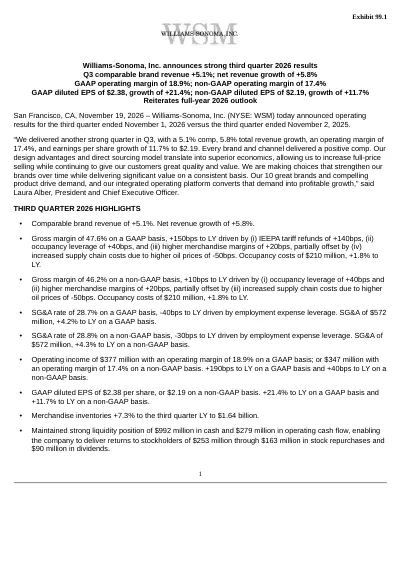
We delivered another strong quarter in Q3, with a 5.1% comp, a positive 5.8% total revenue growth, an operating margin of 17.4%, and earnings per share growth of 12% to $2.19. Our operating margin expanded 40 basis points over last year, our largest year-over-year rate expansion since the current tariff cycle began, and operating margin dollars grew almost 9%.
Every brand and channel delivered a positive comp, and we delivered 70 basis points of non-comp growth. Our design advantages and direct sourcing model translate into superior economics, allowing us to increase full-price selling while continuing to give our customers great quality and value.
We are making choices that strengthen our brands over time while delivering significant value on a consistent basis. Our 10 great brands and compelling product drive demand, and our integrated operating platform converts that demand into profitable growth.
We are proud of our results, particularly given the external backdrop. During the quarter, cost pressures increased, including higher oil, gas, and diesel costs, impacting both raw material and transportation costs.
We delivered these results even with higher than last year tariffs, elevated interest rates, geopolitical uncertainty, and a housing market that has gotten worse. Now I'd like to talk about two key strategies contributing to these strong results.
First, our ability to command higher levels of full-price selling. Second, the operational excellence of our teams.
I'll start with full-price selling. We continue to increase full-price selling with fewer promotions and shallower markdowns.
We've been able to do this because of the strength of our brands, our differentiated product, and our operating model. In our furniture business, we continue to introduce a record number of successful new high-quality programs that are innovative and differentiated, allowing us to increase full-price selling and deliver healthy furniture growth in Q3.
In non-furniture, we pulled back even further on markdowns in all brands, but particularly in our Pottery Barn brands, where we increased full-price sell-throughs in seasonal, Halloween, and back-to-school. We knew this change would have an impact on the near-term comp in the Pottery Barn brands, but we believe it is the right strategy for long-term profitability.
Now let's talk about our operational improvements. We continue to be in an environment where costs are increasing in the global supply chain, and we continue to experience longer transit times due to the Middle East conflict, coupled with port and rail congestion.
Our teams have been trying to find better ways to operate the business and offset these cost increases. Some examples include that our team has negotiated favorable ocean freight costs despite market volatility.
Also, we are continuing to optimize our distribution network, and we are modernizing our warehouse operations. These efforts might sound individually incremental, but at our scale, they are important contributors to both the customer experience and profitability.
As we look to Q4, we continue to experience increased costs and delays in overseas shipments. Again, our team is working to mitigate the impact.
We are prioritizing key deliveries, expediting shipping, and improving communications with our customers. AI is also driving operational improvements, with broader adoption translating into measurable business results.
Our AI assistants are now available across our brands, bringing our product knowledge and service expertise to customers when they need it. These experiences have supported more than 1 million customer chat visits since launch, helping customers discover products, evaluate their choices, and shop with greater confidence.
Digital experience personalization is also driving stronger results. Through Q3, revenue per visit for customers engaging with personalized experiences was up substantially versus the site average and versus last year.
We are expanding these personalized experiences across our websites and email, making recommendations more relevant to each customer's shopping journey. Our digital design platform now uses proprietary AI tools to turn a 3D plan of a customer's own room into a photorealistic image in seconds.
Customers and designers can see their selected furniture and decor from our brands together in their actual space with its accurate layout and dimensions before making a purchase. Unlike generic AI design tools that may place furniture without exact product specifications, our platform uses the actual products a customer selects with their real dimensions, they can see precisely how those pieces fit and work together in their own room.
By combining our assortment with the customer's own space, we bring the entire design to life, giving customers a clearer view of how their choices work together and greater confidence in their finished project. Across our corporate teams, AI is helping associates work more efficiently and amplify the impact of their expertise.
Our in-house AI tools enable creative teams to showcase our products in a wider range of inspiring settings, scaling our brands' distinctive design perspective. AI is also giving business teams faster access to insights and automating repetitive analysis and reporting, freeing associates to focus on decisions and work that moves the business forward.
Now let's review our brands, starting with Pottery Barn. Pottery Barn delivered a 1.8% comp in Q3.
Customers responded to the refreshed Pottery Barn heritage aesthetic with healthy growth in furniture. We are showcasing what Pottery Barn does best, offering beautifully designed, high-quality product at a great value.
We are increasing the pipeline of product in this refreshed aesthetic. We are also chasing back orders of our best sellers and designing more into what is working, both in collection expansions, but also in brand-new collections in the same aesthetic.
The moderation in Pottery Barn's comp was primarily driven by non-furniture, and as I discussed earlier, we planned the quarter with higher levels of regular price, especially in these categories. We've also planned Q4 similarly, with less markdowns and higher full-price selling, especially in the seasonal layer.
We will absolutely offer our customers great value over Black Friday and Cyber Week, but in total, we are positioning the brand at a much higher level of regular price sell-through, and we are positioning both core and furniture as great holiday gifts. Also, we're really excited that in early December, we'll be launching what we believe will be one of Pottery Barn's biggest and most exciting non-comp collaborations.
We have never had a flow at this time of the year in Pottery Barn. You may have seen the press release yesterday announcing Pottery Barn's partnership with the 6666 Ranch.
We are so proud to be working with Taylor Sheridan and his team, and have developed a collection of beautiful furniture, textiles, and decorative accessories that brings the magic of the American West into our customers' homes. Now let's turn to our Pottery Barn children's businesses, which ran a 2.9 comp in Q3.
In the quarter, furniture was an important driver, particularly at Pottery Barn Teen. Customers responded to our expanded assortment of well-designed furniture at compelling values.
Dorm was a particular highlight, delivering another record season. Customers responded strongly to our differentiated furniture, our innovative storage solutions, and washable rugs, reinforcing our position as the destination for high-quality, functional, and stylish dorm room solutions.
Together with Dormify, we continue to expand our reach. Collaborations remain an important growth engine across these children's brands.
LoveShackFancy, Chris Loves Julia, and Aerin performed well, along with newer partnerships, including Pink Palm Puff and our exclusive Nuna LoveShackFancy baby collection. Also in our children's business, we ran fewer markdowns in back-to-school and Halloween, increasing our margin rates.
As we look to Q4, we believe we have a strong lineup of holiday gifting for children of all ages. As the largest specialty retailer, home furnishings for children, we're excited about the growth opportunities ahead across these life-stage businesses.
Our pipeline of new product and collaborations is strong, and we continue to expand our reach with the next generation of customers. Now let's talk about West Elm.
West Elm delivered a 7 comp in Q3. The strength in the quarter was broad-based across both furniture and non-furniture.
Collaborations continue to be a powerful sales driver for the brand. During Q3, West Elm launched a powerful, successful collaboration with Russ & Daughters, which I think many of you know is an iconic New York brand and third-generation family business.
Also, the brand introduced an expanded second collection of their very successful collaboration with Pierce & Ward. We opened two new West Elm stores in Q3: Annapolis, a new market for the brand, and Williamsburg in Brooklyn.
Looking to Q4, West Elm has a compelling new layer of furniture, core, and holiday that builds on the successful programs we have introduced all year. Now let's talk about Williams Sonoma.
Williams Sonoma brand ran a 6.8 comp in Q3. Performance was broad-based, with every division across our kitchen and home businesses delivering positive comps.
Our Q3 performance reflects the strength of this combination: differentiated products, compelling partnerships, and customer experiences supported by continued investments in our stores and our marketing and innovation pipeline. During the quarter, we brought new products to life through influential partnerships.
Maria Sharapova helped introduce our exclusive All-Clad graphite cookware, and coffee expert Morgan Eckroth showcased the new Breville auto-pour-over coffee machine, available only at Williams Sonoma. If you haven't seen it yet or you're looking for a great gift, please go check it out.
It really is the gift of the season. In Williams Sonoma Home, we introduced new collections with artist and designer Josh Young and kitchen designer Christopher Peacock, both of which extended our assortment across more of the home.
Our stores continue to be a major point of differentiation. During Q3, we hosted cookbook signings around the country with culinary leaders, and we continued our popular Skills Series.
The Skills Series was even featured nationally on NBC's Today Show. These experiences bring together product, expertise, community, and inspiration in a way that is very difficult to replicate.
As we enter Q4, we have a holiday assortment, from our iconic peppermint bark to my new favorite, pistachio bark, to everything our customers need or want for Thanksgiving gifting and cooking and entertaining. Our stores, our website, and our associates are ready for holiday.
Now let's move to B2B. B2B grew 15% in Q3, delivering another record quarter, with strength across both contract and trade.
What is particularly exciting is how broad the opportunity has become. Hospitality remains an important driver, with projects across companies including Hilton, Marriott, Rosewood, and Under Canvas.
We are also winning business across food, beverage, gaming, education, and sports and entertainment. Our portfolio allows us to serve a broad range of commercial customers with the design, product quality, and service capabilities our brands are known for.
As we enter Q4, we are focused both on closing large contract projects and on corporate gifting, where our broad assortment and personalization capabilities give us another way to serve existing and new customers during the holiday season. We continue to see significant runway in B2B as we expand our customer base and the industries we serve.
Now let's turn to our exciting emerging brands, which, once again, delivered double-digit growth. Rejuvenation had an excellent quarter, with double-digit growth across both DTC and retail.
Customers continue to invest in renovation projects, and Rejuvenation is benefiting from its authority in quality cabinet hardware, bath, and lighting. Product innovation is expanding that opportunity.
The brand introduced new bath vanities, decorative lighting, expanded hardware collections, and proprietary switches and dimmers. These are highly considered categories where design, quality, craftsmanship, and customization matter, and that is where Rejuvenation really stands out.
Looking ahead, we see continued opportunity to expand Rejuvenation across project-led categories and bring more differentiated product to customers who are renovating their homes. Mark and Graham also delivered another quarter of double-digit growth.
The brand continues to expand beyond traditional gifting occasions, with strength in personalized gifts and corporate gifting. Now we are entering Mark and Graham's most important quarter.
The brand's assortment is built for holiday, with personalized gifts for everyone on the list, complemented by decor and tabletop. GreenRow also delivered another quarter of very healthy growth.
During Q3, the brand launched a handcrafted upcycled holiday collection that showcases its distinctive approach to design and craftsmanship. GreenRow was also recognized by House Beautiful as one of the best stores in America.
Tomorrow, we will open GreenRow's second store in Palo Alto, another important step as we thoughtfully build this young brand. Finally, our global business continued to grow in Q3, led by Mexico, Canada, and the UK.
We saw healthy DTC performance, continued expansion of our brands in the UK, and further growth in our international design and trade businesses. We continue to see the opportunity to extend the reach of our brands in these priority markets.
In closing, Q3 was a strong quarter on both the top and bottom lines. We delivered a 5.1% comp and a 5.8% total revenue growth, with every brand and channel delivering a positive comp.
We achieved a third-quarter operating margin of 17.4%, and earnings per share grew 12% to $2.19. We delivered in an operating environment with higher costs and a housing market that has gotten worse.
We continue to offer high-quality, innovative products, open beautiful new stores, and expand our technological capabilities. We made choices that we believe strengthen the long-term health of the business.
We ran at higher levels of full-price selling, we continue to strengthen our core business, and at the same time, our teams are delivering operational excellence across the company, from transportation and warehouse operations to vendor partnerships, technology, AI, and customer service. To our teams, thank you for your extraordinary efforts as we work to finish the year strong.
To our vendor partners and shareholders, we appreciate your continued partnership. To our customers, thank you for choosing our brands and inviting us into your homes.
Now, I will turn over to Jeff to take you through the numbers in more detail.
Jeff Howie
Thank you, Laura, and good morning, everyone. Our Q3 performance demonstrates the power of our operating model to deliver compounding results.
We grew both the top and bottom lines despite a challenging environment marked by elevated tariffs, rising interest rates, a weak housing market, high oil prices, and geopolitical uncertainty. We continue to take market share in the fragmented home furnishings industry while increasing our penetration of full-price selling and delivering strong earnings growth.
I'll cover three things this morning: first, the IEEPA tariff refunds; second, our Q3 results; and third, our fiscal '26 guidance. I'll start with the IEEPA tariff refunds.
During the quarter, we recognized the remaining $29 million of IEEPA tariff refunds in cost of goods sold as the related inventory sold through. With a small amount of interest and adjustments, the net benefit to Q3 GAAP pretax results was approximately $30 million, with a 19-cent impact to diluted earnings per share.
Including the IEEPA refunds, Q3 operating margin was 18.9%, and diluted earnings per share were $2.38 on a GAAP basis. We have now received substantially all our refunds and have recognized the full benefit in our income statement.
We expect no tariff refund adjustments in Q4. As we did in Q2, we have excluded the IEEPA tariff refunds from our non-GAAP results in Q3.
This gives investors a clean, comparable view of our operating business across fiscal '25, '26, and '27. The full GAAP to non-GAAP reconciliation is in Exhibit 1 of this morning's press release.
The operating results and guidance I discuss from here are all on a non-GAAP basis. Turning now to our third-quarter results.
Q3 net revenue was $1.99 billion, up 5.8% year-over-year, with comparable brand revenue up 5.1%. All brands posted positive comps.
By category, both furniture and non-furniture delivered positive comps, with our growth primarily driven by strength in our furniture business. By channel, e-commerce led with a 6.8% comp, its fourth straight quarter of acceleration.
Retail comps 1.5% on top of an 8.5% comp last year, for a 10% two-year stack. Moving down the income statement, Q3 gross margin was 46.2%, up approximately 10 basis points year-over-year despite higher oil and tariff costs.
Merchandise margin expanded 20 basis points, driven by higher full-price selling even as tariff costs remained a headwind in cost of goods sold. Supply chain deleveraged approximately 50 basis points, as higher oil costs flowed directly through the domestic transportation expense.
U.S. diesel prices were up more than 60% year-over-year in Q3, and up 20% since our last call in August.
Occupancy leveraged approximately 40 basis points, as top-line growth of nearly 6% outpaced a less than 2% increase in occupancy dollars. Turning to SG&A, our Q3 SG&A rate was 28.8% of revenue, approximately 30 basis points better than last year.
Employment leveraged 30 basis points, as top-line growth of nearly 6% outpaced a 3% increase in employment dollars. Advertising remained flat at 7.5% of revenue.
Our in-house marketing team continued to deliver strong returns on spend, allowing us to invest with discipline in high-performing areas. This focus on marketing efficiency contributed to our strong e-commerce revenue growth.
On the bottom line, operating income was $347 million, up 9% year-over-year, with operating margin at 17.4%, up 40 basis points. Diluted earnings per share grew 12% to $2.19 this year, from $1.96 last year.
Turning now to the balance sheet. We ended the quarter with $992 million in cash and no debt.
Merchandise inventories were $1.6 billion, up 7% year-over-year, essentially in line with total revenue growth of nearly 6%. We continue to chase best sellers across both core and newness, and we are working to mitigate the delays in overseas shipments.
During the quarter, we invested $64 million in capital expenditures on our retail stores, e-commerce, and supply chain to support our long-term growth. We also returned $250 million to shareholders, demonstrating our commitment to return excess cash over time.
We paid $90 million in dividends, with our dividend per share up 15% year-over-year. We repurchased $163 million of stock, bringing our year-to-date share repurchases to approximately 2% of shares outstanding.
Summing up our third-quarter results: revenue grew 5.8%, and EPS grew 12%. I want to thank our team for those results.
They did the work. They deserve the credit.
Turning now to our outlook. We are reiterating our full-year guidance: comparable brand revenue growth of 4% to 6.5%, total net revenue growth of 4.7% to 7.2%, and operating margin of 17.8% to 18.2%.
I will focus on three guidance topics in more detail: first, the IEEPA refunds; second, oil; and third, the Q4 dynamics around shrink and tariffs. Starting with the IEEPA refunds.
To be clear, our guidance is non-GAAP and excludes the IEEPA refunds and related interest recognized in Q2 and Q3. We do not anticipate any additional IEEPA refunds in Q4.
Next, oil. Higher oil prices continue to pressure transportation and raw material costs.
Our guidance embeds oil prices at today's levels. That is our best estimate of the impact, as the direction of oil prices is difficult to predict.
Finally, two Q4 dynamics to keep in mind: shrink and tariffs. As a reminder, in Q4 last year, we realized a shrink benefit of approximately 160 basis points from favorable physical inventory results.
We will lap that benefit in Q4 this year. However, we expect lower tariff costs resulting from reduced tariff rates to largely offset the headwind from that comparison.
Below operating income, we expect full-year interest income of approximately $30 million and a full-year effective tax rate of approximately 26%. Our capital expenditure guidance is unchanged at approximately $275 million for the year, with about 95% going to retail, e-commerce, and supply chain.
We continue to expect year-end store count to be essentially flat to last year. As a reminder, most of our leases terminate at fiscal year-end, closures land in Q4.
Our fiscal '26 guidance continues to embed approximately 70 basis points of non-comp growth. In fiscal '27, we anticipate 1% to 3% store count growth.
On returning cash to shareholders, in Q4, we will continue to pay our quarterly dividend of 76 cents per share, a 15% increase year-over-year. We are proud to say this marks our 17th consecutive year of increased dividend payouts.
Regarding share repurchases, we have approximately $900 million remaining under our authorization, and we will continue to repurchase shares opportunistically. Looking beyond '26, we remain confident in our growth strategies and operational execution, and we'll provide guidance for fiscal '27 in March per our usual cadence.
Wrapping up, the five reasons we are confident we will continue to outperform our peers remain the same, and Q3 added another proof point to each: one, our ability to gain share in the fragmented industry—in Q3, we continued to outperform the industry with revenue growth of 5.8%; two, the strength of our in-house proprietary design—full-price selling expanded merchandise margin while we grew our top line; three, the advantage of our digital-first, but not digital-only channel strategy—e-commerce accelerated to a 6.8% comp, and retail comps 1.5% for a 10% two-year stack; four, the ongoing strength of our growth initiatives—business-to-business, emerging brands, and our retail investments are driving growth; and five, the resiliency of our fortress balance sheet—over $990 million in cash, no debt, inventory in line with sales, and approximately $900 million of share repurchase capacity in reserve. When you put those five reasons together, it's clear how the power of 10 brands on one integrated platform produces compounding results.
With that, I'll open the call for questions.
Operator
Thank you. We will now begin the question-and-answer session.
Please limit yourself to one question and one follow-up. If you would like to ask a question, please press star one to raise your hand.
To withdraw your question, press star one again. We ask that you pick up your handset when asking a question to allow for optimum sound quality.
If you are muted locally, please remember to unmute your device. Your first question comes from the line of Peter Benedict with Baird.
Peter, your line is open, please go ahead.
Peter Benedict
All right, thanks, guys. Good quarter, and thanks for taking the question.
My first question, I'm just curious if you've had any past experience with kind of limiting the non-furniture markdowns within Pottery Barn, and just maybe how you expect that to impact kind of the fourth quarter and within that, kind of any early reads in terms of holiday demand kind of across the banners?
Laura Alber
Thanks, Peter. We're excited about holiday.
We're seeing our customers all year respond to differentiated product and great quality and great value. We've been very focused on our whole business taking it to higher levels of regular price.
I think you've been on the journey with us as we remove the site-wide promos. Now we are seeing the opportunity to reduce the amount of markdowns that we take, and particularly in seasonal goods, where we were more promotional last year.
Now, in the marketplace, our peers are very promotional. They're earlier, and they're running site-wide, and some of them have 70% of their assortment on markdown right now.
We also have seen that the customers shopping later towards these seasonal holidays as they are interested in shopping for what's relevant. We're also seeing strength in our foundational core, and when I say that, I also mean new core that we've just introduced that we know, based on the sales, it's going to be around for many, many years, because the strength of the furniture business.
You're watching them spend their money on these longer-term purchases, less discretionary purchases. It's great to see that they really like our new refreshed aesthetic in Pottery Barn, and are responding to furniture across the board.
In terms of the strategy that we executed in Q3 and Q4, it's really a continuation of what we've been doing, which is continue to build our strength in our core brands and grow our emerging brands in B2B, and improve the product pipeline, and bring in brand heat with great collaborators, and at the same time, just deliver great customer service. There's really no big difference in what you're seeing, except that still one of the biggest opportunities of the year is to reduce the amount of promotions in Q4.
Peter Benedict
That's helpful. Thank you.
My follow-up is just around the lead times that seem to be picking up here a little bit given some of the supply chain dynamics. Can you maybe frame what that means for customers, and are you seeing any signs of cancellations or anything along those lines that are stemming from some of these longer lead times?
Thank you.
Laura Alber
We're working very hard. I think you know this.
We have size and scale in our supply chain. We have great partnerships with our vendors, not just our product vendors, but also the shipping companies.
We are working really hard to expedite key goods. Also, it's just like we've seen before.
You get best sellers, and it takes a while to get back in stock, takes a couple of quarters, actually. Clearly, there's sport congestion, here and there, it's great.
There's containers not making it on. There's all sorts of disruptions at country of origin.
All those dynamics are in play, and we're dealing with them like everybody else. We're also trying to be as transparent as possible with our customer.
We actually keep changing the dates and the quote lead times on even orders not placed, so that when you go to the site now, you're getting a more realistic quote time. It's certainly not an easy dynamic, and the whole industry is dealing with it, and we're going to deal with it better than most, but it is a real dynamic.
Operator
Your next question comes from the line of Michael Lasser with UBS. Michael, your line is open, please go ahead.
Michael Lasser
Good morning. Thank you so much for taking my question.
This might be connecting two unrelated topics, but just in case, the decision to more strategically pull back on some of the promotions and maximize the profitability of Pottery Barn is coming at a time where you did not include the reiteration of the long-term algorithm within your press release. Just want to make sure that we should not interpret this as a signal moving into next year that if you continue this strategy and may even expand it to the other banners, it would result in at least a temporary suppression of either the top-line growth or the profitability growth moving into 2027.
Thank you.
Jeff Howie
Good morning, Michael. I think you may be reading too much into that.
Every time this time of year, as we look in and turn into Q4 and '27 is right around the corner, we debate how to handle the question because we're not issuing guidance today for fiscal year '27. We'll issue guidance for fiscal year '27 in March per our usual cadence, and we want to be careful that we don't imply or have people read through that we're actually issuing guidance for '27 when we talk for a long-term guidance.
I think you're reading too much into it. It's simply a function that we're not issuing fiscal year '27 guidance at this time.
As Laura talked about, we're very focused on executing in a very challenging environment in Q4, and that's what our focus is on.
Michael Lasser
Thank you very much for that. Jeff, my wife tells me I read into things too deeply as well, I appreciate that.
My follow-up question is on the tariff benefits that Williams-Sonoma might get into the early half of next year. You quantified that the lower tariff rate in the fourth quarter is going to largely offset the more difficult shrink comparison during this time.
Should we extend that to 2027, at least the first half until you lap some of the more normalized tariff rates, or given the upholstery increase in tariff rates that might kick in in the first part of 2027, we shouldn't extend that math to the first half of next year? Thank you so much.
Jeff Howie
I know everyone's chomping at the bit to talk about fiscal year '27, but again, we're not issuing guidance for '27 until March. We're really focused on Q4.
Michael, you touched on one of the big dynamics in Q4 is we are going to see tariff favorability as we start to come up against lower tariff costs flowing into our income statement, and that'll help us offset the one-time benefit we had last Q4 from a favorable shrink result. As we take a look at next year, there's a lot of puts and takes, and you saw in our earnings release, there's tariff noise out there.
There's also higher oil prices. We're spending more expediting.
It's a little early to talk about '27. One thing I will say, as you mentioned, the higher upholstery and the increase in the tariff rates for the Section 232 tariffs, that will not have a substantial impact on us.
I'll just clarify that for everyone right now. Right now, we're really focused on Q4, and we'll get to fiscal year '27 in March.
Operator
In the interest of time, we now ask that you limit yourself to one question. Your next question comes from the line of Mike Montani with Stifel.
Mike, your line is open, please go ahead.
Mike Montani
Great. Good morning.
Thanks for taking the question. Just wanted to ask, if we assume that the home furnishings industry remains flattish into 2027, can you just underscore some of the key drivers that would allow Williams-Sonoma to continue taking share at this kind of mid-single-digit revenue growth pace?
Laura Alber
Sure. Thank you, Mike, for your coverage and the question.
We are a company that has always built for the long term. We're so proud of our strong 10 brands, and we have great core brands, and we have these emerging brands that are growing and are profitable and have a lot of headroom to grow both short-term and long-term.
When you look at the reason why we are differentiated both in our brands, but also in our profit model, there's a few key aspects to it. First, I think you know that we design our own product, and we have a lot of exclusives, and we have a direct sourcing model.
That gives us great pricing power. The second thing is we have strong digital expertise, technological expertise in terms of the new technology, AI, and how we're deploying it.
It's no surprise that we're close to 70% DTC, which drives our profitability. When you think about those couple things on an integrated platform, the scale and the best-practice sharing really allows us to produce more profit.
We leverage our supply chain, our tech stack, our house file, our performance marketing. Then when you add to that our growth levers, we have the growth of our core brands and strategy execution, particularly in Pottery Barn and West Elm, our emerging brands, and B2B.
All those things are what we're really confident about. Then of course, there's the unknown, the what happens in the macro.
Clearly, as it's been really tough for a lot of people, including our industry, where housing is worse, believe it or not, it's worse. Imagine when we get that acceleration.
Who knows when that's going to happen. I wish I knew.
When that happens, that certainly will be a growth driver.
Operator
Your next question comes from the line of Jonathan Matuszewski from Jefferies. Jonathan, your line is open, please go ahead.
Jonathan Matuszewski
Holy. Thanks.
Good morning, and thanks for taking my question. In the past couple of weeks, there's been some new distractions popping up for the consumer.
We've had some travel disruptions, site outages, some retailers calling out panic buying. Curious if any of these distractions have impacted early 4Q trends relative to the 5 comp from 3Q?
Thanks so much.
Laura Alber
I wish I knew the answer to that. There's plenty going on out there.
It's definitely interesting times, and yet there's a lot of good news out there as well. We're very focused, as I said, on our execution.
There's not much I can do about these distractions. We're focused on what we can control in our stores, with our great service, and how our brands look.
I haven't mentioned it yet, but I mentioned it in my prepared remarks. We have some exciting stuff coming through.
As I think about the end of this year into next, we have some collaborations that are game-changing, I think, that will really drive new customers and new aesthetics across all of our brands, most of which we haven't announced yet. We did announce the Four Sixes yesterday, and that's a really fun one.
I don't know if you've got to see the early teaser campaign on that, but we're getting a lot of whiffs, and the product's great. We're going to launch that December, beginning of December.
I think we've said December 9th. There's a lot of fun stuff that we're going to create our own distraction with, and remind our customers how much they love their homes, and that we have the best design and quality out there.
That's how we're thinking about it. We're not immune to them.
I'm not ignoring them. I also focus on what we can control.
Operator
Your next question comes from the line of Cristina Fernández with Telsey Advisory Group. Cristina, your line is open, please go ahead.
Cristina Fernández
Hi, good morning. I wanted to follow up on the decision to lower promo spend at Pottery Barn.
Why was now the right time, and as you looked at these strategies that you've adopted in other brands in the past, how long does it take for the consumer to normalize and get used to the higher pricing? Would you say it's three months, six months, a couple of quarters?
Maybe some time frame you can give us from past experience. Thank you.
Laura Alber
Sure. We've used strength in our business to make these decisions.
I think you've seen us do that. You watched us really change the trajectory of the West Elm comps, and they have significantly reduced their markdown and promo activity.
Last holiday for Pottery Barn, it wasn't our strongest holiday, as and we took more markdowns last holiday than we will at this holiday. It's not that it's a different strategy, it's that the opportunity is greater in Q4 than it was the rest of the year.
Then for 20 2027, there's still always opportunity, but it's lesser than it is right now in Q4.
Operator
Your next question comes from the line of Simeon Gutman with Morgan Stanley. Simeon, your line is open, please go ahead.
Pedro Gil
Good morning. This is Pedro Gil on for Simeon.
I wanted to ask you about AI and agentic commerce. You briefly touched on it already.
You already told us a bit about all the good work you're doing with your in-house initiatives. Could you expand a bit on your approach to collaborating with external horizontal agents?
Also given your large online business and your presence in social media already, how can you leverage your data and use it to accelerate your market share gains?
Laura Alber
Thank you for the question. I'm going to pass the mic over to Sameer, who is our CTO and CDO.
Sameer Hassan
Appreciate the question. Thanks.
Laura spoke earlier about how we're using AI across the business. Let me start with that, and then I'll address a couple of things in what you had specifically asked for.
What I want to do, add a little bit of color with some specific examples about what we're doing. Laura talked about the room planner tool, and what's really exciting about that one is that with our proprietary tech, you can imagine a whole new look in your room, from the furniture down to the rugs, the lighting, the decorative pieces that give each brand its distinct style.
This isn't just about seeing a sofa in your space. This is a AI-guided, complete design that you're seeing in your space, including decor.
It's just something that's unparalleled in the industry. If you haven't used our tooling before, if you're redecorating, if you're shopping, I highly encourage you to use it.
It's a game-changing experience for anybody that's looking to redecorate, and it's driving real sales for us. That same design expertise is behind the AI imagery Laura talked about earlier.
The tools that we've built draw on years of our own photography. You talked about the data and how we're leveraging it.
Yes, customer data is part of it, but you have to think about the catalog of photography, of imagery, of style that we have that nobody else has. We're leveraging that with AI to show customers the specific color or finish they're considering, more settings, more combinations with our distinctive look of our brands.
Again, this is data that we have with proprietary tech built on top of AI that's allowing us to deliver the same great inspiration that we've always delivered, but just at a much, much higher scale. This holiday, we're applying that same tech to be able to showcase our products in gifting settings as well, which is so seasonally appropriate.
You also heard about the results from digital personalization in Q3. The holiday season is where we're going to put that to work with gift givers.
If you bought somebody a gift last year, we have that data, and again, you kind of talked about that. We're going to use that history to send a timely reminder to suggest gifts from across our brands that the customer might like.
Then not only that, we make it easier for the customer to go from that reminder to purchase with a simpler checkout. It's just a practical way of how we're using AI at scale to make holiday shopping more personal and just a little bit less stressful.
Operator
Your next question comes from the line of Kate McShane with Goldman Sachs. Kate, your line is open, please go ahead.
Kate McShane
Hi, good morning. Thanks for taking our question.
We wanted to go back to some of the supply chain issues that you mentioned, and I think you did say that you would try to expedite shipments in order to mitigate some of the delays. Is there a cost to this that maybe is not being contemplated in guidance as a result, or is there any risk to guidance on the margin side if there were to be more of an effort to expedite shipments to customers in Q4?
Jeff Howie
Good morning, Kate. Thank you for asking that question.
I think it's a topic on a lot of people's minds. It's not just the expediting costs, it's also the higher price of oil.
You saw that flow through in our Q3 income statement. Look, higher oil prices affect especially transportation raw material costs.
As you touched on, we're incurring higher costs expediting products to meet our customer promised delivery dates. Laura talked on that.
Let me talk about what we're experiencing and what's baked into the guidance, and how we're working through it. First is on inbound transportation.
I think everyone knows it's goods going to our distribution center and goes into our cost of goods sold. This is primarily ocean freight.
While we're seeing some pressure here, our size and scale, the 14th largest container importer into the United States, helps us mitigate this pressure. I'd really like to recognize the outstanding work done by our transportation team navigating this challenging environment.
The second place is on domestic transportation. These are shipments leaving our distribution centers going outbound either to a customer's home or to a retail store.
Here, we're seeing a lot of pressure, first from diesel. I think everyone knows diesel's up about 60% year-over-year.
In fact, it's up 20% since our last earnings call in August. In Q3, we absorbed about 75 basis points of pressure from diesel prices.
On the full year, we estimate it could be as high as $60 million of incremental diesel expense that we're absorbing into our P&L. Expediting deliveries to customers also helps outbound delivery expense and transportation expense.
We always put the customer experience first, and we start there, and that is the most important thing to us. Here, we are absorbing incremental costs as delays from congestion forces into expediting orders to meet our customer delivery dates.
That is what is important to us, and we will incur that expense if necessary. Of course, finally, just to mention raw material prices, I think Laura touched on this.
We're working with our vendors to offset and reduce costs where possible. Here's the thing that goes to the heart of your question.
Oil prices at today's levels are embedded in our guidance, is some of the expediting costs. It is hard to predict how all this is going to land out.
Look, if oil prices go up from here, that may lead us to a different place. If we have to expedite a lot more in the holidays, same thing.
That's what we could do. It's hard to predict from here.
Our guidance today is our best estimate of how these expenses will come out and where our operating margin will land for the full year as well as Q4.
Operator
Your next question comes from the line of Oliver Wintermantel with Evercore ISI. Oliver, your line is open, please go ahead.
Oliver Wintermantel
Hi, thanks. My question is about the new stores or remodel stores.
How are they performing on a total market basis, including online sales? Are these investments bringing incremental customers and spending to Williams-Sonoma, or is that more of a channel shift from online to the stores or the other way around?
Thank you.
Laura Alber
I'm sorry, can you repeat your question?
Oliver Wintermantel
Just the new and remodel stores, how are they performing on a total market business, including online sales? Then with these new remodel markets, do you see incremental sales coming to Williams-Sonoma, or is that a channel shift from online to the stores or the other way around?
Laura Alber
Great question. It's so wonderful to see that our new stores are performing well.
We put pretty high expectations on our four-wall for our stores, and we have been opening more stores. We're particularly seeing great results from our new remodeled Pottery Barn and Williams Sonoma stores.
We haven't done enough West Elm yet, and we haven't rolled out that many more Rejuvenation, but in total, the total class of stores is outperforming our pro forma and previous locations, which is great. We work really hard on this, and we're always investing money to improve the customer experience in our stores, and excited about the future and some of the changes we're going to even make next year that we haven't talked about yet, with some refreshed looks, especially in our Pottery Barn brand.
New stores are doing well. Jeff, do you want to add anything to the real estate conversation?
Jeff Howie
I think you touched on a lot of it. We're seeing big success across all of our initiatives.
Particularly the repositioning, where we're moving stores from some of the older, tired indoor malls that are all across the US landscape to more vibrant outdoor lifestyle centers. When we move these and reposition these stores, we're seeing substantial increase in the top lines and better economics in the bottom line.
Then we're entering new markets as well with some of our brands, and as Laura said, on average, they're beating pro forma, and we have very strict profitability criteria in the four-wall, and they're achieving that. It's been a very strong strategy.
It's part of why we're adding 70 basis points of non-comp growth to the year. As we've talked about in prior calls, and we've talked about in our earnings remarks today, as we look forward to '27, we've been talking about adding 1% to 3% store count growth.
Operator
Your next question comes from the line of Brian Nagel with Oppenheimer. Brian, your line is open, please go ahead.
Brian Nagel
Hi, good morning. Thank you for taking my question.
Nice quarter. I wanted to touch again on just Pottery Barn and some of the actions you're taking right now.
I know there's already been a few questions, but I guess the question I have is, as we're thinking about what you announced, or would you discuss today, this further pullback in promotions, is this more of a one-time adjustment, or is this something that's going to be ongoing? I think Jeff, I think maybe you mentioned that you'll still see the impact in the fourth quarter.
I guess, what the duration and how far are we into this effort at this point?
Laura Alber
That's a great question. There's always going to be some incremental movement.
We've been after this since before COVID, it's always been improving our margin. If you look at the improvements in margin in our scripts, you'll see that a lot of it is directly related to changing our pricing strategy from what was very promotional, and still is in the marketplace, to a regular price business.
That does not mean that the customer's not getting great value, because we are so focused on giving the best first price so we can sell through at regular price, okay? That is not changed.
The Q4 is a more acute situation, as was Q3, because of the seasonal holidays versus Q1, which is more foundational. Now, in terms of Pottery Barn, I just want to touch on a few things that we haven't talked about yet.
We launched, as a refreshed aesthetic. It's always been known for its casual, comfortable style that feels timeless, collected, and lived in.
The refreshed aesthetic is even more authentic, inspired by architecture, antiques, auctions. It has a sense of history.
It's approachable, and it's about high design and great value. We have really elevated our materials.
We're focused on our wood finishes and our multi-step finishes that really makes the product look a lot more expensive than it is. The look is really working, and we've really rolled it out most dominantly in furniture.
As I said, we are chasing the best sellers from the fall launches. It's going to take us a while to get back in stock in some of the key best sellers.
Then because we now have confidence in this aesthetic, you're going to see us next year, you're going to see more and more of this aesthetic come through into the other categories. We're very excited about the pipeline of newness in Pottery Barn throughout next year.
As I said, the collaboration lineup is much stronger than this year.
Operator
Your next question comes from the line of Steven Zaccone with Citi. Steven, your line is open, please go ahead.
Steven Zaccone
Great. Thanks so much for taking my question.
I wanted to follow up on Michael's question. It is our job to kind of read into the details here for the investment community.
I understand it's standard practice to guide for '27 in March, but you've always had this long-term comment. It was in the 3Q last release last year.
Is it a reflection of the near-term being tough to read? Do you have a change in some sort of longer-term view of the margin framework for the business?
Any details would be helpful.
Jeff Howie
Steven, I appreciate the question. You're correct, we have put that in the past.
There is no change in the fundamental proposition of Williams-Sonoma, Inc., both in terms of gaining market share, in terms of our long-term algorithm, particularly in a normalized environment. This is some of our inside baseball, as we debate every time this year, as we release Q3 earnings, about what are we saying when we say that at this time of year when '27 or the next year is right around the corner.
If you go back and look, we have massaged that phrase every year in the script, and said it slightly differently. It's simply trying not to give '27 guidance.
You're all reading it one way, we were trying to have you not read it another way, and kind of imply that we were guiding '27 a certain way, because we're not going to do that till March. Again, I think you're reading too much into it.
It's simply we're just trying not to guide '27 until March.
Laura Alber
Our long-term guidance algorithm has not changed.
Operator
We have reached the end of the Q&A session. I will now turn the call back to Laura Alber, CEO, for closing remarks.
Laura Alber
Thank you all for your support and your questions and listening today. Again, I want to thank our teams who've done such a great job.
We have peak right around us, and I hope you're shopping, you guys. I hope you go out and see our stores and check out all the great products.
There's a lot of good stuff to buy. We look forward to talking to you after the new year.
Operator
This concludes today's call. Thank you for attending.
You may now disconnect.